

Passing the Integrated Science Textbook in One Go 2
 |
Description
Book Introduction
Crossing the boundaries of physics, chemistry, life sciences, and earth sciences,
Humanistic imagination and scientific and technological creativity all in one!
Exploring the natural phenomena and science and technology that make up the world
This book will serve as a helpful guide for young people seeking help with their integrated science studies as a first step toward becoming creative and convergent talents, as well as for teachers and parents who want to introduce children to the joy of science and foster their insight.
Humanistic imagination and scientific and technological creativity all in one!
Exploring the natural phenomena and science and technology that make up the world
This book will serve as a helpful guide for young people seeking help with their integrated science studies as a first step toward becoming creative and convergent talents, as well as for teachers and parents who want to introduce children to the joy of science and foster their insight.
- You can preview some of the book's contents.
Preview
index
Entering, what kind of people will the future society need?
Chapter 1: Biodiversity: The Foundation of a Rich Earth
Geologic Mass Extinctions and Biodiversity
How did living things evolve?
How can we conserve biodiversity?
Chapter 2: Chemical Changes: Writing Earth's History
The redox reaction that created the Earth's present
Finding the regularity of redox reactions
How do we distinguish between acids and bases?
Neutralization reactions occurring in every corner of life
Energy that flows in and out when a change in matter occurs
Chapter 3: Ecosystems: The Amazing Relationship Between Living Things and the Environment
How is the ecosystem structured?
What happens when the relationship between eating and being eaten breaks down?
Climate change's message to humanity
Chapter 4: Renewable Energy: Humanity's Hope
How does the sun create energy?
How is electrical energy created?
Find energy sources to replace fossil fuels
Energy usage with a future in mind
Could renewable energy be the energy of the future?
Chapter 5: How will our lives change as science and technology advance?
The Role of Science in Solving Future Social Problems
How are we using big data in our daily lives?
Science and technology that transformed modern society
Scientific ethics to be observed when using science and technology
Good books to read together
Chapter 1: Biodiversity: The Foundation of a Rich Earth
Geologic Mass Extinctions and Biodiversity
How did living things evolve?
How can we conserve biodiversity?
Chapter 2: Chemical Changes: Writing Earth's History
The redox reaction that created the Earth's present
Finding the regularity of redox reactions
How do we distinguish between acids and bases?
Neutralization reactions occurring in every corner of life
Energy that flows in and out when a change in matter occurs
Chapter 3: Ecosystems: The Amazing Relationship Between Living Things and the Environment
How is the ecosystem structured?
What happens when the relationship between eating and being eaten breaks down?
Climate change's message to humanity
Chapter 4: Renewable Energy: Humanity's Hope
How does the sun create energy?
How is electrical energy created?
Find energy sources to replace fossil fuels
Energy usage with a future in mind
Could renewable energy be the energy of the future?
Chapter 5: How will our lives change as science and technology advance?
The Role of Science in Solving Future Social Problems
How are we using big data in our daily lives?
Science and technology that transformed modern society
Scientific ethics to be observed when using science and technology
Good books to read together
Detailed image
Into the book
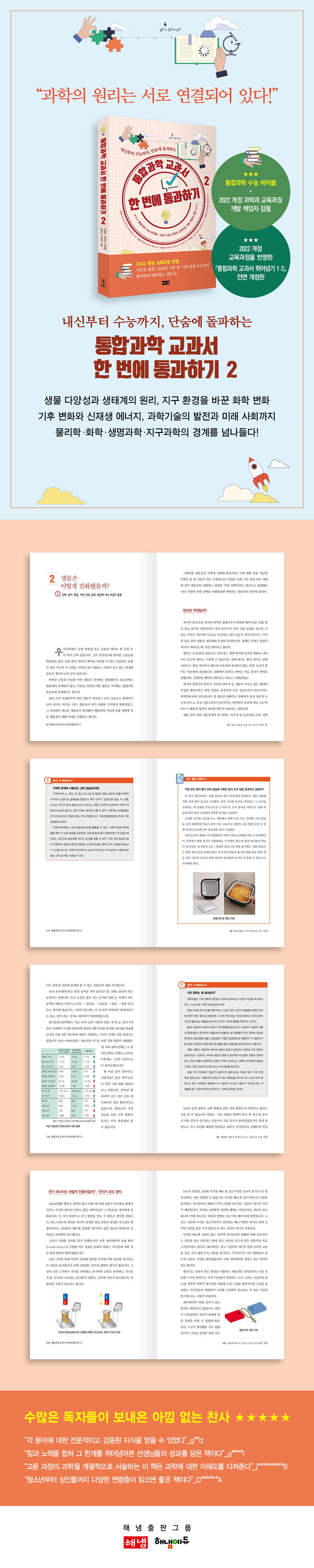
Exploring biodiversity and dreaming of a sustainable future with new technologies
Antibiotic-resistant bacteria are bacteria that have developed antibiotic resistance genes through mutation, allowing them to multiply unhindered in an environment where antibiotics are present.
In an environment without antibiotics, antibiotic resistance is not essential for survival and is therefore rare, and even if it does exist, it is very weak.
However, in an environment where antibiotics are continuously used, antibiotic-resistant bacteria will have a much greater chance of survival than non-antibiotic-resistant bacteria.
So, they are naturally selected to leave more offspring, and when this is repeated, the proportion of antibiotic-resistant bacteria increases.
In November 2017, a North Korean soldier defected to the Joint Security Area (JSA) in Panmunjom.
The soldier was shot while crossing from the north to the south and underwent two major surgeries, but his pneumonia, a bacterial disease, was so severe that it was expected that he would not recover.
However, because antibiotic treatment was not widely available in North Korea, the antibiotics were very effective and the pneumonia symptoms improved surprisingly quickly.
Because he lived in an environment where antibiotics were not widely used, the rate of antibiotic-resistant bacteria was low, making the treatment highly effective.
---From the main text, “Chapter 1: Biodiversity, the Foundation of a Rich Earth”
Just as fireflies use redox reactions, we also use redox reactions in many areas of our daily lives.
Examples of redox reactions include hand warmers containing iron powder used in winter, hair dye applied to the skin, the luminol reaction used by forensic scientists to find traces of blood at crime scenes, fireworks launched into the night sky to create a festive atmosphere, and flares fired to find victims in sea or mountainous areas.
Heat is generated when the iron powder (Fe) in the hand warmer meets oxygen (O2) and becomes iron Ⅲ oxide (Fe2O3).
Scientific investigators use luminol solution to detect blood stains.
Luminol solutions used in criminal investigations contain hydrogen peroxide (H2O2).
The iron ions (Fe2+) in the hemoglobin in the blood remove oxygen from hydrogen peroxide, and this removed oxygen oxidizes the luminol solution, causing it to emit a blue light.
The hydrogen peroxide in hair dye oxidizes the melanin pigment in the hair, causing it to become discolored.
---From the text, “Chapter 2: Chemical Changes, Writing the History of the Earth”
How many levels are there in a food chain within a food web? As you can see by counting the food chains in the food chain diagram above, there are five or fewer levels.
Why is the food chain so short?
Biologists have put forward two hypotheses.
The first is the energy hypothesis.
Passed through the food chain
Only about 10% of the energy is transferred to the upper trophic level.
A producer of about 100 kg can support 10 kg of herbivore biomass and only 1 kg of carnivore biomass.
For this reason, the food chain stages cannot continue indefinitely.
Habitats with high photosynthetic productivity will have a greater amount of energy, allowing for longer food chains.
Second, there is a hypothesis that animals in the food chain tend to grow larger as they go up the chain.
Of course, parasites are an exception.
Carnivores have limits to the size of prey they can eat in one bite.
There are a few exceptions, such as whales that float and eat large quantities of krill, but in general, large carnivores cannot survive on very small prey.
Because small animals cannot provide the amount of food that carnivores need in a given time.
---From the main text, “Chapter 3: Ecosystems: The Amazing Relationship Between Living Things and the Environment”
Supporters of nuclear power argue that renewable energy is not enough to replace fossil fuels to provide electricity, and that more nuclear power plants need to be built to effectively replace coal-fired power plants.
They argue that nuclear reactions help mitigate global warming because they generate heat without producing carbon dioxide.
(syncopation)
The main issue raised by opponents of nuclear power is the radiation emitted from radioactive waste.
In particular, gamma rays, which are high-energy electromagnetic waves among radiation, have excellent penetrability and can cause serious diseases such as cancer by transforming or destroying human cells, and can even lead to immediate death.
However, radioactive waste generated during the power generation process is radioactive and can emit radiation for thousands of years, making it difficult to dispose of safely.
They also argue that although the process of nuclear fission does not produce carbon dioxide and nuclear power is a carbon-free energy production method, it cannot be completely free from carbon dioxide because a lot of carbon dioxide is produced when uranium is mined and made into fuel rods to be used in reactors.
Which argument do you think is more persuasive?
---From the main text, “Chapter 4: Renewable Energy, the Hope Launched by Humanity”
The use of disposable plastic products makes our lives more convenient and hygienic, but discarded plastic waste on land flows into the ocean, causing microplastic problems, which threaten the health of all life on Earth, including humans, beyond the marine ecosystem.
Another major issue is the explosive increase in the use of disposable plastics during the recent global pandemic, COVID-19.
How can we draw a reasonable conclusion about this?
Another example is self-driving cars.
Self-driving cars are a promising technology because they guarantee mobility for people with driving difficulties, including the disabled and elderly, and reduce accidents caused by driver negligence.
However, ethical issues may arise when it is unclear who is responsible for an accident, and there are also negative aspects such as the possibility of dangerous driving due to program hacking.
As such, social issues related to science involve the interests of people with diverse perspectives, and if left unchecked, they could lead to social conflict.
Therefore, when a social conflict related to science arises, members of society must communicate and consult sufficiently to find the best possible agreement and respect and understand each other.
Most issues arise not from questions of right and wrong, but from differences in ideas, perspectives, or understanding.
To reach the most rational decision, each person must be able to logically explain his or her position based on valid reasons.
Antibiotic-resistant bacteria are bacteria that have developed antibiotic resistance genes through mutation, allowing them to multiply unhindered in an environment where antibiotics are present.
In an environment without antibiotics, antibiotic resistance is not essential for survival and is therefore rare, and even if it does exist, it is very weak.
However, in an environment where antibiotics are continuously used, antibiotic-resistant bacteria will have a much greater chance of survival than non-antibiotic-resistant bacteria.
So, they are naturally selected to leave more offspring, and when this is repeated, the proportion of antibiotic-resistant bacteria increases.
In November 2017, a North Korean soldier defected to the Joint Security Area (JSA) in Panmunjom.
The soldier was shot while crossing from the north to the south and underwent two major surgeries, but his pneumonia, a bacterial disease, was so severe that it was expected that he would not recover.
However, because antibiotic treatment was not widely available in North Korea, the antibiotics were very effective and the pneumonia symptoms improved surprisingly quickly.
Because he lived in an environment where antibiotics were not widely used, the rate of antibiotic-resistant bacteria was low, making the treatment highly effective.
---From the main text, “Chapter 1: Biodiversity, the Foundation of a Rich Earth”
Just as fireflies use redox reactions, we also use redox reactions in many areas of our daily lives.
Examples of redox reactions include hand warmers containing iron powder used in winter, hair dye applied to the skin, the luminol reaction used by forensic scientists to find traces of blood at crime scenes, fireworks launched into the night sky to create a festive atmosphere, and flares fired to find victims in sea or mountainous areas.
Heat is generated when the iron powder (Fe) in the hand warmer meets oxygen (O2) and becomes iron Ⅲ oxide (Fe2O3).
Scientific investigators use luminol solution to detect blood stains.
Luminol solutions used in criminal investigations contain hydrogen peroxide (H2O2).
The iron ions (Fe2+) in the hemoglobin in the blood remove oxygen from hydrogen peroxide, and this removed oxygen oxidizes the luminol solution, causing it to emit a blue light.
The hydrogen peroxide in hair dye oxidizes the melanin pigment in the hair, causing it to become discolored.
---From the text, “Chapter 2: Chemical Changes, Writing the History of the Earth”
How many levels are there in a food chain within a food web? As you can see by counting the food chains in the food chain diagram above, there are five or fewer levels.
Why is the food chain so short?
Biologists have put forward two hypotheses.
The first is the energy hypothesis.
Passed through the food chain
Only about 10% of the energy is transferred to the upper trophic level.
A producer of about 100 kg can support 10 kg of herbivore biomass and only 1 kg of carnivore biomass.
For this reason, the food chain stages cannot continue indefinitely.
Habitats with high photosynthetic productivity will have a greater amount of energy, allowing for longer food chains.
Second, there is a hypothesis that animals in the food chain tend to grow larger as they go up the chain.
Of course, parasites are an exception.
Carnivores have limits to the size of prey they can eat in one bite.
There are a few exceptions, such as whales that float and eat large quantities of krill, but in general, large carnivores cannot survive on very small prey.
Because small animals cannot provide the amount of food that carnivores need in a given time.
---From the main text, “Chapter 3: Ecosystems: The Amazing Relationship Between Living Things and the Environment”
Supporters of nuclear power argue that renewable energy is not enough to replace fossil fuels to provide electricity, and that more nuclear power plants need to be built to effectively replace coal-fired power plants.
They argue that nuclear reactions help mitigate global warming because they generate heat without producing carbon dioxide.
(syncopation)
The main issue raised by opponents of nuclear power is the radiation emitted from radioactive waste.
In particular, gamma rays, which are high-energy electromagnetic waves among radiation, have excellent penetrability and can cause serious diseases such as cancer by transforming or destroying human cells, and can even lead to immediate death.
However, radioactive waste generated during the power generation process is radioactive and can emit radiation for thousands of years, making it difficult to dispose of safely.
They also argue that although the process of nuclear fission does not produce carbon dioxide and nuclear power is a carbon-free energy production method, it cannot be completely free from carbon dioxide because a lot of carbon dioxide is produced when uranium is mined and made into fuel rods to be used in reactors.
Which argument do you think is more persuasive?
---From the main text, “Chapter 4: Renewable Energy, the Hope Launched by Humanity”
The use of disposable plastic products makes our lives more convenient and hygienic, but discarded plastic waste on land flows into the ocean, causing microplastic problems, which threaten the health of all life on Earth, including humans, beyond the marine ecosystem.
Another major issue is the explosive increase in the use of disposable plastics during the recent global pandemic, COVID-19.
How can we draw a reasonable conclusion about this?
Another example is self-driving cars.
Self-driving cars are a promising technology because they guarantee mobility for people with driving difficulties, including the disabled and elderly, and reduce accidents caused by driver negligence.
However, ethical issues may arise when it is unclear who is responsible for an accident, and there are also negative aspects such as the possibility of dangerous driving due to program hacking.
As such, social issues related to science involve the interests of people with diverse perspectives, and if left unchecked, they could lead to social conflict.
Therefore, when a social conflict related to science arises, members of society must communicate and consult sufficiently to find the best possible agreement and respect and understand each other.
Most issues arise not from questions of right and wrong, but from differences in ideas, perspectives, or understanding.
To reach the most rational decision, each person must be able to logically explain his or her position based on valid reasons.
---From Chapter 5, “How will our lives change as science and technology advance?”
Publisher's Review
Crossing the boundaries of physics, chemistry, life sciences, and earth sciences,
Humanistic imagination and scientific and technological creativity all in one!
Exploring the natural phenomena and science and technology that make up the world
In January 2025, a massive wildfire broke out in California, USA, destroying over 12,000 buildings and displacing over 200,000 people.
Then, in March, forest fires broke out in the Yeongnam region of South Korea, as well as in the Chungcheong and Honam regions, damaging an area 1.7 times the size of Seoul and causing approximately 80 casualties.
The cause of the increased scale of the forest fire was the hot and dry environment and strong winds caused by climate change.
In this way, the climate crisis is not a phenomenon limited to a specific region, but a problem that occurs all over the planet.
To understand and address complex environmental issues such as climate change, the energy crisis, and biodiversity loss, we must cultivate an integrated perspective encompassing physics, chemistry, life sciences, and earth sciences.
Today, science has moved beyond mere memorization to become a tool for viewing the world in an integrated way. In keeping with this trend, the educational field is moving beyond the limitations of rote learning and emphasizing students' ability to ask questions and create new meaning.
The 'Integrated Science' curriculum, which organically connects the four scientific fields previously divided into four subjects, was newly established with a focus on helping young people grow into creative and convergent talents.
Accordingly, Professor Shin Young-jun of the Department of Science Education at Gyeongin National University of Education and teachers Kim Ho-seong (Chemistry), Park Chang-yong (Earth Science), Oh Hyeon-seon (Life Science), and Lee Se-yeon (Physics), who teach students at schools, published 『Passing the Integrated Science Textbook at Once 1?2』, which kindly guides integrated science and perfectly explains scientific concepts.
This book is a complete revision of 『Beyond the Integrated Science Textbook 1?2』, published in 2020, reflecting the contents of the '2022 Revised Curriculum'. The curriculum development manager and textbook writers directly participated to enhance the completeness and expertise.
Education experts and field teachers analyze areas where students struggle in actual classes and provide guidance to help students more easily access integrated science.
This book is designed to help students prepare for not only their academic performance but also the integrated liberal arts and science college entrance exam after 2028.
Integrated science courses, which place a significant emphasis on student participation through discussions, debates, and inquiry activities, require broad and deep background knowledge.
Accordingly, we covered various activities and knowledge that were not included in textbooks and were suited to the students' level, helping them learn the subject in depth and apply it to their writing.
This book is the second in the "Haeneum Integrated Curriculum Series." It not only explains the curriculum knowledge in accordance with the changed curriculum in an easy and fun way, but also helps young people develop a perspective on the world by integrating knowledge and activities.
You can fully understand scientific concepts and explain them in your own words!
As the years go by, the passages in the Korean and English sections of the College Scholastic Ability Test (CSAT) are becoming longer and more difficult, and passages requiring scientific knowledge are appearing, especially in the non-literature section.
The most difficult test in the 2022 CSAT
Question 17 in the Korean language section, which was considered a luck question, was based on scientific knowledge related to 'basal metabolic rate', and the correct answer rate was only about 17%.
With the integrated College Scholastic Ability Test (CSAT) for liberal arts and sciences starting in 2028, students preparing for integrated science and integrated social studies are facing increasing challenges.
In integrated science, it is important to clearly understand basic scientific concepts, systematically organize the overall flow, and then be able to draw it yourself.
This book faithfully follows the flow of the curriculum and covers six areas, including 'Fundamentals of Science', 'Regularity of Materials', 'Systems and Interactions', 'Change and Diversity', 'Environment and Energy', and 'Science and Future Society', spread across two volumes.
Volume 1 covers the fundamentals of science, the regularities of matter, and systems and interactions.
The fundamentals of science section explains the basic units of science, which are the standards for measuring and comparing nature.
In the realm of regularity of matter, it is revealed that everything in the world began with the Big Bang and formed a world of diverse substances through physical and chemical combinations.
The Systems and Interactions area covers understanding the systems that make up the world we live in, and how they work from the cellular level to the cosmic level.
Volume 2 covers change and diversity, the environment and energy, science and future society.
The Change and Diversity area examines how humans utilize the changes in nature.
In the field of environment and energy, we examine how humanity is coping with environmental and energy issues to survive and explore alternatives for the future.
In the area of science and future society, we imagine the future that will be transformed by the ever-evolving science and technology, and explain the scientific ethics that must be observed.
Develop a perspective that goes beyond academic knowledge and allows you to see the world!
The "Let's Learn More" and "Explore the Inquiry" sections at the end of each chapter of the book help students view natural phenomena comprehensively rather than approaching core concepts in a fragmented manner.
Additionally, through an appendix of 'good books to read together,' we suggest ways to acquire new knowledge beyond textbook study.
By examining the rich images that aid comprehension and the various examples closely linked to real-life principles, you will be able to understand the natural environment, context, and the major trends of science and technology within civilization as a single story.
The authors emphasize the unique human ability to do science, which goes beyond artificial intelligence that simply inputs and outputs knowledge and asks “why” and “how” about phenomena.
Through this, we encourage you to constantly ask questions about the world and develop the ability to perceive it in a new way.
This book will serve as a helpful guide for young people who want to learn integrated science as a first step toward becoming creative and convergent talents, as well as for teachers and parents who want to introduce children to the joy of science and foster their insight.
Humanistic imagination and scientific and technological creativity all in one!
Exploring the natural phenomena and science and technology that make up the world
In January 2025, a massive wildfire broke out in California, USA, destroying over 12,000 buildings and displacing over 200,000 people.
Then, in March, forest fires broke out in the Yeongnam region of South Korea, as well as in the Chungcheong and Honam regions, damaging an area 1.7 times the size of Seoul and causing approximately 80 casualties.
The cause of the increased scale of the forest fire was the hot and dry environment and strong winds caused by climate change.
In this way, the climate crisis is not a phenomenon limited to a specific region, but a problem that occurs all over the planet.
To understand and address complex environmental issues such as climate change, the energy crisis, and biodiversity loss, we must cultivate an integrated perspective encompassing physics, chemistry, life sciences, and earth sciences.
Today, science has moved beyond mere memorization to become a tool for viewing the world in an integrated way. In keeping with this trend, the educational field is moving beyond the limitations of rote learning and emphasizing students' ability to ask questions and create new meaning.
The 'Integrated Science' curriculum, which organically connects the four scientific fields previously divided into four subjects, was newly established with a focus on helping young people grow into creative and convergent talents.
Accordingly, Professor Shin Young-jun of the Department of Science Education at Gyeongin National University of Education and teachers Kim Ho-seong (Chemistry), Park Chang-yong (Earth Science), Oh Hyeon-seon (Life Science), and Lee Se-yeon (Physics), who teach students at schools, published 『Passing the Integrated Science Textbook at Once 1?2』, which kindly guides integrated science and perfectly explains scientific concepts.
This book is a complete revision of 『Beyond the Integrated Science Textbook 1?2』, published in 2020, reflecting the contents of the '2022 Revised Curriculum'. The curriculum development manager and textbook writers directly participated to enhance the completeness and expertise.
Education experts and field teachers analyze areas where students struggle in actual classes and provide guidance to help students more easily access integrated science.
This book is designed to help students prepare for not only their academic performance but also the integrated liberal arts and science college entrance exam after 2028.
Integrated science courses, which place a significant emphasis on student participation through discussions, debates, and inquiry activities, require broad and deep background knowledge.
Accordingly, we covered various activities and knowledge that were not included in textbooks and were suited to the students' level, helping them learn the subject in depth and apply it to their writing.
This book is the second in the "Haeneum Integrated Curriculum Series." It not only explains the curriculum knowledge in accordance with the changed curriculum in an easy and fun way, but also helps young people develop a perspective on the world by integrating knowledge and activities.
You can fully understand scientific concepts and explain them in your own words!
As the years go by, the passages in the Korean and English sections of the College Scholastic Ability Test (CSAT) are becoming longer and more difficult, and passages requiring scientific knowledge are appearing, especially in the non-literature section.
The most difficult test in the 2022 CSAT
Question 17 in the Korean language section, which was considered a luck question, was based on scientific knowledge related to 'basal metabolic rate', and the correct answer rate was only about 17%.
With the integrated College Scholastic Ability Test (CSAT) for liberal arts and sciences starting in 2028, students preparing for integrated science and integrated social studies are facing increasing challenges.
In integrated science, it is important to clearly understand basic scientific concepts, systematically organize the overall flow, and then be able to draw it yourself.
This book faithfully follows the flow of the curriculum and covers six areas, including 'Fundamentals of Science', 'Regularity of Materials', 'Systems and Interactions', 'Change and Diversity', 'Environment and Energy', and 'Science and Future Society', spread across two volumes.
Volume 1 covers the fundamentals of science, the regularities of matter, and systems and interactions.
The fundamentals of science section explains the basic units of science, which are the standards for measuring and comparing nature.
In the realm of regularity of matter, it is revealed that everything in the world began with the Big Bang and formed a world of diverse substances through physical and chemical combinations.
The Systems and Interactions area covers understanding the systems that make up the world we live in, and how they work from the cellular level to the cosmic level.
Volume 2 covers change and diversity, the environment and energy, science and future society.
The Change and Diversity area examines how humans utilize the changes in nature.
In the field of environment and energy, we examine how humanity is coping with environmental and energy issues to survive and explore alternatives for the future.
In the area of science and future society, we imagine the future that will be transformed by the ever-evolving science and technology, and explain the scientific ethics that must be observed.
Develop a perspective that goes beyond academic knowledge and allows you to see the world!
The "Let's Learn More" and "Explore the Inquiry" sections at the end of each chapter of the book help students view natural phenomena comprehensively rather than approaching core concepts in a fragmented manner.
Additionally, through an appendix of 'good books to read together,' we suggest ways to acquire new knowledge beyond textbook study.
By examining the rich images that aid comprehension and the various examples closely linked to real-life principles, you will be able to understand the natural environment, context, and the major trends of science and technology within civilization as a single story.
The authors emphasize the unique human ability to do science, which goes beyond artificial intelligence that simply inputs and outputs knowledge and asks “why” and “how” about phenomena.
Through this, we encourage you to constantly ask questions about the world and develop the ability to perceive it in a new way.
This book will serve as a helpful guide for young people who want to learn integrated science as a first step toward becoming creative and convergent talents, as well as for teachers and parents who want to introduce children to the joy of science and foster their insight.
GOODS SPECIFICS
- Date of issue: June 25, 2025
- Page count, weight, size: 264 pages | 153*224*20mm
- ISBN13: 9791167141187
- ISBN10: 1167141180
You may also like
카테고리
korean


korean

![GQ KOREA Mark (Monthly): December [2025]](http://librairie.coreenne.fr/cdn/shop/files/8ef265dbbfbf186523ed75ba7319009d.jpg?v=1765340328&width=3840)


