

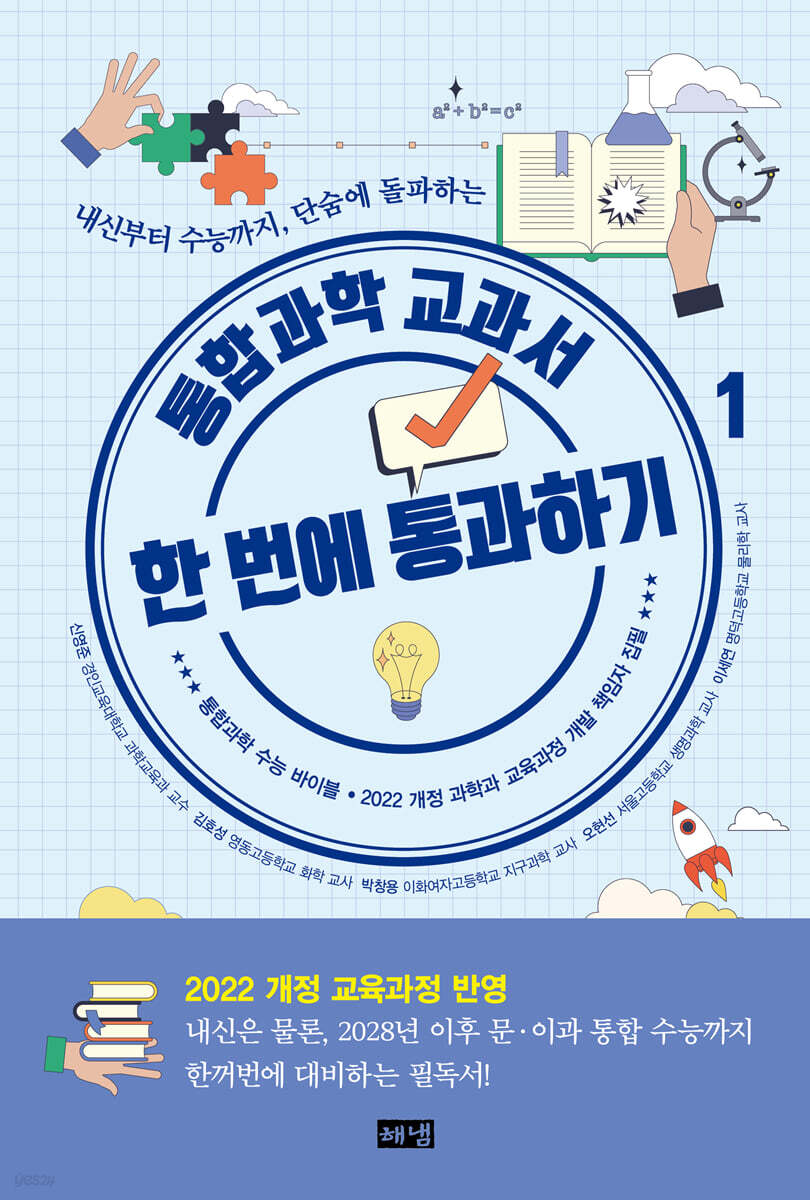
Passing the Integrated Science Textbook in One Go 1
 |
Description
Book Introduction
Crossing the boundaries of physics, chemistry, life sciences, and earth sciences,
Humanistic imagination and scientific and technological creativity all in one!
Exploring the natural phenomena and science and technology that make up the world
This book will serve as a helpful guide for young people who want to learn integrated science as a first step toward becoming creative and convergent talents, as well as for teachers and parents who want to introduce children to the joy of science and foster their insight.
Humanistic imagination and scientific and technological creativity all in one!
Exploring the natural phenomena and science and technology that make up the world
This book will serve as a helpful guide for young people who want to learn integrated science as a first step toward becoming creative and convergent talents, as well as for teachers and parents who want to introduce children to the joy of science and foster their insight.
- You can preview some of the book's contents.
Preview
index
Entering, what kind of people will the future society need?
Before encountering 'integrated science', we prepare for an era of insight and a perspective that views nature in an integrated manner.
Chapter 1 How can we measure the world?
Representing nature in standard time and space
The basis for comparing nature, basic quantities, and measurement standards
A world perceived by sensors and information technology
Chapter 2 How did matter come into being and gather together?
Big Bang! The universe and our starting point
The birth of the Earth and the emergence of life
How does nature exploit the regularities of the elements?
Why do atoms form chemical bonds?
If the bonds are different, will the properties of the material also be different?
Chapter 3: What materials is nature made of?
Minerals that form the earth's crust, carbon compounds that form living things
What rules do the substances that make up living things have?
How have humans used the materials provided by nature?
Chapter 4: We Live in the Earth System
Sub-regions that make up the Earth system
Energy flow and material circulation in the atmosphere and water
Plate tectonics, which explains changes in the earth's crust
Chapter 5: Dynamical Systems: How Do Forces and Motion Work?
The action of gravity and various movements
Collisions and safety devices in everyday life
Chapter 6: Organic and Sophisticated Systems, Life Systems
The basic unit that makes up a living system
Biocatalysts, the core of metabolism
How does information flow within cells?
Good books to read together
Before encountering 'integrated science', we prepare for an era of insight and a perspective that views nature in an integrated manner.
Chapter 1 How can we measure the world?
Representing nature in standard time and space
The basis for comparing nature, basic quantities, and measurement standards
A world perceived by sensors and information technology
Chapter 2 How did matter come into being and gather together?
Big Bang! The universe and our starting point
The birth of the Earth and the emergence of life
How does nature exploit the regularities of the elements?
Why do atoms form chemical bonds?
If the bonds are different, will the properties of the material also be different?
Chapter 3: What materials is nature made of?
Minerals that form the earth's crust, carbon compounds that form living things
What rules do the substances that make up living things have?
How have humans used the materials provided by nature?
Chapter 4: We Live in the Earth System
Sub-regions that make up the Earth system
Energy flow and material circulation in the atmosphere and water
Plate tectonics, which explains changes in the earth's crust
Chapter 5: Dynamical Systems: How Do Forces and Motion Work?
The action of gravity and various movements
Collisions and safety devices in everyday life
Chapter 6: Organic and Sophisticated Systems, Life Systems
The basic unit that makes up a living system
Biocatalysts, the core of metabolism
How does information flow within cells?
Good books to read together
Detailed image
.jpg)
Into the book
Understand how the world works and unlock the secrets of the universe and Earth.
Scientists use estimates to predict research results to some extent and to determine whether measurements are reasonable and close to the true value.
What inconvenience would arise if the measured value and unit were different when reading the scale, even though each person used the same tool or device?
On September 23, 1999, scientists learned that the Mars Climate Orbiter had failed to enter Mars' orbit.
Analysis of the cause revealed that NASA used the international unit of measurement, m (meter), as its unit, but Lockheed Martin, the satellite manufacturer, used the yard-pound system, which was mainly used in the United States and the United Kingdom at the time.
Ultimately, the program input values using different units resulted in the failure to enter Mars orbit, resulting in huge economic losses.
If NASA and the British satellite manufacturer had standardized their program inputs using the same international standard units of measurement, they could have achieved even more success in Mars exploration.
This case study highlights the usefulness and necessity of standardizing basic quantity measurements.
---From the main text, “Chapter 1: How Can We Measure the World?”
There is an anecdote related to the reason Mendeleev completed his own periodic table.
Mendeleev was a professor of chemistry at St. Petersburg University.
However, he said that he introduced card games to his students to teach them the regularities of the elements he was researching, after seeing students living in dormitories playing cards all night and coming to class the next morning sleepy.
He wrote the properties and atomic weights of the elements on cards made of paper, asked the students to find patterns and arrange them, and suggested that students who finished arranging them could return to their dormitories.
Students who were confident in card games tried the given element card arrangements several times.
Mendeleev also made his suggestion without knowing the answer, so he and his students tried numerous times but were unable to find the correct arrangement method, and they had no choice but to waste time worrying.
Then one day, Mendeleev had a dream in which he saw the periodic table, which reflected the regularity of the elements that he had been wondering about.
When he woke up, he wrote down exactly what he had seen in his dream, and this was the moment when the basic framework of the periodic table we use today was born.
---From the main text, “Chapter 2: How did matter come into being and gather together?”
It is predicted that crop production will decline in the future due to urbanization and climate change.
So, since 2003, expert meetings and research on edible insects have been held, and in 2013, the Food and Agriculture Organization of the United Nations (FAO) selected insects as a promising future food.
Why are insects, often considered disgusting, being chosen as future food? First and foremost, insects are easy to raise in confined spaces and are rich in protein.
The word protein in English is derived from the Greek word 'proreios'.
It means 'primary'.
As can be seen from the origin of the word protein, protein is an essential component that regulates life phenomena in all living things, including humans, and is the main substance that makes up living things.
Enzymes that help chemical reactions occur quickly within living organisms.
Hormones that regulate life activities and antibodies that fight pathogens are all made of proteins.
Protein is an essential substance not only for adolescents in their growing years but also for aging adults, and hair, nails, and muscles are all made of protein.
Our body's hair is made of keratin protein, our skin is made of collagen protein, our muscles are made of myosin and actin proteins, and the protein in red blood cells that is responsible for transporting oxygen is hemoglobin.
It is used not only in the human body but also in the bodies of many other creatures, such as peacock feathers, sheep horns, and spider webs.
---From the main text, “Chapter 3: What Materials is Nature Made of?”
When an earthquake occurs, the media reports, “An earthquake of this magnitude occurred” and “An earthquake of this magnitude occurred.”
What is the difference between earthquake magnitude and intensity?
Earthquake magnitude is a measure of the energy released by an earthquake, and was proposed in 1935 by seismologist Charles Richter.
It is also called the Richter scale after him.
A 1.0 increase on the Richter scale means that the energy released by an earthquake increases by 101.5, or about 30 times.
This means that the energy released by an earthquake with a magnitude of 1.0 differs by a factor of 30.
So a magnitude 7.0 earthquake is 30 times stronger than a magnitude 6.0 earthquake, and 900 times stronger than a magnitude 5.0 earthquake.
However, even if a large earthquake occurs, it is not felt in distant areas.
The degree to which the ground in a specific area shakes is called intensity.
In countries that frequently experience earthquakes (such as the United States, Japan, India, Israel, the Philippines, Taiwan, Russia, and China), each determines its own standard and uses it accordingly.
As Korea did not have a standard for the intensity of earthquakes, it used the intensity scale used by the Japan Meteorological Agency until 2000, but since 2001, it has been using the Modified Mercalli intensity scale used in the United States and other places.
---From the main text, “Chapter 4: Living in the Earth System”
Car crash tests don't just show which parts of the body are hit in an accident.
It reveals with precise data how much impact is applied to which part of the body and what effect this impact has on humans.
For this purpose, the dummy is equipped with various advanced sensors.
Typically, about 80 sensors, including load cells, accelerometers, and displacement sensors, are installed on a single dummy.
A load cell is a sensor that precisely measures the amount of force applied to a specific area during a collision, and is the most basic sensor equipped in a dummy.
In a car crash, the head is thrown forward at tremendous speed, which can be very fatal, and an accelerometer is used to measure this acceleration.
Additionally, the human neck and spine, which are parts directly related to life, bend, shrink, or stretch at the moment of impact, and the degree of this compression or bending is measured using a displacement meter.
These sensors are strategically placed in every vital part of the body, from head to toe.
The data collected through this method is used as essential data for improving the safety design of automobiles and developing new safety devices.
The development of crash test dummies is closely linked to the advancement of automotive safety technology, contributing to saving countless lives.
---From the main text, “Chapter 5: Dynamic Systems: How Do Forces and Motion Work?”
If you eat chicken breast, will the protein in it be absorbed directly into your body and build muscle? No, it goes through a digestive process in your digestive organs, like your stomach and small intestine.
The protein in chicken breast must be broken down into smaller amino acids before it can enter cells and be synthesized into the proteins needed for muscle formation.
In this way, chemical reactions that break down or synthesize proteins occur in our body, and this is called metabolism.
All living things, including humans, obtain the substances and energy necessary for life activities through metabolism.
Metabolism is a chemical reaction, but it is different from the chemical reactions that occur outside of living organisms.
In order for the protein in chicken breast to be broken down through chemical reactions outside of a living organism, it must be soaked in hydrochloric acid and kept at a high temperature of over 200℃ for a day, but inside a living organism, it is broken down through metabolism at a low temperature of 35-37℃ in just 1-2 hours.
Scientists use estimates to predict research results to some extent and to determine whether measurements are reasonable and close to the true value.
What inconvenience would arise if the measured value and unit were different when reading the scale, even though each person used the same tool or device?
On September 23, 1999, scientists learned that the Mars Climate Orbiter had failed to enter Mars' orbit.
Analysis of the cause revealed that NASA used the international unit of measurement, m (meter), as its unit, but Lockheed Martin, the satellite manufacturer, used the yard-pound system, which was mainly used in the United States and the United Kingdom at the time.
Ultimately, the program input values using different units resulted in the failure to enter Mars orbit, resulting in huge economic losses.
If NASA and the British satellite manufacturer had standardized their program inputs using the same international standard units of measurement, they could have achieved even more success in Mars exploration.
This case study highlights the usefulness and necessity of standardizing basic quantity measurements.
---From the main text, “Chapter 1: How Can We Measure the World?”
There is an anecdote related to the reason Mendeleev completed his own periodic table.
Mendeleev was a professor of chemistry at St. Petersburg University.
However, he said that he introduced card games to his students to teach them the regularities of the elements he was researching, after seeing students living in dormitories playing cards all night and coming to class the next morning sleepy.
He wrote the properties and atomic weights of the elements on cards made of paper, asked the students to find patterns and arrange them, and suggested that students who finished arranging them could return to their dormitories.
Students who were confident in card games tried the given element card arrangements several times.
Mendeleev also made his suggestion without knowing the answer, so he and his students tried numerous times but were unable to find the correct arrangement method, and they had no choice but to waste time worrying.
Then one day, Mendeleev had a dream in which he saw the periodic table, which reflected the regularity of the elements that he had been wondering about.
When he woke up, he wrote down exactly what he had seen in his dream, and this was the moment when the basic framework of the periodic table we use today was born.
---From the main text, “Chapter 2: How did matter come into being and gather together?”
It is predicted that crop production will decline in the future due to urbanization and climate change.
So, since 2003, expert meetings and research on edible insects have been held, and in 2013, the Food and Agriculture Organization of the United Nations (FAO) selected insects as a promising future food.
Why are insects, often considered disgusting, being chosen as future food? First and foremost, insects are easy to raise in confined spaces and are rich in protein.
The word protein in English is derived from the Greek word 'proreios'.
It means 'primary'.
As can be seen from the origin of the word protein, protein is an essential component that regulates life phenomena in all living things, including humans, and is the main substance that makes up living things.
Enzymes that help chemical reactions occur quickly within living organisms.
Hormones that regulate life activities and antibodies that fight pathogens are all made of proteins.
Protein is an essential substance not only for adolescents in their growing years but also for aging adults, and hair, nails, and muscles are all made of protein.
Our body's hair is made of keratin protein, our skin is made of collagen protein, our muscles are made of myosin and actin proteins, and the protein in red blood cells that is responsible for transporting oxygen is hemoglobin.
It is used not only in the human body but also in the bodies of many other creatures, such as peacock feathers, sheep horns, and spider webs.
---From the main text, “Chapter 3: What Materials is Nature Made of?”
When an earthquake occurs, the media reports, “An earthquake of this magnitude occurred” and “An earthquake of this magnitude occurred.”
What is the difference between earthquake magnitude and intensity?
Earthquake magnitude is a measure of the energy released by an earthquake, and was proposed in 1935 by seismologist Charles Richter.
It is also called the Richter scale after him.
A 1.0 increase on the Richter scale means that the energy released by an earthquake increases by 101.5, or about 30 times.
This means that the energy released by an earthquake with a magnitude of 1.0 differs by a factor of 30.
So a magnitude 7.0 earthquake is 30 times stronger than a magnitude 6.0 earthquake, and 900 times stronger than a magnitude 5.0 earthquake.
However, even if a large earthquake occurs, it is not felt in distant areas.
The degree to which the ground in a specific area shakes is called intensity.
In countries that frequently experience earthquakes (such as the United States, Japan, India, Israel, the Philippines, Taiwan, Russia, and China), each determines its own standard and uses it accordingly.
As Korea did not have a standard for the intensity of earthquakes, it used the intensity scale used by the Japan Meteorological Agency until 2000, but since 2001, it has been using the Modified Mercalli intensity scale used in the United States and other places.
---From the main text, “Chapter 4: Living in the Earth System”
Car crash tests don't just show which parts of the body are hit in an accident.
It reveals with precise data how much impact is applied to which part of the body and what effect this impact has on humans.
For this purpose, the dummy is equipped with various advanced sensors.
Typically, about 80 sensors, including load cells, accelerometers, and displacement sensors, are installed on a single dummy.
A load cell is a sensor that precisely measures the amount of force applied to a specific area during a collision, and is the most basic sensor equipped in a dummy.
In a car crash, the head is thrown forward at tremendous speed, which can be very fatal, and an accelerometer is used to measure this acceleration.
Additionally, the human neck and spine, which are parts directly related to life, bend, shrink, or stretch at the moment of impact, and the degree of this compression or bending is measured using a displacement meter.
These sensors are strategically placed in every vital part of the body, from head to toe.
The data collected through this method is used as essential data for improving the safety design of automobiles and developing new safety devices.
The development of crash test dummies is closely linked to the advancement of automotive safety technology, contributing to saving countless lives.
---From the main text, “Chapter 5: Dynamic Systems: How Do Forces and Motion Work?”
If you eat chicken breast, will the protein in it be absorbed directly into your body and build muscle? No, it goes through a digestive process in your digestive organs, like your stomach and small intestine.
The protein in chicken breast must be broken down into smaller amino acids before it can enter cells and be synthesized into the proteins needed for muscle formation.
In this way, chemical reactions that break down or synthesize proteins occur in our body, and this is called metabolism.
All living things, including humans, obtain the substances and energy necessary for life activities through metabolism.
Metabolism is a chemical reaction, but it is different from the chemical reactions that occur outside of living organisms.
In order for the protein in chicken breast to be broken down through chemical reactions outside of a living organism, it must be soaked in hydrochloric acid and kept at a high temperature of over 200℃ for a day, but inside a living organism, it is broken down through metabolism at a low temperature of 35-37℃ in just 1-2 hours.
---From the text, “Chapter 6: Organic and Sophisticated Systems, Life Systems”
Publisher's Review
Crossing the boundaries of physics, chemistry, life sciences, and earth sciences,
Humanistic imagination and scientific and technological creativity all in one!
Exploring the natural phenomena and science and technology that make up the world
In January 2025, a massive wildfire broke out in California, USA, destroying over 12,000 buildings and displacing over 200,000 people.
Then, in March, forest fires broke out in the Yeongnam region of South Korea, as well as in the Chungcheong and Honam regions, damaging an area 1.7 times the size of Seoul and causing approximately 80 casualties.
The cause of the increased scale of the forest fire was the hot and dry environment and strong winds caused by climate change.
In this way, the climate crisis is not a phenomenon limited to a specific region, but a problem that occurs all over the planet.
To understand and address complex environmental issues such as climate change, the energy crisis, and biodiversity loss, we must cultivate an integrated perspective encompassing physics, chemistry, life sciences, and earth sciences.
Today, science has moved beyond mere memorization to become a tool for viewing the world in an integrated way. In keeping with this trend, the educational field is moving beyond the limitations of rote learning and emphasizing the ability of students to ask questions and create new meaning.
The 'Integrated Science' curriculum, which organically connects the four scientific fields previously divided into four subjects, was newly established with a focus on helping young people grow into creative and convergent talents.
Accordingly, Professor Shin Young-jun of the Department of Science Education at Gyeongin National University of Education and teachers Kim Ho-seong (Chemistry), Park Chang-yong (Earth Science), Oh Hyeon-seon (Life Science), and Lee Se-yeon (Physics), who teach students at schools, published 『Passing the Integrated Science Textbook at Once 1?2』, which kindly guides integrated science and perfectly explains scientific concepts.
This book is a complete revision of 『Beyond the Integrated Science Textbook 1?2』, published in 2020, reflecting the contents of the '2022 Revised Curriculum'. The curriculum development manager and textbook writers directly participated to enhance the completeness and expertise.
Education experts and field teachers analyze areas where students struggle in actual classes and provide guidance to help students more easily access integrated science.
This book is designed to help students prepare for not only their academic performance but also the integrated liberal arts and science college entrance exam after 2028.
Integrated science courses, which place a significant emphasis on student participation through discussions, debates, and inquiry activities, require broad and deep background knowledge.
Accordingly, we covered various activities and knowledge that were not included in textbooks and were suited to the students' level, helping them learn the subject in depth and apply it to their writing.
This book is the second in the "Haeneum Integrated Curriculum Series." It not only explains the curriculum knowledge in accordance with the changed curriculum in an easy and fun way, but also helps young people develop a perspective on the world by integrating knowledge and activities.
You can fully understand scientific concepts and explain them in your own words!
As the years go by, the passages in the Korean and English sections of the College Scholastic Ability Test (CSAT) are becoming longer and more difficult, and passages requiring scientific knowledge are appearing, especially in the non-literature section.
The most difficult test in the 2022 CSAT
Question 17 in the Korean language section, which was considered a luck question, was based on scientific knowledge related to 'basal metabolic rate', and the correct answer rate was only about 17%.
With the integrated College Scholastic Ability Test (CSAT) for liberal arts and sciences starting in 2028, students preparing for integrated science and integrated social studies are facing increasing challenges.
In integrated science, it is important to clearly understand basic scientific concepts, systematically organize the overall flow, and then be able to draw it yourself.
This book faithfully follows the flow of the curriculum and covers six areas, including 'Fundamentals of Science', 'Regularity of Materials', 'Systems and Interactions', 'Change and Diversity', 'Environment and Energy', and 'Science and Future Society', spread across two volumes.
Volume 1 covers the fundamentals of science, the regularities of matter, and systems and interactions.
The fundamentals of science section explains the basic units of science, which are the standards for measuring and comparing nature.
In the realm of regularity of matter, it is revealed that everything in the world began with the Big Bang and formed a world of diverse substances through physical and chemical combinations.
The Systems and Interactions area covers understanding the systems that make up the world we live in, and how they work from the cellular level to the cosmic level.
Volume 2 covers change and diversity, the environment and energy, science and future society.
The Change and Diversity area examines how humans utilize the changes in nature.
In the field of environment and energy, we examine how humanity is coping with environmental and energy issues to survive and explore alternatives for the future.
In the area of science and future society, we imagine the future that will be transformed by the ever-evolving science and technology, and explain the scientific ethics that must be observed.
Develop a perspective that goes beyond academic knowledge and allows you to see the world!
The "Let's Learn More" and "Explore the Inquiry" sections at the end of each chapter of the book help students view natural phenomena comprehensively rather than approaching core concepts in a fragmented manner.
Additionally, through an appendix of 'good books to read together,' we suggest ways to acquire new knowledge beyond textbook study.
By examining the rich images that aid comprehension and the various examples closely linked to real-life principles, you will be able to understand the natural environment, context, and the major trends of science and technology within civilization as a single story.
The authors emphasize the unique human ability to do science, which goes beyond artificial intelligence that simply inputs and outputs knowledge and asks “why” and “how” about phenomena.
Through this, we encourage you to constantly ask questions about the world and develop the ability to perceive it in a new way.
This book will serve as a helpful guide for young people seeking help with their integrated science studies as a first step toward becoming creative and convergent talents, as well as for teachers and parents who want to introduce children to the joy of science and foster their insight.
Humanistic imagination and scientific and technological creativity all in one!
Exploring the natural phenomena and science and technology that make up the world
In January 2025, a massive wildfire broke out in California, USA, destroying over 12,000 buildings and displacing over 200,000 people.
Then, in March, forest fires broke out in the Yeongnam region of South Korea, as well as in the Chungcheong and Honam regions, damaging an area 1.7 times the size of Seoul and causing approximately 80 casualties.
The cause of the increased scale of the forest fire was the hot and dry environment and strong winds caused by climate change.
In this way, the climate crisis is not a phenomenon limited to a specific region, but a problem that occurs all over the planet.
To understand and address complex environmental issues such as climate change, the energy crisis, and biodiversity loss, we must cultivate an integrated perspective encompassing physics, chemistry, life sciences, and earth sciences.
Today, science has moved beyond mere memorization to become a tool for viewing the world in an integrated way. In keeping with this trend, the educational field is moving beyond the limitations of rote learning and emphasizing the ability of students to ask questions and create new meaning.
The 'Integrated Science' curriculum, which organically connects the four scientific fields previously divided into four subjects, was newly established with a focus on helping young people grow into creative and convergent talents.
Accordingly, Professor Shin Young-jun of the Department of Science Education at Gyeongin National University of Education and teachers Kim Ho-seong (Chemistry), Park Chang-yong (Earth Science), Oh Hyeon-seon (Life Science), and Lee Se-yeon (Physics), who teach students at schools, published 『Passing the Integrated Science Textbook at Once 1?2』, which kindly guides integrated science and perfectly explains scientific concepts.
This book is a complete revision of 『Beyond the Integrated Science Textbook 1?2』, published in 2020, reflecting the contents of the '2022 Revised Curriculum'. The curriculum development manager and textbook writers directly participated to enhance the completeness and expertise.
Education experts and field teachers analyze areas where students struggle in actual classes and provide guidance to help students more easily access integrated science.
This book is designed to help students prepare for not only their academic performance but also the integrated liberal arts and science college entrance exam after 2028.
Integrated science courses, which place a significant emphasis on student participation through discussions, debates, and inquiry activities, require broad and deep background knowledge.
Accordingly, we covered various activities and knowledge that were not included in textbooks and were suited to the students' level, helping them learn the subject in depth and apply it to their writing.
This book is the second in the "Haeneum Integrated Curriculum Series." It not only explains the curriculum knowledge in accordance with the changed curriculum in an easy and fun way, but also helps young people develop a perspective on the world by integrating knowledge and activities.
You can fully understand scientific concepts and explain them in your own words!
As the years go by, the passages in the Korean and English sections of the College Scholastic Ability Test (CSAT) are becoming longer and more difficult, and passages requiring scientific knowledge are appearing, especially in the non-literature section.
The most difficult test in the 2022 CSAT
Question 17 in the Korean language section, which was considered a luck question, was based on scientific knowledge related to 'basal metabolic rate', and the correct answer rate was only about 17%.
With the integrated College Scholastic Ability Test (CSAT) for liberal arts and sciences starting in 2028, students preparing for integrated science and integrated social studies are facing increasing challenges.
In integrated science, it is important to clearly understand basic scientific concepts, systematically organize the overall flow, and then be able to draw it yourself.
This book faithfully follows the flow of the curriculum and covers six areas, including 'Fundamentals of Science', 'Regularity of Materials', 'Systems and Interactions', 'Change and Diversity', 'Environment and Energy', and 'Science and Future Society', spread across two volumes.
Volume 1 covers the fundamentals of science, the regularities of matter, and systems and interactions.
The fundamentals of science section explains the basic units of science, which are the standards for measuring and comparing nature.
In the realm of regularity of matter, it is revealed that everything in the world began with the Big Bang and formed a world of diverse substances through physical and chemical combinations.
The Systems and Interactions area covers understanding the systems that make up the world we live in, and how they work from the cellular level to the cosmic level.
Volume 2 covers change and diversity, the environment and energy, science and future society.
The Change and Diversity area examines how humans utilize the changes in nature.
In the field of environment and energy, we examine how humanity is coping with environmental and energy issues to survive and explore alternatives for the future.
In the area of science and future society, we imagine the future that will be transformed by the ever-evolving science and technology, and explain the scientific ethics that must be observed.
Develop a perspective that goes beyond academic knowledge and allows you to see the world!
The "Let's Learn More" and "Explore the Inquiry" sections at the end of each chapter of the book help students view natural phenomena comprehensively rather than approaching core concepts in a fragmented manner.
Additionally, through an appendix of 'good books to read together,' we suggest ways to acquire new knowledge beyond textbook study.
By examining the rich images that aid comprehension and the various examples closely linked to real-life principles, you will be able to understand the natural environment, context, and the major trends of science and technology within civilization as a single story.
The authors emphasize the unique human ability to do science, which goes beyond artificial intelligence that simply inputs and outputs knowledge and asks “why” and “how” about phenomena.
Through this, we encourage you to constantly ask questions about the world and develop the ability to perceive it in a new way.
This book will serve as a helpful guide for young people seeking help with their integrated science studies as a first step toward becoming creative and convergent talents, as well as for teachers and parents who want to introduce children to the joy of science and foster their insight.
GOODS SPECIFICS
- Date of issue: June 25, 2025
- Page count, weight, size: 264 pages | 153*224*20mm
- ISBN13: 9791167141170
- ISBN10: 1167141172
You may also like
카테고리
korean


korean

![GQ KOREA Mark (Monthly): December [2025]](http://librairie.coreenne.fr/cdn/shop/files/8ef265dbbfbf186523ed75ba7319009d.jpg?v=1765340328&width=3840)


