

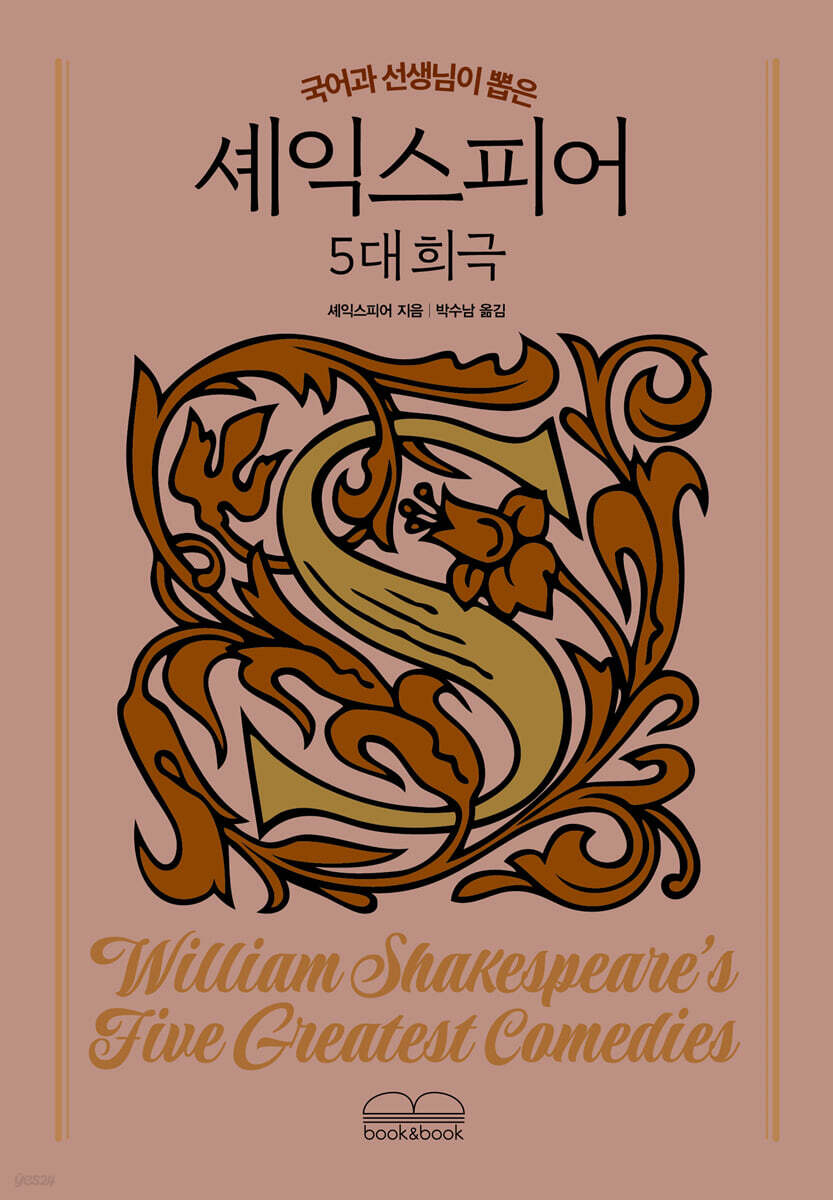
Shakespeare's 5 Greatest Comedies Chosen by Korean Language Teachers
 |
Description
Book Introduction
A must-read for students majoring in English education and English literature, as well as students studying acting and directing in middle and high school, who dream of becoming actors!
A great influence on writers and artists around the world, the pride of the British people, and a great poet and philosopher for all time, Shakespeare's works transcend time and space, exploring all areas of life and beautifully expressing the various elements of tragedy and comedy, such as greed, conspiracy, and frustration hidden in the human psyche, through stories that anyone can relate to.
The five great comedies, including “The Taming of the Shrew,” “A Midsummer Night’s Dream,” “The Merchant of Venice,” “As You Like It,” and “Twelfth Night,” which depict the bright and joyful aspects of life that will remain with us forever as a brilliant legacy of humanity and will never disappear, contain serious reflections on human nature and are required reading not only for middle and high school students but also for students majoring in English education and English literature, and for those who dream of becoming actors and studying acting or directing.
A great influence on writers and artists around the world, the pride of the British people, and a great poet and philosopher for all time, Shakespeare's works transcend time and space, exploring all areas of life and beautifully expressing the various elements of tragedy and comedy, such as greed, conspiracy, and frustration hidden in the human psyche, through stories that anyone can relate to.
The five great comedies, including “The Taming of the Shrew,” “A Midsummer Night’s Dream,” “The Merchant of Venice,” “As You Like It,” and “Twelfth Night,” which depict the bright and joyful aspects of life that will remain with us forever as a brilliant legacy of humanity and will never disappear, contain serious reflections on human nature and are required reading not only for middle and high school students but also for students majoring in English education and English literature, and for those who dream of becoming actors and studying acting or directing.
- You can preview some of the book's contents.
Preview
index
Header
About Shakespeare
The Taming of the Shrew
West curtain
Act 1
Act 2
Act 3
Act 4
Act 5
A Midsummer Night's Dream
Act 1
Act 2
Act 3
Act 4
Act 5
The Merchant of Venice
Act 1
Act 2
Act 3
Act 4
Act 5
Do as you wish
Act 1
Act 2
Act 3
Act 4
Act 5
Twelfth Night
Act 1
Act 2
Act 3
Act 4
Act 5
commentary
annual report
About Shakespeare
The Taming of the Shrew
West curtain
Act 1
Act 2
Act 3
Act 4
Act 5
A Midsummer Night's Dream
Act 1
Act 2
Act 3
Act 4
Act 5
The Merchant of Venice
Act 1
Act 2
Act 3
Act 4
Act 5
Do as you wish
Act 1
Act 2
Act 3
Act 4
Act 5
Twelfth Night
Act 1
Act 2
Act 3
Act 4
Act 5
commentary
annual report
Detailed image
Into the book
A coward dies many times before he dies.
The brave die only once.
William Shakespeare, born in England, had a profound influence on writers and artists around the world and is considered the greatest writer in the history of English literature.
He is one of the greatest playwrights in the history of world literature, leaving behind masterpieces of skill and expression that offer insight into life and the universe. His works are praised as the best works written in the English language.
He is the pride of the British people and a great poet with a universal heart for all times, not just one, but a philosopher. His works contain elements that allow us to explore all areas of life that transcend time and space.
Shakespeare's five immortal comedies, "The Taming of the Shrew," "A Midsummer Night's Dream," "The Merchant of Venice," "As You Like It," and "Twelfth Night," which have had a great influence on English literature, theater, and world culture and contain serious reflections on human nature, exquisitely depict various tragic and comic elements such as greed, conspiracy, and frustration hidden within the human psyche.
His works are considered to be stories that transcend race and language, relatable to everyone, and to be works that express the English language more beautifully than anyone else.
Hamlet's famous soliloquy, "To be or not to be, that is the question," from "The Tragedy of Hamlet, Prince of Denmark," excites and ecstasies with his inimitable language and method.
Shakespeare's fame and influence, revered as a brilliant legacy of humanity and a great writer who had insight into the human mind, explains why he is still so revered four hundred years after his death.
British novelist Jane Austen said, 'You know Shakespeare without knowing it.
It is a part of the British Constitution, and its thoughts and beauty are spread all over the world, so that wherever you go you feel it and are instinctively close to it.'
And Carlyle said, 'India will one day be lost, but Shakespeare will never disappear and will be with us forever,' and Elizabeth I also said, 'I would not give up Shakespeare even if I had to give up my entire country.'
Even now, hundreds of years later, Shakespeare's forty-odd plays, translated into every language worldwide and still performed and enjoying immense popularity, have inspired countless works of art and are essential reading for students majoring in English education and English literature, as well as those studying acting or directing with dreams of becoming actors.
--- From the "Header"
"The Taming of the Shrew" is a highly regarded comedy among Shakespeare's many plays, written between 1590 and 1594, which depicts a story that takes place in a household in Padua, Italy.
Among Shakespeare's many other works, "The Taming of the Shrew" is a unique play-within-a-play structured as a play-within-a-play, with the prologue, which explains the play and outlines the work before the play begins, being an authentic induction play developed into an expanded and developed frame structure.
"The Taming of the Shrew" is an early work by Shakespeare, consisting of five acts, depicting the process by which Petruchio, a gentleman from Verona, tames the shrew Katharina into a docile wife. It is a work of study inspired by Italian comedy.
It is the story of Petruchio, a generous and cheerful gentleman, who proposes to the notorious tomboy Katharina and deliberately behaves recklessly to tame her into becoming a docile wife.
"The Taming of the Shrew" is a romantic comedy that combines the elements of a farce and romantic comedy, a play-within-a-play that has been the subject of various interpretations and controversies depending on the era, as it is a work that reveals his genius in satirizing and criticizing the patriarchal society of the time, as well as the misogyny and submissive female image of taming a wife.
"A Midsummer Night's Dream" is Shakespeare's representative romantic comedy, written around 1594-1595 and first published in 1600. It is a story about two couples caught in a love quadrangle based on characters from Greek mythology, and the friction and discord of their entangled love eventually harmonize into reconciliation and marriage through supernatural powers.
"A Midsummer Night's Dream" is a five-act comedy similar to the story of "Romeo and Juliet," which contains tragic content such as the difficulties of love between a young man and woman due to their parents' opposition and the suicide that occurs due to misunderstandings caused by the time difference.
This play was created to celebrate the wedding of a nobleman, and is a work composed of three different groups, inspired by folklore related to the May and Summer ceremonies.
First, the Athenians; second, Bottom and his colleagues preparing the play; and third, the nymphs.
And the tragedy "Romeo and Juliet", written around the same time, also has the same subject matter as the story of Pyramus and Thisbe, which is performed as a play in the middle of this comedy.
He appears to have written two works, a comedy and a tragedy, on the same subject.
This play, a collection of diverse materials, is a romantic comedy that organically connects three different groups, borrowing the form of A Midsummer Night's Dream to depict the true love of young people and the commotion caused by fairies who cast a spell on them, creating a fantastic and romantic atmosphere, and enhancing the perfection of Shakespeare's comedic creations during his youth.
"The Merchant of Venice" is a story about a Venetian merchant who owes a large sum of money to a vicious Jew and is tried for cannibalism, written around 1596-1598 based on a short story by the Italian writer Giovanni and first published in 1600.
"The Merchant of Venice" is a comedy in five acts that depicts the romantic love between a young man and a young woman who borrow money from the moneylender Shylock in order for the poor merchant Bassanio to propose to his beloved Portia, and the triumph of virtue over evil. It also shows the prejudice against Jews in European society at the time. It compares and judges the thoughts and attitudes toward life of the protagonist and the antagonist in the form of a trial.
The reason this work became his most famous comedy may be because of the character of Shylock, the Jewish moneylender who appears in the play.
Set in the bustling streets of Venice, this is a delightful and enigmatic tale of absurd trials where a woman is asked to pay a pound of flesh instead of money, and a man choosing a marriage partner according to his father's will.
It is a story about a love affair between a Jew and a Christian, and the embarrassment she suffered because of a ring she gave to a judge disguised as a man.
Rather than being a triumph of virtue over vice, this comedy teaches us not to confuse appearances with reality, as shown in the box-picking game of finding a marriage partner.
Whatever the motive, Shylock ends up becoming a tragic figure, and Portia's line about the 'nature of mercy' in the trial scene is also a famous line.
"The Merchant of Venice" interestingly weaves together the conflict between Judaism and Christianity, with religious conflicts emphasized and the entire work reflecting the circumstances of the time.
"The Merchant of Venice" is a representative work of Shakespeare's that is classified as a comedy, but also has a tragic aspect.
"As You Like It" is a romantic comedy composed of 22 scenes in 5 acts, written around 1598-1599 and first published in 1623. It is set in a pastoral countryside and depicts the story of the Duke of No, who has lost his lands to his younger brother Frederick; Orlando, who is threatened with assassination by his brother; Oliver, who pursues him; Rosalind, who is hated and driven out by her uncle; and Celia, who runs away with her uncle's daughter, who comes to the Forest of Arden to escape the reality facing them, and the young man and woman who fall in love and get married there.
"As You Like It" is a comedy that belongs to the pastoral drama that deals with love between a man and a woman, sibling conflict over land, usurpation of power, jealousy, animosity, a woman disguised as a man, and elements of a play within a play, based on the contemporary writer Thomas Losey's novel "Rosalind." It vividly depicts conflicts such as a younger brother expelling his older brother to usurp the position of duke, and an older brother expelling his younger brother without giving him his inheritance, and from the very beginning, a tense and dangerous palace atmosphere is unfolding.
"As You Like It" is a typical romantic comedy that shines with Shakespeare's idea that good and evil, black and white, cannot be distinguished and that the standards for them are meaningless, contrasting the ideal pastoral life of the Forest of Arden, which is the central setting of this play, with the corrupt society of the palace, and highlighting the romanticism that takes place within it and the tragic aspects that criticize human society.
"Twelfth Night," written around 1601-1602 and first published in 1623, is the story of twins who are separated by a shipwreck during a voyage and fall in love.
This work is about the series of events that unfold after the twins Viola and Sebastian are shipwrecked in Illyria, due to the misunderstandings and delusions of those around them due to their identical appearances.
"Twelfth Night" refers to the twelfth night from Christmas Day, January 6th, the Feast of the Epiphany, which was a festival as big as Christmas in Shakespeare's time.
It is believed that he wrote this play with the intention of performing it on the first day of the festival.
In this play, Shakespeare used various devices to hide the complex and tangled story of the events unfolding between the twin brothers.
An absurd situation occurs where a young lady disguised as a servant runs an errand for a duke to propose to him, but ends up receiving his love instead.
Then, the plot and confusion reach their peak when the twin brother who was thought to be dead appears.
But then the two siblings face each other and all the complicated events are resolved.
"Twelfth Night" is a cliche about twin brothers who fall in love with each other, but it is a perfect example of Shakespeare's delightful romantic comedy, showcasing all the humor, wit, and humor in the amusingly complex situations hidden in every corner.
The brave die only once.
William Shakespeare, born in England, had a profound influence on writers and artists around the world and is considered the greatest writer in the history of English literature.
He is one of the greatest playwrights in the history of world literature, leaving behind masterpieces of skill and expression that offer insight into life and the universe. His works are praised as the best works written in the English language.
He is the pride of the British people and a great poet with a universal heart for all times, not just one, but a philosopher. His works contain elements that allow us to explore all areas of life that transcend time and space.
Shakespeare's five immortal comedies, "The Taming of the Shrew," "A Midsummer Night's Dream," "The Merchant of Venice," "As You Like It," and "Twelfth Night," which have had a great influence on English literature, theater, and world culture and contain serious reflections on human nature, exquisitely depict various tragic and comic elements such as greed, conspiracy, and frustration hidden within the human psyche.
His works are considered to be stories that transcend race and language, relatable to everyone, and to be works that express the English language more beautifully than anyone else.
Hamlet's famous soliloquy, "To be or not to be, that is the question," from "The Tragedy of Hamlet, Prince of Denmark," excites and ecstasies with his inimitable language and method.
Shakespeare's fame and influence, revered as a brilliant legacy of humanity and a great writer who had insight into the human mind, explains why he is still so revered four hundred years after his death.
British novelist Jane Austen said, 'You know Shakespeare without knowing it.
It is a part of the British Constitution, and its thoughts and beauty are spread all over the world, so that wherever you go you feel it and are instinctively close to it.'
And Carlyle said, 'India will one day be lost, but Shakespeare will never disappear and will be with us forever,' and Elizabeth I also said, 'I would not give up Shakespeare even if I had to give up my entire country.'
Even now, hundreds of years later, Shakespeare's forty-odd plays, translated into every language worldwide and still performed and enjoying immense popularity, have inspired countless works of art and are essential reading for students majoring in English education and English literature, as well as those studying acting or directing with dreams of becoming actors.
--- From the "Header"
"The Taming of the Shrew" is a highly regarded comedy among Shakespeare's many plays, written between 1590 and 1594, which depicts a story that takes place in a household in Padua, Italy.
Among Shakespeare's many other works, "The Taming of the Shrew" is a unique play-within-a-play structured as a play-within-a-play, with the prologue, which explains the play and outlines the work before the play begins, being an authentic induction play developed into an expanded and developed frame structure.
"The Taming of the Shrew" is an early work by Shakespeare, consisting of five acts, depicting the process by which Petruchio, a gentleman from Verona, tames the shrew Katharina into a docile wife. It is a work of study inspired by Italian comedy.
It is the story of Petruchio, a generous and cheerful gentleman, who proposes to the notorious tomboy Katharina and deliberately behaves recklessly to tame her into becoming a docile wife.
"The Taming of the Shrew" is a romantic comedy that combines the elements of a farce and romantic comedy, a play-within-a-play that has been the subject of various interpretations and controversies depending on the era, as it is a work that reveals his genius in satirizing and criticizing the patriarchal society of the time, as well as the misogyny and submissive female image of taming a wife.
"A Midsummer Night's Dream" is Shakespeare's representative romantic comedy, written around 1594-1595 and first published in 1600. It is a story about two couples caught in a love quadrangle based on characters from Greek mythology, and the friction and discord of their entangled love eventually harmonize into reconciliation and marriage through supernatural powers.
"A Midsummer Night's Dream" is a five-act comedy similar to the story of "Romeo and Juliet," which contains tragic content such as the difficulties of love between a young man and woman due to their parents' opposition and the suicide that occurs due to misunderstandings caused by the time difference.
This play was created to celebrate the wedding of a nobleman, and is a work composed of three different groups, inspired by folklore related to the May and Summer ceremonies.
First, the Athenians; second, Bottom and his colleagues preparing the play; and third, the nymphs.
And the tragedy "Romeo and Juliet", written around the same time, also has the same subject matter as the story of Pyramus and Thisbe, which is performed as a play in the middle of this comedy.
He appears to have written two works, a comedy and a tragedy, on the same subject.
This play, a collection of diverse materials, is a romantic comedy that organically connects three different groups, borrowing the form of A Midsummer Night's Dream to depict the true love of young people and the commotion caused by fairies who cast a spell on them, creating a fantastic and romantic atmosphere, and enhancing the perfection of Shakespeare's comedic creations during his youth.
"The Merchant of Venice" is a story about a Venetian merchant who owes a large sum of money to a vicious Jew and is tried for cannibalism, written around 1596-1598 based on a short story by the Italian writer Giovanni and first published in 1600.
"The Merchant of Venice" is a comedy in five acts that depicts the romantic love between a young man and a young woman who borrow money from the moneylender Shylock in order for the poor merchant Bassanio to propose to his beloved Portia, and the triumph of virtue over evil. It also shows the prejudice against Jews in European society at the time. It compares and judges the thoughts and attitudes toward life of the protagonist and the antagonist in the form of a trial.
The reason this work became his most famous comedy may be because of the character of Shylock, the Jewish moneylender who appears in the play.
Set in the bustling streets of Venice, this is a delightful and enigmatic tale of absurd trials where a woman is asked to pay a pound of flesh instead of money, and a man choosing a marriage partner according to his father's will.
It is a story about a love affair between a Jew and a Christian, and the embarrassment she suffered because of a ring she gave to a judge disguised as a man.
Rather than being a triumph of virtue over vice, this comedy teaches us not to confuse appearances with reality, as shown in the box-picking game of finding a marriage partner.
Whatever the motive, Shylock ends up becoming a tragic figure, and Portia's line about the 'nature of mercy' in the trial scene is also a famous line.
"The Merchant of Venice" interestingly weaves together the conflict between Judaism and Christianity, with religious conflicts emphasized and the entire work reflecting the circumstances of the time.
"The Merchant of Venice" is a representative work of Shakespeare's that is classified as a comedy, but also has a tragic aspect.
"As You Like It" is a romantic comedy composed of 22 scenes in 5 acts, written around 1598-1599 and first published in 1623. It is set in a pastoral countryside and depicts the story of the Duke of No, who has lost his lands to his younger brother Frederick; Orlando, who is threatened with assassination by his brother; Oliver, who pursues him; Rosalind, who is hated and driven out by her uncle; and Celia, who runs away with her uncle's daughter, who comes to the Forest of Arden to escape the reality facing them, and the young man and woman who fall in love and get married there.
"As You Like It" is a comedy that belongs to the pastoral drama that deals with love between a man and a woman, sibling conflict over land, usurpation of power, jealousy, animosity, a woman disguised as a man, and elements of a play within a play, based on the contemporary writer Thomas Losey's novel "Rosalind." It vividly depicts conflicts such as a younger brother expelling his older brother to usurp the position of duke, and an older brother expelling his younger brother without giving him his inheritance, and from the very beginning, a tense and dangerous palace atmosphere is unfolding.
"As You Like It" is a typical romantic comedy that shines with Shakespeare's idea that good and evil, black and white, cannot be distinguished and that the standards for them are meaningless, contrasting the ideal pastoral life of the Forest of Arden, which is the central setting of this play, with the corrupt society of the palace, and highlighting the romanticism that takes place within it and the tragic aspects that criticize human society.
"Twelfth Night," written around 1601-1602 and first published in 1623, is the story of twins who are separated by a shipwreck during a voyage and fall in love.
This work is about the series of events that unfold after the twins Viola and Sebastian are shipwrecked in Illyria, due to the misunderstandings and delusions of those around them due to their identical appearances.
"Twelfth Night" refers to the twelfth night from Christmas Day, January 6th, the Feast of the Epiphany, which was a festival as big as Christmas in Shakespeare's time.
It is believed that he wrote this play with the intention of performing it on the first day of the festival.
In this play, Shakespeare used various devices to hide the complex and tangled story of the events unfolding between the twin brothers.
An absurd situation occurs where a young lady disguised as a servant runs an errand for a duke to propose to him, but ends up receiving his love instead.
Then, the plot and confusion reach their peak when the twin brother who was thought to be dead appears.
But then the two siblings face each other and all the complicated events are resolved.
"Twelfth Night" is a cliche about twin brothers who fall in love with each other, but it is a perfect example of Shakespeare's delightful romantic comedy, showcasing all the humor, wit, and humor in the amusingly complex situations hidden in every corner.
--- From the "Commentary"
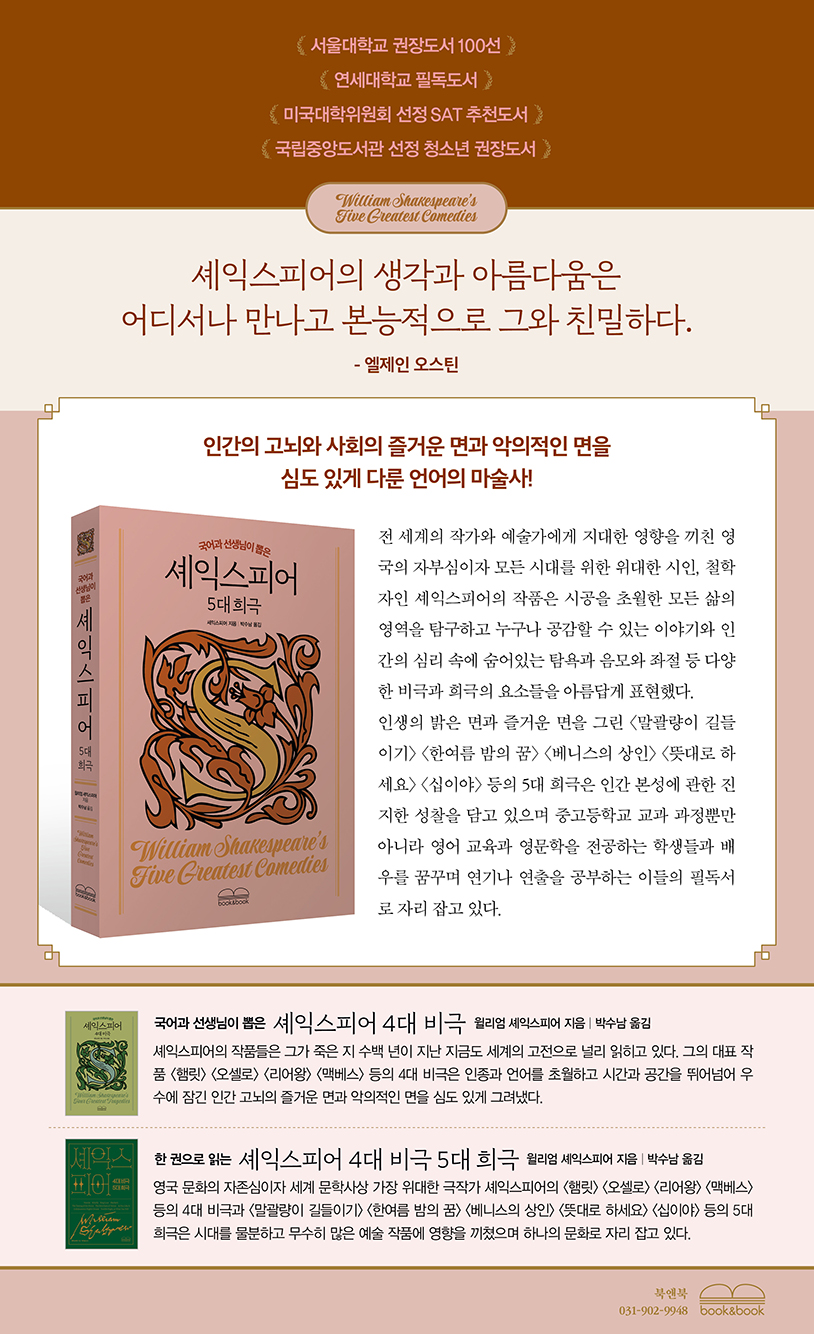
Publisher's Review
Nobel Institute's 100 World Literature
Seoul National University's 100 Recommended Books
Seoul National University's 200 East-West Classics
Yonsei University must-read books
SAT Recommended Reading Lists Selected by the College Board
Recommended books for youth selected by the National Library of Korea
A magician of language who delves deeply into the problems of human suffering and the joyful and malevolent aspects of human society!
Shakespeare's thoughts and beauty are encountered everywhere and we are instinctively close to him.
-Jane Austen
Seoul National University's 100 Recommended Books
Seoul National University's 200 East-West Classics
Yonsei University must-read books
SAT Recommended Reading Lists Selected by the College Board
Recommended books for youth selected by the National Library of Korea
A magician of language who delves deeply into the problems of human suffering and the joyful and malevolent aspects of human society!
Shakespeare's thoughts and beauty are encountered everywhere and we are instinctively close to him.
-Jane Austen
GOODS SPECIFICS
- Date of issue: April 15, 2025
- Page count, weight, size: 512 pages | 670g | 148*213*21mm
- ISBN13: 9791186649886
- ISBN10: 1186649887
You may also like
카테고리
korean


korean

![GQ KOREA Mark (Monthly): December [2025]](http://librairie.coreenne.fr/cdn/shop/files/8ef265dbbfbf186523ed75ba7319009d.jpg?v=1765340328&width=3840)


