

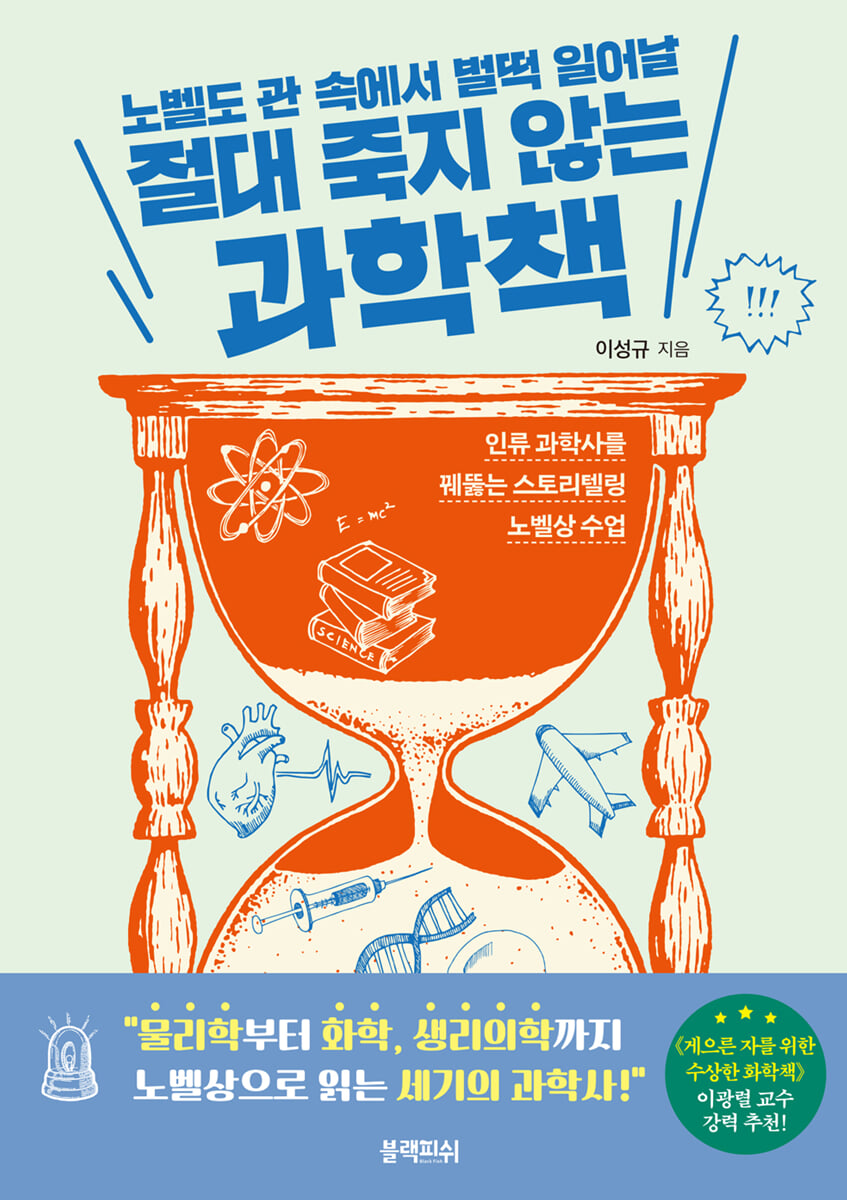
The science book that never dies
 |
Description
Book Introduction
“An irrefutable and entertaining science book that looks back on 100 years of scientific history!”
From physics to chemistry and physiology
The history of human science read through the lens of the Nobel Prize!
『Suspicious Chemistry Book for Lazy People』 Highly recommended by Gwangryeol Lee!
Every year, there is an award given to scientists who have made the world's most important discoveries.
The Nobel Prize, the world's most prestigious award with a history spanning over 100 years, began in 1901.
Now that author Han Kang has achieved the feat of becoming Korea's second Nobel laureate by winning the 2024 Nobel Prize in Literature, isn't it time to look forward to a Nobel Prize in science?
"The Never-Deadly Science Book That Would Make Nobel Rise from His Coffin" is a book that penetrates the core of the history of science surrounding human civilization, following the wondrous journeys of 45 scientists who have achieved great things in the fields of physics, chemistry, and physiology and medicine.
From X-rays, which are indispensable to the current medical field, to nitrogen fertilizers that dramatically increased food production, to morphine, penicillin, and insulin that saved humanity from pain and disease, to plastic, which is considered one of the greatest inventions of the 20th century, and even the transistor, which played a key role in the electronics industrial revolution.
The process of learning about the origins of the scientific civilization that humanity enjoys today will help us look more closely at the world we live in.
The book is full of eye-opening, entertaining stories.
From Marconi's wireless communication technology that caught a murderer on a ship, to Bergius's synthetic oil that made Hitler decide to go to war, to Frederick Sanger's DNA sequencing method that saved Angelina Jolie, to Georg Hevesy's radioactive tracer that uncovered corruption in a boarding house, these books unravel complex theories with interesting storytelling, making them easy to read even for teenagers who are not familiar with science.
Why not dream of becoming a "Nobel scientist of the future" with this book that explores the pulse of modern basic science? Enter the exciting world of science that has shaped human life today!
From physics to chemistry and physiology
The history of human science read through the lens of the Nobel Prize!
『Suspicious Chemistry Book for Lazy People』 Highly recommended by Gwangryeol Lee!
Every year, there is an award given to scientists who have made the world's most important discoveries.
The Nobel Prize, the world's most prestigious award with a history spanning over 100 years, began in 1901.
Now that author Han Kang has achieved the feat of becoming Korea's second Nobel laureate by winning the 2024 Nobel Prize in Literature, isn't it time to look forward to a Nobel Prize in science?
"The Never-Deadly Science Book That Would Make Nobel Rise from His Coffin" is a book that penetrates the core of the history of science surrounding human civilization, following the wondrous journeys of 45 scientists who have achieved great things in the fields of physics, chemistry, and physiology and medicine.
From X-rays, which are indispensable to the current medical field, to nitrogen fertilizers that dramatically increased food production, to morphine, penicillin, and insulin that saved humanity from pain and disease, to plastic, which is considered one of the greatest inventions of the 20th century, and even the transistor, which played a key role in the electronics industrial revolution.
The process of learning about the origins of the scientific civilization that humanity enjoys today will help us look more closely at the world we live in.
The book is full of eye-opening, entertaining stories.
From Marconi's wireless communication technology that caught a murderer on a ship, to Bergius's synthetic oil that made Hitler decide to go to war, to Frederick Sanger's DNA sequencing method that saved Angelina Jolie, to Georg Hevesy's radioactive tracer that uncovered corruption in a boarding house, these books unravel complex theories with interesting storytelling, making them easy to read even for teenagers who are not familiar with science.
Why not dream of becoming a "Nobel scientist of the future" with this book that explores the pulse of modern basic science? Enter the exciting world of science that has shaped human life today!
- You can preview some of the book's contents.
Preview
index
Opening remarks
PART 1.
A Physics Story That Would Surprise Even Nobel Prize Winners
1.
Wilhelm Röntgen, who discovered X-rays (the first X-ray photograph clearly showing a wedding ring)
2.
Marie Curie, the first woman to win a Nobel Prize (her lab notes can only be seen while wearing a protective suit)
3.
Guglielmo Marconi, inventor of the wireless telegraph (and the secret to catching a murderer who fled to Canada)
4.
Max von Laue, a pioneer in crystallography (who changed the world with an idea he had while skiing)
5.
Albert Einstein, the father of modern physics (Nobel committee ignored the theory of relativity)
6.
Arthur Compton, who proved that light is a particle (don't believe Einstein either?)
7.
Owen Richardson, who discovered the 'Edison Effect' (The bizarre phenomenon that inventor Edison missed)
8.
Louis de Broglie, who proposed the theory of matter waves (won the Nobel Prize for his doctoral thesis)
9.
Chandrasekara Raman, who discovered the Raman effect (the first Asian to win the Nobel Prize in Physics)
10.
Paul Dirac, the father of antimatter (a genius scientist who hated being famous)
11.
James Chadwick, who discovered the neutron (a disciple who discovered the particle predicted by his teacher)
12.
Edward Appleton, who discovered the ionosphere and solved the mystery of long-distance wireless communication
13.
John Bardeen, inventor of the transistor (transforming the analog world into a digital one)
14.
Anton Hewish, the discoverer of pulsars (What is the identity of the mysterious signal from outer space?)
15.
Peter Higgs, who predicted the Higgs particle (the 'God particle' whose identity was revealed after 48 years)
PART 2.
A Chemistry Story That Would Surprise Even Nobel
1.
Svante Arrhenius, who advocated the theory of ionization (Is climate change a blessing for humanity?)
2.
Henri Moissan, who isolated the element fluorine (what scientific achievement beat Mendeleev by one vote?)
3.
Ernest Rutherford, who discovered the atomic nucleus (why the father of nuclear physics received the Nobel Prize in Chemistry)
4.
Richard Willstätter, who discovered the secrets of photosynthesis (chlorophyll, the first Nobel Prize in botany)
5.
Fritz Haber, who developed ammonia synthesis (the scientist who made bread and explosives from air)
6.
Friedrich Bergius, who created synthetic oil (why did Hitler decide to go to war despite the oil shortage?)
7.
Adolf Butenandt, who discovered pheromones (the mysterious substance found in 500,000 moths)
8.
Georg Hevesch, the inventor of the radioactive tracer (the magical science that uncovered the boarding house scandal)
9.
Otto Hahn, who discovered nuclear fission (the principle of the atomic bomb discovered by a German scientist)
10.
Robert Robinson, who revealed the secret of morphine (an opium ingredient named after the Greek god of dreams)
11.
Hermann Staudinger, who advocated the theory of macromolecules (the secret of plastic that even Nobel laureates didn't believe)
12.
Frederick Sanger, the genius chemist who developed the DNA sequencing method (and who saved Angelina Jolie's life)
13.
Willard Libby, who developed the dating method (What is the secret to accurately dating the Dead Sea Scrolls?)
14. Kary Mullis, the developer of PCR (a dinosaur cloning technology created by a heretic in the scientific community)
15.
Paul Crutzen, who saved the ozone layer from depletion (Save the Earth's natural sunscreen!)
PART 3.
A Physiology and Medicine Story That Would Surprise Even Nobel Prize Winners
1.
Ronald Ross, the man who unlocked the secrets of malaria (and discovered the identity of the most dangerous animal on Earth)
2.
Ivan Pavlov, who studied conditioned reflexes (Did 'conditioned reflexes' interfere with Nobel Prize research?)
3.
Robert Koch, who discovered the tuberculosis bacillus (a birthday present that turned a country doctor into the "father of bacteriology")
4.
Frederick Banting, the discoverer of insulin (Why did Nobel laureates divide their prize money?)
5.
Karl Landsteiner, the discoverer of blood types (What determines the luck of surgery?)
6.
Thomas Morgan, the man who uncovered the secrets of heredity (The story of how the founder of modern genetics was accused of plagiarism)
7.
Alexander Fleming, the discoverer of penicillin (is there another real protagonist of the penicillin myth?)
8. Paul Hermann Müller, who developed DDT (the pesticide that was turned into a poison in "God's Blessing")
9.
Werner Forssmann, the doctor who developed cardiac catheterization (the one who inserted a rubber tube into his own heart)
10.
Georg von Békesi, who discovered the secrets of the cochlea (a physicist who cut off the ear of a dead elephant at the zoo)
11. James Watson, who discovered the structure of DNA (a one-page paper that revolutionized biology)
12.
Konrad Lorenz, the zoologist who discovered imprinting (and became a mother of goslings)
13.
Barbara McClintock, who discovered the jumping gene (Why are there black dots in yellow corn?)
14.
Stanley Prusiner, the discoverer of prions (and the mystery of the laughing-death disease)
15.
Barry Marshall, the physician who discovered the identity of Helicobacter pylori (who drank beef broth containing the bacteria)
References
PART 1.
A Physics Story That Would Surprise Even Nobel Prize Winners
1.
Wilhelm Röntgen, who discovered X-rays (the first X-ray photograph clearly showing a wedding ring)
2.
Marie Curie, the first woman to win a Nobel Prize (her lab notes can only be seen while wearing a protective suit)
3.
Guglielmo Marconi, inventor of the wireless telegraph (and the secret to catching a murderer who fled to Canada)
4.
Max von Laue, a pioneer in crystallography (who changed the world with an idea he had while skiing)
5.
Albert Einstein, the father of modern physics (Nobel committee ignored the theory of relativity)
6.
Arthur Compton, who proved that light is a particle (don't believe Einstein either?)
7.
Owen Richardson, who discovered the 'Edison Effect' (The bizarre phenomenon that inventor Edison missed)
8.
Louis de Broglie, who proposed the theory of matter waves (won the Nobel Prize for his doctoral thesis)
9.
Chandrasekara Raman, who discovered the Raman effect (the first Asian to win the Nobel Prize in Physics)
10.
Paul Dirac, the father of antimatter (a genius scientist who hated being famous)
11.
James Chadwick, who discovered the neutron (a disciple who discovered the particle predicted by his teacher)
12.
Edward Appleton, who discovered the ionosphere and solved the mystery of long-distance wireless communication
13.
John Bardeen, inventor of the transistor (transforming the analog world into a digital one)
14.
Anton Hewish, the discoverer of pulsars (What is the identity of the mysterious signal from outer space?)
15.
Peter Higgs, who predicted the Higgs particle (the 'God particle' whose identity was revealed after 48 years)
PART 2.
A Chemistry Story That Would Surprise Even Nobel
1.
Svante Arrhenius, who advocated the theory of ionization (Is climate change a blessing for humanity?)
2.
Henri Moissan, who isolated the element fluorine (what scientific achievement beat Mendeleev by one vote?)
3.
Ernest Rutherford, who discovered the atomic nucleus (why the father of nuclear physics received the Nobel Prize in Chemistry)
4.
Richard Willstätter, who discovered the secrets of photosynthesis (chlorophyll, the first Nobel Prize in botany)
5.
Fritz Haber, who developed ammonia synthesis (the scientist who made bread and explosives from air)
6.
Friedrich Bergius, who created synthetic oil (why did Hitler decide to go to war despite the oil shortage?)
7.
Adolf Butenandt, who discovered pheromones (the mysterious substance found in 500,000 moths)
8.
Georg Hevesch, the inventor of the radioactive tracer (the magical science that uncovered the boarding house scandal)
9.
Otto Hahn, who discovered nuclear fission (the principle of the atomic bomb discovered by a German scientist)
10.
Robert Robinson, who revealed the secret of morphine (an opium ingredient named after the Greek god of dreams)
11.
Hermann Staudinger, who advocated the theory of macromolecules (the secret of plastic that even Nobel laureates didn't believe)
12.
Frederick Sanger, the genius chemist who developed the DNA sequencing method (and who saved Angelina Jolie's life)
13.
Willard Libby, who developed the dating method (What is the secret to accurately dating the Dead Sea Scrolls?)
14. Kary Mullis, the developer of PCR (a dinosaur cloning technology created by a heretic in the scientific community)
15.
Paul Crutzen, who saved the ozone layer from depletion (Save the Earth's natural sunscreen!)
PART 3.
A Physiology and Medicine Story That Would Surprise Even Nobel Prize Winners
1.
Ronald Ross, the man who unlocked the secrets of malaria (and discovered the identity of the most dangerous animal on Earth)
2.
Ivan Pavlov, who studied conditioned reflexes (Did 'conditioned reflexes' interfere with Nobel Prize research?)
3.
Robert Koch, who discovered the tuberculosis bacillus (a birthday present that turned a country doctor into the "father of bacteriology")
4.
Frederick Banting, the discoverer of insulin (Why did Nobel laureates divide their prize money?)
5.
Karl Landsteiner, the discoverer of blood types (What determines the luck of surgery?)
6.
Thomas Morgan, the man who uncovered the secrets of heredity (The story of how the founder of modern genetics was accused of plagiarism)
7.
Alexander Fleming, the discoverer of penicillin (is there another real protagonist of the penicillin myth?)
8. Paul Hermann Müller, who developed DDT (the pesticide that was turned into a poison in "God's Blessing")
9.
Werner Forssmann, the doctor who developed cardiac catheterization (the one who inserted a rubber tube into his own heart)
10.
Georg von Békesi, who discovered the secrets of the cochlea (a physicist who cut off the ear of a dead elephant at the zoo)
11. James Watson, who discovered the structure of DNA (a one-page paper that revolutionized biology)
12.
Konrad Lorenz, the zoologist who discovered imprinting (and became a mother of goslings)
13.
Barbara McClintock, who discovered the jumping gene (Why are there black dots in yellow corn?)
14.
Stanley Prusiner, the discoverer of prions (and the mystery of the laughing-death disease)
15.
Barry Marshall, the physician who discovered the identity of Helicobacter pylori (who drank beef broth containing the bacteria)
References
Detailed image

Into the book
Isaac Newton, who discovered the law of universal gravitation, said, “If I have seen further, it is because I have stood on the shoulders of giants.”
This means that his achievements were not achieved alone, but were born from the knowledge of the great scientists who came before him.
(syncopation)
This book examines how scientific progress has been made by highlighting the lives and achievements of key figures who have won the Nobel Prizes in Physics, Chemistry, and Physiology or Medicine.
Would you like to stand on the shoulders of the great giants who laid the foundation for modern science?
--- From the "Opening Remarks"
The paper that Louis de Broglie submitted to Langevin for his doctoral dissertation dealt with the duality of things.
At that time, it was recognized that light, which is composed of photons, has two forms: particles and waves.
However, in his doctoral thesis, de Broglie argued that 'all matter, including electrons, can simultaneously have particle and wave properties like light, and therefore matter waves exist.'
That is, he claimed that electrons, which were considered to be material particles, also have wave properties.
From the perspective of the time, that paper seemed like a ridiculous idea.
The paper that mathematically proved the existence of matter waves by applying the relationship between the momentum and wavelength of light quanta in Einstein's light quantum hypothesis to electrons was a groundbreaking idea, but Langevin thought it was too philosophical a topic.
Langevin, who was in deep thought, ended up sending the paper to his close friend Einstein by parcel so that he could read it.
It was because my relationship with the student who wrote the thesis was too special to just unilaterally reject it.
(syncopation)
However, Einstein, who received Louis de Broglie's paper, praised it as a great masterpiece, completely contrary to Langevin's expectations.
Because the paper was a natural derivation from the theory of relativity and the quantum hypothesis that he had created.
Einstein widely introduced de Broglie's concept of matter waves to the European physics community, and naturally, Louis de Broglie's name also became widely known.
De Broglie's claim that particles called electrons also have wave properties was experimentally verified by two scientists who happened to attend a conference of the British Association for the Advancement of Science in Oxford in 1926.
--- From "Louis de Broglie, who proposed the theory of material waves"
Haber collaborates with industrial chemist Carl Bosch to begin mass production of ammonia.
This earned him the nickname 'the scientist who made bread out of air'.
Because the ammonia synthesis method he developed dramatically increased food production, freeing humanity from the fear of starvation.
About 40% of the nitrogen fertilizer currently applied to farmland around the world is made through the Haber-Bosch process, and it is said that about one-third of the protein consumed by the entire human race comes from nitrogen fertilizer.
If there were no nitrogen fertilizers, about half of the world's population would starve, so you can imagine how important his invention was.
However, even now, whenever there is controversy over the eligibility of the Nobel Prize winner, Haber is often cited as a representative example of the dark history of the Nobel Prize.
What on earth is going on?
In fact, the ammonia he succeeded in mass-producing was a major contributor to solving the food shortage, but it also became a material for producing explosives.
When World War I broke out, Haber volunteered to work on manufacturing potassium nitrate, a raw material for gunpowder.
At the time, Germany was unable to import potassium nitrate due to the Allied naval blockade, but was able to wage war with Haber's help.
The reason he was so obsessed with researching the mass production of ammonia was to help Germany with its war effort.
But the real reason people were so shocked was because of the poison gas.
Haber was the head of a secret department that developed poison gas for warfare, and was the first person in the world to successfully use poison gas in an effective attack.
A prime example is the battle between the Anglo-French and German forces at Ypres, Belgium, on April 22, 1915.
At that time, the German army launched a concentrated artillery attack on the Allied positions and then opened about 6,000 gas canisters to spray chlorine gas.
As a result, approximately 5,000 Allied soldiers died from lung damage caused by chlorine gas, and another 15,000 were poisoned by the gas.
This means that his achievements were not achieved alone, but were born from the knowledge of the great scientists who came before him.
(syncopation)
This book examines how scientific progress has been made by highlighting the lives and achievements of key figures who have won the Nobel Prizes in Physics, Chemistry, and Physiology or Medicine.
Would you like to stand on the shoulders of the great giants who laid the foundation for modern science?
--- From the "Opening Remarks"
The paper that Louis de Broglie submitted to Langevin for his doctoral dissertation dealt with the duality of things.
At that time, it was recognized that light, which is composed of photons, has two forms: particles and waves.
However, in his doctoral thesis, de Broglie argued that 'all matter, including electrons, can simultaneously have particle and wave properties like light, and therefore matter waves exist.'
That is, he claimed that electrons, which were considered to be material particles, also have wave properties.
From the perspective of the time, that paper seemed like a ridiculous idea.
The paper that mathematically proved the existence of matter waves by applying the relationship between the momentum and wavelength of light quanta in Einstein's light quantum hypothesis to electrons was a groundbreaking idea, but Langevin thought it was too philosophical a topic.
Langevin, who was in deep thought, ended up sending the paper to his close friend Einstein by parcel so that he could read it.
It was because my relationship with the student who wrote the thesis was too special to just unilaterally reject it.
(syncopation)
However, Einstein, who received Louis de Broglie's paper, praised it as a great masterpiece, completely contrary to Langevin's expectations.
Because the paper was a natural derivation from the theory of relativity and the quantum hypothesis that he had created.
Einstein widely introduced de Broglie's concept of matter waves to the European physics community, and naturally, Louis de Broglie's name also became widely known.
De Broglie's claim that particles called electrons also have wave properties was experimentally verified by two scientists who happened to attend a conference of the British Association for the Advancement of Science in Oxford in 1926.
--- From "Louis de Broglie, who proposed the theory of material waves"
Haber collaborates with industrial chemist Carl Bosch to begin mass production of ammonia.
This earned him the nickname 'the scientist who made bread out of air'.
Because the ammonia synthesis method he developed dramatically increased food production, freeing humanity from the fear of starvation.
About 40% of the nitrogen fertilizer currently applied to farmland around the world is made through the Haber-Bosch process, and it is said that about one-third of the protein consumed by the entire human race comes from nitrogen fertilizer.
If there were no nitrogen fertilizers, about half of the world's population would starve, so you can imagine how important his invention was.
However, even now, whenever there is controversy over the eligibility of the Nobel Prize winner, Haber is often cited as a representative example of the dark history of the Nobel Prize.
What on earth is going on?
In fact, the ammonia he succeeded in mass-producing was a major contributor to solving the food shortage, but it also became a material for producing explosives.
When World War I broke out, Haber volunteered to work on manufacturing potassium nitrate, a raw material for gunpowder.
At the time, Germany was unable to import potassium nitrate due to the Allied naval blockade, but was able to wage war with Haber's help.
The reason he was so obsessed with researching the mass production of ammonia was to help Germany with its war effort.
But the real reason people were so shocked was because of the poison gas.
Haber was the head of a secret department that developed poison gas for warfare, and was the first person in the world to successfully use poison gas in an effective attack.
A prime example is the battle between the Anglo-French and German forces at Ypres, Belgium, on April 22, 1915.
At that time, the German army launched a concentrated artillery attack on the Allied positions and then opened about 6,000 gas canisters to spray chlorine gas.
As a result, approximately 5,000 Allied soldiers died from lung damage caused by chlorine gas, and another 15,000 were poisoned by the gas.
--- From "Fritz Haber, who developed the ammonia synthesis method"
Publisher's Review
From nitrogen fertilizers that revolutionized food production,
From morphine, which liberated humanity from pain, to transistors, which opened the digital world.
A History of Human Science Through the Nobel Prizes
How different would our lives be without science? Without food preservation techniques, we couldn't stockpile food. Without medicine when sick, and even the causes of illness unknown. Without TVs, smartphones, or computers, we could only access news from people in person. Without airplanes or ships, we couldn't interact with other countries.
Could we even imagine the convenience and abundance that humanity enjoys today without science?
If you want to know what science has changed the world, pay attention to the Nobel Prizes awarded each year to scientists who have made the most significant discoveries and inventions! "The Never-Deadly Science Book: Even Nobel Would Rise from His Coffin" follows the astonishing journeys of scientists who have achieved great achievements in physics, chemistry, and physiology, penetrating the core of scientific history encompassing human civilization.
From X-rays, which are indispensable to the current medical field, to nitrogen fertilizers that dramatically increased food production, to morphine, penicillin, and insulin that saved humanity from pain and disease, to plastic, which is considered one of the greatest inventions of the 20th century, and even the transistor, which played a key role in the electronics industrial revolution.
The process of learning about the origins of the scientific civilization that humanity enjoys today will help us look more closely at the world we live in.
Furthermore, this book presents the bright and dark sides of modern science without bias, including the development of nuclear physics, which led to the atomic bomb, and the pesticide DDT, which saved more lives than any other compound in history but later gave birth to the modern environmental movement.
This is a must-read science textbook for young people, providing much food for thought on the intersection of scientific advancement and ethical awareness.
Is there an internist who puts a rubber tube in his own heart?
What is the radioactive tracer that uncovered the boarding house scandal?
A science storytelling filled with excitement and fun
[The first object that Röntgen photographed with the strange light he discovered during his experiments was his wife Bertha's hand.
Bertha was surprised to see the photo of her hand and said:
“Oh my God!
“It’s as if I’m looking into my own death.” Why did Röntgen’s wife say that when she saw the photograph?
- From “Wilhelm Röntgen, the Discoverer of X-Rays”
The first X-ray photograph taken by Wilhelm Röntgen, who won the first Nobel Prize in Physics in 1901, was of his wife's hand wearing a wedding ring.
Great and innovative science is often born from trivial everyday events or coincidental events, and is often closely connected to reality.
Pavlov's 'conditioned reflex' actually began as a study that was hindered by a Nobel Prize-winning experiment, and Georg Hevesy used a radioactive tracer he developed to uncover food recycling scandals in boarding houses.
Alexander Fleming's discovery of penicillin, the first antibiotic in human history, also resulted from an unintended and accidental phenomenon that occurred during his research.
But behind every great discovery, there was the persistence and pure passion of scientists.
The true stories of great men who laid the foundations of modern science through difficult challenges, such as Adolf Butenandt, who discovered pheromones through an experiment in which he removed the secretory glands from 500,000 female silkworm moths, and Werner Forssmann, who developed cardiac catheterization by inserting a rubber tube into his own heart, will awaken creativity and inspiration in us all.
The charm of this book lies in the fact that it presents difficult scientific theories that seemed inaccessible in an interesting way through episodes from the real world.
In particular, the storytelling introduction that raises questions and arouses curiosity is an important device that makes it impossible to put the book down.
Let's dive into the story of that day, which was so surprising and ingenious that even Nobel would jump up!
Complex theories made easy and clear without formulas!
Complete Basic Science in Physics, Chemistry, and Biology in One Volume
A magical book that makes science and non-fiction easy at the same time.
Science has accumulated and developed over time.
Just as the discovery of various types of radiation, starting with X-rays, marked the beginning of a truly modern era of physics, just as Ernest Rutherford, the 'father of nuclear physics', discovered the atomic nucleus and his disciple James Chadwick discovered the 'neutron' he had predicted, just as the DNA structure was discovered and then the DNA sequencing method was developed, science has accelerated innovation from generation to generation.
Could there be a better book to look across the scientific landscape, from past to present and into the future?
This book introduces in an easy-to-understand way the major concepts and theories of modern science that we have heard of but have never understood, such as Einstein's theory of relativity and the photoelectric effect, quantum theory, nuclear fission, matter waves, the ionosphere, macromolecular theory, DNA and base sequence analysis, etc.
It avoids complex formulas and clearly conveys only the core of science that can be applied to real life.
This book is even more valuable because it covers physics, chemistry, and physiology, which have developed while exerting a tremendous influence on each other, all in one volume.
If you are a student who has had a particularly hard time with the science section of the Korean language non-literature section, why not try developing your scientific skills easily with this book?
From morphine, which liberated humanity from pain, to transistors, which opened the digital world.
A History of Human Science Through the Nobel Prizes
How different would our lives be without science? Without food preservation techniques, we couldn't stockpile food. Without medicine when sick, and even the causes of illness unknown. Without TVs, smartphones, or computers, we could only access news from people in person. Without airplanes or ships, we couldn't interact with other countries.
Could we even imagine the convenience and abundance that humanity enjoys today without science?
If you want to know what science has changed the world, pay attention to the Nobel Prizes awarded each year to scientists who have made the most significant discoveries and inventions! "The Never-Deadly Science Book: Even Nobel Would Rise from His Coffin" follows the astonishing journeys of scientists who have achieved great achievements in physics, chemistry, and physiology, penetrating the core of scientific history encompassing human civilization.
From X-rays, which are indispensable to the current medical field, to nitrogen fertilizers that dramatically increased food production, to morphine, penicillin, and insulin that saved humanity from pain and disease, to plastic, which is considered one of the greatest inventions of the 20th century, and even the transistor, which played a key role in the electronics industrial revolution.
The process of learning about the origins of the scientific civilization that humanity enjoys today will help us look more closely at the world we live in.
Furthermore, this book presents the bright and dark sides of modern science without bias, including the development of nuclear physics, which led to the atomic bomb, and the pesticide DDT, which saved more lives than any other compound in history but later gave birth to the modern environmental movement.
This is a must-read science textbook for young people, providing much food for thought on the intersection of scientific advancement and ethical awareness.
Is there an internist who puts a rubber tube in his own heart?
What is the radioactive tracer that uncovered the boarding house scandal?
A science storytelling filled with excitement and fun
[The first object that Röntgen photographed with the strange light he discovered during his experiments was his wife Bertha's hand.
Bertha was surprised to see the photo of her hand and said:
“Oh my God!
“It’s as if I’m looking into my own death.” Why did Röntgen’s wife say that when she saw the photograph?
- From “Wilhelm Röntgen, the Discoverer of X-Rays”
The first X-ray photograph taken by Wilhelm Röntgen, who won the first Nobel Prize in Physics in 1901, was of his wife's hand wearing a wedding ring.
Great and innovative science is often born from trivial everyday events or coincidental events, and is often closely connected to reality.
Pavlov's 'conditioned reflex' actually began as a study that was hindered by a Nobel Prize-winning experiment, and Georg Hevesy used a radioactive tracer he developed to uncover food recycling scandals in boarding houses.
Alexander Fleming's discovery of penicillin, the first antibiotic in human history, also resulted from an unintended and accidental phenomenon that occurred during his research.
But behind every great discovery, there was the persistence and pure passion of scientists.
The true stories of great men who laid the foundations of modern science through difficult challenges, such as Adolf Butenandt, who discovered pheromones through an experiment in which he removed the secretory glands from 500,000 female silkworm moths, and Werner Forssmann, who developed cardiac catheterization by inserting a rubber tube into his own heart, will awaken creativity and inspiration in us all.
The charm of this book lies in the fact that it presents difficult scientific theories that seemed inaccessible in an interesting way through episodes from the real world.
In particular, the storytelling introduction that raises questions and arouses curiosity is an important device that makes it impossible to put the book down.
Let's dive into the story of that day, which was so surprising and ingenious that even Nobel would jump up!
Complex theories made easy and clear without formulas!
Complete Basic Science in Physics, Chemistry, and Biology in One Volume
A magical book that makes science and non-fiction easy at the same time.
Science has accumulated and developed over time.
Just as the discovery of various types of radiation, starting with X-rays, marked the beginning of a truly modern era of physics, just as Ernest Rutherford, the 'father of nuclear physics', discovered the atomic nucleus and his disciple James Chadwick discovered the 'neutron' he had predicted, just as the DNA structure was discovered and then the DNA sequencing method was developed, science has accelerated innovation from generation to generation.
Could there be a better book to look across the scientific landscape, from past to present and into the future?
This book introduces in an easy-to-understand way the major concepts and theories of modern science that we have heard of but have never understood, such as Einstein's theory of relativity and the photoelectric effect, quantum theory, nuclear fission, matter waves, the ionosphere, macromolecular theory, DNA and base sequence analysis, etc.
It avoids complex formulas and clearly conveys only the core of science that can be applied to real life.
This book is even more valuable because it covers physics, chemistry, and physiology, which have developed while exerting a tremendous influence on each other, all in one volume.
If you are a student who has had a particularly hard time with the science section of the Korean language non-literature section, why not try developing your scientific skills easily with this book?
GOODS SPECIFICS
- Date of issue: January 10, 2025
- Page count, weight, size: 280 pages | 444g | 148*210*17mm
- ISBN13: 9788968334917
You may also like
카테고리
korean


korean

![GQ KOREA Mark (Monthly): December [2025]](http://librairie.coreenne.fr/cdn/shop/files/8ef265dbbfbf186523ed75ba7319009d.jpg?v=1765340328&width=3840)


