

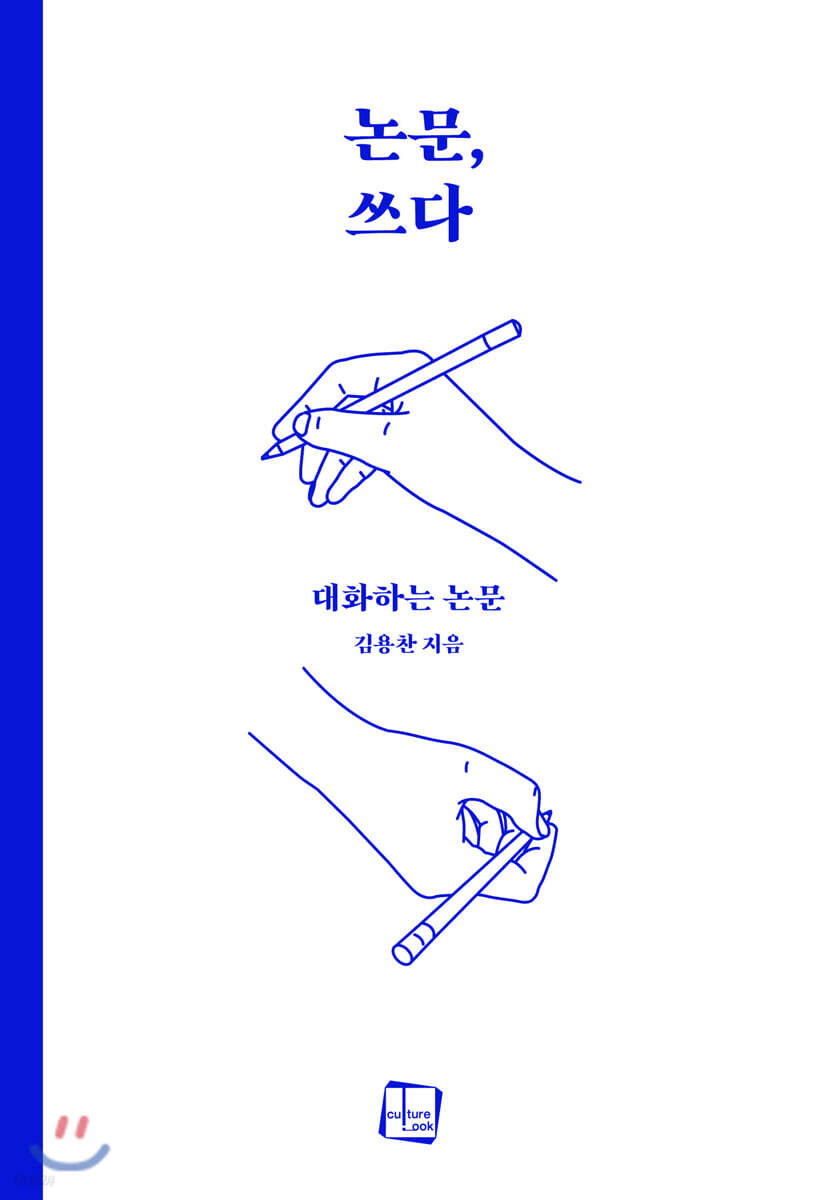
write a thesis
 |
Description
Book Introduction
A must-read for anyone who needs to write essays.
A must-read for anyone struggling to write a good thesis.
What is a thesis and why is it written?
A thesis is a representative form of academic writing.
You write a thesis to receive a degree and publish your research results in an academic journal.
All researchers in academia write papers and, through them, contribute to the academic community (and society).
There are many books out there that guide you through the process and techniques of writing a paper, but it can be difficult to easily understand what makes a good paper and what preparations are necessary.
How can I write a good paper?
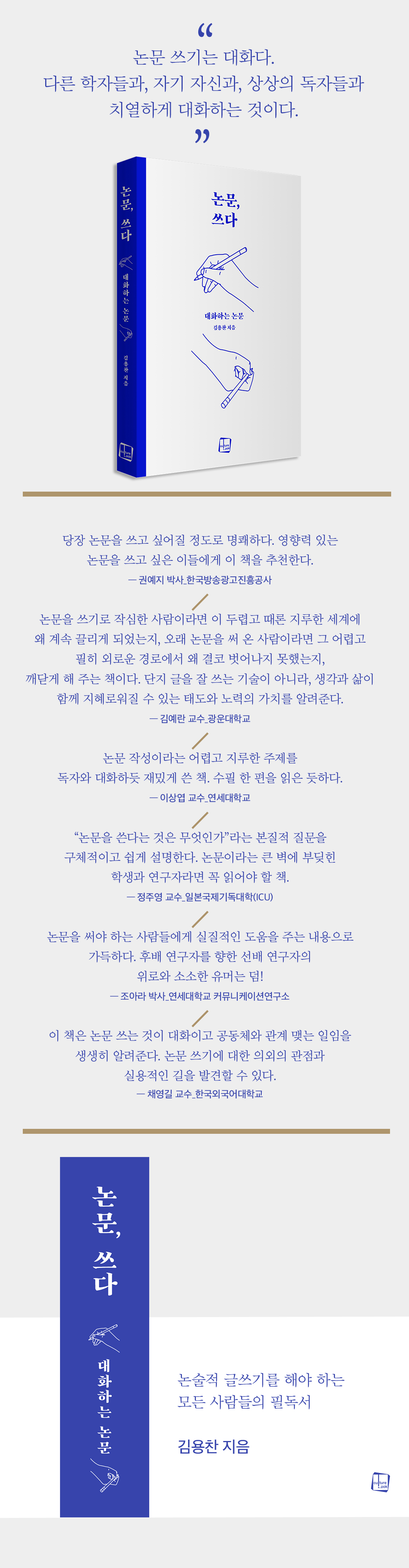
Professor Yongchan Kim of Yonsei University's book, "Writing a Paper: A Conversational Paper," is a book that answers these questions.
This book is a compilation of advice the author has repeatedly given over many years of guiding dissertations.
In this book, the author states that a paper is a tool for academic conversation and a forum for conversation itself.
To have these conversations, the authors of the paper emphasize that finding good questions requires having the courage to challenge authority and a curiosity about the ordinary.
It also contains meticulous advice on everything from the composition of the paper to the details.
These contents provide practical help to those who are at a loss while writing a thesis by asking fundamental questions about the thesis.
This book not only provides technical guidance on how to write a paper, but also explains what constitutes a good paper and how to write one. It is useful not only for those preparing master's and doctoral dissertations, but also for researchers preparing papers to be submitted to academic journals.
This will be helpful to anyone preparing a logical and academic essay (a so-called dissertation) or a "logical and evidence-based essay" (a piece of writing that requires logical reasoning, regardless of whether it is in the humanities or social sciences or the natural sciences).
A must-read for anyone struggling to write a good thesis.
What is a thesis and why is it written?
A thesis is a representative form of academic writing.
You write a thesis to receive a degree and publish your research results in an academic journal.
All researchers in academia write papers and, through them, contribute to the academic community (and society).
There are many books out there that guide you through the process and techniques of writing a paper, but it can be difficult to easily understand what makes a good paper and what preparations are necessary.
How can I write a good paper?
Professor Yongchan Kim of Yonsei University's book, "Writing a Paper: A Conversational Paper," is a book that answers these questions.
This book is a compilation of advice the author has repeatedly given over many years of guiding dissertations.
In this book, the author states that a paper is a tool for academic conversation and a forum for conversation itself.
To have these conversations, the authors of the paper emphasize that finding good questions requires having the courage to challenge authority and a curiosity about the ordinary.
It also contains meticulous advice on everything from the composition of the paper to the details.
These contents provide practical help to those who are at a loss while writing a thesis by asking fundamental questions about the thesis.
This book not only provides technical guidance on how to write a paper, but also explains what constitutes a good paper and how to write one. It is useful not only for those preparing master's and doctoral dissertations, but also for researchers preparing papers to be submitted to academic journals.
This will be helpful to anyone preparing a logical and academic essay (a so-called dissertation) or a "logical and evidence-based essay" (a piece of writing that requires logical reasoning, regardless of whether it is in the humanities or social sciences or the natural sciences).
- You can preview some of the book's contents.
Preview
index
introduction
1.
Writing a Paper as a Conversation
Writing a Paper and the Modern Academic Community | Writing a Paper | Writing a Paper is a Conversation | Writing a Paper as Storytelling
2.
Good Papers Have Good Questions: How to Craft Questions
'Challenging Idols' and 'Curiosity About the Ordinary' | Where Do We Get Questions? | Basic Question Forms: Differences and Relationships | Question Types | What Makes a Good Question? | What's My Question?
3.
Structure and flow of the paper as a narrative
Structure of the Paper | Flow of the Paper | Build the Narrative of the Paper
4.
How to Start a Conversation: Title, Abstract, Introduction
Title | Checklist | Abstract | Introduction | Address to the Reader
5.
Bridging the Gap: A Literature Review and Research Questions
Continue to imagine your hypothetical reader | Structure the literature review and research question sections | The problem of relationships | The problem of the speaker | The literature review is not a textbook | A few more stories | Tell your story in your own voice
6.
Public Writing: Research Methods and Results
Research Methods | Some (Worried) Suggestions | Research Results | Replicability and Clarity
7.
The Emergence of a New Audience: Discussing the Results
Discussion of Results | Introduction to the Research Purpose and Summary of Results | Limitations of the Study and Suggestions for Further Research | Critically Discussing Your Own Research
8.
A few remaining issues to consider when writing your thesis
A paper should be written in a way that constantly moves forward | Avoid 'big-picture' speech and be suspicious of all directives | Write in parentheses as a rule | Only one idea per paragraph | Avoid one-sentence paragraphs if possible | Use conjunctions sparingly | Write in short sentences | Use active rather than passive sentences | Subjects and predicates should agree | 'Inanimate subject' | Follow the paper writing guidelines | In the end, the question is how to write well.
9.
The Conversation Continues: A Conversation with the Judges
Choosing a Journal | What to Expect After Submitting a Paper | Responding to Reviewers | When Your Paper Is Rejected | The Paper Submission Process Is a Conversation
10.
Thesis as a Dialogue, the Final Story
Avoid groundbreaking stories | Tell stories that are meaningful to you.
1.
Writing a Paper as a Conversation
Writing a Paper and the Modern Academic Community | Writing a Paper | Writing a Paper is a Conversation | Writing a Paper as Storytelling
2.
Good Papers Have Good Questions: How to Craft Questions
'Challenging Idols' and 'Curiosity About the Ordinary' | Where Do We Get Questions? | Basic Question Forms: Differences and Relationships | Question Types | What Makes a Good Question? | What's My Question?
3.
Structure and flow of the paper as a narrative
Structure of the Paper | Flow of the Paper | Build the Narrative of the Paper
4.
How to Start a Conversation: Title, Abstract, Introduction
Title | Checklist | Abstract | Introduction | Address to the Reader
5.
Bridging the Gap: A Literature Review and Research Questions
Continue to imagine your hypothetical reader | Structure the literature review and research question sections | The problem of relationships | The problem of the speaker | The literature review is not a textbook | A few more stories | Tell your story in your own voice
6.
Public Writing: Research Methods and Results
Research Methods | Some (Worried) Suggestions | Research Results | Replicability and Clarity
7.
The Emergence of a New Audience: Discussing the Results
Discussion of Results | Introduction to the Research Purpose and Summary of Results | Limitations of the Study and Suggestions for Further Research | Critically Discussing Your Own Research
8.
A few remaining issues to consider when writing your thesis
A paper should be written in a way that constantly moves forward | Avoid 'big-picture' speech and be suspicious of all directives | Write in parentheses as a rule | Only one idea per paragraph | Avoid one-sentence paragraphs if possible | Use conjunctions sparingly | Write in short sentences | Use active rather than passive sentences | Subjects and predicates should agree | 'Inanimate subject' | Follow the paper writing guidelines | In the end, the question is how to write well.
9.
The Conversation Continues: A Conversation with the Judges
Choosing a Journal | What to Expect After Submitting a Paper | Responding to Reviewers | When Your Paper Is Rejected | The Paper Submission Process Is a Conversation
10.
Thesis as a Dialogue, the Final Story
Avoid groundbreaking stories | Tell stories that are meaningful to you.
Detailed image
GOODS SPECIFICS
- Date of issue: July 10, 2020
- Page count, weight, size: 288 pages | 304g | 128*188*20mm
- ISBN13: 9791185521800
- ISBN10: 1185521801
You may also like
카테고리
korean


korean

![GQ KOREA Mark (Monthly): December [2025]](http://librairie.coreenne.fr/cdn/shop/files/8ef265dbbfbf186523ed75ba7319009d.jpg?v=1765340328&width=3840)


