

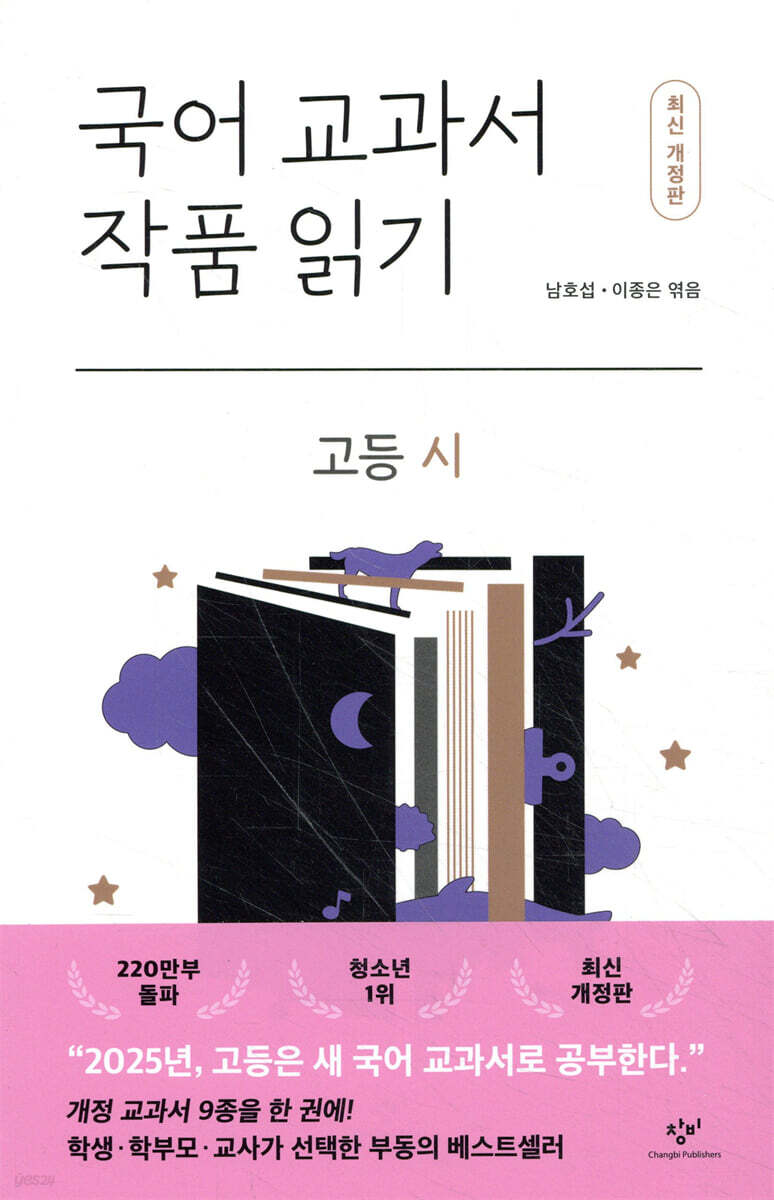
Reading Korean Textbook Works: High School Poetry
 |
Description
Book Introduction
The foundation of literacy is ‘reading Korean language textbooks’!
We will be a friendly guide for studying the increasingly difficult Korean language.
Starting in 2025, high school Korean language will be reorganized into Common Korean 1 and 2, and students will learn using nine new Common Korean language textbooks.
They say that these days, the Korean language is becoming more difficult and literacy is declining.
The more so, the more important it is to build a strong foundation from the beginning.
The Korean language is the foundation of all subjects.
The latest revised edition of Changbi's "Reading Korean Textbook Works" introduces poetry, novels, essays, and non-fiction works that students studying any of the nine common Korean textbooks according to the revised curriculum must read.
This book is a diverse collection of essential works that are repeatedly included in various textbooks, as well as works that are being included in textbooks for the first time to keep pace with the changing times.
Additionally, it contains commentary tailored to students' level and a wealth of post-reading activity questions to help students learn independently.
We will help students understand and enjoy the work on their own and develop their Korean language skills.
We will be a friendly guide for studying the increasingly difficult Korean language.
Starting in 2025, high school Korean language will be reorganized into Common Korean 1 and 2, and students will learn using nine new Common Korean language textbooks.
They say that these days, the Korean language is becoming more difficult and literacy is declining.
The more so, the more important it is to build a strong foundation from the beginning.
The Korean language is the foundation of all subjects.
The latest revised edition of Changbi's "Reading Korean Textbook Works" introduces poetry, novels, essays, and non-fiction works that students studying any of the nine common Korean textbooks according to the revised curriculum must read.
This book is a diverse collection of essential works that are repeatedly included in various textbooks, as well as works that are being included in textbooks for the first time to keep pace with the changing times.
Additionally, it contains commentary tailored to students' level and a wealth of post-reading activity questions to help students learn independently.
We will help students understand and enjoy the work on their own and develop their Korean language skills.
- You can preview some of the book's contents.
Preview
index
Publishing the latest revised edition of 'Reading Korean Language Textbook Works'
Part 1 Visitors
Jeong Hyeon-jong / Visitor
Jeong Ho-seung / The Person I Love
Han Yong-un / My Dream
Yun Dong-ju / Self-portrait
Baekseok / Seonwoosa Temple
Oh Eun / I am today
Jeong Il-geun / Mother's Grim
Choi Young-mi / at Seonunsa Temple
Cheon Yang-hee / I write to you
Kim So-wol / Azalea
Jeong Gyeot-byeol / In front of the homepage
Gyerang / Lee Hwa-woo, scattering
Hwang Jin-i / Cheongsan is my will
Author unknown / No trees or rocks
Part 2: No Apology
Yun Dong-ju / Seosi
Han Yong-un / The Ferry and the Pedestrian
Jeong Jin-gyu / Writing with a pencil
Na Hee-deok / Blue Night
Kim Yong-taek / In the pine forest of your life
Kim So-wol / Gaeyeoul
Jang Seok-nam / Tie the Boat
Moon Jeong-hee / After the breakup
Kim I-deum / No apology
Lee Won / I click, therefore I am
Wolmyeongsa Temple / Jemangmaega
Author unknown / Gasiri
Yun Seon-do / Manheung
Part 3: Farming the Cornelian Cherry Tree
Baekseok / Sura
Jeong Ji-yong / Perfume
Jeong Hyeon-jong / Deep Soil
Na Hee-deok / To the Roots
Bae Chang-hwan / Gil
Jeong Hee-seong / Forest
Moon Tae-jun / Cornelian Cherry Farming
Son Taek-su / The Dream of a Tree
Lee Moon-jae / Gwanghwamun, winter, fireworks, trees
Heavenly disease / noble and common
Author unknown / Cheongsanbyeolgok
Song Soon / Ten years of management
Author unknown / Plowing the fields and weeding
Jeong Geuk-in / Sangchun-gok
Part 4: Poems Like Wildflowers
Jeong Ji-yong / Hometown
There is a white stone / white wind wall
Park Jae-sam / When you go to the mountain
Jeong Hyeon-jong / Nestled in a Tree
Ma Jong-gi / The River of Fables 1
Jeong Hee-seong / One longing leads to another longing
Jeong Ho-seung / Delivery
Na Hee-deok / In the mountains
Lee Moon-jae / In some cases
Jo Hyang-mi / Poetry like a wild flower
An Mi-ok / Momentary
Jeongcheol / Cut out my heart
Maeng Sa-seong / Kang Ho-sa-si-ga
Author unknown / Seogyeongbyeolgok
Part 5: Poetry of People
Lee Yong-ak / One Star at a Time
Baek Seok / Nam Shin-ui-ju Yoo Dong Park Si-bong
Yun Dong-ju / Star Counting Night
Kim Soo-young / Waterfall
Shin Kyeong-rim / Agricultural Affairs
Jeong Hee-seong / Washing a shovel in the river at sunset
Na Hee-deok / Land's End
Moon Tae-jun / 1942 Train
Kim Jung-sik / Suddenly, the one who left
Yoo Hyun-ah / Poetry of People
Giljae / A capital city of 500 years
Park Pang-nyeon / The crow is hit by the snow
Author unknown / Toad biting a fly
Jeongcheol / Sokmiingok
About the poet
Source of the work
View included textbooks
Part 1 Visitors
Jeong Hyeon-jong / Visitor
Jeong Ho-seung / The Person I Love
Han Yong-un / My Dream
Yun Dong-ju / Self-portrait
Baekseok / Seonwoosa Temple
Oh Eun / I am today
Jeong Il-geun / Mother's Grim
Choi Young-mi / at Seonunsa Temple
Cheon Yang-hee / I write to you
Kim So-wol / Azalea
Jeong Gyeot-byeol / In front of the homepage
Gyerang / Lee Hwa-woo, scattering
Hwang Jin-i / Cheongsan is my will
Author unknown / No trees or rocks
Part 2: No Apology
Yun Dong-ju / Seosi
Han Yong-un / The Ferry and the Pedestrian
Jeong Jin-gyu / Writing with a pencil
Na Hee-deok / Blue Night
Kim Yong-taek / In the pine forest of your life
Kim So-wol / Gaeyeoul
Jang Seok-nam / Tie the Boat
Moon Jeong-hee / After the breakup
Kim I-deum / No apology
Lee Won / I click, therefore I am
Wolmyeongsa Temple / Jemangmaega
Author unknown / Gasiri
Yun Seon-do / Manheung
Part 3: Farming the Cornelian Cherry Tree
Baekseok / Sura
Jeong Ji-yong / Perfume
Jeong Hyeon-jong / Deep Soil
Na Hee-deok / To the Roots
Bae Chang-hwan / Gil
Jeong Hee-seong / Forest
Moon Tae-jun / Cornelian Cherry Farming
Son Taek-su / The Dream of a Tree
Lee Moon-jae / Gwanghwamun, winter, fireworks, trees
Heavenly disease / noble and common
Author unknown / Cheongsanbyeolgok
Song Soon / Ten years of management
Author unknown / Plowing the fields and weeding
Jeong Geuk-in / Sangchun-gok
Part 4: Poems Like Wildflowers
Jeong Ji-yong / Hometown
There is a white stone / white wind wall
Park Jae-sam / When you go to the mountain
Jeong Hyeon-jong / Nestled in a Tree
Ma Jong-gi / The River of Fables 1
Jeong Hee-seong / One longing leads to another longing
Jeong Ho-seung / Delivery
Na Hee-deok / In the mountains
Lee Moon-jae / In some cases
Jo Hyang-mi / Poetry like a wild flower
An Mi-ok / Momentary
Jeongcheol / Cut out my heart
Maeng Sa-seong / Kang Ho-sa-si-ga
Author unknown / Seogyeongbyeolgok
Part 5: Poetry of People
Lee Yong-ak / One Star at a Time
Baek Seok / Nam Shin-ui-ju Yoo Dong Park Si-bong
Yun Dong-ju / Star Counting Night
Kim Soo-young / Waterfall
Shin Kyeong-rim / Agricultural Affairs
Jeong Hee-seong / Washing a shovel in the river at sunset
Na Hee-deok / Land's End
Moon Tae-jun / 1942 Train
Kim Jung-sik / Suddenly, the one who left
Yoo Hyun-ah / Poetry of People
Giljae / A capital city of 500 years
Park Pang-nyeon / The crow is hit by the snow
Author unknown / Toad biting a fly
Jeongcheol / Sokmiingok
About the poet
Source of the work
View included textbooks
Detailed image
Publisher's Review
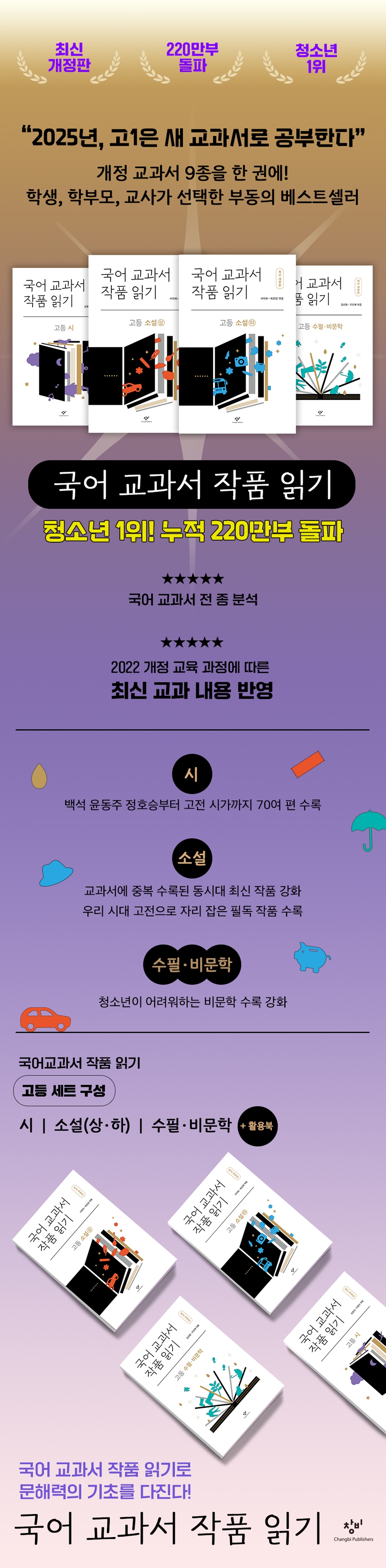
“In 2025, high school students will study using the new Korean language textbook.”
Nine revised textbooks in one volume!
A bestseller chosen by students, parents, and teachers
The proven series 'Reading Korean Language Textbooks', which was first introduced in 2010 and has been chosen by 2.2 million readers, has been republished in its latest revised edition.
Changbi's 'Reading Korean Textbooks' has been published in revised editions in accordance with the new curriculum since its first edition, and with the implementation of the '2022 Revised Curriculum', it is publishing the latest revised edition in preparation for the new Korean textbooks in 2025.
In this curriculum, high school Korean language textbooks were reorganized into ‘Common Korean Language 1’ and ‘Common Korean Language 2’.
With the introduction of the 'high school credit system' where credits are earned each semester, high school students earn credits through various elective subjects, but the common Korean language is still required to be learned, not as an elective.
Recently, as students' literacy skills have been declining due to difficulties in understanding texts because they do not know the meaning of words or are unable to grasp the context of texts they read, this has become a hot topic in schools.
Current Korean language teachers agree that starting with reading the original text of a Korean language textbook and building reading skills helps improve literacy.
Korean is the foundation for learning all subjects, and by establishing a solid foundation in Korean, critical and creative thinking skills can also be strengthened.
The latest revised edition of Changbi's 'Reading Korean Textbooks' has been strengthened with a customized structure that helps build a foundation for literacy and improve Korean language skills.
The latest revised edition of Changbi's 'Reading Korean Language Textbook Works' is organized by genre: poetry, novels, essays, and non-fiction, with the works included in the 18 volumes of the newly revised common Korean language textbooks in 9 categories.
This book is a diverse collection of essential works that are repeatedly included in various textbooks, works that convey a new era and sensibility, and works that should be read carefully and thoughtfully even if they may seem unfamiliar and difficult at first.
We also provide helpful texts for deeper appreciation, provide detailed definitions for each work, and provide activities to help students reach the new curriculum's achievement standards and improve literacy.
With nearly 15 years of accumulated expertise and the trust of countless readers, "Reading Korean Textbooks" is not only the perfect preparation for the changing textbooks, but also a stepping stone for building a solid foundation in Korean.
*The latest revised edition of the 'Reading Korean Language Textbooks' series is scheduled to be published in 2025 for the 2nd grade middle school series and in 2026 for the 3rd grade middle school series, in line with the development of new textbooks.
Features of "Reading Korean Language Textbook Works: High School Poetry" (Latest Revised Edition)
ㆍ Based on the nine revised high school common Korean language textbooks, carefully selected by current Korean language teachers and poets
According to the revised 2022 curriculum, high school students will be required to study common Korean language starting in 2025.
All poems included in 18 volumes of 9 common Korean language textbooks were carefully read and analyzed by current Korean language teachers and poets.
It contains a total of 72 poems, including 69 poems selected from 9 textbooks and 3 poems from outside the textbooks that are good to read together.
It includes 55 modern poems and 17 classical poems so that you can enjoy them across both modern and classical poetry.
ㆍ Sub-components to support self-directed and immersive appreciation
The book was structured to be read like a poetry collection so that even students who have difficulty reading poetry can approach it in a friendly manner.
It introduces the poems by grouping them into themes such as the inner self of the poetic speaker, the voice of love, life and nature, society and history, and provides a space for writing one's own reviews to help one enjoy them independently.
ㆍ Strengthening post-reading activities and articles to help students understand the genre of lyric poetry and develop literacy skills.
To help readers understand the author and the work's historical background, metaphors and rhetoric, rhythm and imagery, and other lyrical genres, we've added appreciation guides and activity problems to each poem.
Each book is organized to help readers develop multifaceted appreciation skills and improve literacy by combining works with similar themes.
Nine revised textbooks in one volume!
A bestseller chosen by students, parents, and teachers
The proven series 'Reading Korean Language Textbooks', which was first introduced in 2010 and has been chosen by 2.2 million readers, has been republished in its latest revised edition.
Changbi's 'Reading Korean Textbooks' has been published in revised editions in accordance with the new curriculum since its first edition, and with the implementation of the '2022 Revised Curriculum', it is publishing the latest revised edition in preparation for the new Korean textbooks in 2025.
In this curriculum, high school Korean language textbooks were reorganized into ‘Common Korean Language 1’ and ‘Common Korean Language 2’.
With the introduction of the 'high school credit system' where credits are earned each semester, high school students earn credits through various elective subjects, but the common Korean language is still required to be learned, not as an elective.
Recently, as students' literacy skills have been declining due to difficulties in understanding texts because they do not know the meaning of words or are unable to grasp the context of texts they read, this has become a hot topic in schools.
Current Korean language teachers agree that starting with reading the original text of a Korean language textbook and building reading skills helps improve literacy.
Korean is the foundation for learning all subjects, and by establishing a solid foundation in Korean, critical and creative thinking skills can also be strengthened.
The latest revised edition of Changbi's 'Reading Korean Textbooks' has been strengthened with a customized structure that helps build a foundation for literacy and improve Korean language skills.
The latest revised edition of Changbi's 'Reading Korean Language Textbook Works' is organized by genre: poetry, novels, essays, and non-fiction, with the works included in the 18 volumes of the newly revised common Korean language textbooks in 9 categories.
This book is a diverse collection of essential works that are repeatedly included in various textbooks, works that convey a new era and sensibility, and works that should be read carefully and thoughtfully even if they may seem unfamiliar and difficult at first.
We also provide helpful texts for deeper appreciation, provide detailed definitions for each work, and provide activities to help students reach the new curriculum's achievement standards and improve literacy.
With nearly 15 years of accumulated expertise and the trust of countless readers, "Reading Korean Textbooks" is not only the perfect preparation for the changing textbooks, but also a stepping stone for building a solid foundation in Korean.
*The latest revised edition of the 'Reading Korean Language Textbooks' series is scheduled to be published in 2025 for the 2nd grade middle school series and in 2026 for the 3rd grade middle school series, in line with the development of new textbooks.
Features of "Reading Korean Language Textbook Works: High School Poetry" (Latest Revised Edition)
ㆍ Based on the nine revised high school common Korean language textbooks, carefully selected by current Korean language teachers and poets
According to the revised 2022 curriculum, high school students will be required to study common Korean language starting in 2025.
All poems included in 18 volumes of 9 common Korean language textbooks were carefully read and analyzed by current Korean language teachers and poets.
It contains a total of 72 poems, including 69 poems selected from 9 textbooks and 3 poems from outside the textbooks that are good to read together.
It includes 55 modern poems and 17 classical poems so that you can enjoy them across both modern and classical poetry.
ㆍ Sub-components to support self-directed and immersive appreciation
The book was structured to be read like a poetry collection so that even students who have difficulty reading poetry can approach it in a friendly manner.
It introduces the poems by grouping them into themes such as the inner self of the poetic speaker, the voice of love, life and nature, society and history, and provides a space for writing one's own reviews to help one enjoy them independently.
ㆍ Strengthening post-reading activities and articles to help students understand the genre of lyric poetry and develop literacy skills.
To help readers understand the author and the work's historical background, metaphors and rhetoric, rhythm and imagery, and other lyrical genres, we've added appreciation guides and activity problems to each poem.
Each book is organized to help readers develop multifaceted appreciation skills and improve literacy by combining works with similar themes.
GOODS SPECIFICS
- Date of issue: December 20, 2024
- Page count, weight, size: 228 pages | 368g | 141*216*14mm
- ISBN13: 9788936431471
- ISBN10: 8936431471
You may also like
카테고리
korean


korean

![GQ KOREA Mark (Monthly): December [2025]](http://librairie.coreenne.fr/cdn/shop/files/8ef265dbbfbf186523ed75ba7319009d.jpg?v=1765340328&width=3840)


