

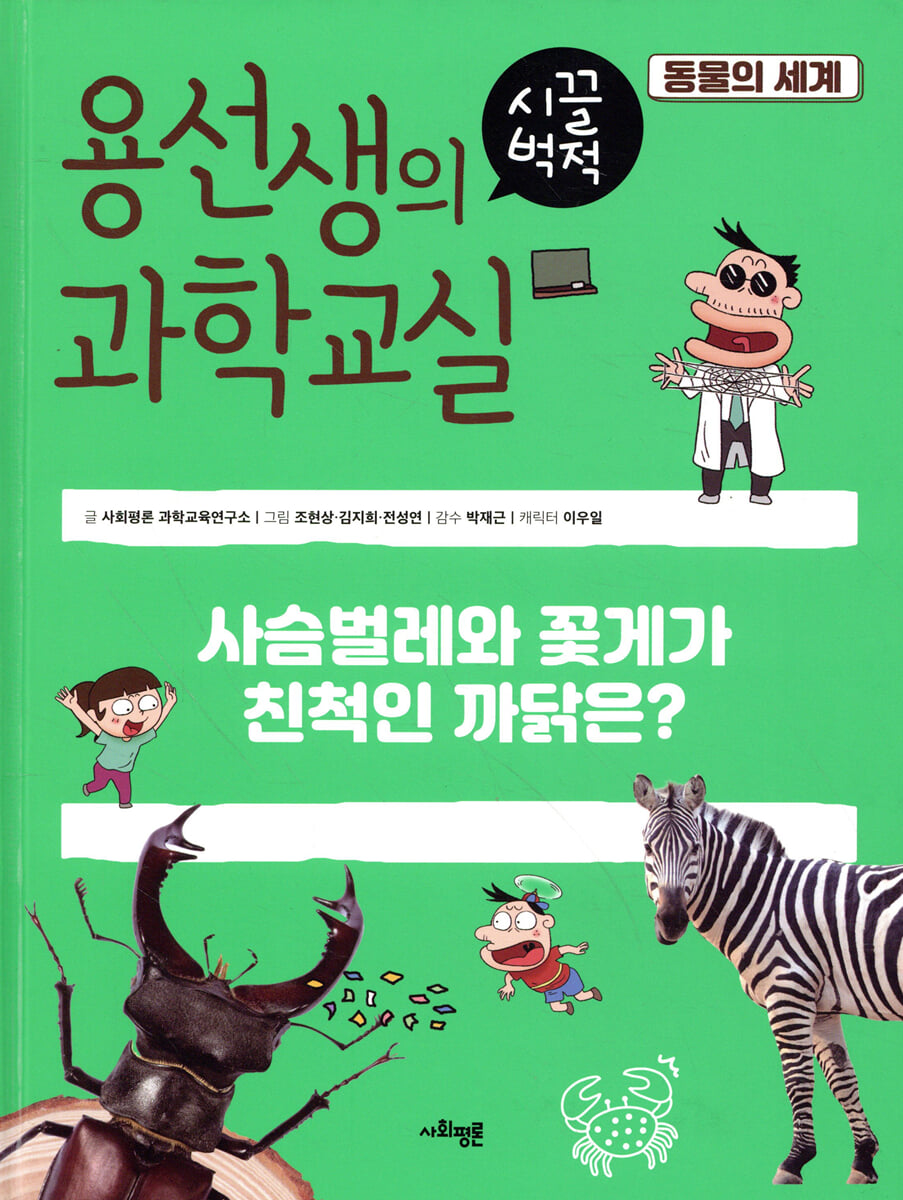
Mr. Yong's Bustling Science Classroom 36: The World of Animals
 |
Description
Book Introduction
True to the reputation of the Yongseonsaeng history series, this time it's science! A Curiosity-Exploding Science Adventure with Mr. Yong and the Children The new book in the 『Mr. Yong's Bustling Science Classroom』 series, a new book from the best-selling author of the history of immovables, Mr. Yong, has been released. "Mr. Yong's Bustling Science Classroom" is a story about Mr. Yong and the children learning science in a noisy way. This book contains everything elementary school students need to know about science, including easy-to-understand narratives that take into account today's children's reading habits, eye-catching visuals with vivid photos and whimsical illustrations, content that faithfully reflects the latest science textbooks, and concepts and principles explained with materials that stimulate curiosity. In 『Mr. Yong's Bustling Science Class - 36 Animal World』, we learn about animals among the countless creatures living on Earth. Animals are familiar to children because they are commonly seen around them. But when you actually try to list down what you know about animals, most of it is just a bunch of fragmentary facts. In this book, we will learn about the characteristics of animals, classify them according to various criteria, and then carefully examine the similarities and differences between the classified animals. Finally, once children understand that similar animals are classified as close relatives and less similar animals are classified as distant relatives, they will be able to understand animals more systematically and scientifically and look at them with new eyes. |
- You can preview some of the book's contents.
Preview
index
1st Period | Characteristics of Animals_Is the sea squirt a plant or an animal?
What characteristics do animals have? ··· 13
Every animal is different, different! ··· 17
How should we categorize various animals? ··· 21
Spiral Love's Organizing Notes... 24
Find the Science Quiz Master! ··· 25
2nd Period | Mammals and Birds_How are bats different from birds?
Bird, bird, what are your characteristics? ··· 28
Uncover the Bat's Identity! ··· 32
What do magpies and cows have in common? ··· 36
Spiral Love's Organizing Notes... 40
Find the Science Quiz Master! ··· 41
Mr. Yong's Science Cafe... 42
- Who knew there were mammals like this in the world!
3rd Period | Reptiles and Amphibians_What are the differences between salamanders and lizards?
How do lizards survive? ··· 46
The Secret to Smooth Salamander Skin... 51
How to survive the cold winter without a fur coat? ··· 54
Spiral Love's Organizing Notes... 58
Find the Science Quiz Master! ··· 59
Mr. Yong's Science Cafe... 60
- What amphibian lives its entire life as a tadpole?
4th Period | Fish_Is an octopus a fish or not?
What are the characteristics of a water swan? ··· 65
Enter the world of diverse fish! ··· 69
Are all those who live in water fish? ··· 73
Spiral Love's Organizing Notes... 76
Find the Science Quiz Master! ··· 77
5th Period | Arthropods_What is the difference between insects and spiders?
What group of animals do insects belong to? ··· 80
Why aren't spiders insects? ··· 86
In search of another arthropod! ··· 89
Spiral Love's Organizing Notes... 92
Find the Science Quiz Master! ··· 93
Mr. Yong's Science Cafe... 94
- Confusing animals, reveal their identities!
6th Period | Other Animals_What kind of animal is the jellyfish floating in the water?
What do earthworms eat? ··· 98
Even if it's like this, it's still an animal! ··· 101
The more you learn, the more mystical the world of animals becomes! ··· 106
Spiral Love's Organizing Notes... 110
Find the Science Quiz Master! ··· 111
Mr. Yong's Science Cafe... 112
- Imitate the animals, like this!
Crossword Quiz... 114
Into the Textbook... 116
Search ··· 118
Quiz Answers... 119
What characteristics do animals have? ··· 13
Every animal is different, different! ··· 17
How should we categorize various animals? ··· 21
Spiral Love's Organizing Notes... 24
Find the Science Quiz Master! ··· 25
2nd Period | Mammals and Birds_How are bats different from birds?
Bird, bird, what are your characteristics? ··· 28
Uncover the Bat's Identity! ··· 32
What do magpies and cows have in common? ··· 36
Spiral Love's Organizing Notes... 40
Find the Science Quiz Master! ··· 41
Mr. Yong's Science Cafe... 42
- Who knew there were mammals like this in the world!
3rd Period | Reptiles and Amphibians_What are the differences between salamanders and lizards?
How do lizards survive? ··· 46
The Secret to Smooth Salamander Skin... 51
How to survive the cold winter without a fur coat? ··· 54
Spiral Love's Organizing Notes... 58
Find the Science Quiz Master! ··· 59
Mr. Yong's Science Cafe... 60
- What amphibian lives its entire life as a tadpole?
4th Period | Fish_Is an octopus a fish or not?
What are the characteristics of a water swan? ··· 65
Enter the world of diverse fish! ··· 69
Are all those who live in water fish? ··· 73
Spiral Love's Organizing Notes... 76
Find the Science Quiz Master! ··· 77
5th Period | Arthropods_What is the difference between insects and spiders?
What group of animals do insects belong to? ··· 80
Why aren't spiders insects? ··· 86
In search of another arthropod! ··· 89
Spiral Love's Organizing Notes... 92
Find the Science Quiz Master! ··· 93
Mr. Yong's Science Cafe... 94
- Confusing animals, reveal their identities!
6th Period | Other Animals_What kind of animal is the jellyfish floating in the water?
What do earthworms eat? ··· 98
Even if it's like this, it's still an animal! ··· 101
The more you learn, the more mystical the world of animals becomes! ··· 106
Spiral Love's Organizing Notes... 110
Find the Science Quiz Master! ··· 111
Mr. Yong's Science Cafe... 112
- Imitate the animals, like this!
Crossword Quiz... 114
Into the Textbook... 116
Search ··· 118
Quiz Answers... 119
Detailed image

Publisher's Review
『Mr. Yong's Bustling Science Classroom』 Volume 36: The World of Animals
Why aren't spiders insects?
There are countless animals living on Earth.
Dogs, cats, birds, fish, and insects that we commonly see around us are all animals.
Of course, people are animals too.
On the other hand, there are many animals that are difficult to see, such as camels living in the desert, lions living in the grasslands, and polar bears living in the North Pole.
As such, animals are numerous and of great variety, and their lifestyles are also very diverse.
In 『Mr. Yong's Bustling Science Class - 36 Animal World』, we learn about the various animals living on Earth.
What are the unique characteristics of animals that distinguish them from plants? Bats and birds both fly, but how are they different? How can we tell the difference between salamanders and lizards, which not only have similar names but also look similar? Carp and sharks are fish, but are octopuses also fish? Spiders aren't insects, so what makes them different? What kinds of animals are jellyfish and earthworms?
This book explores the characteristics of animals and examines the criteria for classifying them.
In particular, we will divide vertebrates into mammals, birds, reptiles, amphibians, and fish, and learn about the similarities and differences between each type.
You can also see that not only vertebrates but also invertebrates without a backbone are divided into several types according to their characteristics.
Finally, you will learn that by classifying animals and then organizing similar animals into close relationships and less similar animals into distant relationships, you can conduct systematic animal research.
After reading this book, children will gain a scientific understanding of animals and look at the animals around them with new eyes.
If you read it with interest and enjoyment, you will soon find that scientific knowledge has entered your head!
Considering the reading level of children today, who are familiar with visual media but lack basic reading comprehension skills, the content was delivered in the easiest language possible at children's eye level.
The friendly narrative style, consisting of dialogue between characters, makes it easy for even children who are not accustomed to reading short stories.
We've also optimized the structure to make it easy to read and understand accurately by utilizing various visual aids.
Satisfy your curiosity in real life and develop your scientific thinking skills!
It provides a framework for viewing not only simple scientific concepts but also phenomena and problems through a scientific lens.
This book, which draws scientific curiosity from real-life materials and approaches concepts and principles, resonates with children and naturally draws them into the book.
Readers can not only satisfy their scientific curiosity and gain knowledge, but also develop scientific thinking and attitudes.
A colorful visual composition that catches the eye!
It delivers content intuitively through a variety of visual aids, including vivid and realistic photos, clear illustrations, and humorous characters.
Additionally, we've designed the book to reduce the burden of learning and make science an enjoyable subject by summarizing the key content of each unit through 4-panel cartoons.
A new standard for elementary science based on the latest science textbooks!
It faithfully reflects the contents of the most recently revised elementary and middle school textbooks.
Each volume, organized by topic, covers elementary school subjects as well as concepts learned in middle school, tailored to the elementary school level.
Additionally, we have further enhanced the curriculum connectivity by reflecting the scientific terminology used in the revised textbooks.
A book painstakingly developed by trusted science education experts!
This book was painstakingly created by science education experts who have long studied science at universities and taught children directly in the field, participating in the entire development process from planning to editing.
To convey accurate scientific concepts at an elementary school level, we studied elementary, middle, and high school textbooks as well as various domestic and international expert materials to develop fresh materials and explanation methods that are suitable for children's level.
Additionally, the series' reliability has been enhanced by repeatedly ensuring the accuracy of its content through review by authoritative professors who teach science at education universities.
Why aren't spiders insects?
There are countless animals living on Earth.
Dogs, cats, birds, fish, and insects that we commonly see around us are all animals.
Of course, people are animals too.
On the other hand, there are many animals that are difficult to see, such as camels living in the desert, lions living in the grasslands, and polar bears living in the North Pole.
As such, animals are numerous and of great variety, and their lifestyles are also very diverse.
In 『Mr. Yong's Bustling Science Class - 36 Animal World』, we learn about the various animals living on Earth.
What are the unique characteristics of animals that distinguish them from plants? Bats and birds both fly, but how are they different? How can we tell the difference between salamanders and lizards, which not only have similar names but also look similar? Carp and sharks are fish, but are octopuses also fish? Spiders aren't insects, so what makes them different? What kinds of animals are jellyfish and earthworms?
This book explores the characteristics of animals and examines the criteria for classifying them.
In particular, we will divide vertebrates into mammals, birds, reptiles, amphibians, and fish, and learn about the similarities and differences between each type.
You can also see that not only vertebrates but also invertebrates without a backbone are divided into several types according to their characteristics.
Finally, you will learn that by classifying animals and then organizing similar animals into close relationships and less similar animals into distant relationships, you can conduct systematic animal research.
After reading this book, children will gain a scientific understanding of animals and look at the animals around them with new eyes.
If you read it with interest and enjoyment, you will soon find that scientific knowledge has entered your head!
Considering the reading level of children today, who are familiar with visual media but lack basic reading comprehension skills, the content was delivered in the easiest language possible at children's eye level.
The friendly narrative style, consisting of dialogue between characters, makes it easy for even children who are not accustomed to reading short stories.
We've also optimized the structure to make it easy to read and understand accurately by utilizing various visual aids.
Satisfy your curiosity in real life and develop your scientific thinking skills!
It provides a framework for viewing not only simple scientific concepts but also phenomena and problems through a scientific lens.
This book, which draws scientific curiosity from real-life materials and approaches concepts and principles, resonates with children and naturally draws them into the book.
Readers can not only satisfy their scientific curiosity and gain knowledge, but also develop scientific thinking and attitudes.
A colorful visual composition that catches the eye!
It delivers content intuitively through a variety of visual aids, including vivid and realistic photos, clear illustrations, and humorous characters.
Additionally, we've designed the book to reduce the burden of learning and make science an enjoyable subject by summarizing the key content of each unit through 4-panel cartoons.
A new standard for elementary science based on the latest science textbooks!
It faithfully reflects the contents of the most recently revised elementary and middle school textbooks.
Each volume, organized by topic, covers elementary school subjects as well as concepts learned in middle school, tailored to the elementary school level.
Additionally, we have further enhanced the curriculum connectivity by reflecting the scientific terminology used in the revised textbooks.
A book painstakingly developed by trusted science education experts!
This book was painstakingly created by science education experts who have long studied science at universities and taught children directly in the field, participating in the entire development process from planning to editing.
To convey accurate scientific concepts at an elementary school level, we studied elementary, middle, and high school textbooks as well as various domestic and international expert materials to develop fresh materials and explanation methods that are suitable for children's level.
Additionally, the series' reliability has been enhanced by repeatedly ensuring the accuracy of its content through review by authoritative professors who teach science at education universities.
GOODS SPECIFICS
- Publication date: July 26, 2022
- Format: Hardcover book binding method guide
- Page count, weight, size: 124 pages | 460g | 195*257*10mm
- ISBN13: 9791162732328
- ISBN10: 1162732326
- KC Certification: Certification Type: Conformity Confirmation
You may also like
카테고리
korean


korean

![GQ KOREA Mark (Monthly): December [2025]](http://librairie.coreenne.fr/cdn/shop/files/8ef265dbbfbf186523ed75ba7319009d.jpg?v=1765340328&width=3840)


