

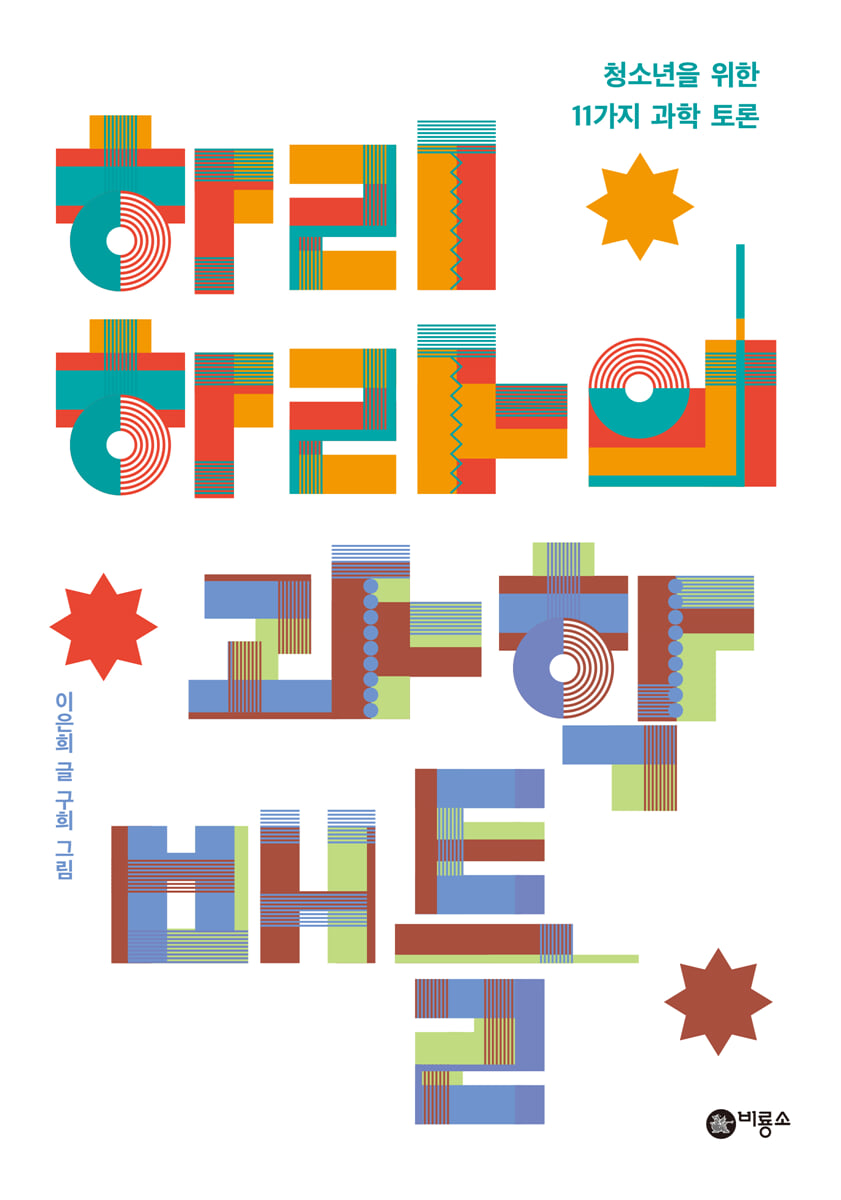
Harihara's Science Battle
 |
Description
Book Introduction
11 topics that are heating up the world,
Let's dig smart with science discussions!
The new work 『Harihara's Science Battle』 by Lee Eun-hee, a science communicator representing Korea, has been published by Biryongso Co., Ltd.
The author, who has been introducing science in a familiar way through broadcasts such as "YTN Science Talk" and "EBS Lifelong School," as well as through YouTube and newspaper columns, has recently pulled out a card to help young people develop scientific thinking skills: "Science Discussion."
The importance of scientific discussion is already widely known in schools.
It is perfectly suited to fostering creativity, critical thinking, logical thinking, and communication skills, and is actively being utilized, such as through performance evaluations through scientific discussions.
Additionally, the government hosts the Youth Science Fair (formerly the National Youth Science Exploration Competition), in which over 100,000 middle and high school students from all over the country participate in the science discussion portion every year.
This is because it is an excellent opportunity for young people aspiring to study science to develop their scientific thinking skills and compete against each other.
The author suggests that we practice this important scientific discussion in practice through this book.
Let's dig smart with science discussions!
The new work 『Harihara's Science Battle』 by Lee Eun-hee, a science communicator representing Korea, has been published by Biryongso Co., Ltd.
The author, who has been introducing science in a familiar way through broadcasts such as "YTN Science Talk" and "EBS Lifelong School," as well as through YouTube and newspaper columns, has recently pulled out a card to help young people develop scientific thinking skills: "Science Discussion."
The importance of scientific discussion is already widely known in schools.
It is perfectly suited to fostering creativity, critical thinking, logical thinking, and communication skills, and is actively being utilized, such as through performance evaluations through scientific discussions.
Additionally, the government hosts the Youth Science Fair (formerly the National Youth Science Exploration Competition), in which over 100,000 middle and high school students from all over the country participate in the science discussion portion every year.
This is because it is an excellent opportunity for young people aspiring to study science to develop their scientific thinking skills and compete against each other.
The author suggests that we practice this important scientific discussion in practice through this book.
- You can preview some of the book's contents.
Preview
index
Round 1 Dirt Spoon has no answer?
Harihara's Opening Thoughts: Networks in Animal Society
Full-scale battle pros and cons debate: Class inheritance is an inevitable phenomenon.
Round 2: Are men and women different?
Harihara's Opening Thoughts: Heredity and Environment
Full-scale battle pros and cons debate: Gender differences between men and women are a product of genetics.
Round 3 waste separation is useless?
Harihara's Open Mind: Plastics and Recycling
Full-scale battle pros and cons debate: Separating waste for plastic recycling is unnecessary.
Round 4 virus doesn't go away?
Harihara's Opening Thoughts: Viruses
Full-scale battle pros and cons debate: Conquering the virus that threatens humanity is impossible.
What is the most effective way to divide the work into 5 rounds?
Harihara's Opening Thoughts: Teamwork in Insect Society
Full-scale battle pros and cons debate: The most important thing in team play is equal division of labor.
Round 6 Hair color is the problem?
Harihara's Opening Thoughts: The Colors of Living Things
A full-blown battle debate: We need laws prohibiting discrimination based on appearance.
Round 7: Can you live without meat?
Harihara's Open Mind: Alternative Meat and Cultured Meat
Full-scale battle pros and cons debate: It's better for humans not to eat meat.
Round 8: Are there any genders other than male and female?
Harihara's Opening Thoughts: The Distinction of Gender
A full-blown battle debate: We need to move beyond the gender binary to promote social diversity.
9-round eco-bags are not good for the environment?
Harihara's Opening Thoughts: Carbon Footprint
The real battle for pros and cons: All products should be required to display their carbon footprints.
What will change when the era of artificial intelligence arrives?
Harihara's Open Mind: Artificial Intelligence and the Fourth Industrial Revolution
A full-blown battle pros and cons debate: Will artificial intelligence be a blessing to humanity?
Round 11: Consideration for the disabled, isn't this reverse discrimination?
Harihara's Opening Thoughts: Mirror Neurons
A full-blown battle for and against: Considerations and benefits for people with disabilities harm people without disabilities.
Author's Note
Harihara's Opening Thoughts: Networks in Animal Society
Full-scale battle pros and cons debate: Class inheritance is an inevitable phenomenon.
Round 2: Are men and women different?
Harihara's Opening Thoughts: Heredity and Environment
Full-scale battle pros and cons debate: Gender differences between men and women are a product of genetics.
Round 3 waste separation is useless?
Harihara's Open Mind: Plastics and Recycling
Full-scale battle pros and cons debate: Separating waste for plastic recycling is unnecessary.
Round 4 virus doesn't go away?
Harihara's Opening Thoughts: Viruses
Full-scale battle pros and cons debate: Conquering the virus that threatens humanity is impossible.
What is the most effective way to divide the work into 5 rounds?
Harihara's Opening Thoughts: Teamwork in Insect Society
Full-scale battle pros and cons debate: The most important thing in team play is equal division of labor.
Round 6 Hair color is the problem?
Harihara's Opening Thoughts: The Colors of Living Things
A full-blown battle debate: We need laws prohibiting discrimination based on appearance.
Round 7: Can you live without meat?
Harihara's Open Mind: Alternative Meat and Cultured Meat
Full-scale battle pros and cons debate: It's better for humans not to eat meat.
Round 8: Are there any genders other than male and female?
Harihara's Opening Thoughts: The Distinction of Gender
A full-blown battle debate: We need to move beyond the gender binary to promote social diversity.
9-round eco-bags are not good for the environment?
Harihara's Opening Thoughts: Carbon Footprint
The real battle for pros and cons: All products should be required to display their carbon footprints.
What will change when the era of artificial intelligence arrives?
Harihara's Open Mind: Artificial Intelligence and the Fourth Industrial Revolution
A full-blown battle pros and cons debate: Will artificial intelligence be a blessing to humanity?
Round 11: Consideration for the disabled, isn't this reverse discrimination?
Harihara's Opening Thoughts: Mirror Neurons
A full-blown battle for and against: Considerations and benefits for people with disabilities harm people without disabilities.
Author's Note
Detailed image

Publisher's Review
Climate crisis, gender discrimination, vegetarianism, global pandemics…
Tackling the hottest issues of this era head-on with science!
Eleven timely and sensitive social issues, including the climate crisis, artificial intelligence, gender discrimination, and the gap between the rich and the poor, are proposed as topics for each chapter of this book.
The author poses hot global issues to readers, such as “Is plastic waste separation unnecessary?”, “Is artificial intelligence truly a blessing for humanity?”, “Is there a third gender besides male and female?”, “Can we eliminate viruses that threaten humanity?”, and “Should humans stop eating meat?”, and then unravels these issues with interesting scientific information.
The goal is to enable readers to consider various perspectives on each issue by reading scientific knowledge such as the current state of plastic recycling research, the diverse gender spectrum of living organisms, the survival and mutation of viruses, and alternative meat and cultured meat for vegetarians.
Additionally, it does not miss the real-world issues that young people face both inside and outside the classroom.
It presents an unconventional perspective on issues in the lives of teenagers, such as “Is it right to discriminate based on appearance?”, “Do eco-bags help the environment?”, and “What is most important in a team project?”, through scientific explanations such as the reason why living things have different colors, the process of making eco-bags, and the division of labor in insect societies.
Readers who read this will find it useful in presenting their own opinions wherever they are.
Opening Thoughts - Pros and Cons Debate - Mind Map
Completely master the 3-step science debate!
Middle school students Chani and Bani, who appear in the discussion corner of this book, are best friends, but their opinions on every topic of discussion are always different, leading to a tense standoff.
If there is Bani who argues that plastic does not decompose easily, so it is necessary to separate it for disposal, then there is Chani who argues that we should quickly develop biodegradable plastic technology rather than going through the hassle of separating and disposing of waste.
Step 1, the introduction of each chapter begins with everyday conversations between Chani and Barney, such as “Let’s go to the academy together” and “No, I quit that academy.”
As this naturally leads to issues of class, such as the inheritance of wealth, scientific arguments, such as the phenomenon of class inheritance in animal societies, are presented through the 'Harihara's Open Thought' corner.
Step 2: You can experience a heated debate through the comic 'Full-scale Battle Pros and Cons Debate'.
The clever yet comical debate between Barney, who believes that class inheritance is inevitable, and Chani, who disagrees, provides readers with a vivid and relatable example of scientific discussion.
Step 3: Let's take a look at the mind map that shows the pros and cons of Chani and Barney's arguments at a glance.
Clean colors and simple infographics allow readers to simplify and organize the discussion process themselves.
These three steps can also be applied to real-world scientific discussions.
By adapting the three-step method of 'focusing the audience's attention', 'persuading the other party and the audience with scientific arguments', and finally 'simplifying one's own opinion', readers of this book will be able to become solid scientific debaters.
This book is for students who find discussion difficult and fearful to organize their thoughts on their own.
It helps you speak logically.
-Recommended by the Seoul Science Teachers Association
Think logically and solve various social problems inside and outside the classroom.
This is a book that builds your scientific muscles.
It would be a good choice to develop scientific thinking and literacy skills in young people.
-Recommended by the Science Education Research Association's "People Who Make Science Exciting"
Tackling the hottest issues of this era head-on with science!
Eleven timely and sensitive social issues, including the climate crisis, artificial intelligence, gender discrimination, and the gap between the rich and the poor, are proposed as topics for each chapter of this book.
The author poses hot global issues to readers, such as “Is plastic waste separation unnecessary?”, “Is artificial intelligence truly a blessing for humanity?”, “Is there a third gender besides male and female?”, “Can we eliminate viruses that threaten humanity?”, and “Should humans stop eating meat?”, and then unravels these issues with interesting scientific information.
The goal is to enable readers to consider various perspectives on each issue by reading scientific knowledge such as the current state of plastic recycling research, the diverse gender spectrum of living organisms, the survival and mutation of viruses, and alternative meat and cultured meat for vegetarians.
Additionally, it does not miss the real-world issues that young people face both inside and outside the classroom.
It presents an unconventional perspective on issues in the lives of teenagers, such as “Is it right to discriminate based on appearance?”, “Do eco-bags help the environment?”, and “What is most important in a team project?”, through scientific explanations such as the reason why living things have different colors, the process of making eco-bags, and the division of labor in insect societies.
Readers who read this will find it useful in presenting their own opinions wherever they are.
Opening Thoughts - Pros and Cons Debate - Mind Map
Completely master the 3-step science debate!
Middle school students Chani and Bani, who appear in the discussion corner of this book, are best friends, but their opinions on every topic of discussion are always different, leading to a tense standoff.
If there is Bani who argues that plastic does not decompose easily, so it is necessary to separate it for disposal, then there is Chani who argues that we should quickly develop biodegradable plastic technology rather than going through the hassle of separating and disposing of waste.
Step 1, the introduction of each chapter begins with everyday conversations between Chani and Barney, such as “Let’s go to the academy together” and “No, I quit that academy.”
As this naturally leads to issues of class, such as the inheritance of wealth, scientific arguments, such as the phenomenon of class inheritance in animal societies, are presented through the 'Harihara's Open Thought' corner.
Step 2: You can experience a heated debate through the comic 'Full-scale Battle Pros and Cons Debate'.
The clever yet comical debate between Barney, who believes that class inheritance is inevitable, and Chani, who disagrees, provides readers with a vivid and relatable example of scientific discussion.
Step 3: Let's take a look at the mind map that shows the pros and cons of Chani and Barney's arguments at a glance.
Clean colors and simple infographics allow readers to simplify and organize the discussion process themselves.
These three steps can also be applied to real-world scientific discussions.
By adapting the three-step method of 'focusing the audience's attention', 'persuading the other party and the audience with scientific arguments', and finally 'simplifying one's own opinion', readers of this book will be able to become solid scientific debaters.
This book is for students who find discussion difficult and fearful to organize their thoughts on their own.
It helps you speak logically.
-Recommended by the Seoul Science Teachers Association
Think logically and solve various social problems inside and outside the classroom.
This is a book that builds your scientific muscles.
It would be a good choice to develop scientific thinking and literacy skills in young people.
-Recommended by the Science Education Research Association's "People Who Make Science Exciting"
GOODS SPECIFICS
- Date of issue: April 15, 2024
- Page count, weight, size: 224 pages | 360g | 143*205*14mm
- ISBN13: 9788949187365
- ISBN10: 8949187361
- KC Certification: Certification Type: Conformity Confirmation
You may also like
카테고리
korean


korean

![GQ KOREA Mark (Monthly): December [2025]](http://librairie.coreenne.fr/cdn/shop/files/8ef265dbbfbf186523ed75ba7319009d.jpg?v=1765340328&width=3840)


