

Masspresso
 |
Description
Book Introduction
With 1.8 million views, Mathpresso, a YouTube channel specializing in math, offers an exciting taste of math! Behind the famous scenes that changed the course of civilization, there was a great mathematical concept. How many holes does a straw have? Zero? One? Two? But if you ask a mathematician that question, they'll probably ask back, "What are the holes here?" Mathematical concepts such as logarithms, trigonometry, calculus, and probability theory were born from these fundamental questions of mathematicians and have decisively changed our lives. The mathematical concepts we study without any context were born from the great questions of mathematicians, and when combined with other disciplines and technologies, they led to the IT and scientific revolutions. If there were no positional notation, there would be no computers, and if there were no coordinate geometry, there would be no navigation. Without probability theory, there would be no quantum mechanics, and without that, there would be no TVs or smartphones. Without big data statistics, there would be no artificial intelligence, and without calculus, humanity would not have entered the space age. As the era of artificial intelligence, triggered by Chatgpt, opens, the importance of mathematics is growing. At this juncture, "Mathpresso" will provide a new perspective and insight into how mathematical concepts, which we consider complex and difficult to grasp, were born, and how they are changing the world through combination with other disciplines and technologies. It's not the bitter taste of mathematics, but the taste of Mathpresso that makes you fall in love with it the more you read it! |
- You can preview some of the book's contents.
Preview
index
preface
A great tip for reading this book efficiently!
Chapter Ⅰ: The Power of Mathematics That Driven Modern Civilization
01 How did the spaceship send the photos? - Numerical and digital
02 There is a ranking system even in the infinite world - sets and infinity
03 A Monk Can't Cut His Own Hair - The Barber's Paradox and the Incompleteness Theory
04 Can Machines Think? - Computers and Artificial Intelligence
05 Unbreakable Encryption - RSA and Quantum Computers
Chapter Ⅱ A Great Event That Changed the Course of Mathematics
06 Ten Swords that Conquered the Empire - Euclid's Elements
07 Two Parallel Lines Can Intersect - Non-Euclidean Geometry
08 The Geniuses' Dream of Extending Their Lives - The Birth of Rogue
09 Navigation Born in Bed - Coordinate Geometry
10 A New Language for Describing the Universe - Differentiation and Integration
Chapter Ⅲ: The Passion of Mathematics in Challenging Uncertainty
11 Why the Doctor Stole the Formula - Equations and Group Theory
12 The World's Most Beautiful Formulas - Taylor Series and Euler's Formula
13 Does God Play Dice? - Probability Theory and Bayes' Theorem
14 Can You Tell Pepsi from Coke? - The Evolution of Statistics
Chapter Ⅳ Discovering New Forms that Please the Eye
15 The Golden Ratio Rabbit - Fibonacci Sequence
Why Girl Group Centers Stand Out - Projective Geometry and Renaissance Art
17 Stairs that stay the same no matter how high you climb - Tessellation and the Penrose Triangle
18 How many holes does a straw have? - Topology
19 Amoeba Walks Along the Coastline - Fractal
Appendix 1.
Classification of Mathematics (Map)
Appendix 2.
Mathematics History News
A great tip for reading this book efficiently!
Chapter Ⅰ: The Power of Mathematics That Driven Modern Civilization
01 How did the spaceship send the photos? - Numerical and digital
02 There is a ranking system even in the infinite world - sets and infinity
03 A Monk Can't Cut His Own Hair - The Barber's Paradox and the Incompleteness Theory
04 Can Machines Think? - Computers and Artificial Intelligence
05 Unbreakable Encryption - RSA and Quantum Computers
Chapter Ⅱ A Great Event That Changed the Course of Mathematics
06 Ten Swords that Conquered the Empire - Euclid's Elements
07 Two Parallel Lines Can Intersect - Non-Euclidean Geometry
08 The Geniuses' Dream of Extending Their Lives - The Birth of Rogue
09 Navigation Born in Bed - Coordinate Geometry
10 A New Language for Describing the Universe - Differentiation and Integration
Chapter Ⅲ: The Passion of Mathematics in Challenging Uncertainty
11 Why the Doctor Stole the Formula - Equations and Group Theory
12 The World's Most Beautiful Formulas - Taylor Series and Euler's Formula
13 Does God Play Dice? - Probability Theory and Bayes' Theorem
14 Can You Tell Pepsi from Coke? - The Evolution of Statistics
Chapter Ⅳ Discovering New Forms that Please the Eye
15 The Golden Ratio Rabbit - Fibonacci Sequence
Why Girl Group Centers Stand Out - Projective Geometry and Renaissance Art
17 Stairs that stay the same no matter how high you climb - Tessellation and the Penrose Triangle
18 How many holes does a straw have? - Topology
19 Amoeba Walks Along the Coastline - Fractal
Appendix 1.
Classification of Mathematics (Map)
Appendix 2.
Mathematics History News
Detailed image
Into the book
Originally, the word "information" was virtually synonymous with "knowledge." However, with the emergence of the incomparable genius Claude Shannon (1916–2001, American), the concept of "information" came to encompass the transmission and storage of knowledge. Shannon, a mathematician and electrical engineer from MIT, focused on the idea of "Morse code."
It corresponds the on/off of an electrical signal to 1 and 0.
If data can be represented as a combination of 1s and 0s, easy transmission and storage become possible.
In 1948, immediately after World War II, Shannon published the groundbreaking mathematical paper, “A Mathematical Theory of Communication,” pioneering a new discipline called “information theory.”
The terms 'digital' and 'bit' were coined by Shannon.
--- p.17~18
When 'navigation' first came out, I thought it would be stupid to use it. So, slow adopters (the opposite of early adopters), including myself, used paper maps for a while.
But the interesting thing is that navigation itself is coordinate geometry.
When you enter an address into the navigation system, the navigation system recognizes it as coordinates and finds the destination.
Also, a ‘smartphone’ is, in a word, a ‘coordinate phone’.
We touch a point on our smartphone, but the coordinates of each point are recognized as commands, and the phone performs a task. With the advent of coordinate geometry, we can now predict not only shapes but also changes, or motion.
This is because the position of a point (x, y) moving on a coordinate plane can be expressed only as a function of time t.
--- p.105
Probability theory spread like a virus to other fields of study, collaborating with number theory and calculus, after Soviet mathematics hero Kolmogorov (1903-1987, Russia) published [Axiomatic Theory of Probability] in 1933, which defined probability axiomatically.
Statistics, physics, biology, economics, psychology, and more, we live in a world where nothing can be predicted without probability.
Newton's classical mechanics, which dominated physics until the 19th century, predicted motion using a tool called calculus based on 'determinism'.
However, quantum mechanics, which explains the movement of the microscopic world (atoms, etc.) today, has introduced probability, creating a crack in determinism.
--- p.163
Florence Nightingale (1820-1910, England), known as the 'Angel in White', was born into an upper-class family and became a nurse despite her parents' opposition. During the Crimean War, she worked in a field hospital.
At that time, hospitals were so poor that when wounded people were hospitalized during the war, they died not from their injuries, but from secondary infections caused by hygiene problems.
Nightingale analyzed this statistically and found that the mortality rate among hospitalized patients dropped from 42% to 2%.
At this time, in order to persuade the military leadership who did not understand statistics at all, a [rose diagram] was created, which became a monumental diagram in statistics and developed into the [pie chart] of today.
--- p.173
Inspired by the 'Klein bottle', many mathematicians attempted to flip the sphere inside out without cutting it, and in 1958, Steven Smale (1930-USA) succeeded in flipping the sphere.
However, the condition was that the ball could penetrate its own surface.
If the Klein bottle becomes a reality someday, it will be possible to eat a tangerine without peeling it, perform surgery without bleeding, and if we are ants in a four-dimensional glass bottle called the universe, we will be able to go outside the universe.
It corresponds the on/off of an electrical signal to 1 and 0.
If data can be represented as a combination of 1s and 0s, easy transmission and storage become possible.
In 1948, immediately after World War II, Shannon published the groundbreaking mathematical paper, “A Mathematical Theory of Communication,” pioneering a new discipline called “information theory.”
The terms 'digital' and 'bit' were coined by Shannon.
--- p.17~18
When 'navigation' first came out, I thought it would be stupid to use it. So, slow adopters (the opposite of early adopters), including myself, used paper maps for a while.
But the interesting thing is that navigation itself is coordinate geometry.
When you enter an address into the navigation system, the navigation system recognizes it as coordinates and finds the destination.
Also, a ‘smartphone’ is, in a word, a ‘coordinate phone’.
We touch a point on our smartphone, but the coordinates of each point are recognized as commands, and the phone performs a task. With the advent of coordinate geometry, we can now predict not only shapes but also changes, or motion.
This is because the position of a point (x, y) moving on a coordinate plane can be expressed only as a function of time t.
--- p.105
Probability theory spread like a virus to other fields of study, collaborating with number theory and calculus, after Soviet mathematics hero Kolmogorov (1903-1987, Russia) published [Axiomatic Theory of Probability] in 1933, which defined probability axiomatically.
Statistics, physics, biology, economics, psychology, and more, we live in a world where nothing can be predicted without probability.
Newton's classical mechanics, which dominated physics until the 19th century, predicted motion using a tool called calculus based on 'determinism'.
However, quantum mechanics, which explains the movement of the microscopic world (atoms, etc.) today, has introduced probability, creating a crack in determinism.
--- p.163
Florence Nightingale (1820-1910, England), known as the 'Angel in White', was born into an upper-class family and became a nurse despite her parents' opposition. During the Crimean War, she worked in a field hospital.
At that time, hospitals were so poor that when wounded people were hospitalized during the war, they died not from their injuries, but from secondary infections caused by hygiene problems.
Nightingale analyzed this statistically and found that the mortality rate among hospitalized patients dropped from 42% to 2%.
At this time, in order to persuade the military leadership who did not understand statistics at all, a [rose diagram] was created, which became a monumental diagram in statistics and developed into the [pie chart] of today.
--- p.173
Inspired by the 'Klein bottle', many mathematicians attempted to flip the sphere inside out without cutting it, and in 1958, Steven Smale (1930-USA) succeeded in flipping the sphere.
However, the condition was that the ball could penetrate its own surface.
If the Klein bottle becomes a reality someday, it will be possible to eat a tangerine without peeling it, perform surgery without bleeding, and if we are ants in a four-dimensional glass bottle called the universe, we will be able to go outside the universe.
--- p.223~224
Publisher's Review
The more you read, the more you get hooked on the taste of Mathpresso mathematics!
'Those who pursue the answer will be dominated by AI,
'Those who ask questions will dominate AI'
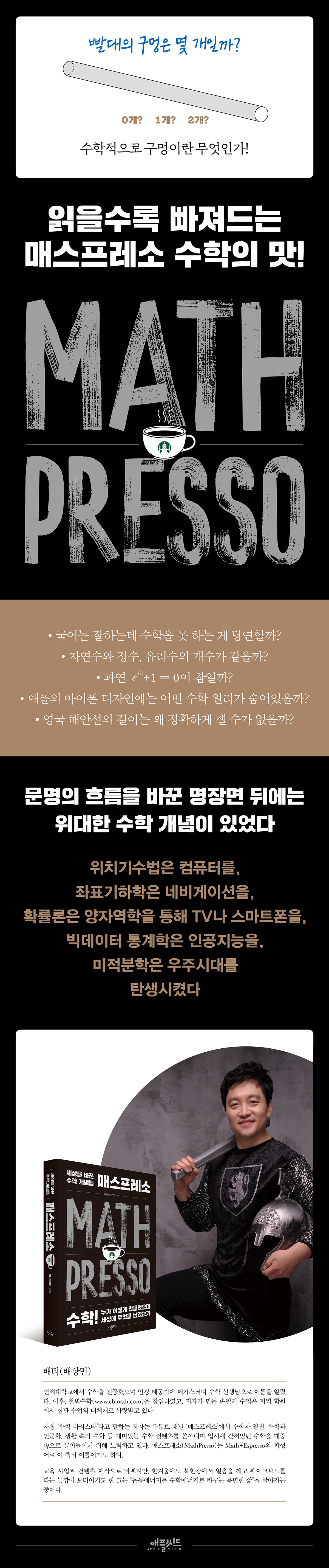
How many holes does a straw have?
This is a question that once heated up the Internet.
This question has 0, 1, 2… answers.
There are various claims, etc.
If you ask this question to a mathematician, he will probably ask back, “What is the hole here?”
The answer will vary depending on your definition of a hole.
In reality, depending on the definition of a hole, the straw and the coffee cup have the same number of holes, so if you knead them properly, the shape will eventually become the same.
This is the concept of topology.
'What if the axiom of parallel lines is false?'
Mathematicians began to ask the question, "Is it really true?" about the parallel line axiom, which states that "there is only one line parallel to a line."
Riemannian geometry, which was born from such questions, evolved into differential geometry and later became a crucial clue for Einstein to prove his general theory of relativity.
'How should the stakes be distributed?'
Two people, A and B, decide to play a coin tossing game with a best-of-five system.
The stakes are a whopping 100 million won! The rules of the game are that the first player to roll the dice 3 times out of 5 takes all 100 million won.
However, after the third coin toss, with A leading 2-1, a war suddenly broke out and the game was halted.
If you were me, how would you allocate the stakes?
At first glance, it seems reasonable to decide the winner based on performance so far or to split the prize money 2:1.
But the mathematician asks a question.
"Can we accurately predict the winning percentage of a suspended game based on its current odds?" This question gave birth to probability theory, which, in collaboration with calculus, has enabled us to accurately predict uncertain situations and the future.
The mathematical concepts we study without any context were born from the great questions of mathematicians, and when combined with other disciplines and technologies, they led to the IT and scientific revolutions.
If there were no positional notation, there would be no computers, and if there were no coordinate geometry, there would be no navigation.
Without probability theory, there would be no quantum mechanics, and without that, there would be no TVs or smartphones.
Without big data statistics, there would be no artificial intelligence, and without calculus, humanity would not have been able to usher in the space age.
For this reason, Google was so serious about mathematics that it even took its company name from the word "googol."
Global tech companies such as Google, Intel, Microsoft, and IBM are competing to enter the cryptographic war in preparation for the era of artificial intelligence and quantum computing.
The ultimate winner of this war will be the company that excels at math.
As the era of artificial intelligence, triggered by Chatgpt, opens, the importance of mathematics is growing.
At this juncture, [Mathpresso] will provide a new perspective and insight into how mathematical concepts, which we consider complex and difficult to grasp, were born, and how they are changing the world when combined with other disciplines and technologies.
It's not the bitter taste of mathematics, but the taste of Mathpresso that makes you fall in love with it the more you read it!
· Is it natural to be good at Korean but bad at math?
· Are the number of natural numbers, integers, and rational numbers the same?
· I opened the password, but why isn't it being stolen?
· What mathematical principles are hidden in Apple's iPhone design?
· Why do straws and coffee cups have the same shape?
· Why can't the length of the British coastline be measured accurately?
'Those who pursue the answer will be dominated by AI,
'Those who ask questions will dominate AI'
How many holes does a straw have?
This is a question that once heated up the Internet.
This question has 0, 1, 2… answers.
There are various claims, etc.
If you ask this question to a mathematician, he will probably ask back, “What is the hole here?”
The answer will vary depending on your definition of a hole.
In reality, depending on the definition of a hole, the straw and the coffee cup have the same number of holes, so if you knead them properly, the shape will eventually become the same.
This is the concept of topology.
'What if the axiom of parallel lines is false?'
Mathematicians began to ask the question, "Is it really true?" about the parallel line axiom, which states that "there is only one line parallel to a line."
Riemannian geometry, which was born from such questions, evolved into differential geometry and later became a crucial clue for Einstein to prove his general theory of relativity.
'How should the stakes be distributed?'
Two people, A and B, decide to play a coin tossing game with a best-of-five system.
The stakes are a whopping 100 million won! The rules of the game are that the first player to roll the dice 3 times out of 5 takes all 100 million won.
However, after the third coin toss, with A leading 2-1, a war suddenly broke out and the game was halted.
If you were me, how would you allocate the stakes?
At first glance, it seems reasonable to decide the winner based on performance so far or to split the prize money 2:1.
But the mathematician asks a question.
"Can we accurately predict the winning percentage of a suspended game based on its current odds?" This question gave birth to probability theory, which, in collaboration with calculus, has enabled us to accurately predict uncertain situations and the future.
The mathematical concepts we study without any context were born from the great questions of mathematicians, and when combined with other disciplines and technologies, they led to the IT and scientific revolutions.
If there were no positional notation, there would be no computers, and if there were no coordinate geometry, there would be no navigation.
Without probability theory, there would be no quantum mechanics, and without that, there would be no TVs or smartphones.
Without big data statistics, there would be no artificial intelligence, and without calculus, humanity would not have been able to usher in the space age.
For this reason, Google was so serious about mathematics that it even took its company name from the word "googol."
Global tech companies such as Google, Intel, Microsoft, and IBM are competing to enter the cryptographic war in preparation for the era of artificial intelligence and quantum computing.
The ultimate winner of this war will be the company that excels at math.
As the era of artificial intelligence, triggered by Chatgpt, opens, the importance of mathematics is growing.
At this juncture, [Mathpresso] will provide a new perspective and insight into how mathematical concepts, which we consider complex and difficult to grasp, were born, and how they are changing the world when combined with other disciplines and technologies.
It's not the bitter taste of mathematics, but the taste of Mathpresso that makes you fall in love with it the more you read it!
· Is it natural to be good at Korean but bad at math?
· Are the number of natural numbers, integers, and rational numbers the same?
· I opened the password, but why isn't it being stolen?
· What mathematical principles are hidden in Apple's iPhone design?
· Why do straws and coffee cups have the same shape?
· Why can't the length of the British coastline be measured accurately?
GOODS SPECIFICS
- Date of issue: April 3, 2024
- Page count, weight, size: 260 pages | 464g | 152*225*15mm
- ISBN13: 9791198613608
- ISBN10: 1198613602
You may also like
카테고리
korean


korean

![GQ KOREA Mark (Monthly): December [2025]](http://librairie.coreenne.fr/cdn/shop/files/8ef265dbbfbf186523ed75ba7319009d.jpg?v=1765340328&width=3840)


