

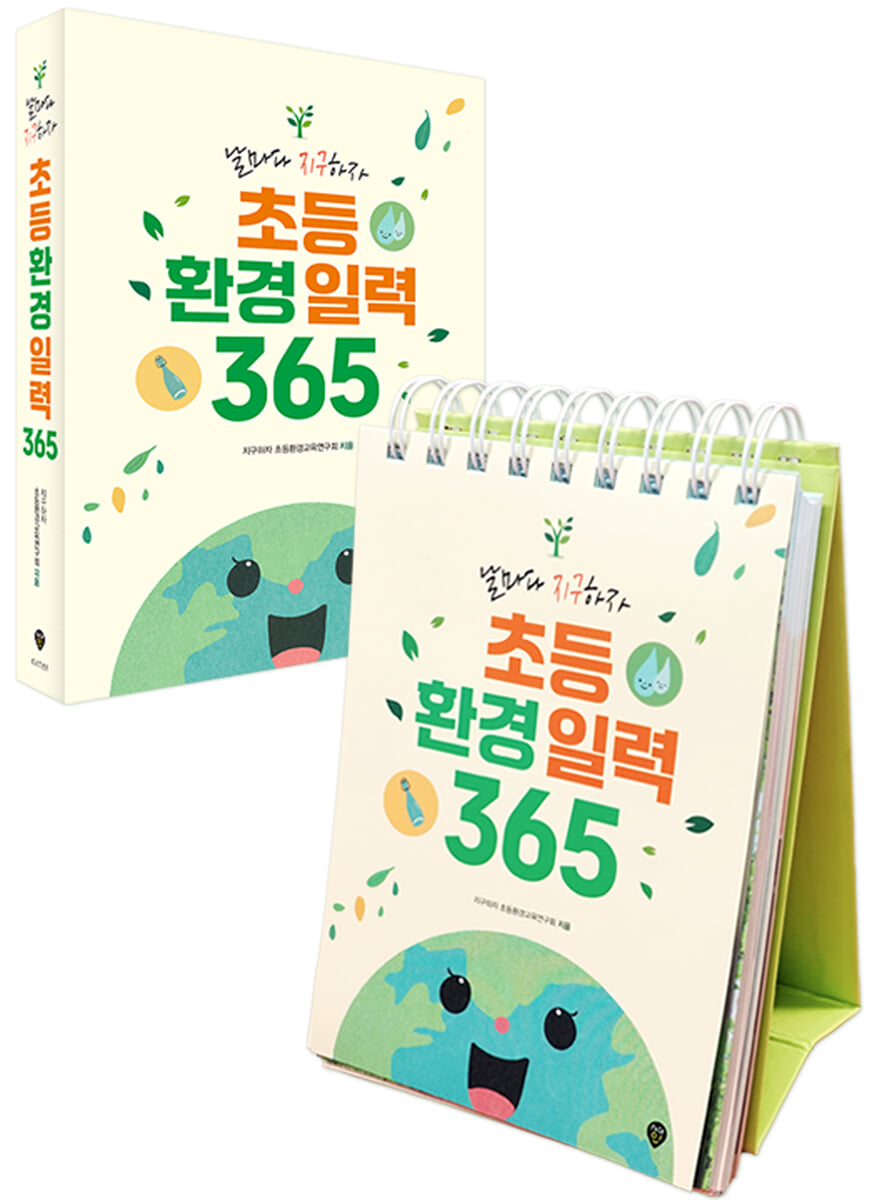
Elementary School Environmental Calendar 365
 |
Description
Book Introduction
Easy environmental practices starting with a 365-day calendar
The First Step to Climate Action for Sustainable Living
A story about the Earth's environment that starts easily with a 365-day calendar.
Global warming, climate crisis, ocean desertification… Our planet is suffering from global warming.
The climate crisis we feared is approaching more seriously and faster than we thought.
Climate change has led to more frequent forest fires, heat waves, droughts, and storms, while melting glaciers and rising water temperatures have devastated marine forests.
And the Earth's out-of-balance ecosystem is having a huge impact on us, the people.
We're losing our farms to wildfires, being swept away by floodwaters from heavy rains, and losing our homes to rising sea levels.
What if all of this stemmed from our actions? We can no longer ignore the climate crisis.
We must recognize our mistakes and strive to take responsibility.
If our children, as well as adults, want to overcome the climate crisis more wisely when they grow up, they need to learn more about the phenomenon of the climate crisis, its causes, and solutions, and form their own opinions.
We must take climate action now to protect our collective home, the Earth, for ourselves, for life on Earth, and for future generations, and to live sustainably.
This book contains stories about environmental issues and anniversaries, showing how our daily lives, what we eat, drink, and enjoy, are closely related to the Earth's environment.
After reading this book, vague terms like “climate crisis,” “carbon neutrality,” and “global warming” will no longer seem difficult.
And we've included easy and simple activities to help you take climate action by turning one page a day on the calendar.
If you gradually put into practice things you've only thought about but never put into practice, things you haven't been able to do because you lacked the courage, you will gain courage and confidence.
Our courageous climate action will have a positive impact on our families and friends, inspiring us all to become eco-heroes who save the planet.
The First Step to Climate Action for Sustainable Living
A story about the Earth's environment that starts easily with a 365-day calendar.
Global warming, climate crisis, ocean desertification… Our planet is suffering from global warming.
The climate crisis we feared is approaching more seriously and faster than we thought.
Climate change has led to more frequent forest fires, heat waves, droughts, and storms, while melting glaciers and rising water temperatures have devastated marine forests.
And the Earth's out-of-balance ecosystem is having a huge impact on us, the people.
We're losing our farms to wildfires, being swept away by floodwaters from heavy rains, and losing our homes to rising sea levels.
What if all of this stemmed from our actions? We can no longer ignore the climate crisis.
We must recognize our mistakes and strive to take responsibility.
If our children, as well as adults, want to overcome the climate crisis more wisely when they grow up, they need to learn more about the phenomenon of the climate crisis, its causes, and solutions, and form their own opinions.
We must take climate action now to protect our collective home, the Earth, for ourselves, for life on Earth, and for future generations, and to live sustainably.
This book contains stories about environmental issues and anniversaries, showing how our daily lives, what we eat, drink, and enjoy, are closely related to the Earth's environment.
After reading this book, vague terms like “climate crisis,” “carbon neutrality,” and “global warming” will no longer seem difficult.
And we've included easy and simple activities to help you take climate action by turning one page a day on the calendar.
If you gradually put into practice things you've only thought about but never put into practice, things you haven't been able to do because you lacked the courage, you will gain courage and confidence.
Our courageous climate action will have a positive impact on our families and friends, inspiring us all to become eco-heroes who save the planet.
- You can preview some of the book's contents.
Preview
index
January Climate Month
February is Resource Circulation Month
March is Air Month
April is Ecological Sensitivity Month
May is Biodiversity Month
June is Marine Environment Month
July is Plastic Zero Month
August is Energy Month
September Food Month
October is Animal Welfare Month
November is Environmental Justice Month
December is Sustainable Living Month
February is Resource Circulation Month
March is Air Month
April is Ecological Sensitivity Month
May is Biodiversity Month
June is Marine Environment Month
July is Plastic Zero Month
August is Energy Month
September Food Month
October is Animal Welfare Month
November is Environmental Justice Month
December is Sustainable Living Month
Detailed image

Into the book
'Carbon' refers to carbon dioxide, which accounts for most greenhouse gases, and 'neutral' refers to a state that is not biased to either side and is in the middle.
Carbon neutrality is about creating a balance between the amount of carbon dioxide produced by human activities and the amount of carbon dioxide absorbed.
The world is working towards carbon neutrality to reduce the amount of carbon dioxide in the atmosphere and prevent the greenhouse effect from worsening.
--- From "Carbon Neutrality"
When making something, waste is inevitably produced and energy is consumed.
But in today's fast-paced society, people buy and throw away things easily.
A day to buy nothing was created to reflect on the problems of resource waste and environmental pollution caused by excessive consumption.
The habit of thinking carefully about whether you really need something before buying it and making careful purchases is a great help to both you and the planet.
--- From "A Day of Buying Nothing"
As cities grew and more people began to live there, various problems arose. To solve these problems, the United Nations created World Cities Day.
When people live together, various urban environmental problems such as air pollution and water pollution arise.
So, the city of the future is planning an eco-friendly city that is comfortable for residents to live in without harming the environment.
--- From "World Cities Day"
The Draize test, one of the animal tests, is a test to determine the harmful effects of chemicals on human eyes.
People have done chemical experiments on rabbits because they have large eyes and don't blink often.
As awareness grows of how much suffering these experiments cause to animals, a movement against animal testing is emerging.
Nowadays, products are made without animal testing or using animal ingredients.
--- From "Draize Test"
If the environment is polluted, will everyone suffer equally? Conversely, if the environment is well preserved, will everyone benefit equally? No.
Environmental justice means that environmental problems must be resolved fairly so that no one class, country, or race is harmed or benefits from it.
The idea that democracy, which states that all people are equal, should be applied equally to environmental issues is a misconception.
In November, let's look at environmental inequality and efforts to address it justly.
--- From "Environmental Justice"
Climate citizens are those who think about the rights and responsibilities they should enjoy as humans in response to the climate crisis and practice climate action in their own lives.
Our country is aiming for 'Net Zero' carbon neutrality by 2050, but this cannot be achieved through government policies or corporate investment alone.
We need to recognize that citizens are the most powerful actors in solving the climate crisis, think about what we need to do, and act as climate citizens.
Carbon neutrality is about creating a balance between the amount of carbon dioxide produced by human activities and the amount of carbon dioxide absorbed.
The world is working towards carbon neutrality to reduce the amount of carbon dioxide in the atmosphere and prevent the greenhouse effect from worsening.
--- From "Carbon Neutrality"
When making something, waste is inevitably produced and energy is consumed.
But in today's fast-paced society, people buy and throw away things easily.
A day to buy nothing was created to reflect on the problems of resource waste and environmental pollution caused by excessive consumption.
The habit of thinking carefully about whether you really need something before buying it and making careful purchases is a great help to both you and the planet.
--- From "A Day of Buying Nothing"
As cities grew and more people began to live there, various problems arose. To solve these problems, the United Nations created World Cities Day.
When people live together, various urban environmental problems such as air pollution and water pollution arise.
So, the city of the future is planning an eco-friendly city that is comfortable for residents to live in without harming the environment.
--- From "World Cities Day"
The Draize test, one of the animal tests, is a test to determine the harmful effects of chemicals on human eyes.
People have done chemical experiments on rabbits because they have large eyes and don't blink often.
As awareness grows of how much suffering these experiments cause to animals, a movement against animal testing is emerging.
Nowadays, products are made without animal testing or using animal ingredients.
--- From "Draize Test"
If the environment is polluted, will everyone suffer equally? Conversely, if the environment is well preserved, will everyone benefit equally? No.
Environmental justice means that environmental problems must be resolved fairly so that no one class, country, or race is harmed or benefits from it.
The idea that democracy, which states that all people are equal, should be applied equally to environmental issues is a misconception.
In November, let's look at environmental inequality and efforts to address it justly.
--- From "Environmental Justice"
Climate citizens are those who think about the rights and responsibilities they should enjoy as humans in response to the climate crisis and practice climate action in their own lives.
Our country is aiming for 'Net Zero' carbon neutrality by 2050, but this cannot be achieved through government policies or corporate investment alone.
We need to recognize that citizens are the most powerful actors in solving the climate crisis, think about what we need to do, and act as climate citizens.
--- From "Climate Citizen"
Publisher's Review
365 environmental issues and missions,
The First Step to Climate Action for Sustainable Living
The Earth is suffering from global warming, and the climate crisis we feared is approaching more seriously and rapidly.
"Elementary Environmental Calendar 365" focuses on environmental issues, explaining the causes of the climate crisis and practical ways to protect the global environment in a way that children can easily understand.
'Food Waste Awareness Day' mentions that food waste discarded due to an abundant diet should be considered from the perspective of environmental justice as well as the global environment, and 'Used Clothes Collection Box' points out that good intentions for the environment are actually causing environmental pollution.
In addition, it raises hot topics related to the environment, such as 'natural restoration of the ecosystem,' 'comfortable human life and animal rights,' and 'fairness in the climate crisis,' providing an opportunity to reconsider issues that are closely related to everyday life.
Government policies and corporate investments alone will not be able to solve the current climate crisis.
If you recognize that citizens hold the greatest power in this matter and want to do even the smallest thing for a better Earth, opening this book will be the beginning of your journey to becoming a climate citizen.
Environmental Education Guide for Teachers and Guardians
Many teachers and parents are aware of the severity of environmental issues and why children need environmental education, but they are unsure where and how to begin.
This book is designed to be placed on the desks of teachers and guardians who are hesitant about starting environmental education, so that they can naturally share and practice environmental stories.
"Let's Save the Earth," a group of teachers who are practicing environmental education in the field, has included various environmental issues based on twelve environmental themes appropriate for each season and month, and has also incorporated my environmental education know-how by incorporating my experience teaching children.
"Elementary Environmental Calendar 365" is a welcome book that helps not only children who were not familiar with global environmental issues, but also adults who were at a loss as to how to provide environmental education, to take climate action in an easy and fun way.
★ Linked to elementary school curriculum ★
3-2 Science: Animal Life
3-2 Society: Different Lifestyles Depending on the Environment
3-2 Morality: We Respect Life
4-1 Science: The Life Cycle of a Plant
4-2 Science: The Journey of Water
4-2 Science: Plant Life
4-2 Society: Community Development
5-1 Science: Various Living Things and Our Lives
5-2 Science: Biology and the Environment
5-2 Science: Weather and Our Lives
5th Grade Home Economics: Plant and Animal Resources
6-1 Science: Various Gases
6-2 Science: Energy and Life
6-2 Society: Nature and Culture of Countries Around the World
6-2 Society: The Future of a Unified Korea and Global Peace
6th Grade Practical Arts: Sustainable Living
The First Step to Climate Action for Sustainable Living
The Earth is suffering from global warming, and the climate crisis we feared is approaching more seriously and rapidly.
"Elementary Environmental Calendar 365" focuses on environmental issues, explaining the causes of the climate crisis and practical ways to protect the global environment in a way that children can easily understand.
'Food Waste Awareness Day' mentions that food waste discarded due to an abundant diet should be considered from the perspective of environmental justice as well as the global environment, and 'Used Clothes Collection Box' points out that good intentions for the environment are actually causing environmental pollution.
In addition, it raises hot topics related to the environment, such as 'natural restoration of the ecosystem,' 'comfortable human life and animal rights,' and 'fairness in the climate crisis,' providing an opportunity to reconsider issues that are closely related to everyday life.
Government policies and corporate investments alone will not be able to solve the current climate crisis.
If you recognize that citizens hold the greatest power in this matter and want to do even the smallest thing for a better Earth, opening this book will be the beginning of your journey to becoming a climate citizen.
Environmental Education Guide for Teachers and Guardians
Many teachers and parents are aware of the severity of environmental issues and why children need environmental education, but they are unsure where and how to begin.
This book is designed to be placed on the desks of teachers and guardians who are hesitant about starting environmental education, so that they can naturally share and practice environmental stories.
"Let's Save the Earth," a group of teachers who are practicing environmental education in the field, has included various environmental issues based on twelve environmental themes appropriate for each season and month, and has also incorporated my environmental education know-how by incorporating my experience teaching children.
"Elementary Environmental Calendar 365" is a welcome book that helps not only children who were not familiar with global environmental issues, but also adults who were at a loss as to how to provide environmental education, to take climate action in an easy and fun way.
★ Linked to elementary school curriculum ★
3-2 Science: Animal Life
3-2 Society: Different Lifestyles Depending on the Environment
3-2 Morality: We Respect Life
4-1 Science: The Life Cycle of a Plant
4-2 Science: The Journey of Water
4-2 Science: Plant Life
4-2 Society: Community Development
5-1 Science: Various Living Things and Our Lives
5-2 Science: Biology and the Environment
5-2 Science: Weather and Our Lives
5th Grade Home Economics: Plant and Animal Resources
6-1 Science: Various Gases
6-2 Science: Energy and Life
6-2 Society: Nature and Culture of Countries Around the World
6-2 Society: The Future of a Unified Korea and Global Peace
6th Grade Practical Arts: Sustainable Living
GOODS SPECIFICS
- Date of issue: December 15, 2023
- Format: Springbook book binding method guide
- Page count, weight, size: 384 pages | 446g | 128*197*27mm
- ISBN13: 9791138347235
- ISBN10: 113834723X
You may also like
카테고리
korean


korean

![GQ KOREA Mark (Monthly): December [2025]](http://librairie.coreenne.fr/cdn/shop/files/8ef265dbbfbf186523ed75ba7319009d.jpg?v=1765340328&width=3840)


