

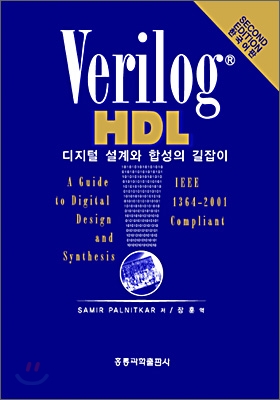
A Guide to Verilog HDL Digital Design and Synthesis
 |
Description
Book Introduction
This book is written for both experienced users and beginners, and covers Verilog HDL extensively.
It covers a wide range of practical design and synthesis of Verilog, not just from a programming language perspective.
Additionally, the information covered in this book is fully compliant with the IEEE 1364-2001 Verilog HDL standard.
This edition:
? Explains the latest verification technologies.
? It covers gate, RTL, behavioral and switch level modeling.
? Introducing the PLI (Programming Language Interface).
? It describes the logic synthesis methodology.
? Explains timing and delay simulation.
? Explains about user-defined primitives.
? It provides many practical modeling techniques.
This book provides over 300 illustrations, examples, exercises, and a list of Verilog resources.
Each chapter provides learning objectives and a summary.
“Mr. Palnitkar shows why and how Verilog HDL is used for most complex circuit designs today.
This book will be a valuable reference for beginners as well as experienced Verilog users.
I highly recommend this book to anyone doing Verilog-based designs.”
-Rajeev Madhavan, Chairman and CEO of Magma Design Automation
"This book is unique in the breadth of information it provides when it comes to covering Verilog and Verilog-related topics.
It provides readers with the basic information they need, aligned with the IEEE 1364-2001 standard, and includes several chapters covering advanced topics in verification, PLI, synthesis, and modeling techniques.
-Michael Mcnamara, IEEE 1364-2001 Verilog Standards Association Chair
"This is a book I often use when teaching at universities.
This is the only book that covers practical Verilog.
A must-read for beginners and experts alike.
-Berend Ozceri, Design Engineer, Cicso Systems, Inc.
“The simplicity, logic, and meticulous composition hidden within the rich illustrations make this book an ideal textbook.”
-Arun K.
Somani, Professor Emeritus, Iowa State University
It covers a wide range of practical design and synthesis of Verilog, not just from a programming language perspective.
Additionally, the information covered in this book is fully compliant with the IEEE 1364-2001 Verilog HDL standard.
This edition:
? Explains the latest verification technologies.
? It covers gate, RTL, behavioral and switch level modeling.
? Introducing the PLI (Programming Language Interface).
? It describes the logic synthesis methodology.
? Explains timing and delay simulation.
? Explains about user-defined primitives.
? It provides many practical modeling techniques.
This book provides over 300 illustrations, examples, exercises, and a list of Verilog resources.
Each chapter provides learning objectives and a summary.
“Mr. Palnitkar shows why and how Verilog HDL is used for most complex circuit designs today.
This book will be a valuable reference for beginners as well as experienced Verilog users.
I highly recommend this book to anyone doing Verilog-based designs.”
-Rajeev Madhavan, Chairman and CEO of Magma Design Automation
"This book is unique in the breadth of information it provides when it comes to covering Verilog and Verilog-related topics.
It provides readers with the basic information they need, aligned with the IEEE 1364-2001 standard, and includes several chapters covering advanced topics in verification, PLI, synthesis, and modeling techniques.
-Michael Mcnamara, IEEE 1364-2001 Verilog Standards Association Chair
"This is a book I often use when teaching at universities.
This is the only book that covers practical Verilog.
A must-read for beginners and experts alike.
-Berend Ozceri, Design Engineer, Cicso Systems, Inc.
“The simplicity, logic, and meticulous composition hidden within the rich illustrations make this book an ideal textbook.”
-Arun K.
Somani, Professor Emeritus, Iowa State University
index
Part 1: Verilog Basics
Chapter 1: Overview of Digital Design Using Verilog HDL
Chapter 2 Hierarchical Modeling Concepts
Chapter 3 Basic Concepts
Chapter 4 Modules and Ports xvi
Chapter 5 Gate-Level Modeling
Chapter 6 Dataflow Modeling
Chapter 7: Behavior-Level Modeling
Chapter 8: Tasks and Functions
Chapter 9 Useful Modeling Techniques
Part 2 Advanced Verilog
Chapter 10 Timing and Delay
Chapter 11 Switch-Level Modeling
Chapter 12 User-Defined Primitives
Chapter 13 Programming Language Interface
Chapter 14 Logic Synthesis Using Verilog HDL
Chapter 15: Enhanced Verification Techniques
Part 3 Appendix
A signal strength modeling and advanced net definition
List of B PLI routines
List of C keywords, system tasks, and compiler directives
D Formal Grammar Definition
Short stories about E Verlog
F Verilog example
Chapter 1: Overview of Digital Design Using Verilog HDL
Chapter 2 Hierarchical Modeling Concepts
Chapter 3 Basic Concepts
Chapter 4 Modules and Ports xvi
Chapter 5 Gate-Level Modeling
Chapter 6 Dataflow Modeling
Chapter 7: Behavior-Level Modeling
Chapter 8: Tasks and Functions
Chapter 9 Useful Modeling Techniques
Part 2 Advanced Verilog
Chapter 10 Timing and Delay
Chapter 11 Switch-Level Modeling
Chapter 12 User-Defined Primitives
Chapter 13 Programming Language Interface
Chapter 14 Logic Synthesis Using Verilog HDL
Chapter 15: Enhanced Verification Techniques
Part 3 Appendix
A signal strength modeling and advanced net definition
List of B PLI routines
List of C keywords, system tasks, and compiler directives
D Formal Grammar Definition
Short stories about E Verlog
F Verilog example
GOODS SPECIFICS
- Date of issue: September 10, 2005
- Page count, weight, size: 512 pages | 188*254*35mm
- ISBN13: 9788972835011
- ISBN10: 8972835013
You may also like
카테고리
korean


korean

![GQ KOREA Mark (Monthly): December [2025]](http://librairie.coreenne.fr/cdn/shop/files/8ef265dbbfbf186523ed75ba7319009d.jpg?v=1765340328&width=3840)


