

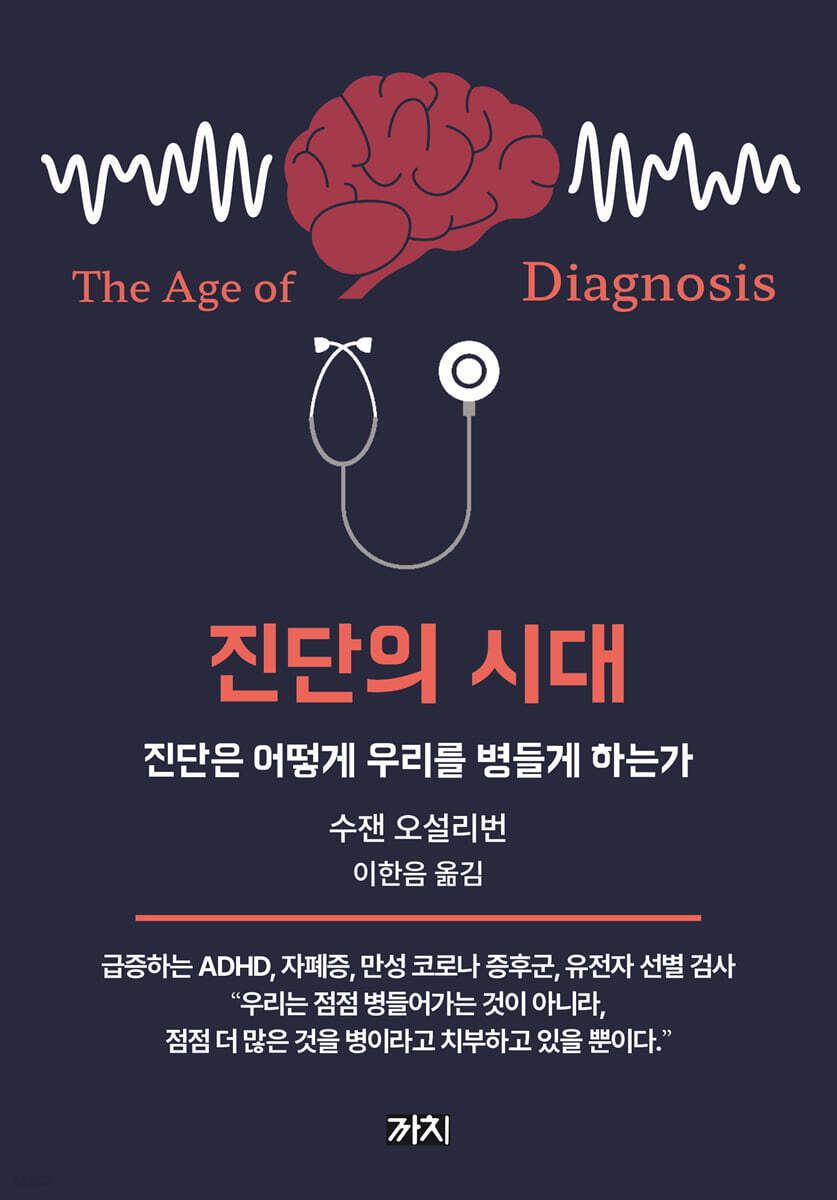
The Age of Diagnosis
 |
Description
Book Introduction
The more people try to be healthy, the more sick they become!
Face the reality of the diagnosis made by modern medicine
Redefining our expectations and perspectives on illness and health!
ADHD, autism, and chronic syndromes plague modern people.
News reports of the increasing incidence of these diseases are no longer shocking; they are now topics of everyday conversation.
The author, a neurologist who has been treating patients for over 30 years, has also noticed that the number of young people coming to him after being diagnosed with more than three or four chronic diseases has been increasing recently.
The author questions whether we are living in an era of overdiagnosis, a time of too many diagnoses due to advancements in cutting-edge science and changing social attitudes toward health, and urges us to seriously consider what a medical diagnosis is and what it should mean to those who receive it.
Additionally, this book vividly presents various aspects of diagnosis through the experiences of various patients.
The story of a daughter who, after learning that her mother has Huntington's disease, is debating whether she should get tested to see if she also has the Huntington's disease gene; the story of a doctor and wife who had no choice but to seek out a gray area medical institution for her husband who seemed to have Lyme disease but was denied antibiotics because the antibody test was negative; the story of a mother who worries that her severely autistic son, who deserves support, will be neglected because people with mild autism are driving the autism paradigm; the story of a woman who decided to have a mastectomy after learning that she has a cancer gene and lacking information about the surgery; the story of a mother who receives test results indicating that her child has a rare genetic mutation but has no idea what effect the result will have on the child's future.
Their vivid voices testify to the need to revisit the common notion that medical diagnosis is accurate, that getting a diagnosis is essential, and that it helps with treatment.
Through the stories of doctors and experts who make diagnoses and the vivid experiences of those who undergo tests and diagnoses, we are forced to face the reality we face in hospitals today.
Through this book, readers will reflect on whether we are living in an age of overdiagnosis and overly obsessed with perfect health, and think together about how to create an environment where everyone can receive good medical care.
Face the reality of the diagnosis made by modern medicine
Redefining our expectations and perspectives on illness and health!
ADHD, autism, and chronic syndromes plague modern people.
News reports of the increasing incidence of these diseases are no longer shocking; they are now topics of everyday conversation.
The author, a neurologist who has been treating patients for over 30 years, has also noticed that the number of young people coming to him after being diagnosed with more than three or four chronic diseases has been increasing recently.
The author questions whether we are living in an era of overdiagnosis, a time of too many diagnoses due to advancements in cutting-edge science and changing social attitudes toward health, and urges us to seriously consider what a medical diagnosis is and what it should mean to those who receive it.
Additionally, this book vividly presents various aspects of diagnosis through the experiences of various patients.
The story of a daughter who, after learning that her mother has Huntington's disease, is debating whether she should get tested to see if she also has the Huntington's disease gene; the story of a doctor and wife who had no choice but to seek out a gray area medical institution for her husband who seemed to have Lyme disease but was denied antibiotics because the antibody test was negative; the story of a mother who worries that her severely autistic son, who deserves support, will be neglected because people with mild autism are driving the autism paradigm; the story of a woman who decided to have a mastectomy after learning that she has a cancer gene and lacking information about the surgery; the story of a mother who receives test results indicating that her child has a rare genetic mutation but has no idea what effect the result will have on the child's future.
Their vivid voices testify to the need to revisit the common notion that medical diagnosis is accurate, that getting a diagnosis is essential, and that it helps with treatment.
Through the stories of doctors and experts who make diagnoses and the vivid experiences of those who undergo tests and diagnoses, we are forced to face the reality we face in hospitals today.
Through this book, readers will reflect on whether we are living in an age of overdiagnosis and overly obsessed with perfect health, and think together about how to create an environment where everyone can receive good medical care.
- You can preview some of the book's contents.
Preview
index
prolog
introduction
1.
Huntington's disease
2.
Lyme disease and chronic COVID syndrome
3.
autism
4.
cancer genes
5. ADHD, depression, and neurodiversity
6.
syndrome without a name
conclusion
Acknowledgements
main
Translator's Note
Biographical Index
introduction
1.
Huntington's disease
2.
Lyme disease and chronic COVID syndrome
3.
autism
4.
cancer genes
5. ADHD, depression, and neurodiversity
6.
syndrome without a name
conclusion
Acknowledgements
main
Translator's Note
Biographical Index
Detailed image
Publisher's Review
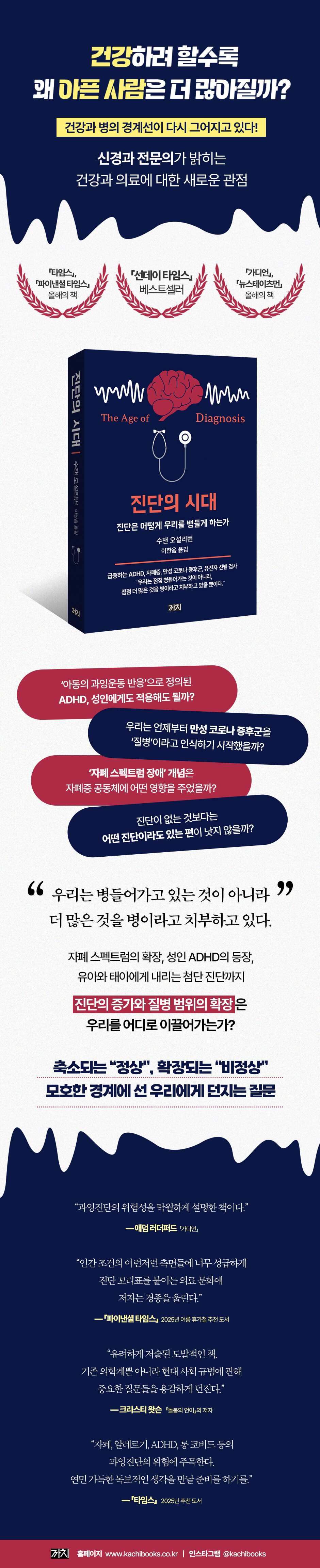
ADHD, autism, and chronic syndromes plague modern people.
News reports of the increasing incidence of these diseases are no longer shocking; they are now topics of everyday conversation.
The author, a neurologist who has been treating patients for over 30 years, has also noticed that the number of young people coming to him after being diagnosed with more than three or four chronic diseases has been increasing recently.
The author questions whether we are living in an era of overdiagnosis, a time of too many diagnoses due to advancements in cutting-edge science and changing social attitudes toward health, and urges us to seriously consider what a medical diagnosis is and what it should mean to those who receive it.
The author's view that the boundaries between "normal" and "abnormal" surrounding diagnosis are often too vague, and that the scope of "normal" is gradually shrinking and the scope of "abnormal" is expanding, provides many implications for medical diagnosis.
The author makes it clear that medical diagnosis is actually a clinical skill rendered by an experienced physician who listens carefully to the patient's mental and physical symptoms.
The exact figures that serve as the basis for diagnosis are also decided by consensus.
The same goes for blood sugar, which many people are paying attention to these days.
Even a small adjustment in blood sugar levels, which are the standard for distinguishing pre-diabetes, could suddenly force a huge number of people into a situation where they have to worry about diabetes overnight.
The author worries that by expanding the definition of disease in this way, people might be receiving unnecessary treatments without any benefit.
Additionally, this book vividly presents various aspects of diagnosis through the experiences of various patients.
The story of a daughter who, after learning that her mother has Huntington's disease, is debating whether she should get tested to see if she also has the Huntington's disease gene; the story of a doctor and wife who had no choice but to seek out a gray area medical institution for her husband who seemed to have Lyme disease but was denied antibiotics because the antibody test was negative; the story of a mother who worries that her severely autistic son, who deserves support, will be neglected because people with mild autism are driving the autism paradigm; the story of a woman who decided to have a mastectomy after learning that she has a cancer gene and lacking information about the surgery; the story of a mother who receives test results indicating that her child has a rare genetic mutation but has no idea what effect the result will have on the child's future.
Their vivid voices testify to the need to revisit the common notion that medical diagnosis is accurate, that getting a diagnosis is essential, and that it helps with treatment.
This book confronts us with the realities we face in hospitals today through the stories of doctors and specialists who make diagnoses and the vivid experiences of those who undergo tests and diagnoses.
Through this book, readers will reflect on whether we are living in an age of overdiagnosis and overly obsessed with perfect health, and think together about how to create an environment where everyone can receive good medical care.
Key Contents
Chapter 1 first examines Huntington's disease.
In reality, most of us will never encounter this disease, but it tells us a very important story that everyone may face sooner or later.
This is a story about what choices would be available to us if we could know for sure whether we would develop a disease in the future through early diagnosis testing.
As tests become more sensitive and genetic testing becomes more widely available, it is possible that more people will soon be in situations similar to Huntington's disease with other diseases.
If you were destined to develop dementia within the next ten years and live with an incurable condition, would you truly want to know? This chapter explores the diverse stories of families living with such a fate, exploring how best to cope with such harsh circumstances and considering whether knowledge is always better than ignorance.
The next chapter covers Lyme disease and chronic COVID syndrome.
These two diseases have a lot in common.
Because it emerged in a very unconventional way as a patient-led movement, it sparked intense controversy.
Lyme disease is a disease transmitted to humans by ticks that live in the Lyme area of Connecticut, USA, and it took a woman's tremendous effort to get it recognized as a disease.
Chronic Corona Syndrome also spread through social media during the COVID period, drawing sympathy from many people and becoming recognized as a disease.
The lessons these diseases teach us are applicable to all diagnoses.
The lesson is that the medical tests we actually receive are not as accurate as we expect.
Although it pretends to provide accuracy, in fact errors may exist.
The authors argue that, contrary to popular expectations, medical diagnosis is a subjective, truly clinical art, susceptible to error, self-interest, and social pressure.
This chapter provides an opportunity to reflect on our thinking about diagnosis.
Chapter 3 explores how autism, once chronically underdiagnosed, became so common, and why people with autism today look so different from those with autism in the 1940s.
Autism first became known in 1943 when a child psychiatrist published a paper describing the symptoms of eight boys and three girls among the children he treated who appeared to have a unique disorder he described as “extreme autistic isolation.” The concept was expanded in the 1960s to include autism spectrum disorder.
The Diagnostic and Statistical Manual of Mental Disorders, which outlines the typical signs and diagnostic criteria for these mental disorders, has reflected numerous changes since its first publication in 1952.
As a result, while 50 years ago, only 4 out of 10,000 people suffered from this disorder, the global average is now 1 out of 100.
This clearly shows how diagnoses naturally evolve and grow over time based on social consensus.
Chapter 3 also examines whether the autism community benefits, both at the individual and collective level, from this more comprehensive modification of the disability.
Chapter 4 deals with cancer genes.
Cancer is on the rise, and cancer screening and tests to identify those at risk save lives.
This chapter questions whether the cutting-edge and early detection of cancer we receive through health screenings is truly reliable, focusing on the stories of women who discovered they carried cancer genes, particularly those who underwent mastectomy after learning they had a BRCA mutation linked to breast cancer.
We examine whether, in our enthusiasm for new technologies and the early eradication of disease, we are actually sending people for unnecessary treatments, and we also examine the more troubling problems that the massive increase in genetic testing has created.
Chapter 5, which covers ADHD, depression, and neurodiversity, examines whether all mental health diagnoses are medical problems and whether the emotional rewards that follow such diagnoses can lead to recovery. ADHD was defined in a single sentence in the 1968 handbook as "hyperkinetic responses in children, with inattentiveness and restlessness that resolve during adolescence."
The diagnosis of ADHD in adults and in mild cases has increased significantly in recent years, as what was initially a diagnosis given to children has become available to adults as well.
As the scope of diagnosis expands, conflicts are arising in the gray area of diagnosis over where to draw the line between “normal” and “abnormal.”
The author also raises concerns about the “disease identity” surrounding ADHD and neurodiversity.
Research shows that people with a strong illness identity see their doctor more often.
Chapter 6, “The Nameless Syndrome,” examines the ethical and practical issues surrounding advanced diagnostics in children, infants, and fetuses.
Childhood is a time when we must allow ourselves to believe that any future is possible.
We ask whether predicting a child's future and choosing the genetically "perfect" baby are really the best ways to ensure a healthier and happier future for the next generation, whether we are pursuing perfect health too much, and what is the point of even receiving an accurate diagnosis with cutting-edge medicine if it is incurable and has an unknown prognosis, leaving us unable to prepare for the rest of our lives?
The author concludes the book with the story of one patient.
Before coming to see the author, a neurologist, the young patient had already received various diagnoses.
Rather than eliminating the patient's other diagnoses, the author was forced to end the treatment by adding a new diagnosis to the patient.
This part makes us look back at the current state of medicine, which is caught in a kind of communal madness.
The author's argument that individuals, the medical community, and society as a whole must change to avoid overdiagnosis and ensure quality medical services is something everyone should heed.
The author sounds the alarm about a medical culture that is too quick to label various aspects of the human condition, even if it is done with good intentions.
The authors point out that even though the number of children diagnosed with ADHD and autism has increased, they have not become healthier or happier.
It also emphasizes that although the sensitivity of cancer screening tests is increasing, this does not necessarily mean that they benefit patients.
This is a book that reveals compassion and courage.
―Financial Times Recommended Books for Summer Vacations in 2025
The author has written insightful books on psychosomatic illnesses.
This book highlights the dangers of overdiagnosis of autism, allergies, ADHD, and long-term COVID-19.
Prepare to meet unique, compassionate thoughts.
―The Times' Recommended Books for 2025
News reports of the increasing incidence of these diseases are no longer shocking; they are now topics of everyday conversation.
The author, a neurologist who has been treating patients for over 30 years, has also noticed that the number of young people coming to him after being diagnosed with more than three or four chronic diseases has been increasing recently.
The author questions whether we are living in an era of overdiagnosis, a time of too many diagnoses due to advancements in cutting-edge science and changing social attitudes toward health, and urges us to seriously consider what a medical diagnosis is and what it should mean to those who receive it.
The author's view that the boundaries between "normal" and "abnormal" surrounding diagnosis are often too vague, and that the scope of "normal" is gradually shrinking and the scope of "abnormal" is expanding, provides many implications for medical diagnosis.
The author makes it clear that medical diagnosis is actually a clinical skill rendered by an experienced physician who listens carefully to the patient's mental and physical symptoms.
The exact figures that serve as the basis for diagnosis are also decided by consensus.
The same goes for blood sugar, which many people are paying attention to these days.
Even a small adjustment in blood sugar levels, which are the standard for distinguishing pre-diabetes, could suddenly force a huge number of people into a situation where they have to worry about diabetes overnight.
The author worries that by expanding the definition of disease in this way, people might be receiving unnecessary treatments without any benefit.
Additionally, this book vividly presents various aspects of diagnosis through the experiences of various patients.
The story of a daughter who, after learning that her mother has Huntington's disease, is debating whether she should get tested to see if she also has the Huntington's disease gene; the story of a doctor and wife who had no choice but to seek out a gray area medical institution for her husband who seemed to have Lyme disease but was denied antibiotics because the antibody test was negative; the story of a mother who worries that her severely autistic son, who deserves support, will be neglected because people with mild autism are driving the autism paradigm; the story of a woman who decided to have a mastectomy after learning that she has a cancer gene and lacking information about the surgery; the story of a mother who receives test results indicating that her child has a rare genetic mutation but has no idea what effect the result will have on the child's future.
Their vivid voices testify to the need to revisit the common notion that medical diagnosis is accurate, that getting a diagnosis is essential, and that it helps with treatment.
This book confronts us with the realities we face in hospitals today through the stories of doctors and specialists who make diagnoses and the vivid experiences of those who undergo tests and diagnoses.
Through this book, readers will reflect on whether we are living in an age of overdiagnosis and overly obsessed with perfect health, and think together about how to create an environment where everyone can receive good medical care.
Key Contents
Chapter 1 first examines Huntington's disease.
In reality, most of us will never encounter this disease, but it tells us a very important story that everyone may face sooner or later.
This is a story about what choices would be available to us if we could know for sure whether we would develop a disease in the future through early diagnosis testing.
As tests become more sensitive and genetic testing becomes more widely available, it is possible that more people will soon be in situations similar to Huntington's disease with other diseases.
If you were destined to develop dementia within the next ten years and live with an incurable condition, would you truly want to know? This chapter explores the diverse stories of families living with such a fate, exploring how best to cope with such harsh circumstances and considering whether knowledge is always better than ignorance.
The next chapter covers Lyme disease and chronic COVID syndrome.
These two diseases have a lot in common.
Because it emerged in a very unconventional way as a patient-led movement, it sparked intense controversy.
Lyme disease is a disease transmitted to humans by ticks that live in the Lyme area of Connecticut, USA, and it took a woman's tremendous effort to get it recognized as a disease.
Chronic Corona Syndrome also spread through social media during the COVID period, drawing sympathy from many people and becoming recognized as a disease.
The lessons these diseases teach us are applicable to all diagnoses.
The lesson is that the medical tests we actually receive are not as accurate as we expect.
Although it pretends to provide accuracy, in fact errors may exist.
The authors argue that, contrary to popular expectations, medical diagnosis is a subjective, truly clinical art, susceptible to error, self-interest, and social pressure.
This chapter provides an opportunity to reflect on our thinking about diagnosis.
Chapter 3 explores how autism, once chronically underdiagnosed, became so common, and why people with autism today look so different from those with autism in the 1940s.
Autism first became known in 1943 when a child psychiatrist published a paper describing the symptoms of eight boys and three girls among the children he treated who appeared to have a unique disorder he described as “extreme autistic isolation.” The concept was expanded in the 1960s to include autism spectrum disorder.
The Diagnostic and Statistical Manual of Mental Disorders, which outlines the typical signs and diagnostic criteria for these mental disorders, has reflected numerous changes since its first publication in 1952.
As a result, while 50 years ago, only 4 out of 10,000 people suffered from this disorder, the global average is now 1 out of 100.
This clearly shows how diagnoses naturally evolve and grow over time based on social consensus.
Chapter 3 also examines whether the autism community benefits, both at the individual and collective level, from this more comprehensive modification of the disability.
Chapter 4 deals with cancer genes.
Cancer is on the rise, and cancer screening and tests to identify those at risk save lives.
This chapter questions whether the cutting-edge and early detection of cancer we receive through health screenings is truly reliable, focusing on the stories of women who discovered they carried cancer genes, particularly those who underwent mastectomy after learning they had a BRCA mutation linked to breast cancer.
We examine whether, in our enthusiasm for new technologies and the early eradication of disease, we are actually sending people for unnecessary treatments, and we also examine the more troubling problems that the massive increase in genetic testing has created.
Chapter 5, which covers ADHD, depression, and neurodiversity, examines whether all mental health diagnoses are medical problems and whether the emotional rewards that follow such diagnoses can lead to recovery. ADHD was defined in a single sentence in the 1968 handbook as "hyperkinetic responses in children, with inattentiveness and restlessness that resolve during adolescence."
The diagnosis of ADHD in adults and in mild cases has increased significantly in recent years, as what was initially a diagnosis given to children has become available to adults as well.
As the scope of diagnosis expands, conflicts are arising in the gray area of diagnosis over where to draw the line between “normal” and “abnormal.”
The author also raises concerns about the “disease identity” surrounding ADHD and neurodiversity.
Research shows that people with a strong illness identity see their doctor more often.
Chapter 6, “The Nameless Syndrome,” examines the ethical and practical issues surrounding advanced diagnostics in children, infants, and fetuses.
Childhood is a time when we must allow ourselves to believe that any future is possible.
We ask whether predicting a child's future and choosing the genetically "perfect" baby are really the best ways to ensure a healthier and happier future for the next generation, whether we are pursuing perfect health too much, and what is the point of even receiving an accurate diagnosis with cutting-edge medicine if it is incurable and has an unknown prognosis, leaving us unable to prepare for the rest of our lives?
The author concludes the book with the story of one patient.
Before coming to see the author, a neurologist, the young patient had already received various diagnoses.
Rather than eliminating the patient's other diagnoses, the author was forced to end the treatment by adding a new diagnosis to the patient.
This part makes us look back at the current state of medicine, which is caught in a kind of communal madness.
The author's argument that individuals, the medical community, and society as a whole must change to avoid overdiagnosis and ensure quality medical services is something everyone should heed.
The author sounds the alarm about a medical culture that is too quick to label various aspects of the human condition, even if it is done with good intentions.
The authors point out that even though the number of children diagnosed with ADHD and autism has increased, they have not become healthier or happier.
It also emphasizes that although the sensitivity of cancer screening tests is increasing, this does not necessarily mean that they benefit patients.
This is a book that reveals compassion and courage.
―Financial Times Recommended Books for Summer Vacations in 2025
The author has written insightful books on psychosomatic illnesses.
This book highlights the dangers of overdiagnosis of autism, allergies, ADHD, and long-term COVID-19.
Prepare to meet unique, compassionate thoughts.
―The Times' Recommended Books for 2025
GOODS SPECIFICS
- Date of issue: November 17, 2025
- Page count, weight, size: 364 pages | 518g | 150*215*22mm
- ISBN13: 9788972918844
- ISBN10: 8972918849
You may also like
카테고리
korean


korean

![GQ KOREA Mark (Monthly): December [2025]](http://librairie.coreenne.fr/cdn/shop/files/8ef265dbbfbf186523ed75ba7319009d.jpg?v=1765340328&width=3840)


