

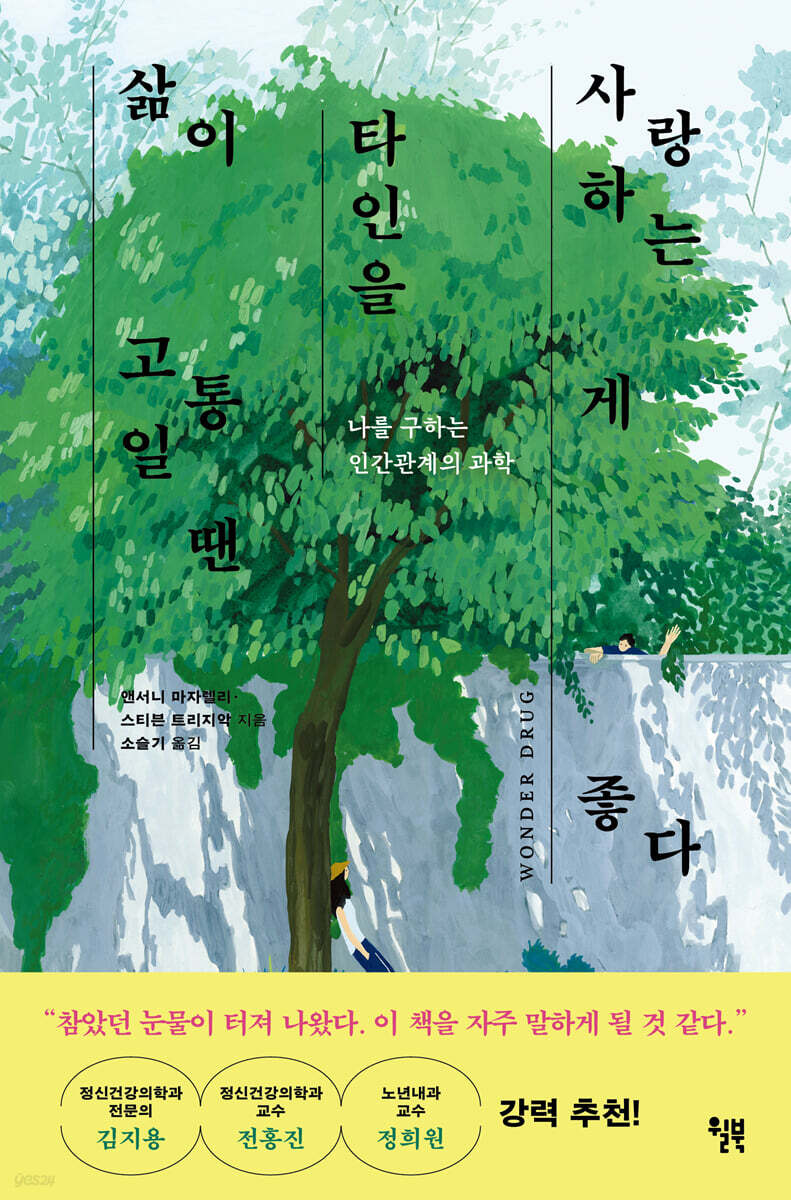
When life is painful, it's good to love others.
 |
Description
Book Introduction
★ There is no such thing as a happy egoist.
★ “Empathy is a panacea, discovered by science.”
★ A hot topic from Amazon bestselling authors for 6 consecutive years
★ Highly recommended by Jeong Hee-won (Professor of Geriatrics, Author of “You Can Age Slowly Too”), Jeon Hong-jin (Professor of Psychiatry), Kim Ji-yong (Psychiatrist, Author of “Brain Rich People”), and James Doty (Professor of Stanford University School of Medicine)!
A powerful and nuanced guide to a happier life for lonely modern people living in a society lacking empathy.
Would you believe that the health of your body and brain depends not on your cholesterol levels but on the satisfaction of your relationships? What if people who are more other-centered suffer less from burnout and lethargy and have higher self-esteem than those who are more self-centered? Why does helping others reduce stress compared to spending time and money on yourself? Until now, we've been taught to care for ourselves, invest in ourselves, and find answers within ourselves.
But armed with powerful scientific evidence, this book reveals that it was all a mistake and a misunderstanding.
The authors, both doctors and scientists, say, “Everything you want in life can be achieved by focusing on others.”
And it fascinatingly unfolds the wondrous transformations and benefits that come when we listen to our innate altruism.
When we understand the science of relationships this book presents and put it into practice in our daily lives, the benefits we can experience are incredibly powerful.
This book reminds us that the most powerful way to transform our lives, here and now, without consuming ourselves or falling into self-loathing, is to "help and love others." It also presents a concrete roadmap for anyone to understand the science of relationships and effectively utilize its power in their own lives.
“A book that serves as a compass for us as we navigate through the age of loneliness” (Professor Jeong Hee-won of Geriatrics), “The tears I had been holding back burst from the very first page.
This book, which received praise from psychiatrist Kim Ji-yong, who said, “I think I will be talking about this book often in the future,” presents the most unexpected and most touching scientific answers in an age of self-reliance and isolation.
If you live diligently every day but feel empty or lethargic, as if there's a hole somewhere, and if you want to live a life that's truly meaningful and satisfying, not just for show, then open this book.
You will have a powerful and accurate prescription for a freer and happier life.
★ “Empathy is a panacea, discovered by science.”
★ A hot topic from Amazon bestselling authors for 6 consecutive years
★ Highly recommended by Jeong Hee-won (Professor of Geriatrics, Author of “You Can Age Slowly Too”), Jeon Hong-jin (Professor of Psychiatry), Kim Ji-yong (Psychiatrist, Author of “Brain Rich People”), and James Doty (Professor of Stanford University School of Medicine)!
A powerful and nuanced guide to a happier life for lonely modern people living in a society lacking empathy.
Would you believe that the health of your body and brain depends not on your cholesterol levels but on the satisfaction of your relationships? What if people who are more other-centered suffer less from burnout and lethargy and have higher self-esteem than those who are more self-centered? Why does helping others reduce stress compared to spending time and money on yourself? Until now, we've been taught to care for ourselves, invest in ourselves, and find answers within ourselves.
But armed with powerful scientific evidence, this book reveals that it was all a mistake and a misunderstanding.
The authors, both doctors and scientists, say, “Everything you want in life can be achieved by focusing on others.”
And it fascinatingly unfolds the wondrous transformations and benefits that come when we listen to our innate altruism.
When we understand the science of relationships this book presents and put it into practice in our daily lives, the benefits we can experience are incredibly powerful.
This book reminds us that the most powerful way to transform our lives, here and now, without consuming ourselves or falling into self-loathing, is to "help and love others." It also presents a concrete roadmap for anyone to understand the science of relationships and effectively utilize its power in their own lives.
“A book that serves as a compass for us as we navigate through the age of loneliness” (Professor Jeong Hee-won of Geriatrics), “The tears I had been holding back burst from the very first page.
This book, which received praise from psychiatrist Kim Ji-yong, who said, “I think I will be talking about this book often in the future,” presents the most unexpected and most touching scientific answers in an age of self-reliance and isolation.
If you live diligently every day but feel empty or lethargic, as if there's a hole somewhere, and if you want to live a life that's truly meaningful and satisfying, not just for show, then open this book.
You will have a powerful and accurate prescription for a freer and happier life.
- You can preview some of the book's contents.
Preview
index
Recommendation
prolog
Part 1: There Is No Such Thing as a Happy Egoist
1 The Vortex of a 'Me'-Centered Culture
2 Affectionate Strangers Survive
The paradox that the more you give, the more you get
4 Empathy Rewires the Brain
Part 2: How We Treat Others Determines Our Lives
5 The Powerful Healing Power of Hugs
6 How to Age Slowly and Live Longer
7 For an unbreakable heart
8 How to Find True, Incomparable Happiness
9 Ways to Deepen Success
10 Ways to Become a Person Who Shines Inside Out
Part 3: The 7-Step Roadmap to Becoming a Giver
11 Start Small: The 16-Minute Prescription
12 Practice Gratitude
13 Finding New Purpose and Joy in Life
14 Increase my side
15 Don't give in to helplessness
16 Feeling the excitement
17 Be confident in my strength
Epilogue
source
prolog
Part 1: There Is No Such Thing as a Happy Egoist
1 The Vortex of a 'Me'-Centered Culture
2 Affectionate Strangers Survive
The paradox that the more you give, the more you get
4 Empathy Rewires the Brain
Part 2: How We Treat Others Determines Our Lives
5 The Powerful Healing Power of Hugs
6 How to Age Slowly and Live Longer
7 For an unbreakable heart
8 How to Find True, Incomparable Happiness
9 Ways to Deepen Success
10 Ways to Become a Person Who Shines Inside Out
Part 3: The 7-Step Roadmap to Becoming a Giver
11 Start Small: The 16-Minute Prescription
12 Practice Gratitude
13 Finding New Purpose and Joy in Life
14 Increase my side
15 Don't give in to helplessness
16 Feeling the excitement
17 Be confident in my strength
Epilogue
source
Detailed image

Into the book
As I continued to review the various studies, I was repeatedly surprised and filled with hope.
The evidence was clear.
The cure for burnout syndrome wasn't escape.
The best way to build resilience in body and mind was to focus on others, not myself, and to be more empathetic.
The power of empathy is immediate and powerful.
One study found that when healthcare professionals spent just 40 seconds more empathizing with their patients, there was a positive change for both parties.
Patients experienced less physical pain, recovered faster, and doctors experienced less burnout.
Empathy has become a shield for everyone.
--- From the "Prologue"
Several celebrities have emerged claiming that happiness can be found by focusing on and working on oneself, and 'self-care' has emerged as a panacea that can heal us all.
If there were scientific data showing that prioritizing 'me' above all else is beneficial to health, this trend would probably become even more serious.
But such data is nowhere to be found.
To tell the truth, focusing only on myself doesn't help me.
Research has shown that being preoccupied with oneself is linked to poorer physical and mental health, emotional well-being, and career success across virtually every indicator.
--- From "The Vortex of 'I'-Centered Culture"
Homo sapiens started out as a small tribe and grew into a huge civilization.
This is not because we fought tooth and nail for scraps of meat, but because we sat around a campfire, shared mammoth steaks, and helped each other.
When anthropologist Margaret Mead was asked to identify the first signs of civilization, she didn't point to things like man-made tools.
Instead, he cited a 15,000-year-old femur discovered at an archaeological excavation site.
The bone showed signs of being broken and then healed.
This ancient patient was left where he fell, and was not eaten by predators.
Someone from his own tribe took him to a safe place and cared for him until he got better.
Mead said.
“Civilization begins with helping someone in need.”
--- From "Affectionate Strangers Survive"
"You're so selfish." Have you ever heard something like that in your life? (Hopefully not.) How do you assess your own self-centeredness and other-centeredness? Do you consider yourself altruistic? How strong is your self-centeredness? The test below will reveal the answer.
Please write down your level of agreement or disagreement on a 5-point scale next to the following 20 items.
Please answer as honestly as possible.
--- From "Empathy Changes Brain Wiring"
Researchers collected nearly three years' worth of data from 300,000 cohabiting couples.
It was based on the idea that couples living in the same house would have similar lifestyles and environments, which could affect the results.
According to the study, even couples who live together have a lower mortality rate if they volunteer.
But non-volunteers didn't see the same longevity benefits, even though they slept in the same bed, ate the same dinner, and hung out with the same friends.
The study results show that altruistic behavior, rather than diet or environment, is the decisive factor in ensuring a longer life.
Giving a little of yourself.
This is the key.
Ashley Willens of Harvard University conducted an interesting study that pharmaceutical companies might not be happy about.
He asked 186 adults with high blood pressure how much money they donated to charity or spent helping others.
And in a follow-up study two years later, people who spent more money on others had better blood pressure than those who saved money.
Willens writes, 'The effects of altruistic behavior were comparable to those of taking antihypertensive drugs or exercising.'
--- From "How to Age Slowly and Live Long"
How often do you refer to 'I' in conversation? (...) The variable that better predicted increased blood pressure was not how much stress the subjects felt.
Rather, the clue was in ‘self-absorption.’
Those most likely to die from heart disease were those who used the most 'dense' self-absorbed language in their initial interviews.
--- "'Me, me.
Don't use words that start with 'I' too often"
If you think, "Nothing in the world is more important than me," but you're not very happy, I have good news.
According to Jennifer Mascaro and her team at Emory University, you're the one who can benefit the most from improving your empathy.
The researchers randomly divided second-year medical students into Group A and gave them empathy training, while Group B was given an unrelated task (control group).
As expected, group A students reported feeling more understanding of others, as well as less lonely and depressed.
In particular, those who complained of depression at the beginning of the experiment showed the highest levels of emotional well-being and improved empathy.
--- From "For a Heart That Doesn't Collapse"
Now that we've looked at the benefits of giving, let's calculate the "dose" of altruism needed to achieve them.
As a result, the answer was 16 minutes per day.
By spending just 16 minutes a day caring for others, empathizing with them, and offering selfless help, you can live a long, healthy, fulfilling, and happy life.
How did the number 16 minutes come about?
The evidence was clear.
The cure for burnout syndrome wasn't escape.
The best way to build resilience in body and mind was to focus on others, not myself, and to be more empathetic.
The power of empathy is immediate and powerful.
One study found that when healthcare professionals spent just 40 seconds more empathizing with their patients, there was a positive change for both parties.
Patients experienced less physical pain, recovered faster, and doctors experienced less burnout.
Empathy has become a shield for everyone.
--- From the "Prologue"
Several celebrities have emerged claiming that happiness can be found by focusing on and working on oneself, and 'self-care' has emerged as a panacea that can heal us all.
If there were scientific data showing that prioritizing 'me' above all else is beneficial to health, this trend would probably become even more serious.
But such data is nowhere to be found.
To tell the truth, focusing only on myself doesn't help me.
Research has shown that being preoccupied with oneself is linked to poorer physical and mental health, emotional well-being, and career success across virtually every indicator.
--- From "The Vortex of 'I'-Centered Culture"
Homo sapiens started out as a small tribe and grew into a huge civilization.
This is not because we fought tooth and nail for scraps of meat, but because we sat around a campfire, shared mammoth steaks, and helped each other.
When anthropologist Margaret Mead was asked to identify the first signs of civilization, she didn't point to things like man-made tools.
Instead, he cited a 15,000-year-old femur discovered at an archaeological excavation site.
The bone showed signs of being broken and then healed.
This ancient patient was left where he fell, and was not eaten by predators.
Someone from his own tribe took him to a safe place and cared for him until he got better.
Mead said.
“Civilization begins with helping someone in need.”
--- From "Affectionate Strangers Survive"
"You're so selfish." Have you ever heard something like that in your life? (Hopefully not.) How do you assess your own self-centeredness and other-centeredness? Do you consider yourself altruistic? How strong is your self-centeredness? The test below will reveal the answer.
Please write down your level of agreement or disagreement on a 5-point scale next to the following 20 items.
Please answer as honestly as possible.
--- From "Empathy Changes Brain Wiring"
Researchers collected nearly three years' worth of data from 300,000 cohabiting couples.
It was based on the idea that couples living in the same house would have similar lifestyles and environments, which could affect the results.
According to the study, even couples who live together have a lower mortality rate if they volunteer.
But non-volunteers didn't see the same longevity benefits, even though they slept in the same bed, ate the same dinner, and hung out with the same friends.
The study results show that altruistic behavior, rather than diet or environment, is the decisive factor in ensuring a longer life.
Giving a little of yourself.
This is the key.
Ashley Willens of Harvard University conducted an interesting study that pharmaceutical companies might not be happy about.
He asked 186 adults with high blood pressure how much money they donated to charity or spent helping others.
And in a follow-up study two years later, people who spent more money on others had better blood pressure than those who saved money.
Willens writes, 'The effects of altruistic behavior were comparable to those of taking antihypertensive drugs or exercising.'
--- From "How to Age Slowly and Live Long"
How often do you refer to 'I' in conversation? (...) The variable that better predicted increased blood pressure was not how much stress the subjects felt.
Rather, the clue was in ‘self-absorption.’
Those most likely to die from heart disease were those who used the most 'dense' self-absorbed language in their initial interviews.
--- "'Me, me.
Don't use words that start with 'I' too often"
If you think, "Nothing in the world is more important than me," but you're not very happy, I have good news.
According to Jennifer Mascaro and her team at Emory University, you're the one who can benefit the most from improving your empathy.
The researchers randomly divided second-year medical students into Group A and gave them empathy training, while Group B was given an unrelated task (control group).
As expected, group A students reported feeling more understanding of others, as well as less lonely and depressed.
In particular, those who complained of depression at the beginning of the experiment showed the highest levels of emotional well-being and improved empathy.
--- From "For a Heart That Doesn't Collapse"
Now that we've looked at the benefits of giving, let's calculate the "dose" of altruism needed to achieve them.
As a result, the answer was 16 minutes per day.
By spending just 16 minutes a day caring for others, empathizing with them, and offering selfless help, you can live a long, healthy, fulfilling, and happy life.
How did the number 16 minutes come about?
--- From "Start Small - 16-Minute Prescription"
Publisher's Review
Empathy is a panacea, scientifically proven.
For lonely modern people living in a society lacking in empathy
A powerful and nuanced guide to a happy life.
According to a recent survey on social connection, 7 out of 10 Koreans feel lonely.
People who are exhausted from chronic anxiety and stress either consume momentary pleasures, focus on self-care, or close their hearts and build up inner loneliness.
But this isolation only creates a vicious cycle that creates greater loneliness and further pain in both body and mind.
The two authors of "When Life Is Suffering, It's Good to Love Others," both doctors and scientists, emphasize that our bodies and brains are designed to be healthy and happy when we connect, interact, and cooperate with others, and they prescribe "empathy" as a powerful panacea to save a society suffering from excessive individualism and materialism and modern people struggling to protect themselves alone.
This book contains the truths discovered through four years of data from over 1,000 brain science, psychology, and medicine, as well as experiments conducted on myself in my daily life, all clearly organized.
There have been books on empathy before, but this is the only one that so broadly and deeply explores the benefits and effects we can gain when we empathize.
When we understand the science of empathy presented in this book and put it into practice in our daily lives, the benefits we can experience are incredibly powerful.
If you live diligently every day but feel empty or lethargic, as if there's a hole somewhere, and if you want to live a life that's truly meaningful and satisfying, not just for show, then open this book.
A miracle will come to you, allowing you to live each day in a virtuous cycle of better mood and better health.
“How Empathy Becomes a Power That Sustains and Transforms Me”
The miraculous changes in body, brain, and relationships brought about by 'giving'
16 Minutes of Empathy a Day: 7 Roadmaps to Change Your Life
Of course, it is a good thing to be interested in others and to act altruistically ('Let's live well!').
But will that be the power to save me? This book presents credible experimental studies by world-renowned scientists, persuasively explaining why empathy is the key to a better life.
What makes this book special is that it presents a systematic and effective roadmap.
We introduce seven sustainable and realistic methods, including '16 minutes of empathy a day' and 'finding purpose and joy in life.'
“Like a caring trainer, anyone can ‘practice’ empathy and choose the path to saving themselves” (Professor Jeong Hee-won of Geriatrics).
If you want to live a healthy and happy life, use this book as a compass and follow it.
We can learn almost anything we want, and empathy is no exception.
This book promises that anyone can live a happy life for themselves if they have the will.
“We need more empathy in our lives.”
A hot topic from Amazon bestselling authors for six consecutive years
This book attracted a lot of attention even before it was published.
The authors' previous work, "Compassionomics," about the healing power of empathy, was published in the United States in 2019 and has since received acclaim from readers and the media, and is currently ranked number one in the health care administration category on Amazon.
Author Anthony Mazzarelli is an emergency medicine physician at Cooper University Hospital in the United States and a recipient of the Halo Award, which recognizes individuals who have made a positive social impact.
Steven Treziak is a critical care physician and chief medical officer at the same university hospital, and a passionate scientist who has published over 120 scientific papers.
In this second co-authored book, the authors delve deeper and broader into how empathy can transform our lives.
People are happiest when they are by each other's side.
Only when we connect, engage, and collaborate with others can we rise above the vortex of anxiety that has dominated us and become free.
I can face life with a healthy and relaxed attitude, without being consumed by the problems right in front of me that only consume me.
This book reminds us that people are miracles to each other, and it is the ultimate guide to helping us break free from our isolation, discover each other, and lead a transformation toward a better life.
For lonely modern people living in a society lacking in empathy
A powerful and nuanced guide to a happy life.
According to a recent survey on social connection, 7 out of 10 Koreans feel lonely.
People who are exhausted from chronic anxiety and stress either consume momentary pleasures, focus on self-care, or close their hearts and build up inner loneliness.
But this isolation only creates a vicious cycle that creates greater loneliness and further pain in both body and mind.
The two authors of "When Life Is Suffering, It's Good to Love Others," both doctors and scientists, emphasize that our bodies and brains are designed to be healthy and happy when we connect, interact, and cooperate with others, and they prescribe "empathy" as a powerful panacea to save a society suffering from excessive individualism and materialism and modern people struggling to protect themselves alone.
This book contains the truths discovered through four years of data from over 1,000 brain science, psychology, and medicine, as well as experiments conducted on myself in my daily life, all clearly organized.
There have been books on empathy before, but this is the only one that so broadly and deeply explores the benefits and effects we can gain when we empathize.
When we understand the science of empathy presented in this book and put it into practice in our daily lives, the benefits we can experience are incredibly powerful.
If you live diligently every day but feel empty or lethargic, as if there's a hole somewhere, and if you want to live a life that's truly meaningful and satisfying, not just for show, then open this book.
A miracle will come to you, allowing you to live each day in a virtuous cycle of better mood and better health.
“How Empathy Becomes a Power That Sustains and Transforms Me”
The miraculous changes in body, brain, and relationships brought about by 'giving'
16 Minutes of Empathy a Day: 7 Roadmaps to Change Your Life
Of course, it is a good thing to be interested in others and to act altruistically ('Let's live well!').
But will that be the power to save me? This book presents credible experimental studies by world-renowned scientists, persuasively explaining why empathy is the key to a better life.
What makes this book special is that it presents a systematic and effective roadmap.
We introduce seven sustainable and realistic methods, including '16 minutes of empathy a day' and 'finding purpose and joy in life.'
“Like a caring trainer, anyone can ‘practice’ empathy and choose the path to saving themselves” (Professor Jeong Hee-won of Geriatrics).
If you want to live a healthy and happy life, use this book as a compass and follow it.
We can learn almost anything we want, and empathy is no exception.
This book promises that anyone can live a happy life for themselves if they have the will.
“We need more empathy in our lives.”
A hot topic from Amazon bestselling authors for six consecutive years
This book attracted a lot of attention even before it was published.
The authors' previous work, "Compassionomics," about the healing power of empathy, was published in the United States in 2019 and has since received acclaim from readers and the media, and is currently ranked number one in the health care administration category on Amazon.
Author Anthony Mazzarelli is an emergency medicine physician at Cooper University Hospital in the United States and a recipient of the Halo Award, which recognizes individuals who have made a positive social impact.
Steven Treziak is a critical care physician and chief medical officer at the same university hospital, and a passionate scientist who has published over 120 scientific papers.
In this second co-authored book, the authors delve deeper and broader into how empathy can transform our lives.
People are happiest when they are by each other's side.
Only when we connect, engage, and collaborate with others can we rise above the vortex of anxiety that has dominated us and become free.
I can face life with a healthy and relaxed attitude, without being consumed by the problems right in front of me that only consume me.
This book reminds us that people are miracles to each other, and it is the ultimate guide to helping us break free from our isolation, discover each other, and lead a transformation toward a better life.
GOODS SPECIFICS
- Date of issue: August 15, 2024
- Page count, weight, size: 296 pages | 476g | 145*210*17mm
- ISBN13: 9791155817544
- ISBN10: 1155817540
You may also like
카테고리
korean


korean

![GQ KOREA Mark (Monthly): December [2025]](http://librairie.coreenne.fr/cdn/shop/files/8ef265dbbfbf186523ed75ba7319009d.jpg?v=1765340328&width=3840)


