

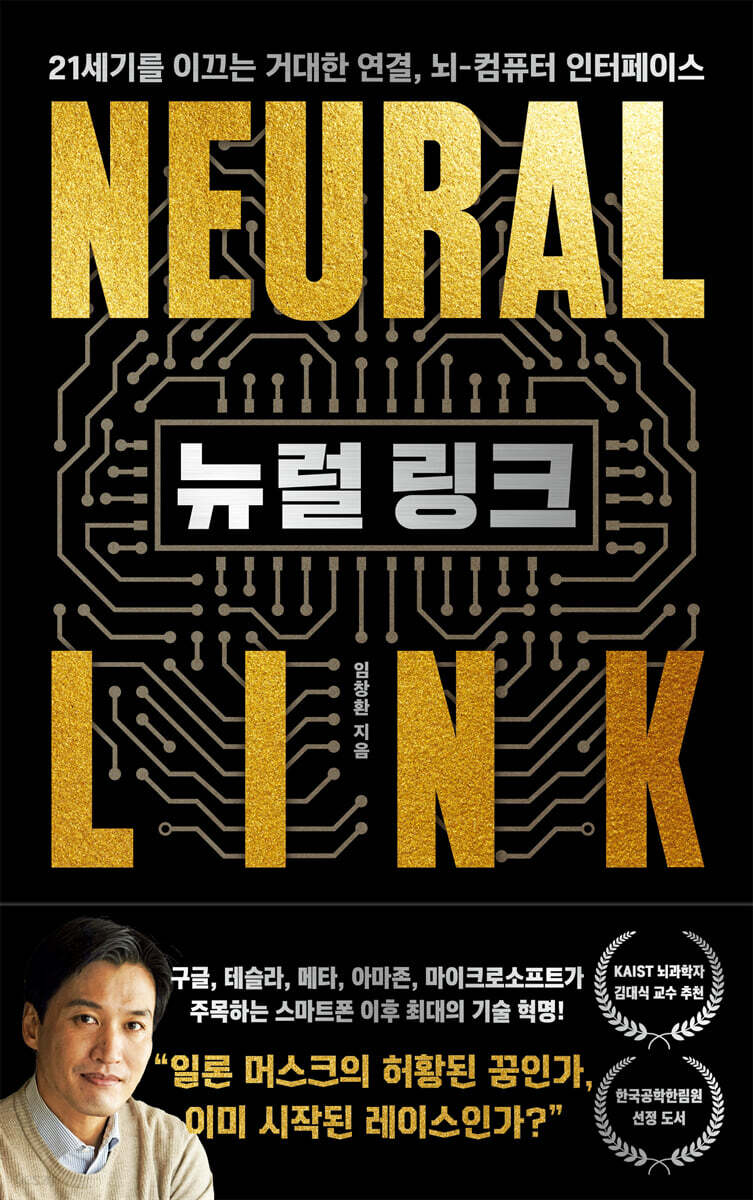
Neural Link
 |
Description
Book Introduction
Recommended by KAIST neuroscientist Professor Dae-sik Kim Books selected by the National Academy of Engineering of Korea Selection of 100 Future Technology Leaders May 2023: US FDA approves clinical trial of chip implant surgery Google, Tesla, Meta, Amazon, and Microsoft are paying attention. The biggest technological revolution since the smartphone! “Is this Elon Musk’s pipe dream? “Has the race already begun?” In January 2023, the brain engineering company Synchron announced that the 2021 surgeries in which they implanted chips called "Stentrods" into the brains of patients with severe paralysis were successful. In May of the same year, Neuralink, founded by Tesla's Elon Musk, announced that it had received approval for clinical trials from the U.S. Food and Drug Administration (FDA) and that it would begin implanting "Link" surgeries in 2024. In October, Meta (formerly Facebook) announced that it had succeeded in reproducing images of what the human brain perceives and processes. Beyond Synchron's recent $75 million funding from Amazon founder Jeff Bezos and Microsoft's Bill Gates, Kernel announced it has already secured $230 million in funding for its research and development of a "hippocampus chip" that enhances human cognitive abilities. However, despite the fact that brain-computer interface (BCI) technology, which connects the brain and computers, is at the center of these groundbreaking movements and rapid changes, it is difficult for non-experts to grasp the reality of this technology because of the mixed misunderstanding, exaggeration, criticism, and denigration surrounding it. The author, who was the first in Korea to research brain-computer interfaces and has published over 200 papers in renowned international journals, presents the basic principles of brain-computer interfaces, the latest status, and near-future scenarios to dispel this misunderstanding. Why is the development of brain-computer interfaces taking place across two tracks: invasive and non-invasive BCI, and what are the pros and cons of each? What brainwave devices are already commercially available, and what technologies, such as stentrods, are on the verge of commercialization? Beyond their use for patients with communication or mobility difficulties, how will BCI technology penetrate the education, gaming, sports, and cultural industries? What future do leading brain engineers and futurists predict will be like? The author, who has been at the forefront of brain-computer interface research for over 15 years, addresses all these questions from a balanced perspective, covering virtually every topic from virtual assistants to artificial skulls, neurofeedback, electronic brains, deep brain stimulation devices, and even brain-to-brain interfaces. “Most brain engineers have no hesitation in calling brain-computer interface technology ‘an innovation that will change the future of humanity.’ This is because we recognize the enormous potential of brain-computer interface technology, both as a means of treating various brain diseases, including dementia, the biggest challenge of the aging society, and as a means of achieving artificial evolution, a human instinct, in the long term. We invite you to the world of brain-computer interfaces, which will have a ripple effect as profound as the emergence of smartphones and artificial intelligence in human history.” |
- You can preview some of the book's contents.
Preview
index
Part 1: The Brain, Connecting with the World
Chapter 1: Communicating with a Soul Trapped in a Body
Chapter 2: If you upload your brain to a computer
Chapter 3: The Dream-Storing Machine
Chapter 4: The Historic Encounter between Brain and Computer
Part 2: A World Driven by the Brain
Chapter 5: Robots that Fly with Thought
Chapter 6: The Machine That Reads and Transmits Minds
Chapter 7: In Search of the Lost Body
Chapter 8: What are the 'real' arms and legs?
Part 3: The Machine That Knows Me Better Than I Know Myself
Chapter 9: Who is the owner of our brain?
Chapter 10: Human, All Too Human
Chapter 11: Algorithms for Anatomy of the Mind
Chapter 12: Would You Like to Change Your Brain?
Part 4 Beyond Brain-Computer Interface
Chapter 13: The Human Brain Cultivated in the Laboratory
Chapter 14 Connecting Brains, Brain-Brain Interface
Chapter 15: An electronic brain that erases memories and enhances intelligence
Chapter 16: BCI: Four Future Scenarios
Epilogue
References
Chapter 1: Communicating with a Soul Trapped in a Body
Chapter 2: If you upload your brain to a computer
Chapter 3: The Dream-Storing Machine
Chapter 4: The Historic Encounter between Brain and Computer
Part 2: A World Driven by the Brain
Chapter 5: Robots that Fly with Thought
Chapter 6: The Machine That Reads and Transmits Minds
Chapter 7: In Search of the Lost Body
Chapter 8: What are the 'real' arms and legs?
Part 3: The Machine That Knows Me Better Than I Know Myself
Chapter 9: Who is the owner of our brain?
Chapter 10: Human, All Too Human
Chapter 11: Algorithms for Anatomy of the Mind
Chapter 12: Would You Like to Change Your Brain?
Part 4 Beyond Brain-Computer Interface
Chapter 13: The Human Brain Cultivated in the Laboratory
Chapter 14 Connecting Brains, Brain-Brain Interface
Chapter 15: An electronic brain that erases memories and enhances intelligence
Chapter 16: BCI: Four Future Scenarios
Epilogue
References
Detailed image

Into the book
Bus Vice, which quietly developed the idea, was founded in 2011 by Stephen D.
Together with a young neuroscientist named Larson, he founded the OpenWorm Foundation, a non-profit organization whose ultimate goal was to create an artificial C. elegans worm that could live inside a computer.
--- p.48
Professor Dan inserted 177 needle-shaped electrodes into the lateral geniculate nucleus of a cat and found out which locations on the cat's retina each of the 177 neurons corresponded to.
To do this, she showed bright lights in different positions in front of the cats' eyes and observed which neurons responded.
Once this process was complete, she showed the cats several black-and-white videos and reconstructed the images using neural signals measured in the cats' lateral geniculate nucleus.
The results were truly amazing.
A video with a similar outline to the video shown to the cat was created!
--- p.57
In 2013, when research on machine control using brain waves was losing popularity, a research result that made headlines around the world was announced.
This was the news that came from Professor Bin Hee's research team at the University of Minnesota.
It was a successful experiment in which a drone was precisely controlled and passed through various obstacles using only thoughts through brain waves.
--- p.87-88
A year and a half before the World Cup began, Professor Nicolelis and 156 like-minded researchers from 25 countries launched a global project called the Walk Again Project.
Soon after, dozens of paralyzed patients volunteered.
After going through various medical tests, the candidates were narrowed down to three, and ultimately, 29-year-old Juliano Pinto was selected as the test subject.
Pintu was left completely immobile from his chest down to his toes due to an accident that damaged his spinal cord.
--- p.109
But what if technology is being developed to read our brains, even when we're not aware of it? And what if it uses brain-computer interface technology?
This type of brain-computer interface technology is called a 'passive brain-computer interface (pBCI)'.
The term 'passive' was given here because, unlike 'active' brain-computer interfaces developed for existing device control or communication, it only passively reads the brain's state and does not allow the user to generate any commands on their own.
--- p.139
An interesting example of the application of this type of neurofeedback training is the research results of Dr. Mitsuo Kawato's team at the International Telecommunications Basic Research Institute in Japan, a leader in this field.
In 2016, Dr. Kawato's research team succeeded in controlling preferences for specific faces by controlling the activity of the cingulate cortex in real time.
It is said that you can change your ideal face by controlling your brain.
Meanwhile, a 2018 study successfully reduced fear when viewing a fearful object by modulating activity in the inferior temporal lobe.
--- p.187
However, these miniature brains, or brain organoids, created by humans can also be used in research that combines biological neural networks and artificial intelligence.
The first study to demonstrate this possibility was published in 2022.
Dr. Brett Kagan, co-founder of Cortical Labs, a brain science startup based in Melbourne, Australia, and his team led by Professor Karl Friston at University College London have successfully connected a biological neural network to a computer to play a simple game.
--- p.205
This means that memory ability has been improved due to the hippocampus chip.
Currently, hippocampal chips are being developed with the aim of improving the quality of life of patients suffering from memory loss due to Alzheimer's disease.
However, it is possible to predict that even ordinary people with no memory problems will have better memories if they use hippocampal chips.
Professor Berger's research team started a project to develop a hippocampus chip that can be implanted into the human brain through a company called Kernel.
It is known that Kernel has attracted a large amount of investment amounting to 300 billion won of our money so far.
Together with a young neuroscientist named Larson, he founded the OpenWorm Foundation, a non-profit organization whose ultimate goal was to create an artificial C. elegans worm that could live inside a computer.
--- p.48
Professor Dan inserted 177 needle-shaped electrodes into the lateral geniculate nucleus of a cat and found out which locations on the cat's retina each of the 177 neurons corresponded to.
To do this, she showed bright lights in different positions in front of the cats' eyes and observed which neurons responded.
Once this process was complete, she showed the cats several black-and-white videos and reconstructed the images using neural signals measured in the cats' lateral geniculate nucleus.
The results were truly amazing.
A video with a similar outline to the video shown to the cat was created!
--- p.57
In 2013, when research on machine control using brain waves was losing popularity, a research result that made headlines around the world was announced.
This was the news that came from Professor Bin Hee's research team at the University of Minnesota.
It was a successful experiment in which a drone was precisely controlled and passed through various obstacles using only thoughts through brain waves.
--- p.87-88
A year and a half before the World Cup began, Professor Nicolelis and 156 like-minded researchers from 25 countries launched a global project called the Walk Again Project.
Soon after, dozens of paralyzed patients volunteered.
After going through various medical tests, the candidates were narrowed down to three, and ultimately, 29-year-old Juliano Pinto was selected as the test subject.
Pintu was left completely immobile from his chest down to his toes due to an accident that damaged his spinal cord.
--- p.109
But what if technology is being developed to read our brains, even when we're not aware of it? And what if it uses brain-computer interface technology?
This type of brain-computer interface technology is called a 'passive brain-computer interface (pBCI)'.
The term 'passive' was given here because, unlike 'active' brain-computer interfaces developed for existing device control or communication, it only passively reads the brain's state and does not allow the user to generate any commands on their own.
--- p.139
An interesting example of the application of this type of neurofeedback training is the research results of Dr. Mitsuo Kawato's team at the International Telecommunications Basic Research Institute in Japan, a leader in this field.
In 2016, Dr. Kawato's research team succeeded in controlling preferences for specific faces by controlling the activity of the cingulate cortex in real time.
It is said that you can change your ideal face by controlling your brain.
Meanwhile, a 2018 study successfully reduced fear when viewing a fearful object by modulating activity in the inferior temporal lobe.
--- p.187
However, these miniature brains, or brain organoids, created by humans can also be used in research that combines biological neural networks and artificial intelligence.
The first study to demonstrate this possibility was published in 2022.
Dr. Brett Kagan, co-founder of Cortical Labs, a brain science startup based in Melbourne, Australia, and his team led by Professor Karl Friston at University College London have successfully connected a biological neural network to a computer to play a simple game.
--- p.205
This means that memory ability has been improved due to the hippocampus chip.
Currently, hippocampal chips are being developed with the aim of improving the quality of life of patients suffering from memory loss due to Alzheimer's disease.
However, it is possible to predict that even ordinary people with no memory problems will have better memories if they use hippocampal chips.
Professor Berger's research team started a project to develop a hippocampus chip that can be implanted into the human brain through a company called Kernel.
It is known that Kernel has attracted a large amount of investment amounting to 300 billion won of our money so far.
--- p.230
Publisher's Review
Neuromarketing: Seducing the Consumer's Brain
Neurofeedback, a technology that modifies your own brain
An electronic brain that erases memories and enhances intelligence
A passive BCI that reads my mind without me even knowing it
A deep brain stimulation machine that produces pleasure with the push of a button
Artificial skull that enhances cognitive and physical abilities…
Brain-computer, brain-artificial intelligence, brain-brain connection technology
Fundamentals, current status, and future prediction scenarios!
In July 2019, Neuralink, founded in 2017, posted on its website a link to a YouTube live broadcast along with an announcement that Neuralink would be holding a presentation showcasing the results of its research over the past two years.
Despite the lack of extensive media coverage, the live stream attracted over 200,000 concurrent viewers, holding their breath as Neuralink unveiled its new neural signal measurement system.
Just a year later, in August 2020, hundreds of thousands of viewers connected simultaneously, this time for a successful demonstration of implanting electrodes into a pig's brain and connecting it to a computer.
In the same month, Neuralink announced another implantable wireless interface system called 'Link v0.9'.
And nearly four years have passed since then.
Part 1, "The Brain, Connecting with the World," begins with the story that it is now possible to communicate with locked-in syndrome patients through brain waves, and then looks at the latest achievements and potential applications of "mind uploading," a technology that stores the neural network of C. elegans on a computer, and its applications, as well as "dream recording," a technology that restores images from dreams or imagination based on visual information processing.
Part 2, "A World Powered by the Brain," introduces innovative technologies such as the mind typewriter, stent rod, and artificial skull that allow you to surf the internet, drive a car, play games, operate a drone, and go beyond just thinking about moving a robotic arm to feel sensations through a robotic arm.
Part 3, "Machines That Know Me Better Than I Know Myself," explores how neurofeedback technology, which modifies our brains to prevent mental illness and change our tastes, as well as passive brain-computer interface technology, which involves virtual assistants that respond to our emotions, are advancing at a rapid pace unlike anything before.
We also pay attention to the commercialization of wearable devices that induce sleep and meditation, such as the 'Muse' series, and the movement to expand and apply these technologies to fields such as education and marketing.
A world where the brain is modified and strengthened,
Utopia/dystopia that has already begun
“Would you like to upgrade your brain?”
In 2011, Professor Theodore Berger of the University of Southern California injected mice with a drug called MK801.
The drug-injected rats were unable to perform even a simple memory task called "delayed sample mismatch," but when Professor Berger implanted a small chip into the rats' hippocampus, the rats performed the task just as well as before.
This was the moment when the so-called 'hippocampus chip' was born.
But Professor Berger didn't stop there, and conducted a follow-up study, this time using normal rats that had not been injected with drugs.
Mice with hippocampal chips implanted performed significantly better on the delayed-sample mismatch task than mice without the chips.
What would happen if a hippocampal chip were implanted in a human? It's possible that not only patients with memory loss due to Alzheimer's disease, but also people with normal memory problems would experience improved memory.
In fact, Professor Berger's research team has launched a project to develop a hippocampus chip that can be implanted into the human brain through Kernel, and Kernel is known to have attracted an investment amounting to 300 billion won in our money.
Brain engineering technologies that enhance intelligence through brain chips or brain waves are currently developing rapidly.
Surprisingly, the technology to significantly improve concentration, memory, and language comprehension by activating brain regions like the Wernicke's area or the dorsolateral prefrontal cortex is already mature enough that it could be available to us within a few years.
Deep brain stimulation machines that can erase painful memories, reduce depression, and even produce pleasure with a single electrical stimulus have already reached a considerable level, to the point that neuroscientists have raised the question in their papers, “If happiness could be easily achieved with a single press of a button, would it really be ethically sound?”
Part 4, 'Beyond Brain-Computer Interface', focuses on cognitive enhancement, emotional relief/amplification technologies, as well as brain-onoguides that connect artificial intelligence and the brain, and brain-to-brain interface technologies.
Artificial intelligence and brain science, advancing at a breakneck pace, present us with a future that, through engineering, will be no different. The latter half of the book presents four future scenarios, drawn from leading brain engineers, neuroscientists, and futurists, highlighting the future of brain-computer interfaces—a vision as rosy as it is bleak—and the resulting changes in the labor market and social structure, as well as the emergence of new industries.
Neurofeedback, a technology that modifies your own brain
An electronic brain that erases memories and enhances intelligence
A passive BCI that reads my mind without me even knowing it
A deep brain stimulation machine that produces pleasure with the push of a button
Artificial skull that enhances cognitive and physical abilities…
Brain-computer, brain-artificial intelligence, brain-brain connection technology
Fundamentals, current status, and future prediction scenarios!
In July 2019, Neuralink, founded in 2017, posted on its website a link to a YouTube live broadcast along with an announcement that Neuralink would be holding a presentation showcasing the results of its research over the past two years.
Despite the lack of extensive media coverage, the live stream attracted over 200,000 concurrent viewers, holding their breath as Neuralink unveiled its new neural signal measurement system.
Just a year later, in August 2020, hundreds of thousands of viewers connected simultaneously, this time for a successful demonstration of implanting electrodes into a pig's brain and connecting it to a computer.
In the same month, Neuralink announced another implantable wireless interface system called 'Link v0.9'.
And nearly four years have passed since then.
Part 1, "The Brain, Connecting with the World," begins with the story that it is now possible to communicate with locked-in syndrome patients through brain waves, and then looks at the latest achievements and potential applications of "mind uploading," a technology that stores the neural network of C. elegans on a computer, and its applications, as well as "dream recording," a technology that restores images from dreams or imagination based on visual information processing.
Part 2, "A World Powered by the Brain," introduces innovative technologies such as the mind typewriter, stent rod, and artificial skull that allow you to surf the internet, drive a car, play games, operate a drone, and go beyond just thinking about moving a robotic arm to feel sensations through a robotic arm.
Part 3, "Machines That Know Me Better Than I Know Myself," explores how neurofeedback technology, which modifies our brains to prevent mental illness and change our tastes, as well as passive brain-computer interface technology, which involves virtual assistants that respond to our emotions, are advancing at a rapid pace unlike anything before.
We also pay attention to the commercialization of wearable devices that induce sleep and meditation, such as the 'Muse' series, and the movement to expand and apply these technologies to fields such as education and marketing.
A world where the brain is modified and strengthened,
Utopia/dystopia that has already begun
“Would you like to upgrade your brain?”
In 2011, Professor Theodore Berger of the University of Southern California injected mice with a drug called MK801.
The drug-injected rats were unable to perform even a simple memory task called "delayed sample mismatch," but when Professor Berger implanted a small chip into the rats' hippocampus, the rats performed the task just as well as before.
This was the moment when the so-called 'hippocampus chip' was born.
But Professor Berger didn't stop there, and conducted a follow-up study, this time using normal rats that had not been injected with drugs.
Mice with hippocampal chips implanted performed significantly better on the delayed-sample mismatch task than mice without the chips.
What would happen if a hippocampal chip were implanted in a human? It's possible that not only patients with memory loss due to Alzheimer's disease, but also people with normal memory problems would experience improved memory.
In fact, Professor Berger's research team has launched a project to develop a hippocampus chip that can be implanted into the human brain through Kernel, and Kernel is known to have attracted an investment amounting to 300 billion won in our money.
Brain engineering technologies that enhance intelligence through brain chips or brain waves are currently developing rapidly.
Surprisingly, the technology to significantly improve concentration, memory, and language comprehension by activating brain regions like the Wernicke's area or the dorsolateral prefrontal cortex is already mature enough that it could be available to us within a few years.
Deep brain stimulation machines that can erase painful memories, reduce depression, and even produce pleasure with a single electrical stimulus have already reached a considerable level, to the point that neuroscientists have raised the question in their papers, “If happiness could be easily achieved with a single press of a button, would it really be ethically sound?”
Part 4, 'Beyond Brain-Computer Interface', focuses on cognitive enhancement, emotional relief/amplification technologies, as well as brain-onoguides that connect artificial intelligence and the brain, and brain-to-brain interface technologies.
Artificial intelligence and brain science, advancing at a breakneck pace, present us with a future that, through engineering, will be no different. The latter half of the book presents four future scenarios, drawn from leading brain engineers, neuroscientists, and futurists, highlighting the future of brain-computer interfaces—a vision as rosy as it is bleak—and the resulting changes in the labor market and social structure, as well as the emergence of new industries.
GOODS SPECIFICS
- Date of issue: January 8, 2024
- Page count, weight, size: 272 pages | 422g | 135*215*17mm
- ISBN13: 9788962625936
You may also like
카테고리
korean


korean

![ELLE 엘르 스페셜 에디션 A형 : 12월 [2025]](http://librairie.coreenne.fr/cdn/shop/files/b8e27a3de6c9538896439686c6b0e8fb.jpg?v=1766436872&width=3840)


