

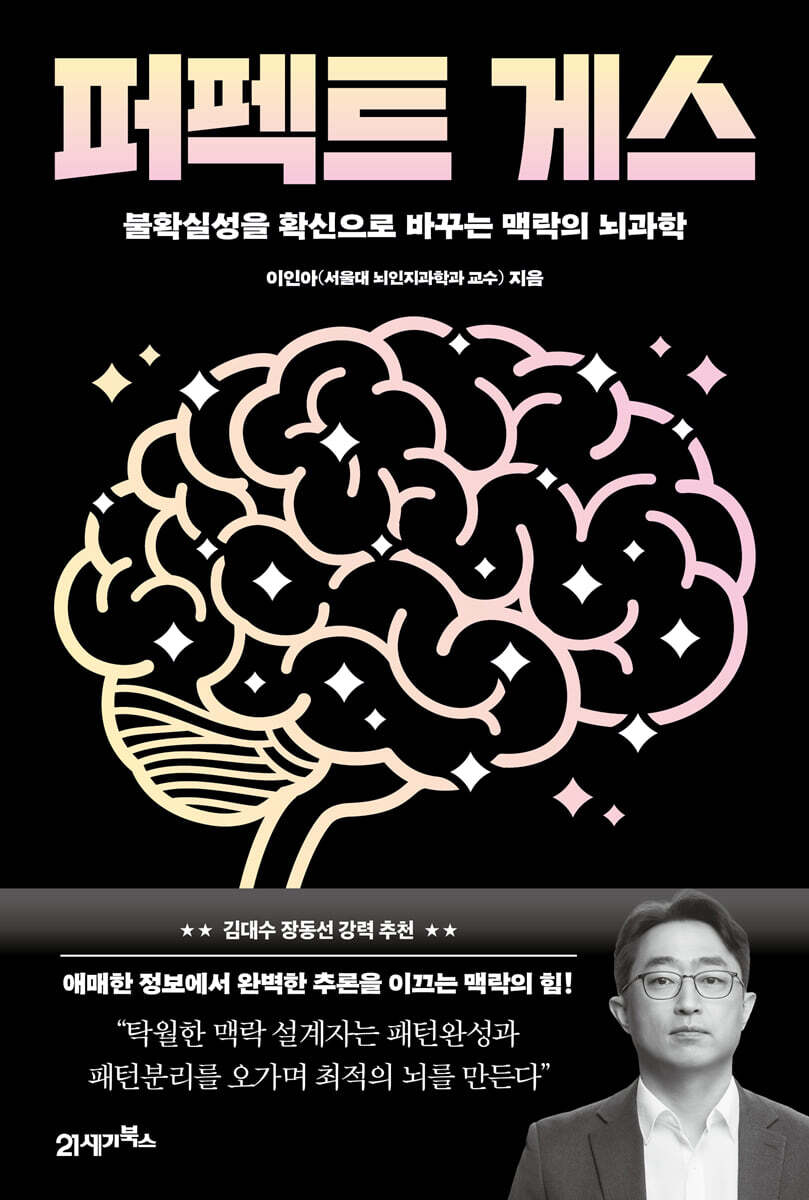
Perfect Guess
 |
Description
Book Introduction
How does contextual reasoning solve life's problems? The power of context to lead to perfect inferences from ambiguous information! Professor Lee In-ah of Seoul National University, a world-renowned authority on the brain, especially the hippocampus, which controls learning and memory, says in her new book, "The Perfect Guess," that we can design the optimal brain to adapt and survive in a complex world through our life experiences and choices. Professor Lee In-ah, who has been researching and teaching convergent brain science at the forefront of biology, cognitive science, natural intelligence, and artificial intelligence for 30 years, uses the language of science to fascinatingly address the problems and questions we encounter in everyday life. By explaining the entire information processing stage of the brain, which continuously learns and utilizes this while alive, as a single, grand principle called 'context', it will provide the inspiration necessary to become a 'context designer' of the brain that can adapt to change at times powerfully and at times flexibly. All human senses exist to interpret stimuli and information present in the natural environment, but some information is too ambiguous and difficult to interpret. At this time, thanks to the brain's survival strategy of "predict and act" that fights against this ambiguity and infers the identity of the stimulus as perfectly as possible, we are able to adapt to the ever-changing environment and survive as "me." Just as the saying goes, "Know thyself," and as Professor Lee In-ah has said, "Know thy brain," if we can understand and utilize the characteristics of our own brain, we will have the miraculous experience of transforming our uncertain lives and work into certainty. |
- You can preview some of the book's contents.
Preview
index
Recommendation
prolog
Part 1: How Our Brains Struggle with Ambiguous Information
1 The great operating principle that moves the brain
2 From Strangeness to Familiarity: The Power of Context
3 “Predict and Act”: The Brain’s Survival Strategy
4 Context Creators vs. Context Consumers
5 Brain Differences Between Quick and Slow People
6 Reasons Why You Should Know Your Brain's Potential and Limitations
Part 2: How Contextual Reasoning Solves Life's Problems
From Sense to Perception: How We Understand the World
8 Uncertainty is overcome by learned context.
9 Unique experiential contexts create your own individuality.
10 A World Categorized by Brain Biases
11 The Magic of Context: How Cheap Wine Becomes Expensive
12 Extremely vague information creates fear.
13 Why do some smells evoke memories?
14 A Mind-Blowing Wind Guide to Powerful Immersion
Part 3: The Secrets of Contextual Design That Determine Perfect Inference
15 Learning, memory, and context in the hippocampus
16 When does the contextual brain develop?
17 Storytelling and Framing to Create Experiences
18 Reasons Why Practice Should Be Real
19 Why Our Brain Feels Emotions
20. Balancing the Boundaries of Pattern Completion and Pattern Separation
21 Three Elements of Episodic Memory Completed Through Hippocampal Learning
Problems that arise when context design fails in Part 4.
22 The Difficulty of the Social Context of Human Relationships
23 What Happens in the Brain with Dementia
24 When the Hippocampus Is Damaged, the Power of Routines and Habits
25 How to expand the size of the context
Part 5: How Contextual Designers Use Their Brains
26 Understanding the vast context of the forest
27 The Joy of Designing a World That's Perfect for Me
28 Beware of Misuse of Context
29 The brain holds the key to overcoming conflict.
30 AI's Bottom-Up Context vs. the Brain's Top-Down Context
31 How to Find Big Meaning in the Small Human Brain
32 More Perfect Inference
Epilogue
prolog
Part 1: How Our Brains Struggle with Ambiguous Information
1 The great operating principle that moves the brain
2 From Strangeness to Familiarity: The Power of Context
3 “Predict and Act”: The Brain’s Survival Strategy
4 Context Creators vs. Context Consumers
5 Brain Differences Between Quick and Slow People
6 Reasons Why You Should Know Your Brain's Potential and Limitations
Part 2: How Contextual Reasoning Solves Life's Problems
From Sense to Perception: How We Understand the World
8 Uncertainty is overcome by learned context.
9 Unique experiential contexts create your own individuality.
10 A World Categorized by Brain Biases
11 The Magic of Context: How Cheap Wine Becomes Expensive
12 Extremely vague information creates fear.
13 Why do some smells evoke memories?
14 A Mind-Blowing Wind Guide to Powerful Immersion
Part 3: The Secrets of Contextual Design That Determine Perfect Inference
15 Learning, memory, and context in the hippocampus
16 When does the contextual brain develop?
17 Storytelling and Framing to Create Experiences
18 Reasons Why Practice Should Be Real
19 Why Our Brain Feels Emotions
20. Balancing the Boundaries of Pattern Completion and Pattern Separation
21 Three Elements of Episodic Memory Completed Through Hippocampal Learning
Problems that arise when context design fails in Part 4.
22 The Difficulty of the Social Context of Human Relationships
23 What Happens in the Brain with Dementia
24 When the Hippocampus Is Damaged, the Power of Routines and Habits
25 How to expand the size of the context
Part 5: How Contextual Designers Use Their Brains
26 Understanding the vast context of the forest
27 The Joy of Designing a World That's Perfect for Me
28 Beware of Misuse of Context
29 The brain holds the key to overcoming conflict.
30 AI's Bottom-Up Context vs. the Brain's Top-Down Context
31 How to Find Big Meaning in the Small Human Brain
32 More Perfect Inference
Epilogue
Detailed image

Into the book
Wanting to know about someone, including myself, means wanting to understand how the human mind and thoughts work and why certain behaviors occur.
To satisfy this curiosity and intellectual appetite, people seek information in their own unique ways. They take personality tests like the MBTI and various aptitude tests, have their fortunes read, and even seek professional advice.
"A Perfect Guess" is a book that talks about where to find answers to this basic human curiosity.
And he suggests that the answer lies in understanding our brain scientifically.
--- p.6, from “Prologue”
Contextual information processing is essential for allowing all stages of 'sensation-perception-learning-memory-decision-making-action' to flow naturally in the brain.
Most of this information processing occurs unconsciously and cannot be felt consciously.
It's scary to think that my brain is processing information, influenced by countless contexts, without me even knowing it.
But being afraid of something may be because you don't know exactly what it is.
Instead of being afraid, I think you can live a much better life if you understand the core information processing that happens in your brain and make the most of it.
--- p.23~24, from “Part 1: How Our Brains Fight Ambiguous Information”
Just as top decision-makers in a well-run company understand the state of the people working in lower-level organizations, understand their work, and strive to reflect this in their decisions, the brain's early and upper stages of information processing organically communicate and constantly influence each other, forming a vast context.
Through this, in the early sensory and perceptual stages, the brain strives to perceive what is contextually predicted, while higher cognitive areas constantly monitor how accurately their predictions are.
--- p.108~109, from “Part 2: How Contextual Reasoning Solves Life’s Problems”
An MRI study to study brain activity in two-year-old infants reported that the hippocampus was more active when the infants heard a familiar lullaby while sleeping than when they heard an unfamiliar lullaby.
What's even more surprising is that the better the child remembered the place where they heard the lullaby or the toy that was next to them when they heard the lullaby, the higher the hippocampal activity was shown in the MRI when the lullaby was played.
That is, the more strongly the hippocampus processed contextual information, the higher the hippocampal activity in the child.
This is a remarkable neurocognitive scientific experiment that shows that even the brains of newborn babies already consider all the contextual information surrounding them when interacting with and learning about the world and making decisions about their actions.
--- p.131~132, from “Part 3: The Secret of Contextual Design That Determines Perfect Inference”
Like cells in the hippocampus, the ability to move between contexts of different sizes and apply what we learn in one context to another is one of the brain's essential functions for adapting to the environment.
In some cases, this context may be called culture.
If we define culture as a set of behavioral and lifestyle patterns shared by members of a particular society through acquired learning, then this culture determines how the human brain should react to events occurring in the environment or to objects and people encountered.
--- p.212~213, from “Problems that arise when context design fails in Part 4”
Before we act, we always take out a model that fits the situation and make a prediction.
Because our brain often makes predictions unconsciously, we may not be aware that our brain is always trying to predict something.
Then, when that prediction turns out to be spectacularly wrong, you suddenly realize that you were expecting something, that you were making a "perfect inference" with your existing model, without even realizing its flaws.
Experiences that contradict the inferences made by existing models are opportunities to update or upgrade the model to make it perfect again.
From the moment we are born, our brain continues to elaborate and update various models in our head to adapt and survive in the world.
--- p.247~248, from “Part 5: How to Use the Brain of an Excellent Context Designer”
Depending on what you put into the space called the brain, it can either become a beautiful, one-of-a-kind garden with beautiful flowers and trees arranged in your own unique way, or it can become a monotonous space made up of just ordinary, factory-produced artificial flowers.
More importantly, how you train your brain will change how you see the world, and as your perspective on the world changes, so will your way of living.
It may sound grandiose, but if I consider each and every experience I have at this moment as important, as if I were choosing each stone to decorate a garden, and actively and subjectively choose them, my brain will eventually develop its own wonderful and unique context.
To satisfy this curiosity and intellectual appetite, people seek information in their own unique ways. They take personality tests like the MBTI and various aptitude tests, have their fortunes read, and even seek professional advice.
"A Perfect Guess" is a book that talks about where to find answers to this basic human curiosity.
And he suggests that the answer lies in understanding our brain scientifically.
--- p.6, from “Prologue”
Contextual information processing is essential for allowing all stages of 'sensation-perception-learning-memory-decision-making-action' to flow naturally in the brain.
Most of this information processing occurs unconsciously and cannot be felt consciously.
It's scary to think that my brain is processing information, influenced by countless contexts, without me even knowing it.
But being afraid of something may be because you don't know exactly what it is.
Instead of being afraid, I think you can live a much better life if you understand the core information processing that happens in your brain and make the most of it.
--- p.23~24, from “Part 1: How Our Brains Fight Ambiguous Information”
Just as top decision-makers in a well-run company understand the state of the people working in lower-level organizations, understand their work, and strive to reflect this in their decisions, the brain's early and upper stages of information processing organically communicate and constantly influence each other, forming a vast context.
Through this, in the early sensory and perceptual stages, the brain strives to perceive what is contextually predicted, while higher cognitive areas constantly monitor how accurately their predictions are.
--- p.108~109, from “Part 2: How Contextual Reasoning Solves Life’s Problems”
An MRI study to study brain activity in two-year-old infants reported that the hippocampus was more active when the infants heard a familiar lullaby while sleeping than when they heard an unfamiliar lullaby.
What's even more surprising is that the better the child remembered the place where they heard the lullaby or the toy that was next to them when they heard the lullaby, the higher the hippocampal activity was shown in the MRI when the lullaby was played.
That is, the more strongly the hippocampus processed contextual information, the higher the hippocampal activity in the child.
This is a remarkable neurocognitive scientific experiment that shows that even the brains of newborn babies already consider all the contextual information surrounding them when interacting with and learning about the world and making decisions about their actions.
--- p.131~132, from “Part 3: The Secret of Contextual Design That Determines Perfect Inference”
Like cells in the hippocampus, the ability to move between contexts of different sizes and apply what we learn in one context to another is one of the brain's essential functions for adapting to the environment.
In some cases, this context may be called culture.
If we define culture as a set of behavioral and lifestyle patterns shared by members of a particular society through acquired learning, then this culture determines how the human brain should react to events occurring in the environment or to objects and people encountered.
--- p.212~213, from “Problems that arise when context design fails in Part 4”
Before we act, we always take out a model that fits the situation and make a prediction.
Because our brain often makes predictions unconsciously, we may not be aware that our brain is always trying to predict something.
Then, when that prediction turns out to be spectacularly wrong, you suddenly realize that you were expecting something, that you were making a "perfect inference" with your existing model, without even realizing its flaws.
Experiences that contradict the inferences made by existing models are opportunities to update or upgrade the model to make it perfect again.
From the moment we are born, our brain continues to elaborate and update various models in our head to adapt and survive in the world.
--- p.247~248, from “Part 5: How to Use the Brain of an Excellent Context Designer”
Depending on what you put into the space called the brain, it can either become a beautiful, one-of-a-kind garden with beautiful flowers and trees arranged in your own unique way, or it can become a monotonous space made up of just ordinary, factory-produced artificial flowers.
More importantly, how you train your brain will change how you see the world, and as your perspective on the world changes, so will your way of living.
It may sound grandiose, but if I consider each and every experience I have at this moment as important, as if I were choosing each stone to decorate a garden, and actively and subjectively choose them, my brain will eventually develop its own wonderful and unique context.
--- p.265~266, from “Epilogue”
Publisher's Review
★★★ Kim Dae-soo and Jang Dong-seon strongly recommended ★★★
Developing my brain in an age of uncertainty
A must-read book on brain science that illuminates unprecedented paths.
The experiences and choices of this moment come together
Finally, it becomes a 'brain' that has the context of 'me'!
"A must-read for brain science that illuminates unprecedented paths to developing your own brain."
- Kim Dae-su (Professor of Life Sciences at KAIST, author of "When Brain Science is Necessary in Life")
"A Guide to Optimal Brain Design for Strong, Flexible Adaptation to Change"
- Jang Dong-seon (Professor, Creative Convergence Education Center, Hanyang University, author of "There's Another Brain Inside the Brain")
Everyone wants to know about themselves, and also about the other people and the environment around them.
We want to quickly understand and accurately interpret how we, our minds and thoughts, work and behave, and how the world changes and adapts.
"A Perfect Guess" is a book that seeks answers to this basic human curiosity.
The author, Professor Lee In-ah, suggests that the answer lies in understanding our brain scientifically.
This book unfolds the story through the brain's grand operating principle, 'contextual reasoning.'
Professor Lee In-ah explains that although the brain's functioning may differ slightly depending on each person's life experiences, the fundamental principles underlying its operation remain the same.
Our brain is solving problems as perfectly as possible at every moment through contextual reasoning using complex and ambiguous information coming from the outside.
Furthermore, he emphasizes that our brains can make almost no decisions without learning and utilizing context.
In other words, the secret that allows us to more easily understand what happens to us and better understand and respond to the actions of others and the complex world lies within our brains.
Normal brain function is nearly impossible in a vast sea of ambiguity without the lighthouse of 'context'.
Anyone who has ever struggled with the complex and uncertain problems they encounter in daily life will discover through this book the opportunity to become a "context designer" or "context executor" of their brain.
The author says that depending on what you put into the space called the brain, it can either become a beautiful, one-of-a-kind garden arranged in your own unique way, or it can become a monotonous, monotonous space.
If you actively and subjectively choose each experience in this moment, you will eventually be able to upgrade your brain into one with its own wonderful and unique context.
The most accurate way to understand and utilize the brain, revealed by the latest brain science research!
"Excellent context designers create optimal brains by alternating between pattern completion and pattern separation."
Agatha Christie's mystery novels, such as Murder on the Orient Express and And Then There Were None, have long captivated many people, drawing readers into the story.
In this storytelling technique of gripping narrative development and dramatic twists, we discover two key functions of the brain's reasoning activity.
These are the 'pattern completion' and 'pattern separation' of the hippocampus, the most important area in the brain that creates contextual information.
Professor Lee In-ah explains that the hippocampus, located deep in the brain, fragments and processes information from the environment surrounding us, that is, the outside world, through each individual sense and perception, such as sight, hearing, and taste, and then instantly knits it together as if knitting, restoring it as close to reality as possible.
The process of creating a three-dimensional structure from individual pieces of information that are broken down like blocks is called 'context'.
This 'pattern-completed' context is stored in the mind and performs the function of perfectly inferring with the power of context even when encountering new events and situations.
On the other hand, we often face the dilemma of encountering a new and unfamiliar situation that is completely different from the context we have already learned, and in this case, the brain must create a new context through 'pattern separation'.
The author explains that the reason we can become immersed in a mystery novel is because it is impossible without this contextual brain activity.
This is because when the hippocampus is immersed in a specific context, it draws attention through a reversal that takes it out of context and makes it work harder to learn the new context, leading to immersion.
In this book, the author shows through several examples that the boundary between 'pattern completion' and 'pattern separation' varies from person to person depending on the amount of life experience and age.
He emphasizes that in order to interpret situations encountered in daily life, one must sometimes utilize powerful contextual information to make precise judgments, and at other times, one must be able to form new contextual information through dynamic contextual information processing.
It guides us into the world of contextual neuroscience through important and interesting issues that we may encounter in our lives, such as psychological disorders like depression and PTSD, brain diseases like dementia, as well as the debate between AI and humans, the old-timers, and the truths and misconceptions surrounding brain aging.
By following the author's friendly explanations, you will finally discover the possibility of designing an optimal brain for survival and adaptation by going back and forth between pattern completion and pattern separation, and gain hints on how to awaken the potential of our brain.
Sometimes strong, sometimes flexible
The brain that designs context survives!
This book is divided into five parts.
Part 1 explains the concept of 'context', which is a key factor in explaining the brain's information processing, and explains in an easy-to-understand way how our brains struggle with ambiguous information through everyday examples.
In Part 2, we will explore how our brain processes information from the outside and solves various problems in life through a brain activity called 'contextual reasoning.'
Part 3 introduces the most outstanding and useful knowledge for understanding brain science by unraveling the mechanisms of the brain's contextual design that enable perfect inference through the latest research and compelling hypotheses.
Part 4 shows how errors in the brain's decontextualized information processing and reasoning functions arise through various problems that arise when context design fails.
Part 5 offers ideas for designing your own unique context for your life and work, sometimes powerfully and flexibly, and sometimes intelligently and competently leveraging your brain's potential.
The author emphasizes that living without thinking, just seeing, hearing, and experiencing what is given to us from the outside is not the way to properly utilize our brain.
"Our brains, with their incredible plasticity and ability to learn anything, are too powerful and precious a space to be carelessly exploited." I encourage everyone to consider their potential and experience contextual neuroscience to become the master architects of their own brains.
As the author's message suggests, you will have the amazing experience of how your brain is nurtured, which will change the way you see the world and live.
Developing my brain in an age of uncertainty
A must-read book on brain science that illuminates unprecedented paths.
The experiences and choices of this moment come together
Finally, it becomes a 'brain' that has the context of 'me'!
"A must-read for brain science that illuminates unprecedented paths to developing your own brain."
- Kim Dae-su (Professor of Life Sciences at KAIST, author of "When Brain Science is Necessary in Life")
"A Guide to Optimal Brain Design for Strong, Flexible Adaptation to Change"
- Jang Dong-seon (Professor, Creative Convergence Education Center, Hanyang University, author of "There's Another Brain Inside the Brain")
Everyone wants to know about themselves, and also about the other people and the environment around them.
We want to quickly understand and accurately interpret how we, our minds and thoughts, work and behave, and how the world changes and adapts.
"A Perfect Guess" is a book that seeks answers to this basic human curiosity.
The author, Professor Lee In-ah, suggests that the answer lies in understanding our brain scientifically.
This book unfolds the story through the brain's grand operating principle, 'contextual reasoning.'
Professor Lee In-ah explains that although the brain's functioning may differ slightly depending on each person's life experiences, the fundamental principles underlying its operation remain the same.
Our brain is solving problems as perfectly as possible at every moment through contextual reasoning using complex and ambiguous information coming from the outside.
Furthermore, he emphasizes that our brains can make almost no decisions without learning and utilizing context.
In other words, the secret that allows us to more easily understand what happens to us and better understand and respond to the actions of others and the complex world lies within our brains.
Normal brain function is nearly impossible in a vast sea of ambiguity without the lighthouse of 'context'.
Anyone who has ever struggled with the complex and uncertain problems they encounter in daily life will discover through this book the opportunity to become a "context designer" or "context executor" of their brain.
The author says that depending on what you put into the space called the brain, it can either become a beautiful, one-of-a-kind garden arranged in your own unique way, or it can become a monotonous, monotonous space.
If you actively and subjectively choose each experience in this moment, you will eventually be able to upgrade your brain into one with its own wonderful and unique context.
The most accurate way to understand and utilize the brain, revealed by the latest brain science research!
"Excellent context designers create optimal brains by alternating between pattern completion and pattern separation."
Agatha Christie's mystery novels, such as Murder on the Orient Express and And Then There Were None, have long captivated many people, drawing readers into the story.
In this storytelling technique of gripping narrative development and dramatic twists, we discover two key functions of the brain's reasoning activity.
These are the 'pattern completion' and 'pattern separation' of the hippocampus, the most important area in the brain that creates contextual information.
Professor Lee In-ah explains that the hippocampus, located deep in the brain, fragments and processes information from the environment surrounding us, that is, the outside world, through each individual sense and perception, such as sight, hearing, and taste, and then instantly knits it together as if knitting, restoring it as close to reality as possible.
The process of creating a three-dimensional structure from individual pieces of information that are broken down like blocks is called 'context'.
This 'pattern-completed' context is stored in the mind and performs the function of perfectly inferring with the power of context even when encountering new events and situations.
On the other hand, we often face the dilemma of encountering a new and unfamiliar situation that is completely different from the context we have already learned, and in this case, the brain must create a new context through 'pattern separation'.
The author explains that the reason we can become immersed in a mystery novel is because it is impossible without this contextual brain activity.
This is because when the hippocampus is immersed in a specific context, it draws attention through a reversal that takes it out of context and makes it work harder to learn the new context, leading to immersion.
In this book, the author shows through several examples that the boundary between 'pattern completion' and 'pattern separation' varies from person to person depending on the amount of life experience and age.
He emphasizes that in order to interpret situations encountered in daily life, one must sometimes utilize powerful contextual information to make precise judgments, and at other times, one must be able to form new contextual information through dynamic contextual information processing.
It guides us into the world of contextual neuroscience through important and interesting issues that we may encounter in our lives, such as psychological disorders like depression and PTSD, brain diseases like dementia, as well as the debate between AI and humans, the old-timers, and the truths and misconceptions surrounding brain aging.
By following the author's friendly explanations, you will finally discover the possibility of designing an optimal brain for survival and adaptation by going back and forth between pattern completion and pattern separation, and gain hints on how to awaken the potential of our brain.
Sometimes strong, sometimes flexible
The brain that designs context survives!
This book is divided into five parts.
Part 1 explains the concept of 'context', which is a key factor in explaining the brain's information processing, and explains in an easy-to-understand way how our brains struggle with ambiguous information through everyday examples.
In Part 2, we will explore how our brain processes information from the outside and solves various problems in life through a brain activity called 'contextual reasoning.'
Part 3 introduces the most outstanding and useful knowledge for understanding brain science by unraveling the mechanisms of the brain's contextual design that enable perfect inference through the latest research and compelling hypotheses.
Part 4 shows how errors in the brain's decontextualized information processing and reasoning functions arise through various problems that arise when context design fails.
Part 5 offers ideas for designing your own unique context for your life and work, sometimes powerfully and flexibly, and sometimes intelligently and competently leveraging your brain's potential.
The author emphasizes that living without thinking, just seeing, hearing, and experiencing what is given to us from the outside is not the way to properly utilize our brain.
"Our brains, with their incredible plasticity and ability to learn anything, are too powerful and precious a space to be carelessly exploited." I encourage everyone to consider their potential and experience contextual neuroscience to become the master architects of their own brains.
As the author's message suggests, you will have the amazing experience of how your brain is nurtured, which will change the way you see the world and live.
GOODS SPECIFICS
- Date of issue: January 3, 2024
- Page count, weight, size: 268 pages | 510g | 145*215*20mm
- ISBN13: 9791171173525
- ISBN10: 1171173520
You may also like
카테고리
korean


korean

![GQ KOREA Mark (Monthly): December [2025]](http://librairie.coreenne.fr/cdn/shop/files/8ef265dbbfbf186523ed75ba7319009d.jpg?v=1765340328&width=3840)


