

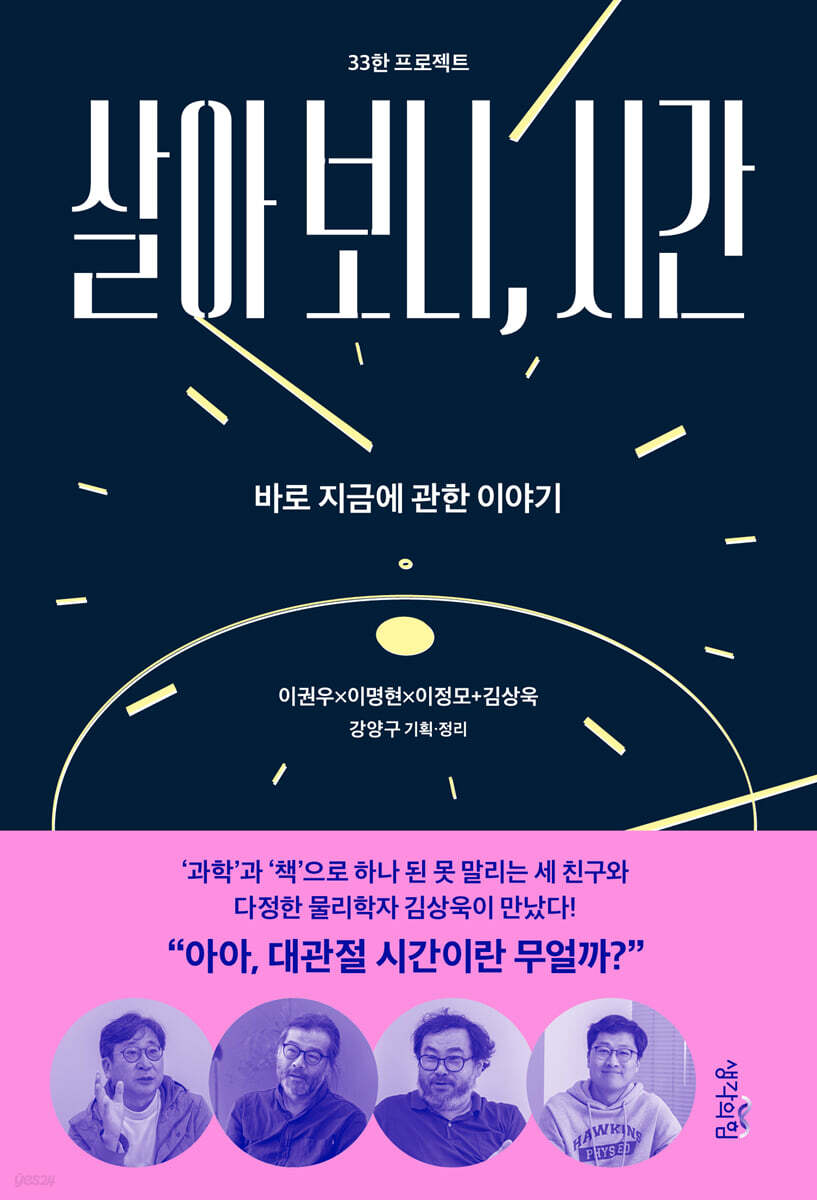
As I live, time
 |
Description
Book Introduction
- A word from MD
- [Living, Time, Intelligence, and Evolution] People, life, and science meet.
A project to celebrate the 60th birthdays of Lee Kwon-woo, Lee Myeong-hyeon, and Lee Jeong-mo, representatives of the liberal arts and science community, planned by reporter Kang Yang-gu.
It features conversations with Kim Sang-wook, Jeong Jae-seung, and Jang Dae-ik on the topics of time, evolution, and intelligence.
I am happy to hear the experiences and gentle advice of an 'adult' who best suits the expression 'having lived'.
- Hyunjae Ahn, PD of Natural Sciences
The eternal theme of humanity,
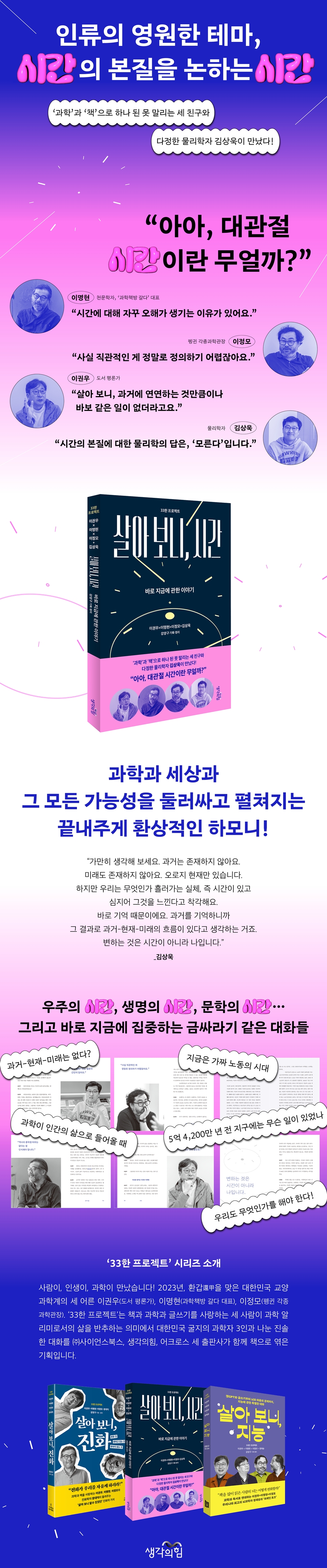
Time to discuss the essence of 'time'
Here, a book has been published that presents a truly fantastical harmony surrounding science, the world, and all its possibilities.
Astronomer and CEO of 'Science Bookstore Galda' Lee Myeong-hyeon, Penguin Science Museum Director Lee Jeong-mo, book critic Lee Kwon-woo, and physicist Kim Sang-wook come together to discuss the ins and outs of time.
The book is divided into Part 1 (Past, Present, Future) and Part 2 (Now).
Part 1 delves into the gap between our perception of time and that of scientists, while Part 2 closely examines the very moment we stand upon in this boundless world.
The four are gathered around the single theme of 'time', but they do not speak with one voice.
Each of them tells their own unique 'time'.
Even within the single volume of “Living, Time,” readers experience the mysterious experience of transcending time and space.
We look at all of time, which exists sometimes as numbers, sometimes as memories, and sometimes as experiences.
Time to discuss the essence of 'time'
Here, a book has been published that presents a truly fantastical harmony surrounding science, the world, and all its possibilities.
Astronomer and CEO of 'Science Bookstore Galda' Lee Myeong-hyeon, Penguin Science Museum Director Lee Jeong-mo, book critic Lee Kwon-woo, and physicist Kim Sang-wook come together to discuss the ins and outs of time.
The book is divided into Part 1 (Past, Present, Future) and Part 2 (Now).
Part 1 delves into the gap between our perception of time and that of scientists, while Part 2 closely examines the very moment we stand upon in this boundless world.
The four are gathered around the single theme of 'time', but they do not speak with one voice.
Each of them tells their own unique 'time'.
Even within the single volume of “Living, Time,” readers experience the mysterious experience of transcending time and space.
We look at all of time, which exists sometimes as numbers, sometimes as memories, and sometimes as experiences.
- You can preview some of the book's contents.
Preview
index
Opening Remarks | The Meaning of Time, the Meaning of Sixtieth Birthday_Kim Sang-wook
Part 1: Past, Present, and Future
Part 2 now
Closing Remarks | Time Travel_Lee Myeong-hyeon
Changes in Planning | Sam-i (三李) as Seen by Kang Yang-gu
Part 1: Past, Present, and Future
Part 2 now
Closing Remarks | Time Travel_Lee Myeong-hyeon
Changes in Planning | Sam-i (三李) as Seen by Kang Yang-gu
Detailed image
Into the book
Numbers have no meaning.
1 is 1, and 2 is just two 1s put together.
There is no profound meaning to '1+1=2'.
It is the process of creating 2, and also the definition of 2.
Justice is giving a name.
My name is 'Kim Sang-wook'.
There is no necessary reason for this.
If it weren't for that, even people who see me for the first time would know my name just by looking at my face.
The original definition has no meaning.
--- p.7, from the “Opening Remarks”
Lee Kwon-woo: There may also be differences depending on whether or not there is a new experience.
When I was young, everything was new and vivid in my memory.
But as we get older, we tend to repeat the same things we've experienced before, and there's no need to remember them all.
Isn't it because memories are scattered like this that we feel time passes quickly?
--- p.24, from “Part 1, “Time Does Not Flow Equally””
Kim Sang-wook: As always, the question "what is it?" isn't simple.
Essential questions like 'What is time?' are not questions of physics.
Physics is a discipline that describes phenomena.
The question in physics is: can mass be measured? More importantly, can it be predicted?
I think Isaac Newton thought so too.
He never defined time either.
In fact, no physicist since Newton has ever answered the question, "What is time?"
Since Newton, 'time' has been a 'number' to physicists.
Philosophically speaking, we could say something fancy like “Time (as a physical entity) does not exist.”
--- p.27~28, from “Part 1, “What is Time?”
Lee Jeong-mo: Will humans be able to survive when climate change accelerates mass extinctions? We are the only species on Earth that has attempted to define time.
By our standards, we interpreted cosmic time and Earth time as the time of life.
But if humans who worry about time disappear, will time really have any meaning?
--- p.53, from “Part 1, “To Discuss Time Forever””
Lee Myeong-hyeon: I think the impact of railroads on society in the early modern era was enormous.
If you read modern novels, trains appear a lot.
There are people who leave on the train and people who are left behind.
Those left behind are portrayed as frustrated and isolated, unable to make it into the modern era.
Railways and trains were symbols of modern times.
--- p.64~65, from “Part 1, Until the Clock Hands of Everywhere Match”
Lee Kwon-woo: As Professor Kim Sang-wook strongly emphasized, critical reflection is inevitable when science enters human life.
And considering the impact of science and technology on our lives today, it is the job of the humanities and social sciences to properly criticize and reflect on it.
--- p.93, from “Part 2, When Science Enters Human Life”
Lee Jeong-mo: We live within a modern time frame anyway.
If so, then we must accept that as modern people, we cannot stop thinking about a world that is a little better than the one we have now, as our limitation.
The problem is that we stop worrying about that even though we still live in a modern time concept.
--- p.107, from “Part 2, “Now Again, the Time of Myth”
Lee Myeong-hyeon: Professor Kim Sang-wook just asked a fundamental question.
I think what we've learned from history so far is that it's a matter of attitude.
There are things you shouldn't do.
Setting a goal and running towards it as if there is an end point in history.
We must recognize that there is no such thing as an end point to history.
The best we can do is to take a half-step, not a full step, into the future, and discuss and compare our options without insisting that our own half-step is the best option.
Furthermore, we will make it a reality one by one by making the most of the values, systems, and tools that have been positive for human happiness so far.
--- p.113~114, from “Part 2, “We Must Do Something Too””
Kim Sang-wook: Now that we're on the subject, let me add one thing: Newton's and Hamilton's approaches are also connected to two different approaches to consciousness.
The modern computer originated from the Turing machine, proposed by mathematician Alan Turing in 1936.
The Turing machine is the Newtonian method.
The bit (information) of this moment determines the next bit (information).
However, the human brain or an AI that mimics it sets a goal, examines numerous paths to reach that goal, and then finds the optimal path.
It's Hamilton's method.
So both Newton's method and Hamilton's method exist in the universe.
Interestingly, Hamilton's method seems to have a purpose.
This is why we often feel like we are finding purpose in a purposeless universe.
You could say that this is something that happens because humans become obsessed with their purpose.
--- p.124~125, from “Part 2, “The Possibility of Copying Future Works”
The night sky may be full of fossils of stars and galaxies.
Sometimes I lie down and look at the night sky.
When I look at the night sky filled with traces of the past, I enjoy 'time'.
What else could it be but a sense of time if the reality of countless celestial bodies existing in different times and spaces are captured in my eyes and transmitted to my brain in an instant, causing me to have such thoughts?
1 is 1, and 2 is just two 1s put together.
There is no profound meaning to '1+1=2'.
It is the process of creating 2, and also the definition of 2.
Justice is giving a name.
My name is 'Kim Sang-wook'.
There is no necessary reason for this.
If it weren't for that, even people who see me for the first time would know my name just by looking at my face.
The original definition has no meaning.
--- p.7, from the “Opening Remarks”
Lee Kwon-woo: There may also be differences depending on whether or not there is a new experience.
When I was young, everything was new and vivid in my memory.
But as we get older, we tend to repeat the same things we've experienced before, and there's no need to remember them all.
Isn't it because memories are scattered like this that we feel time passes quickly?
--- p.24, from “Part 1, “Time Does Not Flow Equally””
Kim Sang-wook: As always, the question "what is it?" isn't simple.
Essential questions like 'What is time?' are not questions of physics.
Physics is a discipline that describes phenomena.
The question in physics is: can mass be measured? More importantly, can it be predicted?
I think Isaac Newton thought so too.
He never defined time either.
In fact, no physicist since Newton has ever answered the question, "What is time?"
Since Newton, 'time' has been a 'number' to physicists.
Philosophically speaking, we could say something fancy like “Time (as a physical entity) does not exist.”
--- p.27~28, from “Part 1, “What is Time?”
Lee Jeong-mo: Will humans be able to survive when climate change accelerates mass extinctions? We are the only species on Earth that has attempted to define time.
By our standards, we interpreted cosmic time and Earth time as the time of life.
But if humans who worry about time disappear, will time really have any meaning?
--- p.53, from “Part 1, “To Discuss Time Forever””
Lee Myeong-hyeon: I think the impact of railroads on society in the early modern era was enormous.
If you read modern novels, trains appear a lot.
There are people who leave on the train and people who are left behind.
Those left behind are portrayed as frustrated and isolated, unable to make it into the modern era.
Railways and trains were symbols of modern times.
--- p.64~65, from “Part 1, Until the Clock Hands of Everywhere Match”
Lee Kwon-woo: As Professor Kim Sang-wook strongly emphasized, critical reflection is inevitable when science enters human life.
And considering the impact of science and technology on our lives today, it is the job of the humanities and social sciences to properly criticize and reflect on it.
--- p.93, from “Part 2, When Science Enters Human Life”
Lee Jeong-mo: We live within a modern time frame anyway.
If so, then we must accept that as modern people, we cannot stop thinking about a world that is a little better than the one we have now, as our limitation.
The problem is that we stop worrying about that even though we still live in a modern time concept.
--- p.107, from “Part 2, “Now Again, the Time of Myth”
Lee Myeong-hyeon: Professor Kim Sang-wook just asked a fundamental question.
I think what we've learned from history so far is that it's a matter of attitude.
There are things you shouldn't do.
Setting a goal and running towards it as if there is an end point in history.
We must recognize that there is no such thing as an end point to history.
The best we can do is to take a half-step, not a full step, into the future, and discuss and compare our options without insisting that our own half-step is the best option.
Furthermore, we will make it a reality one by one by making the most of the values, systems, and tools that have been positive for human happiness so far.
--- p.113~114, from “Part 2, “We Must Do Something Too””
Kim Sang-wook: Now that we're on the subject, let me add one thing: Newton's and Hamilton's approaches are also connected to two different approaches to consciousness.
The modern computer originated from the Turing machine, proposed by mathematician Alan Turing in 1936.
The Turing machine is the Newtonian method.
The bit (information) of this moment determines the next bit (information).
However, the human brain or an AI that mimics it sets a goal, examines numerous paths to reach that goal, and then finds the optimal path.
It's Hamilton's method.
So both Newton's method and Hamilton's method exist in the universe.
Interestingly, Hamilton's method seems to have a purpose.
This is why we often feel like we are finding purpose in a purposeless universe.
You could say that this is something that happens because humans become obsessed with their purpose.
--- p.124~125, from “Part 2, “The Possibility of Copying Future Works”
The night sky may be full of fossils of stars and galaxies.
Sometimes I lie down and look at the night sky.
When I look at the night sky filled with traces of the past, I enjoy 'time'.
What else could it be but a sense of time if the reality of countless celestial bodies existing in different times and spaces are captured in my eyes and transmitted to my brain in an instant, causing me to have such thoughts?
--- p.133, from the “Closing Remarks”
Publisher's Review
With 'science' and 'books'
With three unstoppable friends who became one
We met the affectionate physicist Kim Sang-wook.
'Time' is near.
It's familiar.
It's clear.
It's life and everyday life.
But when we move into the realm of physics, the story is very different.
Newton, the father of physics, did not define time (a “really brilliant decision,” according to physicist Sang-wook Kim), and neither did Einstein.
No physicist has ever answered the question, 'What is time?'
To them, time is nothing more or less than a number, and past-present-future are illusions.
They say that even the expression “time passes” is a misleading expression that can lead to misunderstanding.
The reader is suddenly confused.
So I try to protest, but for some reason my mouth won't open.
Ah, what on earth is time!
Here, a book has been published that presents a truly fantastical harmony surrounding science, the world, and all its possibilities.
As always, the question 'what is' is not simple.
That's why they came together.
Astronomer and 'Science Bookstore Galda' CEO Lee Myeong-hyeon, who has been immersed in popularizing knowledge by consistently interacting with 'science' and 'reading' for the past 20 years, Penguin Various Science Museum Director Lee Jeong-mo, book critic Lee Kwon-woo, and physicist Kim Sang-wook, who was inspired by their journey, come together to discuss the ins and outs of time.
From Earth to space, it travels through countless misconceptions about time and various theories that explain the world.
A breathless exchange of golden conversations focusing on the time of the universe, the time of humanity, the time of life, the time of labor, the time of literature, and the present moment.
There is no past-present-future!?
Is this the era of fake labor!?
In the opening essay, “The Meaning of Time, the Meaning of Sixtieth Birthday,” Kim Sang-wook says:
“The answer from physics to the question of the nature of time is (firmly) ‘I don’t know.’” He had previously mentioned ‘time’ as “the devil’s subject” on his personal SNS.
In fact, this project began as a celebration of the joint 60th birthday of three friends of the same age: Lee Kwon-woo, Lee Myeong-hyeon, and Lee Jeong-mo.
This naturally leads to the topic of the conversation, ‘time’, and Kim Sang-wook pours cold water on it, saying, “This event started from something that was essentially meaningless.”
However, he soon adds, “There are many ways to give meaning to the meaningless,” rekindling the project’s flame. This marks the beginning of a profound yet unpredictable conversation surrounding the eternal and age-old theme of humanity: the essence of time.
The book is divided into Part 1 (Past, Present, Future) and Part 2 (Now).
Part 1 explores the gap between our perception of time and that of scientists.
We think (or mistakenly believe) that there is a flow of past-present-future because of 'memory', but in fact, along with Kim Sang-wook's words (page 39) that "it is not time that changes, but I", subtopics such as "Time Does Not Flow Evenly", "The Past Does Not Exist!?", "What Happened to Earth 542 Million Years Ago", "The Periodic Table and Evolution", and "Until Clock Hands All Over the World Agree" rush toward the reader.
Part 2 examines in detail the moment we step foot in the boundless vastness of the world.
We will reflect on the concerns and best practices we must address now, moving through sub-topics such as “The Age of Fake Labor,” “Time That Cannot Be Converted into Money is Beautiful,” “When Science Enters Human Life,” and “We Must Do Something, Too.”
People who have lived
Passed on to those who will live
Hot words and words
In the closing essay, “Time Travel,” Lee Myeong-hyeon says:
“I often wonder if we are time travelers, traveling through different time zones.” These four people are gathered around the theme of ‘time,’ but they do not speak with one voice.
Lee Kwon-woo tells Lee Kwon-woo's unique 'time', Lee Myeong-hyeon tells Lee Myeong-hyeon's unique 'time', Lee Jeong-mo tells Lee Jeong-mo's unique 'time', and Kim Sang-wook tells Kim Sang-wook's unique 'time'.
Within the single volume of “Living, Time,” readers experience the mysterious experience of transcending time and space.
It examines all of time, which exists sometimes as numbers, sometimes as memories, and sometimes as experiences.
The special friendship they have shared for over 20 years warmly envelops every corner of the page.
Just as I was passionate about the past time, I will carefully add my affection and concern to the future time as well.
Thanks to this, we can encounter the refreshing experience of retrieving the warm and gentle nagging of 'adults' that have been absent in our times.
“Finally, I would like to say just one thing to the readers of this book.
As I live, I realize that there is nothing more foolish than dwelling on the past.
“I hope you can forget all the pain, wounds, regrets, and hesitation and focus on the present, on today,” said Lee Kwon-woo.
There is no time for business, and after going around and around, it all comes down to ‘now.’
With three unstoppable friends who became one
We met the affectionate physicist Kim Sang-wook.
'Time' is near.
It's familiar.
It's clear.
It's life and everyday life.
But when we move into the realm of physics, the story is very different.
Newton, the father of physics, did not define time (a “really brilliant decision,” according to physicist Sang-wook Kim), and neither did Einstein.
No physicist has ever answered the question, 'What is time?'
To them, time is nothing more or less than a number, and past-present-future are illusions.
They say that even the expression “time passes” is a misleading expression that can lead to misunderstanding.
The reader is suddenly confused.
So I try to protest, but for some reason my mouth won't open.
Ah, what on earth is time!
Here, a book has been published that presents a truly fantastical harmony surrounding science, the world, and all its possibilities.
As always, the question 'what is' is not simple.
That's why they came together.
Astronomer and 'Science Bookstore Galda' CEO Lee Myeong-hyeon, who has been immersed in popularizing knowledge by consistently interacting with 'science' and 'reading' for the past 20 years, Penguin Various Science Museum Director Lee Jeong-mo, book critic Lee Kwon-woo, and physicist Kim Sang-wook, who was inspired by their journey, come together to discuss the ins and outs of time.
From Earth to space, it travels through countless misconceptions about time and various theories that explain the world.
A breathless exchange of golden conversations focusing on the time of the universe, the time of humanity, the time of life, the time of labor, the time of literature, and the present moment.
There is no past-present-future!?
Is this the era of fake labor!?
In the opening essay, “The Meaning of Time, the Meaning of Sixtieth Birthday,” Kim Sang-wook says:
“The answer from physics to the question of the nature of time is (firmly) ‘I don’t know.’” He had previously mentioned ‘time’ as “the devil’s subject” on his personal SNS.
In fact, this project began as a celebration of the joint 60th birthday of three friends of the same age: Lee Kwon-woo, Lee Myeong-hyeon, and Lee Jeong-mo.
This naturally leads to the topic of the conversation, ‘time’, and Kim Sang-wook pours cold water on it, saying, “This event started from something that was essentially meaningless.”
However, he soon adds, “There are many ways to give meaning to the meaningless,” rekindling the project’s flame. This marks the beginning of a profound yet unpredictable conversation surrounding the eternal and age-old theme of humanity: the essence of time.
The book is divided into Part 1 (Past, Present, Future) and Part 2 (Now).
Part 1 explores the gap between our perception of time and that of scientists.
We think (or mistakenly believe) that there is a flow of past-present-future because of 'memory', but in fact, along with Kim Sang-wook's words (page 39) that "it is not time that changes, but I", subtopics such as "Time Does Not Flow Evenly", "The Past Does Not Exist!?", "What Happened to Earth 542 Million Years Ago", "The Periodic Table and Evolution", and "Until Clock Hands All Over the World Agree" rush toward the reader.
Part 2 examines in detail the moment we step foot in the boundless vastness of the world.
We will reflect on the concerns and best practices we must address now, moving through sub-topics such as “The Age of Fake Labor,” “Time That Cannot Be Converted into Money is Beautiful,” “When Science Enters Human Life,” and “We Must Do Something, Too.”
People who have lived
Passed on to those who will live
Hot words and words
In the closing essay, “Time Travel,” Lee Myeong-hyeon says:
“I often wonder if we are time travelers, traveling through different time zones.” These four people are gathered around the theme of ‘time,’ but they do not speak with one voice.
Lee Kwon-woo tells Lee Kwon-woo's unique 'time', Lee Myeong-hyeon tells Lee Myeong-hyeon's unique 'time', Lee Jeong-mo tells Lee Jeong-mo's unique 'time', and Kim Sang-wook tells Kim Sang-wook's unique 'time'.
Within the single volume of “Living, Time,” readers experience the mysterious experience of transcending time and space.
It examines all of time, which exists sometimes as numbers, sometimes as memories, and sometimes as experiences.
The special friendship they have shared for over 20 years warmly envelops every corner of the page.
Just as I was passionate about the past time, I will carefully add my affection and concern to the future time as well.
Thanks to this, we can encounter the refreshing experience of retrieving the warm and gentle nagging of 'adults' that have been absent in our times.
“Finally, I would like to say just one thing to the readers of this book.
As I live, I realize that there is nothing more foolish than dwelling on the past.
“I hope you can forget all the pain, wounds, regrets, and hesitation and focus on the present, on today,” said Lee Kwon-woo.
There is no time for business, and after going around and around, it all comes down to ‘now.’
GOODS SPECIFICS
- Date of issue: December 20, 2023
- Page count, weight, size: 152 pages | 224g | 128*188*12mm
- ISBN13: 9791193166383
- ISBN10: 1193166381
You may also like
카테고리
korean


korean

![ELLE 엘르 스페셜 에디션 A형 : 12월 [2025]](http://librairie.coreenne.fr/cdn/shop/files/b8e27a3de6c9538896439686c6b0e8fb.jpg?v=1766436872&width=3840)


