

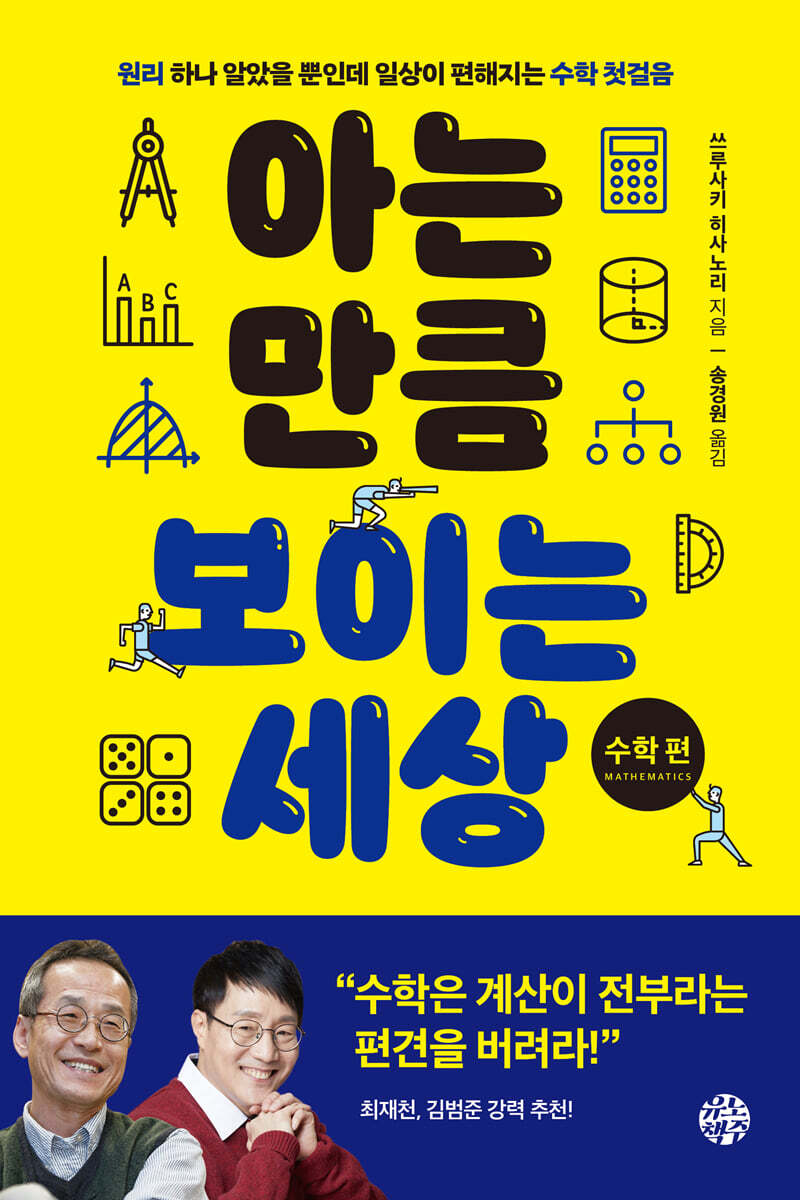
The World You See as Much as You Know: Mathematics
 |
Description
Book Introduction
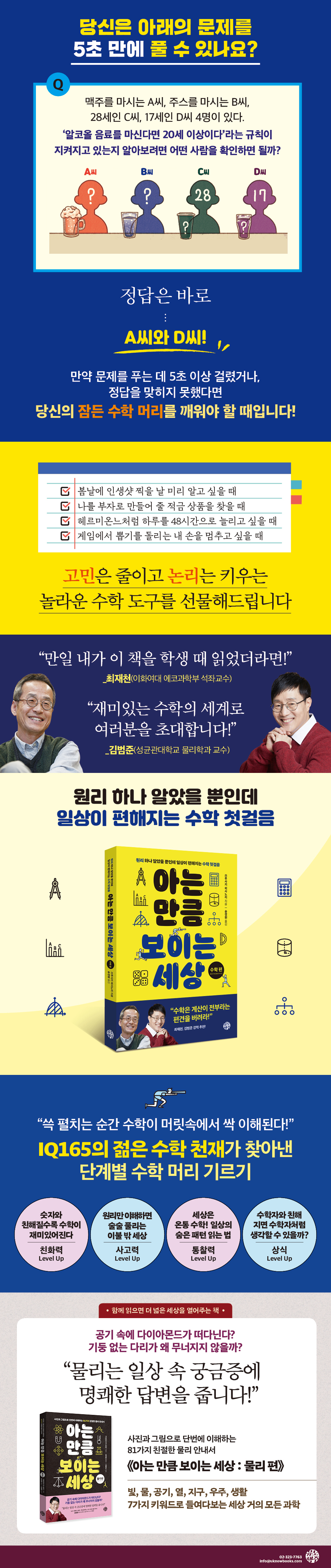
Choi Jae-cheon and Kim Beom-jun highly recommended! From the miracle of using a day as if it were 48 hours Even the method of shortening the distance from Seoul to Busan in just 5 minutes “Get rid of the prejudice that math is all about calculations!” “How can studying math help me in life?” It all started with this question that everyone, regardless of age, gender, or background, has asked themselves at least once. Why do we have such doubts about mathematics? It's because, throughout our years of education, from elementary school through high school, we're forced to calculate the concentration of salt water, a subject we've never even wondered about, and memorize complex formulas that seem only necessary for exams. Without even learning how to apply the mathematical formulas that we memorized with such difficulty in real life. But whether we're conscious of it or not, we see, touch, and use mathematics every day. For example, the corners of the road you encounter on your way to work are created using a curve called a 'clothoid' that uses mathematical principles. The goal is to design roads so that people can travel as safely as possible, thereby reducing the risk of accidents as much as possible. Additionally, all paper used for printing, such as A4 or B4 paper, is produced according to a mathematical ratio called 'Baek Eun-bi'. This is because objects made of silver always maintain the same proportions even if their size increases or decreases. Mathematics, which was so obvious that it was often overlooked, is still alive and breathing with us in our daily lives. |
- You can preview some of the book's contents.
Preview
index
We invite you to the fun and useful world of mathematics.
CHAPTER 1.
The more familiar you become with numbers, the more fun math becomes. _Level Up Your Affinity
Can you become Da Vinci just by knowing numbers? · The Golden Ratio
What do rabbits and sunflowers have in common? · Fibonacci sequence
Math is Hidden Even in A4 Paper · Baek Eun-bi
Why Mathematicians Praise Pythagoras · The Pythagorean Theorem
What do you call a number larger than 'trillion'? · Unit of number
Where did 'nano' and 'giga' come from? · SI prefixes
The Secret Behind the Saying: Without Math, There Would Be No Google · Googol
The identity of the number so large that it was included in the Guinness Book of World Records: Graham's number
Why did mathematicians deny infinity? · The emergence of infinity
Why the 'concentration' of chemistry and mathematics is different · Concentration of mathematics
A joke-like number that you couldn't believe even after seeing it. · Infinite discovery.
Why '-1' was called a 'fake number' until recently · 0 and negative numbers
Pythagoras denied the number '√2' · Irrational number
The last number reached by mankind · Imaginary number
What lies at the end of the number world? Complex numbers
CHAPTER 2.
The world outside the blankets becomes easier once you understand the principles - Level up your thinking skills
Before you start playing the game, let's open the math book first. · Probability theory
How many trees are there on the mountain behind my house? · One-on-one correspondence
Can you use math to determine the number of crows living on your neighborhood hill? · Marker recapture method
How to avoid getting lost in a maze? · Search algorithm
How to find the word you want in the dictionary using only guesses · Binary search
The Miracle Flowchart That Turns My Day into 48 Hours
Knowing 'this' is all you need to get a new smartphone? · Venn Diagram
The Law of Compound Interest: Getting Rich Through Math · Simple Interest and Compound Interest
Will one English word you memorize today turn into a hundred? · Effort and Compensation
True or false, the standard is the issue · Daewoo Law
There's no need to give up on your ideal type in advance. Using the treatment method.
Why "Sizing Up" at the Supermarket Feels Like a Scam · Similarity Ratio
Why Mathematicians Don't Believe in the Mean · Standard Deviation
How much better am I doing compared to others? · Deviation value
CHAPTER 3.
The world is full of math! How to read hidden patterns in everyday life - Level up your insight.
Why You Can't Become a Millionaire Through Gambling · Martingale Method
Is Buying a Lottery Ticket a Win or a Loss? · Calculating Expected Value
If you want to sell insurance, you need to know math. Insurance and math.
From Seoul to Busan in 5 minutes? · Cycloid
Why are there so many curves at highway exits? · Clothoid
The Truth Behind the Claim That Differentiation Is a Relic of War · The Birth of Differentiation
How can an electronic thermometer measure body temperature in just 30 seconds? · Using Differentiation
The mathematician who died unjustly because of 'integration' · The history of integration
How to Know When Cherry Blossoms Will Bloom Before the Meteorological Administration · Integral Calculus and Cherry Blossoms
Why You Can Log In to Internet Sites Without Worry · The Evolution of Passwords
Public key cryptography and RSA encryption that protect our information
Anyone can become a hacker with just one computer? · Shor's Algorithm
Statistics are important for insurance and pensions. Statistics
How many people should be asked in an exit poll to be accurate? · Sample polling
People who became politicians by cheating on numbers · Gerrymandering
How to Distinguish Chance from Necessity · Reliability
Why do mathematicians hate blood type? · Blood Type and Probability
Did Humans Originally Only Have Type O Blood? · The History of Blood Types
CHAPTER 4.
Will Becoming a Mathematician Help You Think Like One? _Common Sense Level Up
The Secret of Pythagoras We Didn't Know · Pythagoras
Who was the first person to determine the size of the Earth? · Eratosthenes
Why 'Fermat's Last Theorem' is Famous · Pierre de Fermat
The man who discovered gravity but couldn't make money · Isaac Newton
Évariste Galois, the genius mathematician who died in a duel
Is there math hidden in taxi license plates? · Srinivasa Ramanujan
Can Computers Be Beat by Calculating? · John von Neumann
Ending the War by Breaking Codes · Alan Turing
Even monkeys fall out of trees · Alexander Grothendieck
Calculation techniques that are helpful to know in the appendix
Until the day we all find our own formula
CHAPTER 1.
The more familiar you become with numbers, the more fun math becomes. _Level Up Your Affinity
Can you become Da Vinci just by knowing numbers? · The Golden Ratio
What do rabbits and sunflowers have in common? · Fibonacci sequence
Math is Hidden Even in A4 Paper · Baek Eun-bi
Why Mathematicians Praise Pythagoras · The Pythagorean Theorem
What do you call a number larger than 'trillion'? · Unit of number
Where did 'nano' and 'giga' come from? · SI prefixes
The Secret Behind the Saying: Without Math, There Would Be No Google · Googol
The identity of the number so large that it was included in the Guinness Book of World Records: Graham's number
Why did mathematicians deny infinity? · The emergence of infinity
Why the 'concentration' of chemistry and mathematics is different · Concentration of mathematics
A joke-like number that you couldn't believe even after seeing it. · Infinite discovery.
Why '-1' was called a 'fake number' until recently · 0 and negative numbers
Pythagoras denied the number '√2' · Irrational number
The last number reached by mankind · Imaginary number
What lies at the end of the number world? Complex numbers
CHAPTER 2.
The world outside the blankets becomes easier once you understand the principles - Level up your thinking skills
Before you start playing the game, let's open the math book first. · Probability theory
How many trees are there on the mountain behind my house? · One-on-one correspondence
Can you use math to determine the number of crows living on your neighborhood hill? · Marker recapture method
How to avoid getting lost in a maze? · Search algorithm
How to find the word you want in the dictionary using only guesses · Binary search
The Miracle Flowchart That Turns My Day into 48 Hours
Knowing 'this' is all you need to get a new smartphone? · Venn Diagram
The Law of Compound Interest: Getting Rich Through Math · Simple Interest and Compound Interest
Will one English word you memorize today turn into a hundred? · Effort and Compensation
True or false, the standard is the issue · Daewoo Law
There's no need to give up on your ideal type in advance. Using the treatment method.
Why "Sizing Up" at the Supermarket Feels Like a Scam · Similarity Ratio
Why Mathematicians Don't Believe in the Mean · Standard Deviation
How much better am I doing compared to others? · Deviation value
CHAPTER 3.
The world is full of math! How to read hidden patterns in everyday life - Level up your insight.
Why You Can't Become a Millionaire Through Gambling · Martingale Method
Is Buying a Lottery Ticket a Win or a Loss? · Calculating Expected Value
If you want to sell insurance, you need to know math. Insurance and math.
From Seoul to Busan in 5 minutes? · Cycloid
Why are there so many curves at highway exits? · Clothoid
The Truth Behind the Claim That Differentiation Is a Relic of War · The Birth of Differentiation
How can an electronic thermometer measure body temperature in just 30 seconds? · Using Differentiation
The mathematician who died unjustly because of 'integration' · The history of integration
How to Know When Cherry Blossoms Will Bloom Before the Meteorological Administration · Integral Calculus and Cherry Blossoms
Why You Can Log In to Internet Sites Without Worry · The Evolution of Passwords
Public key cryptography and RSA encryption that protect our information
Anyone can become a hacker with just one computer? · Shor's Algorithm
Statistics are important for insurance and pensions. Statistics
How many people should be asked in an exit poll to be accurate? · Sample polling
People who became politicians by cheating on numbers · Gerrymandering
How to Distinguish Chance from Necessity · Reliability
Why do mathematicians hate blood type? · Blood Type and Probability
Did Humans Originally Only Have Type O Blood? · The History of Blood Types
CHAPTER 4.
Will Becoming a Mathematician Help You Think Like One? _Common Sense Level Up
The Secret of Pythagoras We Didn't Know · Pythagoras
Who was the first person to determine the size of the Earth? · Eratosthenes
Why 'Fermat's Last Theorem' is Famous · Pierre de Fermat
The man who discovered gravity but couldn't make money · Isaac Newton
Évariste Galois, the genius mathematician who died in a duel
Is there math hidden in taxi license plates? · Srinivasa Ramanujan
Can Computers Be Beat by Calculating? · John von Neumann
Ending the War by Breaking Codes · Alan Turing
Even monkeys fall out of trees · Alexander Grothendieck
Calculation techniques that are helpful to know in the appendix
Until the day we all find our own formula
Detailed image
Into the book
“There’s no difference! Aren’t you lying in the store?”
We've all probably complained about this at least once when ordering a "double portion" of food at a Chinese restaurant or a "size up" drink at a cafe.
This is also similar to the 10% increase in tofu in the example above, where the store increased the quantity of the product as advertised, but it is likely that it was not readily apparent.
--- From "Why 'Sizing Up' at the Mart Feels Like a Scam"
They say there's no surefire way to win in gambling, but some people secretly hope to "make a fortune overnight and turn their lives around!"
These dreams make you wonder if there are other ways to gamble or bet that have a better chance of making money.
The standard for judgment at this time is the ‘expected value’ or ‘deduction rate’.
(Omitted) For example, let's think about a dice game.
If you were to roll a dice once and there were two conditions: 'If you get a 1, you get 10,000 won, if you get any other number, you get 0 won' and 'If you get a 1, you get 0 won, if you get any other number, you get 2,500 won', and you could participate in either game, which one would you choose?
--- From "Is it profitable or a loss to buy a lottery ticket?"
The most widely used encryption method today is RSA cryptography, widely used in applications such as email and e-commerce security. RSA cryptography uses "public key cryptography" rather than shared key cryptography.
The keys used for encryption and decryption are different, and the key used for encryption can be made public.
In the case of common key encryption, there is a risk of the key being stolen when handed over, and it is also expensive to transmit it secretly.
That's why it's difficult for ordinary people to exchange data using common key encryption.
Public key cryptography is what solves this problem.
--- From "Public Key Cryptography That Protects Our Information"
Newton also lost 20,000 pounds, which is equivalent to 4.4 million pounds (about 6.8 billion won) in today's money, invested in South Sea Company stock at this time.
After suffering such a huge loss, Newton said, “I can calculate the motions of heavenly bodies, but not the madness of men.”
Even Newton, a genius mathematician and scientist, had no great talent for investing.
We've all probably complained about this at least once when ordering a "double portion" of food at a Chinese restaurant or a "size up" drink at a cafe.
This is also similar to the 10% increase in tofu in the example above, where the store increased the quantity of the product as advertised, but it is likely that it was not readily apparent.
--- From "Why 'Sizing Up' at the Mart Feels Like a Scam"
They say there's no surefire way to win in gambling, but some people secretly hope to "make a fortune overnight and turn their lives around!"
These dreams make you wonder if there are other ways to gamble or bet that have a better chance of making money.
The standard for judgment at this time is the ‘expected value’ or ‘deduction rate’.
(Omitted) For example, let's think about a dice game.
If you were to roll a dice once and there were two conditions: 'If you get a 1, you get 10,000 won, if you get any other number, you get 0 won' and 'If you get a 1, you get 0 won, if you get any other number, you get 2,500 won', and you could participate in either game, which one would you choose?
--- From "Is it profitable or a loss to buy a lottery ticket?"
The most widely used encryption method today is RSA cryptography, widely used in applications such as email and e-commerce security. RSA cryptography uses "public key cryptography" rather than shared key cryptography.
The keys used for encryption and decryption are different, and the key used for encryption can be made public.
In the case of common key encryption, there is a risk of the key being stolen when handed over, and it is also expensive to transmit it secretly.
That's why it's difficult for ordinary people to exchange data using common key encryption.
Public key cryptography is what solves this problem.
--- From "Public Key Cryptography That Protects Our Information"
Newton also lost 20,000 pounds, which is equivalent to 4.4 million pounds (about 6.8 billion won) in today's money, invested in South Sea Company stock at this time.
After suffering such a huge loss, Newton said, “I can calculate the motions of heavenly bodies, but not the madness of men.”
Even Newton, a genius mathematician and scientist, had no great talent for investing.
--- From "The Man Who Discovered Gravity But Couldn't Attract Money"
Publisher's Review
“If only I had read this book when I was a student!”
Choi Jae-cheon (Professor Emeritus, Department of Eco-Science, Ewha Womans University)
“We invite you to the fun world of mathematics!”
Kim Beom-jun (Professor of Physics, Sungkyunkwan University)
《The World You See as Much as You Know: Mathematics》 is an invitation from a mathematician to those who want to enjoy mathematics a little more and learn how to apply it in real life.
There are no complicated formulas to memorize or boring questions with points at stake.
From Chapters 1 to 4, the book introduces the secrets of numbers and mathematical principles hidden in everyday life through daily experiences, leading readers to naturally discover mathematics through simple observations.
Additionally, the concept of numbers is explained in an easy and fun way that even middle school students can understand, so background knowledge related to mathematics is not required.
Whether you're new to math or a dropout who finds it too difficult, this book will help you discover the mathematical principles surrounding you and help you think about everyday problems through a mathematical lens.
And by the time you finish reading the book and close it, you will have experienced your thoughts being easily resolved through the development of your thinking skills as you become more familiar with mathematics, and you will realize that mathematics is the best tool to solve the problems in our lives.
How can mathematics solve life's problems?
How can you make your day twice as long as it is now? Could you get from Seoul to Busan in just five minutes? Why knowing math can help you avoid being scammed in gambling? What bank products should you invest in to make more money?
As we live, we face countless questions and are faced with difficult choices.
What if there was a way to quickly broaden your perspective on the world and make everyday decisions easier? In fact, you've already addressed this question yourself.
Because math, which most students gave up on and ignored, is the answer.
Just knowing one principle is the first step to making your daily life easier in mathematics!
Every year, as the college entrance exam approaches, I see articles about a torrent of students who have given up on math.
There are two reasons why they give up on math.
The first is 'because it's too difficult', and the second is 'because it's difficult and doesn't seem to be of much use'.
Both are misconceptions about math, but the second one is more problematic in our lives.
Have you ever heard the saying, "All philosophers are mathematicians"? This is like saying that the foundation of logic is mathematics.
In fact, mathematical principles are hidden in everything we wear, use, and eat, so the more we know about mathematics, the better we can logically solve various problems we encounter in real life.
Let's think about a situation where we cook dinner ourselves.
Do you only start making side dishes after the rice is cooked? Absolutely not.
First, put the rice in the rice cooker, and while the rice is cooking, wash the vegetables, prepare the ingredients, and prepare other dishes.
Most people may not be conscious of this and act accordingly, but this is also an attempt to handle things logically.
But with just a little more knowledge of simple math principles, you can figure out how to cook faster than anyone else with minimal effort.
In this way, mathematics becomes a powerful weapon for analyzing and solving everyday problems.
Enhance your thinking skills and insight, and discover the fun of mathematics.
Almost all everyday math!
Hisanori Tsurusaki, a mathematician who graduated from the Department of Mathematics at the University of Tokyo and is famous among the Japanese public as the “Quiz King” through his activities on various TV programs and YouTube, felt sorry for people who were tired of difficult formulas and calculation processes.
And I created this book by leveraging the fun of mathematics that I discovered at the age of three and my own experience of freely using mathematics in real life.
This book introduces mathematical principles in everyday life through four stages, so that even those who are afraid of math can break down the barrier and gradually improve their mathematical thinking skills.
The first, 'The more familiar you become with numbers, the more fun math becomes', introduces the story of numbers that we often come across but do not know in detail.
You can read about episodes related to numbers in an easy and fun way, such as why the internet search engine 'Google' became 'Google' and what the last number discovered by mankind was.
Now that numbers feel more familiar, you can learn how to apply math to your daily life through various examples in the second book, "The World Outside the Blankets: A World That Solves Easily with Just Understanding the Principles."
The 'method of dealing', which can reveal the weaknesses of a liar with just a moment's thought, or the reason why drawing a lottery in a game always leads to failure, can be figured out through simple principles.
The third, "The World is Full of Math! How to Read Hidden Patterns in Everyday Life," contains the hidden mathematical principles that underpin our daily lives.
"How does the Korea Meteorological Administration determine when cherry blossoms will bloom?", "How many people should be asked in an exit poll to be accurate?" You can find the answers to these questions right here.
The fourth, "If I Become Friends with Mathematicians, Can I Think Like One?", introduces mathematicians who have left their mark on history and the various episodes they are involved in.
Learning about the stories of mathematicians who display both remarkable genius and eccentricity will make mathematics, which can be difficult to approach, feel a little more approachable.
The last part of the book gives some techniques to speed up the calculations.
We've compiled a collection of simple calculation methods that can be easily utilized by anyone, regardless of whether they're in the humanities or sciences, and are useful in everyday life. We highly recommend that you try them out at least once.
A fun introduction to math that both liberal arts students and math nerds will enjoy reading!
Many people learn math reluctantly and are dragged into it during their school days, so once they break free from the shackles of 'studying', they no longer look back at math.
The fact that math is difficult and boring is not because math is really that difficult, but rather an illusion created by the exam-oriented math textbooks and education system.
This book, consisting of a total of 56 stories, adds the author's solid storytelling to everyday mathematical principles, making mathematics accessible and fun at the same time.
However, this does not mean that this book is light.
Even if you start off easy, as you read the book, you will be drawn deep into the world of mathematics guided by the author, and you will encounter a world of mathematical knowledge and stories you were not aware of before.
Some people may have just realized something they were curious about in middle school class decades ago, while others may have found a solution to a problem they've been struggling with for a long time.
You see as much as you know.
I hope that through this book, both math dropouts and math experts will experience a broader world.
Choi Jae-cheon (Professor Emeritus, Department of Eco-Science, Ewha Womans University)
“We invite you to the fun world of mathematics!”
Kim Beom-jun (Professor of Physics, Sungkyunkwan University)
《The World You See as Much as You Know: Mathematics》 is an invitation from a mathematician to those who want to enjoy mathematics a little more and learn how to apply it in real life.
There are no complicated formulas to memorize or boring questions with points at stake.
From Chapters 1 to 4, the book introduces the secrets of numbers and mathematical principles hidden in everyday life through daily experiences, leading readers to naturally discover mathematics through simple observations.
Additionally, the concept of numbers is explained in an easy and fun way that even middle school students can understand, so background knowledge related to mathematics is not required.
Whether you're new to math or a dropout who finds it too difficult, this book will help you discover the mathematical principles surrounding you and help you think about everyday problems through a mathematical lens.
And by the time you finish reading the book and close it, you will have experienced your thoughts being easily resolved through the development of your thinking skills as you become more familiar with mathematics, and you will realize that mathematics is the best tool to solve the problems in our lives.
How can mathematics solve life's problems?
How can you make your day twice as long as it is now? Could you get from Seoul to Busan in just five minutes? Why knowing math can help you avoid being scammed in gambling? What bank products should you invest in to make more money?
As we live, we face countless questions and are faced with difficult choices.
What if there was a way to quickly broaden your perspective on the world and make everyday decisions easier? In fact, you've already addressed this question yourself.
Because math, which most students gave up on and ignored, is the answer.
Just knowing one principle is the first step to making your daily life easier in mathematics!
Every year, as the college entrance exam approaches, I see articles about a torrent of students who have given up on math.
There are two reasons why they give up on math.
The first is 'because it's too difficult', and the second is 'because it's difficult and doesn't seem to be of much use'.
Both are misconceptions about math, but the second one is more problematic in our lives.
Have you ever heard the saying, "All philosophers are mathematicians"? This is like saying that the foundation of logic is mathematics.
In fact, mathematical principles are hidden in everything we wear, use, and eat, so the more we know about mathematics, the better we can logically solve various problems we encounter in real life.
Let's think about a situation where we cook dinner ourselves.
Do you only start making side dishes after the rice is cooked? Absolutely not.
First, put the rice in the rice cooker, and while the rice is cooking, wash the vegetables, prepare the ingredients, and prepare other dishes.
Most people may not be conscious of this and act accordingly, but this is also an attempt to handle things logically.
But with just a little more knowledge of simple math principles, you can figure out how to cook faster than anyone else with minimal effort.
In this way, mathematics becomes a powerful weapon for analyzing and solving everyday problems.
Enhance your thinking skills and insight, and discover the fun of mathematics.
Almost all everyday math!
Hisanori Tsurusaki, a mathematician who graduated from the Department of Mathematics at the University of Tokyo and is famous among the Japanese public as the “Quiz King” through his activities on various TV programs and YouTube, felt sorry for people who were tired of difficult formulas and calculation processes.
And I created this book by leveraging the fun of mathematics that I discovered at the age of three and my own experience of freely using mathematics in real life.
This book introduces mathematical principles in everyday life through four stages, so that even those who are afraid of math can break down the barrier and gradually improve their mathematical thinking skills.
The first, 'The more familiar you become with numbers, the more fun math becomes', introduces the story of numbers that we often come across but do not know in detail.
You can read about episodes related to numbers in an easy and fun way, such as why the internet search engine 'Google' became 'Google' and what the last number discovered by mankind was.
Now that numbers feel more familiar, you can learn how to apply math to your daily life through various examples in the second book, "The World Outside the Blankets: A World That Solves Easily with Just Understanding the Principles."
The 'method of dealing', which can reveal the weaknesses of a liar with just a moment's thought, or the reason why drawing a lottery in a game always leads to failure, can be figured out through simple principles.
The third, "The World is Full of Math! How to Read Hidden Patterns in Everyday Life," contains the hidden mathematical principles that underpin our daily lives.
"How does the Korea Meteorological Administration determine when cherry blossoms will bloom?", "How many people should be asked in an exit poll to be accurate?" You can find the answers to these questions right here.
The fourth, "If I Become Friends with Mathematicians, Can I Think Like One?", introduces mathematicians who have left their mark on history and the various episodes they are involved in.
Learning about the stories of mathematicians who display both remarkable genius and eccentricity will make mathematics, which can be difficult to approach, feel a little more approachable.
The last part of the book gives some techniques to speed up the calculations.
We've compiled a collection of simple calculation methods that can be easily utilized by anyone, regardless of whether they're in the humanities or sciences, and are useful in everyday life. We highly recommend that you try them out at least once.
A fun introduction to math that both liberal arts students and math nerds will enjoy reading!
Many people learn math reluctantly and are dragged into it during their school days, so once they break free from the shackles of 'studying', they no longer look back at math.
The fact that math is difficult and boring is not because math is really that difficult, but rather an illusion created by the exam-oriented math textbooks and education system.
This book, consisting of a total of 56 stories, adds the author's solid storytelling to everyday mathematical principles, making mathematics accessible and fun at the same time.
However, this does not mean that this book is light.
Even if you start off easy, as you read the book, you will be drawn deep into the world of mathematics guided by the author, and you will encounter a world of mathematical knowledge and stories you were not aware of before.
Some people may have just realized something they were curious about in middle school class decades ago, while others may have found a solution to a problem they've been struggling with for a long time.
You see as much as you know.
I hope that through this book, both math dropouts and math experts will experience a broader world.
GOODS SPECIFICS
- Date of issue: October 20, 2023
- Page count, weight, size: 236 pages | 332g | 140*210*20mm
- ISBN13: 9791192300870
- ISBN10: 1192300874
You may also like
카테고리
korean


korean

![GQ KOREA Mark (Monthly): December [2025]](http://librairie.coreenne.fr/cdn/shop/files/8ef265dbbfbf186523ed75ba7319009d.jpg?v=1765340328&width=3840)


