

Science Toon Scientists 3
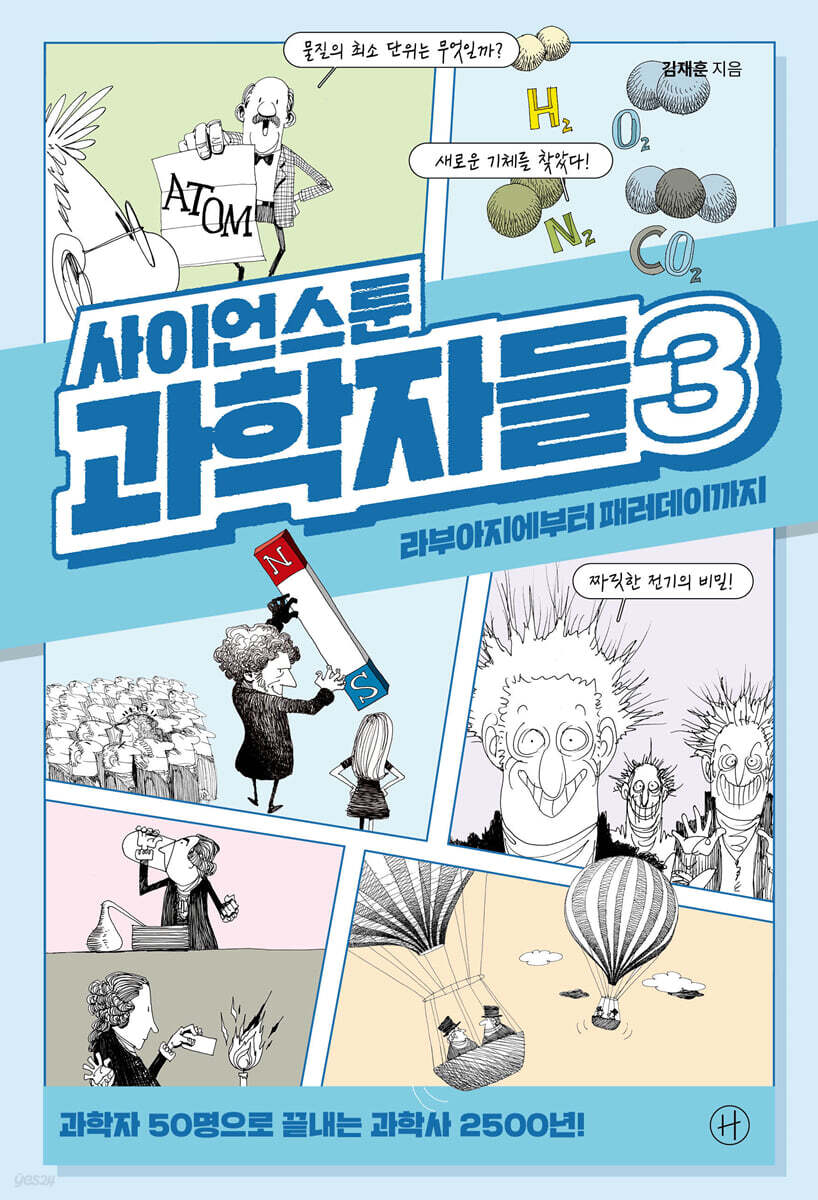 |
Description
Book Introduction
Textbook characters tell the story themselves
A science story that you can grasp without memorizing.
2500 years of scientific history, wrapped up with 50 scientists!
“The scientific laws and principles I learned… Who discovered them, when, and how?”
A scientific story told directly by scientists we've often encountered in textbooks but rarely know in detail! From ancient times to the present, across all eras and fields of science—physics, chemistry, life sciences, and earth sciences—we meet 50 scientists who shaped the scientific world of today. Before you know it, a panoramic view of 2,500 years of scientific history unfolds before your eyes!
Artist Jaehoon Kim, renowned for his ability to transform liberal arts knowledge into intuitive and engaging comics, presents the magnificent 2,500-year history of science.
By leveraging the strengths of comics, scientists are brought to life as vivid characters and difficult scientific principles and laws are clearly explained, making scientific concepts that were once difficult to understand in a friendly and fun way.
"Science Toon Scientists" is a book that can be enjoyed by everyone: children who are developing a keen interest in science and are immersed in experiments and exploration, students who find science at school boring, and even beginners who want to properly summarize science at least once.
Let's go now to the world of science, filled with boundless curiosity and scientists who are both funny and heartbreaking, great and full of humanity!
A science story that you can grasp without memorizing.
2500 years of scientific history, wrapped up with 50 scientists!
“The scientific laws and principles I learned… Who discovered them, when, and how?”
A scientific story told directly by scientists we've often encountered in textbooks but rarely know in detail! From ancient times to the present, across all eras and fields of science—physics, chemistry, life sciences, and earth sciences—we meet 50 scientists who shaped the scientific world of today. Before you know it, a panoramic view of 2,500 years of scientific history unfolds before your eyes!
Artist Jaehoon Kim, renowned for his ability to transform liberal arts knowledge into intuitive and engaging comics, presents the magnificent 2,500-year history of science.
By leveraging the strengths of comics, scientists are brought to life as vivid characters and difficult scientific principles and laws are clearly explained, making scientific concepts that were once difficult to understand in a friendly and fun way.
"Science Toon Scientists" is a book that can be enjoyed by everyone: children who are developing a keen interest in science and are immersed in experiments and exploration, students who find science at school boring, and even beginners who want to properly summarize science at least once.
Let's go now to the world of science, filled with boundless curiosity and scientists who are both funny and heartbreaking, great and full of humanity!
- You can preview some of the book's contents.
Preview
index
Before starting the book
01 Benjamin Franklin: The Man Who Unlocked the Secrets of Electricity
02 Alessandro Volta: An unforgettable name as long as electricity is used.
03 Joseph Black: The Rediscovery of Aircraft
04 Cavendish and Priestley: Scientists Who Believed in Phlogiston
05 Antoine Lavoisier: The Tragedy of the Chemical Revolution
06 James Watt: From Science to Industry
07 John Dalton: The Great Hypothesis, Atomic Theory
08 Amedeo Avogadro: The Intuition of a Genius Who Resolved Contradictions
09 George Stephenson: Revolution in Space and Time, Father of the Locomotive
10 Michael Faraday 1: Oh! Faraday
11 Michael Faraday 2: Electromagnetic Induction
Author's Note
Characters and major events appearing in this book
Literature mentioned in this book
References
Search
01 Benjamin Franklin: The Man Who Unlocked the Secrets of Electricity
02 Alessandro Volta: An unforgettable name as long as electricity is used.
03 Joseph Black: The Rediscovery of Aircraft
04 Cavendish and Priestley: Scientists Who Believed in Phlogiston
05 Antoine Lavoisier: The Tragedy of the Chemical Revolution
06 James Watt: From Science to Industry
07 John Dalton: The Great Hypothesis, Atomic Theory
08 Amedeo Avogadro: The Intuition of a Genius Who Resolved Contradictions
09 George Stephenson: Revolution in Space and Time, Father of the Locomotive
10 Michael Faraday 1: Oh! Faraday
11 Michael Faraday 2: Electromagnetic Induction
Author's Note
Characters and major events appearing in this book
Literature mentioned in this book
References
Search
Detailed image

Publisher's Review
“We’ll explain everything ourselves!”
-All the scientists and concepts you need to know, all in one place!
-Understanding the development of science through time, from ancient times to the present.
A science guide for everyone from children to adults
《Science Toon Scientists》 covers 2,500 years of scientific history in chronological order, from the 5th century BC to the 20th century.
The reason we follow the axis of time to understand science is because there have been notable major trends that have shaped the discipline of science from its foundation to its current form.
For example, Aristotle's worldview, which had been intact for nearly 2,000 years, was gradually destroyed by the accumulated observations, experiments, bold claims, and competition of natural scientists, and in the process, astronomy, physics, and chemistry sequentially achieved modern innovation.
Classical physics, established by Newton in the 17th century, became inapplicable, at least in the microscopic world, with the advent of quantum mechanics in the 20th century, and the way to understand the universe could no longer return to the way it was before the advent of the Big Bang theory.
As Newton's "shoulders of giants" symbolizes, scientists have built on the knowledge of their predecessors while constantly updating it, and contemporary scientists have influenced each other to advance science.
By going back in chronological order like this, we can understand scientific knowledge that was scattered across each field within a larger context.
The story, which focuses on the "character" of a scientist, allows readers to broadly enjoy the world of science without the need for complex concepts or prior background knowledge.
It lowers the barrier for those who are not familiar with science, and provides new and rich stories behind the knowledge they already knew.
We follow the lives of scientists, the coincidences and opportunities they encounter at crucial moments in their lives, and naturally encounter their scientific achievements.
When I encounter the moment when the great theories and laws that changed the world are born in the lives of 'humans' who are similar yet different from me, science feels more familiar than before.
《Science Toon Scientists》 is the ultimate science guide that everyone can enjoy, from children to adults, from science beginners to science nerds.
“Easier and more fun with comics!”
_Scientific principles and concepts at a glance with pictures
_50 Scientists with 50 Unique Characters
Artist Kim Jae-hoon, who has provided readers with new intellectual enjoyment by creating intuitive and engaging comics that convey knowledge of humanities such as history, mythology, and philosophy, previously accessible only through text, also demonstrates his outstanding skills on the topic of science.
It maximizes the strengths of comics by clearly explaining difficult scientific principles and concepts through pictures.
Topics that we are familiar with in school, such as the concepts of speed and velocity, changes in the volume of gases, the principles of blood circulation, elements and the periodic table, as well as theories that seem difficult and abstract, such as quantum mechanics, the theory of relativity, and the law of electromagnetic induction, are all melted into a single picture.
The scientists who have been brought back to life as irreplaceable characters are the core charm that makes it impossible to put down "Science Toon Scientists."
Scientist Marie Curie, who broke the rule that one cannot receive a Nobel Prize in two fields and won the Nobel Prize in Physics and Chemistry, and Albert Einstein, who shook up the concept of space and time and published four historic papers in a row in one year…
Figures who marked the decisive moments in the history of science appear one after another.
But even these revolutionary greats, like ordinary people, lived each day with failure, frustration, jealousy, and betrayal, changing the world of science.
Robert Hooke, a salaried scientist whose primary goal was to make a living; Gilbert Newton Lewis, who was at odds with his colleagues and isolated; Rosalind Franklin, who had the crucial evidence for the double helix structure of DNA stolen by a fellow scientist…
The pages turn without a break as the lives of scientists are filled with admiration, laughter, anger, and sadness.
This is the reason and charm of leading the story with scientists as the main characters.
Volume 3: From Lavoisier to Faraday
_18th Century, 11 Pioneers
_The development of chemistry, the beginning of electromagnetism
Pioneers of the chemical revolution and electromagnetism, who hypothesized models and properties of invisible particles and struggled to uncover the true nature of electricity! The 18th century witnessed remarkable chemistry advancements and a surge of interest in electricity.
The era of the chemical revolution began with the discovery of various gases such as carbon dioxide and oxygen, and scientists such as Dalton and Lavoisier competed to discover surprising facts about the basic particles of matter and chemical reactions.
Meanwhile, as the secrets of electricity began to be gradually revealed, a new century began with Faraday's great leap forward in electromagnetism.
-All the scientists and concepts you need to know, all in one place!
-Understanding the development of science through time, from ancient times to the present.
A science guide for everyone from children to adults
《Science Toon Scientists》 covers 2,500 years of scientific history in chronological order, from the 5th century BC to the 20th century.
The reason we follow the axis of time to understand science is because there have been notable major trends that have shaped the discipline of science from its foundation to its current form.
For example, Aristotle's worldview, which had been intact for nearly 2,000 years, was gradually destroyed by the accumulated observations, experiments, bold claims, and competition of natural scientists, and in the process, astronomy, physics, and chemistry sequentially achieved modern innovation.
Classical physics, established by Newton in the 17th century, became inapplicable, at least in the microscopic world, with the advent of quantum mechanics in the 20th century, and the way to understand the universe could no longer return to the way it was before the advent of the Big Bang theory.
As Newton's "shoulders of giants" symbolizes, scientists have built on the knowledge of their predecessors while constantly updating it, and contemporary scientists have influenced each other to advance science.
By going back in chronological order like this, we can understand scientific knowledge that was scattered across each field within a larger context.
The story, which focuses on the "character" of a scientist, allows readers to broadly enjoy the world of science without the need for complex concepts or prior background knowledge.
It lowers the barrier for those who are not familiar with science, and provides new and rich stories behind the knowledge they already knew.
We follow the lives of scientists, the coincidences and opportunities they encounter at crucial moments in their lives, and naturally encounter their scientific achievements.
When I encounter the moment when the great theories and laws that changed the world are born in the lives of 'humans' who are similar yet different from me, science feels more familiar than before.
《Science Toon Scientists》 is the ultimate science guide that everyone can enjoy, from children to adults, from science beginners to science nerds.
“Easier and more fun with comics!”
_Scientific principles and concepts at a glance with pictures
_50 Scientists with 50 Unique Characters
Artist Kim Jae-hoon, who has provided readers with new intellectual enjoyment by creating intuitive and engaging comics that convey knowledge of humanities such as history, mythology, and philosophy, previously accessible only through text, also demonstrates his outstanding skills on the topic of science.
It maximizes the strengths of comics by clearly explaining difficult scientific principles and concepts through pictures.
Topics that we are familiar with in school, such as the concepts of speed and velocity, changes in the volume of gases, the principles of blood circulation, elements and the periodic table, as well as theories that seem difficult and abstract, such as quantum mechanics, the theory of relativity, and the law of electromagnetic induction, are all melted into a single picture.
The scientists who have been brought back to life as irreplaceable characters are the core charm that makes it impossible to put down "Science Toon Scientists."
Scientist Marie Curie, who broke the rule that one cannot receive a Nobel Prize in two fields and won the Nobel Prize in Physics and Chemistry, and Albert Einstein, who shook up the concept of space and time and published four historic papers in a row in one year…
Figures who marked the decisive moments in the history of science appear one after another.
But even these revolutionary greats, like ordinary people, lived each day with failure, frustration, jealousy, and betrayal, changing the world of science.
Robert Hooke, a salaried scientist whose primary goal was to make a living; Gilbert Newton Lewis, who was at odds with his colleagues and isolated; Rosalind Franklin, who had the crucial evidence for the double helix structure of DNA stolen by a fellow scientist…
The pages turn without a break as the lives of scientists are filled with admiration, laughter, anger, and sadness.
This is the reason and charm of leading the story with scientists as the main characters.
Volume 3: From Lavoisier to Faraday
_18th Century, 11 Pioneers
_The development of chemistry, the beginning of electromagnetism
Pioneers of the chemical revolution and electromagnetism, who hypothesized models and properties of invisible particles and struggled to uncover the true nature of electricity! The 18th century witnessed remarkable chemistry advancements and a surge of interest in electricity.
The era of the chemical revolution began with the discovery of various gases such as carbon dioxide and oxygen, and scientists such as Dalton and Lavoisier competed to discover surprising facts about the basic particles of matter and chemical reactions.
Meanwhile, as the secrets of electricity began to be gradually revealed, a new century began with Faraday's great leap forward in electromagnetism.
GOODS SPECIFICS
- Date of issue: September 25, 2023
- Page count, weight, size: 408 pages | 726g | 150*220*25mm
- ISBN13: 9791170870500
- ISBN10: 1170870503
You may also like
카테고리
korean


korean

![GQ KOREA Mark (Monthly): December [2025]](http://librairie.coreenne.fr/cdn/shop/files/8ef265dbbfbf186523ed75ba7319009d.jpg?v=1765340328&width=3840)


