

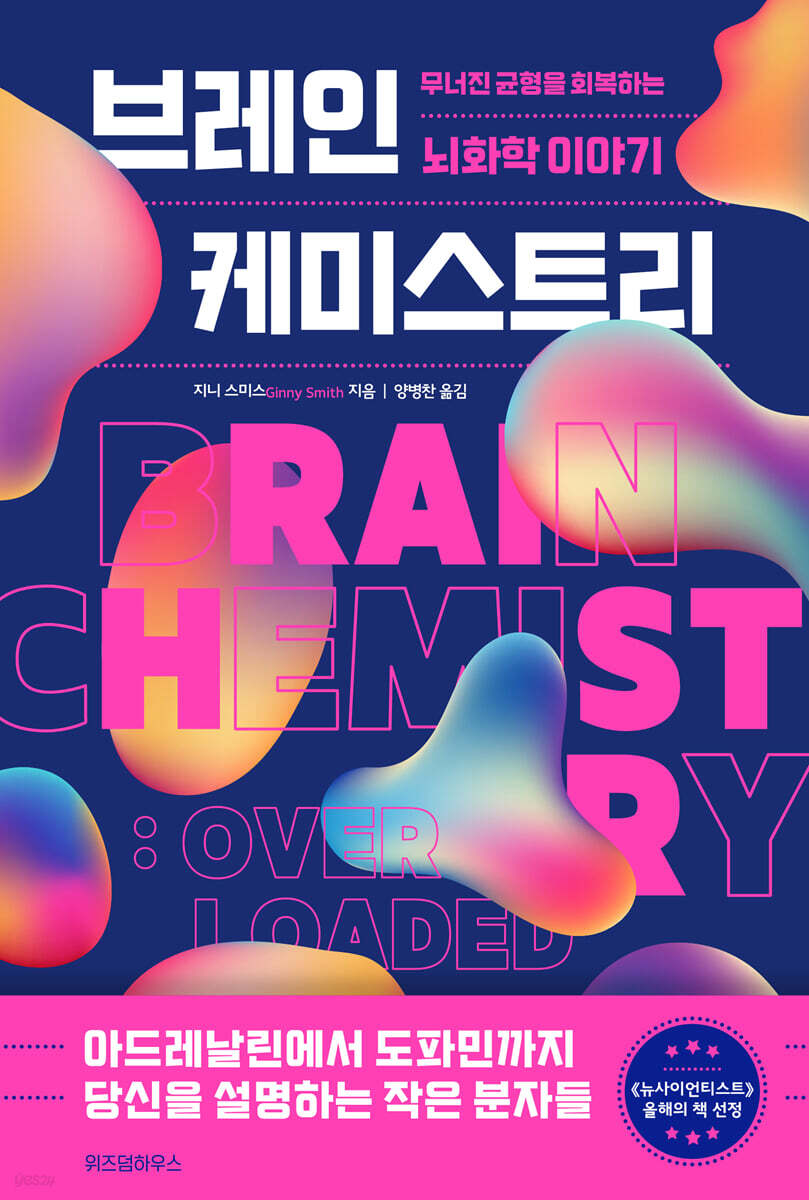
Brain Chemistry
 |
Description
Book Introduction
How do our split-second decisions, our ever-changing emotions, the temptations we face, and our inertial behaviors come about? The underlying cause lies not in the brain itself, which slowly changes, but in the activity of hormones and neurotransmitters secreted within it.
This book is a brain chemistry class that introduces you to the network of neurotransmitters you may have heard of before, such as adrenaline, serotonin, dopamine, and oxytocin.
We examine the exact mechanisms by which tiny chemicals move to form our unique selves.
While the cells that make up the brain are important, what is directly involved in every moment of my daily life are the various chemicals that moisturize brain cells and enable communication between neurons.
This book is a brain chemistry class that introduces you to the network of neurotransmitters you may have heard of before, such as adrenaline, serotonin, dopamine, and oxytocin.
We examine the exact mechanisms by which tiny chemicals move to form our unique selves.
While the cells that make up the brain are important, what is directly involved in every moment of my daily life are the various chemicals that moisturize brain cells and enable communication between neurons.
- You can preview some of the book's contents.
Preview
index
prolog
CHAPTER 1 The Brain, a Chemical Arena
More Questions Than Answers | Frogs, Frankenstein, and Jennifer Aniston | The Debate of the Century | Watch the Gap!
CHAPTER 2: Building a Large Storage Warehouse
Scientists who skewered slugs | Do we remember correctly? | Memory manipulation | If concentration is required | Smart pills? | Babies and goslings | Ceaușescu's children | Crying babies
CHAPTER 3: Addiction, the Traps of Reward and Motivation
Understanding Addiction | The Rise of the Strange Rat, the Discovery of Dopamine | Monkey Experiments, the Rediscovery of Dopamine | The Pleasure Hotspot | Try, Friends | The Problem with Dopamine Elevation | Welcome to Rat Park
CHAPTER 4 Depression: The Brain's Careful Balance
Fight-or-Flight Response | Emotions and Feelings | Moods, Muscles, and Mussels | The Happiness Hormone? | The Off Switch | Always Look on the Bright Side | Hope on the Horizon | Finding Balance in Life
CHAPTER 5: Sleep: The Brain's Greatest Mystery
The Punctuality System | Adjusting Your Circadian Clock | The Blind Fish Living in Cave | The Coffee Trap | The Sleep Switch | Peaceful Sleep? | The Evolution of Sleep | Beauty Sleep for the Brain | The Brain Rinse Cycle | Sleep to Forget, Sleep to Remember | What is Sleep for?
CHAPTER 6 Appetite: The Uncomplicated Driving Force of Survival
The Need to Eat | Tipping the Scales | The Satiety Factor | A Heavy Problem | The Temptation of Delicious Foods | What Have You Ever Eaten? | Stress and Degenerative Desserts | I Can't Get Enough of Them | What Causes Anorexia?
CHAPTER 7 Decisions: Logic or Chemicals?
How much is it worth? | Progress and pause | Emotional decision-making | Pick any card | Chemicals that control emotional decision-making? | Apple picking in an orchard | Cash is king! | Give it to me now!
CHAPTER 8 Love, like bread, always being remade and renewed
What is Lust? | Marilyn Monroe, the 'Fit Man' | Your Lovely Body Smell | Do Humans Have Pheromones? | The Difference Between Experimental and Reality | Blind Love | Medicine or Poison? | A Mother's Transformation | A Field Mice in Love | The Hormone of Hugging
CHAPTER 9 Pain, Our Body's Little Ambulance
People Who Don't Feel Pain | How to Manage Pain | The Pain-Reducing Poppy | Pride and Prejudice | Pain-Regulating Pathways | The Science of Swearing | The Pain-Canceling Placebo | The Vicious Cycle of Chronic Pain
Epilogue | Glossary | Brain Structure | Acknowledgments | References | Index
CHAPTER 1 The Brain, a Chemical Arena
More Questions Than Answers | Frogs, Frankenstein, and Jennifer Aniston | The Debate of the Century | Watch the Gap!
CHAPTER 2: Building a Large Storage Warehouse
Scientists who skewered slugs | Do we remember correctly? | Memory manipulation | If concentration is required | Smart pills? | Babies and goslings | Ceaușescu's children | Crying babies
CHAPTER 3: Addiction, the Traps of Reward and Motivation
Understanding Addiction | The Rise of the Strange Rat, the Discovery of Dopamine | Monkey Experiments, the Rediscovery of Dopamine | The Pleasure Hotspot | Try, Friends | The Problem with Dopamine Elevation | Welcome to Rat Park
CHAPTER 4 Depression: The Brain's Careful Balance
Fight-or-Flight Response | Emotions and Feelings | Moods, Muscles, and Mussels | The Happiness Hormone? | The Off Switch | Always Look on the Bright Side | Hope on the Horizon | Finding Balance in Life
CHAPTER 5: Sleep: The Brain's Greatest Mystery
The Punctuality System | Adjusting Your Circadian Clock | The Blind Fish Living in Cave | The Coffee Trap | The Sleep Switch | Peaceful Sleep? | The Evolution of Sleep | Beauty Sleep for the Brain | The Brain Rinse Cycle | Sleep to Forget, Sleep to Remember | What is Sleep for?
CHAPTER 6 Appetite: The Uncomplicated Driving Force of Survival
The Need to Eat | Tipping the Scales | The Satiety Factor | A Heavy Problem | The Temptation of Delicious Foods | What Have You Ever Eaten? | Stress and Degenerative Desserts | I Can't Get Enough of Them | What Causes Anorexia?
CHAPTER 7 Decisions: Logic or Chemicals?
How much is it worth? | Progress and pause | Emotional decision-making | Pick any card | Chemicals that control emotional decision-making? | Apple picking in an orchard | Cash is king! | Give it to me now!
CHAPTER 8 Love, like bread, always being remade and renewed
What is Lust? | Marilyn Monroe, the 'Fit Man' | Your Lovely Body Smell | Do Humans Have Pheromones? | The Difference Between Experimental and Reality | Blind Love | Medicine or Poison? | A Mother's Transformation | A Field Mice in Love | The Hormone of Hugging
CHAPTER 9 Pain, Our Body's Little Ambulance
People Who Don't Feel Pain | How to Manage Pain | The Pain-Reducing Poppy | Pride and Prejudice | Pain-Regulating Pathways | The Science of Swearing | The Pain-Canceling Placebo | The Vicious Cycle of Chronic Pain
Epilogue | Glossary | Brain Structure | Acknowledgments | References | Index
Detailed image
Into the book
How does our brain make us behave in certain ways? I believe the answer lies not in our brain's wiring, but in the chemicals that permeate it.
Because, as we will see, connections between neurons can and do change, and the process happens slowly.
This means that it's not our wiring that governs the millisecond-by-millisecond changes we experience—the split-second decisions, the emotional swings, the temptations we face.
Instead, these changes are all governed by brain chemistry.
--- p.26, from “The Brain, a Chemical Competition Arena”
Even if you think about it on a superficial level, it's obvious that significant events are stored differently, so they are much easier to recall than other ordinary days.
But how are these differences encoded in our brains? When I recall that evening, when the sticky floor and graffiti-covered walls come to mind so readily, what's actually happening in my neurons and synapses?
--- p.32, from “Building a Large-Capacity Storage Warehouse for Memory”
Addiction is a funny word.
We might all think we know what addiction means, but defining it is surprisingly difficult.
For example, we often say we are 'addicted' to a new TV show or food, making statements that contradict the clinical definition of addiction.
And while some people claim it's possible to become addicted to food, most of us don't.
To be defined as an addiction, it must be so intense that one sacrifices other things in life to pursue it, harming one's work, relationships, and even one's own safety.
So what drives people to these extremes?
--- p.80, from “Addiction, the Trap of Reward and Motivation”
If emotions are created entirely by bodily reactions, there should be distinct bodily sensations for each different emotion.
Then we could accurately figure out how someone is feeling just by measuring things like heart rate, skin temperature, or sweat.
But that is impossible.
In fact, many feelings cause the same (or very similar) physical changes.
And we should be able to make someone afraid simply by injecting them with adrenaline.
But as we will soon find out, that is also impossible.
--- p.128, from “Depression, the Brain’s Careful Balance”
I've always been fascinated by how sleep, so crucial to our long-term health, can be so easily attained for some and a constant battle for others.
So I want to find out what happens in the brains of some people when they fall asleep easily.
I beg my brain to let me go, using all the tricks in the book.
My first task is to look at why we (mostly) sleep at night, which means exploring our body's built-in biological clock.
--- p.171, from “Sleep, the greatest mystery surrounding the brain”
Beyond the obvious factors that influence eating, like hunger and thirst, there are more surprising things that influence appetite.
It's memory.
Research shows that memory has a huge influence on food choices.
If you had pizza for dinner the night before, the memory of that indulgence may prompt you to choose salad for lunch the next day.
But memory is much more fundamental than this.
People with a type of severe amnesia who cannot form new memories eat their second lunch just 10 minutes after their first.
They also do not report feeling less hungry after eating.
--- p.244, from “Appetite, the complex driving force of survival”
It was early morning.
Let's say you think you'll be late for work, so you run out of the house before you even eat breakfast.
There are five minutes left to catch the subway, but people are already lining up at the coffee cart.
Would you rather risk missing the subway to wait for coffee and a muffin? Or would you rather forgo the coffee and take the subway with a few minutes to spare? To make that decision, you need to weigh the potential cost of missing the subway and being late against the benefit of having coffee.
--- p.277, from “Decision, Logic or Chemicals?”
There's another important factor that people often overlook when talking about neurochemicals.
Too little of a chemical can be bad news, but too much can also be harmful.
Low serotonin levels have sometimes been linked to depression, while high levels have been linked to anxiety.
Like Goldilocks, our brains appear to have a "sweet spot" when it comes to chemicals, and any deviation from this point can lead to problems.
Because, as we will see, connections between neurons can and do change, and the process happens slowly.
This means that it's not our wiring that governs the millisecond-by-millisecond changes we experience—the split-second decisions, the emotional swings, the temptations we face.
Instead, these changes are all governed by brain chemistry.
--- p.26, from “The Brain, a Chemical Competition Arena”
Even if you think about it on a superficial level, it's obvious that significant events are stored differently, so they are much easier to recall than other ordinary days.
But how are these differences encoded in our brains? When I recall that evening, when the sticky floor and graffiti-covered walls come to mind so readily, what's actually happening in my neurons and synapses?
--- p.32, from “Building a Large-Capacity Storage Warehouse for Memory”
Addiction is a funny word.
We might all think we know what addiction means, but defining it is surprisingly difficult.
For example, we often say we are 'addicted' to a new TV show or food, making statements that contradict the clinical definition of addiction.
And while some people claim it's possible to become addicted to food, most of us don't.
To be defined as an addiction, it must be so intense that one sacrifices other things in life to pursue it, harming one's work, relationships, and even one's own safety.
So what drives people to these extremes?
--- p.80, from “Addiction, the Trap of Reward and Motivation”
If emotions are created entirely by bodily reactions, there should be distinct bodily sensations for each different emotion.
Then we could accurately figure out how someone is feeling just by measuring things like heart rate, skin temperature, or sweat.
But that is impossible.
In fact, many feelings cause the same (or very similar) physical changes.
And we should be able to make someone afraid simply by injecting them with adrenaline.
But as we will soon find out, that is also impossible.
--- p.128, from “Depression, the Brain’s Careful Balance”
I've always been fascinated by how sleep, so crucial to our long-term health, can be so easily attained for some and a constant battle for others.
So I want to find out what happens in the brains of some people when they fall asleep easily.
I beg my brain to let me go, using all the tricks in the book.
My first task is to look at why we (mostly) sleep at night, which means exploring our body's built-in biological clock.
--- p.171, from “Sleep, the greatest mystery surrounding the brain”
Beyond the obvious factors that influence eating, like hunger and thirst, there are more surprising things that influence appetite.
It's memory.
Research shows that memory has a huge influence on food choices.
If you had pizza for dinner the night before, the memory of that indulgence may prompt you to choose salad for lunch the next day.
But memory is much more fundamental than this.
People with a type of severe amnesia who cannot form new memories eat their second lunch just 10 minutes after their first.
They also do not report feeling less hungry after eating.
--- p.244, from “Appetite, the complex driving force of survival”
It was early morning.
Let's say you think you'll be late for work, so you run out of the house before you even eat breakfast.
There are five minutes left to catch the subway, but people are already lining up at the coffee cart.
Would you rather risk missing the subway to wait for coffee and a muffin? Or would you rather forgo the coffee and take the subway with a few minutes to spare? To make that decision, you need to weigh the potential cost of missing the subway and being late against the benefit of having coffee.
--- p.277, from “Decision, Logic or Chemicals?”
There's another important factor that people often overlook when talking about neurochemicals.
Too little of a chemical can be bad news, but too much can also be harmful.
Low serotonin levels have sometimes been linked to depression, while high levels have been linked to anxiety.
Like Goldilocks, our brains appear to have a "sweet spot" when it comes to chemicals, and any deviation from this point can lead to problems.
--- p.407, from "Epilogue"
Publisher's Review
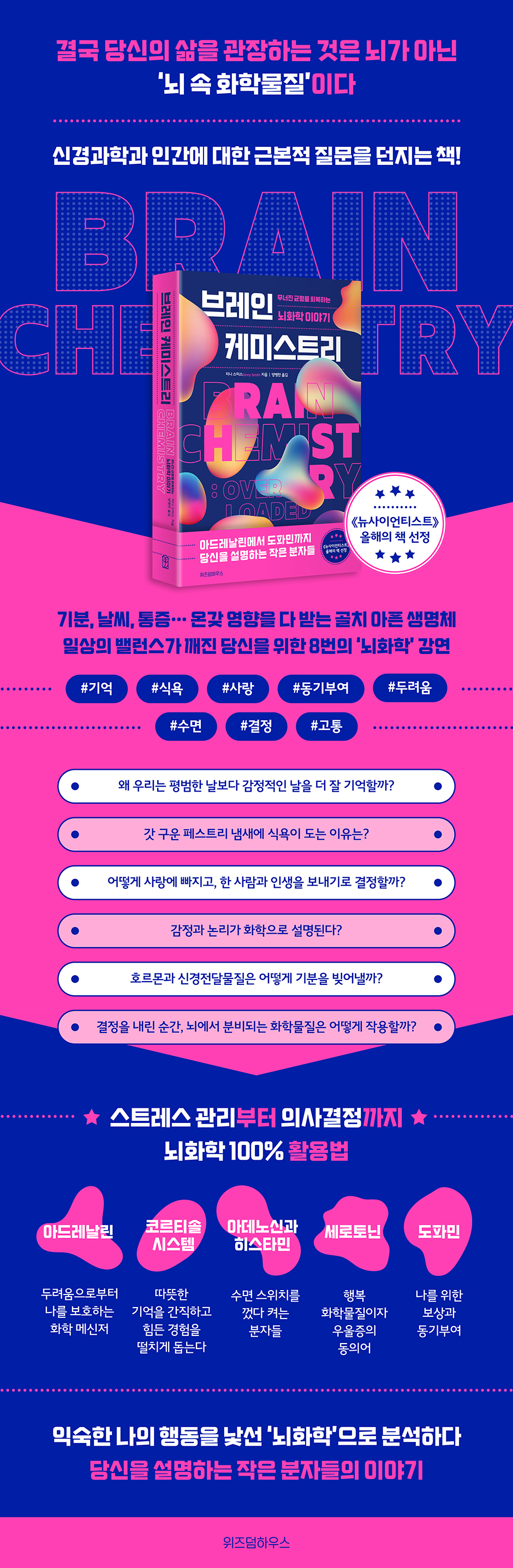
Ultimately, it's not your brain that controls your life, but the chemicals in your brain.
From Adrenaline to Dopamine: A Brain Chemistry Lecture to Restore Your Balance
“A book that poses fundamental questions about neuroscience and humanity.”
* Why do we remember emotional days better than ordinary days? * Why does the smell of freshly baked pastries make us hungry? * How do we fall in love and decide to spend our lives with one person? * Does coffee help us stay awake? * What should I have for lunch? Why are decisions always so difficult?
This book is a brain chemistry class that introduces you to the network of neurotransmitters you may have heard of before, such as adrenaline, serotonin, dopamine, and oxytocin.
We examine the exact mechanisms by which tiny chemicals move to form our unique selves.
While the cells that make up the brain are important, what is directly involved in every moment of my daily life are the various chemicals that moisturize brain cells and enable communication between neurons.
The split-second decisions we make every day, the emotions that change from moment to moment, the temptations we face, and the inertial behaviors we adopt are not the result of the brain itself, which changes slowly, but of the hormones and neurotransmitters secreted within the brain.
Neuroscience and psychology expert Genie Smith explains the role of chemicals in the brain, closely linking the most basic human desires, such as love, appetite, fear, and sleep, to the principles of memory and the process of judgment.
Eight key words that make up our lives, from mood to pain, are closely intertwined to reveal the secrets of the brain.
The author also interviews neurochemistry researchers currently at the forefront of research, capturing their brilliant scientific achievements and analyzing the theories of legendary scientists who pioneered neuroscience to provide a multi-faceted look into the unknown brain.
Genie Smith stands out as a talented science communicator who vividly conveys the latest news from the field without using difficult jargon.
8 Lessons on Brain Chemicals That Affect Every Aspect of Life
“We swim in a turbulent sea of neurotransmitters, shaping our unique selves.”
The author says that concepts that are simply known, such as 'serotonin = happiness', 'dopamine = addiction', and 'motherhood = oxytocin', miss the key role of chemicals that work in balance and harmony.
Adrenaline is the chemical messenger that protects us from fear, while the cortisol system helps us preserve warm memories and shake off difficult experiences.
Adenosine and histamine pathways switch sleep on and off, serotonin is used in science as a synonym for happiness as well as depression, and dopamine is responsible for reward and motivation.
In this way, rather than one chemical having one effect, the amount, speed, location, and timing of secretion are delicately balanced to produce a variety of answers.
The brain is an organ characterized by a high degree of interconnectivity.
Therefore, the two-faced nature of chemicals and the unexpected connections created by different combinations arouse readers' curiosity about the 'brain chemical network.'
And this leads to a fundamental question in neuroscience and a major topic of discussion in the scientific community: 'How does the brain generate everyday experiences and drive behavior?'
So how do hormones and neurotransmitters create our moods? Can emotions and logic truly be explained by chemistry? When I make a decision, where and how do the special molecules secreted in my brain move? This book helps us accurately understand the chemicals that control all human behavior and discover ways to utilize our brains.
How to Use Brain Chemistry 100% for Those Who Want to Restore Their Balance
“The brain provides us with timely opportunities to change and adapt.”
Neurotransmitters, which spread rapidly through the brain, maintain a delicate balance, allowing us to maintain homeostasis as we go about our daily lives.
They can also respond quickly to subtle changes in the external environment, such as changing the areas of the brain that are activated, forming new pathways in chemical networks, or changing the way molecules are released.
This means that the brain chemical mechanism is sensitive to and influenced by my very small actions.
This is why humans can adapt flexibly in a complex world.
So what happens in our brains when we change our behavior and habits? For example, if we constantly stimulate our memory circuits while studying a foreign language, acetylcholine is released, allowing the brain to focus on internal changes, and new knowledge is efficiently stored.
The author, who has been teaching memory, learning, and sleep, explains, “If you change what you do, you can change the activation of brain regions and the release of chemicals.”
The more we learn and understand the complexity of the brain, the more we can use this knowledge.
From stress management to decision-making, unstable sleep quality, and occasional bouts of anxiety, Brain Chemistry examines our familiar behaviors through the lens of unfamiliar "brain chemistry," offering an opportunity to restore our lost balance and take back control of our lives.
The author emphasizes that “choices and actions are engraved into the chemical pathways in the brain and ultimately constitute ‘me.’”
And I encourage you to understand the interplay and workings of hormones and chemicals that influence every aspect of your life, and to face your changing self.
From Adrenaline to Dopamine: A Brain Chemistry Lecture to Restore Your Balance
“A book that poses fundamental questions about neuroscience and humanity.”
* Why do we remember emotional days better than ordinary days? * Why does the smell of freshly baked pastries make us hungry? * How do we fall in love and decide to spend our lives with one person? * Does coffee help us stay awake? * What should I have for lunch? Why are decisions always so difficult?
This book is a brain chemistry class that introduces you to the network of neurotransmitters you may have heard of before, such as adrenaline, serotonin, dopamine, and oxytocin.
We examine the exact mechanisms by which tiny chemicals move to form our unique selves.
While the cells that make up the brain are important, what is directly involved in every moment of my daily life are the various chemicals that moisturize brain cells and enable communication between neurons.
The split-second decisions we make every day, the emotions that change from moment to moment, the temptations we face, and the inertial behaviors we adopt are not the result of the brain itself, which changes slowly, but of the hormones and neurotransmitters secreted within the brain.
Neuroscience and psychology expert Genie Smith explains the role of chemicals in the brain, closely linking the most basic human desires, such as love, appetite, fear, and sleep, to the principles of memory and the process of judgment.
Eight key words that make up our lives, from mood to pain, are closely intertwined to reveal the secrets of the brain.
The author also interviews neurochemistry researchers currently at the forefront of research, capturing their brilliant scientific achievements and analyzing the theories of legendary scientists who pioneered neuroscience to provide a multi-faceted look into the unknown brain.
Genie Smith stands out as a talented science communicator who vividly conveys the latest news from the field without using difficult jargon.
8 Lessons on Brain Chemicals That Affect Every Aspect of Life
“We swim in a turbulent sea of neurotransmitters, shaping our unique selves.”
The author says that concepts that are simply known, such as 'serotonin = happiness', 'dopamine = addiction', and 'motherhood = oxytocin', miss the key role of chemicals that work in balance and harmony.
Adrenaline is the chemical messenger that protects us from fear, while the cortisol system helps us preserve warm memories and shake off difficult experiences.
Adenosine and histamine pathways switch sleep on and off, serotonin is used in science as a synonym for happiness as well as depression, and dopamine is responsible for reward and motivation.
In this way, rather than one chemical having one effect, the amount, speed, location, and timing of secretion are delicately balanced to produce a variety of answers.
The brain is an organ characterized by a high degree of interconnectivity.
Therefore, the two-faced nature of chemicals and the unexpected connections created by different combinations arouse readers' curiosity about the 'brain chemical network.'
And this leads to a fundamental question in neuroscience and a major topic of discussion in the scientific community: 'How does the brain generate everyday experiences and drive behavior?'
So how do hormones and neurotransmitters create our moods? Can emotions and logic truly be explained by chemistry? When I make a decision, where and how do the special molecules secreted in my brain move? This book helps us accurately understand the chemicals that control all human behavior and discover ways to utilize our brains.
How to Use Brain Chemistry 100% for Those Who Want to Restore Their Balance
“The brain provides us with timely opportunities to change and adapt.”
Neurotransmitters, which spread rapidly through the brain, maintain a delicate balance, allowing us to maintain homeostasis as we go about our daily lives.
They can also respond quickly to subtle changes in the external environment, such as changing the areas of the brain that are activated, forming new pathways in chemical networks, or changing the way molecules are released.
This means that the brain chemical mechanism is sensitive to and influenced by my very small actions.
This is why humans can adapt flexibly in a complex world.
So what happens in our brains when we change our behavior and habits? For example, if we constantly stimulate our memory circuits while studying a foreign language, acetylcholine is released, allowing the brain to focus on internal changes, and new knowledge is efficiently stored.
The author, who has been teaching memory, learning, and sleep, explains, “If you change what you do, you can change the activation of brain regions and the release of chemicals.”
The more we learn and understand the complexity of the brain, the more we can use this knowledge.
From stress management to decision-making, unstable sleep quality, and occasional bouts of anxiety, Brain Chemistry examines our familiar behaviors through the lens of unfamiliar "brain chemistry," offering an opportunity to restore our lost balance and take back control of our lives.
The author emphasizes that “choices and actions are engraved into the chemical pathways in the brain and ultimately constitute ‘me.’”
And I encourage you to understand the interplay and workings of hormones and chemicals that influence every aspect of your life, and to face your changing self.
GOODS SPECIFICS
- Date of issue: September 20, 2023
- Page count, weight, size: 428 pages | 590g | 145*215*23mm
- ISBN13: 9791168127869
- ISBN10: 1168127866
You may also like
카테고리
korean


korean

![ELLE 엘르 스페셜 에디션 A형 : 12월 [2025]](http://librairie.coreenne.fr/cdn/shop/files/b8e27a3de6c9538896439686c6b0e8fb.jpg?v=1766436872&width=3840)


