

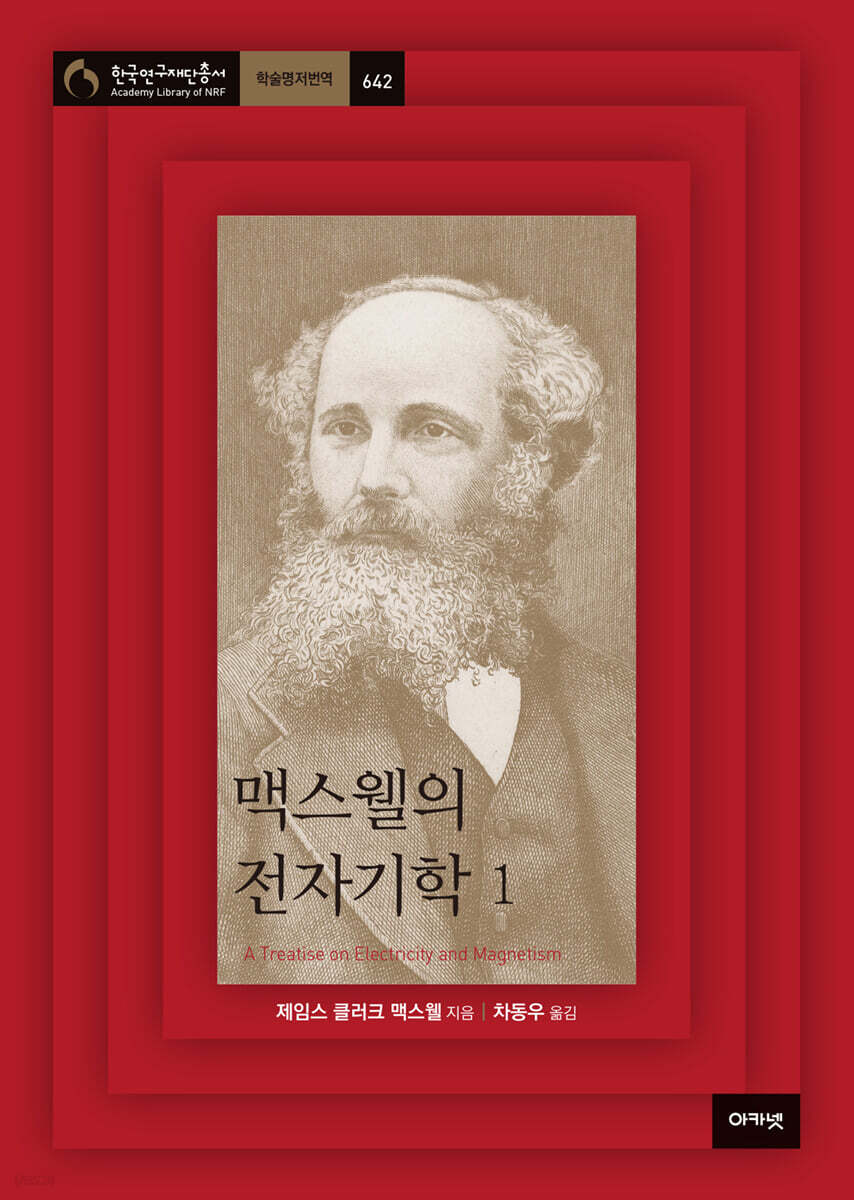
Maxwell's Electromagnetism 1
 |
Description
Book Introduction
A historical masterpiece that laid the foundation for classical physics
Laid the foundation for the emergence of modern physics in the 20th century
If classical physics is broadly divided into mechanics and electromagnetism, and mechanics is said to be based on Newton's Principia, then electromagnetism can be said to be based on Maxwell's Electromagnetism.
Moreover, this book vividly documents the process by which new concepts were formed to shape electromagnetism into what it is today, something you will never find in today's electromagnetism textbooks, and how mathematics was used to define those concepts.
Author James Clerk Maxwell (1831-1879) expressed the seemingly unrelated laws of electricity and magnetism that had been discovered over nearly a century into four partial differential equations for electric and magnetic fields, establishing Maxwell's equations, and revealed that these were the fundamental laws that govern all electromagnetic phenomena.
Furthermore, by theoretically predicting the existence of electromagnetic waves from Maxwell's equations and confirming that light is a type of electromagnetic wave, it inspired Einstein to formulate the special theory of relativity in the 20th century, and the subsequent theory of light directly contributed to the birth of quantum mechanics in the early 20th century.
In other words, Maxwell's Electromagnetism became an important foundation for the emergence of modern physics in the 20th century.
Laid the foundation for the emergence of modern physics in the 20th century
If classical physics is broadly divided into mechanics and electromagnetism, and mechanics is said to be based on Newton's Principia, then electromagnetism can be said to be based on Maxwell's Electromagnetism.
Moreover, this book vividly documents the process by which new concepts were formed to shape electromagnetism into what it is today, something you will never find in today's electromagnetism textbooks, and how mathematics was used to define those concepts.
Author James Clerk Maxwell (1831-1879) expressed the seemingly unrelated laws of electricity and magnetism that had been discovered over nearly a century into four partial differential equations for electric and magnetic fields, establishing Maxwell's equations, and revealed that these were the fundamental laws that govern all electromagnetic phenomena.
Furthermore, by theoretically predicting the existence of electromagnetic waves from Maxwell's equations and confirming that light is a type of electromagnetic wave, it inspired Einstein to formulate the special theory of relativity in the 20th century, and the subsequent theory of light directly contributed to the birth of quantum mechanics in the early 20th century.
In other words, Maxwell's Electromagnetism became an important foundation for the emergence of modern physics in the 20th century.
- You can preview some of the book's contents.
Preview
index
Translator's Preface
Before we begin: Measurement of physical quantities
Part 1: Electrostatics
Chapter 1: About the phenomenon
Chapter 2: Basic Mathematical Theory of Static Electricity
Chapter 3 Electrical Work and Energy in Conductor Groups
Chapter 4 General Summary
Chapter 5 Mechanical Action Between Two Electrical Systems
Chapter 6: Equilibrium Point and Equilibrium Line
Chapter 7: Shapes of equipotential surfaces and electric field lines in simple cases
Chapter 8 Simple Charge Distribution
Chapter 9 Spherical Harmonics
Chapter 10: Confocal Second-Order Surfaces
Chapter 11: Electric Image Charge and Electric Inverse Problem Theory
Chapter 12: Conjugate Function Theory in Two Dimensions
Chapter 13: Electrostatic Tools
Part 2 Electrokinetics
Chapter 1 Current
Chapter 2 Electrical Conduction and Electrical Resistance
Chapter 3 Electromotive force between objects in contact
Chapter 4 Electrolysis
Chapter 5 Electrolyte Polarization
Chapter 6 Linear Current
Chapter 7 Three-Dimensional Conduction
Chapter 8 Resistance and Conductivity in Three Dimensions
Chapter 9 Conduction through Various Media
Chapter 10 Conduction in the Genome
Chapter 11 Electrical Resistance Measurement
Chapter 12: On the Electrical Resistance of Materials
Figures I-XIII
annotation
Before we begin: Measurement of physical quantities
Part 1: Electrostatics
Chapter 1: About the phenomenon
Chapter 2: Basic Mathematical Theory of Static Electricity
Chapter 3 Electrical Work and Energy in Conductor Groups
Chapter 4 General Summary
Chapter 5 Mechanical Action Between Two Electrical Systems
Chapter 6: Equilibrium Point and Equilibrium Line
Chapter 7: Shapes of equipotential surfaces and electric field lines in simple cases
Chapter 8 Simple Charge Distribution
Chapter 9 Spherical Harmonics
Chapter 10: Confocal Second-Order Surfaces
Chapter 11: Electric Image Charge and Electric Inverse Problem Theory
Chapter 12: Conjugate Function Theory in Two Dimensions
Chapter 13: Electrostatic Tools
Part 2 Electrokinetics
Chapter 1 Current
Chapter 2 Electrical Conduction and Electrical Resistance
Chapter 3 Electromotive force between objects in contact
Chapter 4 Electrolysis
Chapter 5 Electrolyte Polarization
Chapter 6 Linear Current
Chapter 7 Three-Dimensional Conduction
Chapter 8 Resistance and Conductivity in Three Dimensions
Chapter 9 Conduction through Various Media
Chapter 10 Conduction in the Genome
Chapter 11 Electrical Resistance Measurement
Chapter 12: On the Electrical Resistance of Materials
Figures I-XIII
annotation
Into the book
“Knowing the dimensions of a unit gives us a convenient way to check the correctness of the equations resulting from complex investigations.
The dimensions of each basic unit of such a complex equation must be the same.
If not, then the formula makes no sense and there must be something wrong somewhere.
Because the interpretation of the formula will vary depending on which system of units is used.”
---From "Before You Begin: Measurement of Physical Quantities, page 2"
“It may be considered that the law of force was established with considerable accuracy by Coulomb's experiments using a torsion balance.
However, this type of experiment is difficult and somewhat uncertain due to several intractable causes, so it is imperative to thoroughly track down and properly correct these causes.
First, the two objects must be reasonably sized relative to the distance between them, so that each object can carry a sufficient amount of charge for the force to be measured.
Then, the action of each object affects the charge distributed on other objects, so we cannot think of the charge as being evenly distributed over the surface of the object or concentrated at the center of gravity.
Rather, its effects must be calculated through complex research.
However, Poisson was very good at calculating problems involving two spherical objects, and W.
Sir Thomson greatly simplified the calculations by using the theory of image charges.
(……) The fact that an object is imperfectly insulated also presents its own difficulties, separate from other situations, because the object's charge continues to decrease.
Coulomb investigated the law of dissipation of electric charge and corrected it by taking into account the effects of dissipation of charge in his experiments.”
---From “Part 1, Chapter 1, On the Phenomenon, pp. 64-65”
“Now let us assume that object A is a conductor.
If we treat this as a case of equilibrium of a system of several bodies, and consider the movable charge as part of this system, we can argue that the system is unstable when we remove many degrees of freedom by fixing the charge, and that the system should be more definitely unstable when we regain those degrees of freedom.
However, we can consider this case in a more special way.
First, let us assume that the charge is fixed on A and that A moves a short distance dr.
The increase in the potential of A due to such causes has already been taken into account.
Next, let us assume that the charge is always allowed to move to a stable equilibrium position inside object A.
During this exercise, the potential must decrease by an amount that can be called Cdr.”
---From "Part 1, Chapter 6, Equilibrium Points and Parallel Lines, pp. 229-230"
“A galvanometer generally consists of one or more coils of silk-covered wire and a magnet suspended on a horizontal axis inside the coils.
When current flows through the wire, the magnet tries to orient itself on an axis perpendicular to the plane in which the coils lie.
“If the plane of the coils is parallel to the plane of the Earth's equator, and if the current flows through the coils from east to west, which is the direction of the apparent motion of the Sun, the magnets inside the coils will think that their magnetization is that of a giant magnet and will move in a direction that tries to align with the Earth's magnetization, similar to the point of a compass needle with the North Pole pointing south.”
---From "Part 2, Chapter 1, Current, p. 455"
“If a large number of Leyden bottles, each of which has a very large capacitance, are connected in series by conductors of very high resistance (such as the wet cotton in Gogain’s experiment), the electromotive force acting on this series connection will cause a current to flow, which the galvanometer indicates will gradually decrease until the Leyden bottles are completely charged.
The apparent resistance of such a series connection increases, and if the dielectric making up the Leyden bottle were a perfect insulator, the resistance would increase indefinitely.
Now, if we remove the electromotive force and connect the two ends of the series connection, we will observe a current flowing in the opposite direction, and in the case of a perfect insulator, the total charge due to such a current will be equal to the total charge due to the direct current.
A similar effect is observed in the secondary pile, with one difference being that although the final insulation is not as good, the capacitance per unit surface is vastly greater.
In the case of cables whose covering is an insulator such as gutta-percha, if an electromotive force is applied for half an hour and then the conductor is connected to an external electrode, a current in the opposite direction is generated, which flows for some time and the system gradually returns to its original state.
This phenomenon is similar to the phenomenon called 'residual discharge' in a Leyden jar, except that the amount of polarization is much greater in insulators such as gutta-percha than in glass.”
The dimensions of each basic unit of such a complex equation must be the same.
If not, then the formula makes no sense and there must be something wrong somewhere.
Because the interpretation of the formula will vary depending on which system of units is used.”
---From "Before You Begin: Measurement of Physical Quantities, page 2"
“It may be considered that the law of force was established with considerable accuracy by Coulomb's experiments using a torsion balance.
However, this type of experiment is difficult and somewhat uncertain due to several intractable causes, so it is imperative to thoroughly track down and properly correct these causes.
First, the two objects must be reasonably sized relative to the distance between them, so that each object can carry a sufficient amount of charge for the force to be measured.
Then, the action of each object affects the charge distributed on other objects, so we cannot think of the charge as being evenly distributed over the surface of the object or concentrated at the center of gravity.
Rather, its effects must be calculated through complex research.
However, Poisson was very good at calculating problems involving two spherical objects, and W.
Sir Thomson greatly simplified the calculations by using the theory of image charges.
(……) The fact that an object is imperfectly insulated also presents its own difficulties, separate from other situations, because the object's charge continues to decrease.
Coulomb investigated the law of dissipation of electric charge and corrected it by taking into account the effects of dissipation of charge in his experiments.”
---From “Part 1, Chapter 1, On the Phenomenon, pp. 64-65”
“Now let us assume that object A is a conductor.
If we treat this as a case of equilibrium of a system of several bodies, and consider the movable charge as part of this system, we can argue that the system is unstable when we remove many degrees of freedom by fixing the charge, and that the system should be more definitely unstable when we regain those degrees of freedom.
However, we can consider this case in a more special way.
First, let us assume that the charge is fixed on A and that A moves a short distance dr.
The increase in the potential of A due to such causes has already been taken into account.
Next, let us assume that the charge is always allowed to move to a stable equilibrium position inside object A.
During this exercise, the potential must decrease by an amount that can be called Cdr.”
---From "Part 1, Chapter 6, Equilibrium Points and Parallel Lines, pp. 229-230"
“A galvanometer generally consists of one or more coils of silk-covered wire and a magnet suspended on a horizontal axis inside the coils.
When current flows through the wire, the magnet tries to orient itself on an axis perpendicular to the plane in which the coils lie.
“If the plane of the coils is parallel to the plane of the Earth's equator, and if the current flows through the coils from east to west, which is the direction of the apparent motion of the Sun, the magnets inside the coils will think that their magnetization is that of a giant magnet and will move in a direction that tries to align with the Earth's magnetization, similar to the point of a compass needle with the North Pole pointing south.”
---From "Part 2, Chapter 1, Current, p. 455"
“If a large number of Leyden bottles, each of which has a very large capacitance, are connected in series by conductors of very high resistance (such as the wet cotton in Gogain’s experiment), the electromotive force acting on this series connection will cause a current to flow, which the galvanometer indicates will gradually decrease until the Leyden bottles are completely charged.
The apparent resistance of such a series connection increases, and if the dielectric making up the Leyden bottle were a perfect insulator, the resistance would increase indefinitely.
Now, if we remove the electromotive force and connect the two ends of the series connection, we will observe a current flowing in the opposite direction, and in the case of a perfect insulator, the total charge due to such a current will be equal to the total charge due to the direct current.
A similar effect is observed in the secondary pile, with one difference being that although the final insulation is not as good, the capacitance per unit surface is vastly greater.
In the case of cables whose covering is an insulator such as gutta-percha, if an electromotive force is applied for half an hour and then the conductor is connected to an external electrode, a current in the opposite direction is generated, which flows for some time and the system gradually returns to its original state.
This phenomenon is similar to the phenomenon called 'residual discharge' in a Leyden jar, except that the amount of polarization is much greater in insulators such as gutta-percha than in glass.”
---From “Part 2, Chapter 12, On the Electrical Resistance of Materials, pp. 626-627”
Publisher's Review
A historical masterpiece that laid the foundation for classical physics
Laid the foundation for the emergence of modern physics in the 20th century
If classical physics is broadly divided into mechanics and electromagnetism, and mechanics is said to be based on Newton's Principia, then electromagnetism can be said to be based on Maxwell's Electromagnetism.
Moreover, this book vividly documents the process by which new concepts were formed to shape electromagnetism into what it is today, something you will never find in today's electromagnetism textbooks, and how mathematics was used to define those concepts.
Author James Clerk Maxwell (1831-1879) expressed the seemingly unrelated laws of electricity and magnetism that had been discovered over nearly a century into four partial differential equations for electric and magnetic fields, establishing Maxwell's equations, and revealed that these were the fundamental laws that govern all electromagnetic phenomena.
Furthermore, by theoretically predicting the existence of electromagnetic waves from Maxwell's equations and confirming that light is a type of electromagnetic wave, it inspired Einstein to formulate the special theory of relativity in the 20th century, and the subsequent theory of light directly contributed to the birth of quantum mechanics in the early 20th century.
In other words, Maxwell's Electromagnetism became an important foundation for the emergence of modern physics in the 20th century.
Maxwell's equations, which established the theoretical system of electromagnetism,
Maxwell's groundbreaking achievements, leading to the theory of light through the study of electromagnetic waves.
James Clerk Maxwell is often cited alongside Isaac Newton and Albert Einstein as one of the three greatest physicists in history, and is considered one of the most outstanding physicists of the 19th century who had the greatest influence on 20th-century physics.
In this book, Maxwell's Electromagnetism, Maxwell established a theoretical system of electromagnetism by obtaining equivalent partial differential equations from Coulomb's law, Ampere's law, and Faraday's law expressed in integral form, and the result is the famous Maxwell's equations.
The laws of electromagnetics, which were previously thought to be independent of each other through Maxwell's equations, were in fact revealed to be equations for the divergence and curl of electric fields and the divergence and curl of magnetic fields, and it was discovered that these are the fundamental laws that govern all electromagnetic phenomena.
In addition, Maxwell realized that if a change in magnetic field causes an electric field in Faraday's law while comparing Maxwell's equations expressed as partial differential equations, then a term indicating that a change in electric field causes a magnetic field should be added to Ampere's law, and he modified Ampere's law for the magnetic field. He also showed that if the electric field or the magnetic field is eliminated in Ampere's law and Faraday's law, which are simultaneous partial differential equations for electric and magnetic fields, the electric and magnetic fields satisfy the same wave equation in empty space, and from this, he proposed that electromagnetic waves, a phenomenon in which electric and magnetic fields propagate in the form of waves, would exist.
In addition, he predicted that light is a type of electromagnetic wave because the speed of electromagnetic waves is the same as the speed of light using the wave equation, and in 1888, Hertz of Germany succeeded in actually generating electromagnetic waves, proving that Maxwell's theory was correct.
The most influential physicist of the 20th century
Tributes pour in for the 19th century's most outstanding physicist.
Despite his achievements in physics rivaling those of Newton, Maxwell was not knighted like other famous scientists in Britain at the time, and was buried near his hometown without a state funeral.
However, his masterpiece, Maxwell's Electromagnetism, had a great influence on the 20th century and is still praised in the 21st century.
Pierce Williams, a prominent professor of the history of science, commented on the book:
“In 1873, Maxwell published a challenging two-volume work on electromagnetism that changed the orthodox understanding of physical reality.
What the equations of motion in Newton's Principia did for classical mechanics, Maxwell's equations in this book did for electromagnetism.
This book not only provided the mathematical tools to investigate and represent the entire theory of electromagnetics, but also changed the very framework of theoretical and experimental physics.
“It was this book that finally transformed the physics of interactions between non-contacting objects into the physics of spatial fields.”
Also, the famous American physicist Richard Feynman paid this tribute to Maxwell:
“If we look at human history from a distance, say ten thousand years from now, there can be no doubt that Maxwell's discovery of the laws of electromagnetism will be the most important event that occurred in the 19th century.
Compared to this, the American Civil War, which took place in the same century, would be nothing more than a minor, local affair.”
Laid the foundation for the emergence of modern physics in the 20th century
If classical physics is broadly divided into mechanics and electromagnetism, and mechanics is said to be based on Newton's Principia, then electromagnetism can be said to be based on Maxwell's Electromagnetism.
Moreover, this book vividly documents the process by which new concepts were formed to shape electromagnetism into what it is today, something you will never find in today's electromagnetism textbooks, and how mathematics was used to define those concepts.
Author James Clerk Maxwell (1831-1879) expressed the seemingly unrelated laws of electricity and magnetism that had been discovered over nearly a century into four partial differential equations for electric and magnetic fields, establishing Maxwell's equations, and revealed that these were the fundamental laws that govern all electromagnetic phenomena.
Furthermore, by theoretically predicting the existence of electromagnetic waves from Maxwell's equations and confirming that light is a type of electromagnetic wave, it inspired Einstein to formulate the special theory of relativity in the 20th century, and the subsequent theory of light directly contributed to the birth of quantum mechanics in the early 20th century.
In other words, Maxwell's Electromagnetism became an important foundation for the emergence of modern physics in the 20th century.
Maxwell's equations, which established the theoretical system of electromagnetism,
Maxwell's groundbreaking achievements, leading to the theory of light through the study of electromagnetic waves.
James Clerk Maxwell is often cited alongside Isaac Newton and Albert Einstein as one of the three greatest physicists in history, and is considered one of the most outstanding physicists of the 19th century who had the greatest influence on 20th-century physics.
In this book, Maxwell's Electromagnetism, Maxwell established a theoretical system of electromagnetism by obtaining equivalent partial differential equations from Coulomb's law, Ampere's law, and Faraday's law expressed in integral form, and the result is the famous Maxwell's equations.
The laws of electromagnetics, which were previously thought to be independent of each other through Maxwell's equations, were in fact revealed to be equations for the divergence and curl of electric fields and the divergence and curl of magnetic fields, and it was discovered that these are the fundamental laws that govern all electromagnetic phenomena.
In addition, Maxwell realized that if a change in magnetic field causes an electric field in Faraday's law while comparing Maxwell's equations expressed as partial differential equations, then a term indicating that a change in electric field causes a magnetic field should be added to Ampere's law, and he modified Ampere's law for the magnetic field. He also showed that if the electric field or the magnetic field is eliminated in Ampere's law and Faraday's law, which are simultaneous partial differential equations for electric and magnetic fields, the electric and magnetic fields satisfy the same wave equation in empty space, and from this, he proposed that electromagnetic waves, a phenomenon in which electric and magnetic fields propagate in the form of waves, would exist.
In addition, he predicted that light is a type of electromagnetic wave because the speed of electromagnetic waves is the same as the speed of light using the wave equation, and in 1888, Hertz of Germany succeeded in actually generating electromagnetic waves, proving that Maxwell's theory was correct.
The most influential physicist of the 20th century
Tributes pour in for the 19th century's most outstanding physicist.
Despite his achievements in physics rivaling those of Newton, Maxwell was not knighted like other famous scientists in Britain at the time, and was buried near his hometown without a state funeral.
However, his masterpiece, Maxwell's Electromagnetism, had a great influence on the 20th century and is still praised in the 21st century.
Pierce Williams, a prominent professor of the history of science, commented on the book:
“In 1873, Maxwell published a challenging two-volume work on electromagnetism that changed the orthodox understanding of physical reality.
What the equations of motion in Newton's Principia did for classical mechanics, Maxwell's equations in this book did for electromagnetism.
This book not only provided the mathematical tools to investigate and represent the entire theory of electromagnetics, but also changed the very framework of theoretical and experimental physics.
“It was this book that finally transformed the physics of interactions between non-contacting objects into the physics of spatial fields.”
Also, the famous American physicist Richard Feynman paid this tribute to Maxwell:
“If we look at human history from a distance, say ten thousand years from now, there can be no doubt that Maxwell's discovery of the laws of electromagnetism will be the most important event that occurred in the 19th century.
Compared to this, the American Civil War, which took place in the same century, would be nothing more than a minor, local affair.”
GOODS SPECIFICS
- Date of issue: February 10, 2023
- Page count, weight, size: 684 pages | 1,058g | 152*215*35mm
- ISBN13: 9788957338414
- ISBN10: 8957338411
You may also like
카테고리
korean


korean

![ELLE 엘르 스페셜 에디션 A형 : 12월 [2025]](http://librairie.coreenne.fr/cdn/shop/files/b8e27a3de6c9538896439686c6b0e8fb.jpg?v=1766436872&width=3840)


