

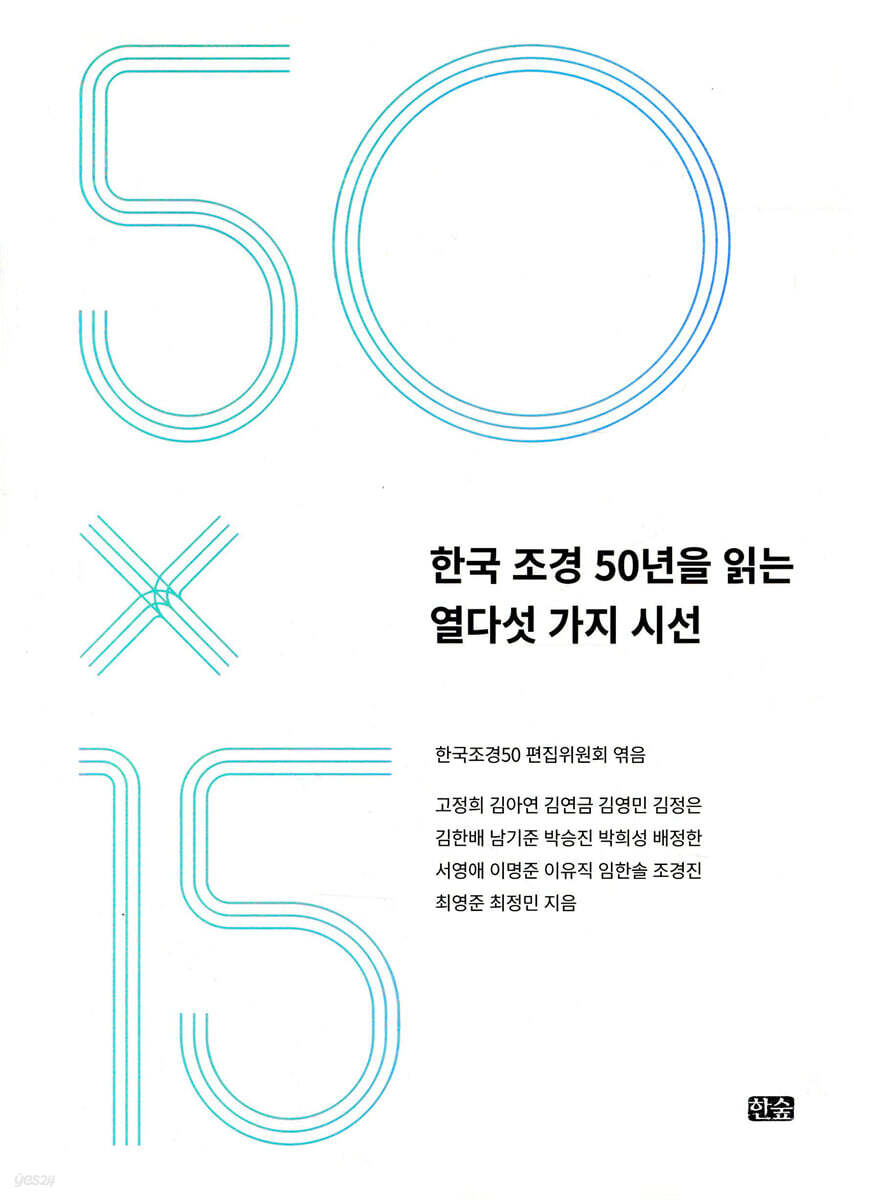
Fifteen Perspectives on 50 Years of Korean Landscape Architecture
 |
Description
Book Introduction
50 Years of Korean Landscape Architecture
The history of modern Korean landscape architecture dates back to 1972, when the Korean Society of Landscape Architecture was founded.
This book covers the history and major discourses of Korean landscape architecture over the past fifty years, and presents information on the '50 representative works of modern Korean landscape architecture' selected through a survey, spread over three parts.
Parts 1 and 2 are an 'interpretation' of the topography and landscape of 50 years of Korean landscape architecture, and a critique from fifteen perspectives.
Part 1 consists of six essays by Lee Myeong-jun (Theory and Aesthetics), Choi Yeong-jun (Design Competition), Lim Han-sol (Reproduction of Tradition), Ko Jeong-hee (Food Design), Choi Jeong-min (Contemporaneity and Identity), and Park Hee-seong (Development Era), and interprets the major trends and issues spanning the past 50 years in the form of a bird's-eye view.
If Part 1 is a bird's eye view of the overall topography and landscape of Korean landscape architecture, Part 2 is a close-up of the main sections.
Part 2, which compiles nine essays by Kim A-yeon (Ecological Park), Lee Yu-jik (Linear Park), Seo Yeong-ae (Parkification of Former Sites), Kim Yeong-min (Apartment Landscaping), Kim Jeong-eun (Between and Boundaries), Kim Yeon-geum (Context), Kim Han-bae (Social Art), Park Seung-jin (Civil Society), and Nam Gi-jun (Text), captures and explains the major themes that have unfolded over the past 50 years of Korean landscaping.
Finally, in order to 'record' the key points of the terrain that Korean landscape architecture has drawn, the editorial committee of this book, together with the Korean Institute of Landscape Architecture, the monthly magazine 『Environment and Landscape』, and the Korean Landscape Architect Association, selected works that represent the achievements of the past 50 years.
A survey was conducted from April 19 to May 21, 2021, targeting members of the Korean Institute of Landscape Architecture, members of the Korean Landscape Architecture Association, and landscape design experts, with 303 experts participating.
The list of candidates for the survey was compiled based on the results of the survey commemorating the 201st issue of 『Environment and Landscape』 titled "50 Representative Works of Modern Korean Landscape Architecture" (2005) and the survey commemorating the 30th anniversary of the publication titled "Best Works Chosen by Landscape Architects by Era" (2012), past winners of the IFLA International Federation of Landscape Architects Awards and the ASLA American Society of Landscape Architects Awards, and recommendations from the editorial committee of 『Environment and Landscape Architecture』 and the editorial committee of this book.
Part 3 briefly summarizes the information on the '50 Modern Korean Landscapes' selected through the survey results.
Through this, we can examine the past and present of Korean landscape architecture and gauge its future through 50 representative works that capture the trends and trends of the past 50 years.
Ultimately, this book is a critique that looks back on 50 years of Korean landscape architecture and a kind of guidebook that lays the foundation for designing the 'next 50 years.'
This book will serve as a reference book for students who want to learn about landscape architecture by incorporating discourse on the present and future of 50 years of Korean landscape architecture into real-life examples, a guidebook for those working in the field of landscape architecture to guide them on Korean landscape architecture and the path they should take, and a collection of works introducing the beauty of landscape architecture to the general public interested in landscape architecture.
The history of modern Korean landscape architecture dates back to 1972, when the Korean Society of Landscape Architecture was founded.
This book covers the history and major discourses of Korean landscape architecture over the past fifty years, and presents information on the '50 representative works of modern Korean landscape architecture' selected through a survey, spread over three parts.
Parts 1 and 2 are an 'interpretation' of the topography and landscape of 50 years of Korean landscape architecture, and a critique from fifteen perspectives.
Part 1 consists of six essays by Lee Myeong-jun (Theory and Aesthetics), Choi Yeong-jun (Design Competition), Lim Han-sol (Reproduction of Tradition), Ko Jeong-hee (Food Design), Choi Jeong-min (Contemporaneity and Identity), and Park Hee-seong (Development Era), and interprets the major trends and issues spanning the past 50 years in the form of a bird's-eye view.
If Part 1 is a bird's eye view of the overall topography and landscape of Korean landscape architecture, Part 2 is a close-up of the main sections.
Part 2, which compiles nine essays by Kim A-yeon (Ecological Park), Lee Yu-jik (Linear Park), Seo Yeong-ae (Parkification of Former Sites), Kim Yeong-min (Apartment Landscaping), Kim Jeong-eun (Between and Boundaries), Kim Yeon-geum (Context), Kim Han-bae (Social Art), Park Seung-jin (Civil Society), and Nam Gi-jun (Text), captures and explains the major themes that have unfolded over the past 50 years of Korean landscaping.
Finally, in order to 'record' the key points of the terrain that Korean landscape architecture has drawn, the editorial committee of this book, together with the Korean Institute of Landscape Architecture, the monthly magazine 『Environment and Landscape』, and the Korean Landscape Architect Association, selected works that represent the achievements of the past 50 years.
A survey was conducted from April 19 to May 21, 2021, targeting members of the Korean Institute of Landscape Architecture, members of the Korean Landscape Architecture Association, and landscape design experts, with 303 experts participating.
The list of candidates for the survey was compiled based on the results of the survey commemorating the 201st issue of 『Environment and Landscape』 titled "50 Representative Works of Modern Korean Landscape Architecture" (2005) and the survey commemorating the 30th anniversary of the publication titled "Best Works Chosen by Landscape Architects by Era" (2012), past winners of the IFLA International Federation of Landscape Architects Awards and the ASLA American Society of Landscape Architects Awards, and recommendations from the editorial committee of 『Environment and Landscape Architecture』 and the editorial committee of this book.
Part 3 briefly summarizes the information on the '50 Modern Korean Landscapes' selected through the survey results.
Through this, we can examine the past and present of Korean landscape architecture and gauge its future through 50 representative works that capture the trends and trends of the past 50 years.
Ultimately, this book is a critique that looks back on 50 years of Korean landscape architecture and a kind of guidebook that lays the foundation for designing the 'next 50 years.'
This book will serve as a reference book for students who want to learn about landscape architecture by incorporating discourse on the present and future of 50 years of Korean landscape architecture into real-life examples, a guidebook for those working in the field of landscape architecture to guide them on Korean landscape architecture and the path they should take, and a collection of works introducing the beauty of landscape architecture to the general public interested in landscape architecture.
index
At the publication of the book_Jo Kyung-jin
Prologue: 50×15, Reading Korean Landscape_Bae Jeong-han
Part 1
Korean Landscape Architecture and Theory: A Keyword Guide_Lee Myeong-jun
The Evolution of Design Competitions and the Growth of Landscape Architecture_Choi Young-jun
Living Past, Re-creating Tradition_Im Han-sol
The skewed relationship between Korean landscape architecture and plants_Koh Jeong-hee
The Contemporaneity and Identity of Korean Landscape Architecture_Choi Jeong-min
Landscaping in the Development Era: Its Crucial Moments_Park Hee-seong
Part 2
City Nature, Ecological Park_Kim A-yeon
Landscape of Recovery, Urban Linear Park_Lee Yu-jik
From the former site to the park_Seo Young-ae
Commerciality and Publicness: The Contradictions and Future of Apartment Landscaping_Kim Young-min
Between City and Architecture_Kim Jong-un
Landscape Architecture: Reading and Building Context_Kim Yeon-geum
Landscape Architecture as Social Art: From Public to Social_Kim Han-bae
Parks and Civil Society_Park Seung-jin
Korean Landscape Architecture in Text_Nam Gi-jun
Part 3
50 Modern Korean Landscapes
Gyeongui Line Forest Trail | Seoul Forest | Seonyudo Park | Cheonggyecheon Stream | Amorepacific's new headquarters building | Nodeul Island | Hwadam Forest | Gwanggyo Lake Park | Suncheon Bay National Garden | Seoul Botanical Garden | Seoullo 7017 | Gwanghwamun Square | Olympic Park | West Seoul Lake Park | Becke Garden | Dongdaemun Design Plaza | Buk Seoul Dream Forest | Heewon | Oil Tank Culture Park | Songdo Central Park | Haneul Park | Brickwell Garden | DH Honor Hills | Gildong Ecological Park | Gyeongchun Line Forest Trail | Yangjaecheon Stream | Osulloc Tea Museum? Innisfree Jeju | Deoksugung Pedestrian Trail | South Cape Owners' Club | Ilsan Lake Park | Yeouido Park | Yeouido Hangang Park | Seosomun Historical Park | Gyeongju Bomun Tourist Complex | Seoul Children's Grand Park | Banpo Hangang Park | Dongtan Lake Park | Busan Citizens' Park | National Sejong Arboretum | Paris Park | Misa Riverside Central Xi | Raemian Shinbanpo Palace | Baegot Life Park | Yeouido Saetgang Ecological Park | Gyeongju Hilton Hotel | National Debt Redemption Movement Memorial Park | CJ Blossom Park | Ulsan Grand Park | Sejong Central Park | National Asia Culture Center
Prologue: 50×15, Reading Korean Landscape_Bae Jeong-han
Part 1
Korean Landscape Architecture and Theory: A Keyword Guide_Lee Myeong-jun
The Evolution of Design Competitions and the Growth of Landscape Architecture_Choi Young-jun
Living Past, Re-creating Tradition_Im Han-sol
The skewed relationship between Korean landscape architecture and plants_Koh Jeong-hee
The Contemporaneity and Identity of Korean Landscape Architecture_Choi Jeong-min
Landscaping in the Development Era: Its Crucial Moments_Park Hee-seong
Part 2
City Nature, Ecological Park_Kim A-yeon
Landscape of Recovery, Urban Linear Park_Lee Yu-jik
From the former site to the park_Seo Young-ae
Commerciality and Publicness: The Contradictions and Future of Apartment Landscaping_Kim Young-min
Between City and Architecture_Kim Jong-un
Landscape Architecture: Reading and Building Context_Kim Yeon-geum
Landscape Architecture as Social Art: From Public to Social_Kim Han-bae
Parks and Civil Society_Park Seung-jin
Korean Landscape Architecture in Text_Nam Gi-jun
Part 3
50 Modern Korean Landscapes
Gyeongui Line Forest Trail | Seoul Forest | Seonyudo Park | Cheonggyecheon Stream | Amorepacific's new headquarters building | Nodeul Island | Hwadam Forest | Gwanggyo Lake Park | Suncheon Bay National Garden | Seoul Botanical Garden | Seoullo 7017 | Gwanghwamun Square | Olympic Park | West Seoul Lake Park | Becke Garden | Dongdaemun Design Plaza | Buk Seoul Dream Forest | Heewon | Oil Tank Culture Park | Songdo Central Park | Haneul Park | Brickwell Garden | DH Honor Hills | Gildong Ecological Park | Gyeongchun Line Forest Trail | Yangjaecheon Stream | Osulloc Tea Museum? Innisfree Jeju | Deoksugung Pedestrian Trail | South Cape Owners' Club | Ilsan Lake Park | Yeouido Park | Yeouido Hangang Park | Seosomun Historical Park | Gyeongju Bomun Tourist Complex | Seoul Children's Grand Park | Banpo Hangang Park | Dongtan Lake Park | Busan Citizens' Park | National Sejong Arboretum | Paris Park | Misa Riverside Central Xi | Raemian Shinbanpo Palace | Baegot Life Park | Yeouido Saetgang Ecological Park | Gyeongju Hilton Hotel | National Debt Redemption Movement Memorial Park | CJ Blossom Park | Ulsan Grand Park | Sejong Central Park | National Asia Culture Center
Into the book
Landscaping is a design practice that creates the beauty of a landscape with human hands.
Landscape architects have always tried to create new landscapes with creative ideas.
A closer look at the diverse range of Korean contemporary landscape architecture, which at first glance appears to be dominated by Olmsted's pastoral landscapes, reveals the sincerity of designers and theorists who have sought alternative design directions, breaking away from existing conventions and social norms, and this is deeply moving.
--- p.27
This article divides the 30-year history of Korean landscape design competitions into three periods.
The first period is the 'initial' stage when design competitions for representative open spaces in Seoul began and various design competition systems were introduced, from the Yeouido Plaza park design competition mentioned above to the 2003 Seoul Forest competition.
The next period was a period of prosperity, with many design competitions held, driven by large-scale park and green space systems centered around the second new town, Sejong City-related projects, and the Han River Renaissance Project.
The last period is the 'maturity period' from the 2012 Yongsan Park design international competition to the present, when the competition process was improved and plans diversified.
--- p.52
The power of tradition varies greatly depending on who the subject is and what they are trying to achieve.
If the early traditional practice of Korean landscaping placed a great deal of emphasis on establishing national identity and discovering its essence, future traditional practice is expected to focus more on the dimensions of locality, diversity, discovery, and reinterpretation.
As the examples presented later in the text illustrate, the reinterpretation of tradition is a sensory tool that summons temporality and a means of rethinking history.
Let us recall the well-known characteristics of traditional Korean landscaping.
The unique respect for nature and extroversion that values and values mountains and rivers and does not limit the scope of landscape manipulation to the boundaries of the land have great potential to be used as a rhetoric and metaphor for modern landscaping.
--- p.82
We spend a lot of time on the road during the day.
Morning and evening commutes to and from work and school.
Whether you're going shopping or visiting an amusement park or park on the weekend, you have to get out of the way first.
If you leave the road, you will be delayed for a long time on the road.
The park is far, but the apartment is close.
These days, more than 60% of the population lives in apartments, so apartment landscaping may be the first natural experience for children.
Of course, there are limits to the role of landscape architecture in taking charge of the landscapes experienced on the road and the road movies that dominate our daily lives.
Our 'ugly cities', created by the rapid development of new cities, cannot regain their beauty even with street green space improvement projects.
--- p.106
If the garden business becomes active, landscaping has room to develop in a more microscopic aspect.
There is a possibility that institutional measures will be put in place to address the somewhat lacking maintenance and management issues, and diversification of plant materials and planting designs is also expected.
The expansion of garden culture and the growth of the garden industry are also expected to lead to the development of landscaping.
Furthermore, gardening will certainly bring about changes in citizen participation, which has mainly been passive, as it involves the active act of creating and caring for nature while increasing intimacy with it.
In addition to producing experts, it will also be possible to expand into the fields of horticulture and forestry.
If the ambitious Garden City Project, which the Korea Forest Service is pursuing, is successfully implemented, it will become easier to encounter urban landscapes led by landscaping in the future.
--- p.152
The parents formed a countermeasure committee and went to the district office to demand corrective action, but it was not readily accepted.
Eventually, the accident that day was reported in the daily newspaper, and the district office had no choice but to launch an investigation.
The realization that the new playground could be a weapon for children led to an inspection of all playground equipment in the neighborhood and a major replacement project.
It was a victory for the 'Playground Moms'.
Mothers with children of similar ages banded together with a sense of solidarity as a "neighborhood" and began to take care of local issues.
They began to assert their rights as taxpayers, taking issue with everything from the paving of alleyways, the water supply, and even the noise of airplanes (they lived close to the airport).
She was reborn as a ‘citizen’ rather than a ‘neighborhood auntie.’
Landscape architects have always tried to create new landscapes with creative ideas.
A closer look at the diverse range of Korean contemporary landscape architecture, which at first glance appears to be dominated by Olmsted's pastoral landscapes, reveals the sincerity of designers and theorists who have sought alternative design directions, breaking away from existing conventions and social norms, and this is deeply moving.
--- p.27
This article divides the 30-year history of Korean landscape design competitions into three periods.
The first period is the 'initial' stage when design competitions for representative open spaces in Seoul began and various design competition systems were introduced, from the Yeouido Plaza park design competition mentioned above to the 2003 Seoul Forest competition.
The next period was a period of prosperity, with many design competitions held, driven by large-scale park and green space systems centered around the second new town, Sejong City-related projects, and the Han River Renaissance Project.
The last period is the 'maturity period' from the 2012 Yongsan Park design international competition to the present, when the competition process was improved and plans diversified.
--- p.52
The power of tradition varies greatly depending on who the subject is and what they are trying to achieve.
If the early traditional practice of Korean landscaping placed a great deal of emphasis on establishing national identity and discovering its essence, future traditional practice is expected to focus more on the dimensions of locality, diversity, discovery, and reinterpretation.
As the examples presented later in the text illustrate, the reinterpretation of tradition is a sensory tool that summons temporality and a means of rethinking history.
Let us recall the well-known characteristics of traditional Korean landscaping.
The unique respect for nature and extroversion that values and values mountains and rivers and does not limit the scope of landscape manipulation to the boundaries of the land have great potential to be used as a rhetoric and metaphor for modern landscaping.
--- p.82
We spend a lot of time on the road during the day.
Morning and evening commutes to and from work and school.
Whether you're going shopping or visiting an amusement park or park on the weekend, you have to get out of the way first.
If you leave the road, you will be delayed for a long time on the road.
The park is far, but the apartment is close.
These days, more than 60% of the population lives in apartments, so apartment landscaping may be the first natural experience for children.
Of course, there are limits to the role of landscape architecture in taking charge of the landscapes experienced on the road and the road movies that dominate our daily lives.
Our 'ugly cities', created by the rapid development of new cities, cannot regain their beauty even with street green space improvement projects.
--- p.106
If the garden business becomes active, landscaping has room to develop in a more microscopic aspect.
There is a possibility that institutional measures will be put in place to address the somewhat lacking maintenance and management issues, and diversification of plant materials and planting designs is also expected.
The expansion of garden culture and the growth of the garden industry are also expected to lead to the development of landscaping.
Furthermore, gardening will certainly bring about changes in citizen participation, which has mainly been passive, as it involves the active act of creating and caring for nature while increasing intimacy with it.
In addition to producing experts, it will also be possible to expand into the fields of horticulture and forestry.
If the ambitious Garden City Project, which the Korea Forest Service is pursuing, is successfully implemented, it will become easier to encounter urban landscapes led by landscaping in the future.
--- p.152
The parents formed a countermeasure committee and went to the district office to demand corrective action, but it was not readily accepted.
Eventually, the accident that day was reported in the daily newspaper, and the district office had no choice but to launch an investigation.
The realization that the new playground could be a weapon for children led to an inspection of all playground equipment in the neighborhood and a major replacement project.
It was a victory for the 'Playground Moms'.
Mothers with children of similar ages banded together with a sense of solidarity as a "neighborhood" and began to take care of local issues.
They began to assert their rights as taxpayers, taking issue with everything from the paving of alleyways, the water supply, and even the noise of airplanes (they lived close to the airport).
She was reborn as a ‘citizen’ rather than a ‘neighborhood auntie.’
--- p.248
GOODS SPECIFICS
- Date of issue: September 1, 2022
- Page count, weight, size: 344 pages | 624g | 152*210*20mm
- ISBN13: 9791187511366
- ISBN10: 1187511366
You may also like
카테고리
korean


korean

![ELLE 엘르 스페셜 에디션 A형 : 12월 [2025]](http://librairie.coreenne.fr/cdn/shop/files/b8e27a3de6c9538896439686c6b0e8fb.jpg?v=1766436872&width=3840)


