

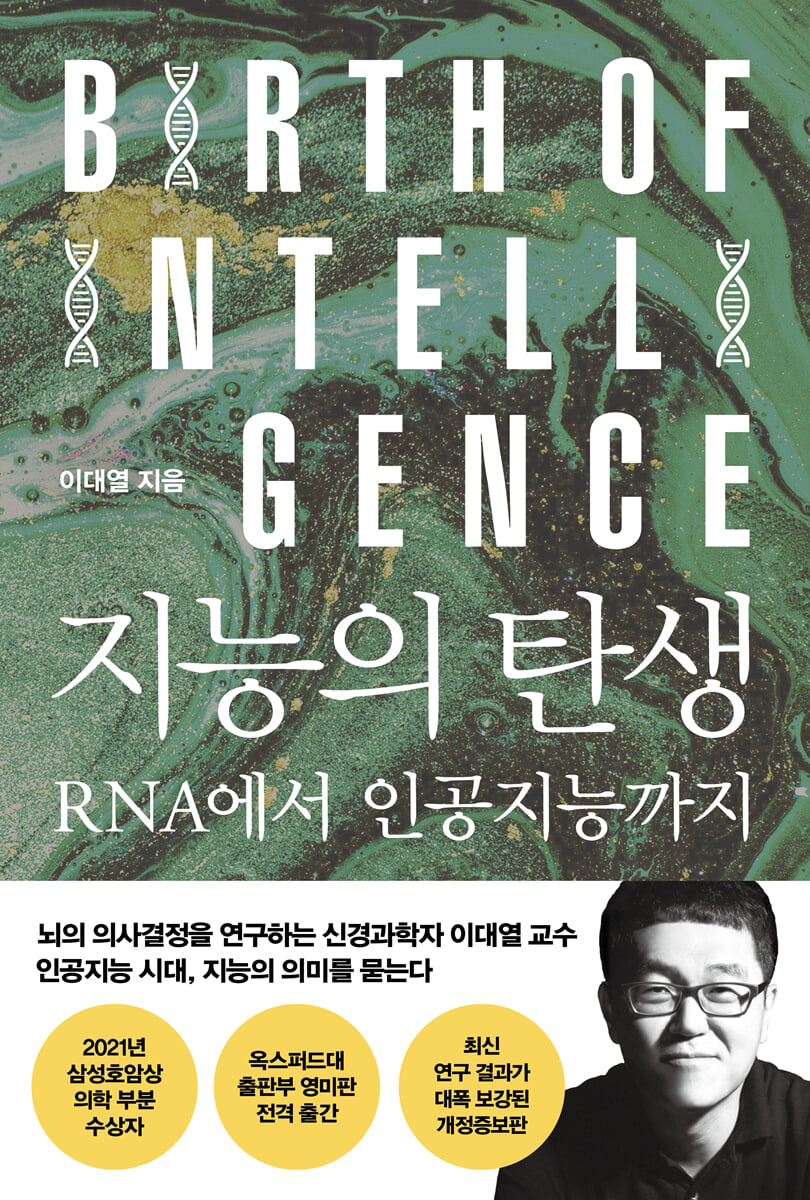
The Birth of Intelligence
 |
Description
Book Introduction
In the age of artificial intelligence, we question the meaning of intelligence.
Can artificial intelligence surpass human intelligence?
Published in 2017, around the time artificial intelligence was emerging, neuroscientist Professor Dae-yeol Lee's book, "The Birth of Intelligence," which raised fundamental questions about the meaning of intelligence, has been republished in a revised and expanded edition.
Professor Dae-Yeol Lee of Johns Hopkins University, winner of the 2021 Samsung Ho-Am Prize in Medicine and a world-renowned neuroeconomics expert who studies the brain's decision-making, has published the English version of 『Birth of Intelligence』 by Oxford University Press, significantly supplementing the contents he reviewed and the latest research results on artificial intelligence, and once again raises fundamental questions about the meaning of intelligence in the age of artificial intelligence.
Professor Lee Dae-yeol traces the essence of intelligence from the perspective of life and examines why true intelligence is 'still' a unique function of living things.
As DeepMind's neuroscientist Boschwinik puts it, this book not only provides a key insight into one of the most important debates of our time: the question of artificial intelligence, but also provides an opportunity for non-experts to participate in the debate.
Can artificial intelligence surpass human intelligence?
Published in 2017, around the time artificial intelligence was emerging, neuroscientist Professor Dae-yeol Lee's book, "The Birth of Intelligence," which raised fundamental questions about the meaning of intelligence, has been republished in a revised and expanded edition.
Professor Dae-Yeol Lee of Johns Hopkins University, winner of the 2021 Samsung Ho-Am Prize in Medicine and a world-renowned neuroeconomics expert who studies the brain's decision-making, has published the English version of 『Birth of Intelligence』 by Oxford University Press, significantly supplementing the contents he reviewed and the latest research results on artificial intelligence, and once again raises fundamental questions about the meaning of intelligence in the age of artificial intelligence.
Professor Lee Dae-yeol traces the essence of intelligence from the perspective of life and examines why true intelligence is 'still' a unique function of living things.
As DeepMind's neuroscientist Boschwinik puts it, this book not only provides a key insight into one of the most important debates of our time: the question of artificial intelligence, but also provides an opportunity for non-experts to participate in the debate.
- You can preview some of the book's contents.
Preview
index
Recommendation
Preface to the Revised Edition
introduction
Part 1: What is Intelligence?
Chapter 1: Conditions of Intelligence
What is Intelligence? | Brainless Intelligence: From Bacteria to Plants | How the Nervous System Works | The Most Basic Behavior, Reflexes | The Limits of Reflexes: Cockroach Reflexes | The Brain Connectome | Various Muscle Control Devices | Eye Movement Examples
Chapter 2 Brain and Intelligence
Utility Theory | Factors Influencing Decision Making | Buridan's Donkey | The Limits of Utility Theory | Is Decision Making for Happiness? | Utility Theory and the Brain | A Direct Look into the Brain | The Evolution of Utility
Chapter 3 Artificial Intelligence
Brains and Computers | Can Computers Become Brain-Imaginable? | Synapses and Transistors | Hardware and Software | AI on Mars | The Sojourner Ship Becomes a Membrane | Autonomous AI | AI and Utility | Robot Teams and Collective Intelligence
Part 2: The Evolution of Intelligence
Chapter 4: Intelligence and Self-Replicating Machines
What is a self-replicating machine? | The evolution of self-replicating machines | The all-rounder protein | The emergence of multicellular life | The evolution of the brain | Evolution and development
Chapter 5: Brain and Genes
Division of Labor and Delegation | The Principal-Agent Problem | The Incentives Genes Offer the Brain: Learning
Part 3: Intelligence and Learning
Chapter 6 Why Learn?
The Varieties of Learning | Classical Conditioning: Dogs and Buzzers | The Law of Consequences and Operant Learning: The Curious Cat | Combining Classical and Instrumental Conditioning | Knowledge: Latent Learning and Place Learning
Chapter 7 The Learning Brain
Neurons and Learning | In Search of Engrams | The Hippocampus and the Basal Ganglia | Reinforcement Learning Theory | The Pleasure Chemical: Dopamine | Reinforcement Learning and Knowledge | Regret and the Orbitofrontal Cortex | Regret and Neurons
Chapter 8: Learning Machines
AlexNet's Ancestor: Perceptron | Deep Learning: AlexNet | Deep Reinforcement Learning: AlphaGo | The Future of AI
Chapter 9 Social Intelligence and Altruism
The Rise of Game Theory | The Death of Game Theory? | The Iterated Prisoner's Dilemma | Pavlov's Strategy | A Cooperative Society | The Dark Side of Altruism | Can We Predict Others' Choices? | Recursive Reasoning | The Social, All-Too-Social Brain
Chapter 10 Intelligence and the Self
The Paradox of Self-Awareness | Metacognition and Metaselection | The Masters of Intelligence
Conclusion
main
References
Search
Preface to the Revised Edition
introduction
Part 1: What is Intelligence?
Chapter 1: Conditions of Intelligence
What is Intelligence? | Brainless Intelligence: From Bacteria to Plants | How the Nervous System Works | The Most Basic Behavior, Reflexes | The Limits of Reflexes: Cockroach Reflexes | The Brain Connectome | Various Muscle Control Devices | Eye Movement Examples
Chapter 2 Brain and Intelligence
Utility Theory | Factors Influencing Decision Making | Buridan's Donkey | The Limits of Utility Theory | Is Decision Making for Happiness? | Utility Theory and the Brain | A Direct Look into the Brain | The Evolution of Utility
Chapter 3 Artificial Intelligence
Brains and Computers | Can Computers Become Brain-Imaginable? | Synapses and Transistors | Hardware and Software | AI on Mars | The Sojourner Ship Becomes a Membrane | Autonomous AI | AI and Utility | Robot Teams and Collective Intelligence
Part 2: The Evolution of Intelligence
Chapter 4: Intelligence and Self-Replicating Machines
What is a self-replicating machine? | The evolution of self-replicating machines | The all-rounder protein | The emergence of multicellular life | The evolution of the brain | Evolution and development
Chapter 5: Brain and Genes
Division of Labor and Delegation | The Principal-Agent Problem | The Incentives Genes Offer the Brain: Learning
Part 3: Intelligence and Learning
Chapter 6 Why Learn?
The Varieties of Learning | Classical Conditioning: Dogs and Buzzers | The Law of Consequences and Operant Learning: The Curious Cat | Combining Classical and Instrumental Conditioning | Knowledge: Latent Learning and Place Learning
Chapter 7 The Learning Brain
Neurons and Learning | In Search of Engrams | The Hippocampus and the Basal Ganglia | Reinforcement Learning Theory | The Pleasure Chemical: Dopamine | Reinforcement Learning and Knowledge | Regret and the Orbitofrontal Cortex | Regret and Neurons
Chapter 8: Learning Machines
AlexNet's Ancestor: Perceptron | Deep Learning: AlexNet | Deep Reinforcement Learning: AlphaGo | The Future of AI
Chapter 9 Social Intelligence and Altruism
The Rise of Game Theory | The Death of Game Theory? | The Iterated Prisoner's Dilemma | Pavlov's Strategy | A Cooperative Society | The Dark Side of Altruism | Can We Predict Others' Choices? | Recursive Reasoning | The Social, All-Too-Social Brain
Chapter 10 Intelligence and the Self
The Paradox of Self-Awareness | Metacognition and Metaselection | The Masters of Intelligence
Conclusion
main
References
Search
Detailed image
Publisher's Review
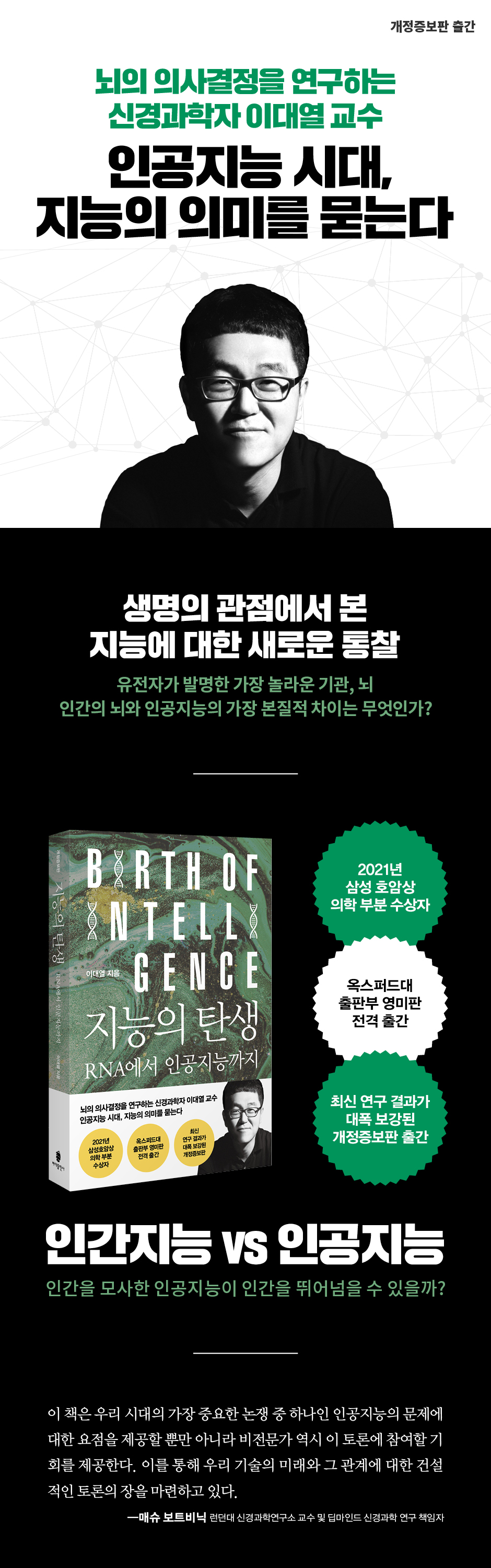
The Birth of Intelligence: From RNA to Artificial Intelligence
This book raises two fundamental questions: what is intelligence and why is it important for biological systems?
Drawing on key findings from neuroscience, computer science, psychology, biology, and economics, Professor Lee Dae-yeol explains that the flexible ability to cope with unexpected situations is central to intelligence, and that this ability is inextricably linked to the reproduction and replication of living organisms.
This is the only book that explains intelligence and the brain so well, as well as Mars rovers, transistors, and the actor's dilemma.
Matthew Rushworth, Professor of Cognitive Neuroscience at Oxford University
In this engaging book, renowned neuroscientist Professor Dae-Yeol Lee presents the core science of the brain and mind in an authoritative yet accessible way.
Based on this, he presents an insightful new argument about the difference between biological intelligence and artificial intelligence.
This book not only provides a key insight into one of the most important debates of our time—the question of artificial intelligence—but also provides an opportunity for non-experts to participate in this discussion.
Through this, we are providing a forum for constructive discussion about the future of our technology and its relationships.
Matthew Botvinick, Professor at the University of London's Institute of Neuroscience and Director of Neuroscience Research at DeepMind
In this book, which addresses the complex topic of intelligence, Professor Dae-Yeol Lee, a leading figure in neuroscience and psychology, offers a new perspective on the role of intelligence in evolution.
He covers the broad topic of decision-making, drawing on a wide range of disciplines including psychology, neuroscience, mathematics, probability theory, economics, evolution, philosophy, and artificial intelligence.
This logically structured book is filled with engaging narratives that provide new insights into the neurological basis of intelligence.
?Gordon M.
ShepherdGordon M.
Shepherd Distinguished Professor of Neuroscience, Yale University School of Medicine
New insights into intelligence,
The Nature of Intelligence as Seen Through the Principal-Agent Theory
Could we be misunderstanding the concept of "intelligence"? We often refer to people who are extremely smart or possess exceptional computational skills as "highly intelligent."
But intelligence is not simply about reasoning or calculation skills.
It is a concept that encompasses all universal cognitive abilities such as thinking, empathizing, and dreaming.
You can tell just by looking at a calculator that can perform complex mathematical operations in the blink of an eye that it is not said to be highly intelligent.
In “The Birth of Intelligence,” Professor Lee Dae-yeol calls for a rethinking of our common sense about intelligence.
The idea is to look at intelligence from the perspective of life and genes.
Of course, intelligence is related to problem-solving ability.
However, the problems that living beings, including humans, had to solve were not simple mathematical problems, but much more complex and challenging.
The problems that living things face in their environment are constantly changing, so a problem that was solved skillfully yesterday does not mean that it will be easily solved tomorrow.
In reality, many of the problems we encounter in real life, unlike math problems, often do not have objective answers.
In other words, in a harsh survival environment, living things had to become versatile problem solvers who could solve various complex problems in various ways, rather than electronic calculators that could solve only one problem.
The ability that a living organism acquires in this process is intelligence, and intelligence can be said to be the decision-making ability to consider the possible actions in a problem situation and then select the most appropriate action among them.
The goal of this book is to understand the nature of intelligence as expressed through these various decision-making processes.
This book explores the diverse facets of intelligence through behaviors exhibited in cockroaches, jellyfish, C. elegans, and the human eye.
Part 2, which explains brain evolution from a genetic perspective, contains Professor Lee Dae-yeol's unique insights.
The relationship between genes and the brain is similar to the relationship between a boss and a worker.
Since the boss can't do everything himself, he hires people to work for him and pays them a salary.
If this worker works hard and earns a lot of money and the company does well, it is beneficial for both the boss and the worker.
Genes also use the brain to do things they cannot do on their own, and although what happens in the brain is for the genes and not for the brain itself, the brain also benefits from the relationship.
The author, Professor Lee Dae-yeol, examines the division of labor and delegation that takes place between genes and the brain by incorporating the economics of the 'principal-agent theory.'
Division of labor and delegation are mechanisms that play an essential role in the evolution of complex structures like the brain.
Human Intelligence vs. Artificial Intelligence
Can artificial intelligence that mimics humans surpass humans?
Do you remember the shocking victory between 9-dan Lee Sedol and AlphaGo that stunned the world? It's now undeniable that artificial intelligence is beginning to surpass humans in games like object recognition and Go.
Since the advent of AlphaGo, human intelligence has not changed much, but the performance of artificial intelligence has continued to improve.
One of the most surprising examples is 'AlphStar', who plays StarCraft.
AlphaStar is outperforming humans in StarCraft, a game more realistic than Go in that it requires making real-time strategic decisions using information gathered from various sources.
Artificial intelligence has advanced at an astonishing rate over the past half century.
One thing to note is that the driving force behind this revolutionary technological advancement came from the process in which computer science and neuroscience observed and learned from each other.
This is because, in the 2010s, new artificial intelligence algorithms based on artificial neural network technology, which had previously failed to produce tangible results, began to demonstrate superhuman performance.
This was possible thanks to the emergence of an algorithm called deep learning, which mimics a neural network that learns from changes in the external environment.
This revised and expanded edition includes new content on machine learning, helping even readers with limited mathematical or computer knowledge understand how artificial intelligence, implemented through artificial neural networks, can solve a variety of problems.
Cutting-edge algorithms, such as deep reinforcement learning used in AlphaStar and AlphaGo, are now being applied in various fields, including autonomous driving.
In the future, artificial intelligence with such amazing capabilities will continue to reveal itself to us.
So, will AI truly replace human intelligence? Professor Lee Dae-yeol analyzes that, despite the remarkable advancements and performance of AI, it will not replace humans anytime soon.
Intelligence is 'still' a unique function of life.
In August 2012, the artificial intelligence rover 'Curiosity' was dispatched to Mars.
Curiosity, which makes decisions on its own and drives to its destination without the need for human intervention, is an artificial intelligence robot that is superior to AlphaGo in that it solves all problems on its own.
Unlike AlphaGo, which specialized in Go, Curiosity can perform various functions, such as autonomous driving, energy distribution for mission execution, and video editing to analyze collected data and transmit important information to Earth.
Curiosity, the Autonomous Robot: Can Mechanical Robots Like Curiosity Have 'Real' Intelligence?
Professor Lee Dae-yeol answers that this is not the case.
The reason Curiosity appears to be intelligent is because some features of intelligence are mistaken for intelligence as a whole.
Professor Lee Dae-yeol says that a comprehensive understanding of intelligence is possible only when viewed from the perspective of life and genes.
At the intersection of neuroscience and behavioral economics, he explores the origins and limits of intelligence, arguing that intelligence is still a living thing.
Through this analysis, Professor Lee Dae-yeol argues that an event like the singularity, where artificial intelligence completely replaces human intelligence, will not occur for the time being.
This is because intelligence is fundamentally a part of the life phenomenon that centers around self-replication.
According to his argument, even if machines surpass humans in many aspects of intellectual ability, AI will remain a proxy for humans unless the machines equipped with AI begin to replicate themselves.
This book raises two fundamental questions: what is intelligence and why is it important for biological systems?
Drawing on key findings from neuroscience, computer science, psychology, biology, and economics, Professor Lee Dae-yeol explains that the flexible ability to cope with unexpected situations is central to intelligence, and that this ability is inextricably linked to the reproduction and replication of living organisms.
This is the only book that explains intelligence and the brain so well, as well as Mars rovers, transistors, and the actor's dilemma.
Matthew Rushworth, Professor of Cognitive Neuroscience at Oxford University
In this engaging book, renowned neuroscientist Professor Dae-Yeol Lee presents the core science of the brain and mind in an authoritative yet accessible way.
Based on this, he presents an insightful new argument about the difference between biological intelligence and artificial intelligence.
This book not only provides a key insight into one of the most important debates of our time—the question of artificial intelligence—but also provides an opportunity for non-experts to participate in this discussion.
Through this, we are providing a forum for constructive discussion about the future of our technology and its relationships.
Matthew Botvinick, Professor at the University of London's Institute of Neuroscience and Director of Neuroscience Research at DeepMind
In this book, which addresses the complex topic of intelligence, Professor Dae-Yeol Lee, a leading figure in neuroscience and psychology, offers a new perspective on the role of intelligence in evolution.
He covers the broad topic of decision-making, drawing on a wide range of disciplines including psychology, neuroscience, mathematics, probability theory, economics, evolution, philosophy, and artificial intelligence.
This logically structured book is filled with engaging narratives that provide new insights into the neurological basis of intelligence.
?Gordon M.
ShepherdGordon M.
Shepherd Distinguished Professor of Neuroscience, Yale University School of Medicine
New insights into intelligence,
The Nature of Intelligence as Seen Through the Principal-Agent Theory
Could we be misunderstanding the concept of "intelligence"? We often refer to people who are extremely smart or possess exceptional computational skills as "highly intelligent."
But intelligence is not simply about reasoning or calculation skills.
It is a concept that encompasses all universal cognitive abilities such as thinking, empathizing, and dreaming.
You can tell just by looking at a calculator that can perform complex mathematical operations in the blink of an eye that it is not said to be highly intelligent.
In “The Birth of Intelligence,” Professor Lee Dae-yeol calls for a rethinking of our common sense about intelligence.
The idea is to look at intelligence from the perspective of life and genes.
Of course, intelligence is related to problem-solving ability.
However, the problems that living beings, including humans, had to solve were not simple mathematical problems, but much more complex and challenging.
The problems that living things face in their environment are constantly changing, so a problem that was solved skillfully yesterday does not mean that it will be easily solved tomorrow.
In reality, many of the problems we encounter in real life, unlike math problems, often do not have objective answers.
In other words, in a harsh survival environment, living things had to become versatile problem solvers who could solve various complex problems in various ways, rather than electronic calculators that could solve only one problem.
The ability that a living organism acquires in this process is intelligence, and intelligence can be said to be the decision-making ability to consider the possible actions in a problem situation and then select the most appropriate action among them.
The goal of this book is to understand the nature of intelligence as expressed through these various decision-making processes.
This book explores the diverse facets of intelligence through behaviors exhibited in cockroaches, jellyfish, C. elegans, and the human eye.
Part 2, which explains brain evolution from a genetic perspective, contains Professor Lee Dae-yeol's unique insights.
The relationship between genes and the brain is similar to the relationship between a boss and a worker.
Since the boss can't do everything himself, he hires people to work for him and pays them a salary.
If this worker works hard and earns a lot of money and the company does well, it is beneficial for both the boss and the worker.
Genes also use the brain to do things they cannot do on their own, and although what happens in the brain is for the genes and not for the brain itself, the brain also benefits from the relationship.
The author, Professor Lee Dae-yeol, examines the division of labor and delegation that takes place between genes and the brain by incorporating the economics of the 'principal-agent theory.'
Division of labor and delegation are mechanisms that play an essential role in the evolution of complex structures like the brain.
Human Intelligence vs. Artificial Intelligence
Can artificial intelligence that mimics humans surpass humans?
Do you remember the shocking victory between 9-dan Lee Sedol and AlphaGo that stunned the world? It's now undeniable that artificial intelligence is beginning to surpass humans in games like object recognition and Go.
Since the advent of AlphaGo, human intelligence has not changed much, but the performance of artificial intelligence has continued to improve.
One of the most surprising examples is 'AlphStar', who plays StarCraft.
AlphaStar is outperforming humans in StarCraft, a game more realistic than Go in that it requires making real-time strategic decisions using information gathered from various sources.
Artificial intelligence has advanced at an astonishing rate over the past half century.
One thing to note is that the driving force behind this revolutionary technological advancement came from the process in which computer science and neuroscience observed and learned from each other.
This is because, in the 2010s, new artificial intelligence algorithms based on artificial neural network technology, which had previously failed to produce tangible results, began to demonstrate superhuman performance.
This was possible thanks to the emergence of an algorithm called deep learning, which mimics a neural network that learns from changes in the external environment.
This revised and expanded edition includes new content on machine learning, helping even readers with limited mathematical or computer knowledge understand how artificial intelligence, implemented through artificial neural networks, can solve a variety of problems.
Cutting-edge algorithms, such as deep reinforcement learning used in AlphaStar and AlphaGo, are now being applied in various fields, including autonomous driving.
In the future, artificial intelligence with such amazing capabilities will continue to reveal itself to us.
So, will AI truly replace human intelligence? Professor Lee Dae-yeol analyzes that, despite the remarkable advancements and performance of AI, it will not replace humans anytime soon.
Intelligence is 'still' a unique function of life.
In August 2012, the artificial intelligence rover 'Curiosity' was dispatched to Mars.
Curiosity, which makes decisions on its own and drives to its destination without the need for human intervention, is an artificial intelligence robot that is superior to AlphaGo in that it solves all problems on its own.
Unlike AlphaGo, which specialized in Go, Curiosity can perform various functions, such as autonomous driving, energy distribution for mission execution, and video editing to analyze collected data and transmit important information to Earth.
Curiosity, the Autonomous Robot: Can Mechanical Robots Like Curiosity Have 'Real' Intelligence?
Professor Lee Dae-yeol answers that this is not the case.
The reason Curiosity appears to be intelligent is because some features of intelligence are mistaken for intelligence as a whole.
Professor Lee Dae-yeol says that a comprehensive understanding of intelligence is possible only when viewed from the perspective of life and genes.
At the intersection of neuroscience and behavioral economics, he explores the origins and limits of intelligence, arguing that intelligence is still a living thing.
Through this analysis, Professor Lee Dae-yeol argues that an event like the singularity, where artificial intelligence completely replaces human intelligence, will not occur for the time being.
This is because intelligence is fundamentally a part of the life phenomenon that centers around self-replication.
According to his argument, even if machines surpass humans in many aspects of intellectual ability, AI will remain a proxy for humans unless the machines equipped with AI begin to replicate themselves.
GOODS SPECIFICS
- Publication date: April 23, 2021
- Page count, weight, size: 344 pages | 528g | 152*225*21mm
- ISBN13: 9791166890130
- ISBN10: 1166890139
You may also like
카테고리
korean


korean

![ELLE 엘르 스페셜 에디션 A형 : 12월 [2025]](http://librairie.coreenne.fr/cdn/shop/files/b8e27a3de6c9538896439686c6b0e8fb.jpg?v=1766436872&width=3840)


