

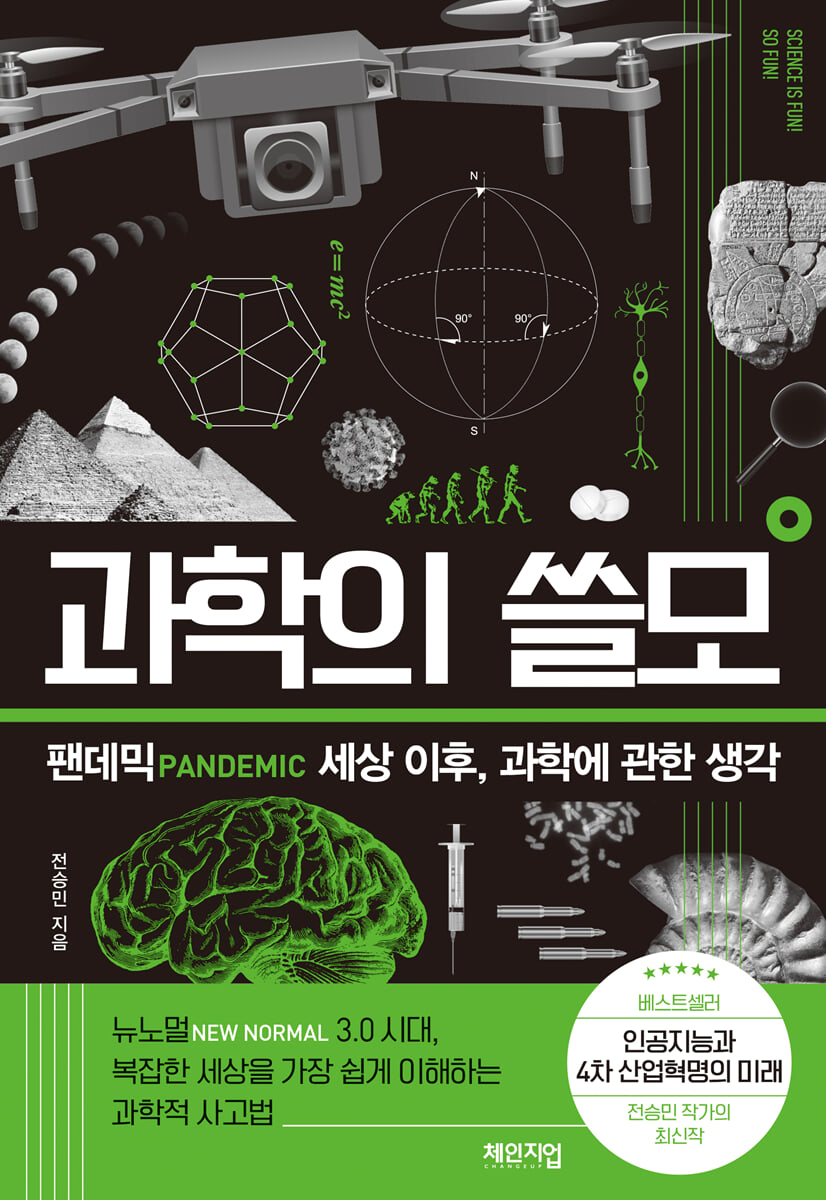
The Usefulness of Science
 |
Description
Book Introduction
Thoughts on Science in a Post-Pandemic World
Eliminate potential risks from the greatest challenges threatening humanity
Essential Science Stories for Everyday Life
Coronavirus and Immunity, Artificial Intelligence and Robotics, Future Transportation and Renewable Energy, Space, and Brain Science
The pandemic has accelerated the Fourth Industrial Revolution as contactless interactions have become widespread.
In the post-COVID era, smart factory systems will be installed in industrial settings, and artificial intelligence (AI) will replace people.
Various media outlets are creating buzz by pitting artificial intelligence (AI) against humans.
However, despite the heated interest in the Fourth Industrial Revolution, not many people are aware of its true nature.
This book is a science textbook written by author Jeon Seung-min, who has been writing science articles at the forefront of science for many years, explaining the Fourth Industrial Revolution, which has been perceived as rigid until now.
It's not just the 4th industrial revolution.
"The Usefulness of Science" compiles and explains general scientific knowledge that protects people from potential dangers that threaten humanity.
Instead of difficult diagrams or formulas, we have included vivid data and photos that will help you understand easily.
Chapter 1 addresses the life-or-death question of science: how do we protect ourselves from external agents, including viruses, infections, immune diseases, and toxins?
Chapter 2 examines the 'field of the 4th Industrial Revolution', which holds the key to opening the future, and Chapter 3 stimulates scientific imagination by unfolding stories of 'cutting-edge technologies' such as renewable energy, space, and brain science.
Eliminate potential risks from the greatest challenges threatening humanity
Essential Science Stories for Everyday Life
Coronavirus and Immunity, Artificial Intelligence and Robotics, Future Transportation and Renewable Energy, Space, and Brain Science
The pandemic has accelerated the Fourth Industrial Revolution as contactless interactions have become widespread.
In the post-COVID era, smart factory systems will be installed in industrial settings, and artificial intelligence (AI) will replace people.
Various media outlets are creating buzz by pitting artificial intelligence (AI) against humans.
However, despite the heated interest in the Fourth Industrial Revolution, not many people are aware of its true nature.
This book is a science textbook written by author Jeon Seung-min, who has been writing science articles at the forefront of science for many years, explaining the Fourth Industrial Revolution, which has been perceived as rigid until now.
It's not just the 4th industrial revolution.
"The Usefulness of Science" compiles and explains general scientific knowledge that protects people from potential dangers that threaten humanity.
Instead of difficult diagrams or formulas, we have included vivid data and photos that will help you understand easily.
Chapter 1 addresses the life-or-death question of science: how do we protect ourselves from external agents, including viruses, infections, immune diseases, and toxins?
Chapter 2 examines the 'field of the 4th Industrial Revolution', which holds the key to opening the future, and Chapter 3 stimulates scientific imagination by unfolding stories of 'cutting-edge technologies' such as renewable energy, space, and brain science.
- You can preview some of the book's contents.
Preview
index
Preface: What Happens When You Don't Know Science
Necessity1 Science, a matter of life and death
_Disease and Disaster: What You Need to Know
Virus: Why COVID-19 Won't Stop
Infection: How to Deal with Microorganisms
Immune and Genetic Diseases: The Diseases My Body Creates
Poisons and Injuries: Protecting Yourself from Disaster
BOX 1: The Post-COVID Era: A World Blending "Contact" and "Untact"
BOX 2 Thinking: The Shadow of Life Science: What if a World We Could Set Our Baby's IQ at Will?
Necessity2 Science: The Key to a New Era
The Launch of a New Industry: What We Need to Prepare for
A game changer for our time, artificial intelligence is permeating our daily lives.
Robots: A mechanical body for artificial intelligence
Cutting-edge technologies that will complete the Fourth Industrial Revolution
Focus on 'communications technology,' the foundation of innovation.
BOX 1: A New Era: The Path Forward for Our Industry
BOX 2 Think about it: What if robots become smarter than humans?
Necessity3 A New World Created by Science
_You must know the root to see a new era.
The Foundation of Civilization: The Present and Future of Energy Technology
Future energy technologies from the perspective of the electric power industry
- Hydrogen and nuclear fusion, the leading future energy sources
Trains that fly underground, cars that run in the sky
Advancing space technology: Will we ever move to Mars?
Neuroscience: A Pandora's Box We Must Open
BOX 1: What would a nuclear-free world look like?
BOX 2: Consider: As science advances, will we one day be able to 'time travel'?
Necessity1 Science, a matter of life and death
_Disease and Disaster: What You Need to Know
Virus: Why COVID-19 Won't Stop
Infection: How to Deal with Microorganisms
Immune and Genetic Diseases: The Diseases My Body Creates
Poisons and Injuries: Protecting Yourself from Disaster
BOX 1: The Post-COVID Era: A World Blending "Contact" and "Untact"
BOX 2 Thinking: The Shadow of Life Science: What if a World We Could Set Our Baby's IQ at Will?
Necessity2 Science: The Key to a New Era
The Launch of a New Industry: What We Need to Prepare for
A game changer for our time, artificial intelligence is permeating our daily lives.
Robots: A mechanical body for artificial intelligence
Cutting-edge technologies that will complete the Fourth Industrial Revolution
Focus on 'communications technology,' the foundation of innovation.
BOX 1: A New Era: The Path Forward for Our Industry
BOX 2 Think about it: What if robots become smarter than humans?
Necessity3 A New World Created by Science
_You must know the root to see a new era.
The Foundation of Civilization: The Present and Future of Energy Technology
Future energy technologies from the perspective of the electric power industry
- Hydrogen and nuclear fusion, the leading future energy sources
Trains that fly underground, cars that run in the sky
Advancing space technology: Will we ever move to Mars?
Neuroscience: A Pandora's Box We Must Open
BOX 1: What would a nuclear-free world look like?
BOX 2: Consider: As science advances, will we one day be able to 'time travel'?
Detailed image

Into the book
Bringing COVID-19 under control and completely eradicating it are two different things.
The most similar respiratory viral infection to COVID-19 is probably the 1918 influenza pandemic, also known as the "Spanish flu."
At the time, the WHO declared a "pandemic," just like the current COVID-19 outbreak, and the disease spread across the globe, killing between 17 million and 50 million people.
Considering that the cumulative global death toll from COVID-19 as of 2021 is around 2 million, the damage caused by the Spanish flu can be considered truly enormous.
But as you know, the Spanish flu is still far from being 'over'.
The influenza virus that caused the Spanish flu, also known as the flu virus, still kills about 650,000 people every year.
COVID-19 has already spread globally, and like the flu, we must prepare for an annual pandemic.
In this case, this safe contact culture can serve as a very important preventative measure.
--- p.82, from “The Post-Corona Era: A World Blending ‘Contact’ and ‘Untact’”
It is very unlikely that all human jobs will disappear in the age of artificial intelligence.
Because without humans, artificial intelligence can do nothing.
Knowing this, we can probably predict to some extent how humans and artificial intelligence (or robots that move under the command of artificial intelligence) will divide up work in the future.
In other words, occupations that take the initiative in their work can use artificial intelligence as a useful tool, and occupations that require judgment based on knowledge or rules or simple tasks can be replaced by artificial intelligence.
Of course, this is only a technical criterion.
In reality, the future of jobs that can be replaced by AI will be achieved gradually over a relatively long period of time, taking into account social norms, culture, and legal regulations.
--- p.109, from “Game Changer of the Era, Artificial Intelligence Digging into Everyday Life”
Let's say a malicious hacker steals a self-driving car and runs off with it.
Hacking this one car doesn't end there.
The artificial intelligence in the car checks the stored blocks before driving and instantly compares them with all the blocks in cars of the same model (let's say 10,000 cars).
And if there is a block with changed information, it will be considered hacked and will not move any further.
If a hacker were to attempt to hack a bank account using blockchain technology, they would have to hack all depositors using the same service simultaneously.
This is virtually impossible.
Also, these blocks are not stored on a central computer, but are distributed among all users, making it difficult to know exactly where they are.
--- p.131, from “Advanced Technologies Completing the Fourth Industrial Revolution”
The EU held its parliamentary session in Brussels, Belgium, in January 2017.
Here, a motion was passed to designate the legal status of robots with artificial intelligence as "electronic personhood."
The legal status of artificial intelligence was determined at the national level.
Although artificial intelligence is not yet at a level where it can directly threaten humans, it was the first time that the idea of establishing legal and institutional countermeasures in advance was institutionalized in anticipation of the need for related laws and systems to be established at some point, and it became a huge topic of conversation at the time.
Although electronic humans are not human, they are beings that can exercise some human-like authority.
Although humans are in the highest position, if robots can think and judge for themselves, then let's divide them into classes and allow them to live their lives.
--- p.156, from “We Need ‘Another Class’ That Is Neither Human, Animal, nor Machine”
Among renewable energy sources, 'geothermal' technology, which utilizes heat from the ground, is also widely used.
In other words, it uses the heat of magma underground to boil water and generate electricity.
Boiling water using geothermal heat eliminates the need for coal, oil, nuclear power, or gas, allowing us to generate electricity without polluting the environment. Furthermore, it can also solve the problem of sustainable power generation, the biggest weakness of renewable energy.
The problem is that there are not many volcanic areas where this can be done.
To generate power in other regions, we need to adopt the 'deep geothermal power' method, which involves digging more than 5,000 meters into the ground.
However, there is a problem in that there are cases where earthquakes are triggered when using this method.
Recently, another method has been explored: boiling substances other than water to generate electricity.
If you dig a few meters into the ground, the temperature will remain constant at around 10 to 20 degrees Celsius.
This principle is commonly used when building wine cellars and the like.
If you dig deeper from here, about 1,000 to 1,500 meters, the temperature will be around 40 to 50 degrees.
This temperature difference could be used to generate electricity.
--- p.174, from “The Foundation of Civilization, the Present and Future of Energy Technology--- p. Future Energy Technology as Seen Through the Electric Power Industry”
Many people compare hydrogen cars and electric cars, but both have their pros and cons.
Electric vehicles can be charged in the underground parking lot of a home or apartment, as long as there is a charging facility, and can even be charged while shopping at a supermarket.
On the other hand, hydrogen cars have the disadvantage of having to visit a hydrogen charging station, and their energy efficiency is also low because the hydrogen must be converted into electricity before use.
Instead, since the fuel is relatively light compared to electric vehicles, if it is made into a large vehicle, it can carry a lot of fuel.
In other words, technically it is more advantageous for long-distance mass transportation.
For passenger cars driving in urban areas, electric vehicles would be advantageous if only charging efficiency could be improved, but for trucks transporting large loads between cities, hydrogen has a greater advantage.
--- p.186, from “The Foundation of Civilization, the Present and Future of Energy Technology - Hydrogen and Nuclear Fusion, Leading Future Energy Sources”
It is expected that the next thing that will bring about innovation in urban areas and transportation systems after self-driving cars will be 'flying cars' that can fly in the sky.
The term 'urban air mobility' is sometimes used, and it's a concept that literally came from the idea that it would be nice if people could drive cars that could fly in the sky.
Until 2019, this concept was thought of as something like a 'personal small aircraft'.
The terminology used by each research institute or company is different, and names such as PAV (personal aerial vehicle), air taxi, and drone taxi are used separately.
There were even experimental cases where cars running in the city center were made to spread their wings and fly in the sky.
The form is mainly a helicopter drone type, literally a drone with four or more propellers made large enough for a person to ride on.
It can take off and land on the roof of a building, which would be very convenient when moving to a high-rise building within a distance of tens of kilometers.
Because it runs on electric batteries, it is environmentally friendly and much quieter than conventional helicopters.
--- p.203, from “Trains that fly underground, cars that run in the sky”
And although it may seem like a story of the very distant future, there are many predictions that in the surprisingly near future, humans will leave Earth and live on the moon and Mars.
Just a few years ago, such plans were nothing more than vague fantasies or technical predictions of someday feasibility, but now they are moving closer to reality.
The one at the forefront is, of course, American businessman Elon Musk.
SpaceX, the space company he founded, is actually developing a large space launch vehicle called Starship that can carry 80 to 120 people.
It is said that it will be used for the purpose of human migration to Mars someday.
Space launch vehicle technology, that is, the technology to ascend into the sky using rockets, is the basis of space exploration.
The huge cost of launching a large amount of resources and fuel was a stumbling block, but SpaceX is solving this problem with technology to recycle launch vehicles that have already been launched into the sky.
--- p.211, from “Developing Space Technology: Will We Come to a World Where We Move by Video?”
A city in the sky is an island or city floating in the sky.
It appears in numerous works, such as the floating island in the movie [Avatar], the floating city Zalem in the movie [Alita: Battle Angel], and the floating island in the cartoon [Laputa: Island in the Sky].
First, let's look at the movie [Avatar].
The film features a floating island called Hallelujah Island.
This planet has a lighter gravity than Earth and a very strong magnetic field. It is set up that a special mineral called unobtanium, which exists only on the planet, reacts to the magnetic field and allows it to float like this.
There are two realistic ways to make an object float in the air on its own.
The first thing that comes to mind is the method that uses the power of magnets, and the method that uses the electric field that uses the power of electrostatics.
Scientists are using this principle to levitate very small objects and develop new materials.
Trying to float a city or island using this 'levitation' method would require enormous amounts of energy, which is not realistically feasible.
The most similar respiratory viral infection to COVID-19 is probably the 1918 influenza pandemic, also known as the "Spanish flu."
At the time, the WHO declared a "pandemic," just like the current COVID-19 outbreak, and the disease spread across the globe, killing between 17 million and 50 million people.
Considering that the cumulative global death toll from COVID-19 as of 2021 is around 2 million, the damage caused by the Spanish flu can be considered truly enormous.
But as you know, the Spanish flu is still far from being 'over'.
The influenza virus that caused the Spanish flu, also known as the flu virus, still kills about 650,000 people every year.
COVID-19 has already spread globally, and like the flu, we must prepare for an annual pandemic.
In this case, this safe contact culture can serve as a very important preventative measure.
--- p.82, from “The Post-Corona Era: A World Blending ‘Contact’ and ‘Untact’”
It is very unlikely that all human jobs will disappear in the age of artificial intelligence.
Because without humans, artificial intelligence can do nothing.
Knowing this, we can probably predict to some extent how humans and artificial intelligence (or robots that move under the command of artificial intelligence) will divide up work in the future.
In other words, occupations that take the initiative in their work can use artificial intelligence as a useful tool, and occupations that require judgment based on knowledge or rules or simple tasks can be replaced by artificial intelligence.
Of course, this is only a technical criterion.
In reality, the future of jobs that can be replaced by AI will be achieved gradually over a relatively long period of time, taking into account social norms, culture, and legal regulations.
--- p.109, from “Game Changer of the Era, Artificial Intelligence Digging into Everyday Life”
Let's say a malicious hacker steals a self-driving car and runs off with it.
Hacking this one car doesn't end there.
The artificial intelligence in the car checks the stored blocks before driving and instantly compares them with all the blocks in cars of the same model (let's say 10,000 cars).
And if there is a block with changed information, it will be considered hacked and will not move any further.
If a hacker were to attempt to hack a bank account using blockchain technology, they would have to hack all depositors using the same service simultaneously.
This is virtually impossible.
Also, these blocks are not stored on a central computer, but are distributed among all users, making it difficult to know exactly where they are.
--- p.131, from “Advanced Technologies Completing the Fourth Industrial Revolution”
The EU held its parliamentary session in Brussels, Belgium, in January 2017.
Here, a motion was passed to designate the legal status of robots with artificial intelligence as "electronic personhood."
The legal status of artificial intelligence was determined at the national level.
Although artificial intelligence is not yet at a level where it can directly threaten humans, it was the first time that the idea of establishing legal and institutional countermeasures in advance was institutionalized in anticipation of the need for related laws and systems to be established at some point, and it became a huge topic of conversation at the time.
Although electronic humans are not human, they are beings that can exercise some human-like authority.
Although humans are in the highest position, if robots can think and judge for themselves, then let's divide them into classes and allow them to live their lives.
--- p.156, from “We Need ‘Another Class’ That Is Neither Human, Animal, nor Machine”
Among renewable energy sources, 'geothermal' technology, which utilizes heat from the ground, is also widely used.
In other words, it uses the heat of magma underground to boil water and generate electricity.
Boiling water using geothermal heat eliminates the need for coal, oil, nuclear power, or gas, allowing us to generate electricity without polluting the environment. Furthermore, it can also solve the problem of sustainable power generation, the biggest weakness of renewable energy.
The problem is that there are not many volcanic areas where this can be done.
To generate power in other regions, we need to adopt the 'deep geothermal power' method, which involves digging more than 5,000 meters into the ground.
However, there is a problem in that there are cases where earthquakes are triggered when using this method.
Recently, another method has been explored: boiling substances other than water to generate electricity.
If you dig a few meters into the ground, the temperature will remain constant at around 10 to 20 degrees Celsius.
This principle is commonly used when building wine cellars and the like.
If you dig deeper from here, about 1,000 to 1,500 meters, the temperature will be around 40 to 50 degrees.
This temperature difference could be used to generate electricity.
--- p.174, from “The Foundation of Civilization, the Present and Future of Energy Technology--- p. Future Energy Technology as Seen Through the Electric Power Industry”
Many people compare hydrogen cars and electric cars, but both have their pros and cons.
Electric vehicles can be charged in the underground parking lot of a home or apartment, as long as there is a charging facility, and can even be charged while shopping at a supermarket.
On the other hand, hydrogen cars have the disadvantage of having to visit a hydrogen charging station, and their energy efficiency is also low because the hydrogen must be converted into electricity before use.
Instead, since the fuel is relatively light compared to electric vehicles, if it is made into a large vehicle, it can carry a lot of fuel.
In other words, technically it is more advantageous for long-distance mass transportation.
For passenger cars driving in urban areas, electric vehicles would be advantageous if only charging efficiency could be improved, but for trucks transporting large loads between cities, hydrogen has a greater advantage.
--- p.186, from “The Foundation of Civilization, the Present and Future of Energy Technology - Hydrogen and Nuclear Fusion, Leading Future Energy Sources”
It is expected that the next thing that will bring about innovation in urban areas and transportation systems after self-driving cars will be 'flying cars' that can fly in the sky.
The term 'urban air mobility' is sometimes used, and it's a concept that literally came from the idea that it would be nice if people could drive cars that could fly in the sky.
Until 2019, this concept was thought of as something like a 'personal small aircraft'.
The terminology used by each research institute or company is different, and names such as PAV (personal aerial vehicle), air taxi, and drone taxi are used separately.
There were even experimental cases where cars running in the city center were made to spread their wings and fly in the sky.
The form is mainly a helicopter drone type, literally a drone with four or more propellers made large enough for a person to ride on.
It can take off and land on the roof of a building, which would be very convenient when moving to a high-rise building within a distance of tens of kilometers.
Because it runs on electric batteries, it is environmentally friendly and much quieter than conventional helicopters.
--- p.203, from “Trains that fly underground, cars that run in the sky”
And although it may seem like a story of the very distant future, there are many predictions that in the surprisingly near future, humans will leave Earth and live on the moon and Mars.
Just a few years ago, such plans were nothing more than vague fantasies or technical predictions of someday feasibility, but now they are moving closer to reality.
The one at the forefront is, of course, American businessman Elon Musk.
SpaceX, the space company he founded, is actually developing a large space launch vehicle called Starship that can carry 80 to 120 people.
It is said that it will be used for the purpose of human migration to Mars someday.
Space launch vehicle technology, that is, the technology to ascend into the sky using rockets, is the basis of space exploration.
The huge cost of launching a large amount of resources and fuel was a stumbling block, but SpaceX is solving this problem with technology to recycle launch vehicles that have already been launched into the sky.
--- p.211, from “Developing Space Technology: Will We Come to a World Where We Move by Video?”
A city in the sky is an island or city floating in the sky.
It appears in numerous works, such as the floating island in the movie [Avatar], the floating city Zalem in the movie [Alita: Battle Angel], and the floating island in the cartoon [Laputa: Island in the Sky].
First, let's look at the movie [Avatar].
The film features a floating island called Hallelujah Island.
This planet has a lighter gravity than Earth and a very strong magnetic field. It is set up that a special mineral called unobtanium, which exists only on the planet, reacts to the magnetic field and allows it to float like this.
There are two realistic ways to make an object float in the air on its own.
The first thing that comes to mind is the method that uses the power of magnets, and the method that uses the electric field that uses the power of electrostatics.
Scientists are using this principle to levitate very small objects and develop new materials.
Trying to float a city or island using this 'levitation' method would require enormous amounts of energy, which is not realistically feasible.
--- p.245, from “If science advances, will we ever be able to ‘time travel’?”
Publisher's Review
Thoughts on Science in a Post-Pandemic World
Eliminate potential risks from the greatest challenges threatening humanity
Essential Science Stories for Everyday Life
Coronavirus and Immunity, Artificial Intelligence and Robotics, Future Transportation and Renewable Energy, Space, and Brain Science
Future science and technology, which is ushering in a new era, is currently becoming an investment target for the most promising global companies.
Why are companies rushing to invest in biotechnology? Why has Bill Gates dedicated over a decade to developing clean energy to overcome climate disaster? Why is Elon Musk launching a rocket to Mars? Why are fully autonomous vehicles considered safer than human-driven ones?
In the era of New Normal 3.0, prepare for the future with scientific thinking that most easily understands a complex world.
The pandemic has accelerated the Fourth Industrial Revolution as contactless interactions have become widespread.
In the post-COVID era, smart factory systems will be installed in industrial sites, and artificial intelligence (AI) will replace people.
Various media outlets are creating buzz by pitting artificial intelligence (AI) against humans.
However, despite the heated interest in the Fourth Industrial Revolution, not many people are aware of its true nature.
This book is a science textbook written by author Jeon Seung-min, who has been writing science articles at the forefront of science for many years, explaining the Fourth Industrial Revolution, which has been perceived as rigid until now.
It's not just the 4th industrial revolution.
"The Usefulness of Science" compiles and explains general scientific knowledge that protects people from potential dangers that threaten humanity.
Instead of difficult diagrams or formulas, we have included vivid data and photos that will help you understand easily.
Chapter 1 addresses the life-or-death question of science: how do we protect ourselves from external agents, including viruses, infections, immune diseases, and toxins?
Chapter 2 examines the 'field of the 4th Industrial Revolution', which holds the key to opening the future, and Chapter 3 stimulates scientific imagination by discussing 'cutting-edge technologies' such as renewable energy, space, and brain science.
We can no longer live in a world without science.
To address various climate and environmental disasters, the World Meteorological Organization (WMO) has begun using artificial intelligence to manage disasters.
On the other hand, artificial intelligence and robots, the game changers of the era that will open up the future, are threatening our jobs.
What about 'pandemic'?
Has "pandemic" ever been so ingrained in everyday language? We're bombarded with difficult scientific knowledge on our smartphones and TVs.
What's more difficult are the common-sense questions that get in the way of reality.
Who are the masks for, why doesn't the coronavirus stop, etc.
If I can't answer these questions, the loss will be mine.
We are now asked to speak about all these questions in the 'language of science' rather than in the 'language of everyday life'.
As of 2021, the global death toll has reached 2 million, with countless people losing their lives to COVID-19.
Wouldn't things have been better if they had known basic preventative measures? In the 21st century, science has become a "survival guide."
Let's begin our exploration of practical science, connected to the present, future, and the entire world, with this book!
Eliminate potential risks from the greatest challenges threatening humanity
Essential Science Stories for Everyday Life
Coronavirus and Immunity, Artificial Intelligence and Robotics, Future Transportation and Renewable Energy, Space, and Brain Science
Future science and technology, which is ushering in a new era, is currently becoming an investment target for the most promising global companies.
Why are companies rushing to invest in biotechnology? Why has Bill Gates dedicated over a decade to developing clean energy to overcome climate disaster? Why is Elon Musk launching a rocket to Mars? Why are fully autonomous vehicles considered safer than human-driven ones?
In the era of New Normal 3.0, prepare for the future with scientific thinking that most easily understands a complex world.
The pandemic has accelerated the Fourth Industrial Revolution as contactless interactions have become widespread.
In the post-COVID era, smart factory systems will be installed in industrial sites, and artificial intelligence (AI) will replace people.
Various media outlets are creating buzz by pitting artificial intelligence (AI) against humans.
However, despite the heated interest in the Fourth Industrial Revolution, not many people are aware of its true nature.
This book is a science textbook written by author Jeon Seung-min, who has been writing science articles at the forefront of science for many years, explaining the Fourth Industrial Revolution, which has been perceived as rigid until now.
It's not just the 4th industrial revolution.
"The Usefulness of Science" compiles and explains general scientific knowledge that protects people from potential dangers that threaten humanity.
Instead of difficult diagrams or formulas, we have included vivid data and photos that will help you understand easily.
Chapter 1 addresses the life-or-death question of science: how do we protect ourselves from external agents, including viruses, infections, immune diseases, and toxins?
Chapter 2 examines the 'field of the 4th Industrial Revolution', which holds the key to opening the future, and Chapter 3 stimulates scientific imagination by discussing 'cutting-edge technologies' such as renewable energy, space, and brain science.
We can no longer live in a world without science.
To address various climate and environmental disasters, the World Meteorological Organization (WMO) has begun using artificial intelligence to manage disasters.
On the other hand, artificial intelligence and robots, the game changers of the era that will open up the future, are threatening our jobs.
What about 'pandemic'?
Has "pandemic" ever been so ingrained in everyday language? We're bombarded with difficult scientific knowledge on our smartphones and TVs.
What's more difficult are the common-sense questions that get in the way of reality.
Who are the masks for, why doesn't the coronavirus stop, etc.
If I can't answer these questions, the loss will be mine.
We are now asked to speak about all these questions in the 'language of science' rather than in the 'language of everyday life'.
As of 2021, the global death toll has reached 2 million, with countless people losing their lives to COVID-19.
Wouldn't things have been better if they had known basic preventative measures? In the 21st century, science has become a "survival guide."
Let's begin our exploration of practical science, connected to the present, future, and the entire world, with this book!
GOODS SPECIFICS
- Date of issue: March 2, 2021
- Page count, weight, size: 252 pages | 422g | 148*215*15mm
- ISBN13: 9791191378009
- ISBN10: 1191378004
You may also like
카테고리
korean


korean

![GQ KOREA Mark (Monthly): December [2025]](http://librairie.coreenne.fr/cdn/shop/files/8ef265dbbfbf186523ed75ba7319009d.jpg?v=1765340328&width=3840)


