

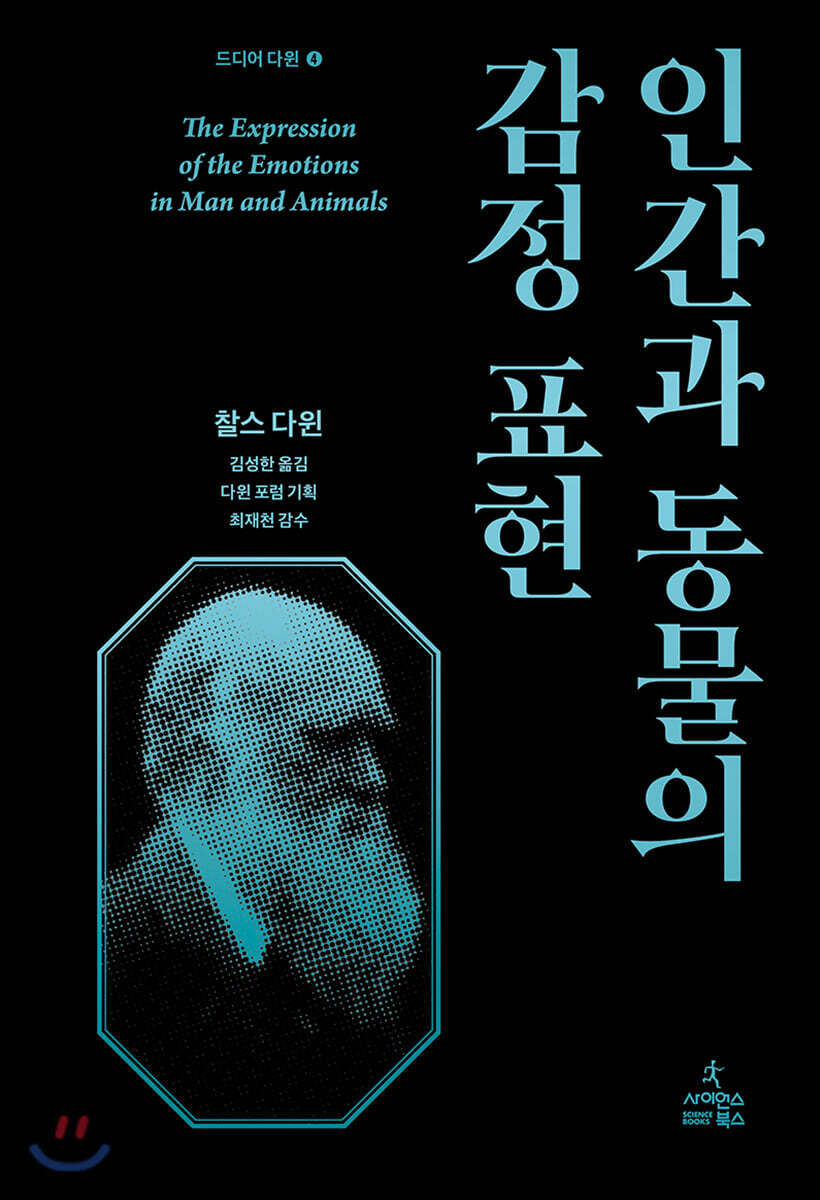
Expression of emotions in humans and animals
 |
Description
Book Introduction
"Prove that humans and animals have the same roots
which made us all Darwinists,
"The most lovable book" (_Choi Jae-cheon (Professor Emeritus, Ewha Womans University))
Darwin predicted that one day psychology and sociology would become branches of biology.
As he predicted, evolutionary theory is currently producing innovative results in various fields such as economics, sociology, psychology, and brain science.
Sociobiology and evolutionary psychology are just two of its important outcomes.
So what book was the genesis of all this? It was none other than The Expression of the Emotions in Man and Animals, the final book in the evolution trilogy.
which made us all Darwinists,
"The most lovable book" (_Choi Jae-cheon (Professor Emeritus, Ewha Womans University))
Darwin predicted that one day psychology and sociology would become branches of biology.
As he predicted, evolutionary theory is currently producing innovative results in various fields such as economics, sociology, psychology, and brain science.
Sociobiology and evolutionary psychology are just two of its important outcomes.
So what book was the genesis of all this? It was none other than The Expression of the Emotions in Man and Animals, the final book in the evolution trilogy.
- You can preview some of the book's contents.
Preview
index
Preface 5
Translator's Preface 13
Introduction 43
Chapter 1 General Principles of Expression 75
Chapter 2 General Principles of Expression - Continued 103
Chapter 3: General Principles of Expression - Conclusion 119
Chapter 4: Animal Expression 141
Chapter 5: Animals' Special Facial Expressions 179
Chapter 6: The Unique Expressions of Humanity - Suffering and Tears 217
Chapter 7: Discouragement, Worry, Sadness, Disappointment, and Frustration 251
Chapter 8: Pleasure, Feeling Good, Love, Warm Feelings, and Devotion 275
Chapter 9: Reflection, Meditation, Discontent, Sulking, and Resolution 303
Chapter 10: Hatred and Anger 325
Chapter 11: Contempt, contempt, disgust, guilt, arrogance, helplessness, patience, positive and negative feelings 345
Chapter 12: Surprise, Amazement, Fear, and Tremor 375
Chapter 13: Self-Reflection, Shame, Shyness, Dignity, and Blushing 415
Chapter 14 Conclusion and Summary 461
Later Zhou 486
Search 520
Translator's Preface 13
Introduction 43
Chapter 1 General Principles of Expression 75
Chapter 2 General Principles of Expression - Continued 103
Chapter 3: General Principles of Expression - Conclusion 119
Chapter 4: Animal Expression 141
Chapter 5: Animals' Special Facial Expressions 179
Chapter 6: The Unique Expressions of Humanity - Suffering and Tears 217
Chapter 7: Discouragement, Worry, Sadness, Disappointment, and Frustration 251
Chapter 8: Pleasure, Feeling Good, Love, Warm Feelings, and Devotion 275
Chapter 9: Reflection, Meditation, Discontent, Sulking, and Resolution 303
Chapter 10: Hatred and Anger 325
Chapter 11: Contempt, contempt, disgust, guilt, arrogance, helplessness, patience, positive and negative feelings 345
Chapter 12: Surprise, Amazement, Fear, and Tremor 375
Chapter 13: Self-Reflection, Shame, Shyness, Dignity, and Blushing 415
Chapter 14 Conclusion and Summary 461
Later Zhou 486
Search 520
Detailed image

Publisher's Review
Demonstrating the continuity of human psychology and animal behavior evolution
A classic that serves as the origin of sociobiology, behavioral ecology, and evolutionary psychology!
Charles Robert Darwin (February 12, 1809 – April 19, 1882), the founder of the modern theory of evolution, was the heir to a wealthy family of doctors for two generations and the son-in-law of the Wedgwood family, the founders of the Wedgwood porcelain company, famous even today for its high-end tableware for royal families around the world. He was a member of the wealthy, or what we would call today, 'economically free' gentleman class.
He received a substantial inheritance and 'dowry' at the time of his marriage, with which he lived a comfortable and secure life in a mansion with a farm outside London for the rest of his life.
When Darwin died, he left his wife and children a much larger inheritance than he had received from his parents and in-laws.
Darwin was talented not only in scientific research but also in financial management.
Royalties from books based on his research also contributed to the increase in his wealth.
It is said that by 1881, he had earned about 10,000 pounds in royalties, which is equivalent to 500,000 pounds in today's currency, or almost 900 million won.
It is a performance that is in no way inferior to that of modern bestselling authors.
Among Darwin's many writings, The Expression of the Emotions in Man and Animals, published in 1872 and selling over 9,000 copies in just four months, is one of the best-selling books.
What makes this book so popular is not only its fascinating study of facial expressions and emotional expressions, filled with patient observation and meticulous description, but also the illustrations and photographs used throughout the book.
This book was the first mass-produced publication to use mechanical photocopiers for its illustrations, and it was one of the first scientific books to actively use photographs, which were popular at the time, to support its arguments.
Drawings by popular animal illustrators of the time, such as Josef Wolf and Thomas Wood, captured the expressions and emotions of animals, while photographs of mental patients making artificial facial expressions with electric shocks and children making vivid expressions captured the attention of readers.
Darwin spent a lot of money, time, and effort to include these illustrations and photographs in his book.
The reason Charles Darwin put so much effort into this book is because it is the final book in the trilogy on evolution that Darwin wrote to prove his theory of evolution.
The last book in Darwin's evolution trilogy
The Korean text translated by an evolutionary ethicist
Darwin's trilogy of evolutionary theories, which began with "The Origin of Species," "The Descent of Man and Sexual Selection," and then this book, "The Expression of the Emotions in Man and Animals," was in fact a grand project to prove that the roots of human existence are no different from those of animals.
This trilogy consists of 『On the Origin of Species』, which argues that all animal and plant species, including humans, originated through evolution through natural selection; 『The Descent of Man and Sexual Selection』, which shows that humans also originated through evolution through natural selection as proven in 『On the Origin of Species』 and that various human behavioral patterns can also be explained by this theory of evolution; and 『The Expression of Emotions in Humans and Animals』, which proves that the human mind, including emotions, also originated through evolution through natural selection by discovering common connections in the facial expressions and emotional expressions of humans and animals.
In particular, in the last 『Expression of Emotions in Humans and Animals』, he argued that our facial expressions and gestures, which instinctively reveal what is going on inside us without us even realizing it, are clear evidence that our animal ancestors still live in our hearts.
Our bloodline, our bodies, and even our minds are all products of evolution and the legacy of our animal ancestors.
This time, 『The Expression of Emotions in Humans and Animals』, published by Science Books as part of the "Finally Darwin" series, is a classic among classics that allows a glimpse into the core of Darwin's thought, which developed his research from the origin of species to the origin of the mind and completed the theory of evolution through natural selection.
In particular, this book, which has never been translated by a specialist before, was translated by Professor Kim Seong-han of the Department of Ethics Education at Jeonju National University of Education, an expert in evolutionary ethics that combines evolutionary theory with ethics, who spent a long time translating this book. Furthermore, Professor Choi Jae-cheon of the Department of Ecological Science at Ewha Womans University, a representative of the Korean evolutionary biology community and a world-renowned authority in behavioral ecology, took on the role of reviewer, adding to its reliability.
Translated by Professor Kim Seong-han of Jeonju National University of Education
Planned and supervised by Professor Jae-Cheon Choi of the Department of Eco-Science at Ewha Womans University and the Darwin Forum
The first Darwin anthology that brings together the capabilities of the Korean evolutionary biology community.
The fourth book in the "Finally Darwin" series!
If we perceive humans and all other animals as distinct creatures, our natural desire to explore the causes of expression as far as possible will too easily achieve its intended purpose.
There is nothing that cannot be explained by the position that views the two as separate.
But, as in all other fields of natural history, this position has proved detrimental to the inquiry into expression.
Unless you believe that humans once existed in a much lower, more animalistic form, some expressions such as extreme terror, hair standing on end, intense anger, and baring of teeth are difficult to understand.
For example, commonalities in certain expressions observed across distinct but related species—such as the fact that humans and several species of monkeys move the same facial muscles when smiling—are easier to understand if we believe they originated from a common ancestor.
Anyone who accepts the general position that the structure and habits of all animals have evolved gradually will be able to look at the whole subject of expression from a new and interesting perspective.
(_Charles Darwin)
The 'century of biology' has now arrived in this land.
But unfortunately, most scholars studying biology in this country are not biologists in the strict sense of the word.
They are natural scientists who study chemistry or physics using living organisms as their subject.
As a result, unlike in the West, a significant number of biology or life science professors are not well-versed in Darwin's theory of evolution.
There are surprisingly many professors who teach general biology classes without actually teaching evolution, but instead assign it as a self-study assignment.
Even if I leave aside the general reader, I am most delighted that biologists in this country have finally had the opportunity to properly encounter Darwin.
Reading Darwin's book in its original text is not an easy task.
Now, we can finally read Darwin's works in proper Korean translation.
I believe that studying biology without reading Darwin is almost like becoming a priest without reading the Bible or the Koran.
Now, I hope you all become proud and confident biologists.
(_Choi Jae-cheon (Darwin Forum Representative, Ewha Womans University Distinguished Professor))
The book's core theme of expression and facial expression, its focus on common characteristics between animals and humans as a methodology for analyzing it, and the method adopted to secure commonalities unique to humans, all the way to the book's inclusion of illustrations and writing in a way that the general public can read, all of which lead to a long argument, have had a ripple effect that is growing day by day.
For example, the material covered in this book has had a wide-ranging impact on a wide range of people in various fields studying emotions and facial expressions, including micro-expression studies, represented by Ekman.
For this reason alone, it can be said that The Expression of the Emotions in Humans and Animals is not at all lacking in its place as a classic in its field.
(_Kim Seong-han (Professor of Ethics Education, Jeonju National University of Education))
A classic that serves as the origin of sociobiology, behavioral ecology, and evolutionary psychology!
Charles Robert Darwin (February 12, 1809 – April 19, 1882), the founder of the modern theory of evolution, was the heir to a wealthy family of doctors for two generations and the son-in-law of the Wedgwood family, the founders of the Wedgwood porcelain company, famous even today for its high-end tableware for royal families around the world. He was a member of the wealthy, or what we would call today, 'economically free' gentleman class.
He received a substantial inheritance and 'dowry' at the time of his marriage, with which he lived a comfortable and secure life in a mansion with a farm outside London for the rest of his life.
When Darwin died, he left his wife and children a much larger inheritance than he had received from his parents and in-laws.
Darwin was talented not only in scientific research but also in financial management.
Royalties from books based on his research also contributed to the increase in his wealth.
It is said that by 1881, he had earned about 10,000 pounds in royalties, which is equivalent to 500,000 pounds in today's currency, or almost 900 million won.
It is a performance that is in no way inferior to that of modern bestselling authors.
Among Darwin's many writings, The Expression of the Emotions in Man and Animals, published in 1872 and selling over 9,000 copies in just four months, is one of the best-selling books.
What makes this book so popular is not only its fascinating study of facial expressions and emotional expressions, filled with patient observation and meticulous description, but also the illustrations and photographs used throughout the book.
This book was the first mass-produced publication to use mechanical photocopiers for its illustrations, and it was one of the first scientific books to actively use photographs, which were popular at the time, to support its arguments.
Drawings by popular animal illustrators of the time, such as Josef Wolf and Thomas Wood, captured the expressions and emotions of animals, while photographs of mental patients making artificial facial expressions with electric shocks and children making vivid expressions captured the attention of readers.
Darwin spent a lot of money, time, and effort to include these illustrations and photographs in his book.
The reason Charles Darwin put so much effort into this book is because it is the final book in the trilogy on evolution that Darwin wrote to prove his theory of evolution.
The last book in Darwin's evolution trilogy
The Korean text translated by an evolutionary ethicist
Darwin's trilogy of evolutionary theories, which began with "The Origin of Species," "The Descent of Man and Sexual Selection," and then this book, "The Expression of the Emotions in Man and Animals," was in fact a grand project to prove that the roots of human existence are no different from those of animals.
This trilogy consists of 『On the Origin of Species』, which argues that all animal and plant species, including humans, originated through evolution through natural selection; 『The Descent of Man and Sexual Selection』, which shows that humans also originated through evolution through natural selection as proven in 『On the Origin of Species』 and that various human behavioral patterns can also be explained by this theory of evolution; and 『The Expression of Emotions in Humans and Animals』, which proves that the human mind, including emotions, also originated through evolution through natural selection by discovering common connections in the facial expressions and emotional expressions of humans and animals.
In particular, in the last 『Expression of Emotions in Humans and Animals』, he argued that our facial expressions and gestures, which instinctively reveal what is going on inside us without us even realizing it, are clear evidence that our animal ancestors still live in our hearts.
Our bloodline, our bodies, and even our minds are all products of evolution and the legacy of our animal ancestors.
This time, 『The Expression of Emotions in Humans and Animals』, published by Science Books as part of the "Finally Darwin" series, is a classic among classics that allows a glimpse into the core of Darwin's thought, which developed his research from the origin of species to the origin of the mind and completed the theory of evolution through natural selection.
In particular, this book, which has never been translated by a specialist before, was translated by Professor Kim Seong-han of the Department of Ethics Education at Jeonju National University of Education, an expert in evolutionary ethics that combines evolutionary theory with ethics, who spent a long time translating this book. Furthermore, Professor Choi Jae-cheon of the Department of Ecological Science at Ewha Womans University, a representative of the Korean evolutionary biology community and a world-renowned authority in behavioral ecology, took on the role of reviewer, adding to its reliability.
Translated by Professor Kim Seong-han of Jeonju National University of Education
Planned and supervised by Professor Jae-Cheon Choi of the Department of Eco-Science at Ewha Womans University and the Darwin Forum
The first Darwin anthology that brings together the capabilities of the Korean evolutionary biology community.
The fourth book in the "Finally Darwin" series!
If we perceive humans and all other animals as distinct creatures, our natural desire to explore the causes of expression as far as possible will too easily achieve its intended purpose.
There is nothing that cannot be explained by the position that views the two as separate.
But, as in all other fields of natural history, this position has proved detrimental to the inquiry into expression.
Unless you believe that humans once existed in a much lower, more animalistic form, some expressions such as extreme terror, hair standing on end, intense anger, and baring of teeth are difficult to understand.
For example, commonalities in certain expressions observed across distinct but related species—such as the fact that humans and several species of monkeys move the same facial muscles when smiling—are easier to understand if we believe they originated from a common ancestor.
Anyone who accepts the general position that the structure and habits of all animals have evolved gradually will be able to look at the whole subject of expression from a new and interesting perspective.
(_Charles Darwin)
The 'century of biology' has now arrived in this land.
But unfortunately, most scholars studying biology in this country are not biologists in the strict sense of the word.
They are natural scientists who study chemistry or physics using living organisms as their subject.
As a result, unlike in the West, a significant number of biology or life science professors are not well-versed in Darwin's theory of evolution.
There are surprisingly many professors who teach general biology classes without actually teaching evolution, but instead assign it as a self-study assignment.
Even if I leave aside the general reader, I am most delighted that biologists in this country have finally had the opportunity to properly encounter Darwin.
Reading Darwin's book in its original text is not an easy task.
Now, we can finally read Darwin's works in proper Korean translation.
I believe that studying biology without reading Darwin is almost like becoming a priest without reading the Bible or the Koran.
Now, I hope you all become proud and confident biologists.
(_Choi Jae-cheon (Darwin Forum Representative, Ewha Womans University Distinguished Professor))
The book's core theme of expression and facial expression, its focus on common characteristics between animals and humans as a methodology for analyzing it, and the method adopted to secure commonalities unique to humans, all the way to the book's inclusion of illustrations and writing in a way that the general public can read, all of which lead to a long argument, have had a ripple effect that is growing day by day.
For example, the material covered in this book has had a wide-ranging impact on a wide range of people in various fields studying emotions and facial expressions, including micro-expression studies, represented by Ekman.
For this reason alone, it can be said that The Expression of the Emotions in Humans and Animals is not at all lacking in its place as a classic in its field.
(_Kim Seong-han (Professor of Ethics Education, Jeonju National University of Education))
GOODS SPECIFICS
- Publication date: November 24, 2020
- Format: Hardcover book binding method guide
- Page count, weight, size: 532 pages | 634g | 128*188*35mm
- ISBN13: 9791189198879
- ISBN10: 1189198878
You may also like
카테고리
korean


korean

![ELLE 엘르 스페셜 에디션 A형 : 12월 [2025]](http://librairie.coreenne.fr/cdn/shop/files/b8e27a3de6c9538896439686c6b0e8fb.jpg?v=1766436872&width=3840)


