

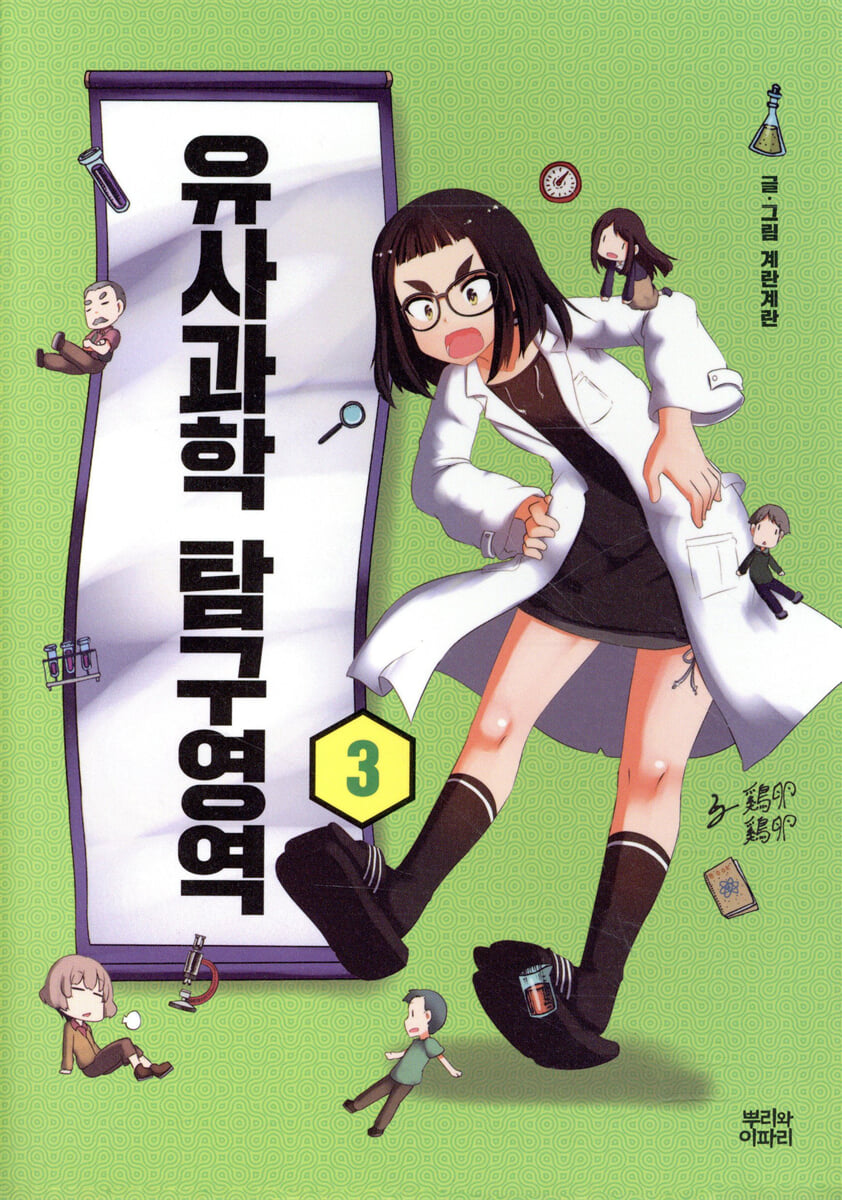
Pseudoscience Exploration Area 3
 |
Description
Book Introduction
Surfactants cause cervical cancer! They say cancer cells smell like shampoo.
They say getting vaccinated can cause autism! They say it contains heavy metals like mercury.
You shouldn't reheat fatty foods! They say it creates trans fats.
Stop the shaming! How to eat well and live well without worrying about pseudoscience.
Volume 3 of "Pseudoscience Exploration Areas" released!
No matter how much you dig, it's just a ghost story: The war against pseudoscience isn't over until it's over.
In November 2018, following the once-huge scandal of radon beds, the Nuclear Safety and Security Commission announced measures to limit the use of radioactive materials such as monazite and ban false advertising of negative ion products.
In March 2019, the Ministry of Food and Drug Safety conducted an intensive inspection of false and exaggerated advertising of "hydrogen water" products that claimed to remove fine dust and discharge waste, and caught 13 products and 24 companies.
Will these crackdowns and sanctions gradually lead to the disappearance of many pseudoscience products?
But, it's impossible!! Just visit online shopping malls or crowdfunding sites and you'll see how vain such expectations are.
The pseudoscientist's phantom that "water knows the answer" continues to create pseudoscientific marketing that turns even plain water into a miracle water, and recently, Blue Solar Water, which is said to be effective simply by exposing it to blue light, and a detergent that is said to be made by decomposing 100% pure water are being sold.
In addition, the blind sales of products that would make even Bong-i Kim Seon-dal hit his knees with things like yin-yang water, magnetized hexagonal water, and silicon water continue by only changing the material and name of the products.
“In today’s world where countless pseudoscience products are popping up every day, it’s incredibly difficult for me as a cartoonist to know whether I should be happy about the endless supply of material, or as a scientist to feel bitter about the flood of misinformation and sales tactics.” A science webtoon titled “Pseudoscience Exploration Area” that satirizes the world in a way that makes it hard to know whether to laugh or be sad.
This book is a compilation of 20 episodes of Season 3, from Episodes 41 to 60.
They say getting vaccinated can cause autism! They say it contains heavy metals like mercury.
You shouldn't reheat fatty foods! They say it creates trans fats.
Stop the shaming! How to eat well and live well without worrying about pseudoscience.
Volume 3 of "Pseudoscience Exploration Areas" released!
No matter how much you dig, it's just a ghost story: The war against pseudoscience isn't over until it's over.
In November 2018, following the once-huge scandal of radon beds, the Nuclear Safety and Security Commission announced measures to limit the use of radioactive materials such as monazite and ban false advertising of negative ion products.
In March 2019, the Ministry of Food and Drug Safety conducted an intensive inspection of false and exaggerated advertising of "hydrogen water" products that claimed to remove fine dust and discharge waste, and caught 13 products and 24 companies.
Will these crackdowns and sanctions gradually lead to the disappearance of many pseudoscience products?
But, it's impossible!! Just visit online shopping malls or crowdfunding sites and you'll see how vain such expectations are.
The pseudoscientist's phantom that "water knows the answer" continues to create pseudoscientific marketing that turns even plain water into a miracle water, and recently, Blue Solar Water, which is said to be effective simply by exposing it to blue light, and a detergent that is said to be made by decomposing 100% pure water are being sold.
In addition, the blind sales of products that would make even Bong-i Kim Seon-dal hit his knees with things like yin-yang water, magnetized hexagonal water, and silicon water continue by only changing the material and name of the products.
“In today’s world where countless pseudoscience products are popping up every day, it’s incredibly difficult for me as a cartoonist to know whether I should be happy about the endless supply of material, or as a scientist to feel bitter about the flood of misinformation and sales tactics.” A science webtoon titled “Pseudoscience Exploration Area” that satirizes the world in a way that makes it hard to know whether to laugh or be sad.
This book is a compilation of 20 episodes of Season 3, from Episodes 41 to 60.
- You can preview some of the book's contents.
Preview
index
41.
Blue Solar Water
42.
Cheonggukjang lactic acid bacteria
43.
Meditation Breathing and Life Electronics
44.
The surfactant of fear
45. MSG
Bonus Comic 1: Why I Eat Candy on the CSAT Day
46.
Tourmaline self-heating
47.
Soju and oxygen
48.
Yellow clay hot water mat
49.
Water-decomposing detergent
50.
sea salt
Bonus Manga 2: School Story: The Curse of the Four
51.
Removal of fecal impaction
52.
Health functional foods
53.
A collection of small questions
54.
vaccination
55.
balanced diet
Bonus Comic 3: It's Youth
56.
water-soluble silicon
57.
Foods with fine dust benefits
58.
Hazards of reheating cooking
59.
nucleic acids
60.
Insu-gu's shadow
Author's Note
Blue Solar Water
42.
Cheonggukjang lactic acid bacteria
43.
Meditation Breathing and Life Electronics
44.
The surfactant of fear
45. MSG
Bonus Comic 1: Why I Eat Candy on the CSAT Day
46.
Tourmaline self-heating
47.
Soju and oxygen
48.
Yellow clay hot water mat
49.
Water-decomposing detergent
50.
sea salt
Bonus Manga 2: School Story: The Curse of the Four
51.
Removal of fecal impaction
52.
Health functional foods
53.
A collection of small questions
54.
vaccination
55.
balanced diet
Bonus Comic 3: It's Youth
56.
water-soluble silicon
57.
Foods with fine dust benefits
58.
Hazards of reheating cooking
59.
nucleic acids
60.
Insu-gu's shadow
Author's Note
Publisher's Review
Are you eating?: The myth of health food
The World Health Organization (WHO) recommends consuming no more than 2,000 milligrams of sodium (5 grams of salt) per day.
However, according to the 2017 National Health and Nutrition Survey conducted by the Korea Centers for Disease Control and Prevention, Koreans consume about 180 percent of the WHO recommended intake of sodium every day.
Author Egg Egg explains that 'eating too much' is the main reason why people are harming their health today.
This is because obesity and high blood pressure occur due to overnutrition.
Ultimately, the key to staying healthy is to eat moderately and eat a variety of foods!
However, 'health merchants' who sell various health functional foods and bogus nutritional supplements armed with pseudoscience try to feed as much of their products as possible to people who have problems due to overeating.
Are such products truly helpful? For example, calamansi, which is said to contain 30 times more vitamin C than lemon, actually has a similar vitamin C content to lemon, and even lemon, the comparison fruit, has a lower vitamin C content per weight (due to its higher juice content).
A nucleic acid supplement that repairs DNA damaged by active oxygen. Since our body synthesizes DNA (deoxyribonucleic acid) using glucose or glutamic acid, eating more of it will only put a burden on the liver and kidneys (it is enough to just eat rice and meat).
The author points out that most of these 'health foods' that claim to improve your health simply by eating them, such as chlorella, spirulina, and chaga mushrooms, are unfounded.
Of course, there may be ingredients that regulate physiological functions, but if the efficacy is as great as the herbalists claim, the history of medicine would have been changed.
Additionally, health functional foods would have been strictly managed and distributed as ‘medicines’ rather than ‘foods’.
However, such functional foods are haphazardly released into the market, become popular for a short time thanks to pseudo-scientific marketing, and then quickly become forgotten as they fail to show any actual efficacy.
If you want to take care of your health, the author recommends not relying too much on such foods and eating three meals a day.
So, the saying goes, 'food is medicine.'
“You should definitely filter out any advertisements that talk about constipation.”
How to 'believe' (believe and reject) pseudoscience
“Since I started using tourmaline, my asthma and atopic dermatitis have improved!” A typical claim made when discussing the efficacy of pseudoscientific products is, “I saw results anyway.”
Although we don't know the exact principle, it is difficult to simply refute the claim that it may be effective even if only a little.
It is difficult to give a definitive answer, considering the possibility that it has not yet been scientifically proven, or the placebo effect, where the psychological belief that a disease can be cured leads to actual healing.
Here, the author talks about filtering out even the 100% pseudoscience that doesn't even have that 'one in ten thousand possibility'.
One of them is a product that emphasizes the removal of waste.
The barrier is slippery, covered in mucus, and constantly moving, with cells constantly being replaced, so nothing can remain in it in the first place.
In other words, the concept of ‘sukbyeon’ itself is a fiction.
The same goes for ‘foods that emit fine dust.’
Fine dust is a substance that causes problems when it enters the respiratory system, so eating seaweed or mushroom extracts to send it to the digestive system is of little use.
In a world overflowing with scientific and unscientific claims, 『Pseudoscience Exploration』 recommends that we "believe and filter" at least what this cartoon points out.
The World Health Organization (WHO) recommends consuming no more than 2,000 milligrams of sodium (5 grams of salt) per day.
However, according to the 2017 National Health and Nutrition Survey conducted by the Korea Centers for Disease Control and Prevention, Koreans consume about 180 percent of the WHO recommended intake of sodium every day.
Author Egg Egg explains that 'eating too much' is the main reason why people are harming their health today.
This is because obesity and high blood pressure occur due to overnutrition.
Ultimately, the key to staying healthy is to eat moderately and eat a variety of foods!
However, 'health merchants' who sell various health functional foods and bogus nutritional supplements armed with pseudoscience try to feed as much of their products as possible to people who have problems due to overeating.
Are such products truly helpful? For example, calamansi, which is said to contain 30 times more vitamin C than lemon, actually has a similar vitamin C content to lemon, and even lemon, the comparison fruit, has a lower vitamin C content per weight (due to its higher juice content).
A nucleic acid supplement that repairs DNA damaged by active oxygen. Since our body synthesizes DNA (deoxyribonucleic acid) using glucose or glutamic acid, eating more of it will only put a burden on the liver and kidneys (it is enough to just eat rice and meat).
The author points out that most of these 'health foods' that claim to improve your health simply by eating them, such as chlorella, spirulina, and chaga mushrooms, are unfounded.
Of course, there may be ingredients that regulate physiological functions, but if the efficacy is as great as the herbalists claim, the history of medicine would have been changed.
Additionally, health functional foods would have been strictly managed and distributed as ‘medicines’ rather than ‘foods’.
However, such functional foods are haphazardly released into the market, become popular for a short time thanks to pseudo-scientific marketing, and then quickly become forgotten as they fail to show any actual efficacy.
If you want to take care of your health, the author recommends not relying too much on such foods and eating three meals a day.
So, the saying goes, 'food is medicine.'
“You should definitely filter out any advertisements that talk about constipation.”
How to 'believe' (believe and reject) pseudoscience
“Since I started using tourmaline, my asthma and atopic dermatitis have improved!” A typical claim made when discussing the efficacy of pseudoscientific products is, “I saw results anyway.”
Although we don't know the exact principle, it is difficult to simply refute the claim that it may be effective even if only a little.
It is difficult to give a definitive answer, considering the possibility that it has not yet been scientifically proven, or the placebo effect, where the psychological belief that a disease can be cured leads to actual healing.
Here, the author talks about filtering out even the 100% pseudoscience that doesn't even have that 'one in ten thousand possibility'.
One of them is a product that emphasizes the removal of waste.
The barrier is slippery, covered in mucus, and constantly moving, with cells constantly being replaced, so nothing can remain in it in the first place.
In other words, the concept of ‘sukbyeon’ itself is a fiction.
The same goes for ‘foods that emit fine dust.’
Fine dust is a substance that causes problems when it enters the respiratory system, so eating seaweed or mushroom extracts to send it to the digestive system is of little use.
In a world overflowing with scientific and unscientific claims, 『Pseudoscience Exploration』 recommends that we "believe and filter" at least what this cartoon points out.
GOODS SPECIFICS
- Date of issue: September 23, 2019
- Page count, weight, size: 292 pages | 494g | 148*210*20mm
- ISBN13: 9788964621257
- ISBN10: 8964621255
You may also like
카테고리
korean


korean

![GQ KOREA Mark (Monthly): December [2025]](http://librairie.coreenne.fr/cdn/shop/files/8ef265dbbfbf186523ed75ba7319009d.jpg?v=1765340328&width=3840)


