

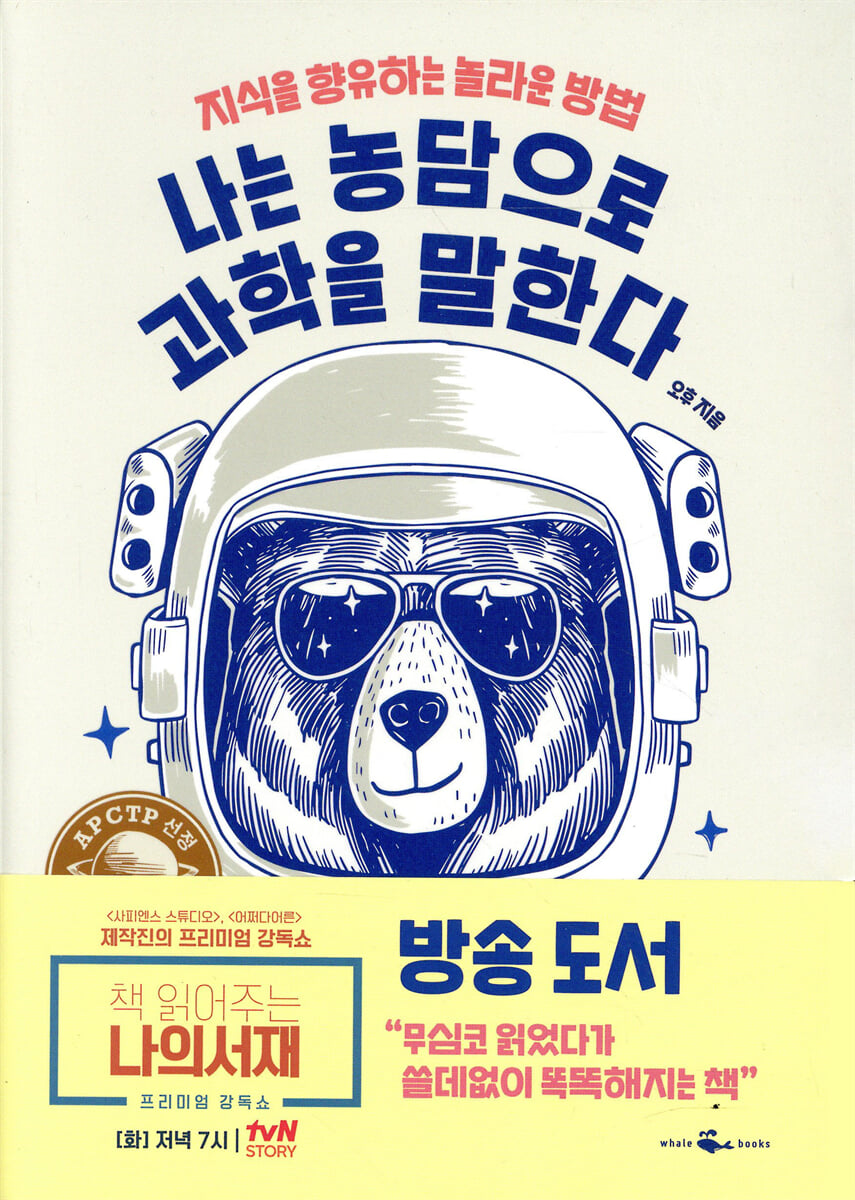
I talk about science as a joke
 |
Description
Book Introduction
“Science education so funny that even Bill Bryson would cry!”
Uncovering the untold stories of technologies that transformed humanity but were never told.
You are afraid of science now.
What has made us "science ignorant"? Is there an easy way to overcome the high barriers to entry into science? This book finds the answer in "jokes."
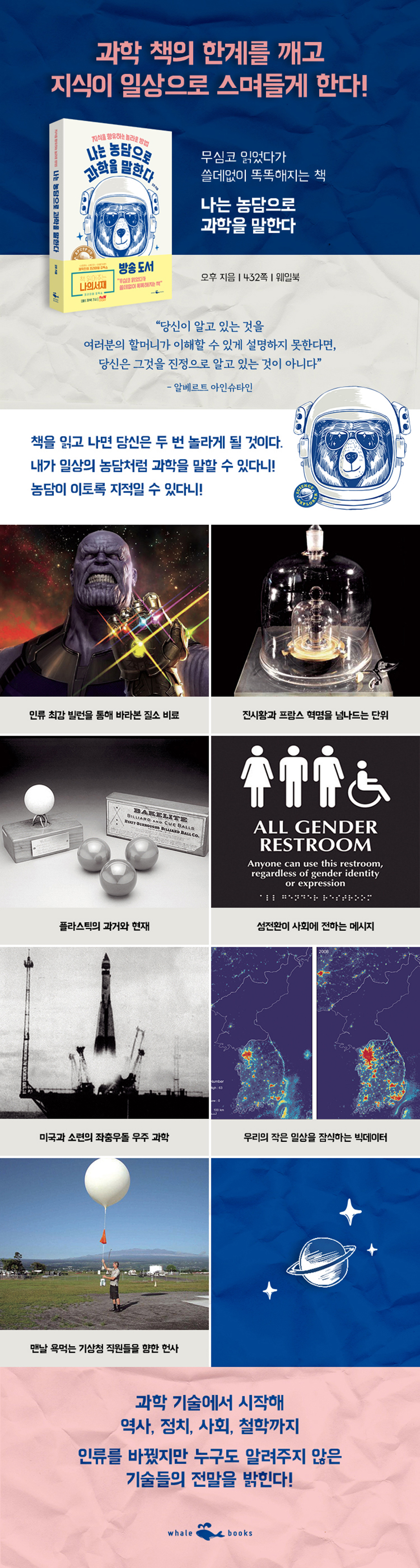
Nitrogen fertilizer as seen through the eyes of humanity's most powerful villain, a unit story that crosses Qin Shi Huang and the French Revolution, the past and present of plastic, the message that gender transition conveys to society, the story of the tumultuous space science of the US and the Soviet Union, big data that encroaches on our small daily lives, and a tribute to the weather bureau employees who are constantly being cursed.
The stories contained in each of the seven scientific fields are intertwined with history, politics, society, and philosophy, making for an enjoyable read throughout.
The author, who wrote a book about drugs in his previous work, delves into the science and technology of this era with his characteristic otaku-like investigative skills.
Sentences that flow like water and sharp metaphors show the essence of humorous science.
After reading the book, you will be surprised twice.
I can't believe I can talk about science like it's a daily joke! Jokes can be so intelligent!
Uncovering the untold stories of technologies that transformed humanity but were never told.
You are afraid of science now.
What has made us "science ignorant"? Is there an easy way to overcome the high barriers to entry into science? This book finds the answer in "jokes."
Nitrogen fertilizer as seen through the eyes of humanity's most powerful villain, a unit story that crosses Qin Shi Huang and the French Revolution, the past and present of plastic, the message that gender transition conveys to society, the story of the tumultuous space science of the US and the Soviet Union, big data that encroaches on our small daily lives, and a tribute to the weather bureau employees who are constantly being cursed.
The stories contained in each of the seven scientific fields are intertwined with history, politics, society, and philosophy, making for an enjoyable read throughout.
The author, who wrote a book about drugs in his previous work, delves into the science and technology of this era with his characteristic otaku-like investigative skills.
Sentences that flow like water and sharp metaphors show the essence of humorous science.
After reading the book, you will be surprised twice.
I can't believe I can talk about science like it's a daily joke! Jokes can be so intelligent!
- You can preview some of the book's contents.
Preview
index
Prologue. Half-joking, half-serious.
1.
Before the Devil Knows You're Dead: Humanity's Odyssey in Search of Nitrogen
Population grows exponentially, while food supplies grow arithmetically.
The Blessings and Curses of Bird Poop
The Alchemy of Turning Air into Bread
The strongest villain who saved humanity
Have we escaped the Malthusian trap?
2.
The Link Between You and Me: Between Qin Shi Huang and the French Revolution
How accurate are the units?
Unit confusion
Unification of Weights and Measures and the Empire
The French Revolution and the Metric System
Current metric system
Those who rejected the metric system
The history of time
Decimal system and the French Revolutionary calendar
People who 'hope' that everyone will live in peace
Can Esperanto become an international language?
The future of units
3.
Now is the Plastic Age: Plastic Ethics and the Spirit of Capitalism
I'll give you ten thousand dollars if you bring me the billiard balls.
In search of the true origin of plastic
Synthetic Fibers Open Up Fashion
Plastic? Plastic!
The Future of Plastics
Plastic and Nature Conservation
Different approaches to the plastic problem
4.
We Are Everywhere: Transgenderism, Surgery, and the Never-ending Story
Third gender
Transgender?
The beginning of the transition
The long and arduous road to surgery
The first MtF sex reassignment surgery
First FtM sex reassignment surgery
MtF's genital surgery process
FtM genital surgery process
Surgery doesn't end with surgery.
We know your gender
What Transgender People Can Tell Us
For gender neutrality
5.
A Little Star Shot by Heo: Soviet Space Workers Who Cried Out
Long, long ago in Russia...
How did they end up in space?
Soviet run
America's Counterattack: A Great Step Forward for Humanity
Their own way
The Soviet Union put people in space
Soviet space workers who could do anything they set their mind to
The collapse of the Soviet Union and its aftermath
Where did Soviet space science go?
6.
Do the Sleeping Humanities Dream of Science?: Society as Seen Through Big Data, and How Big Data Will Change It
The Birth of Big Data
Google's arrival shakes up the research landscape.
Finding Google in History
What data will be applied and how?
Do the sleeping humanities dream of science? Bigger data on top of data.
The Pitfalls of Big Data: If the Data is Right, the Conclusions Are Right Too?
Big Data Pitfall 2.
Data is harsh on the weak
Big Data Pitfalls 3.
There are always exceptions.
Big Data Pitfalls 4.
Who has big data?
Between Big Data Democracy and Big Brother
7.
The Secret of the Infinite Hexahedron: How Weather Changes Us, and How We Change Weather
Rain is counter-revolutionary
There is weather behind history.
Get weather information
We are the World
Numerical Forecasting Models: From Empirical to Mathematical
Why are weather forecasts always wrong?
I don't know about a week from now, but I know about 30 years from now?
Can technology stop global warming?
When science performs a ritual
Controversy over the effectiveness of artificial rain
Can weather be a weapon?
Is it okay for humans to change the weather?
Tomorrow's weather
Epilogue. How did we stop loving and start loving bombs?
Detailed image
Into the book
Within three years of the popularization of artificial fertilizers, food production doubled the rate of population growth.
Malthus's theory, which started from the assumption that population increases geometrically and food increases arithmetically, has completely collapsed.
The food crisis that drove humanity to madness for 100 years has disappeared.
Haber becomes a world hero with nicknames such as 'the scientist who made bread out of air' and 'the alchemist of air'.
--- From "Before the Devil Knows You're Dead"
Once a unit has taken over us, it does not disappear easily.
No matter how good a food is for your health, if it is high in calories, it is the enemy of dieting.
Units are like languages.
People who saw their houses in 'pyeong' units when they were young, no matter how much they use square meters (㎡), will only get a sense of it after roughly converting the square meters into pyeong by dividing them by 3 and discarding the remainder.
I'm only in my 30s, but I'll probably never fully understand square meters again.
Just as we read English and interpret it in Korean, the same goes for units.
Once you get caught up in a mindset, it's hard to change.
--- From "You and Me | The Link"
Sunlight streams in through the plastic blinds.
After lying down for a while with a pillow filled with plastic filling, I check my plastic clock and wake up with a start.
Open the plastic refrigerator door, take out a plastic water bottle, drink some water, and sit on the plastic toilet with a plastic toothbrush, doing two things at the same time.
Toothbrushes go into a plastic sterilizer, and used tissues go into a plastic trash can.
Wear plastic clothes over plastic underwear.
I wrap the fried rice for lunch in a plastic lunch box, and put the plastic lunch box inside a plastic bag to prevent the soup from leaking.
Put the plastic bag in a plastic bag, and take your smartphone in a plastic case, plastic earphones, and plastic cards.
--- From "Now is the Plastic Age"
The most important thing in human rights issues is to recognize their existence.
Those who criticize the human rights movement live within their own logic.
Minorities do not exist for them.
If you have a minority among those close to you, or if you 'really' recognize their existence, you can never speak carelessly about them.
Once you 'really' know how difficult the lives of the elderly who collect waste paper are, you can never treat them carelessly.
No one wants to be a bad person.
So there is a possibility for humans.
--- From "We Are Everywhere"
There is an interesting anecdote about this collaborative project.
The two countries' research was conducted near Moscow, on Soviet territory, and the American astronauts and engineers stayed in Moscow hotels.
Honest Soviet spies wouldn't leave them alone.
If they wiretap their own citizens, why wouldn't they wiretap Americans?
The wiretapping was public knowledge, and even American astronauts took it for granted.
When Americans ran out of hangers in their rooms, they would say out loud, "Oh, the Soviets don't even have hangers in their hotels," and the next day, there would be many more hangers in the rooms.
--- From "A Little Star Shot by Hesse"
What diseases are Koreans most interested in? Cancer, the number one killer? Carcinogens and anti-cancer foods are featured daily on TV, and various methods to combat cancer are introduced.
But looking at search volume, people were much more interested in premature ejaculation than cancer.
Of course, just because the search results are like this, we cannot conclude that Koreans are more concerned about premature ejaculation than cancer.
Information about cancer is readily available online, but premature ejaculation is difficult to talk about openly and there are no ways to obtain information, so many people resort to internet searches.
--- From "Does the Sleeping Humanities Dream of Science?"
The truth about the meme “It’s going to rain at the Korea Meteorological Administration’s sports festival.”
There are many opinions that this statement shows the incompetence of the Korea Meteorological Administration (they made a mistake in the forecast and scheduled the sports day on a rainy day), and a minority opinion that it is a 'big feature' of the Korea Meteorological Administration (who would want to have a company sports day? They scheduled it on a rainy day on purpose).
Regarding this, a Korea Meteorological Administration official stated, “Events such as sports competitions are planned a quarter in advance, so they are unrelated to the weather forecast.”
That's a valid point.
There's no way you can schedule an event a week in advance.
But that answer doesn't answer our question.
"So, did it rain at the Korea Meteorological Administration's sports competition or not?"
--- From "The Secret of the Infinite Hexahedron"
From an outsider's perspective, science has less to do with me than drugs.
If I had followed my friends and gone to a technical high school, it would have been at least related to science, but I, who had no self-confidence, went to a humanities high school based on my grades.
Even though I am a liberal arts major, I have no memory of studying science.
As you know, liberal arts students do not take the science exploration section of the CSAT, and Korean high school students do not study if it does not appear on the CSAT.
But so what?
I even had surgery after reading a book called Dema, so it's not like a non-specialist can't write a book.
Malthus's theory, which started from the assumption that population increases geometrically and food increases arithmetically, has completely collapsed.
The food crisis that drove humanity to madness for 100 years has disappeared.
Haber becomes a world hero with nicknames such as 'the scientist who made bread out of air' and 'the alchemist of air'.
--- From "Before the Devil Knows You're Dead"
Once a unit has taken over us, it does not disappear easily.
No matter how good a food is for your health, if it is high in calories, it is the enemy of dieting.
Units are like languages.
People who saw their houses in 'pyeong' units when they were young, no matter how much they use square meters (㎡), will only get a sense of it after roughly converting the square meters into pyeong by dividing them by 3 and discarding the remainder.
I'm only in my 30s, but I'll probably never fully understand square meters again.
Just as we read English and interpret it in Korean, the same goes for units.
Once you get caught up in a mindset, it's hard to change.
--- From "You and Me | The Link"
Sunlight streams in through the plastic blinds.
After lying down for a while with a pillow filled with plastic filling, I check my plastic clock and wake up with a start.
Open the plastic refrigerator door, take out a plastic water bottle, drink some water, and sit on the plastic toilet with a plastic toothbrush, doing two things at the same time.
Toothbrushes go into a plastic sterilizer, and used tissues go into a plastic trash can.
Wear plastic clothes over plastic underwear.
I wrap the fried rice for lunch in a plastic lunch box, and put the plastic lunch box inside a plastic bag to prevent the soup from leaking.
Put the plastic bag in a plastic bag, and take your smartphone in a plastic case, plastic earphones, and plastic cards.
--- From "Now is the Plastic Age"
The most important thing in human rights issues is to recognize their existence.
Those who criticize the human rights movement live within their own logic.
Minorities do not exist for them.
If you have a minority among those close to you, or if you 'really' recognize their existence, you can never speak carelessly about them.
Once you 'really' know how difficult the lives of the elderly who collect waste paper are, you can never treat them carelessly.
No one wants to be a bad person.
So there is a possibility for humans.
--- From "We Are Everywhere"
There is an interesting anecdote about this collaborative project.
The two countries' research was conducted near Moscow, on Soviet territory, and the American astronauts and engineers stayed in Moscow hotels.
Honest Soviet spies wouldn't leave them alone.
If they wiretap their own citizens, why wouldn't they wiretap Americans?
The wiretapping was public knowledge, and even American astronauts took it for granted.
When Americans ran out of hangers in their rooms, they would say out loud, "Oh, the Soviets don't even have hangers in their hotels," and the next day, there would be many more hangers in the rooms.
--- From "A Little Star Shot by Hesse"
What diseases are Koreans most interested in? Cancer, the number one killer? Carcinogens and anti-cancer foods are featured daily on TV, and various methods to combat cancer are introduced.
But looking at search volume, people were much more interested in premature ejaculation than cancer.
Of course, just because the search results are like this, we cannot conclude that Koreans are more concerned about premature ejaculation than cancer.
Information about cancer is readily available online, but premature ejaculation is difficult to talk about openly and there are no ways to obtain information, so many people resort to internet searches.
--- From "Does the Sleeping Humanities Dream of Science?"
The truth about the meme “It’s going to rain at the Korea Meteorological Administration’s sports festival.”
There are many opinions that this statement shows the incompetence of the Korea Meteorological Administration (they made a mistake in the forecast and scheduled the sports day on a rainy day), and a minority opinion that it is a 'big feature' of the Korea Meteorological Administration (who would want to have a company sports day? They scheduled it on a rainy day on purpose).
Regarding this, a Korea Meteorological Administration official stated, “Events such as sports competitions are planned a quarter in advance, so they are unrelated to the weather forecast.”
That's a valid point.
There's no way you can schedule an event a week in advance.
But that answer doesn't answer our question.
"So, did it rain at the Korea Meteorological Administration's sports competition or not?"
--- From "The Secret of the Infinite Hexahedron"
From an outsider's perspective, science has less to do with me than drugs.
If I had followed my friends and gone to a technical high school, it would have been at least related to science, but I, who had no self-confidence, went to a humanities high school based on my grades.
Even though I am a liberal arts major, I have no memory of studying science.
As you know, liberal arts students do not take the science exploration section of the CSAT, and Korean high school students do not study if it does not appear on the CSAT.
But so what?
I even had surgery after reading a book called Dema, so it's not like a non-specialist can't write a book.
--- From "Epilogue"
Publisher's Review
“To truly enjoy something, it must first be fun.”
A Guide to Science and Technology That Feels Better and More Addictive Than Drugs
What do drugs and science have in common?
(1) It is not easy to access.
(2) If you taste it properly, you will feel good (?!)
(3) It is highly addictive.
(4) It is a material covered by one author.
The author, who previously wrote a book about drugs, has now turned his hand to science.
He is neither a drug dealer nor a scientist, yet he wrote a book of over 400 pages.
How could this be possible? The author compares himself to the conman of the century, Ferdinand Demara, and says:
“Among those who are writing the history of the Joseon Dynasty today, there is not a single person who lived during the Joseon Dynasty.” That’s right.
You can talk about science even if you're not a scientist.
And in a very pleasant and intelligent way.
The author, who was living the life of an ordinary liberal arts student, became interested in science after learning the name of a chemist on the other side of the world.
The main character is Fritz Haber, who developed artificial fertilizer and saved 7 billion people on Earth.
The author is shocked by the fact that there are more “science and technology that have changed humanity but that we don’t know much about,” such as artificial fertilizers, Fritz Haber, and nitrogen fixation, than he thought, and that surprisingly many people are not interested in such issues.
He decides to write an easy but profound book that covers 'science, society, history, politics, and philosophy.'
And so, after ten years of curiosity, the world's most entertaining and accessible science textbook was born, combining the talent and persistence of a storyteller.
"We all live on the foundation of scientific achievements, and we are all insiders of science."
Sophisticated intellectual jokes from a variety of materials across seven fields
Wait a minute! Why do we need to know about science? Even if it's an event that changed humanity, isn't it okay to live without knowing it? However, 'the world when we believed the Earth was the center of the universe cannot be the same as the world after we learned that the Earth revolves around the sun. In an era when humanity could be annihilated by nuclear weapons, 'The Art of War' and 'The Prince' cannot have the same meaning as before. Democracy after the advent of smartphones cannot be the same as democracy before.' Rather than dwelling on the past and finding its own meaning, science, as an academic discipline, constantly seeks change through the premise that 'there is no truth.'
It's the least we can do to avoid being buried in the endless stream of news and the macro discourses happening around the world.
People think of science as a special and difficult subject, but in fact, science is present in the most trivial aspects of everyday life.
Whether we know science or not, we are all 'insiders of science' who live on the achievements of science.
Sunlight streams in through the plastic blinds.
After lying down for a while with a pillow filled with plastic filling, I check my plastic clock and wake up with a start.
Open the plastic refrigerator door, take out a plastic water bottle, drink some water, and sit on the plastic toilet with a plastic toothbrush, doing two things at the same time.
Toothbrushes go into a plastic sterilizer, and used tissues go into a plastic trash can.
Wear plastic clothes over plastic underwear.
Put the plastic bag in a plastic bag, and take your smartphone in a plastic case, plastic earphones, and plastic cards.
Finally, check the plastic watch again.
- From "Now is the Plastic Age"
The plastic issue, which is considered a global problem, also originates from our daily lives.
From the one-line ad that spurred the development of the first plastic to the story of exploding billiard balls, the reason why Indian independence activist Gandhi wore a white cloth, to the inconvenient truth about microplastics in Evian, the endless possibilities of plastic and its darker side.
Scientific facts about plastics are organically linked with useful information.
The data yielded a surprising result that no one could have predicted.
People buy seven times more strawberry pop-tarts during a hurricane than usual.
Why strawberry-flavored pop-tarts? I don't know.
How would you know that?
But the data said strawberry Pop-Tarts, and Walmart's delivery trucks delivered strawberry Pop-Tarts to the predicted hurricane path.
Each branch quickly placed strawberry-flavored Pop-Tarts on their shelves, and they sold like hotcakes.
Maybe someday the connection between strawberry pop-tarts and hurricanes will be revealed.
There must be an explainable reason for that.
But if Walmart's management had gone through the process of uncovering causality and formulating rational policies, the hurricane would have already passed.
They accepted the answers the data presented without questioning or questioning them.
This is the moment when big data was born as a religion.
- From "Does the Sleeping Humanities Dream of Science?"
Big data analyzes and organizes our daily interests.
Many people believe they are in control of their own actions and are merely "using" big data, but in reality, big data is shaping their lives.
Hurricanes and Pop-Tarts, two seemingly incompatible words, are organically linked within the religion of big data and dominate our lives.
The chapter "Does the Sleeping Humanities Dream of Science?" covers the history and present of big data, the judgment and selection of data, and various examples from everyday life, while expanding the scope of thought to include the problems of groups and individuals excluded from data.
This book covers seven scientific and technological fields, including plastics and big data, as well as artificial fertilizers, units, sexual minorities, space science, and weather forecasting, which served as the starting point for the book.
Each field begins with a specific historical event and leads readers into a thought-provoking exploration of the hidden stories of the stakeholders, the turbulent development process, and the discourses we face today through engaging and sharp questions.
Familiar, everyday examples and witty expressions enhance readability, while the cool-headed, realistic assessments of science and technology and bold conclusions give readers confidence.
“Breaking the limitations of science books and bringing knowledge into everyday life!”
A book that makes you smarter without thinking
Judging by the success of "Alseulsinjab" and "Broad and Shallow Knowledge for Intellectual Conversation," the public always has a thirst for diverse knowledge.
Indeed, we live in an age of ever-more abundant information, yet our thirst for knowledge remains elusive.
Because it's difficult or not fun.
This book focuses on breaking the inherent limitations of existing knowledge books, especially those in the field of science and technology.
Understanding difficult fields with ease and enjoying science as a culture are only possible through 'intellectual jokes toward knowledge.'
Readers have the right to easy access to knowledge, and writers have a duty to write entertaining books.
A book was completed with this small but great premise.
Having read the book without thinking, you are now ready to understand half of the hidden world.
A Guide to Science and Technology That Feels Better and More Addictive Than Drugs
What do drugs and science have in common?
(1) It is not easy to access.
(2) If you taste it properly, you will feel good (?!)
(3) It is highly addictive.
(4) It is a material covered by one author.
The author, who previously wrote a book about drugs, has now turned his hand to science.
He is neither a drug dealer nor a scientist, yet he wrote a book of over 400 pages.
How could this be possible? The author compares himself to the conman of the century, Ferdinand Demara, and says:
“Among those who are writing the history of the Joseon Dynasty today, there is not a single person who lived during the Joseon Dynasty.” That’s right.
You can talk about science even if you're not a scientist.
And in a very pleasant and intelligent way.
The author, who was living the life of an ordinary liberal arts student, became interested in science after learning the name of a chemist on the other side of the world.
The main character is Fritz Haber, who developed artificial fertilizer and saved 7 billion people on Earth.
The author is shocked by the fact that there are more “science and technology that have changed humanity but that we don’t know much about,” such as artificial fertilizers, Fritz Haber, and nitrogen fixation, than he thought, and that surprisingly many people are not interested in such issues.
He decides to write an easy but profound book that covers 'science, society, history, politics, and philosophy.'
And so, after ten years of curiosity, the world's most entertaining and accessible science textbook was born, combining the talent and persistence of a storyteller.
"We all live on the foundation of scientific achievements, and we are all insiders of science."
Sophisticated intellectual jokes from a variety of materials across seven fields
Wait a minute! Why do we need to know about science? Even if it's an event that changed humanity, isn't it okay to live without knowing it? However, 'the world when we believed the Earth was the center of the universe cannot be the same as the world after we learned that the Earth revolves around the sun. In an era when humanity could be annihilated by nuclear weapons, 'The Art of War' and 'The Prince' cannot have the same meaning as before. Democracy after the advent of smartphones cannot be the same as democracy before.' Rather than dwelling on the past and finding its own meaning, science, as an academic discipline, constantly seeks change through the premise that 'there is no truth.'
It's the least we can do to avoid being buried in the endless stream of news and the macro discourses happening around the world.
People think of science as a special and difficult subject, but in fact, science is present in the most trivial aspects of everyday life.
Whether we know science or not, we are all 'insiders of science' who live on the achievements of science.
Sunlight streams in through the plastic blinds.
After lying down for a while with a pillow filled with plastic filling, I check my plastic clock and wake up with a start.
Open the plastic refrigerator door, take out a plastic water bottle, drink some water, and sit on the plastic toilet with a plastic toothbrush, doing two things at the same time.
Toothbrushes go into a plastic sterilizer, and used tissues go into a plastic trash can.
Wear plastic clothes over plastic underwear.
Put the plastic bag in a plastic bag, and take your smartphone in a plastic case, plastic earphones, and plastic cards.
Finally, check the plastic watch again.
- From "Now is the Plastic Age"
The plastic issue, which is considered a global problem, also originates from our daily lives.
From the one-line ad that spurred the development of the first plastic to the story of exploding billiard balls, the reason why Indian independence activist Gandhi wore a white cloth, to the inconvenient truth about microplastics in Evian, the endless possibilities of plastic and its darker side.
Scientific facts about plastics are organically linked with useful information.
The data yielded a surprising result that no one could have predicted.
People buy seven times more strawberry pop-tarts during a hurricane than usual.
Why strawberry-flavored pop-tarts? I don't know.
How would you know that?
But the data said strawberry Pop-Tarts, and Walmart's delivery trucks delivered strawberry Pop-Tarts to the predicted hurricane path.
Each branch quickly placed strawberry-flavored Pop-Tarts on their shelves, and they sold like hotcakes.
Maybe someday the connection between strawberry pop-tarts and hurricanes will be revealed.
There must be an explainable reason for that.
But if Walmart's management had gone through the process of uncovering causality and formulating rational policies, the hurricane would have already passed.
They accepted the answers the data presented without questioning or questioning them.
This is the moment when big data was born as a religion.
- From "Does the Sleeping Humanities Dream of Science?"
Big data analyzes and organizes our daily interests.
Many people believe they are in control of their own actions and are merely "using" big data, but in reality, big data is shaping their lives.
Hurricanes and Pop-Tarts, two seemingly incompatible words, are organically linked within the religion of big data and dominate our lives.
The chapter "Does the Sleeping Humanities Dream of Science?" covers the history and present of big data, the judgment and selection of data, and various examples from everyday life, while expanding the scope of thought to include the problems of groups and individuals excluded from data.
This book covers seven scientific and technological fields, including plastics and big data, as well as artificial fertilizers, units, sexual minorities, space science, and weather forecasting, which served as the starting point for the book.
Each field begins with a specific historical event and leads readers into a thought-provoking exploration of the hidden stories of the stakeholders, the turbulent development process, and the discourses we face today through engaging and sharp questions.
Familiar, everyday examples and witty expressions enhance readability, while the cool-headed, realistic assessments of science and technology and bold conclusions give readers confidence.
“Breaking the limitations of science books and bringing knowledge into everyday life!”
A book that makes you smarter without thinking
Judging by the success of "Alseulsinjab" and "Broad and Shallow Knowledge for Intellectual Conversation," the public always has a thirst for diverse knowledge.
Indeed, we live in an age of ever-more abundant information, yet our thirst for knowledge remains elusive.
Because it's difficult or not fun.
This book focuses on breaking the inherent limitations of existing knowledge books, especially those in the field of science and technology.
Understanding difficult fields with ease and enjoying science as a culture are only possible through 'intellectual jokes toward knowledge.'
Readers have the right to easy access to knowledge, and writers have a duty to write entertaining books.
A book was completed with this small but great premise.
Having read the book without thinking, you are now ready to understand half of the hidden world.
GOODS SPECIFICS
- Date of issue: July 19, 2019
- Page count, weight, size: 432 pages | 591g | 148*210*30mm
- ISBN13: 9791188248926
- ISBN10: 1188248928
You may also like
카테고리
korean


korean

![ELLE 엘르 스페셜 에디션 A형 : 12월 [2025]](http://librairie.coreenne.fr/cdn/shop/files/b8e27a3de6c9538896439686c6b0e8fb.jpg?v=1766436872&width=3840)


