

When Microbes Met Plato
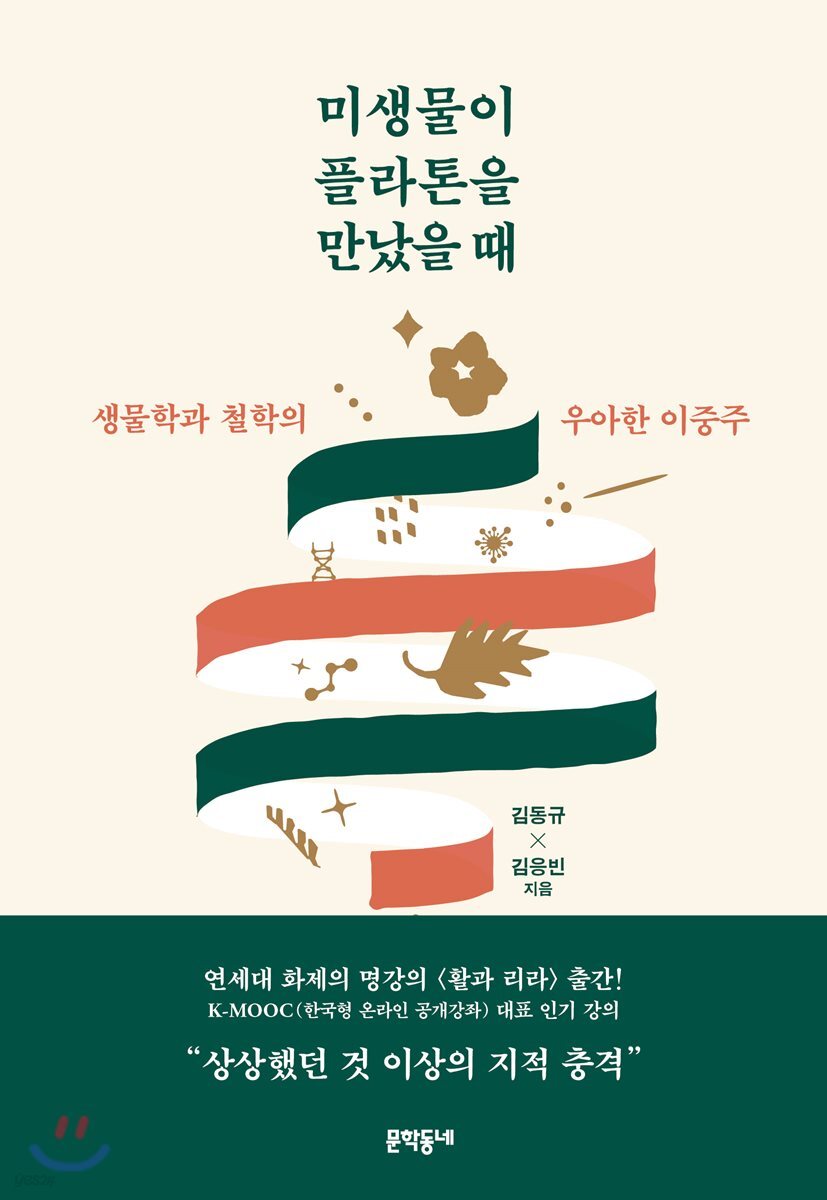 |
Description
Book Introduction
Where Biology Meets Philosophy
This book is the product of a meeting between biologists and philosophers, between natural sciences and humanities.
The protagonists of this meeting are biologist Kim Eung-bin (Department of Biology, Yonsei University), who has been at the forefront of the ‘popularization’ of microorganisms through works such as ‘I Live with Microorganisms’, and philosopher Kim Dong-gyu (Department of Philosophy, Yonsei University), who has explored the ‘melancholic’ identity of Western culture through works such as ‘Aesthetics of Melancholy’ and ‘Melancholia’.
The popular lecture [Bow and Lyre], which two people who have walked completely different academic paths have been giving together at Yonsei University since 2012, became the basis for this book.
The authors wrote this book to expand thinking through “the thrilling harmony between two disparate disciplines” and to impart the wisdom of “coexistence” to modern people struggling to survive in an era of limitless competition.
Although the term "interdisciplinary convergence" or "integration" of natural science and humanities has been talked about and popular for a while now, it is difficult to find a precedent for a biologist and a philosopher co-authoring a book (with the exception of Do Jeong-il and Choi Jae-cheon's "Dialogue," which is a record of a conversation).
This was possible because of our long experience leading joint classes together, as well as intimate conversations and intense discussions.
So why should biology and philosophy meet? The modern age is the age of science.
Among these, biology, which has made rapid progress with technologies such as synthetic biology and CRISPR gene scissors, has come to the point of transforming not only nature but even humans, the subjects of natural scientific knowledge.
As biology exerts such a profound influence on society and civilization, a philosophical foundation for contemplating the future of nature and humanity becomes indispensable.
Moreover, philosophy, which has been reduced to an academic antique, needs to reflect on its inability to speculate, relying solely on classical commentaries, and be revived by connecting with the most dynamic field of knowledge of our time.
In this book, biologists and philosophers do not simply meet, but move toward a fusion that blurs the boundaries between the two disciplines.
At that point of convergence, the two people ultimately talk about life, which encompasses both humans and nature, and love, the source of that life.
This book is the product of a meeting between biologists and philosophers, between natural sciences and humanities.
The protagonists of this meeting are biologist Kim Eung-bin (Department of Biology, Yonsei University), who has been at the forefront of the ‘popularization’ of microorganisms through works such as ‘I Live with Microorganisms’, and philosopher Kim Dong-gyu (Department of Philosophy, Yonsei University), who has explored the ‘melancholic’ identity of Western culture through works such as ‘Aesthetics of Melancholy’ and ‘Melancholia’.
The popular lecture [Bow and Lyre], which two people who have walked completely different academic paths have been giving together at Yonsei University since 2012, became the basis for this book.
The authors wrote this book to expand thinking through “the thrilling harmony between two disparate disciplines” and to impart the wisdom of “coexistence” to modern people struggling to survive in an era of limitless competition.
Although the term "interdisciplinary convergence" or "integration" of natural science and humanities has been talked about and popular for a while now, it is difficult to find a precedent for a biologist and a philosopher co-authoring a book (with the exception of Do Jeong-il and Choi Jae-cheon's "Dialogue," which is a record of a conversation).
This was possible because of our long experience leading joint classes together, as well as intimate conversations and intense discussions.
So why should biology and philosophy meet? The modern age is the age of science.
Among these, biology, which has made rapid progress with technologies such as synthetic biology and CRISPR gene scissors, has come to the point of transforming not only nature but even humans, the subjects of natural scientific knowledge.
As biology exerts such a profound influence on society and civilization, a philosophical foundation for contemplating the future of nature and humanity becomes indispensable.
Moreover, philosophy, which has been reduced to an academic antique, needs to reflect on its inability to speculate, relying solely on classical commentaries, and be revived by connecting with the most dynamic field of knowledge of our time.
In this book, biologists and philosophers do not simply meet, but move toward a fusion that blurs the boundaries between the two disciplines.
At that point of convergence, the two people ultimately talk about life, which encompasses both humans and nature, and love, the source of that life.
- You can preview some of the book's contents.
Preview
index
Prologue: Bow and Lyre - Duet of Life 11
Part 1: When Microbes Met Plato
1.
Mitochondria: Icons of Symbiosis 21
1) Even a severed bee stings
2) What is the smallest unit of life that cannot be divided any further?
3) Mitochondria, long ago they were bacteria!
4) Symbiosis, separate yet together
2.
Life Drawn by Misaeng 36
1) From a fateful encounter to a fateful symbiosis
2) Mitochondria rather than nuclei
3) Marine grasslands are a microbial paradise
4) The minimal life of microorganisms
5) Red Queen vs. Black Queen
3.
Competition or Symbiosis? 50
1) Leading the way in eradicating microbes: Pasteur
2) The Affinity of Femininity and Symbiosis: Lynn Margulis
3) Agon: War is the king of all things.
4) A world that only remembers the number one
5) Multicellular organisms must group together to survive.
4.
Immunity, Kingdom of Chaos 72
1) Who am I?
2) Immunity: Exclude strangers
3) Does the ultimate authority for self-identification lie with the mind or with the body?
4) There is so much of me inside me
5) The Paradox of Immunity: Overprotection Destroys the Self
5.
Viruses and Art 89
1) Is it a work of art or trash?
2) Art is a virus
3) Who is the host of the ‘art virus’?
4) Individual Publicness: Hannah Arendt
5) Art that crosses the city's interior and exterior
6.
Modern Mimicry: The Limitations of Dawkins's Theory 108
1) The splendid revival of imitation
2) Imitation precedes desire: René Girard
3) Cultural Genes 'Memes': Richard Dawkins
4) Replication, imitation, parasitism
5) What Dawkins Missed
6) Gene transmission and transmission of thoughts
7.
From Body Memory to Cosmic Memory 140
1) Goddess vs. Brain: Who is the Master of Memory?
2) Carpe diem vs. memento mori
3) The single-mindedness of bacteria
4) “Memory sees me”
5) Memory media of the universe
6) Imagination is the Janus-faced face of memory.
Part 2: Between Animals and Humans, Natural Sciences and Humanities
8.
Differences between Animals and Humans 167
1) Animality and humanity
2) Topography of animal discourse
3) What is the difference between chimpanzees and humans?
4) The trap of anthropocentrism
5) Ancient microbes awaken in the Arctic
6) Is it a difference of essence or a difference of degree?
9.
Stone, Lizard, Human 188
1) Pascal's best way
2) A lizard sunning itself on a rock
3) Things that only humans have and animals don't have
4) Simple sense of ticks
10.
Between Sacred Life and Monsters 203
1) Living world vs. professional world
2) Sacred Life: The Story of Job
3) Freedom or death!
4) People excluded from the list of the living
5) Zoe and Bios: Giorgio Agamben
6) Nothing is more terrifying than humans.
11.
Philosophy in the Age of Science 226
1) “This is a question of philosophy, not science.”
2) Is there an age limit for philosophizing?
3) Scientist turned philosopher: Carl Woods
4) Three things we lost
5) Island of Perception
12.
The Secret of Life 241
1) The Trinity of Life: Truth, Freedom, Love
2) "Why do you love me?"
3) “Why should we respect life?”
4) Homo melancholicus
5) The sorrow of the survivors
Epilogue: Final Words 257
Week 265
Part 1: When Microbes Met Plato
1.
Mitochondria: Icons of Symbiosis 21
1) Even a severed bee stings
2) What is the smallest unit of life that cannot be divided any further?
3) Mitochondria, long ago they were bacteria!
4) Symbiosis, separate yet together
2.
Life Drawn by Misaeng 36
1) From a fateful encounter to a fateful symbiosis
2) Mitochondria rather than nuclei
3) Marine grasslands are a microbial paradise
4) The minimal life of microorganisms
5) Red Queen vs. Black Queen
3.
Competition or Symbiosis? 50
1) Leading the way in eradicating microbes: Pasteur
2) The Affinity of Femininity and Symbiosis: Lynn Margulis
3) Agon: War is the king of all things.
4) A world that only remembers the number one
5) Multicellular organisms must group together to survive.
4.
Immunity, Kingdom of Chaos 72
1) Who am I?
2) Immunity: Exclude strangers
3) Does the ultimate authority for self-identification lie with the mind or with the body?
4) There is so much of me inside me
5) The Paradox of Immunity: Overprotection Destroys the Self
5.
Viruses and Art 89
1) Is it a work of art or trash?
2) Art is a virus
3) Who is the host of the ‘art virus’?
4) Individual Publicness: Hannah Arendt
5) Art that crosses the city's interior and exterior
6.
Modern Mimicry: The Limitations of Dawkins's Theory 108
1) The splendid revival of imitation
2) Imitation precedes desire: René Girard
3) Cultural Genes 'Memes': Richard Dawkins
4) Replication, imitation, parasitism
5) What Dawkins Missed
6) Gene transmission and transmission of thoughts
7.
From Body Memory to Cosmic Memory 140
1) Goddess vs. Brain: Who is the Master of Memory?
2) Carpe diem vs. memento mori
3) The single-mindedness of bacteria
4) “Memory sees me”
5) Memory media of the universe
6) Imagination is the Janus-faced face of memory.
Part 2: Between Animals and Humans, Natural Sciences and Humanities
8.
Differences between Animals and Humans 167
1) Animality and humanity
2) Topography of animal discourse
3) What is the difference between chimpanzees and humans?
4) The trap of anthropocentrism
5) Ancient microbes awaken in the Arctic
6) Is it a difference of essence or a difference of degree?
9.
Stone, Lizard, Human 188
1) Pascal's best way
2) A lizard sunning itself on a rock
3) Things that only humans have and animals don't have
4) Simple sense of ticks
10.
Between Sacred Life and Monsters 203
1) Living world vs. professional world
2) Sacred Life: The Story of Job
3) Freedom or death!
4) People excluded from the list of the living
5) Zoe and Bios: Giorgio Agamben
6) Nothing is more terrifying than humans.
11.
Philosophy in the Age of Science 226
1) “This is a question of philosophy, not science.”
2) Is there an age limit for philosophizing?
3) Scientist turned philosopher: Carl Woods
4) Three things we lost
5) Island of Perception
12.
The Secret of Life 241
1) The Trinity of Life: Truth, Freedom, Love
2) "Why do you love me?"
3) “Why should we respect life?”
4) Homo melancholicus
5) The sorrow of the survivors
Epilogue: Final Words 257
Week 265
Into the book
A microbe that 'seems to have no concept' and Plato who 'seems to have something' sat across from each other at a round table.
But unexpectedly, Plato is in trouble.
They use all kinds of logic, but they cannot respond appropriately to the reactions of unheard-of microorganisms.
In the end, the noble Plato even changes his mind.
--- p.11
Mitochondrial symbiosis appears to have paved the way for the leap from prokaryotic to eukaryotic life.
--- p.33
Symbiosis is the ancient future of entities.
It is the distant past that created the present entity, and the future of entities that will constantly come together and disperse.
--- p.35
If there were a Creator who ranked all living things according to how much they contributed to the harmonious life of the Earth, microbes would definitely be first, and humans would definitely be last.
--- p.36
The Red Queen hypothesis, now established as a major evolutionary theory, focuses primarily on antagonistic competition.
Recently, a controversial argument has emerged that takes an opposing view.
The protagonist is the 'Black Queen Hypothesis', which emphasizes the reciprocal dependence between living things.
--- pp.47-48
Immunity is a self-protection system and a device for identifying and protecting enemies in a community of cells to maintain their individuality.
There is no denying that.
But there is a paradox and contradiction here.
Excessive self-protection is simply a sign of your current weakness.
--- p.87
Just as a virus is a malignant pathogen that threatens humans, but can also be one of nature's self-purifying mechanisms that humans parasitize, art is a force that parasitizes and decentralizes all kinds of centrism, including individualism, community-centrism, and human-centrism.
--- p.106
Citing contraception as an example, Dawkins declares that “we humans alone are capable of rebelling against the tyranny of selfish replicators.”
Humans will once again become beings capable of overcoming their genes.
You become a being that transcends nature.
The de-anthropocentric approach through genes ultimately proves to be another form of anthropocentrism.
--- p.127
Art is the 'life' of creativity.
Art is a cultural field that creates something new and unfamiliar that never existed before.
Art injects new vitality into culture by introducing an unfamiliar otherness into a culturally homogeneous community.
But memes are based solely on the principles of imitation and replication.
--- p.127
Sexually reproducing organisms, including humans, pass genes from parents to children over generations.
It goes from top to bottom.
That's why it's called 'vertical gene transfer'.
Bacteria can transfer genes vertically through cell division, as well as donate their genes to other bacteria.
Because it is a lateral movement, it is called 'horizontal gene transfer', and it is a kind of bacterial promiscuity.
--- p.135
Humans aren't the only ones who can remember.
The memories of migratory birds and migratory fish, not to mention pets that remember their owners, are truly astonishing in their accuracy.
What's even more surprising is that memory works in the microbial world too.
A representative example of microbial memory is the gene scissors CRISPR, which is currently at the center of controversy.
--- p.150
Genes are the sum total of traces left by the changes and flows of nature, that is, memories.
To be precise, it is a medium that remembers the universe.
--- p.154
We must be wary of words and actions that too easily animalize humans.
It can be far more dangerous than anthropomorphizing animals.
Anthropomorphizing animals is as childish as the animals in fables, but animalizing humans can lead to horrific barbarism.
--- p.222
He who does not know how to mourn has ceased to be human.
Humans are beings who love, endure the death of those they love, and eventually die themselves.
Therefore, we can say that humans are beings who cannot help but suffer from the melancholy of love, that is, they are Homo melancholicus.
--- p.254
In this book, we have always sought to elevate life with love, while also embodying love into life.
Because I saw the evolution of life as the history of love.
--- p.260
In the biosphere, mutual respect for ecological status is the paramount principle.
But unexpectedly, Plato is in trouble.
They use all kinds of logic, but they cannot respond appropriately to the reactions of unheard-of microorganisms.
In the end, the noble Plato even changes his mind.
--- p.11
Mitochondrial symbiosis appears to have paved the way for the leap from prokaryotic to eukaryotic life.
--- p.33
Symbiosis is the ancient future of entities.
It is the distant past that created the present entity, and the future of entities that will constantly come together and disperse.
--- p.35
If there were a Creator who ranked all living things according to how much they contributed to the harmonious life of the Earth, microbes would definitely be first, and humans would definitely be last.
--- p.36
The Red Queen hypothesis, now established as a major evolutionary theory, focuses primarily on antagonistic competition.
Recently, a controversial argument has emerged that takes an opposing view.
The protagonist is the 'Black Queen Hypothesis', which emphasizes the reciprocal dependence between living things.
--- pp.47-48
Immunity is a self-protection system and a device for identifying and protecting enemies in a community of cells to maintain their individuality.
There is no denying that.
But there is a paradox and contradiction here.
Excessive self-protection is simply a sign of your current weakness.
--- p.87
Just as a virus is a malignant pathogen that threatens humans, but can also be one of nature's self-purifying mechanisms that humans parasitize, art is a force that parasitizes and decentralizes all kinds of centrism, including individualism, community-centrism, and human-centrism.
--- p.106
Citing contraception as an example, Dawkins declares that “we humans alone are capable of rebelling against the tyranny of selfish replicators.”
Humans will once again become beings capable of overcoming their genes.
You become a being that transcends nature.
The de-anthropocentric approach through genes ultimately proves to be another form of anthropocentrism.
--- p.127
Art is the 'life' of creativity.
Art is a cultural field that creates something new and unfamiliar that never existed before.
Art injects new vitality into culture by introducing an unfamiliar otherness into a culturally homogeneous community.
But memes are based solely on the principles of imitation and replication.
--- p.127
Sexually reproducing organisms, including humans, pass genes from parents to children over generations.
It goes from top to bottom.
That's why it's called 'vertical gene transfer'.
Bacteria can transfer genes vertically through cell division, as well as donate their genes to other bacteria.
Because it is a lateral movement, it is called 'horizontal gene transfer', and it is a kind of bacterial promiscuity.
--- p.135
Humans aren't the only ones who can remember.
The memories of migratory birds and migratory fish, not to mention pets that remember their owners, are truly astonishing in their accuracy.
What's even more surprising is that memory works in the microbial world too.
A representative example of microbial memory is the gene scissors CRISPR, which is currently at the center of controversy.
--- p.150
Genes are the sum total of traces left by the changes and flows of nature, that is, memories.
To be precise, it is a medium that remembers the universe.
--- p.154
We must be wary of words and actions that too easily animalize humans.
It can be far more dangerous than anthropomorphizing animals.
Anthropomorphizing animals is as childish as the animals in fables, but animalizing humans can lead to horrific barbarism.
--- p.222
He who does not know how to mourn has ceased to be human.
Humans are beings who love, endure the death of those they love, and eventually die themselves.
Therefore, we can say that humans are beings who cannot help but suffer from the melancholy of love, that is, they are Homo melancholicus.
--- p.254
In this book, we have always sought to elevate life with love, while also embodying love into life.
Because I saw the evolution of life as the history of love.
--- p.260
In the biosphere, mutual respect for ecological status is the paramount principle.
--- p.262
Publisher's Review
Where Biology Meets Philosophy
This book is the product of a meeting between biologists and philosophers, between natural sciences and humanities.
The protagonists of this meeting are biologist Kim Eung-bin (Department of Biology, Yonsei University), who has been at the forefront of the ‘popularization’ of microorganisms through works such as ‘I Live with Microorganisms’, and philosopher Kim Dong-gyu (Department of Philosophy, Yonsei University), who has explored the ‘melancholic’ identity of Western culture through works such as ‘Aesthetics of Melancholy’ and ‘Melancholia’.
The popular lecture [Bow and Lyre], which two people who have walked completely different academic paths have been giving together at Yonsei University since 2012, became the basis for this book.
The authors wrote this book to expand thinking through “the thrilling harmony between two disparate disciplines” and to impart the wisdom of “coexistence” to modern people struggling to survive in an era of limitless competition.
Although the term "interdisciplinary convergence" or "integration" of natural science and humanities has been talked about and popular for a while now, it is difficult to find a precedent for a biologist and a philosopher co-authoring a book (with the exception of Do Jeong-il and Choi Jae-cheon's "Dialogue," which is a record of a conversation).
This was possible because of our long experience leading joint classes together, as well as intimate conversations and intense discussions.
So why should biology and philosophy meet? The modern age is the age of science.
Among these, biology, which has made rapid progress with technologies such as synthetic biology and CRISPR gene scissors, has come to the point of transforming not only nature but even humans, the subjects of natural scientific knowledge.
As biology exerts such a profound influence on society and civilization, a philosophical foundation for contemplating the future of nature and humanity becomes indispensable.
Moreover, philosophy, which has been reduced to an academic antique, needs to reflect on its inability to speculate, relying solely on classical commentaries, and be revived by connecting with the most dynamic field of knowledge of our time.
In this book, biologists and philosophers do not simply meet, but move toward a fusion that blurs the boundaries between the two disciplines.
At that point of convergence, the two people ultimately talk about life, which encompasses both humans and nature, and love, the source of that life.
Symbiosis and Competition: Life Wisdom from Biology
This book explores a diverse range of topics from biology, from the symbiosis of invisible microorganisms to immunity and mimicry, and even animality and humanity.
To this end, modern and contemporary biologists from Darwin and Pasteur to Lynn Margulis, Richard Dawkins, and Carl Woods are summoned in biology, and the voices of thinkers such as Plato, Heidegger, Hannah Arendt, René Girard, and Giorgio Agamben are added in philosophy, creating a richer resonance.
The key concept covered in this book is ‘symbiosis.’
The point where we humans are inferior to microorganisms, that is, the core value that we must learn from microorganisms, can be found in this very 'symbiosis'.
But when we say microorganism, we still think of them as insignificant microbes.
This is true even though there are only a few microorganisms that are harmful to humans, such as pathogens, and there are many more beneficial microorganisms, such as lactic acid bacteria.
This prejudice was largely influenced by Louis Pasteur, a pioneer in microbiological research.
By naming bacteria 'pathogens', Pasteur wanted to make himself the killer of microorganisms.
After Pasteur, who was hostile to pathogens, many of his followers viewed all of nature, including microorganisms, as objects of conquest and considered Darwinian struggle for survival as the fundamental principle of evolution.
However, with the discovery of mitochondrial DNA in the 20th century, the 'symbiosis' theory emerged.
Mitochondria are one of the smallest units of life, organelles within cells, and have their own DNA that is different from that of the nucleus.
Mitochondrial DNA rather resembles the DNA of bacteria, which are prokaryotes without a nucleus.
Based on these characteristics of mitochondria, biologist Lynn Margulis proposes the 'endosymbiosis theory'.
The story goes that long ago, when only bacteria lived on Earth, large bacteria ate small bacteria, and the prey happened to survive inside the predator, and after a long time, they learned the skill of coexistence, and this laid the foundation for prokaryotic cells like bacteria to evolve into eukaryotic cells.
Mitochondria are also called the 'hidden rulers of evolution' because they are the origin of eukaryotic cells.
A new theory of evolution that emerged from this intracellular symbiosis theory is 'symbiogenesis theory'.
Symbiosis, unlike most evolutionary theories that explain evolution solely through hostile competition and genetic mutation, explains the emergence of new species through the process of symbiosis.
However, Margulis's symbiosis theory was initially thoroughly rejected by the academic world.
The paper was rejected fifteen times.
This was discrimination she suffered because she was a female scientist and at the same time, because she was an advocate of the non-mainstream theory of symbiosis.
From the Red Queen to the Black Queen
A representative evolutionary theory that focuses on hostile competition is the 'Red Queen hypothesis'.
This hypothesis, put forward by American evolutionary biologist Ben Baylon, states that organisms that cannot continue to change in response to the constant changes (evolution) of their competitors will eventually be eliminated.
It is said that this name came to mind after seeing the scene in 『Alice Through the Looking Glass』 where the main character Alice keeps running under a tree with the Red Queen.
The Red Queen, who rules the Looking Glass Land, speaks to Alice, who is out of breath.
“If I keep running like this, I can stay in the same place.
“If you want to go somewhere, you have to run faster.” The reality is that you have to keep running just to stay.
This is no different from the way modern people must constantly develop themselves to survive in this endless competition.
However, recently, the 'Black Queen Hypothesis' has emerged, which emphasizes the reciprocal dependence between living organisms.
The name of this hypothesis comes from the card game 'Heart (♥)'.
This card game, in which cards are dealt according to certain rules, scores are scored only with all the heart cards and the queen of spades (♠) and queen of spades (Q) cards among the cards in hand at the end.
Each heart card is worth 1 point, the Queen of Spades is worth 13 points, and the ranking is determined by the lowest total score.
If you have the Queen of Spades (Black Queen), you are in last place, so if you want to win the game, you must put the Black Queen in the middle.
The core of the 'Black Queen Hypothesis' is that microorganisms coexist by releasing some of their metabolic products as public goods.
It's like a potluck party where attendees each bring a dish and eat together.
In contrast to the 'Red Queen Hypothesis', the 'Black Queen Hypothesis' emphasizes the role of cooperation or symbiosis rather than competition in the evolution of living organisms.
The Paradox of Immunity
From a biological perspective, immunity is a self-identification device and self-protection system for a community of cells to maintain their individuality.
However, it is difficult for living things to distinguish between themselves and non-self.
This is proven by 'autoimmune' diseases that occur when the body mistakes itself for non-self.
Autoimmune diseases occur in all organs.
Uveitis of the eye, multiple sclerosis of the brain, ulcerative colitis, and rheumatoid arthritis are all such diseases.
However, there is also the opposite of this, 'immune tolerance'.
Immune tolerance is the phenomenon of tolerantly considering non-self as self, and a representative example is the fetus growing inside a woman's body.
Since the fetus only has half of the mother's genes, the mother's immune system should recognize it as non-self, but it does not do so.
Also, although the immune system is concentrated in the digestive organs, which are exposed to a lot of foreign substances, our body is tolerant of such intestinal microorganisms.
For this reason, it is difficult to view immunity as a simple self-defense system.
Excessive self-protection is only a sign of one's own weakness.
Artificial environments, such as sterile conditions, can actually be detrimental to your health.
Coexistence with others is essential, even if it means protecting oneself.
Is art a virus?
The authors use biological metaphors to explain the difficult-to-define nature of art.
This is the proposition that “art is a virus.”
It's interesting to see a biological approach to art, putting aside all aesthetic concepts.
Just as art is a difficult puzzle to explain to humanists, viruses are “nature’s insoluble code” (p. 92) to natural scientists.
The way viruses exist on the border between living and non-living things is that bizarre.
But strangely enough, the characteristics of this virus are very similar to the way art exists.
The 'art virus' that the authors speak of has, first of all, a strong 'contagious power'.
Art easily infects those who encounter it, spreads quickly, and is passed down historically.
The reason why Plato feared and was wary of art was precisely because of this strong contagiousness.
Art viruses survive by ‘parasitizing’ their hosts.
Without the host who breathes life into the work, that is, without humans, the work of art is nothing more than a dead object.
Art cannot exist without humans who understand, remember, and preserve the work.
However, this art virus parasitizes the humans it infects while simultaneously ‘transforming’ them.
By encountering a work of art, the viewer ultimately undergoes self-transformation through the mixing of information and perspectives from entirely different worlds, and gains the power to adapt to an unfamiliar world.
Public art is where the characteristics of this art virus are clearly demonstrated.
The public nature of art is the place where human immortality is realized.
Because there you can go beyond individual limitations.
“Just as viruses, which live on the border between life and death, are close to being immortal” (pp. 104-5), art, too, can be said to be close to being immortal thanks to its unique way of existing, as long as its host, humans, do not go extinct.
Moreover, the art virus infection is both a crisis and an opportunity for the community.
“Just as viruses can be both a virulent pathogen that threatens humanity and a form of nature's self-purification (on which humans parasitize), art is a force that parasitizes and decenters all kinds of centrism—individualism, communitarianism, anthropocentrism, etc. (p. 106)
The Limitations of Richard Dawkins' Theory
In his masterpiece, The Selfish Gene, world-renowned evolutionary biologist Richard Dawkins defines humans as carriers of genes and survival machines, based on the dazzling achievements of molecular biology.
At first glance, this 'genecentrism' appears to be a critique of anthropocentrism.
However, Dawkins reveals a contradiction that seems to return to anthropocentrism when he explains culture as a cultural gene, a 'meme'.
The term 'meme', which Dawkins coined by combining the Greek root meaning imitation (mimesis) and the English pronunciation of gene, is a unit of cultural transmission that occurs non-genetically.
According to Dawkins, this culture is a product of imitation, and imitation is carried out through self-replication, like genes.
However, Dawkins' theory of imitation is by no means an original theory.
To the humanists, it appears to be nothing more than a rehash of the theory of mimesis, the oldest theory explaining culture and art.
For example, in the Symposium, Plato discusses two ways for humans to realize their desire for immortality: one is to have children through physical love, and the other is to create culture such as art, philosophy, and law through spiritual love.
If we replace the love of the soul here with cultural genes, we can see that it does not seem much different from Dawkins' gene/meme theory.
Dawkins also contradicts himself when he starts talking about memes that rebel against genes, even though he explains all life phenomena through genes.
For example, Dawkins cites contraception as an example, declaring that “we humans alone are capable of rebelling against the tyranny of selfish replicators.”
Humans are becoming beings who can overcome genes again and transcend nature.
We cannot help but call this another form of anthropocentrism.
Moreover, it is difficult to explain artistic creativity that creates something new and unfamiliar with the meme theory that only considers imitation and replication as its basic principles.
The explanation that creativity is a mutation in the replication process is “not so much an explanation as an admission that the explanation is in a corner” (p. 128).
The scientist who became a philosopher
There is a person who transformed from a scientist to a philosopher.
This is an interesting case where natural science and philosophy meet again after a long and winding journey.
Microbiologist Carl Richard Woods was the first to define archaea through the phylogenetic classification of ribosomal RNA, and was the first to propose the 'RNA world hypothesis', which seeks the origin of life in RNA, and is the person who rewrote the theory of evolution.
In his later years, Woods displayed deep philosophical reflections in his essay "A New Biology for a New Century."
While Woods sees the inevitable reductionism of science, which analyzes life phenomena by reducing them to their constituent parts, he cautions against the fundamentalist attitude that assumes the world thus explained is the only true world.
He is honest about the limitations of science.
“Molecular biology could read the notes written on a musical score.
But I couldn't hear the music." This is a confession that despite the amazing achievements of molecular biology, life has not been properly captured.
But then Woods redefined the evolutionary model and expanded our perspective on life.
Until now, the theory of evolution was understood as a linear model based on a tree-shaped phylogenetic tree.
This model assumes a common ancestor, but recognizes the independence of individual species.
On the other hand, Woods proposes a 'phylogenetic network' based on 'horizontal gene transfer' of bacteria.
Bacteria, the primitive life forms, not only have vertical gene flow between parents and offspring, but also have the ability to exchange necessary genes with other bacteria. Considering this, the model of evolution is not a tree but a 'network' (see the figure on page 233). This shift in thinking corresponds to the shift from substantialism to relationism in philosophy.
Microbial Memory and the Secrets of Life
‘Memory’ is not the exclusive property of humans.
The memory of migratory birds and homing fish is already well known.
But what's even more surprising is that memory works in the microbial world too.
The immune system's memory cells never forget information about a specific virus that has invaded them in the past.
CRISPR, the genetic scissors found in many bacteria, is a representative example. (pp. 150-1) There are also bacteria that detect the characteristics and immune level of their host, remember them, and then exhibit different pathogenicity depending on the host.
Genes, which are the basic information that constitutes life and the unit of genetic information inherited from previous generations, are ultimately “the sum total of traces left by the changes and flow of nature, that is, memory” (p. 154).
About 10 percent of modern human genes are viral genes that have existed since ancient times.
In this way, traces of ancient virus infection remain in our bodies.
Microorganisms constantly threaten humans, but in the end, it is microorganisms that save humans.
As the microscopic world of life called microorganisms clearly demonstrates, human life is intertwined with all other living organisms.
However, modern science is trying to disconnect from nature by making even human life 'artificial'.
Transhumanism, which celebrates the attempt to replace not only the human body but also the human intellect with artificial objects, represents this phenomenon.
For a long time, biology has pursued the unity of life.
So, in search of the source of life, we went down to the level of 'cells' and DNA and RNA.
The authors, who go beyond the narrow limitations of biology and broaden the concept of life from a humanistic perspective, consider memory (truth), freedom, and love as the trinity of life.
These concepts are the source of the dignity of life and the source of human dignity.
The most important of these is love.
Because in the future, artificial intelligence will be smarter than humans and have more freedom, but it will not be able to properly embody love.
Some scholars cite burial practices as a crucial difference that distinguishes humans from animals.
Because “only a loving human being can mourn, and the social expression of that mourning is burial” (p. 253).
As the authors reveal in the epilogue, this book is the product of an intellectual effort to “elevate life with love and incarnate love into life.”
This is because “the evolutionary process of life is the history of love” (p. 260).
Praise from students
“An intellectual shock beyond imagination.”
"A lecture filled with novel material and ingenious ideas."
“A truly ‘creative’ lecture”
"It could give new impetus to philosophical thought that had been dormant."
“I was able to expand my thinking and see the world.”
"Biology Education You Never Imagined"
"The goal of combining philosophy and science alone was enough to make the class exciting."
"This was the most comprehensive course I've taken since I came to college."
This book is the product of a meeting between biologists and philosophers, between natural sciences and humanities.
The protagonists of this meeting are biologist Kim Eung-bin (Department of Biology, Yonsei University), who has been at the forefront of the ‘popularization’ of microorganisms through works such as ‘I Live with Microorganisms’, and philosopher Kim Dong-gyu (Department of Philosophy, Yonsei University), who has explored the ‘melancholic’ identity of Western culture through works such as ‘Aesthetics of Melancholy’ and ‘Melancholia’.
The popular lecture [Bow and Lyre], which two people who have walked completely different academic paths have been giving together at Yonsei University since 2012, became the basis for this book.
The authors wrote this book to expand thinking through “the thrilling harmony between two disparate disciplines” and to impart the wisdom of “coexistence” to modern people struggling to survive in an era of limitless competition.
Although the term "interdisciplinary convergence" or "integration" of natural science and humanities has been talked about and popular for a while now, it is difficult to find a precedent for a biologist and a philosopher co-authoring a book (with the exception of Do Jeong-il and Choi Jae-cheon's "Dialogue," which is a record of a conversation).
This was possible because of our long experience leading joint classes together, as well as intimate conversations and intense discussions.
So why should biology and philosophy meet? The modern age is the age of science.
Among these, biology, which has made rapid progress with technologies such as synthetic biology and CRISPR gene scissors, has come to the point of transforming not only nature but even humans, the subjects of natural scientific knowledge.
As biology exerts such a profound influence on society and civilization, a philosophical foundation for contemplating the future of nature and humanity becomes indispensable.
Moreover, philosophy, which has been reduced to an academic antique, needs to reflect on its inability to speculate, relying solely on classical commentaries, and be revived by connecting with the most dynamic field of knowledge of our time.
In this book, biologists and philosophers do not simply meet, but move toward a fusion that blurs the boundaries between the two disciplines.
At that point of convergence, the two people ultimately talk about life, which encompasses both humans and nature, and love, the source of that life.
Symbiosis and Competition: Life Wisdom from Biology
This book explores a diverse range of topics from biology, from the symbiosis of invisible microorganisms to immunity and mimicry, and even animality and humanity.
To this end, modern and contemporary biologists from Darwin and Pasteur to Lynn Margulis, Richard Dawkins, and Carl Woods are summoned in biology, and the voices of thinkers such as Plato, Heidegger, Hannah Arendt, René Girard, and Giorgio Agamben are added in philosophy, creating a richer resonance.
The key concept covered in this book is ‘symbiosis.’
The point where we humans are inferior to microorganisms, that is, the core value that we must learn from microorganisms, can be found in this very 'symbiosis'.
But when we say microorganism, we still think of them as insignificant microbes.
This is true even though there are only a few microorganisms that are harmful to humans, such as pathogens, and there are many more beneficial microorganisms, such as lactic acid bacteria.
This prejudice was largely influenced by Louis Pasteur, a pioneer in microbiological research.
By naming bacteria 'pathogens', Pasteur wanted to make himself the killer of microorganisms.
After Pasteur, who was hostile to pathogens, many of his followers viewed all of nature, including microorganisms, as objects of conquest and considered Darwinian struggle for survival as the fundamental principle of evolution.
However, with the discovery of mitochondrial DNA in the 20th century, the 'symbiosis' theory emerged.
Mitochondria are one of the smallest units of life, organelles within cells, and have their own DNA that is different from that of the nucleus.
Mitochondrial DNA rather resembles the DNA of bacteria, which are prokaryotes without a nucleus.
Based on these characteristics of mitochondria, biologist Lynn Margulis proposes the 'endosymbiosis theory'.
The story goes that long ago, when only bacteria lived on Earth, large bacteria ate small bacteria, and the prey happened to survive inside the predator, and after a long time, they learned the skill of coexistence, and this laid the foundation for prokaryotic cells like bacteria to evolve into eukaryotic cells.
Mitochondria are also called the 'hidden rulers of evolution' because they are the origin of eukaryotic cells.
A new theory of evolution that emerged from this intracellular symbiosis theory is 'symbiogenesis theory'.
Symbiosis, unlike most evolutionary theories that explain evolution solely through hostile competition and genetic mutation, explains the emergence of new species through the process of symbiosis.
However, Margulis's symbiosis theory was initially thoroughly rejected by the academic world.
The paper was rejected fifteen times.
This was discrimination she suffered because she was a female scientist and at the same time, because she was an advocate of the non-mainstream theory of symbiosis.
From the Red Queen to the Black Queen
A representative evolutionary theory that focuses on hostile competition is the 'Red Queen hypothesis'.
This hypothesis, put forward by American evolutionary biologist Ben Baylon, states that organisms that cannot continue to change in response to the constant changes (evolution) of their competitors will eventually be eliminated.
It is said that this name came to mind after seeing the scene in 『Alice Through the Looking Glass』 where the main character Alice keeps running under a tree with the Red Queen.
The Red Queen, who rules the Looking Glass Land, speaks to Alice, who is out of breath.
“If I keep running like this, I can stay in the same place.
“If you want to go somewhere, you have to run faster.” The reality is that you have to keep running just to stay.
This is no different from the way modern people must constantly develop themselves to survive in this endless competition.
However, recently, the 'Black Queen Hypothesis' has emerged, which emphasizes the reciprocal dependence between living organisms.
The name of this hypothesis comes from the card game 'Heart (♥)'.
This card game, in which cards are dealt according to certain rules, scores are scored only with all the heart cards and the queen of spades (♠) and queen of spades (Q) cards among the cards in hand at the end.
Each heart card is worth 1 point, the Queen of Spades is worth 13 points, and the ranking is determined by the lowest total score.
If you have the Queen of Spades (Black Queen), you are in last place, so if you want to win the game, you must put the Black Queen in the middle.
The core of the 'Black Queen Hypothesis' is that microorganisms coexist by releasing some of their metabolic products as public goods.
It's like a potluck party where attendees each bring a dish and eat together.
In contrast to the 'Red Queen Hypothesis', the 'Black Queen Hypothesis' emphasizes the role of cooperation or symbiosis rather than competition in the evolution of living organisms.
The Paradox of Immunity
From a biological perspective, immunity is a self-identification device and self-protection system for a community of cells to maintain their individuality.
However, it is difficult for living things to distinguish between themselves and non-self.
This is proven by 'autoimmune' diseases that occur when the body mistakes itself for non-self.
Autoimmune diseases occur in all organs.
Uveitis of the eye, multiple sclerosis of the brain, ulcerative colitis, and rheumatoid arthritis are all such diseases.
However, there is also the opposite of this, 'immune tolerance'.
Immune tolerance is the phenomenon of tolerantly considering non-self as self, and a representative example is the fetus growing inside a woman's body.
Since the fetus only has half of the mother's genes, the mother's immune system should recognize it as non-self, but it does not do so.
Also, although the immune system is concentrated in the digestive organs, which are exposed to a lot of foreign substances, our body is tolerant of such intestinal microorganisms.
For this reason, it is difficult to view immunity as a simple self-defense system.
Excessive self-protection is only a sign of one's own weakness.
Artificial environments, such as sterile conditions, can actually be detrimental to your health.
Coexistence with others is essential, even if it means protecting oneself.
Is art a virus?
The authors use biological metaphors to explain the difficult-to-define nature of art.
This is the proposition that “art is a virus.”
It's interesting to see a biological approach to art, putting aside all aesthetic concepts.
Just as art is a difficult puzzle to explain to humanists, viruses are “nature’s insoluble code” (p. 92) to natural scientists.
The way viruses exist on the border between living and non-living things is that bizarre.
But strangely enough, the characteristics of this virus are very similar to the way art exists.
The 'art virus' that the authors speak of has, first of all, a strong 'contagious power'.
Art easily infects those who encounter it, spreads quickly, and is passed down historically.
The reason why Plato feared and was wary of art was precisely because of this strong contagiousness.
Art viruses survive by ‘parasitizing’ their hosts.
Without the host who breathes life into the work, that is, without humans, the work of art is nothing more than a dead object.
Art cannot exist without humans who understand, remember, and preserve the work.
However, this art virus parasitizes the humans it infects while simultaneously ‘transforming’ them.
By encountering a work of art, the viewer ultimately undergoes self-transformation through the mixing of information and perspectives from entirely different worlds, and gains the power to adapt to an unfamiliar world.
Public art is where the characteristics of this art virus are clearly demonstrated.
The public nature of art is the place where human immortality is realized.
Because there you can go beyond individual limitations.
“Just as viruses, which live on the border between life and death, are close to being immortal” (pp. 104-5), art, too, can be said to be close to being immortal thanks to its unique way of existing, as long as its host, humans, do not go extinct.
Moreover, the art virus infection is both a crisis and an opportunity for the community.
“Just as viruses can be both a virulent pathogen that threatens humanity and a form of nature's self-purification (on which humans parasitize), art is a force that parasitizes and decenters all kinds of centrism—individualism, communitarianism, anthropocentrism, etc. (p. 106)
The Limitations of Richard Dawkins' Theory
In his masterpiece, The Selfish Gene, world-renowned evolutionary biologist Richard Dawkins defines humans as carriers of genes and survival machines, based on the dazzling achievements of molecular biology.
At first glance, this 'genecentrism' appears to be a critique of anthropocentrism.
However, Dawkins reveals a contradiction that seems to return to anthropocentrism when he explains culture as a cultural gene, a 'meme'.
The term 'meme', which Dawkins coined by combining the Greek root meaning imitation (mimesis) and the English pronunciation of gene, is a unit of cultural transmission that occurs non-genetically.
According to Dawkins, this culture is a product of imitation, and imitation is carried out through self-replication, like genes.
However, Dawkins' theory of imitation is by no means an original theory.
To the humanists, it appears to be nothing more than a rehash of the theory of mimesis, the oldest theory explaining culture and art.
For example, in the Symposium, Plato discusses two ways for humans to realize their desire for immortality: one is to have children through physical love, and the other is to create culture such as art, philosophy, and law through spiritual love.
If we replace the love of the soul here with cultural genes, we can see that it does not seem much different from Dawkins' gene/meme theory.
Dawkins also contradicts himself when he starts talking about memes that rebel against genes, even though he explains all life phenomena through genes.
For example, Dawkins cites contraception as an example, declaring that “we humans alone are capable of rebelling against the tyranny of selfish replicators.”
Humans are becoming beings who can overcome genes again and transcend nature.
We cannot help but call this another form of anthropocentrism.
Moreover, it is difficult to explain artistic creativity that creates something new and unfamiliar with the meme theory that only considers imitation and replication as its basic principles.
The explanation that creativity is a mutation in the replication process is “not so much an explanation as an admission that the explanation is in a corner” (p. 128).
The scientist who became a philosopher
There is a person who transformed from a scientist to a philosopher.
This is an interesting case where natural science and philosophy meet again after a long and winding journey.
Microbiologist Carl Richard Woods was the first to define archaea through the phylogenetic classification of ribosomal RNA, and was the first to propose the 'RNA world hypothesis', which seeks the origin of life in RNA, and is the person who rewrote the theory of evolution.
In his later years, Woods displayed deep philosophical reflections in his essay "A New Biology for a New Century."
While Woods sees the inevitable reductionism of science, which analyzes life phenomena by reducing them to their constituent parts, he cautions against the fundamentalist attitude that assumes the world thus explained is the only true world.
He is honest about the limitations of science.
“Molecular biology could read the notes written on a musical score.
But I couldn't hear the music." This is a confession that despite the amazing achievements of molecular biology, life has not been properly captured.
But then Woods redefined the evolutionary model and expanded our perspective on life.
Until now, the theory of evolution was understood as a linear model based on a tree-shaped phylogenetic tree.
This model assumes a common ancestor, but recognizes the independence of individual species.
On the other hand, Woods proposes a 'phylogenetic network' based on 'horizontal gene transfer' of bacteria.
Bacteria, the primitive life forms, not only have vertical gene flow between parents and offspring, but also have the ability to exchange necessary genes with other bacteria. Considering this, the model of evolution is not a tree but a 'network' (see the figure on page 233). This shift in thinking corresponds to the shift from substantialism to relationism in philosophy.
Microbial Memory and the Secrets of Life
‘Memory’ is not the exclusive property of humans.
The memory of migratory birds and homing fish is already well known.
But what's even more surprising is that memory works in the microbial world too.
The immune system's memory cells never forget information about a specific virus that has invaded them in the past.
CRISPR, the genetic scissors found in many bacteria, is a representative example. (pp. 150-1) There are also bacteria that detect the characteristics and immune level of their host, remember them, and then exhibit different pathogenicity depending on the host.
Genes, which are the basic information that constitutes life and the unit of genetic information inherited from previous generations, are ultimately “the sum total of traces left by the changes and flow of nature, that is, memory” (p. 154).
About 10 percent of modern human genes are viral genes that have existed since ancient times.
In this way, traces of ancient virus infection remain in our bodies.
Microorganisms constantly threaten humans, but in the end, it is microorganisms that save humans.
As the microscopic world of life called microorganisms clearly demonstrates, human life is intertwined with all other living organisms.
However, modern science is trying to disconnect from nature by making even human life 'artificial'.
Transhumanism, which celebrates the attempt to replace not only the human body but also the human intellect with artificial objects, represents this phenomenon.
For a long time, biology has pursued the unity of life.
So, in search of the source of life, we went down to the level of 'cells' and DNA and RNA.
The authors, who go beyond the narrow limitations of biology and broaden the concept of life from a humanistic perspective, consider memory (truth), freedom, and love as the trinity of life.
These concepts are the source of the dignity of life and the source of human dignity.
The most important of these is love.
Because in the future, artificial intelligence will be smarter than humans and have more freedom, but it will not be able to properly embody love.
Some scholars cite burial practices as a crucial difference that distinguishes humans from animals.
Because “only a loving human being can mourn, and the social expression of that mourning is burial” (p. 253).
As the authors reveal in the epilogue, this book is the product of an intellectual effort to “elevate life with love and incarnate love into life.”
This is because “the evolutionary process of life is the history of love” (p. 260).
Praise from students
“An intellectual shock beyond imagination.”
"A lecture filled with novel material and ingenious ideas."
“A truly ‘creative’ lecture”
"It could give new impetus to philosophical thought that had been dormant."
“I was able to expand my thinking and see the world.”
"Biology Education You Never Imagined"
"The goal of combining philosophy and science alone was enough to make the class exciting."
"This was the most comprehensive course I've taken since I came to college."
GOODS SPECIFICS
- Date of issue: March 14, 2019
- Page count, weight, size: 272 pages | 357g | 145*210*16mm
- ISBN13: 9788954655422
- ISBN10: 8954655424
You may also like
카테고리
korean


korean

![ELLE 엘르 스페셜 에디션 A형 : 12월 [2025]](http://librairie.coreenne.fr/cdn/shop/files/b8e27a3de6c9538896439686c6b0e8fb.jpg?v=1766436872&width=3840)


