

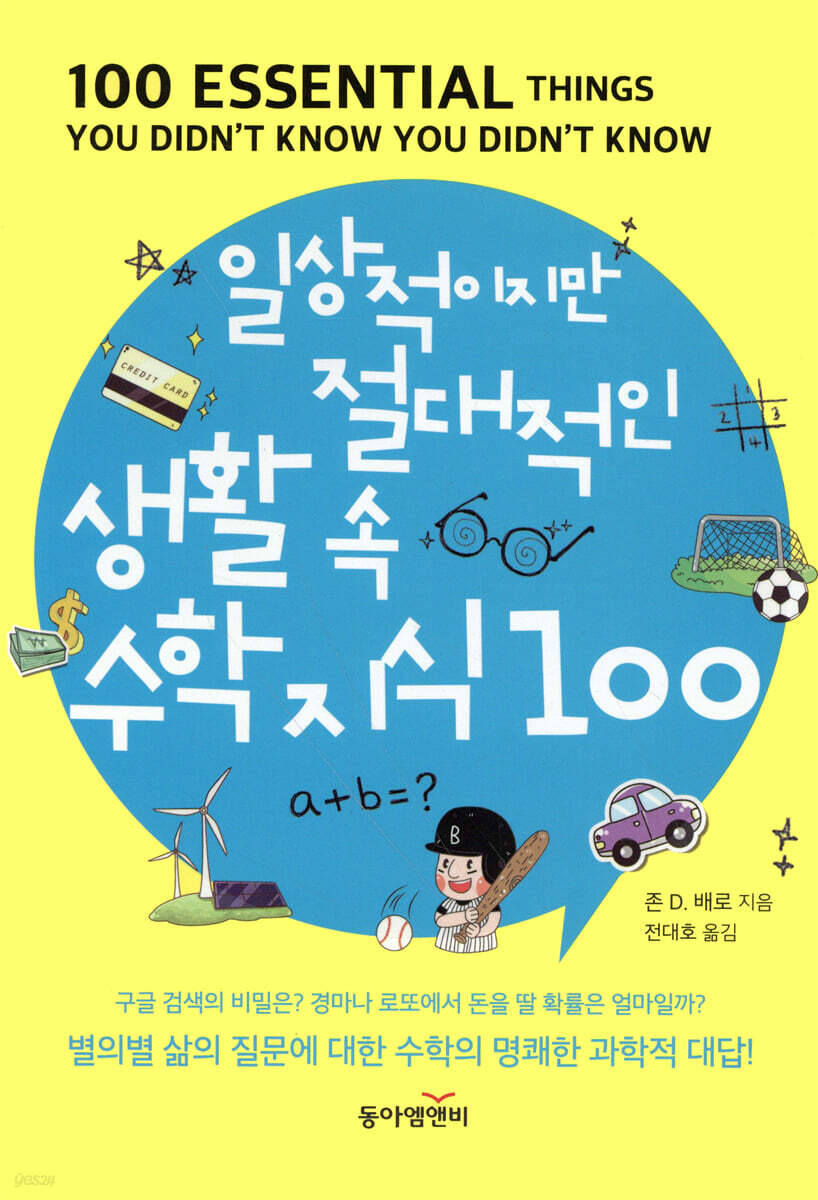
100 Everyday but Essential Math Knowledge for Everyday Life
 |
Description
Book Introduction
How do you win the lottery? Why are the towers shaped like triangles?
How long does it take to double your money? How many guards are needed in a prison? Etc.
The mysteries of mathematics hidden in everyday life are revealed!
Math is so painful and tedious that it's even been called "math phobia." Numerous attempts have been made to incorporate math into daily life, but combining the seemingly contradictory elements of "math" and "fun" has proven challenging.
Before mathematics was just a subject to study for exams, it was logic that formed the foundation of our lives and the intellectual foundation of the world.
"100 Everyday but Absolute Mathematical Knowledge in Life" is a book in which the author, a professor of mathematical sciences at Cambridge University, explains the mathematical laws that permeate our lives in an easy-to-understand way. It is the definitive version of "everyday math" that complements the limitations of existing books on the market and catches two birds with one stone: "mathematics" and "fun."
This book reminds those who believe that everyday life is separate from art or mathematics that everyday life and mathematics are not actually separate, but rather that they are a discipline very close to the world and people.
This book is full of interesting topics just from the titles alone, such as how to win at horse racing, the future of value-added tax, how to drive a car, how to win the lottery, and how long it takes to double your money, so you will lose track of time as you read.
Above all, through 『100 Everyday but Absolute Math Knowledge in Life』, you will be able to break down the preconceived notions and stereotypes about math that nothing has been able to break until now!
How long does it take to double your money? How many guards are needed in a prison? Etc.
The mysteries of mathematics hidden in everyday life are revealed!
Math is so painful and tedious that it's even been called "math phobia." Numerous attempts have been made to incorporate math into daily life, but combining the seemingly contradictory elements of "math" and "fun" has proven challenging.
Before mathematics was just a subject to study for exams, it was logic that formed the foundation of our lives and the intellectual foundation of the world.
"100 Everyday but Absolute Mathematical Knowledge in Life" is a book in which the author, a professor of mathematical sciences at Cambridge University, explains the mathematical laws that permeate our lives in an easy-to-understand way. It is the definitive version of "everyday math" that complements the limitations of existing books on the market and catches two birds with one stone: "mathematics" and "fun."
This book reminds those who believe that everyday life is separate from art or mathematics that everyday life and mathematics are not actually separate, but rather that they are a discipline very close to the world and people.
This book is full of interesting topics just from the titles alone, such as how to win at horse racing, the future of value-added tax, how to drive a car, how to win the lottery, and how long it takes to double your money, so you will lose track of time as you read.
Above all, through 『100 Everyday but Absolute Math Knowledge in Life』, you will be able to break down the preconceived notions and stereotypes about math that nothing has been able to break until now!
- You can preview some of the book's contents.
Preview
index
prolog
1. A tower made of shapes
2 Why tightrope walkers lift poles
3 Things even monkeys can do
4 Probability of guessing the number of typos in a paper
5 Rugby and Relativity
6 Rotational motion of a rolling wheel
7 Will it become stronger in proportion to its size?
8 Why do other lines always get shorter quickly?
9 If a third party intervenes between the two, will the relationship be shaken?
10 The world is small when you know it.
11 Equations for designing bridges
How much would it cost to collect 12 cards?
13 Convenient Number Notation
14. Non-transitivity of relationships
15 How to Win Surely at Horse Racing
16 How high can you jump?
17 The Power of the Edge
18 Value-added tax in the distant future
19 What are the odds of living in a simulated virtual world?
20 The Emergence of the Möbius Strip
21 How to Push a Car Effectively
22 Thermal instability resulting from selfish behavior
23 The gait of a drunk person
24 Misconceptions about random distributions
25 The average is a funny guy
26 Origami that reaches space
27 Distinguishing between easy and difficult problems
28 Can you predict the best record?
29 DIY How to Win at the Lotto
30 I don't believe it!
31 Large fires, dust is fatal?
32 What are the odds of hiring the best candidate?
33. A good division of property between sisters and brothers-in-law
34 Is this really just a coincidence?
35 Why do windmills have three rotor blades?
36 Tricks of a Perfect Word Deceit
What if you could invest in stocks by traveling 37 hours?
38 What coin system produces less change?
39 The Average Lie
40 How long can it last?
41 Presidents Who Preferred the Triangle to the Pentagon
42 Decrypting the code in the card and barcode
43 It's difficult to write down the name
44 Calculus is the secret to longevity
45 Common Factors of Flapping Animals
46 possible zip codes
47 How long does it take to double your money?
48 Is the face in the mirror the same as the real face?
49 The most notorious mathematician, Professor Moriarty
50 The force with which a roller coaster pushes passengers at its highest point
51 Why a Mushroom Cloud Forms from a Nuclear Explosion
52 Please, don't run, walk!
53 Mind Reading Using Mathematics
54 The probability that a conman is telling the truth
55 How to Win the Lotto
56 Most Bizarre Football Matches in History
57 How were the old stone arches made?
58 Why did Central American Indians use the octal system?
59 How high of a vote would it take to be 'delegated' authority?
60 Football League Points System
61 Creating Something from Nothing
62 Election Rigging Methods to Elect an Impossible Candidate
63 The time taken is constant regardless of the shaking width.
64 You can even ride a square wheel bicycle?
65 How many guards should an art gallery have?
66 How many guards does a prison need?
67 Billiards tricks made possible with simple geometry knowledge
Find the total number of female siblings
69 Fair Coin Toss with an Unfair Coin
70 The Magic of Tautology
71 The Effect of Spin on a Tennis Racket
72 Packing Effectively
73 Packing Complex Luggage Efficiently
74 How high can a tiger jump?
75 The story behind the leopard's stripes
76 How to stop the madness of the crowd?
77 The Most Shining Diamond Cutting Techniques
78 The Three Laws of Robotics
79 Think outside the box
80 Secrets of Google Search
81 Psychology that is more sensitive to losses than gains
82 What if I draw until the pencil lead runs out?
83 Why does spaghetti break into three or more pieces?
84 The Aesthetic Achievement of Cucumbers
85 Indicator of price increase, average
86 Knowing everything can be detrimental
87 Can high intelligence be a disadvantage?
88 The sociological impact of the London Underground map
89 There is no such thing as a boring number
90 Is my password safe?
91 The Paradox of Figure Skating Judging
The problem of 'infinity' that has plagued mathematicians
The Truth About Racial Segregation Revealed Through 93 Micro-Motivations
94 A game where you win when you become a minority
95 Venn Diagrams Trapped in Two-Dimensional Logic
Advantages of 96-sheet paper
97 A universal formula for calculating how good our actions are
98 Chaos is not the end of the world
Best boarding procedure to reduce 99-hour delays
A world shrunk to a village of 100 people
Translator's Note
1. A tower made of shapes
2 Why tightrope walkers lift poles
3 Things even monkeys can do
4 Probability of guessing the number of typos in a paper
5 Rugby and Relativity
6 Rotational motion of a rolling wheel
7 Will it become stronger in proportion to its size?
8 Why do other lines always get shorter quickly?
9 If a third party intervenes between the two, will the relationship be shaken?
10 The world is small when you know it.
11 Equations for designing bridges
How much would it cost to collect 12 cards?
13 Convenient Number Notation
14. Non-transitivity of relationships
15 How to Win Surely at Horse Racing
16 How high can you jump?
17 The Power of the Edge
18 Value-added tax in the distant future
19 What are the odds of living in a simulated virtual world?
20 The Emergence of the Möbius Strip
21 How to Push a Car Effectively
22 Thermal instability resulting from selfish behavior
23 The gait of a drunk person
24 Misconceptions about random distributions
25 The average is a funny guy
26 Origami that reaches space
27 Distinguishing between easy and difficult problems
28 Can you predict the best record?
29 DIY How to Win at the Lotto
30 I don't believe it!
31 Large fires, dust is fatal?
32 What are the odds of hiring the best candidate?
33. A good division of property between sisters and brothers-in-law
34 Is this really just a coincidence?
35 Why do windmills have three rotor blades?
36 Tricks of a Perfect Word Deceit
What if you could invest in stocks by traveling 37 hours?
38 What coin system produces less change?
39 The Average Lie
40 How long can it last?
41 Presidents Who Preferred the Triangle to the Pentagon
42 Decrypting the code in the card and barcode
43 It's difficult to write down the name
44 Calculus is the secret to longevity
45 Common Factors of Flapping Animals
46 possible zip codes
47 How long does it take to double your money?
48 Is the face in the mirror the same as the real face?
49 The most notorious mathematician, Professor Moriarty
50 The force with which a roller coaster pushes passengers at its highest point
51 Why a Mushroom Cloud Forms from a Nuclear Explosion
52 Please, don't run, walk!
53 Mind Reading Using Mathematics
54 The probability that a conman is telling the truth
55 How to Win the Lotto
56 Most Bizarre Football Matches in History
57 How were the old stone arches made?
58 Why did Central American Indians use the octal system?
59 How high of a vote would it take to be 'delegated' authority?
60 Football League Points System
61 Creating Something from Nothing
62 Election Rigging Methods to Elect an Impossible Candidate
63 The time taken is constant regardless of the shaking width.
64 You can even ride a square wheel bicycle?
65 How many guards should an art gallery have?
66 How many guards does a prison need?
67 Billiards tricks made possible with simple geometry knowledge
Find the total number of female siblings
69 Fair Coin Toss with an Unfair Coin
70 The Magic of Tautology
71 The Effect of Spin on a Tennis Racket
72 Packing Effectively
73 Packing Complex Luggage Efficiently
74 How high can a tiger jump?
75 The story behind the leopard's stripes
76 How to stop the madness of the crowd?
77 The Most Shining Diamond Cutting Techniques
78 The Three Laws of Robotics
79 Think outside the box
80 Secrets of Google Search
81 Psychology that is more sensitive to losses than gains
82 What if I draw until the pencil lead runs out?
83 Why does spaghetti break into three or more pieces?
84 The Aesthetic Achievement of Cucumbers
85 Indicator of price increase, average
86 Knowing everything can be detrimental
87 Can high intelligence be a disadvantage?
88 The sociological impact of the London Underground map
89 There is no such thing as a boring number
90 Is my password safe?
91 The Paradox of Figure Skating Judging
The problem of 'infinity' that has plagued mathematicians
The Truth About Racial Segregation Revealed Through 93 Micro-Motivations
94 A game where you win when you become a minority
95 Venn Diagrams Trapped in Two-Dimensional Logic
Advantages of 96-sheet paper
97 A universal formula for calculating how good our actions are
98 Chaos is not the end of the world
Best boarding procedure to reduce 99-hour delays
A world shrunk to a village of 100 people
Translator's Note
Into the book
Mathematics is fun and important because it tells us stories about the world that we can't learn about any other way.
Whenever we discuss the fundamentals of physics or the vastness of the universe, mathematics almost inevitably comes up.
But I hope that through this book, readers will come to realize how simple ideas can shed new light on things that are either boringly familiar or overlooked.
---From the "Prologue"
When you stand in line at the airport or post office, it always seems like the other lines move faster.
Whenever a road is blocked, it always seems like the other lanes clear out faster.
So even if I change lanes, it seems like the other lane moves faster.
This phenomenon, known in Britain as the 'Law of Swords', seems to represent the principle of opposition at the core of reality.
Of course, it could also be a result of human delusion or editing.
We are deeply impressed by coincidences.
And yet we often fail to recognize that there are far more coincidences that we have overlooked.
But it's not entirely an illusion that you often feel like you're standing in a line that moves more slowly.
In fact, you often stand in the slow line! ---「008.
Why do other lines always get shorter so quickly?
When a third party interferes between two people who are getting along well, the relationship often becomes shaken.
This phenomenon is even more pronounced when the force that binds the relationship is gravity.
Newton taught us that two bodies, like the Earth and the Moon, can remain in a stable orbit around their center of mass while exerting gravitational forces on each other.
However, when a third object of similar mass is introduced into a system consisting of two such objects, a very dramatic change usually occurs.
One object is expelled from the system, and the remaining two gradually settle into stable orbits.
---「009.
"If a third party intervenes between the two, will the relationship be shaken?"
As long as you ride on a suitable surface, you can ride a bike with square wheels smoothly and without any jerking.
(…) A rider of a square-wheeled bicycle can move smoothly forward by simply steering the bicycle so that the bottom corners of the rotating square wheels keep in contact with the 'valleys' lined up on the surface.
If you place two suitable catenary arches side by side, a right angle will be created where they meet.
Also, the angle formed by two sides at the vertex of a square wheel is a right angle.
Therefore, a square wheel can roll smoothly on a surface with a repeating shape of catenary arches.
---「064.
"You can even ride a square-wheeled bicycle?"
If robots equipped with electronic brains embodying the four laws above were mass-produced, would we feel safe? I don't think so.
What matters is the priority of the laws.
The fact that the Zeroth Law precedes the First Law means that a robot could kill you for driving a fuel-efficient car or not recycling some plastic bottles.
The robot will determine that if your actions continue, humanity is in danger.
Robots may also face serious difficulties if their duties run counter to the wishes of some political leaders.
Asking robots to act for humanity's benefit is a dangerous request.
The goals pursued by this demand are not well defined.
There is no single answer to the question, 'What is in the interest of humanity?'
There can be no computer that prints out a list of all actions that benefit humanity and all actions that harm humanity.
No program can tell us all the good and all the evil.
Whenever we discuss the fundamentals of physics or the vastness of the universe, mathematics almost inevitably comes up.
But I hope that through this book, readers will come to realize how simple ideas can shed new light on things that are either boringly familiar or overlooked.
---From the "Prologue"
When you stand in line at the airport or post office, it always seems like the other lines move faster.
Whenever a road is blocked, it always seems like the other lanes clear out faster.
So even if I change lanes, it seems like the other lane moves faster.
This phenomenon, known in Britain as the 'Law of Swords', seems to represent the principle of opposition at the core of reality.
Of course, it could also be a result of human delusion or editing.
We are deeply impressed by coincidences.
And yet we often fail to recognize that there are far more coincidences that we have overlooked.
But it's not entirely an illusion that you often feel like you're standing in a line that moves more slowly.
In fact, you often stand in the slow line! ---「008.
Why do other lines always get shorter so quickly?
When a third party interferes between two people who are getting along well, the relationship often becomes shaken.
This phenomenon is even more pronounced when the force that binds the relationship is gravity.
Newton taught us that two bodies, like the Earth and the Moon, can remain in a stable orbit around their center of mass while exerting gravitational forces on each other.
However, when a third object of similar mass is introduced into a system consisting of two such objects, a very dramatic change usually occurs.
One object is expelled from the system, and the remaining two gradually settle into stable orbits.
---「009.
"If a third party intervenes between the two, will the relationship be shaken?"
As long as you ride on a suitable surface, you can ride a bike with square wheels smoothly and without any jerking.
(…) A rider of a square-wheeled bicycle can move smoothly forward by simply steering the bicycle so that the bottom corners of the rotating square wheels keep in contact with the 'valleys' lined up on the surface.
If you place two suitable catenary arches side by side, a right angle will be created where they meet.
Also, the angle formed by two sides at the vertex of a square wheel is a right angle.
Therefore, a square wheel can roll smoothly on a surface with a repeating shape of catenary arches.
---「064.
"You can even ride a square-wheeled bicycle?"
If robots equipped with electronic brains embodying the four laws above were mass-produced, would we feel safe? I don't think so.
What matters is the priority of the laws.
The fact that the Zeroth Law precedes the First Law means that a robot could kill you for driving a fuel-efficient car or not recycling some plastic bottles.
The robot will determine that if your actions continue, humanity is in danger.
Robots may also face serious difficulties if their duties run counter to the wishes of some political leaders.
Asking robots to act for humanity's benefit is a dangerous request.
The goals pursued by this demand are not well defined.
There is no single answer to the question, 'What is in the interest of humanity?'
There can be no computer that prints out a list of all actions that benefit humanity and all actions that harm humanity.
No program can tell us all the good and all the evil.
---「078.
From "The Three Laws of Robotics"
From "The Three Laws of Robotics"
Publisher's Review
The delightful math in life that you didn't even know you knew
A fun math story that you won't be able to stop reading once you start!
"100 Everyday but Absolute Math Knowledge in Life" consists of 100 short essays freely arranged with not only interesting math knowledge but also surprisingly ingenious ideas.
This book clearly answers various life questions and helps you approach mathematics as a 'fun game' filled with fun tricks and twists rather than 'boring'. It can be read without burden by people who are interested in mathematics as well as those who are allergic to mathematics.
The author of this book, John D.
Barrow is a bestselling author, professor at the University of Cambridge, fellow of the Royal Society, and director of the Millennium Mathematics Project.
He is also a research fellow at Clare Hall College, Cambridge, and a member of the Royal Society. He has been awarded the Royal Glasgow Philosophical Society's Kelvin Medal (1999) and the Royal Society's Michael Faraday Award (2008), and has earned a reputation as a renowned mathematician in various fields.
The author, who has extensively explored the development of physics, astronomy, and mathematics from historical, philosophical, and literary perspectives, explains in this book the mathematical laws hidden in things we encounter in our daily lives that we may not have noticed before, in an easy and friendly way.
Through the author's witty way of unraveling the mystery as if unraveling a tangled thread, readers will come to realize the surprising truth that there are rules in the seemingly ordinary daily life.
Mathematics' clear scientific answers to life's many questions.
A book like a lavish table with 100 side dishes!
Could monkeys create the complete works of Shakespeare? A troop of monkeys were given a keyboard and asked to type, and their results matched the 19-character string from A Midsummer Night's Dream.
It's only a matter of time before a horde of monkeys produces the complete works of Shakespeare.
How many bridges would it take to become "acquaintances" with someone like Angelina Jolie or David Beckham, or the equivalent of Song Hye-kyo or Song Joong-ki in Korea? Surprisingly, it's less than five.
How many steps does a drunk person have to walk to cover 100 meters? Surprisingly, it's 10,000 steps, or the square of 100.
Of course, this assumes that the average person walks one meter per step.
How should the diamond, the hardest and most brilliant gemstone, be cut to achieve its most beautiful sparkle? There is clearly a specific method for cutting a diamond to maximize its brilliance.
Tolkowski, a Dutchman, studied the refraction and reflection of light inside a diamond and discovered the point where the diamond could shine with the greatest brilliance.
In addition, the book is full of rich stories that will tickle your ears: how to divide property fairly, how to rig elections to elect impossible candidates, how to win the lottery, how to win money at horse racing, how long it takes to double your money, how to push a car effectively, how many guards are needed in a prison, why the wind is strong in a forest of buildings, how to crack passwords in cards and barcodes, how to keep your password safe, the secret of Google search results, mind reading using mathematics, why windmills have three rotors, how to score figure skating matches, the pitfalls of the Venn diagram that was thought to be universal, the point system in soccer leagues, how many guards are needed in an art gallery, Sherlock Holmes' rival, the dangers of dust at a fire scene, chaos and infinity, the possibility of time travel, etc.
As you follow the 'fun and lively math stories,' 'math that seemed difficult' will soon become 'mysterious and vivid math' that lives and breathes in your daily life, helping you discover the true value and joy of math.
A fun math story that you won't be able to stop reading once you start!
"100 Everyday but Absolute Math Knowledge in Life" consists of 100 short essays freely arranged with not only interesting math knowledge but also surprisingly ingenious ideas.
This book clearly answers various life questions and helps you approach mathematics as a 'fun game' filled with fun tricks and twists rather than 'boring'. It can be read without burden by people who are interested in mathematics as well as those who are allergic to mathematics.
The author of this book, John D.
Barrow is a bestselling author, professor at the University of Cambridge, fellow of the Royal Society, and director of the Millennium Mathematics Project.
He is also a research fellow at Clare Hall College, Cambridge, and a member of the Royal Society. He has been awarded the Royal Glasgow Philosophical Society's Kelvin Medal (1999) and the Royal Society's Michael Faraday Award (2008), and has earned a reputation as a renowned mathematician in various fields.
The author, who has extensively explored the development of physics, astronomy, and mathematics from historical, philosophical, and literary perspectives, explains in this book the mathematical laws hidden in things we encounter in our daily lives that we may not have noticed before, in an easy and friendly way.
Through the author's witty way of unraveling the mystery as if unraveling a tangled thread, readers will come to realize the surprising truth that there are rules in the seemingly ordinary daily life.
Mathematics' clear scientific answers to life's many questions.
A book like a lavish table with 100 side dishes!
Could monkeys create the complete works of Shakespeare? A troop of monkeys were given a keyboard and asked to type, and their results matched the 19-character string from A Midsummer Night's Dream.
It's only a matter of time before a horde of monkeys produces the complete works of Shakespeare.
How many bridges would it take to become "acquaintances" with someone like Angelina Jolie or David Beckham, or the equivalent of Song Hye-kyo or Song Joong-ki in Korea? Surprisingly, it's less than five.
How many steps does a drunk person have to walk to cover 100 meters? Surprisingly, it's 10,000 steps, or the square of 100.
Of course, this assumes that the average person walks one meter per step.
How should the diamond, the hardest and most brilliant gemstone, be cut to achieve its most beautiful sparkle? There is clearly a specific method for cutting a diamond to maximize its brilliance.
Tolkowski, a Dutchman, studied the refraction and reflection of light inside a diamond and discovered the point where the diamond could shine with the greatest brilliance.
In addition, the book is full of rich stories that will tickle your ears: how to divide property fairly, how to rig elections to elect impossible candidates, how to win the lottery, how to win money at horse racing, how long it takes to double your money, how to push a car effectively, how many guards are needed in a prison, why the wind is strong in a forest of buildings, how to crack passwords in cards and barcodes, how to keep your password safe, the secret of Google search results, mind reading using mathematics, why windmills have three rotors, how to score figure skating matches, the pitfalls of the Venn diagram that was thought to be universal, the point system in soccer leagues, how many guards are needed in an art gallery, Sherlock Holmes' rival, the dangers of dust at a fire scene, chaos and infinity, the possibility of time travel, etc.
As you follow the 'fun and lively math stories,' 'math that seemed difficult' will soon become 'mysterious and vivid math' that lives and breathes in your daily life, helping you discover the true value and joy of math.
GOODS SPECIFICS
- Date of publication: June 20, 2016
- Page count, weight, size: 340 pages | 487g | 150*220*17mm
- ISBN13: 9791187336136
- ISBN10: 1187336130
You may also like
카테고리
korean


korean

![ELLE 엘르 스페셜 에디션 A형 : 12월 [2025]](http://librairie.coreenne.fr/cdn/shop/files/b8e27a3de6c9538896439686c6b0e8fb.jpg?v=1766436872&width=3840)


