

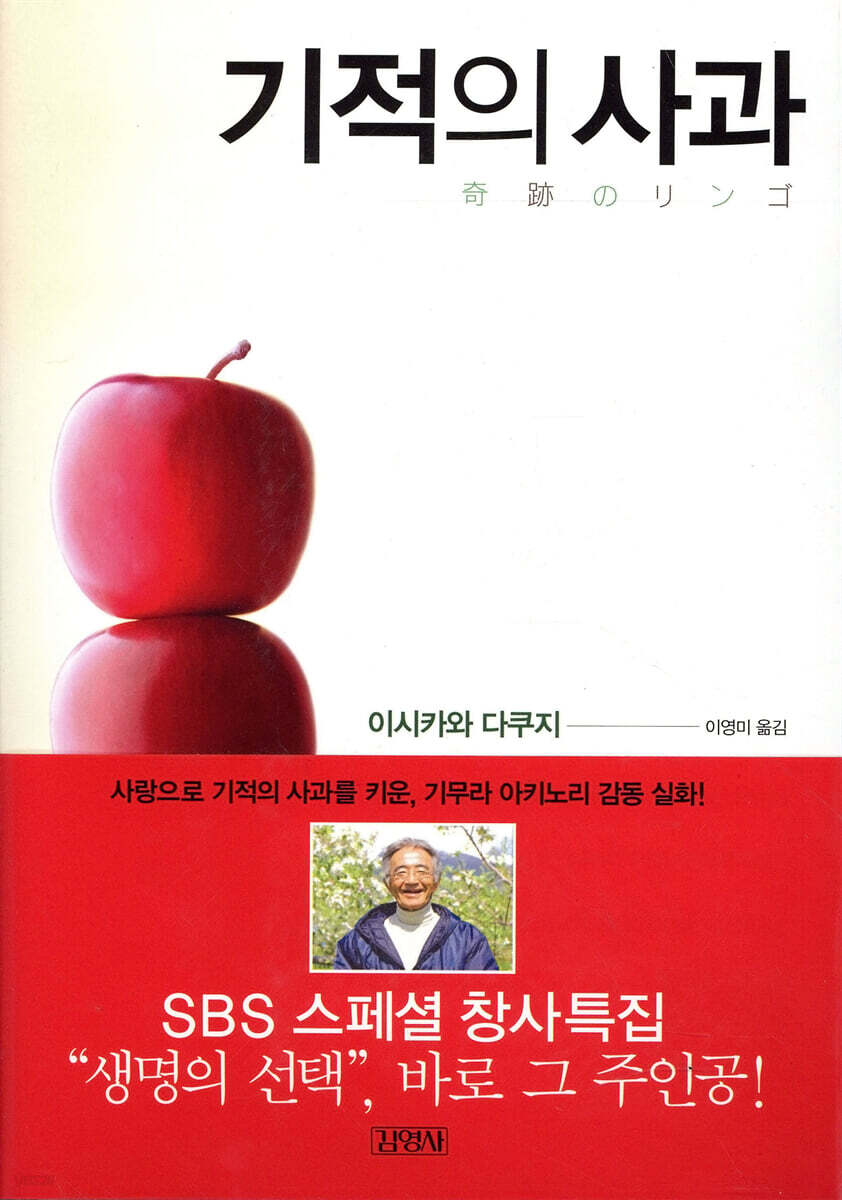
Miracle Apple
 |
Description
Book Introduction
"My eyes and hands are pesticides and fertilizers."
"Apples are not made by humans, but by trees."
This is a moving true story of challenges, adversity, tears, and accomplishments of a stubborn farmer who, with a firm belief in the vitality of Mother Nature, boldly overturned common sense and the impossible and became the first to successfully grow pesticide-free apples.
The secret to the success of a farmer who devoted his life to apples and shook the world by producing the world's first miraculous apple that never rots.
He created the 'myth of apples', something the world had never experienced before, through 'proper farming' that was faithful to principles and fundamentals.
The story of Akinori Kimura, the protagonist who appeared on NHK's program "Professional - The Way of the Professionals" in 2006 and caused a sensation, went beyond touching and created interest that could be called a craze.
The beginning of the great challenge of successfully growing apples without pesticides was humble.
He was so diligent in spraying pesticides according to the pesticide calendar that he received an award from the National Agricultural Cooperative Federation. When he saw his wife sick for a week after spraying pesticides, he was looking for a solution and happened to come across Masanobu Fukuoka's "Natural Farming."
I was completely captivated by the phrase, “farming without pesticides or fertilizers, doing nothing,” and I read the book without thinking, and it made me question the conventional wisdom that without pesticides, apples cannot be protected from diseases or insects.
As pesticides and fertilizers were not used, the apple trees, which had been made more susceptible to pests and diseases due to improved varieties, became infested with insects and the leaves became diseased and fell off.
Even though it wasn't the season, the apple tree burst into bloom like crazy.
He earned the nickname 'Kamadokeshi' (bankrupt).
Mr. Kimura was driven into a dead end called poverty, so he decided to die and went up to the mountains.
And then, by chance, he discovers an acorn tree bearing such delicious fruit that he mistakes it for an apple tree, and has a flash of enlightenment.
He ran down the mountain without thinking and put his enlightenment into practice. After nine years of persistent effort, he finally achieved the result.
"Apples are not made by humans, but by trees."
This is a moving true story of challenges, adversity, tears, and accomplishments of a stubborn farmer who, with a firm belief in the vitality of Mother Nature, boldly overturned common sense and the impossible and became the first to successfully grow pesticide-free apples.
The secret to the success of a farmer who devoted his life to apples and shook the world by producing the world's first miraculous apple that never rots.
He created the 'myth of apples', something the world had never experienced before, through 'proper farming' that was faithful to principles and fundamentals.
The story of Akinori Kimura, the protagonist who appeared on NHK's program "Professional - The Way of the Professionals" in 2006 and caused a sensation, went beyond touching and created interest that could be called a craze.
The beginning of the great challenge of successfully growing apples without pesticides was humble.
He was so diligent in spraying pesticides according to the pesticide calendar that he received an award from the National Agricultural Cooperative Federation. When he saw his wife sick for a week after spraying pesticides, he was looking for a solution and happened to come across Masanobu Fukuoka's "Natural Farming."
I was completely captivated by the phrase, “farming without pesticides or fertilizers, doing nothing,” and I read the book without thinking, and it made me question the conventional wisdom that without pesticides, apples cannot be protected from diseases or insects.
As pesticides and fertilizers were not used, the apple trees, which had been made more susceptible to pests and diseases due to improved varieties, became infested with insects and the leaves became diseased and fell off.
Even though it wasn't the season, the apple tree burst into bloom like crazy.
He earned the nickname 'Kamadokeshi' (bankrupt).
Mr. Kimura was driven into a dead end called poverty, so he decided to die and went up to the mountains.
And then, by chance, he discovers an acorn tree bearing such delicious fruit that he mistakes it for an apple tree, and has a flash of enlightenment.
He ran down the mountain without thinking and put his enlightenment into practice. After nine years of persistent effort, he finally achieved the result.
- You can preview some of the book's contents.
Preview
index
Preface_ A farm that grows apples that don't rot
Prologue: A Challenge That Changed the History of Apple Cultivation
1. If you are crazy about something, you will definitely find the answer.
If you're crazy about one thing, the history of apple cultivation and taking over the family business.
2 Natural farming methods that do nothing
My wife is sensitive to pesticides/Nature is a complete system/Stop using chemical fertilizers
3 Turning an old tree forest into a green apple orchard
Apple Orchards Become a Bug Paradise / Pesticides Saved Aomori Apples / A Trip Back to the Apple Orchards of a Hundred Years Ago / Foods That Can Replace Pesticides
4 Days clinging to a vague hope
The apple tree that never blooms/The nickname 'bankrupt'/The father's dream becomes the family's dream/There is no exit
Invisible Choice
5 Talk to the apple tree
Bug Catching and Vinegar Spraying/The Sounds of Apple Trees/The Meaning of Being Born into This World/Trees in the Forest Don't Need Pesticides
6 Don't just look at the tree, look at the soil.
Letting the weeds grow/To protect the apple tree/Disease and bugs are part of nature.
7 A collaboration between nature, apple trees, and humans
Apple blossoms in full bloom after nine years/Is this really an apple?/The taste of apples that bring tears to your eyes
Epilogue: Humanity's Future Is More Precious Than the Moon Landing
Recommendation_The sky stretching over the trees
Translator's Note: My eyes and hands are pesticides and fertilizers.
Prologue: A Challenge That Changed the History of Apple Cultivation
1. If you are crazy about something, you will definitely find the answer.
If you're crazy about one thing, the history of apple cultivation and taking over the family business.
2 Natural farming methods that do nothing
My wife is sensitive to pesticides/Nature is a complete system/Stop using chemical fertilizers
3 Turning an old tree forest into a green apple orchard
Apple Orchards Become a Bug Paradise / Pesticides Saved Aomori Apples / A Trip Back to the Apple Orchards of a Hundred Years Ago / Foods That Can Replace Pesticides
4 Days clinging to a vague hope
The apple tree that never blooms/The nickname 'bankrupt'/The father's dream becomes the family's dream/There is no exit
Invisible Choice
5 Talk to the apple tree
Bug Catching and Vinegar Spraying/The Sounds of Apple Trees/The Meaning of Being Born into This World/Trees in the Forest Don't Need Pesticides
6 Don't just look at the tree, look at the soil.
Letting the weeds grow/To protect the apple tree/Disease and bugs are part of nature.
7 A collaboration between nature, apple trees, and humans
Apple blossoms in full bloom after nine years/Is this really an apple?/The taste of apples that bring tears to your eyes
Epilogue: Humanity's Future Is More Precious Than the Moon Landing
Recommendation_The sky stretching over the trees
Translator's Note: My eyes and hands are pesticides and fertilizers.
Into the book
I also thought that pesticides were really amazing. They were able to prevent such a serious disease just by spraying pesticides.
But, as strange as it may sound, seeing the field like a forest of old trees actually made me feel more motivated.
In early spring, when there were no problems, there wasn't much of a sense of accomplishment.
Because we didn't use pesticides and did almost nothing else besides making compost.
But when I realized that growing apples without pesticides was not an easy task, I suddenly felt motivated.
Back then, I walked around asking the apple tree for favors.
Because the apple tree is getting weaker and weaker.
Maybe it was useless all the way to the roots.
Even a slight push would cause the tree to shake.
In that state, it seemed like I would soon dry up and die.
I went around to each apple tree, bowed my head, and apologized.
'I'm sorry for making it difficult for you.
He said to the apple tree, 'It doesn't matter if it doesn't bloom or bear fruit, just please don't dry up and die.'
At that time, I was already at a loss as to what to do.
I couldn't bring myself to say that to my family, so I continued working in the fields.
In fact, there was nothing more I could do, so I had no choice but to beg the apple tree.
If someone else had seen it in the surrounding fields, they would have said that Kimura's head had become strange.
But, now that I think about it, I think I was the most innocent back then.
An apple tree cannot survive alone.
It was a creature that lived in the surrounding nature.
The same goes for humans.
Humans forget that and think they can live independently.
And at some point, he came to believe that the crops he grew would be like that too.
The biggest problem with using pesticides is actually in that area.
What humans can do isn't that great.
Everyone says I worked hard, but that's not really me.
The apple tree has grown strong.
This is not humility.
I really think so.
No matter how hard a human tries, he cannot make an apple blossom bloom on his own.
Neither the tips of your fingers nor your toes can make apple blossoms bloom.
You might think that's obvious.
But people who think that way don't know its true meaning.
I realized it deeply when I saw the flowers in full bloom all over the field.
I'm telling you, it wasn't me who made those flowers bloom, it was the apple tree.
I realized to my bones that the protagonist was not a human, but an apple tree.
But all I can do is help the apple tree.
I barely realized it after failing over and over again.
It took me a really long time to realize that.
But, as strange as it may sound, seeing the field like a forest of old trees actually made me feel more motivated.
In early spring, when there were no problems, there wasn't much of a sense of accomplishment.
Because we didn't use pesticides and did almost nothing else besides making compost.
But when I realized that growing apples without pesticides was not an easy task, I suddenly felt motivated.
Back then, I walked around asking the apple tree for favors.
Because the apple tree is getting weaker and weaker.
Maybe it was useless all the way to the roots.
Even a slight push would cause the tree to shake.
In that state, it seemed like I would soon dry up and die.
I went around to each apple tree, bowed my head, and apologized.
'I'm sorry for making it difficult for you.
He said to the apple tree, 'It doesn't matter if it doesn't bloom or bear fruit, just please don't dry up and die.'
At that time, I was already at a loss as to what to do.
I couldn't bring myself to say that to my family, so I continued working in the fields.
In fact, there was nothing more I could do, so I had no choice but to beg the apple tree.
If someone else had seen it in the surrounding fields, they would have said that Kimura's head had become strange.
But, now that I think about it, I think I was the most innocent back then.
An apple tree cannot survive alone.
It was a creature that lived in the surrounding nature.
The same goes for humans.
Humans forget that and think they can live independently.
And at some point, he came to believe that the crops he grew would be like that too.
The biggest problem with using pesticides is actually in that area.
What humans can do isn't that great.
Everyone says I worked hard, but that's not really me.
The apple tree has grown strong.
This is not humility.
I really think so.
No matter how hard a human tries, he cannot make an apple blossom bloom on his own.
Neither the tips of your fingers nor your toes can make apple blossoms bloom.
You might think that's obvious.
But people who think that way don't know its true meaning.
I realized it deeply when I saw the flowers in full bloom all over the field.
I'm telling you, it wasn't me who made those flowers bloom, it was the apple tree.
I realized to my bones that the protagonist was not a human, but an apple tree.
But all I can do is help the apple tree.
I barely realized it after failing over and over again.
It took me a really long time to realize that.
--- From the text
Publisher's Review
A moving true story of challenges, hardships, tears, and triumphs of a stubborn farmer who, with a firm belief in the vitality of Mother Nature, boldly defied conventional wisdom and the impossible, became the first to successfully cultivate pesticide-free apples! A lifelong obsession with apples, this farmer shook the world by producing the world's first miraculous apple that never rots. The secret to his success!
Consecutive #1 in nonfiction/essays and #1 in economics, management, and business figures on Amazon Japan
Amazon Japan: 9th overall, 1st in nonfiction
An apple so delicious it will bring tears to your eyes, an apple that makes every cell in your body cheer the moment you take a bite.
A miraculous apple that won't rot, even eating the core!
The world's first apple that doesn't rot, a touching human story that shook the world!
Apples sold out within 3 minutes of online sales launch
You have to wait a year to eat soup made from miracle apples!
The Secret Behind the World's First Non-Rotating "Miracle Apple"
“‘This is it, this is it, this is it.’ The apple was unbelievably delicious.
“When I suddenly came to my senses, all that was left in my hand was an apple seed.”
There are apples that are like a 'sculpture of taste' that make anyone who has tried them exclaim in admiration.
This apple is produced by Mr. Akinori Kimura in Aomori Prefecture, Japan, and is known as the "Miracle Apple" in Japan.
The "Miracle Apple" became famous because it was discovered by chance by the chef of a restaurant (Restaurant Yamazaki in Hirosaki and a restaurant in Shirokanedai, Tokyo) who makes apple soup using Akinori Kimura's apples.
Kimura cut an apple in half and left it on top of the refrigerator. After two years, it did not rot, did not turn brown, gave off a sweet fragrance, and was small and shriveled up as if it had withered. He was so surprised that he named it the "miracle apple."
Akinori Kimura's "Apple Soup" sold at this Tokyo restaurant is so popular that reservations are often fully booked, requiring a year-long wait.
The "Miracle Apple" craze in Japan began on December 7, 2006, after the NHK documentary program "Professional - The Professional Way" aired a segment on "Apple Farmer Akinori Kimura."
After the broadcast, it created an unusually large response, and over the next three months, NHK received over 700 emails and letters from people saying things like, "I want to send a letter to Mr. Kimura," and "I really want to try Mr. Kimura's apples."
The day after the broadcast, Kimura's home was flooded with 350 orders in one day, and the product sold out within three minutes of going on sale online. To date, Kimura has over 2,700 personal customers.
In the fall of 1991, a four-star typhoon blew through Aomori Prefecture, Japan, causing fatal damage to apple farmers in the area, with over 90 percent of the apples falling.
At that time, a farmer came up with an idea to name the apples that were hanging without falling as "passing apples" and sold them at 10 times the price of regular apples. They sold like hotcakes and became popular.
But the important thing is that despite the typhoon damage at the time, more than 80 percent of Kimura's apples were still attached.
While other apple trees have roots that are only a few meters deep, Kimura's apple tree has roots that are 20 meters deep, and the apples on its stems and branches are thicker and sturdier than those of other apple trees.
The apple's own waxy substance increases linoleic acid and oleic acid, which dissolves the solid substances contained in the peel, increasing the wax content and making it sticky like an oiled state. By doing this, the miracle apple lets itself know that it is at its most nutritious and delicious! The appearance is quite ordinary, with a slightly distorted shape and small blemishes, but what is the secret of this apple that delivers an unbelievably amazing taste?
An indomitable challenge that changed the 4,000-year history of apple cultivation on a 60,000-pyeong farm.
A ‘proper farming’ that is faithful to principles and basics, something that has never been experienced in the world
A dazzling story of courage and hope from a farmer who created the "apple legend."
“They all said that growing apples without pesticides is impossible.
No one has ever succeeded.
“The mere thought of challenging something no one had ever done before made my heart flutter.” (Akinori Kimura)
Apple, the fruit of the gods, if you eat one a day, you won't need a doctor.
Here is a record of a farmer's great challenge that overturned the 4,000-year history of apple cultivation that mankind had been eating in just 10 years.
Is there an apple that is safe for both growers and consumers? Is there an apple that is delicious even when eaten raw, even with the peel? The apples we eat today are said to be improved varieties that couldn't be grown without improved pesticides, developed in the 19th century.
Organic, pesticide-free apples that we could eat were virtually non-existent.
If you don't use pesticides, you can't even dream of harvesting apples.
To anyone who knows the realities of apple growing, it's a question that defies common sense.
It's not a simple story that says that if you don't use pesticides, your harvest will decrease.
Because if we don't use pesticides, there won't be any apple orchards left.
Trees that suffer significant damage, with yields less than 10 percent of the average, will not bloom the following year.
If flowers don't bloom, then of course there can't be fruit.
In other words, if you continue to grow crops without pesticides for two years, the apple harvest will almost certainly be zero.
There is a huge difference between modern apples and those of the time of William Tell or Newton.
That is also the biggest reason why pesticide-free apples cannot be grown.
It is because of breed improvement.
Today's apples are a completely different fruit from the apples of old.
-From the text
There was a farmer here who had a question.
Are pesticides and chemical fertilizers really necessary for growing apples? Is it true that abandoned apple orchards are rife with diseases and pests, leaving no room for control?
"The Miracle Apple" is a moving true story of the challenges, adversity, tears, and accomplishments of a stubborn farmer who boldly overturned common sense and the impossible to become the first to successfully grow pesticide-free apples.
The story of Akinori Kimura, the protagonist who appeared on NHK's program "Professional - The Way of the Professionals" in 2006 and caused a sensation, went beyond touching and created interest that could be called a craze.
The beginning of the great challenge of successfully growing apples without pesticides was humble.
He was so diligent in spraying pesticides according to the pesticide calendar that he received an award from the National Agricultural Cooperative Federation. When he saw his wife sick for a week after spraying pesticides, he was looking for a solution and happened to come across Masanobu Fukuoka's "Natural Farming."
I was completely captivated by the phrase, “farming without pesticides or fertilizers, doing nothing,” and I read the book without thinking, and it made me question the conventional wisdom that without pesticides, apples cannot be protected from diseases or insects.
Mr. Kimura, who had been so creative that he wanted to build a computer using vacuum tubes since his youth, was always an active and positive person who felt uneasy if he was not doing something, and tried various things. However, even for Mr. Kimura, the wall of 'pesticide-free and fertilizer-free' apple cultivation was high.
I also thought that pesticides were really amazing. They were able to prevent such a serious disease just by spraying pesticides.
But, as strange as it may sound, seeing the field like a forest of old trees actually made me feel more motivated.
In early spring, when there were no problems, there wasn't much of a sense of accomplishment.
Because we didn't use pesticides and did almost nothing else besides making compost.
But when I realized that growing apples without pesticides was not an easy task, I suddenly felt motivated.
-From the text
As pesticides and fertilizers were not used, the apple trees, which had been made more susceptible to pests and diseases due to improved varieties, became infested with insects and the leaves became diseased and fell off.
Even though it wasn't the season, the apple tree burst into bloom like crazy.
Apples in surrounding fields that used conventional farming methods using pesticides bore fruit without a hitch, but only Kimura's field was in disarray.
He earned the nickname 'Kamadokeshi' (bankrupt).
Mr. Kimura was driven into a dead end called poverty, so he decided to die and went up to the mountains.
Back then, I walked around asking the apple tree for favors.
Because the apple tree is getting weaker and weaker.
Maybe it was useless all the way to the roots.
Even a slight push would cause the tree to shake.
In that state, it seemed like I would soon dry up and die.
I went around to each apple tree, bowed my head, and apologized.
'I'm sorry for making it difficult for you.
He said to the apple tree, 'It doesn't matter if it doesn't bloom or bear fruit, just please don't dry up and die.'
At that time, I was already at a loss as to what to do.
I couldn't bring myself to say that to my family, so I continued working in the fields.
In fact, there was nothing more I could do, so I had no choice but to beg the apple tree.
If someone else had seen it in the surrounding fields, they would have said that Kimura's head had become strange.
But, now that I think about it, I think I was the most innocent back then.
-From the text
And then, by chance, he discovers an acorn tree bearing such delicious fruit that he mistakes it for an apple tree, and has a flash of enlightenment.
No one sprays a single drop of pesticide in the forest, yet the leaves are lush.
Realizing that the secret lies in the soil where the tree has taken root, he rushes down the mountain and observes the soil of the apple orchard.
He began to let the weeds grow wild in his apple orchard, much like a mountain environment, and to help the soil regain its original vitality. His efforts bore fruit after nine years.
An apple tree cannot survive alone.
It was a creature that lived in the surrounding nature.
The same goes for humans.
Humans forget that, and think they can live independently.
And at some point, he came to believe that the crops he grew would be like that too.
The biggest problem with using pesticides is actually in that area.
-From the text
Discovering the providence of nature through natural farming and the principles of life in Mother Nature.
“My eyes and hands are pesticides and fertilizers.”
“Apples are not made by humans, but by apple trees.”
What humans can do isn't that great.
Everyone says Kimura worked hard, but in reality, it wasn't me.
The apple tree has grown strong.
This is not humility.
I really think so.
That's right, no matter how hard a human tries, he can't make an apple blossom bloom on his own.
Neither the tips of your fingers nor your toes can make apple blossoms bloom.
You might think that's obvious.
But people who think that way don't know its true meaning.
I realized it deeply when I saw the flowers in full bloom all over the field.
I'm telling you, it wasn't me who made those flowers bloom, it was the apple tree.
I realized to my bones that the protagonist was not a human, but an apple tree.
I didn't know that.
I believed I was growing apples.
I thought I was taking care of the apple tree.
But all I can do is help the apple tree.
I barely realized it after failing over and over again.
It took me a really long time to realize that.
-From the text
After nine years of hopeless frustration, insisting on natural farming without pesticides or fertilizers, he discovered a bright light on the day he was ready to die, and achieved success after ten years! The key to cultivating apples without pesticides or fertilizers, which everyone thought was impossible, was natural farming based on the power of the soil. He broke the stereotype and discovered the answer already prepared within nature.
We call strange things that cannot be imagined with common sense 'miracles'.
Here, 'common sense' refers to knowledge that people usually know.
This book is a book that clearly shows this nature of miracles.
The miracle does not lie in the success of growing apples without pesticides or fertilizers, which was considered absolutely impossible.
It lies in the process itself of overturning human misconceptions.
In the midst of that arduous journey is Akinori Kimura, who can be called Aomori's "Don Quixote."
His character and perseverance, which allowed him to overcome endless failures, trials, desperate hardships, and public ridicule to achieve his goals, are the driving force behind his success.
He has achieved success based on strong curiosity, a fresh perspective, a constant spirit of inquiry and honesty, and simple, genuine human qualities and charm. Furthermore, he has not sought to profit from such hard-won achievements for his own benefit, but has instead expanded them to those around him, embracing the greater goal of coexisting with nature, sharing its blessings without destroying it. I cannot help but admire him.
In an age where only the expansion of scale and technological advancement are considered meaningful, the story of a farmer's great life and nature, who threw himself into discovering the providence of nature rather than fame or success, delivers a message of positivity and hope in an age where hope is lost.
The author of this book, nonfiction writer Takuji Ishikawa, interviewed Akinori Kimura directly from December 2006 to June 2008.
Despite being a non-fiction work, the life and achievements of Kimura Akinori are rich in knowledge and cultural theory, reminiscent of a humanities book. Through meticulous and sincere research, the author demonstrates a writing style that is not lacking in introducing the life of this rare figure.
It conveys the emotion that comes from the facts themselves, without any embellishment, through restrained and dry expression.
In modern civilization, which is developing solely through confrontation with nature based on the consumption of fossil fuels, agriculture is one industry that cannot be an exception.
This book is interesting enough as a critique of civilization for readers interested in environmental issues or the dysfunctions of civilization.
As can be seen from Mr. Kimura's words, "My eyes and hands are pesticides and fertilizers," he guides readers to a philosophical realm by simply unraveling the origins of life and the depths of natural science based on dialogue and reconciliation with nature.
The life of Akinori Kimura, who struggled to achieve the once-impossible goal of growing apples without pesticides or fertilizers, is a drama in itself.
Kimura's dramatic yet mythical life story is alive with a moving message that touches the hearts of those who want to go crazy about something, or those who have given up on going crazy halfway.
"The Miracle Apple" makes us realize once again how lonely and difficult it is to pursue the beliefs, goals, and dreams that are so often talked about in the world.
It makes you realize what is truly important in your life.
In a world where science and civilization have advanced, but truly "happy" people are rare, and the number of people who easily give up on anything is increasing, this book gives us all an opportunity to think again about the truly precious things that we have forgotten and turned away from.
Consecutive #1 in nonfiction/essays and #1 in economics, management, and business figures on Amazon Japan
Amazon Japan: 9th overall, 1st in nonfiction
An apple so delicious it will bring tears to your eyes, an apple that makes every cell in your body cheer the moment you take a bite.
A miraculous apple that won't rot, even eating the core!
The world's first apple that doesn't rot, a touching human story that shook the world!
Apples sold out within 3 minutes of online sales launch
You have to wait a year to eat soup made from miracle apples!
The Secret Behind the World's First Non-Rotating "Miracle Apple"
“‘This is it, this is it, this is it.’ The apple was unbelievably delicious.
“When I suddenly came to my senses, all that was left in my hand was an apple seed.”
There are apples that are like a 'sculpture of taste' that make anyone who has tried them exclaim in admiration.
This apple is produced by Mr. Akinori Kimura in Aomori Prefecture, Japan, and is known as the "Miracle Apple" in Japan.
The "Miracle Apple" became famous because it was discovered by chance by the chef of a restaurant (Restaurant Yamazaki in Hirosaki and a restaurant in Shirokanedai, Tokyo) who makes apple soup using Akinori Kimura's apples.
Kimura cut an apple in half and left it on top of the refrigerator. After two years, it did not rot, did not turn brown, gave off a sweet fragrance, and was small and shriveled up as if it had withered. He was so surprised that he named it the "miracle apple."
Akinori Kimura's "Apple Soup" sold at this Tokyo restaurant is so popular that reservations are often fully booked, requiring a year-long wait.
The "Miracle Apple" craze in Japan began on December 7, 2006, after the NHK documentary program "Professional - The Professional Way" aired a segment on "Apple Farmer Akinori Kimura."
After the broadcast, it created an unusually large response, and over the next three months, NHK received over 700 emails and letters from people saying things like, "I want to send a letter to Mr. Kimura," and "I really want to try Mr. Kimura's apples."
The day after the broadcast, Kimura's home was flooded with 350 orders in one day, and the product sold out within three minutes of going on sale online. To date, Kimura has over 2,700 personal customers.
In the fall of 1991, a four-star typhoon blew through Aomori Prefecture, Japan, causing fatal damage to apple farmers in the area, with over 90 percent of the apples falling.
At that time, a farmer came up with an idea to name the apples that were hanging without falling as "passing apples" and sold them at 10 times the price of regular apples. They sold like hotcakes and became popular.
But the important thing is that despite the typhoon damage at the time, more than 80 percent of Kimura's apples were still attached.
While other apple trees have roots that are only a few meters deep, Kimura's apple tree has roots that are 20 meters deep, and the apples on its stems and branches are thicker and sturdier than those of other apple trees.
The apple's own waxy substance increases linoleic acid and oleic acid, which dissolves the solid substances contained in the peel, increasing the wax content and making it sticky like an oiled state. By doing this, the miracle apple lets itself know that it is at its most nutritious and delicious! The appearance is quite ordinary, with a slightly distorted shape and small blemishes, but what is the secret of this apple that delivers an unbelievably amazing taste?
An indomitable challenge that changed the 4,000-year history of apple cultivation on a 60,000-pyeong farm.
A ‘proper farming’ that is faithful to principles and basics, something that has never been experienced in the world
A dazzling story of courage and hope from a farmer who created the "apple legend."
“They all said that growing apples without pesticides is impossible.
No one has ever succeeded.
“The mere thought of challenging something no one had ever done before made my heart flutter.” (Akinori Kimura)
Apple, the fruit of the gods, if you eat one a day, you won't need a doctor.
Here is a record of a farmer's great challenge that overturned the 4,000-year history of apple cultivation that mankind had been eating in just 10 years.
Is there an apple that is safe for both growers and consumers? Is there an apple that is delicious even when eaten raw, even with the peel? The apples we eat today are said to be improved varieties that couldn't be grown without improved pesticides, developed in the 19th century.
Organic, pesticide-free apples that we could eat were virtually non-existent.
If you don't use pesticides, you can't even dream of harvesting apples.
To anyone who knows the realities of apple growing, it's a question that defies common sense.
It's not a simple story that says that if you don't use pesticides, your harvest will decrease.
Because if we don't use pesticides, there won't be any apple orchards left.
Trees that suffer significant damage, with yields less than 10 percent of the average, will not bloom the following year.
If flowers don't bloom, then of course there can't be fruit.
In other words, if you continue to grow crops without pesticides for two years, the apple harvest will almost certainly be zero.
There is a huge difference between modern apples and those of the time of William Tell or Newton.
That is also the biggest reason why pesticide-free apples cannot be grown.
It is because of breed improvement.
Today's apples are a completely different fruit from the apples of old.
-From the text
There was a farmer here who had a question.
Are pesticides and chemical fertilizers really necessary for growing apples? Is it true that abandoned apple orchards are rife with diseases and pests, leaving no room for control?
"The Miracle Apple" is a moving true story of the challenges, adversity, tears, and accomplishments of a stubborn farmer who boldly overturned common sense and the impossible to become the first to successfully grow pesticide-free apples.
The story of Akinori Kimura, the protagonist who appeared on NHK's program "Professional - The Way of the Professionals" in 2006 and caused a sensation, went beyond touching and created interest that could be called a craze.
The beginning of the great challenge of successfully growing apples without pesticides was humble.
He was so diligent in spraying pesticides according to the pesticide calendar that he received an award from the National Agricultural Cooperative Federation. When he saw his wife sick for a week after spraying pesticides, he was looking for a solution and happened to come across Masanobu Fukuoka's "Natural Farming."
I was completely captivated by the phrase, “farming without pesticides or fertilizers, doing nothing,” and I read the book without thinking, and it made me question the conventional wisdom that without pesticides, apples cannot be protected from diseases or insects.
Mr. Kimura, who had been so creative that he wanted to build a computer using vacuum tubes since his youth, was always an active and positive person who felt uneasy if he was not doing something, and tried various things. However, even for Mr. Kimura, the wall of 'pesticide-free and fertilizer-free' apple cultivation was high.
I also thought that pesticides were really amazing. They were able to prevent such a serious disease just by spraying pesticides.
But, as strange as it may sound, seeing the field like a forest of old trees actually made me feel more motivated.
In early spring, when there were no problems, there wasn't much of a sense of accomplishment.
Because we didn't use pesticides and did almost nothing else besides making compost.
But when I realized that growing apples without pesticides was not an easy task, I suddenly felt motivated.
-From the text
As pesticides and fertilizers were not used, the apple trees, which had been made more susceptible to pests and diseases due to improved varieties, became infested with insects and the leaves became diseased and fell off.
Even though it wasn't the season, the apple tree burst into bloom like crazy.
Apples in surrounding fields that used conventional farming methods using pesticides bore fruit without a hitch, but only Kimura's field was in disarray.
He earned the nickname 'Kamadokeshi' (bankrupt).
Mr. Kimura was driven into a dead end called poverty, so he decided to die and went up to the mountains.
Back then, I walked around asking the apple tree for favors.
Because the apple tree is getting weaker and weaker.
Maybe it was useless all the way to the roots.
Even a slight push would cause the tree to shake.
In that state, it seemed like I would soon dry up and die.
I went around to each apple tree, bowed my head, and apologized.
'I'm sorry for making it difficult for you.
He said to the apple tree, 'It doesn't matter if it doesn't bloom or bear fruit, just please don't dry up and die.'
At that time, I was already at a loss as to what to do.
I couldn't bring myself to say that to my family, so I continued working in the fields.
In fact, there was nothing more I could do, so I had no choice but to beg the apple tree.
If someone else had seen it in the surrounding fields, they would have said that Kimura's head had become strange.
But, now that I think about it, I think I was the most innocent back then.
-From the text
And then, by chance, he discovers an acorn tree bearing such delicious fruit that he mistakes it for an apple tree, and has a flash of enlightenment.
No one sprays a single drop of pesticide in the forest, yet the leaves are lush.
Realizing that the secret lies in the soil where the tree has taken root, he rushes down the mountain and observes the soil of the apple orchard.
He began to let the weeds grow wild in his apple orchard, much like a mountain environment, and to help the soil regain its original vitality. His efforts bore fruit after nine years.
An apple tree cannot survive alone.
It was a creature that lived in the surrounding nature.
The same goes for humans.
Humans forget that, and think they can live independently.
And at some point, he came to believe that the crops he grew would be like that too.
The biggest problem with using pesticides is actually in that area.
-From the text
Discovering the providence of nature through natural farming and the principles of life in Mother Nature.
“My eyes and hands are pesticides and fertilizers.”
“Apples are not made by humans, but by apple trees.”
What humans can do isn't that great.
Everyone says Kimura worked hard, but in reality, it wasn't me.
The apple tree has grown strong.
This is not humility.
I really think so.
That's right, no matter how hard a human tries, he can't make an apple blossom bloom on his own.
Neither the tips of your fingers nor your toes can make apple blossoms bloom.
You might think that's obvious.
But people who think that way don't know its true meaning.
I realized it deeply when I saw the flowers in full bloom all over the field.
I'm telling you, it wasn't me who made those flowers bloom, it was the apple tree.
I realized to my bones that the protagonist was not a human, but an apple tree.
I didn't know that.
I believed I was growing apples.
I thought I was taking care of the apple tree.
But all I can do is help the apple tree.
I barely realized it after failing over and over again.
It took me a really long time to realize that.
-From the text
After nine years of hopeless frustration, insisting on natural farming without pesticides or fertilizers, he discovered a bright light on the day he was ready to die, and achieved success after ten years! The key to cultivating apples without pesticides or fertilizers, which everyone thought was impossible, was natural farming based on the power of the soil. He broke the stereotype and discovered the answer already prepared within nature.
We call strange things that cannot be imagined with common sense 'miracles'.
Here, 'common sense' refers to knowledge that people usually know.
This book is a book that clearly shows this nature of miracles.
The miracle does not lie in the success of growing apples without pesticides or fertilizers, which was considered absolutely impossible.
It lies in the process itself of overturning human misconceptions.
In the midst of that arduous journey is Akinori Kimura, who can be called Aomori's "Don Quixote."
His character and perseverance, which allowed him to overcome endless failures, trials, desperate hardships, and public ridicule to achieve his goals, are the driving force behind his success.
He has achieved success based on strong curiosity, a fresh perspective, a constant spirit of inquiry and honesty, and simple, genuine human qualities and charm. Furthermore, he has not sought to profit from such hard-won achievements for his own benefit, but has instead expanded them to those around him, embracing the greater goal of coexisting with nature, sharing its blessings without destroying it. I cannot help but admire him.
In an age where only the expansion of scale and technological advancement are considered meaningful, the story of a farmer's great life and nature, who threw himself into discovering the providence of nature rather than fame or success, delivers a message of positivity and hope in an age where hope is lost.
The author of this book, nonfiction writer Takuji Ishikawa, interviewed Akinori Kimura directly from December 2006 to June 2008.
Despite being a non-fiction work, the life and achievements of Kimura Akinori are rich in knowledge and cultural theory, reminiscent of a humanities book. Through meticulous and sincere research, the author demonstrates a writing style that is not lacking in introducing the life of this rare figure.
It conveys the emotion that comes from the facts themselves, without any embellishment, through restrained and dry expression.
In modern civilization, which is developing solely through confrontation with nature based on the consumption of fossil fuels, agriculture is one industry that cannot be an exception.
This book is interesting enough as a critique of civilization for readers interested in environmental issues or the dysfunctions of civilization.
As can be seen from Mr. Kimura's words, "My eyes and hands are pesticides and fertilizers," he guides readers to a philosophical realm by simply unraveling the origins of life and the depths of natural science based on dialogue and reconciliation with nature.
The life of Akinori Kimura, who struggled to achieve the once-impossible goal of growing apples without pesticides or fertilizers, is a drama in itself.
Kimura's dramatic yet mythical life story is alive with a moving message that touches the hearts of those who want to go crazy about something, or those who have given up on going crazy halfway.
"The Miracle Apple" makes us realize once again how lonely and difficult it is to pursue the beliefs, goals, and dreams that are so often talked about in the world.
It makes you realize what is truly important in your life.
In a world where science and civilization have advanced, but truly "happy" people are rare, and the number of people who easily give up on anything is increasing, this book gives us all an opportunity to think again about the truly precious things that we have forgotten and turned away from.
GOODS SPECIFICS
- Date of issue: July 17, 2009
- Page count, weight, size: 246 pages | 359g | 153*224*20mm
- ISBN13: 9788934935186
- ISBN10: 8934935189
You may also like
카테고리
korean


korean

![GQ KOREA Mark (Monthly): December [2025]](http://librairie.coreenne.fr/cdn/shop/files/8ef265dbbfbf186523ed75ba7319009d.jpg?v=1765340328&width=3840)


