

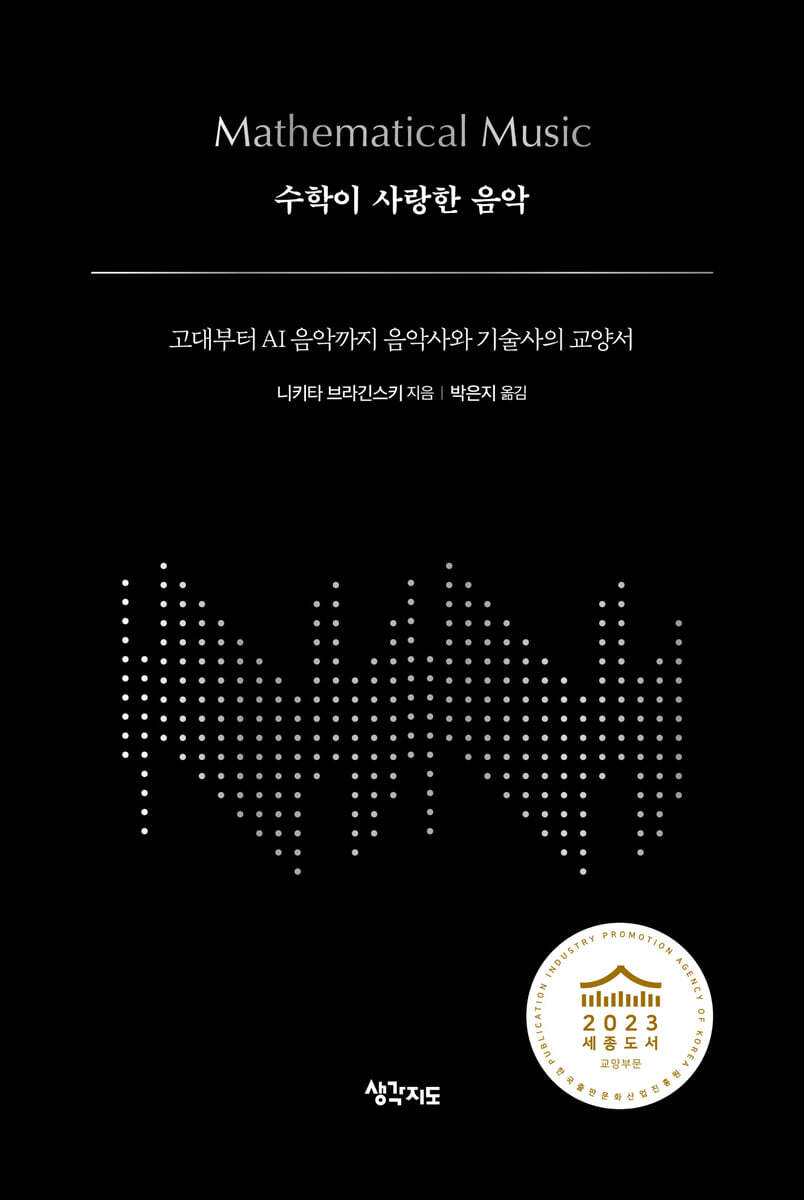
Music Loved by Mathematics
 |
Description
Book Introduction
From the earliest theories of antiquity to today's AI music,
How mathematics has been used in music and will be used in the future.
Recently, Google, which felt threatened by ChatGPT, introduced a text-based music generation AI system called 'MusicLM'.
MusicLM is a text-based music generation AI system that creates music based on simple text commands.
Platforms that recommend personalized music to individuals based on artificial intelligence are rapidly gaining popularity.
In this way, artificial intelligence is bringing a new wind to music.
So when did science and technology begin to be incorporated into the field of music?
The recently published 『Music Loved by Mathematics』 is an introductory book that explains the history of the use of mathematics in the field of musical creation that has continued for centuries.
Author Nikita Braginsky, a musicologist and historian of technology, explains how mathematics began to be used in the field of music, where it is today, and how it might be used in the near future.
In doing so, it deeply explores the science of mathematics, which is now creating a new genre called AI music, from the perspective of a convergence of music history and technology history.
Dr. Eun-ji Park, the translator who introduced this book to Korea, said, “Books containing the origins and history of AI music were difficult to find both domestically and internationally due to the scarcity of research. However, after reading this book, I became convinced of the value of its contents.” This book is truly unique.
While previous music-related books have focused on interpreting and understanding classical music, focusing on the musician's work, this book deserves high praise for its concise and persuasive description of the origins, development, and future potential of AI music, which has recently begun to attract attention.
How mathematics has been used in music and will be used in the future.
Recently, Google, which felt threatened by ChatGPT, introduced a text-based music generation AI system called 'MusicLM'.
MusicLM is a text-based music generation AI system that creates music based on simple text commands.
Platforms that recommend personalized music to individuals based on artificial intelligence are rapidly gaining popularity.
In this way, artificial intelligence is bringing a new wind to music.
So when did science and technology begin to be incorporated into the field of music?
The recently published 『Music Loved by Mathematics』 is an introductory book that explains the history of the use of mathematics in the field of musical creation that has continued for centuries.
Author Nikita Braginsky, a musicologist and historian of technology, explains how mathematics began to be used in the field of music, where it is today, and how it might be used in the near future.
In doing so, it deeply explores the science of mathematics, which is now creating a new genre called AI music, from the perspective of a convergence of music history and technology history.
Dr. Eun-ji Park, the translator who introduced this book to Korea, said, “Books containing the origins and history of AI music were difficult to find both domestically and internationally due to the scarcity of research. However, after reading this book, I became convinced of the value of its contents.” This book is truly unique.
While previous music-related books have focused on interpreting and understanding classical music, focusing on the musician's work, this book deserves high praise for its concise and persuasive description of the origins, development, and future potential of AI music, which has recently begun to attract attention.
- You can preview some of the book's contents.
Preview
index
Recommendation
Recommendation
Translator's Note
As you go in
Part 1.
From continuity
1.
Mathematical music, not revolution
2.
Since ancient times
3.
Since the Middle Ages
4.
Since the modern era
5.
Since the 19th century
6.
Since 1900
7.
Since 1950
Part 2.
As a possibility
8.
Powerful yet limited mathematical music
9.
How Deep Learning Works
10.
AI Music from a Broad Perspective
11.
True World Music, AI Music
12.
The Age of Mass-Produced Music and Personal Music
13.
Avant-garde and pop
Coming out
Glossary
References
Acknowledgements
Recommendation
Translator's Note
As you go in
Part 1.
From continuity
1.
Mathematical music, not revolution
2.
Since ancient times
3.
Since the Middle Ages
4.
Since the modern era
5.
Since the 19th century
6.
Since 1900
7.
Since 1950
Part 2.
As a possibility
8.
Powerful yet limited mathematical music
9.
How Deep Learning Works
10.
AI Music from a Broad Perspective
11.
True World Music, AI Music
12.
The Age of Mass-Produced Music and Personal Music
13.
Avant-garde and pop
Coming out
Glossary
References
Acknowledgements
Detailed image

Into the book
Musical expression is more impressive and truly effective when it deviates slightly from simple integer ratios.
Modern acoustic analysis techniques have demonstrated that the expressive power of music is related to the transformation of sounds.
For example, experienced singers or violinists may produce sounds by slightly lowering or raising the pitch.
They can create and play notes in countless ways, conveying subtle emotional shifts.
When you sing or play an artificially created 'perfect' note with no change in pitch whatsoever, listeners perceive it as a mechanical sound.
---「Chapter 2.
From "Since ancient times"
Kircher's apparatus could be seen as an extension of the technique for mental work.
Since ancient times, writing has been analyzed as an activity that deeply restructures human thought patterns.
Likewise, writing and reading music could be seen as activities that restructure musical theory and practice.
These works began by externalizing the mental task of simply remembering a work, and enabled the creation of more complex and lengthy works.
Perhaps, if there were no skills to write and read musical notation, the form of the work could not have been completed in musical notation, and the concept of authorship could not have emerged.
---「Chapter 4.
From "From the Modern Age"
Ino released a software album called Generative Music 1 in 1996.
As the album title suggests, the software that created the album was one with musical parameters provided by Inno.
He used a software program called Koan, which specializes in creating semi-random music.
The software created a slightly different version of the album each time the listener started the program.
Therefore, when a listener purchases Generative Music 1, it does not mean that they are acquiring the music itself, but rather the means to create it.
The 'generative music' project, which focuses primarily on the process of creating a song rather than the song itself, served as an effective means of communicating Ino's fundamental ideas, and this earned him a long-term reputation.
---「Chapter 7.
From "From 1950"
AI has new powers.
But this comes with the prerequisite of requiring a large amount of data.
Typically, AI tasks require a large amount of training data to tune the parameter calculations of deep learning networks.
For example, to create AI Mozart music, someone would have to manually input information from numerous pieces of music and categorize them as "Mozart music."
Deep learning research presents a wide range of possibilities, and there is no one-size-fits-all approach.
Therefore, developers must be flexible in making various decisions based on the internal structure of the network.
Given all this, it's simpler to ask a human artist whose music piece it is, rather than using a computer.
It is also more cost-effective.
---「Chapter 8.
From "Powerful yet Limited Mathematical Music"
Machine learning, deep learning, and artificial intelligence are the latest weapons in corporate music technology.
However, it is difficult to provide an accurate technical description because the program records, including the source code, are often not disclosed.
Most founders mentioned AI in their interviews, sometimes more specifically neural networks.
One founder said in an interview that he gave the network 100 tunes and received 100 new tunes, of which 50 were deleted because they were "not musical."
---「Chapter 10.
From “Artificial Intelligence Music from a Broad Perspective”
Another possible future experiment is to create products from individually generated stars.
Currently, the stability of stars is threatened by individually made recordings.
Because each listener has their own version of the star and the music.
But even if individual pop music is mass-produced, the famous stars of the previous era will still be able to profit from the new paradigm.
Existing stars could sell new "songs" uniquely tailored to each buyer, using data accumulated through musical tastes, demographics, search history, or commercial online surveillance.
It remains to be seen whether these experiments will harm the star's image.
Modern acoustic analysis techniques have demonstrated that the expressive power of music is related to the transformation of sounds.
For example, experienced singers or violinists may produce sounds by slightly lowering or raising the pitch.
They can create and play notes in countless ways, conveying subtle emotional shifts.
When you sing or play an artificially created 'perfect' note with no change in pitch whatsoever, listeners perceive it as a mechanical sound.
---「Chapter 2.
From "Since ancient times"
Kircher's apparatus could be seen as an extension of the technique for mental work.
Since ancient times, writing has been analyzed as an activity that deeply restructures human thought patterns.
Likewise, writing and reading music could be seen as activities that restructure musical theory and practice.
These works began by externalizing the mental task of simply remembering a work, and enabled the creation of more complex and lengthy works.
Perhaps, if there were no skills to write and read musical notation, the form of the work could not have been completed in musical notation, and the concept of authorship could not have emerged.
---「Chapter 4.
From "From the Modern Age"
Ino released a software album called Generative Music 1 in 1996.
As the album title suggests, the software that created the album was one with musical parameters provided by Inno.
He used a software program called Koan, which specializes in creating semi-random music.
The software created a slightly different version of the album each time the listener started the program.
Therefore, when a listener purchases Generative Music 1, it does not mean that they are acquiring the music itself, but rather the means to create it.
The 'generative music' project, which focuses primarily on the process of creating a song rather than the song itself, served as an effective means of communicating Ino's fundamental ideas, and this earned him a long-term reputation.
---「Chapter 7.
From "From 1950"
AI has new powers.
But this comes with the prerequisite of requiring a large amount of data.
Typically, AI tasks require a large amount of training data to tune the parameter calculations of deep learning networks.
For example, to create AI Mozart music, someone would have to manually input information from numerous pieces of music and categorize them as "Mozart music."
Deep learning research presents a wide range of possibilities, and there is no one-size-fits-all approach.
Therefore, developers must be flexible in making various decisions based on the internal structure of the network.
Given all this, it's simpler to ask a human artist whose music piece it is, rather than using a computer.
It is also more cost-effective.
---「Chapter 8.
From "Powerful yet Limited Mathematical Music"
Machine learning, deep learning, and artificial intelligence are the latest weapons in corporate music technology.
However, it is difficult to provide an accurate technical description because the program records, including the source code, are often not disclosed.
Most founders mentioned AI in their interviews, sometimes more specifically neural networks.
One founder said in an interview that he gave the network 100 tunes and received 100 new tunes, of which 50 were deleted because they were "not musical."
---「Chapter 10.
From “Artificial Intelligence Music from a Broad Perspective”
Another possible future experiment is to create products from individually generated stars.
Currently, the stability of stars is threatened by individually made recordings.
Because each listener has their own version of the star and the music.
But even if individual pop music is mass-produced, the famous stars of the previous era will still be able to profit from the new paradigm.
Existing stars could sell new "songs" uniquely tailored to each buyer, using data accumulated through musical tastes, demographics, search history, or commercial online surveillance.
It remains to be seen whether these experiments will harm the star's image.
---「Chapter 12.
From "The Age of Mass-Produced Music and Personal Music"
From "The Age of Mass-Produced Music and Personal Music"
Publisher's Review
★ Books recommended by professors at Seoul National University, KAIST, Gwangju Institute of Science and Technology, etc.
★ Strongly recommended by Sebashi's CEO, Gu Beom-jun, and Woowa Brothers' Chairman, Kim Bong-jin
★ Selected reading for Dongguk University's lecture "AI Music Industry and History"
AI music wasn't created overnight.
In terms of 'automatic composition', it is the process and flow of music.
This book was completed during the COVID-19 pandemic.
Nikita Braginsky, who has been researching 'mathematical music', the subject of this book, for over a decade, sensed that the world of music, like other fields, was undergoing a turbulent transformation during the COVID-19 pandemic.
Music concerts became impossible, the livelihoods of many musicians were in jeopardy, and digitalization began to take center stage in work and leisure.
Amidst these changes, technology, mathematics, and data-driven tools have been rapidly adopted in music production for both commercial and artistic purposes.
AI music, which has recently been attracting attention, is also being understood and accepted from that perspective.
However, in "Music Loved by Mathematics," the author argues that AI music is not simply a new civilization born from the advancement of computer technology, but rather a long-standing process and flow of music, in the sense of "automatic music composition." AI music is not a revolutionary development overnight, but rather an accumulation of previous mathematical musical ideas.
In the book, the author states that the purpose is to show how human musical tools and thinking have changed from ancient times to the present, and to help readers freely discuss the changes and possibilities of future music technology.
“Music that embraces mathematics is so beautiful!”
A unique book that examines music from a fusion of mathematics and technology.
The first attempt to mathematically formalize the foundations of music began with Pythagoras.
Around 500 BC, Pythagoras, a Greek mathematician and philosopher, sought to discover numerical patterns hidden in everyday life.
One day, he happened to pass by a blacksmith shop and noticed that the hammering sounds were harmonious, even though each sound was different.
After conducting various tests in the blacksmith's shop, Pythagoras noticed that the weight of the hammer and the sound it made changed proportionally.
At the time, Pythagoras, who believed that 'the principle of all things is number', realized that there was a mathematical order to the notes to produce harmonious musical sounds, and began to study sounds using the ratio of the lengths of strings.
As a result, they discovered the mathematical principle that an octave produces a harmonious sound when the ratio is 1:2, and a fifth when the ratio is 2:3.
This is the starting point of today's pitch and acoustics.
○ What did the prehistoric bone flute, the first musical instrument in human history, mean to humans?
○ How did composers of the Baroque era combine and compose music?
○ How did Winkel's 19th-century composition machine, the Componium, enable improvisation?
○ How were music algorithms created before the advent of computers in the early 20th century?
○ How are past composition processes being used in today's music with the use of artificial intelligence and machine learning?
The book begins with a look at prehistoric musical technologies such as bone flutes, and then delves into various fascinating stories related to the history of music and technology, spanning ancient times (ratios), the Middle Ages, modern times (combinatorics), the 19th century (acoustics), and the 20th century (statistics, algorithms, and computers).
If we follow these ideas of mathematical music, we will find that the weft of music history is closely interwoven with the warp of technology history.
The emergence and historical background of AI music,
A timely book that looks into future possibilities.
Overall, this book demonstrates how creative ideas about 'automatic composition' of music have accumulated to make AI music possible and valuable.
Going a step further, we also explore how AI music might evolve in the future.
While Part 1, "From Continuity," unravels the traces of mathematical ideas through case studies, Part 2, "Towards Possibilities," examines the current state of automatic and assistive composition and forecasts its future development potential.
It covers what deep learning realistically enables in today's music, the current state of AI music and the music industry, and why the avant-garde is important to the future of the pop genre.
Music streaming has expanded in recent years, and personalized cultural products are being mass-produced for listeners who prefer personalized music.
We have entered an era where artificial intelligence has made possible the seemingly incompatible concepts of 'mass production' and 'personal optimization.'
However, the concern or negative view that even the realm of human music creation is being automated is not the focus of this book.
Rather, understanding the history of automated music composition and the business of utilizing AI in music can help us gain a balanced perspective on the development of technology and music.
Above all, this book is timely and necessary at this point in time, serving as a starting point for understanding the big picture of AI music, which has emerged as a new paradigm in the rapidly changing digital media era, and for moving forward in various directions.
Professor Chang-Wook Ahn of Gwangju Institute of Science and Technology, the developer of EvoM, the first AI composer developed with our country's own technology, also strongly recommends this book, saying, "If only there had been a book like this in the early stages of EvoM's development that even an AI specialist like me could easily understand."
★ Strongly recommended by Sebashi's CEO, Gu Beom-jun, and Woowa Brothers' Chairman, Kim Bong-jin
★ Selected reading for Dongguk University's lecture "AI Music Industry and History"
AI music wasn't created overnight.
In terms of 'automatic composition', it is the process and flow of music.
This book was completed during the COVID-19 pandemic.
Nikita Braginsky, who has been researching 'mathematical music', the subject of this book, for over a decade, sensed that the world of music, like other fields, was undergoing a turbulent transformation during the COVID-19 pandemic.
Music concerts became impossible, the livelihoods of many musicians were in jeopardy, and digitalization began to take center stage in work and leisure.
Amidst these changes, technology, mathematics, and data-driven tools have been rapidly adopted in music production for both commercial and artistic purposes.
AI music, which has recently been attracting attention, is also being understood and accepted from that perspective.
However, in "Music Loved by Mathematics," the author argues that AI music is not simply a new civilization born from the advancement of computer technology, but rather a long-standing process and flow of music, in the sense of "automatic music composition." AI music is not a revolutionary development overnight, but rather an accumulation of previous mathematical musical ideas.
In the book, the author states that the purpose is to show how human musical tools and thinking have changed from ancient times to the present, and to help readers freely discuss the changes and possibilities of future music technology.
“Music that embraces mathematics is so beautiful!”
A unique book that examines music from a fusion of mathematics and technology.
The first attempt to mathematically formalize the foundations of music began with Pythagoras.
Around 500 BC, Pythagoras, a Greek mathematician and philosopher, sought to discover numerical patterns hidden in everyday life.
One day, he happened to pass by a blacksmith shop and noticed that the hammering sounds were harmonious, even though each sound was different.
After conducting various tests in the blacksmith's shop, Pythagoras noticed that the weight of the hammer and the sound it made changed proportionally.
At the time, Pythagoras, who believed that 'the principle of all things is number', realized that there was a mathematical order to the notes to produce harmonious musical sounds, and began to study sounds using the ratio of the lengths of strings.
As a result, they discovered the mathematical principle that an octave produces a harmonious sound when the ratio is 1:2, and a fifth when the ratio is 2:3.
This is the starting point of today's pitch and acoustics.
○ What did the prehistoric bone flute, the first musical instrument in human history, mean to humans?
○ How did composers of the Baroque era combine and compose music?
○ How did Winkel's 19th-century composition machine, the Componium, enable improvisation?
○ How were music algorithms created before the advent of computers in the early 20th century?
○ How are past composition processes being used in today's music with the use of artificial intelligence and machine learning?
The book begins with a look at prehistoric musical technologies such as bone flutes, and then delves into various fascinating stories related to the history of music and technology, spanning ancient times (ratios), the Middle Ages, modern times (combinatorics), the 19th century (acoustics), and the 20th century (statistics, algorithms, and computers).
If we follow these ideas of mathematical music, we will find that the weft of music history is closely interwoven with the warp of technology history.
The emergence and historical background of AI music,
A timely book that looks into future possibilities.
Overall, this book demonstrates how creative ideas about 'automatic composition' of music have accumulated to make AI music possible and valuable.
Going a step further, we also explore how AI music might evolve in the future.
While Part 1, "From Continuity," unravels the traces of mathematical ideas through case studies, Part 2, "Towards Possibilities," examines the current state of automatic and assistive composition and forecasts its future development potential.
It covers what deep learning realistically enables in today's music, the current state of AI music and the music industry, and why the avant-garde is important to the future of the pop genre.
Music streaming has expanded in recent years, and personalized cultural products are being mass-produced for listeners who prefer personalized music.
We have entered an era where artificial intelligence has made possible the seemingly incompatible concepts of 'mass production' and 'personal optimization.'
However, the concern or negative view that even the realm of human music creation is being automated is not the focus of this book.
Rather, understanding the history of automated music composition and the business of utilizing AI in music can help us gain a balanced perspective on the development of technology and music.
Above all, this book is timely and necessary at this point in time, serving as a starting point for understanding the big picture of AI music, which has emerged as a new paradigm in the rapidly changing digital media era, and for moving forward in various directions.
Professor Chang-Wook Ahn of Gwangju Institute of Science and Technology, the developer of EvoM, the first AI composer developed with our country's own technology, also strongly recommends this book, saying, "If only there had been a book like this in the early stages of EvoM's development that even an AI specialist like me could easily understand."
GOODS SPECIFICS
- Date of issue: February 20, 2023
- Format: Hardcover book binding method guide
- Page count, weight, size: 256 pages | 386g | 124*188*20mm
- ISBN13: 9791187875277
- ISBN10: 1187875279
You may also like
카테고리
korean


korean

![ELLE 엘르 스페셜 에디션 A형 : 12월 [2025]](http://librairie.coreenne.fr/cdn/shop/files/b8e27a3de6c9538896439686c6b0e8fb.jpg?v=1766436872&width=3840)


