

 |
Book Introduction
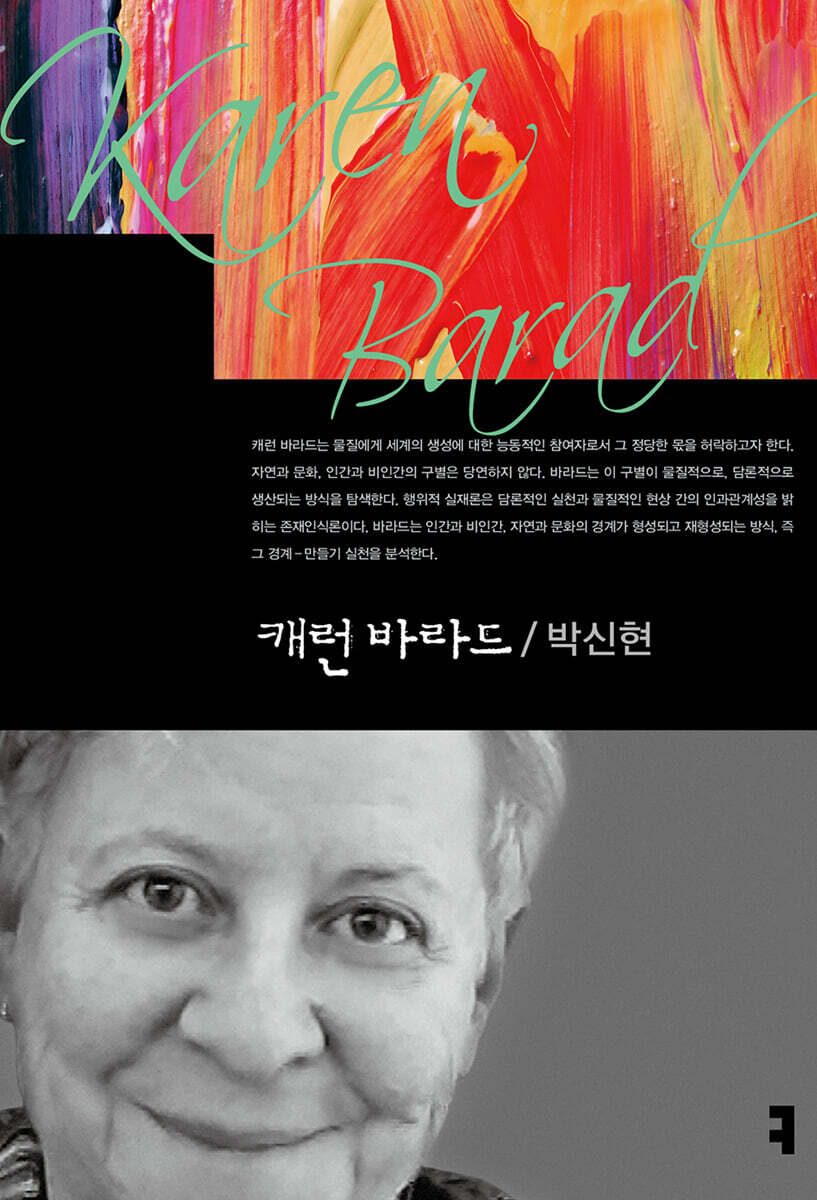
Karen Barad, a feminist scholar of new materialism, develops key concepts from quantum physics to propose "agentic realism," which views the world as being created by the entanglement and relationality of matter and meaning, as her epistemological, ontological, and ethical framework. Barad extends his science-based thinking to minority politics. Among the new materialist scholars who have recently been in the spotlight for their "material turn," Barad, whose unique themes have not been sufficiently introduced in Korea despite his global reputation, has been a key figure in the field. This book contains Barad's main work, "Meeting the Universe in the Middle," as well as Barad's expanded thoughts on quantum field theory and poetics, in 10 keywords. |
- You can preview some of the book's contents.
Preview
index
All life is an encounter
01 Internal workings
02 Spider Starfish
03 Body Boundaries - Creating
04 Diffraction
05 Ethics-Ontology-Epistemology
06 Queer Nature
07 Self-touch, meeting others
08 Quantum Entanglement and the Coming-of-Age
09 Indeterminacy and Infinity
10 Physics and Poetry
Into the book
Barad points out that such assumptions only surface when the body malfunctions, when it breaks down, just as a device first comes to attention only when it stops working.
---From “03 Creating Body Boundaries”
According to Barad, there is no escape from ethics.
Even for a moment, we do not exist alone. We need to “meet the universe halfway.”
In other words, humans must abandon their arrogant attitude and adopt a humble attitude of responsibility for their role in 'negotiating with the universe and coordinating opinions with the universe.'
We must take responsibility for the role we play in the differential creation of the world.
---From “05 Ethics-Ontology-Epistemology”
Barad points out that the phrase "against nature," which often defines and condemns queer behavior as deviant sexual desire, evokes images of beasts and provokes moral outrage in people, but it also conceals an illogic that seeks to solidify the boundary between nature and culture.
If some queer behavior is 'unnatural and against the laws of nature', then the actor is not part of nature but is outside of it.
However, on the other hand, if we criticize him for 'acting like a beast', we are insulting him as 'part of nature'.
---From “06 Queer Nature”
Barad explains that quantum entanglement is not the entanglement of two independent states, entities, or events, but rather questions the very nature of 'twoness' and 'oneness'.
She explains that one is too few and two is too many to describe quantum entanglement, and that the concept of 'between' must be rethought.
That is, quantum entanglement challenges the common-sense notion of communication between separate 'entities' and demands a new sense of responsibility and response-ability.
---From “08 Quantum Entanglement and the Coming Justice”
Barad proposes a specific methodology of resistance, a counter-tactic based on an alternative to the usual system of individual particles.
It was used by Hong Kong democracy protesters.
She assesses that protesters are beginning to think of the movement as becoming like water, rather than appearing in one fixed location as a single particle.
That is, it became like a wave rather than a particle.
This is a movement that moves like water rather than an individual entity.
It is fluid and formless, rushing into one place, quickly dispersing, and then reappearing with intensity somewhere else a short time later.
Publisher's Review
We must meet in the middle of space
The ethics of new materialism created through quantum mechanics and quantum field theory
Is science a journey toward finding a single right answer? Classical physicists would answer "yes," but Barad, who bases his epistemology, ontology, and ethics on quantum physics, offers a slightly different answer.
Barad brings out the concept of agential realism, emphasizing that the world is not composed of clear subjects but is rather entangled.
Agential realism is a posthumanist theory of performativity for all naturalistic and cultural practices, including technoscientific ones.
Barad wants to give matter its due as an active participant in the creation of the world.
Embracing feminism, anti-racism, poststructuralism, queer theory, Marxism, and science studies, and drawing on the insights of Bohr, Butler, Foucault, and Haraway, Barad opens up a posthuman world that Foucault and Butler failed to reach.
Despite Barad's reputation in the field of new materialism, which has recently been gaining attention, his introduction in Korea is still inadequate.
This book is the first in Korea to exclusively cover Barad's thought, and it broadly covers not only Barad's main work, "Meeting the Universe in the Middle," but also Barad's recent expansion into quantum field theory.
This book introduces new and rich concepts to readers who are new to materialism or Barad, as well as to current researchers, such as the queerness of nature itself, the new epistemology of "diffraction," and the new methodology of new materialist research called poetics.
You may also like
카테고리

korean

![GQ KOREA Mark (Monthly): December [2025]](http://librairie.coreenne.fr/cdn/shop/files/8ef265dbbfbf186523ed75ba7319009d.jpg?v=1765340328&width=3840)


