

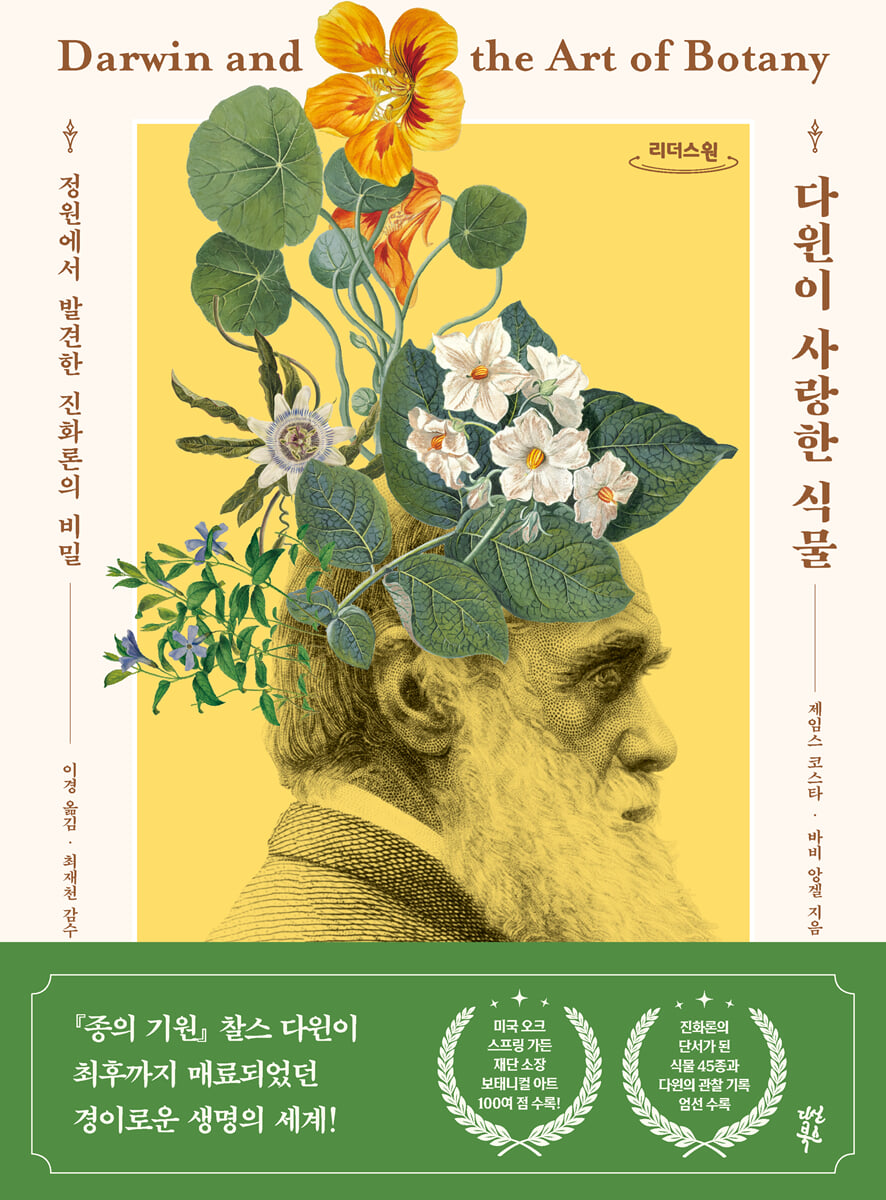
Plants Darwin Loved (Large Print Book)
 |
Description
Book Introduction
“A must-see for plant lovers
“The one and only scientific classic!”
『Origin of Species』 Why was Charles Darwin so obsessed with plants until the very end?
The wondrous world of plants as seen through the eyes of Darwin, the 'original plant butler'!
“No discovery of mine has given me greater pleasure than discovering the secrets of flowers.” - Charles Darwin
Charles Darwin, who opened a new horizon for understanding life with his 'theory of evolution' and is considered one of the greatest biologists in history.
Contrary to his reputation as an animal researcher, he was actually the 'original plant butler'.
Down House, where he lived for about 40 years until his death, had extensive gardens and six greenhouses, and he devoted most of his time there to botanical research until his death in 1882.
The number of published papers in the field of botany reached 75, and the number of books reached 6.
For example, Darwin observed the 30 cm long nectary of Angraicum sesquipedale and speculated that insects with long mouthparts might exist.
His guess was later confirmed when the long-mouthed xanthophan hawk moth was discovered, and the plant was given the nickname “Darwin’s orchid.”
Despite Darwin's groundbreaking contributions to botany, his botanical side received little attention.
This book sheds new light on Darwin's side as a botanist, which was overshadowed by his title as a zoologist.
※ Leaders One's large-print books are books with 'font size' and 'line spacing' enlarged by '120% to 150%' compared to regular paperbacks to provide a comfortable reading environment for all those who have difficulty reading due to small print.
We want to bring back the joy of reading to those who have poor eyesight or find small print frustrating.
“The one and only scientific classic!”
『Origin of Species』 Why was Charles Darwin so obsessed with plants until the very end?
The wondrous world of plants as seen through the eyes of Darwin, the 'original plant butler'!
“No discovery of mine has given me greater pleasure than discovering the secrets of flowers.” - Charles Darwin
Charles Darwin, who opened a new horizon for understanding life with his 'theory of evolution' and is considered one of the greatest biologists in history.
Contrary to his reputation as an animal researcher, he was actually the 'original plant butler'.
Down House, where he lived for about 40 years until his death, had extensive gardens and six greenhouses, and he devoted most of his time there to botanical research until his death in 1882.
The number of published papers in the field of botany reached 75, and the number of books reached 6.
For example, Darwin observed the 30 cm long nectary of Angraicum sesquipedale and speculated that insects with long mouthparts might exist.
His guess was later confirmed when the long-mouthed xanthophan hawk moth was discovered, and the plant was given the nickname “Darwin’s orchid.”
Despite Darwin's groundbreaking contributions to botany, his botanical side received little attention.
This book sheds new light on Darwin's side as a botanist, which was overshadowed by his title as a zoologist.
※ Leaders One's large-print books are books with 'font size' and 'line spacing' enlarged by '120% to 150%' compared to regular paperbacks to provide a comfortable reading environment for all those who have difficulty reading due to small print.
We want to bring back the joy of reading to those who have poor eyesight or find small print frustrating.
index
Reviewer's note
Introduction
introduction
Glossary
Introduction: Meeting the Botanist Darwin
A
Angraecum - Comet Orchid
Arachis - Peanut or Groundnut
B
Bignonia - Crossvine, American tangle, and relatives
C
Cardiospermum - Balloon Vine or Love in a Puff
Catasetum - Catasetum orchid
Clematis - Clematis
Cobaea scandens - cup and saucer vine
Coryanthes - Bucket Orchid
Cyclamen - Cyclamen
Cypripedium - Slipper Orchid
D
Dianthus - Carnation
Digitalis - Foxglove
Dionaea muscipula - Venus flytrap
Drosera rotundifolia (sticky spatula)
E
Echinocystis - Acacia
Epipactis - Hellebore orchid
F
Fragaria - Strawberry
G
Gloriosa - Flame Lily
H
Humulus - Hops
I
Ipomoea - Morning Glory
L
Lathyrus - sweet peas, everlasting peas, and their relatives
Linaria - sea orchid
Linum - probably
Lupinus - Lupine
M
Maulandia (Lupinus) - Climbing Snapdragon
Mimosa - Mimosa
Mitchella Refens - Partridge Berry
O
Ophrys - Bee Orchid
Orchis - orchid
Oxalis - Baby's Breath
P
Passiflora (Passiflar ora)
Phaseolus - Beans
Pinguicula - Insect-eating Violet
Pisum - garden peas
Primula - Primrose
Pulmonaria - lungwort
S
Salvia - Sage
Solanum - Solanaceae plant
Spiranthes - Lady's Thresis
T
Trifolium - Clover
Tropaeolum - Nasturtium
V
Vicia - broad beans or fava beans
Vinca - Periwinkle
Viola - Violet
Vitis vinifera (grape vine)
About the Rachel Lambert Mellon Library at the Oak Spring Gardens Foundation
Botanical Art at the Oak Spring Garden Foundation Library
Acknowledgments, Notes, References, Image Credits, Index
Introduction
introduction
Glossary
Introduction: Meeting the Botanist Darwin
A
Angraecum - Comet Orchid
Arachis - Peanut or Groundnut
B
Bignonia - Crossvine, American tangle, and relatives
C
Cardiospermum - Balloon Vine or Love in a Puff
Catasetum - Catasetum orchid
Clematis - Clematis
Cobaea scandens - cup and saucer vine
Coryanthes - Bucket Orchid
Cyclamen - Cyclamen
Cypripedium - Slipper Orchid
D
Dianthus - Carnation
Digitalis - Foxglove
Dionaea muscipula - Venus flytrap
Drosera rotundifolia (sticky spatula)
E
Echinocystis - Acacia
Epipactis - Hellebore orchid
F
Fragaria - Strawberry
G
Gloriosa - Flame Lily
H
Humulus - Hops
I
Ipomoea - Morning Glory
L
Lathyrus - sweet peas, everlasting peas, and their relatives
Linaria - sea orchid
Linum - probably
Lupinus - Lupine
M
Maulandia (Lupinus) - Climbing Snapdragon
Mimosa - Mimosa
Mitchella Refens - Partridge Berry
O
Ophrys - Bee Orchid
Orchis - orchid
Oxalis - Baby's Breath
P
Passiflora (Passiflar ora)
Phaseolus - Beans
Pinguicula - Insect-eating Violet
Pisum - garden peas
Primula - Primrose
Pulmonaria - lungwort
S
Salvia - Sage
Solanum - Solanaceae plant
Spiranthes - Lady's Thresis
T
Trifolium - Clover
Tropaeolum - Nasturtium
V
Vicia - broad beans or fava beans
Vinca - Periwinkle
Viola - Violet
Vitis vinifera (grape vine)
About the Rachel Lambert Mellon Library at the Oak Spring Gardens Foundation
Botanical Art at the Oak Spring Garden Foundation Library
Acknowledgments, Notes, References, Image Credits, Index
Publisher's Review
A selection of 45 plants that contain insights into evolutionary theory.
The original text of 'Darwin's Plant Observations' has been released for the first time!
Commentary by a world-renowned evolutionary scientist,
Supervised by Korea's top Darwin expert, Choi Jae-cheon!
This book is the first to reveal seven original records of Darwin's observations of plants, including his masterpiece, "The Origin of Species."
James Costa, a world-renowned evolutionary biologist who has studied Darwin at Harvard University Museums and published more than six books on Darwin, selected 45 species of plants studied by Darwin that provided important insights into the theory of evolution, and selected passages that condense Darwin's research methods and insights.
He helps readers understand Darwin's difficult original text with greater ease by providing context for the knowledge and research of Darwin's time.
With the addition of the review and commentary of Professor Choi Jae-cheon, Korea's leading Darwin expert, the book has evolved to a level that is more suitable for Korean readers.
Anyone who loves the beauty and vitality of plants will be able to look at plants with a different perspective, a more scientific eye, by borrowing the perspective of Charles Darwin.
“A visual feast that brings Charles Darwin’s words to life!”
Director of the Oak Spring Garden Foundation in the United States
A collection of over 100 rare and beautiful botanical art pieces!
The idea of presenting Darwin's creative experiments through an artist's lens was first conceived by Bobby Angel, who has been drawing botanicals for over 40 years.
Darwin's correspondence with fellow scientists, sharing the results of his experiments and the vivid records of his boundless curiosity, are presented alongside rare and luxurious botanical art from the Oak Spring Foundation in the United States.
The splendid illustrations, which were not available during Darwin's lifetime or afterward, stimulate readers' imaginations about where Darwin's gaze landed and rekindle their interest in the plants around us.
In particular, the cross-pollination and self-pollination of plants, polyphyletic plants with different pistil lengths, and the property of vines to climb up supports are all exciting observations that can be attempted even from an apartment balcony.
This book was produced in a spacious format and hardcover format so that you can enjoy beautiful botanical art that you can't see anywhere else, making it a valuable collection book that everyone would want to own.
This book, which simultaneously presents the tenacious dedication of one of history's greatest biologists and the delicate sensibility of an artist, will take readers on a vivid and engaging journey through time.
The original text of 'Darwin's Plant Observations' has been released for the first time!
Commentary by a world-renowned evolutionary scientist,
Supervised by Korea's top Darwin expert, Choi Jae-cheon!
This book is the first to reveal seven original records of Darwin's observations of plants, including his masterpiece, "The Origin of Species."
James Costa, a world-renowned evolutionary biologist who has studied Darwin at Harvard University Museums and published more than six books on Darwin, selected 45 species of plants studied by Darwin that provided important insights into the theory of evolution, and selected passages that condense Darwin's research methods and insights.
He helps readers understand Darwin's difficult original text with greater ease by providing context for the knowledge and research of Darwin's time.
With the addition of the review and commentary of Professor Choi Jae-cheon, Korea's leading Darwin expert, the book has evolved to a level that is more suitable for Korean readers.
Anyone who loves the beauty and vitality of plants will be able to look at plants with a different perspective, a more scientific eye, by borrowing the perspective of Charles Darwin.
“A visual feast that brings Charles Darwin’s words to life!”
Director of the Oak Spring Garden Foundation in the United States
A collection of over 100 rare and beautiful botanical art pieces!
The idea of presenting Darwin's creative experiments through an artist's lens was first conceived by Bobby Angel, who has been drawing botanicals for over 40 years.
Darwin's correspondence with fellow scientists, sharing the results of his experiments and the vivid records of his boundless curiosity, are presented alongside rare and luxurious botanical art from the Oak Spring Foundation in the United States.
The splendid illustrations, which were not available during Darwin's lifetime or afterward, stimulate readers' imaginations about where Darwin's gaze landed and rekindle their interest in the plants around us.
In particular, the cross-pollination and self-pollination of plants, polyphyletic plants with different pistil lengths, and the property of vines to climb up supports are all exciting observations that can be attempted even from an apartment balcony.
This book was produced in a spacious format and hardcover format so that you can enjoy beautiful botanical art that you can't see anywhere else, making it a valuable collection book that everyone would want to own.
This book, which simultaneously presents the tenacious dedication of one of history's greatest biologists and the delicate sensibility of an artist, will take readers on a vivid and engaging journey through time.
GOODS SPECIFICS
- Date of issue: October 31, 2025
- Page count, weight, size: 508 pages | 220*298*35mm
- ISBN13: 9791130672151
- ISBN10: 1130672158
You may also like
카테고리
korean


korean

![GQ KOREA Mark (Monthly): December [2025]](http://librairie.coreenne.fr/cdn/shop/files/8ef265dbbfbf186523ed75ba7319009d.jpg?v=1765340328&width=3840)


