

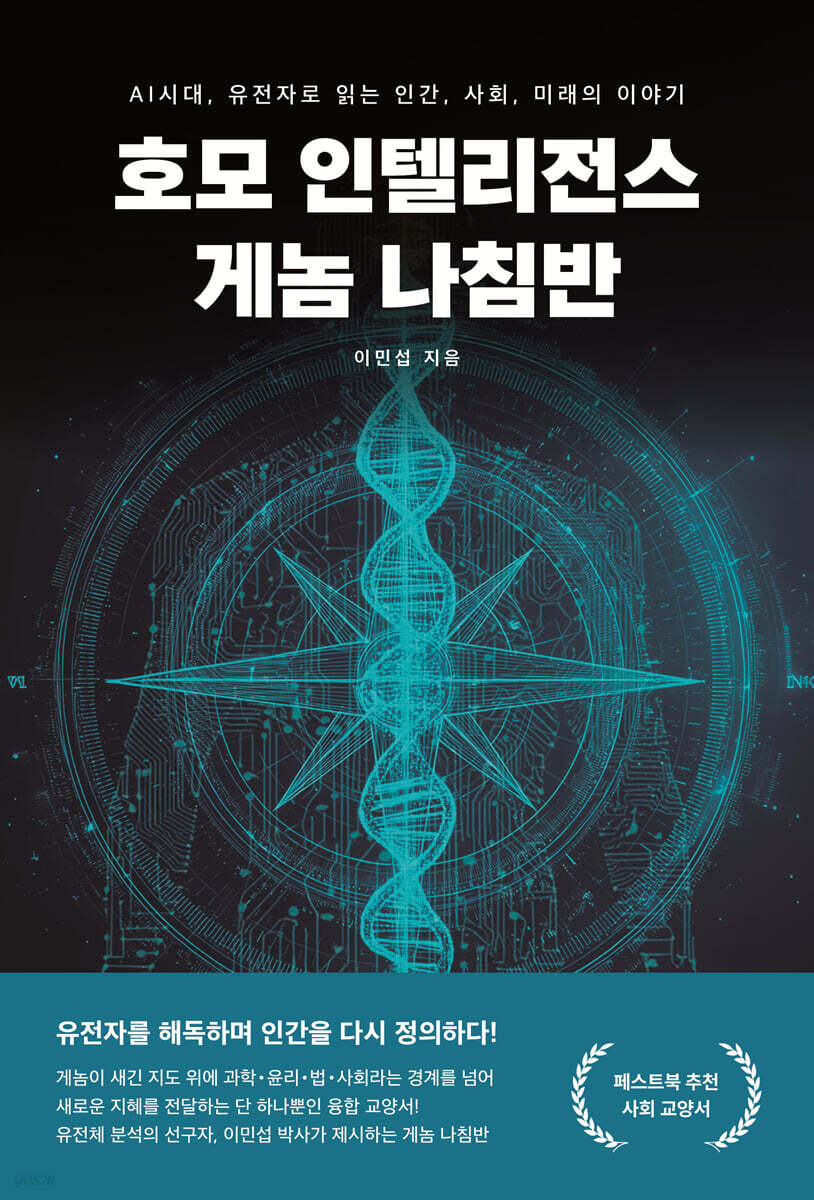
Homo Intelligence Genome Compass
 |
Description
Book Introduction
Deciphering our genes and redefining humanity!
Beyond the boundaries of science, ethics, law, and society on the map engraved by the genome
The only fusion textbook that imparts new wisdom!
A genome compass presented by Dr. Lee Min-seop, a pioneer in genome analysis.
This book is a popular educational resource that explains the vast flow of human genome information in a language that anyone can understand in the age of artificial intelligence.
Under the insight that “genes are not destiny,” it goes beyond simple biological knowledge and examines the questions about health, disease, new drug development, and human identity that modern genetics raises.
Each person's innate DNA differences, their genetic history linked to their ancestors, their risk of developing certain diseases, and even their unique reactions to medications.
The genome already contains everything.
The question is whether we are ready to read it.
The author of the book, Dr. Lee Min-seop, is a person of distinguished achievement who received a master's degree in biotechnology from the University of California, a doctorate in molecular biology from City of Hope National Medical Center, and a postdoctoral fellowship at the Harvard Medical School Genome Center. He published the world's first paper on genetic diversity between races in the journal Science.
He developed non-invasive prenatal testing (NIPT) at Sequenom, a US company, and later founded genetics-based companies such as Diagnomics and EDGC, leading research and development and technology commercialization.
The story of the genome he unfolds goes beyond simple medical knowledge and contains philosophical reflections on technology, industry, and life.
This book demonstrates, through real-life examples, how accessible health technologies are created and how they work.
From the core concepts of precision medicine to how to interpret health information tailored to you, and how genomic technology will transform future society, it helps you prepare for the new era of "self-understanding" brought about by genetic information.
The era has arrived where reading genetic information has become common sense.
This book is the result of the author's extensive field experience combined with academic insight.
This is a must-read for anyone seeking a new perspective on humanity and society through the lens of the genome.
Beyond the boundaries of science, ethics, law, and society on the map engraved by the genome
The only fusion textbook that imparts new wisdom!
A genome compass presented by Dr. Lee Min-seop, a pioneer in genome analysis.
This book is a popular educational resource that explains the vast flow of human genome information in a language that anyone can understand in the age of artificial intelligence.
Under the insight that “genes are not destiny,” it goes beyond simple biological knowledge and examines the questions about health, disease, new drug development, and human identity that modern genetics raises.
Each person's innate DNA differences, their genetic history linked to their ancestors, their risk of developing certain diseases, and even their unique reactions to medications.
The genome already contains everything.
The question is whether we are ready to read it.
The author of the book, Dr. Lee Min-seop, is a person of distinguished achievement who received a master's degree in biotechnology from the University of California, a doctorate in molecular biology from City of Hope National Medical Center, and a postdoctoral fellowship at the Harvard Medical School Genome Center. He published the world's first paper on genetic diversity between races in the journal Science.
He developed non-invasive prenatal testing (NIPT) at Sequenom, a US company, and later founded genetics-based companies such as Diagnomics and EDGC, leading research and development and technology commercialization.
The story of the genome he unfolds goes beyond simple medical knowledge and contains philosophical reflections on technology, industry, and life.
This book demonstrates, through real-life examples, how accessible health technologies are created and how they work.
From the core concepts of precision medicine to how to interpret health information tailored to you, and how genomic technology will transform future society, it helps you prepare for the new era of "self-understanding" brought about by genetic information.
The era has arrived where reading genetic information has become common sense.
This book is the result of the author's extensive field experience combined with academic insight.
This is a must-read for anyone seeking a new perspective on humanity and society through the lens of the genome.
- You can preview some of the book's contents.
Preview
index
Recommendation
introduction
Korean summary
Summary
Chapter 1: New Humanity and Intelligence
Homo sapiens: A Story of Evolutionary Genetics
The Birth of Homo Intelligence
Humans Within Humans: Neanderthals and Denisovans
Definition of Evolution: Selection and Transmission of Information
Evolution of Life and Evolution of Artificial Intelligence
Digital Me: Geni Codes
The Genome of AI: Digital Twins
Genetic Time
Can AI Be Inherited?: The Genetic Evolution of Information
Death from a genetic and AI perspective
About the existence of aliens
The Future of Homo Intelligence: The "I" Created by Information and Genes
Turning on MCP, the new genome of AI
Vibe Coding and DNA Coding: Evolving with Feeling
A2A: The Evolution of HI and AI Agents
Ethics and Responsibilities of Homo Intelligence
Chapter 2 Genome Compass
Why living things began storing information in DNA
Why is DNA four letters long?
Why does RNA use U instead of T?
Another gene above the genes
DNA Conductor: Epigenetics
The Blessing of the DNA Curse: Survival Because It's Imperfect
sleeping genes
The Stranger Within: Mitochondria
Aliens Inside Me: The Microbiome
Intruders in our genes: viruses
Jumping genes: transposons
Silent Evolution of Genes: Genetic Drift
Secrets of the Y Chromosome
Why are sperm becoming weaker?
Is ADHD a genetic defect or an evolutionary survival strategy?
obesity genes
Genomic Compass on the Table
The Genome Compass of Alcohol
The Genomic Compass of Housing
The Genome Compass of Love
Reasons for divorce in old age
The Social Gene: How Empathy Evolved
Anxiety Explained in the Language of Genes
The Secret: The Law of Attraction, Through the Eyes of Genes
Is IQ innate?
Are memories inherited?
Can poverty be inherited?
MBTI of genes
Global Warming: Revisited in the Language of Genes
Is cancer evolution's greatest masterpiece?
Henrietta, the human who gained eternal life
The Coevolution of Genes and Civilization: Our Culture Changes Our Genes, and Our Genes, in turn, Shape Civilization
Chapter 3: Homo Intelligence Korean: The Evolution of the K-Gene
K-Culture and Genes
The 0.7 Fertility Paradox: Evolution Selected by Genes
Suicide and Genetic Evolution: Suicide and Depression in Korea from a Genetic Perspective
Life expectancy and healthy life expectancy in Korea
K-Healthspan: A New National Strategy Designed by Life Sciences and AI
Conclusion
Author Interview
introduction
Korean summary
Summary
Chapter 1: New Humanity and Intelligence
Homo sapiens: A Story of Evolutionary Genetics
The Birth of Homo Intelligence
Humans Within Humans: Neanderthals and Denisovans
Definition of Evolution: Selection and Transmission of Information
Evolution of Life and Evolution of Artificial Intelligence
Digital Me: Geni Codes
The Genome of AI: Digital Twins
Genetic Time
Can AI Be Inherited?: The Genetic Evolution of Information
Death from a genetic and AI perspective
About the existence of aliens
The Future of Homo Intelligence: The "I" Created by Information and Genes
Turning on MCP, the new genome of AI
Vibe Coding and DNA Coding: Evolving with Feeling
A2A: The Evolution of HI and AI Agents
Ethics and Responsibilities of Homo Intelligence
Chapter 2 Genome Compass
Why living things began storing information in DNA
Why is DNA four letters long?
Why does RNA use U instead of T?
Another gene above the genes
DNA Conductor: Epigenetics
The Blessing of the DNA Curse: Survival Because It's Imperfect
sleeping genes
The Stranger Within: Mitochondria
Aliens Inside Me: The Microbiome
Intruders in our genes: viruses
Jumping genes: transposons
Silent Evolution of Genes: Genetic Drift
Secrets of the Y Chromosome
Why are sperm becoming weaker?
Is ADHD a genetic defect or an evolutionary survival strategy?
obesity genes
Genomic Compass on the Table
The Genome Compass of Alcohol
The Genomic Compass of Housing
The Genome Compass of Love
Reasons for divorce in old age
The Social Gene: How Empathy Evolved
Anxiety Explained in the Language of Genes
The Secret: The Law of Attraction, Through the Eyes of Genes
Is IQ innate?
Are memories inherited?
Can poverty be inherited?
MBTI of genes
Global Warming: Revisited in the Language of Genes
Is cancer evolution's greatest masterpiece?
Henrietta, the human who gained eternal life
The Coevolution of Genes and Civilization: Our Culture Changes Our Genes, and Our Genes, in turn, Shape Civilization
Chapter 3: Homo Intelligence Korean: The Evolution of the K-Gene
K-Culture and Genes
The 0.7 Fertility Paradox: Evolution Selected by Genes
Suicide and Genetic Evolution: Suicide and Depression in Korea from a Genetic Perspective
Life expectancy and healthy life expectancy in Korea
K-Healthspan: A New National Strategy Designed by Life Sciences and AI
Conclusion
Author Interview
Detailed image

Into the book
We now stand at a new turning point in human evolution.
This is the era of Homo intelligence, the era of humans evolving based on information.
This book presents a hypothetical scientific name in Latin form: Homo intellectus.
This means 'human of intelligence', and refers to a future human based on information and intelligence that goes beyond the existing Homo sapiens formed by natural selection.
--- p.36
“Are we really pure Homo sapiens?” Modern genome sequencing technology has revealed a surprising truth.
Our DNA contains some of the genes of other, already extinct human species, or 'others'.
Those other people are Neanderthals and Denisovans.
--- p.41
AI is evolving into non-biological entities that mimic genetic traits, without DNA, but can reconfigure themselves, propagate information, and evolve through error.
We are now witnessing the possibility of information life forms that go beyond AI as a mere tool and enable continuous self-replication and evolution.
In particular, through evolutionary algorithms, self-replicating code, and the genealogical hierarchical structure of intelligent agents, AI is increasingly resembling biological concepts of genetic patterns.
These flows suggest that the process by which information organizes itself, reproduces itself, and creates meaning may itself be a new form of life.
--- p.66
The reason DNA became the primary information repository of life is not by chance but by necessity.
(…) DNA is not just a molecule, it is the language of life information.
This language is nature's optimal design, satisfying all the conditions of efficiency, replicability, and evolvability.
--- p.110
Korea is a rare country that has experienced industrialization, democratization, and digitalization all within 50 years.
In this process of compressed growth, Koreans have constantly adapted to change and created new values and narratives.
K-culture is the culmination of this "information-adapted evolution laboratory." BTS, "Squid Game," kimchi, Hangul, webtoons, chicken and beer...
All of this is not a mere fad, but a Korean "cultural gene" that has resonated with people around the world through the combination of information and the refinement of emotions.
What's even more interesting is that this culture isn't being created by the masses, but rather by a small group of young people, growing accidentally, like the outgrowth of a neuron, in an evolutionarily advantageous direction.
--- p.272
We now live in a society where survival and reproduction are not easy.
Instead of being pessimistic or denying that reality, it is time to read the signals our genes are sending and respond socially.
Mental health, birth rates, and happiness are not separate issues.
Only when we understand these issues in an integrated manner can we get closer to finding true solutions for a healthier society.
(…) We now need social wisdom to follow the path that our genes tell us, rather than ignoring their voice.
Science is not just a tool for analyzing causes.
Based on that cause, it can become a compass to create a more humane society.
It's time for us to look at the issues of birth rates, mental health, and high suicide rates with a new compass.
--- p.285
We are now entering the era of AI, which can be said to be the greatest turning point in human history.
Rather than viewing this massive trend as a simple technological innovation, I wanted to interpret it through the lens of genes. Our DNA contains traces of our past, our present, and even the possibilities of our future.
I wrote this book in the hope that it would help us navigate the AI era using the compass called “genes.”
--- From "Author Interview"
DNA is the blueprint of our existence and the blueprint of our destiny.
But it is not an absolute framework that determines everything about us.
Our lives are constantly being adjusted and rewritten by epigenetic changes, environment, lifestyle, and free will choices.
Genes are just the starting point, and the path ahead is created anew by how we live.
The most profound self-understanding that we must realize through our genetic information is, “I am a product of my genes, but at the same time, I am a being who can rewrite my future.
“One small choice of mine can change myself and, by extension, the lives of all of humanity.”
--- From "Author Interview"
AI will become another intelligence capable of reading and interpreting DNA. Just as AI understands human language, I believe it will interpret and predict our genetic code, creating a digital twin in the virtual world that integrates our genetic makeup, epigenetics, and even lifestyle habits.
That digital twin will become another "me," showing me my future and helping me make choices. When AI and DNA meet, humanity will reinvent itself.
(…) Individuals or species that resisted change eventually became extinct or degenerated. If we embrace AI and adapt well, we will evolve into "Homo Intelligence."
Whether I will be reborn as a new human race or fall behind and disappear depends on my choice and will.
--- From "Author Interview"
The past 70 years of South Korea are a microcosm of human evolution, a time when people thrived without fear of challenges.
Of course, many side effects and problems were revealed.
Nevertheless, Koreans have transformed themselves faster than any other people, embraced globalization, and created K-DNA, reaching where they are today.
Writing this article has given me renewed confidence that Korea is a nation that will pioneer new paths in the AI era.
--- From "Author Interview"
Think Outside the Box! People who aren't afraid to try new things are often called weirdos, but they've always changed the world.
Don't settle for the comfort of the present.
Step into the unknown without fear.
That is the greatest characteristic of humans.
Human history has repeated periods of stability and great transformation, and now we stand at a time of great transformation called AI.
Listen to the compass voice of your DNA.
Don't be afraid and follow the path.
This is the era of Homo intelligence, the era of humans evolving based on information.
This book presents a hypothetical scientific name in Latin form: Homo intellectus.
This means 'human of intelligence', and refers to a future human based on information and intelligence that goes beyond the existing Homo sapiens formed by natural selection.
--- p.36
“Are we really pure Homo sapiens?” Modern genome sequencing technology has revealed a surprising truth.
Our DNA contains some of the genes of other, already extinct human species, or 'others'.
Those other people are Neanderthals and Denisovans.
--- p.41
AI is evolving into non-biological entities that mimic genetic traits, without DNA, but can reconfigure themselves, propagate information, and evolve through error.
We are now witnessing the possibility of information life forms that go beyond AI as a mere tool and enable continuous self-replication and evolution.
In particular, through evolutionary algorithms, self-replicating code, and the genealogical hierarchical structure of intelligent agents, AI is increasingly resembling biological concepts of genetic patterns.
These flows suggest that the process by which information organizes itself, reproduces itself, and creates meaning may itself be a new form of life.
--- p.66
The reason DNA became the primary information repository of life is not by chance but by necessity.
(…) DNA is not just a molecule, it is the language of life information.
This language is nature's optimal design, satisfying all the conditions of efficiency, replicability, and evolvability.
--- p.110
Korea is a rare country that has experienced industrialization, democratization, and digitalization all within 50 years.
In this process of compressed growth, Koreans have constantly adapted to change and created new values and narratives.
K-culture is the culmination of this "information-adapted evolution laboratory." BTS, "Squid Game," kimchi, Hangul, webtoons, chicken and beer...
All of this is not a mere fad, but a Korean "cultural gene" that has resonated with people around the world through the combination of information and the refinement of emotions.
What's even more interesting is that this culture isn't being created by the masses, but rather by a small group of young people, growing accidentally, like the outgrowth of a neuron, in an evolutionarily advantageous direction.
--- p.272
We now live in a society where survival and reproduction are not easy.
Instead of being pessimistic or denying that reality, it is time to read the signals our genes are sending and respond socially.
Mental health, birth rates, and happiness are not separate issues.
Only when we understand these issues in an integrated manner can we get closer to finding true solutions for a healthier society.
(…) We now need social wisdom to follow the path that our genes tell us, rather than ignoring their voice.
Science is not just a tool for analyzing causes.
Based on that cause, it can become a compass to create a more humane society.
It's time for us to look at the issues of birth rates, mental health, and high suicide rates with a new compass.
--- p.285
We are now entering the era of AI, which can be said to be the greatest turning point in human history.
Rather than viewing this massive trend as a simple technological innovation, I wanted to interpret it through the lens of genes. Our DNA contains traces of our past, our present, and even the possibilities of our future.
I wrote this book in the hope that it would help us navigate the AI era using the compass called “genes.”
--- From "Author Interview"
DNA is the blueprint of our existence and the blueprint of our destiny.
But it is not an absolute framework that determines everything about us.
Our lives are constantly being adjusted and rewritten by epigenetic changes, environment, lifestyle, and free will choices.
Genes are just the starting point, and the path ahead is created anew by how we live.
The most profound self-understanding that we must realize through our genetic information is, “I am a product of my genes, but at the same time, I am a being who can rewrite my future.
“One small choice of mine can change myself and, by extension, the lives of all of humanity.”
--- From "Author Interview"
AI will become another intelligence capable of reading and interpreting DNA. Just as AI understands human language, I believe it will interpret and predict our genetic code, creating a digital twin in the virtual world that integrates our genetic makeup, epigenetics, and even lifestyle habits.
That digital twin will become another "me," showing me my future and helping me make choices. When AI and DNA meet, humanity will reinvent itself.
(…) Individuals or species that resisted change eventually became extinct or degenerated. If we embrace AI and adapt well, we will evolve into "Homo Intelligence."
Whether I will be reborn as a new human race or fall behind and disappear depends on my choice and will.
--- From "Author Interview"
The past 70 years of South Korea are a microcosm of human evolution, a time when people thrived without fear of challenges.
Of course, many side effects and problems were revealed.
Nevertheless, Koreans have transformed themselves faster than any other people, embraced globalization, and created K-DNA, reaching where they are today.
Writing this article has given me renewed confidence that Korea is a nation that will pioneer new paths in the AI era.
--- From "Author Interview"
Think Outside the Box! People who aren't afraid to try new things are often called weirdos, but they've always changed the world.
Don't settle for the comfort of the present.
Step into the unknown without fear.
That is the greatest characteristic of humans.
Human history has repeated periods of stability and great transformation, and now we stand at a time of great transformation called AI.
Listen to the compass voice of your DNA.
Don't be afraid and follow the path.
--- From "Author Interview"
Publisher's Review
"Homo Intelligence Genome Compass" is a book that answers humanity's age-old question, "Who am I?" in the most scientific language.
Dr. Lee Min-seop suggests a new direction for human evolution at the threshold of an era where two great intelligences, human intelligence (HI) and artificial intelligence (AI), meet.
This book proves that genes go beyond mere biological code and can serve as a compass for our lives, society, and future. For those seeking to be the first to witness humanity's next chapter in the AI era, this book will serve as the most precise map.
Dr. Lee Min-seop suggests a new direction for human evolution at the threshold of an era where two great intelligences, human intelligence (HI) and artificial intelligence (AI), meet.
This book proves that genes go beyond mere biological code and can serve as a compass for our lives, society, and future. For those seeking to be the first to witness humanity's next chapter in the AI era, this book will serve as the most precise map.
GOODS SPECIFICS
- Date of issue: October 31, 2025
- Page count, weight, size: 316 pages | 480g | 152*224*19mm
- ISBN13: 9791169299206
- ISBN10: 1169299202
You may also like
카테고리
korean


korean

![ELLE 엘르 스페셜 에디션 A형 : 12월 [2025]](http://librairie.coreenne.fr/cdn/shop/files/b8e27a3de6c9538896439686c6b0e8fb.jpg?v=1766436872&width=3840)


