

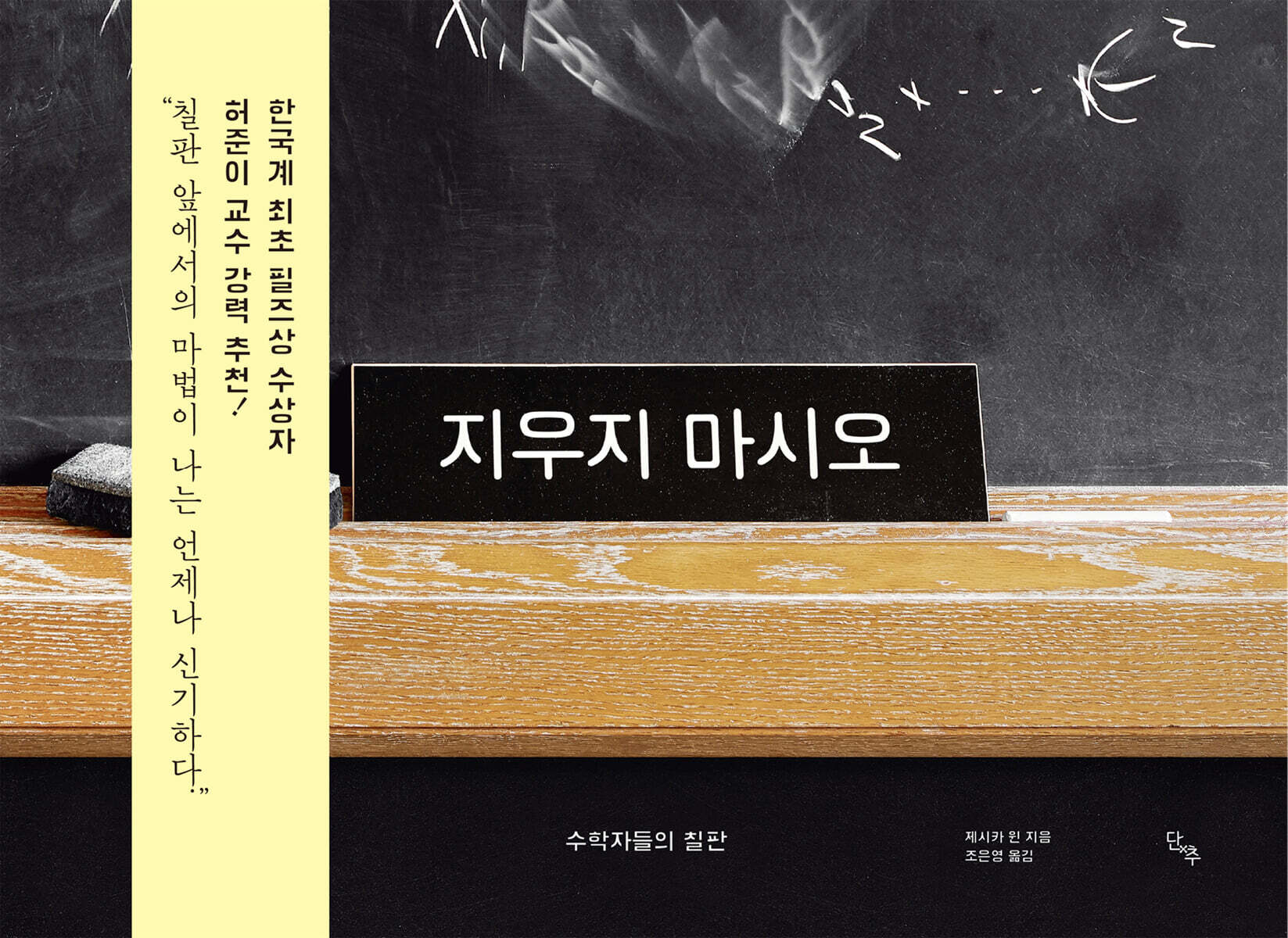
Do not erase
 |
Description
Book Introduction
Why do mathematicians stand in front of a blackboard with chalk dust on their hands? Despite the advancements in modern science and technology, many mathematicians still stand in front of a blackboard with chalk in hand.
"Don't Erase" is a special collection of photographs and voices taken by world-renowned photographer Jessica Wynn while visiting the blackboards of famous mathematicians around the world.
Wynn visited institutions at the forefront of mathematical research, including the Institute for Advanced Study in Princeton, Harvard, MIT, UCLA, the University of Chicago, the Henri Poincaré Institute in Paris, France, and the Institute for Pure and Applied Mathematics in Rio de Janeiro, Brazil, and captured over 100 striking blackboard photographs.
This book is more than just a photo album; it documents the intersection of the abstract world of mathematics and the creativity of human beings who explore it.
Great contemporary mathematicians, including Terence Tao, Alain Cohn, Mikhail Gromov, André Neves, Kasso Okudzu, Peter Shore, and Christina Sormani, share their personal insights and philosophies on mathematics at their blackboards.
"Don't Erase" is a special collection of photographs and voices taken by world-renowned photographer Jessica Wynn while visiting the blackboards of famous mathematicians around the world.
Wynn visited institutions at the forefront of mathematical research, including the Institute for Advanced Study in Princeton, Harvard, MIT, UCLA, the University of Chicago, the Henri Poincaré Institute in Paris, France, and the Institute for Pure and Applied Mathematics in Rio de Janeiro, Brazil, and captured over 100 striking blackboard photographs.
This book is more than just a photo album; it documents the intersection of the abstract world of mathematics and the creativity of human beings who explore it.
Great contemporary mathematicians, including Terence Tao, Alain Cohn, Mikhail Gromov, André Neves, Kasso Okudzu, Peter Shore, and Christina Sormani, share their personal insights and philosophies on mathematics at their blackboards.
- You can preview some of the book's contents.
Preview
Detailed image

Into the book
Mathematics is a collaborative effort of inquisitive minds.
Mathematics is a common language that people use to communicate ideas in a structured way, and it also serves as an essential tool for understanding and solving problems in many other disciplines.
Anyone, regardless of their mathematical ability or level, can enjoy mathematics and be amazed and captivated by its results.
Our journeys with mathematics are personal and unique, but we all share the realization that mathematics is beautiful and important.
- Kai Ying (Assistant Professor, Columbia University)
The beauty of mathematics lies in the effort to realize our connection with nature, both visible and invisible, and to contemplate the truth, both external and internal.
- Yang Li (Postdoctoral Researcher, Institute for Advanced Study, Princeton)
People think they can do math with just paper and pen, but no matter how many papers and pens I have at home, they aren't enough.
The mathematical element of human beings is not something that can be arbitrarily eliminated.
It doesn't matter whether you collaborate or just chat over a cup of coffee.
A lot of interaction with people takes place in front of the blackboard.
- Sylvia Ginassi (Postdoctoral Researcher, University of Washington)
I enjoy collaborating with others on research, and in fact, almost all of the research I do now is collaborative.
We work with collaborators in a variety of ways.
Remotely via the internet, meeting at a cafe and writing on a notebook or laptop.
But I'll probably be standing in front of the lab blackboard the most.
- Matthew Emerton (Professor of Mathematics, University of Chicago)
Mathematics is a common language that people use to communicate ideas in a structured way, and it also serves as an essential tool for understanding and solving problems in many other disciplines.
Anyone, regardless of their mathematical ability or level, can enjoy mathematics and be amazed and captivated by its results.
Our journeys with mathematics are personal and unique, but we all share the realization that mathematics is beautiful and important.
- Kai Ying (Assistant Professor, Columbia University)
The beauty of mathematics lies in the effort to realize our connection with nature, both visible and invisible, and to contemplate the truth, both external and internal.
- Yang Li (Postdoctoral Researcher, Institute for Advanced Study, Princeton)
People think they can do math with just paper and pen, but no matter how many papers and pens I have at home, they aren't enough.
The mathematical element of human beings is not something that can be arbitrarily eliminated.
It doesn't matter whether you collaborate or just chat over a cup of coffee.
A lot of interaction with people takes place in front of the blackboard.
- Sylvia Ginassi (Postdoctoral Researcher, University of Washington)
I enjoy collaborating with others on research, and in fact, almost all of the research I do now is collaborative.
We work with collaborators in a variety of ways.
Remotely via the internet, meeting at a cafe and writing on a notebook or laptop.
But I'll probably be standing in front of the lab blackboard the most.
- Matthew Emerton (Professor of Mathematics, University of Chicago)
--- From the text
Publisher's Review
A special journey that crosses the boundaries between mathematics and art.
"A mathematician is someone who creates patterns, like a painter or a poet," said British mathematician G.
Beginning with the words of H. Hardy, "Don't Erase" is a collection of works by photographer Jessica Wynn that captures the visual beauty and creative process of mathematics through the blackboards of mathematicians around the world.
We photograph the blackboards of over 100 prominent mathematicians and share their stories to illuminate mathematics, art, and the lives of mathematicians.
This book is more than just a photo album; it is a special journey that allows you to visually experience the abstract world of mathematics.
Through his blackboard, Wynn captured the intimate thought processes and creative moments of mathematicians that are difficult for us to access.
"The blackboard is the mathematician's home and laboratory, a personal space where he or she can immerse himself in thought," explains Wynne, highlighting the fundamental similarities between mathematics and art.
This book will be a unique experience, offering new perspectives not only to those interested in mathematics, but also to anyone fascinated by the creative process of thought and the beauty of human intelligence.
It will guide readers into a world of "discovery, truth, mystery and beauty hidden in a dusty room filled with chalk dust."
The meaning and philosophy of "Do not erase!"
The book's title, "Don't Erase," comes from a sign that mathematicians often use when leaving important research on the blackboard or when leaving the room for a moment.
"I've been keeping this part for years," Margulies said.
This phrase appears meaningfully throughout the book, as in the case of “The formula is so complicated and it is cumbersome to rewrite the calculations every time” (p. 110).
This phrase holds significance even at moments of particularly important discoveries.
I can confidently say that wherever mathematics is created, a blackboard appears.
Mathematicians working together? Most likely, they're gathered around a blackboard.
In front of it, one idea is skimmed and discussed.
But the blackboard is soon erased, making room for the next round of ideas.
This process lasts for hours, and eventually those who cannot reach a conclusion hang up this sign and leave.
(p.130)
The indelible problems that mathematicians write on the blackboard may be unfinished or already successful discoveries, but they are all ideas 'worth recording.'
Jessica Wynn added meaning to this simple phrase, incorporating the idea in the title that "the work of mathematicians, like the work of all great artists, deserves to be preserved, honored, and recognized."
Moments of discovery engraved on a blackboard
For mathematicians, the blackboard is more than just a tool.
It is a trace of exploration, a space where ideas take shape.
Mathematicians who collaborate often vividly document the process of thinking, collaborating, and sometimes failing and starting over at the blackboard.
Matthew Emerton explains the central role of the blackboard in his research:
"I enjoy collaborating with others on research, and in fact, almost all of the research I do now is collaborative.
We work with collaborators in a variety of ways.
Remotely via the internet, meeting at a cafe and writing on a notebook or laptop.
But I'll probably be standing in front of the lab blackboard the most." (p.36)
The discussions that unfold in front of the blackboard have a meaning beyond mere records.
The process of researchers with different mindsets sharing ideas, solving problems, and correcting mistakes in one space is like an impromptu performance.
Discoveries in mathematics are not made in a single breath, but are formed gradually on the blackboard, and shine through the constant discussion and collaboration of researchers.
This book offers fascinating insights into why, despite advances in modern technology, mathematicians still cling to blackboards and chalk.
French mathematician Claire Voisin said, "Mathematical communication is a very intense process.
Writing on the blackboard is essential to expanding the verbal communication of mathematics” (p. 138). Terence Tao of UCLA likens mathematics to “a landscape shrouded in fog,” saying, “At first, nothing is visible, but as the fog dissipates, distant peaks begin to appear” (p. 8).
This process of discovery unfolds on the blackboard.
The world of mathematicians, where diversity and passion coexist
"Don't Erase" introduces mathematicians from diverse backgrounds, paying particular attention to the voices of female mathematicians.
The stories of female mathematicians who have made significant contributions to their fields, including Dusa McDuff, Laura Balzano, Ellen Esno, Cristina Sormani, and Alice Chang, demonstrate the diversity of the mathematical community.
Korean mathematician and Yale University professor Oh Hee also appeared and said, "Mathematics teaches humility.
"It shows us the limitations of human existence and the importance of various perspectives and the mysteries hidden within them" (p.40) explains the essence of mathematics.
This book also vividly shows the humor and passion that are characteristic of mathematicians.
French mathematician Etienne Gis once said, "One day I persuaded my wife to hang a blackboard at the head of our bed.
But after six months, the blackboard had served its purpose and the bed was covered in chalk dust.
He recalls, "My wife was very happy when I suggested that we clean up the blackboard" (p.204).
Nicholas Vlamis of Northwestern University says, "All of the closest friends I've made as an adult were people I'd work with at the blackboard, solving math puzzles together" (p. 90).
Benson Farb of Princeton University describes the moment of mathematical discovery as "like being addicted to the thrill of discovering something that was always there."
"The truth of mathematics has been true since before the universe existed, and it has always been there waiting for me!" (p. XI)
"Don't Erase" will resonate with those studying mathematics and provide a new perspective to those unfamiliar with mathematics.
The world of mathematics is not just made up of cold, rigid formulas; it's a place where curiosity, passion, and creative thinking come together.
In front of a chalkboard covered in chalk dust, mathematicians explore new worlds.
And at that moment, mathematics becomes art.
"A mathematician is someone who creates patterns, like a painter or a poet," said British mathematician G.
Beginning with the words of H. Hardy, "Don't Erase" is a collection of works by photographer Jessica Wynn that captures the visual beauty and creative process of mathematics through the blackboards of mathematicians around the world.
We photograph the blackboards of over 100 prominent mathematicians and share their stories to illuminate mathematics, art, and the lives of mathematicians.
This book is more than just a photo album; it is a special journey that allows you to visually experience the abstract world of mathematics.
Through his blackboard, Wynn captured the intimate thought processes and creative moments of mathematicians that are difficult for us to access.
"The blackboard is the mathematician's home and laboratory, a personal space where he or she can immerse himself in thought," explains Wynne, highlighting the fundamental similarities between mathematics and art.
This book will be a unique experience, offering new perspectives not only to those interested in mathematics, but also to anyone fascinated by the creative process of thought and the beauty of human intelligence.
It will guide readers into a world of "discovery, truth, mystery and beauty hidden in a dusty room filled with chalk dust."
The meaning and philosophy of "Do not erase!"
The book's title, "Don't Erase," comes from a sign that mathematicians often use when leaving important research on the blackboard or when leaving the room for a moment.
"I've been keeping this part for years," Margulies said.
This phrase appears meaningfully throughout the book, as in the case of “The formula is so complicated and it is cumbersome to rewrite the calculations every time” (p. 110).
This phrase holds significance even at moments of particularly important discoveries.
I can confidently say that wherever mathematics is created, a blackboard appears.
Mathematicians working together? Most likely, they're gathered around a blackboard.
In front of it, one idea is skimmed and discussed.
But the blackboard is soon erased, making room for the next round of ideas.
This process lasts for hours, and eventually those who cannot reach a conclusion hang up this sign and leave.
(p.130)
The indelible problems that mathematicians write on the blackboard may be unfinished or already successful discoveries, but they are all ideas 'worth recording.'
Jessica Wynn added meaning to this simple phrase, incorporating the idea in the title that "the work of mathematicians, like the work of all great artists, deserves to be preserved, honored, and recognized."
Moments of discovery engraved on a blackboard
For mathematicians, the blackboard is more than just a tool.
It is a trace of exploration, a space where ideas take shape.
Mathematicians who collaborate often vividly document the process of thinking, collaborating, and sometimes failing and starting over at the blackboard.
Matthew Emerton explains the central role of the blackboard in his research:
"I enjoy collaborating with others on research, and in fact, almost all of the research I do now is collaborative.
We work with collaborators in a variety of ways.
Remotely via the internet, meeting at a cafe and writing on a notebook or laptop.
But I'll probably be standing in front of the lab blackboard the most." (p.36)
The discussions that unfold in front of the blackboard have a meaning beyond mere records.
The process of researchers with different mindsets sharing ideas, solving problems, and correcting mistakes in one space is like an impromptu performance.
Discoveries in mathematics are not made in a single breath, but are formed gradually on the blackboard, and shine through the constant discussion and collaboration of researchers.
This book offers fascinating insights into why, despite advances in modern technology, mathematicians still cling to blackboards and chalk.
French mathematician Claire Voisin said, "Mathematical communication is a very intense process.
Writing on the blackboard is essential to expanding the verbal communication of mathematics” (p. 138). Terence Tao of UCLA likens mathematics to “a landscape shrouded in fog,” saying, “At first, nothing is visible, but as the fog dissipates, distant peaks begin to appear” (p. 8).
This process of discovery unfolds on the blackboard.
The world of mathematicians, where diversity and passion coexist
"Don't Erase" introduces mathematicians from diverse backgrounds, paying particular attention to the voices of female mathematicians.
The stories of female mathematicians who have made significant contributions to their fields, including Dusa McDuff, Laura Balzano, Ellen Esno, Cristina Sormani, and Alice Chang, demonstrate the diversity of the mathematical community.
Korean mathematician and Yale University professor Oh Hee also appeared and said, "Mathematics teaches humility.
"It shows us the limitations of human existence and the importance of various perspectives and the mysteries hidden within them" (p.40) explains the essence of mathematics.
This book also vividly shows the humor and passion that are characteristic of mathematicians.
French mathematician Etienne Gis once said, "One day I persuaded my wife to hang a blackboard at the head of our bed.
But after six months, the blackboard had served its purpose and the bed was covered in chalk dust.
He recalls, "My wife was very happy when I suggested that we clean up the blackboard" (p.204).
Nicholas Vlamis of Northwestern University says, "All of the closest friends I've made as an adult were people I'd work with at the blackboard, solving math puzzles together" (p. 90).
Benson Farb of Princeton University describes the moment of mathematical discovery as "like being addicted to the thrill of discovering something that was always there."
"The truth of mathematics has been true since before the universe existed, and it has always been there waiting for me!" (p. XI)
"Don't Erase" will resonate with those studying mathematics and provide a new perspective to those unfamiliar with mathematics.
The world of mathematics is not just made up of cold, rigid formulas; it's a place where curiosity, passion, and creative thinking come together.
In front of a chalkboard covered in chalk dust, mathematicians explore new worlds.
And at that moment, mathematics becomes art.
GOODS SPECIFICS
- Date of issue: March 14, 2025
- Format: Hardcover book binding method guide
- Page count, weight, size: 248 pages | 1,262g | 280*204*25mm
- ISBN13: 9791189723378
You may also like
카테고리
korean


korean

![ELLE 엘르 스페셜 에디션 A형 : 12월 [2025]](http://librairie.coreenne.fr/cdn/shop/files/b8e27a3de6c9538896439686c6b0e8fb.jpg?v=1766436872&width=3840)


