

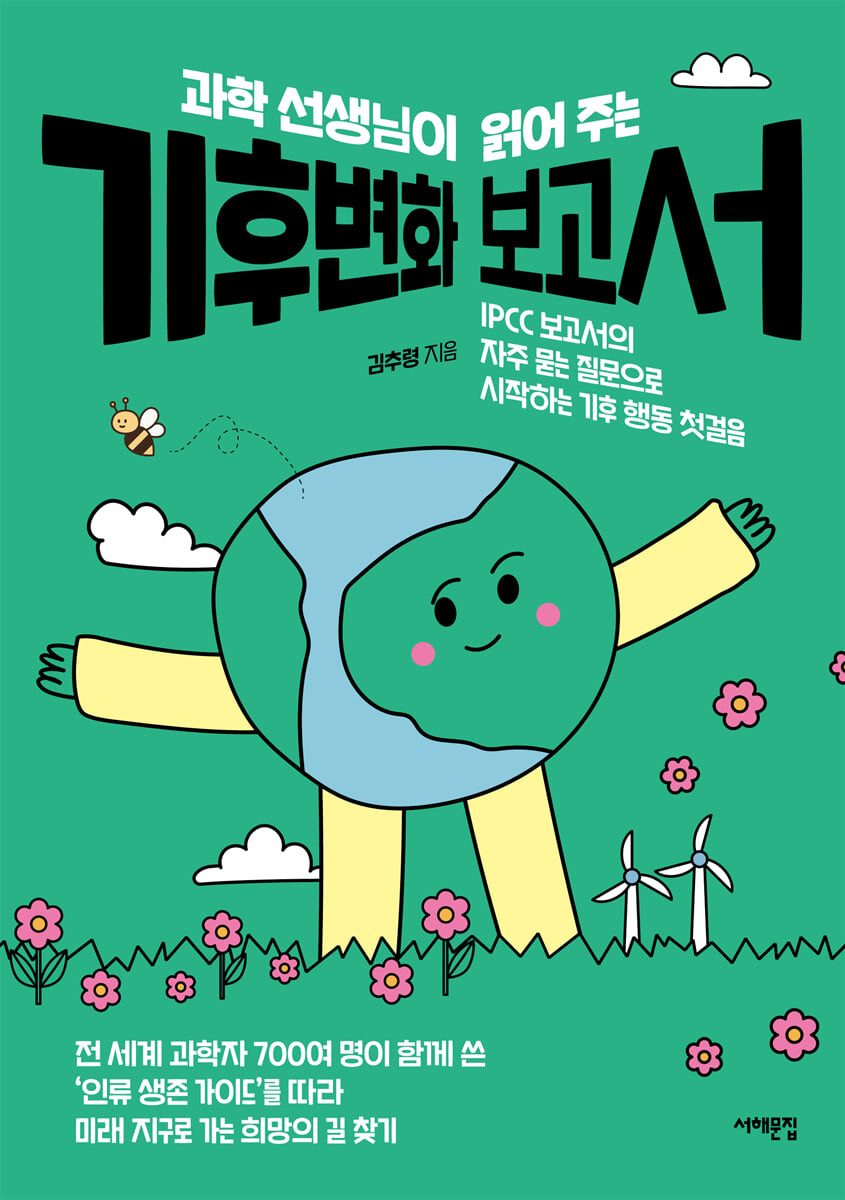
A climate change report read by a science teacher
 |
Description
Book Introduction
A book that interprets the IPCC climate change report from a youth perspective.
Kim Chu-ryeong, author of "Climate Debate Now" and "Let's Talk About Today's Earth," has selected and explained the key concepts and specific actions needed to achieve net zero and climate justice from the extensive IPCC Sixth Assessment Report.
This book, restructured around people's 'frequently asked questions,' does not despair at the siren calls of '10 years left' and 'mass extinction,' but shows in detail what we must change for the future of Earth and what kind of world these changes will create.
Through the passionate voices of over 700 scientists from around the world, readers will find answers to their questions about climate change and its solutions, and move toward carbon neutrality with confidence in the effectiveness of climate action.
A must-read for anyone talking about the climate crisis.
Kim Chu-ryeong, author of "Climate Debate Now" and "Let's Talk About Today's Earth," has selected and explained the key concepts and specific actions needed to achieve net zero and climate justice from the extensive IPCC Sixth Assessment Report.
This book, restructured around people's 'frequently asked questions,' does not despair at the siren calls of '10 years left' and 'mass extinction,' but shows in detail what we must change for the future of Earth and what kind of world these changes will create.
Through the passionate voices of over 700 scientists from around the world, readers will find answers to their questions about climate change and its solutions, and move toward carbon neutrality with confidence in the effectiveness of climate action.
A must-read for anyone talking about the climate crisis.
- You can preview some of the book's contents.
Preview
index
prolog
The Textbook of Humanity, the Human Survival Guide
How do the three working groups differ?
01.
A golden opportunity for humanity
Why are these 10 years important?
What is a carbon budget? ㆍ Working Group 1 FAQ 5.4
What is the difference between carbon neutrality and net zero? ㆍ Working Group 3 FAQ 1.3
How can we achieve net-zero emissions? How will net-zero emissions change the climate? ㆍ Working Group 3 FAQ 3.2
Creating Changes in Demand as a Consumer
If consumption declines, won't the quality of life deteriorate? ㆍ Working Group 3 FAQ 5.3
Taking 'conventional' actions for 1.5 degrees
Creating Change in Social Systems Within 10 Years
We need to change the energy source that produces electricity.
Is an energy system with little or no carbon dioxide emissions different from today's energy system? ㆍ Working Group 3 FAQ 6.1
Can renewable energy sources supply all the energy our energy system needs? ㆍ Working Group 3 FAQ 6.2
We need to change! The way we eat, produce and consume food.
What's special about "agriculture, forestry, and other land uses" in reducing greenhouse gases? ㆍ Working Group 3 FAQ 7.1
How can agriculture, forestry, and other land uses significantly reduce greenhouse gases at a lower cost? Working Group 3 FAQ 7.2
We need to change! The buildings we live in and our habits.
What greenhouse gases are emitted from buildings? ㆍ Working Group 3 FAQ 9.1
What is the most effective way to reduce carbon emissions in the construction sector? ㆍ Working Group 3 FAQ 9.3
What are the benefits of reducing buildings' carbon emissions? What do we have to compromise in the process? ㆍ Working Group 3 FAQ 9.2
We need to change the means of transportation we use to ride and carry things.
Is it important to switch to electric vehicles? Are there any issues with supplying the minerals needed to make batteries? ㆍ Working Group 3 FAQ 10.1
Is it difficult to reduce carbon emissions from large-scale transportation (long-distance trucks, ships, and aircraft)? ㆍ Working Group 3 FAQ 10.2
We need to change! The industry that makes and sells products
What are some key ways to reduce carbon emissions from the industrial sector? ㆍ Working Group 3 FAQ 11.1
Isn't reducing carbon emissions in the industrial sector expensive? Is sustainable development possible? ㆍ Working Group 3 FAQ 11.2
We need smart taxes and systems that reduce fossil fuels and inequality.
02.
Burning Embers: The Latest Science Answers to a Common Sense Story
Why should we limit it to 1.5 degrees?
Visible fine dust and invisible greenhouse gases
What are greenhouse gases, and where do they come from? ㆍ Working Group 3 FAQ 1.2
What substances remain in the atmosphere for a short period of time and cause climate change? What impact do they have on climate? ㆍ Working Group 1 FAQ 6.1
What is the relationship between mitigating climate change and improving air quality? ㆍ Working Group 1 FAQ 6.2
Is climate change a one-man show by greenhouse gases?
What is equilibrium climate sensitivity? How does it relate to future warming? ㆍ Working Group 1 FAQ 7.3
What role do clouds play in a warming climate? ㆍ Working Group 1 FAQ 7.2
Is nature's carbon absorption capacity weakening? ㆍ Working Group 1 FAQ 5.1
Shaky tipping elements
Will melting permafrost accelerate global warming? ㆍ Working Group 1 FAQ 5.2
Will the Gulf Stream Stop Completely? ㆍ Working Group 1 FAQ 9.3
Can the melting of the Greenland and Antarctic ice sheets be halted? How long will it take for the lost ice sheets to grow back? ㆍ Working Group 1 FAQ 9.1
03.
What situation are we in now?
This summer will be the coolest summer of your life.
What is natural variability? How does it contribute to human-induced climate change? ㆍ Working Group 1 FAQ 3.2
Are the recent extreme weather events in our region due to climate change? ㆍ Working Group 1 FAQ 11.3
Will human-induced climate change lead to unprecedented extreme weather events? ㆍ Working Group 1 FAQ 11.2
Until the city becomes a heat island
Why are cities hotspots for global warming? ㆍ Working Group 1 FAQ 10.2
Why are cities and infrastructure particularly vulnerable to the impacts of climate change? How can we mitigate them? ㆍ Working Group 2 FAQ 6.1
What are the major climate risks currently facing cities, settlements, and vulnerable populations? What risks will they face if global temperatures rise by 2 degrees Celsius by 2050? ㆍ Working Group 2 FAQ 6.2
#A Tale of Two Towns in Lagos: Echo Atlantic and Makoko
Will carbon neutrality stop climate change?
How long will it take for reduced carbon dioxide emissions to have an impact? ㆍ Working Group 1 FAQ 4.2
The Sixth Assessment Report's Betrayal: All Future Scenarios Beyond 1.5 Degrees
How close are we to 1.5 degrees? ㆍ 〈Global Warming 1.5 Degrees Special Report〉 FAQ 1.2
How much time do we have left to act to keep global warming below 1.5 degrees Celsius? ㆍ Working Group 3 FAQ 2.3
How will climate change evolve over the next 20 years? ㆍ Working Group 1 FAQ 4.1
It's never too late
04.
It's a crisis, but there's a way out.
To find a way even in a crisis
Is Climate Change Adaptation Urgent? ㆍ Working Group 2 FAQ 1.2
What is needed to successfully adapt to climate change? ㆍ Working Group 2 FAQ 1.3
They say transformational adaptation is necessary. How is it different from adaptation? ㆍ Working Group 2 FAQ 1.4
Changing the world into a bouncy ball society
What is a climate-resilient development pathway? ㆍ Working Group 2 FAQ 18.1
How can all sectors of society, not just government, participate in and exert influence on climate-resilient development? ㆍ Working Group 2 FAQ 18.3
What is needed to achieve climate-resilient development? ㆍ Working Group 2 FAQ 18.4
What are the success criteria for climate-resilient development? ㆍ Working Group 2 FAQ 18.5
Climate change is an ethical issue
Why does climate change disproportionately harm the poor and vulnerable? And why does climate change exacerbate inequality? ㆍ Working Group 2 FAQ 8.1
Which regions of the world are vulnerable? And how many people live there? ㆍ Working Group 2 FAQ 8.2
What can we do to reduce the risks of climate change to the poor? ㆍ Working Group 2 FAQ 8.4
Couldn't science and technology help stop climate change?
Would using technology to directly remove carbon dioxide from the atmosphere help mitigate climate change? ㆍ Working Group 3 FAQ 12.1
#Putting a 'Mask' on the Earth: Engineering Techniques to Block the Sun's Light
A Dark Future for Green Gold Biodiesel?
Why is growing bioenergy crops on a large scale controversial? ㆍ Working Group 3 FAQ 7.3
We have allies on climate change.
Can Planting Trees Tackle Climate Change? ㆍ Working Group 2 FAQ 2.6
Can protecting and managing nature effectively reduce the damage caused by climate change? ㆍ Working Group 2 FAQ 2.5
To restore the relationship between humans and nature
What can we do to limit warming to 1.5 degrees? ㆍ Working Group 3 FAQ 5.1
supplement
List of Frequently Asked Questions for IPCC Working Groups 1, 2, and 3 on the Sixth Assessment Report
The Textbook of Humanity, the Human Survival Guide
How do the three working groups differ?
01.
A golden opportunity for humanity
Why are these 10 years important?
What is a carbon budget? ㆍ Working Group 1 FAQ 5.4
What is the difference between carbon neutrality and net zero? ㆍ Working Group 3 FAQ 1.3
How can we achieve net-zero emissions? How will net-zero emissions change the climate? ㆍ Working Group 3 FAQ 3.2
Creating Changes in Demand as a Consumer
If consumption declines, won't the quality of life deteriorate? ㆍ Working Group 3 FAQ 5.3
Taking 'conventional' actions for 1.5 degrees
Creating Change in Social Systems Within 10 Years
We need to change the energy source that produces electricity.
Is an energy system with little or no carbon dioxide emissions different from today's energy system? ㆍ Working Group 3 FAQ 6.1
Can renewable energy sources supply all the energy our energy system needs? ㆍ Working Group 3 FAQ 6.2
We need to change! The way we eat, produce and consume food.
What's special about "agriculture, forestry, and other land uses" in reducing greenhouse gases? ㆍ Working Group 3 FAQ 7.1
How can agriculture, forestry, and other land uses significantly reduce greenhouse gases at a lower cost? Working Group 3 FAQ 7.2
We need to change! The buildings we live in and our habits.
What greenhouse gases are emitted from buildings? ㆍ Working Group 3 FAQ 9.1
What is the most effective way to reduce carbon emissions in the construction sector? ㆍ Working Group 3 FAQ 9.3
What are the benefits of reducing buildings' carbon emissions? What do we have to compromise in the process? ㆍ Working Group 3 FAQ 9.2
We need to change the means of transportation we use to ride and carry things.
Is it important to switch to electric vehicles? Are there any issues with supplying the minerals needed to make batteries? ㆍ Working Group 3 FAQ 10.1
Is it difficult to reduce carbon emissions from large-scale transportation (long-distance trucks, ships, and aircraft)? ㆍ Working Group 3 FAQ 10.2
We need to change! The industry that makes and sells products
What are some key ways to reduce carbon emissions from the industrial sector? ㆍ Working Group 3 FAQ 11.1
Isn't reducing carbon emissions in the industrial sector expensive? Is sustainable development possible? ㆍ Working Group 3 FAQ 11.2
We need smart taxes and systems that reduce fossil fuels and inequality.
02.
Burning Embers: The Latest Science Answers to a Common Sense Story
Why should we limit it to 1.5 degrees?
Visible fine dust and invisible greenhouse gases
What are greenhouse gases, and where do they come from? ㆍ Working Group 3 FAQ 1.2
What substances remain in the atmosphere for a short period of time and cause climate change? What impact do they have on climate? ㆍ Working Group 1 FAQ 6.1
What is the relationship between mitigating climate change and improving air quality? ㆍ Working Group 1 FAQ 6.2
Is climate change a one-man show by greenhouse gases?
What is equilibrium climate sensitivity? How does it relate to future warming? ㆍ Working Group 1 FAQ 7.3
What role do clouds play in a warming climate? ㆍ Working Group 1 FAQ 7.2
Is nature's carbon absorption capacity weakening? ㆍ Working Group 1 FAQ 5.1
Shaky tipping elements
Will melting permafrost accelerate global warming? ㆍ Working Group 1 FAQ 5.2
Will the Gulf Stream Stop Completely? ㆍ Working Group 1 FAQ 9.3
Can the melting of the Greenland and Antarctic ice sheets be halted? How long will it take for the lost ice sheets to grow back? ㆍ Working Group 1 FAQ 9.1
03.
What situation are we in now?
This summer will be the coolest summer of your life.
What is natural variability? How does it contribute to human-induced climate change? ㆍ Working Group 1 FAQ 3.2
Are the recent extreme weather events in our region due to climate change? ㆍ Working Group 1 FAQ 11.3
Will human-induced climate change lead to unprecedented extreme weather events? ㆍ Working Group 1 FAQ 11.2
Until the city becomes a heat island
Why are cities hotspots for global warming? ㆍ Working Group 1 FAQ 10.2
Why are cities and infrastructure particularly vulnerable to the impacts of climate change? How can we mitigate them? ㆍ Working Group 2 FAQ 6.1
What are the major climate risks currently facing cities, settlements, and vulnerable populations? What risks will they face if global temperatures rise by 2 degrees Celsius by 2050? ㆍ Working Group 2 FAQ 6.2
#A Tale of Two Towns in Lagos: Echo Atlantic and Makoko
Will carbon neutrality stop climate change?
How long will it take for reduced carbon dioxide emissions to have an impact? ㆍ Working Group 1 FAQ 4.2
The Sixth Assessment Report's Betrayal: All Future Scenarios Beyond 1.5 Degrees
How close are we to 1.5 degrees? ㆍ 〈Global Warming 1.5 Degrees Special Report〉 FAQ 1.2
How much time do we have left to act to keep global warming below 1.5 degrees Celsius? ㆍ Working Group 3 FAQ 2.3
How will climate change evolve over the next 20 years? ㆍ Working Group 1 FAQ 4.1
It's never too late
04.
It's a crisis, but there's a way out.
To find a way even in a crisis
Is Climate Change Adaptation Urgent? ㆍ Working Group 2 FAQ 1.2
What is needed to successfully adapt to climate change? ㆍ Working Group 2 FAQ 1.3
They say transformational adaptation is necessary. How is it different from adaptation? ㆍ Working Group 2 FAQ 1.4
Changing the world into a bouncy ball society
What is a climate-resilient development pathway? ㆍ Working Group 2 FAQ 18.1
How can all sectors of society, not just government, participate in and exert influence on climate-resilient development? ㆍ Working Group 2 FAQ 18.3
What is needed to achieve climate-resilient development? ㆍ Working Group 2 FAQ 18.4
What are the success criteria for climate-resilient development? ㆍ Working Group 2 FAQ 18.5
Climate change is an ethical issue
Why does climate change disproportionately harm the poor and vulnerable? And why does climate change exacerbate inequality? ㆍ Working Group 2 FAQ 8.1
Which regions of the world are vulnerable? And how many people live there? ㆍ Working Group 2 FAQ 8.2
What can we do to reduce the risks of climate change to the poor? ㆍ Working Group 2 FAQ 8.4
Couldn't science and technology help stop climate change?
Would using technology to directly remove carbon dioxide from the atmosphere help mitigate climate change? ㆍ Working Group 3 FAQ 12.1
#Putting a 'Mask' on the Earth: Engineering Techniques to Block the Sun's Light
A Dark Future for Green Gold Biodiesel?
Why is growing bioenergy crops on a large scale controversial? ㆍ Working Group 3 FAQ 7.3
We have allies on climate change.
Can Planting Trees Tackle Climate Change? ㆍ Working Group 2 FAQ 2.6
Can protecting and managing nature effectively reduce the damage caused by climate change? ㆍ Working Group 2 FAQ 2.5
To restore the relationship between humans and nature
What can we do to limit warming to 1.5 degrees? ㆍ Working Group 3 FAQ 5.1
supplement
List of Frequently Asked Questions for IPCC Working Groups 1, 2, and 3 on the Sixth Assessment Report
Detailed image
.jpg)
Into the book
What is the difference between carbon neutrality and net zero? Working Group 3 FAQ 1.3
Net zero and carbon neutrality, whether used on a global scale or at regional or national levels, are the same concept.
Some of the reasons for the confusion are:
First, carbon neutrality is also calculated by purchasing emission permits and eliminating emissions from businesses, goods, and services, rather than from countries.
Of course, this case is not net zero.
…second, because some often use carbon dioxide and all greenhouse gas emissions, including carbon dioxide, indiscriminately.
--- pp.28-29
However, there is something to be careful about.
We cannot leave the responsibility for this low-carbon lifestyle solely up to individuals.
What if you can't afford to remodel with well-insulated double or triple-glazed windows, switch to an electric car, or find a home near your workplace that fits your budget, forcing you to commute long distances? How can you reduce plastic bag use when so many products are packaged in plastic bags at the supermarket? How can you use public transportation when there's only one bus per hour?
…so the report explains that there needs to be active corporate investment and political intervention to enable this investment.
Moving politics also starts with ‘me alone.’
They also say that the culture needs to change.
Cultural change begins with a change in the values of ‘me alone.’
Consumer choices based on this change demand and reduce carbon emissions.
--- pp.41-42
In Indonesia, they say they have successfully eliminated subsidies on gasoline.
The government was able to persuade the public that the funds generated by the subsidy suspension would be used to support vulnerable groups who were struggling due to the system and to fund national health insurance.
Eliminating subsidies on diesel and kerosene is a future challenge.
What if we applied a carbon tax proportional to income level? Or, what if we set a standard carbon emission limit for everyone, regardless of income? This would ensure a reasonable quality of life for those who emit very little, while ensuring that those who emit excessively are required to reduce their emissions.
Even the best policies will have difficulty being implemented if the value of fairness is not at the center.
--- pp.81-82
It's never too late.
1.5 degrees is not a rule, but a value that represents probability.
… Occasionally, we hear news from various weather observation agencies around the world that the temperature has exceeded 1.5 degrees.
The 1.5 degree target set by the United Nations Framework Convention on Climate Change refers to the average temperature over a 30-year period or a similar period.
Exceeding 1.5 degrees does not mean exceeding it in one day, one month, or one year.
So, if the temperature briefly exceeds 1.5 degrees or goes over 1.5 degrees, what we need to do is take action to lower it by even 0.01 degrees.
This way, the chances of avoiding danger increase.
This is why it is not always too late to go over 1.5 degrees.
--- p.155
What can we do to limit warming to 1.5 degrees? Working Group 3 FAQ 5.1
Citizens, please educate yourself about climate change.
Organize your community and exert political pressure.
Be an example to others.
Are you a professional (engineer, urban planner, teacher, researcher)? Reshape societal standards to meet decarbonization.
City planners and architects must transform our cities to make it safe for children to walk and bike.
Have a lot of money? Invest in carbon-neutral technologies and move away from fossil fuels.
…Consider and practice sustainable consumption and a good life.
Study history, poetry, art, religion, and philosophy.
Design and participate in a decent life that meets local interests and culture.
Are you a politician? Establish various economic and political systems that establish economic incentives and environmentally friendly methods as the default, such as carbon dividends and carbon taxes.
Net zero and carbon neutrality, whether used on a global scale or at regional or national levels, are the same concept.
Some of the reasons for the confusion are:
First, carbon neutrality is also calculated by purchasing emission permits and eliminating emissions from businesses, goods, and services, rather than from countries.
Of course, this case is not net zero.
…second, because some often use carbon dioxide and all greenhouse gas emissions, including carbon dioxide, indiscriminately.
--- pp.28-29
However, there is something to be careful about.
We cannot leave the responsibility for this low-carbon lifestyle solely up to individuals.
What if you can't afford to remodel with well-insulated double or triple-glazed windows, switch to an electric car, or find a home near your workplace that fits your budget, forcing you to commute long distances? How can you reduce plastic bag use when so many products are packaged in plastic bags at the supermarket? How can you use public transportation when there's only one bus per hour?
…so the report explains that there needs to be active corporate investment and political intervention to enable this investment.
Moving politics also starts with ‘me alone.’
They also say that the culture needs to change.
Cultural change begins with a change in the values of ‘me alone.’
Consumer choices based on this change demand and reduce carbon emissions.
--- pp.41-42
In Indonesia, they say they have successfully eliminated subsidies on gasoline.
The government was able to persuade the public that the funds generated by the subsidy suspension would be used to support vulnerable groups who were struggling due to the system and to fund national health insurance.
Eliminating subsidies on diesel and kerosene is a future challenge.
What if we applied a carbon tax proportional to income level? Or, what if we set a standard carbon emission limit for everyone, regardless of income? This would ensure a reasonable quality of life for those who emit very little, while ensuring that those who emit excessively are required to reduce their emissions.
Even the best policies will have difficulty being implemented if the value of fairness is not at the center.
--- pp.81-82
It's never too late.
1.5 degrees is not a rule, but a value that represents probability.
… Occasionally, we hear news from various weather observation agencies around the world that the temperature has exceeded 1.5 degrees.
The 1.5 degree target set by the United Nations Framework Convention on Climate Change refers to the average temperature over a 30-year period or a similar period.
Exceeding 1.5 degrees does not mean exceeding it in one day, one month, or one year.
So, if the temperature briefly exceeds 1.5 degrees or goes over 1.5 degrees, what we need to do is take action to lower it by even 0.01 degrees.
This way, the chances of avoiding danger increase.
This is why it is not always too late to go over 1.5 degrees.
--- p.155
What can we do to limit warming to 1.5 degrees? Working Group 3 FAQ 5.1
Citizens, please educate yourself about climate change.
Organize your community and exert political pressure.
Be an example to others.
Are you a professional (engineer, urban planner, teacher, researcher)? Reshape societal standards to meet decarbonization.
City planners and architects must transform our cities to make it safe for children to walk and bike.
Have a lot of money? Invest in carbon-neutral technologies and move away from fossil fuels.
…Consider and practice sustainable consumption and a good life.
Study history, poetry, art, religion, and philosophy.
Design and participate in a decent life that meets local interests and culture.
Are you a politician? Establish various economic and political systems that establish economic incentives and environmentally friendly methods as the default, such as carbon dividends and carbon taxes.
--- pp.207-208
Publisher's Review
There is a word that is always mentioned when talking about climate change.
This is the 'IPCC (Intergovernmental Panel on Climate Change) Climate Change Report'.
This report, published by the IPCC since 1990, explains the principles of climate change, its social and economic impacts, and countermeasures.
It is frequently mentioned by people as scientific evidence in climate crisis response policies established by each government, newspaper articles, and climate-related books.
But it's difficult to look into it properly.
As it examines climate change around the globe, the scope of the topic is very broad and the volume exceeds 10,000 pages.
It's very complex, full of numbers, parentheses, and sources, as it involves the factual reporting of research by over 700 scientists from around the world.
So, it is difficult for people to reach the 'hope and change' that the report talks about.
We are only afraid of the numbers indicating worsening global warming.
Now, even when climate change is felt on our skin, we give up, thinking, "Isn't it too late?" or "Can I do it alone?"
Rather, it was young people, the ones least responsible for this crisis, who took climate action.
Local youth environmental clubs are directly approaching government agencies to protect the damaged nature, and 'Youth Climate Action' won a constitutional petition, claiming that the country's greenhouse gas reduction target violates the people's fundamental rights, including the right to life and the right to an environment.
This book is designed to acknowledge the inaction of previous generations, encourage youth to take climate action, and inspire more people to take action now.
"Humanity's Textbook" "Humanity's Survival Guide"
A book that interprets the IPCC climate change report from a youth perspective!
Climate Debate Now, Let's Talk About Today's Earth
"The Road to Hope for the Future Earth," read by Professor Kim Chu-ryeong
I must start by saying this.
"I'm sorry.
I'm so sorry.
“My thinking was too short.”
If, from the moment I was born, the world had been filled with sirens about the 'climate crisis' and the 'sixth mass extinction,' I would have felt truly wronged.
So I thought the beginning of this book should be a clear apology.
But what I want to talk about more clearly is hope and change.
_From the prologue
The author, who has been talking about climate change from a close perspective for future generations through “Climate Debate Now” and “Let’s Talk About Today’s Earth,” has selected from a vast number of reports the contents that show what we need to change for the Earth and what kind of world those changes will create.
This Frequently Asked Questions (FAQ) section, designed to help more people understand the report's core concepts, provides a selection of concepts you need to know to understand climate change and actions you can take to mitigate the crisis.
The book does not stop at conveying the contents of the report.
Colorful metaphors, helpful commentary and illustrations, and a variety of examples of climate action being implemented in other countries help young readers understand the report more concretely.
Examples include net-zero energy buildings in the United States and Indonesia's policy of eliminating and utilizing gasoline subsidies.
We also introduced interesting stories such as solar geoengineering experiments that explore the possibility of lowering the Earth's temperature through science and technology.
You don't have to read it in order from the beginning.
First, read the content you are interested in, and if you want to know more, scan the QR code in the book to go to the IPCC official website or the Korea Meteorological Administration website, download the English or Korean report, and read it yourself.
You can use the appendix, which contains a complete list of frequently asked questions from the IPCC Sixth Assessment Report, as a guide.
Questions and concerns surrounding climate change
A clear answer to the effectiveness of climate action
A must-read for anyone talking about the climate crisis.
What's the difference between carbon neutrality and net zero? How close are we to reaching 1.5 degrees? Can my actions alone stop climate change? If we reduce consumption for the sake of the planet, won't our quality of life suffer? Is it difficult for companies, not individuals, to reduce their carbon emissions? Will carbon neutrality stop climate change?
Through this book, readers can completely resolve any questions they may have about climate change.
The report's responses were written in a way that was easy for young people to read, but was carefully refined to avoid misconceptions and to maintain the overall context.
You may have heard a lot about it but didn't know exactly, or you may learn new facts.
The reason why the goal of keeping the global temperature rise below 1.5 degrees Celsius was set is because reducing fine dust will raise the global temperature, the process by which the climate system related to Arctic ice and clouds accelerates global warming, and the fact that changing human demand can reduce global greenhouse gas emissions by 40-70% by 2050.
It also includes predictions of future global temperature changes, ways to minimize damage from extreme weather events that exceed the capacity of natural and human systems to cope, and ways for everyone to live a decent life without increasing carbon emissions.
Of course, it is all based on scientific evidence derived from data and research.
Ultimately, we will create a world where both humanity and nature can thrive.
A story about scientific and ethical practice
This basis is also a voice calling for an ethical approach to the climate crisis and the realization of climate justice.
At first glance, the numerous numbers and graphs that seem rigid and difficult are saying that 'damage occurs most greatly in the weakest places', and therefore 'we must make the weak safe and correct the unequal world.'
Nigeria is a prime example of this, with its low-carbon, eco-friendly city, Eco Atlantic, and the world's largest floating slum, Makoko Village.
After reading this book, you'll hear a louder call to eat more plant-based, buy less, use public transportation, change our current urban environment, be wary of the relentless pursuit of growth, prevent the polarization brought about by the climate crisis, and design a future that coexists with nature.
You will be confident in the effectiveness of climate action, take action for the planet, and feel a burning desire to encourage others to join you in changing the world.
This is the 'IPCC (Intergovernmental Panel on Climate Change) Climate Change Report'.
This report, published by the IPCC since 1990, explains the principles of climate change, its social and economic impacts, and countermeasures.
It is frequently mentioned by people as scientific evidence in climate crisis response policies established by each government, newspaper articles, and climate-related books.
But it's difficult to look into it properly.
As it examines climate change around the globe, the scope of the topic is very broad and the volume exceeds 10,000 pages.
It's very complex, full of numbers, parentheses, and sources, as it involves the factual reporting of research by over 700 scientists from around the world.
So, it is difficult for people to reach the 'hope and change' that the report talks about.
We are only afraid of the numbers indicating worsening global warming.
Now, even when climate change is felt on our skin, we give up, thinking, "Isn't it too late?" or "Can I do it alone?"
Rather, it was young people, the ones least responsible for this crisis, who took climate action.
Local youth environmental clubs are directly approaching government agencies to protect the damaged nature, and 'Youth Climate Action' won a constitutional petition, claiming that the country's greenhouse gas reduction target violates the people's fundamental rights, including the right to life and the right to an environment.
This book is designed to acknowledge the inaction of previous generations, encourage youth to take climate action, and inspire more people to take action now.
"Humanity's Textbook" "Humanity's Survival Guide"
A book that interprets the IPCC climate change report from a youth perspective!
Climate Debate Now, Let's Talk About Today's Earth
"The Road to Hope for the Future Earth," read by Professor Kim Chu-ryeong
I must start by saying this.
"I'm sorry.
I'm so sorry.
“My thinking was too short.”
If, from the moment I was born, the world had been filled with sirens about the 'climate crisis' and the 'sixth mass extinction,' I would have felt truly wronged.
So I thought the beginning of this book should be a clear apology.
But what I want to talk about more clearly is hope and change.
_From the prologue
The author, who has been talking about climate change from a close perspective for future generations through “Climate Debate Now” and “Let’s Talk About Today’s Earth,” has selected from a vast number of reports the contents that show what we need to change for the Earth and what kind of world those changes will create.
This Frequently Asked Questions (FAQ) section, designed to help more people understand the report's core concepts, provides a selection of concepts you need to know to understand climate change and actions you can take to mitigate the crisis.
The book does not stop at conveying the contents of the report.
Colorful metaphors, helpful commentary and illustrations, and a variety of examples of climate action being implemented in other countries help young readers understand the report more concretely.
Examples include net-zero energy buildings in the United States and Indonesia's policy of eliminating and utilizing gasoline subsidies.
We also introduced interesting stories such as solar geoengineering experiments that explore the possibility of lowering the Earth's temperature through science and technology.
You don't have to read it in order from the beginning.
First, read the content you are interested in, and if you want to know more, scan the QR code in the book to go to the IPCC official website or the Korea Meteorological Administration website, download the English or Korean report, and read it yourself.
You can use the appendix, which contains a complete list of frequently asked questions from the IPCC Sixth Assessment Report, as a guide.
Questions and concerns surrounding climate change
A clear answer to the effectiveness of climate action
A must-read for anyone talking about the climate crisis.
What's the difference between carbon neutrality and net zero? How close are we to reaching 1.5 degrees? Can my actions alone stop climate change? If we reduce consumption for the sake of the planet, won't our quality of life suffer? Is it difficult for companies, not individuals, to reduce their carbon emissions? Will carbon neutrality stop climate change?
Through this book, readers can completely resolve any questions they may have about climate change.
The report's responses were written in a way that was easy for young people to read, but was carefully refined to avoid misconceptions and to maintain the overall context.
You may have heard a lot about it but didn't know exactly, or you may learn new facts.
The reason why the goal of keeping the global temperature rise below 1.5 degrees Celsius was set is because reducing fine dust will raise the global temperature, the process by which the climate system related to Arctic ice and clouds accelerates global warming, and the fact that changing human demand can reduce global greenhouse gas emissions by 40-70% by 2050.
It also includes predictions of future global temperature changes, ways to minimize damage from extreme weather events that exceed the capacity of natural and human systems to cope, and ways for everyone to live a decent life without increasing carbon emissions.
Of course, it is all based on scientific evidence derived from data and research.
Ultimately, we will create a world where both humanity and nature can thrive.
A story about scientific and ethical practice
This basis is also a voice calling for an ethical approach to the climate crisis and the realization of climate justice.
At first glance, the numerous numbers and graphs that seem rigid and difficult are saying that 'damage occurs most greatly in the weakest places', and therefore 'we must make the weak safe and correct the unequal world.'
Nigeria is a prime example of this, with its low-carbon, eco-friendly city, Eco Atlantic, and the world's largest floating slum, Makoko Village.
After reading this book, you'll hear a louder call to eat more plant-based, buy less, use public transportation, change our current urban environment, be wary of the relentless pursuit of growth, prevent the polarization brought about by the climate crisis, and design a future that coexists with nature.
You will be confident in the effectiveness of climate action, take action for the planet, and feel a burning desire to encourage others to join you in changing the world.
GOODS SPECIFICS
- Date of issue: February 15, 2025
- Page count, weight, size: 224 pages | 318g | 148*210*14mm
- ISBN13: 9791194413202
You may also like
카테고리
korean


korean

![GQ KOREA Mark (Monthly): December [2025]](http://librairie.coreenne.fr/cdn/shop/files/8ef265dbbfbf186523ed75ba7319009d.jpg?v=1765340328&width=3840)


