

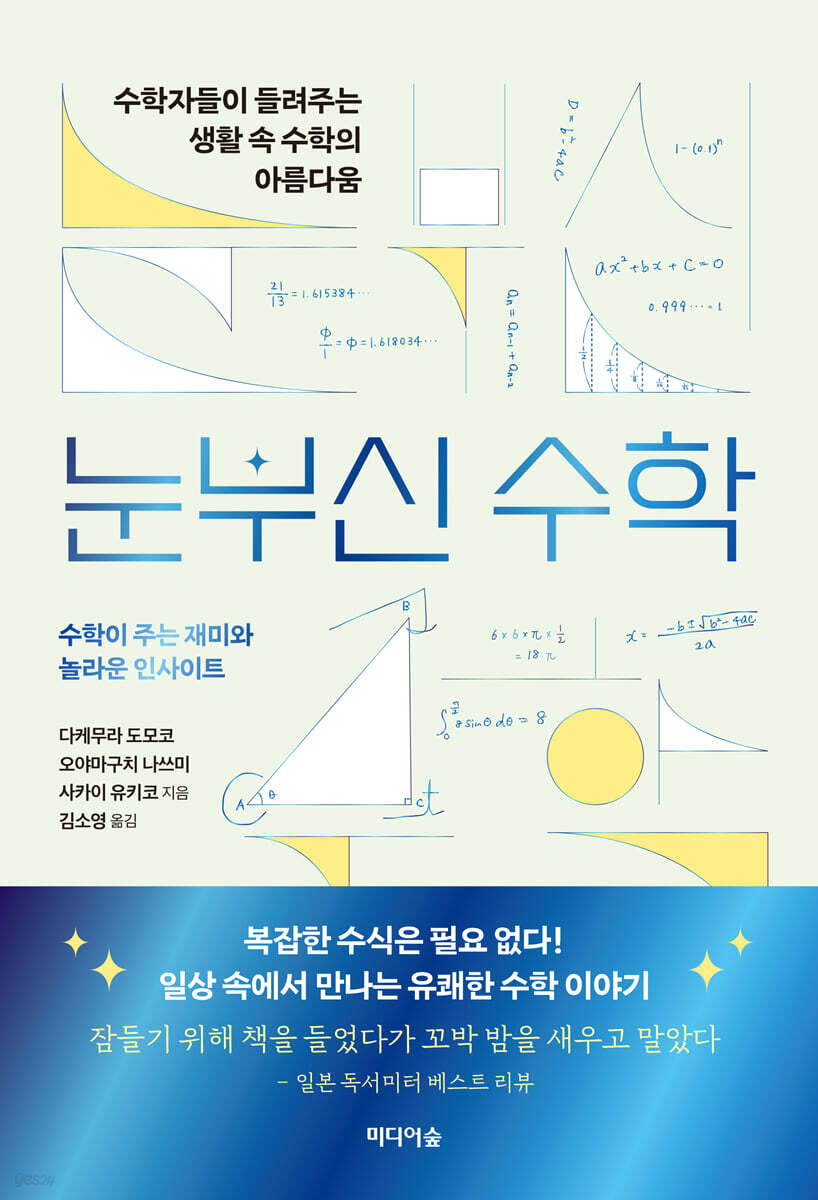
Dazzling mathematics
 |
Description
Book Introduction
Are you saying that math is useless once you graduate from school?
The beauty of mathematics in everyday life, as told by young mathematicians!
If you've been avoiding math your whole life, thinking it's difficult, this book will be the starting point for a change in your thinking.
It shows how closely mathematics is embedded in our daily lives and how fun and beautiful it is.
The three female mathematicians who author this book each bring their own unique expertise and personalities to bear on interesting topics that can easily be encountered in everyday life.
It explains everyday mathematics in an easy and friendly way using illustrations so that anyone can understand it without having to use complicated formulas.
The authors wrote this book with the hope that mathematics will not be seen as something heavy and difficult, but rather enjoyed with a variety of colors and topics, like a delicious lunchbox.
The fact that unexpected mathematical principles are actually hidden in everyday life that seems to have nothing to do with mathematics adds a fresh shock and interest.
Mathematical patterns can be found in the petals of chrysanthemums, the Fibonacci sequence in the rind of a pineapple, and even in the bridges we cross every day.
In particular, the authors' warm and humorous explanations serve as a key to alleviating the vague fear of mathematics.
It is structured to be easily accessible, focusing on text and illustrations instead of formulas, so both beginners and experienced math users can enjoy it.
"Dazzling Mathematics" is like a small travel guide that will make your life more colorful.
Even if you start reading lightly, you will soon find yourself captivated by the charm of mathematics.
I hope that the colorful colors of mathematics will permeate your daily life, and that many readers will join me on this enjoyable adventure.
The beauty of mathematics in everyday life, as told by young mathematicians!
If you've been avoiding math your whole life, thinking it's difficult, this book will be the starting point for a change in your thinking.
It shows how closely mathematics is embedded in our daily lives and how fun and beautiful it is.
The three female mathematicians who author this book each bring their own unique expertise and personalities to bear on interesting topics that can easily be encountered in everyday life.
It explains everyday mathematics in an easy and friendly way using illustrations so that anyone can understand it without having to use complicated formulas.
The authors wrote this book with the hope that mathematics will not be seen as something heavy and difficult, but rather enjoyed with a variety of colors and topics, like a delicious lunchbox.
The fact that unexpected mathematical principles are actually hidden in everyday life that seems to have nothing to do with mathematics adds a fresh shock and interest.
Mathematical patterns can be found in the petals of chrysanthemums, the Fibonacci sequence in the rind of a pineapple, and even in the bridges we cross every day.
In particular, the authors' warm and humorous explanations serve as a key to alleviating the vague fear of mathematics.
It is structured to be easily accessible, focusing on text and illustrations instead of formulas, so both beginners and experienced math users can enjoy it.
"Dazzling Mathematics" is like a small travel guide that will make your life more colorful.
Even if you start reading lightly, you will soon find yourself captivated by the charm of mathematics.
I hope that the colorful colors of mathematics will permeate your daily life, and that many readers will join me on this enjoyable adventure.
- You can preview some of the book's contents.
Preview
index
Entering
PART 1
STORY 1: When to Let Go of Your Winning Clothes
STORY 2 Suggestions for the Golden Ratio Recipe!
STORY 3: Wherever the Needle Rolled, There Was Pi (π) [Buffon's Needle]
STORY 4: The Secret of Numbers Hidden in Flower Petals [Fibonacci Sequence]
STORY 5: Have you collected all your favorite goods? [Coupon Collector Challenge]
STORY 6 How many ways do you know to tie a tie?
STORY 7: The Minority and the Competition for Survival [The Minority Cicada Story]
STORY 8: How to properly unfold a milk carton [Tetrahedron Tile Arrangement]
STORY 9 Finger Multiplication Table
STORY 10: A Morning Scene of Taking Out Trash
PART 2
STORY 11: Coincidence or Fate? [Probability]
STORY 12: The Infinitely Continuing Magic of Addition as Seen Through "Jujutsu Kaisen" [Infinity]
STORY 13 Is everything made of knots?
STORY 14 A Drink, Sports, and Math [Random Walk]
STORY 15: The Secret of the World's Most Beautiful Vegetable [Fractal]
STORY 16 Have you ever thought about it when you stand in line?
STORY 17: The Hot Topic in the COVID-19 Era: "Exponential Function" [Exponential Function]
STORY 18 Soap Bubbles [Minimal Surface]
STORY 19 The Magic of Numbers in Creating Music
STORY 20 We are protected by prime numbers [Factorization]
STORY 21 When buying a bag
PART 3
STORY 22: The Sumida River Bridges: A Mathematical Perspective [Königsberg Bridges]
STORY 23: How Far Does Infinity Go? [Hilbert Hotel]
STORY 24 Choose the strongest among the three!
STORY 25 How to Divide a Cake into Exact Thirds [Triangulation Ratio]
STORY 26: Is This Consistency Alright? [The Monty Hall Problem]
STORY 27: A Thoughtful Story Through Vending Machines
STORY 28 Snack Time [Topology]
STORY 29 Let's multiply using ladders.
STORY 30: The Endless Realities of Mathematics, Everyday Pleasures
Coming out
PART 1
STORY 1: When to Let Go of Your Winning Clothes
STORY 2 Suggestions for the Golden Ratio Recipe!
STORY 3: Wherever the Needle Rolled, There Was Pi (π) [Buffon's Needle]
STORY 4: The Secret of Numbers Hidden in Flower Petals [Fibonacci Sequence]
STORY 5: Have you collected all your favorite goods? [Coupon Collector Challenge]
STORY 6 How many ways do you know to tie a tie?
STORY 7: The Minority and the Competition for Survival [The Minority Cicada Story]
STORY 8: How to properly unfold a milk carton [Tetrahedron Tile Arrangement]
STORY 9 Finger Multiplication Table
STORY 10: A Morning Scene of Taking Out Trash
PART 2
STORY 11: Coincidence or Fate? [Probability]
STORY 12: The Infinitely Continuing Magic of Addition as Seen Through "Jujutsu Kaisen" [Infinity]
STORY 13 Is everything made of knots?
STORY 14 A Drink, Sports, and Math [Random Walk]
STORY 15: The Secret of the World's Most Beautiful Vegetable [Fractal]
STORY 16 Have you ever thought about it when you stand in line?
STORY 17: The Hot Topic in the COVID-19 Era: "Exponential Function" [Exponential Function]
STORY 18 Soap Bubbles [Minimal Surface]
STORY 19 The Magic of Numbers in Creating Music
STORY 20 We are protected by prime numbers [Factorization]
STORY 21 When buying a bag
PART 3
STORY 22: The Sumida River Bridges: A Mathematical Perspective [Königsberg Bridges]
STORY 23: How Far Does Infinity Go? [Hilbert Hotel]
STORY 24 Choose the strongest among the three!
STORY 25 How to Divide a Cake into Exact Thirds [Triangulation Ratio]
STORY 26: Is This Consistency Alright? [The Monty Hall Problem]
STORY 27: A Thoughtful Story Through Vending Machines
STORY 28 Snack Time [Topology]
STORY 29 Let's multiply using ladders.
STORY 30: The Endless Realities of Mathematics, Everyday Pleasures
Coming out
Detailed image
.jpg)
Publisher's Review
The world is overflowing with mathematics.
Discover the magic of mathematics hidden in everyday life.
This book covers a variety of mathematical topics, including prime numbers, sequences, functions, trigonometric functions, infinity, probability, knots, and random walks.
Most of these topics, which may seem difficult at first, actually start from interesting mathematical puzzles that we can find in our daily lives.
Three emerging female mathematicians in Japanese academia solve puzzles with simple, intuitive explanations, while presenting simple proofs in a familiar blackboard style that readers can naturally understand and say, "Ah, so that's it!"
This book introduces a total of 30 mathematical puzzles, and what is particularly interesting is that natural creatures that seem far removed from mathematics already possess mathematical principles.
For example, the Fibonacci sequence of 1, 1, 2, 3, 5, 8… can also be found in the number of petals in Asteraceae plants and the pattern on the skin of a pineapple.
If you continue this sequence of numbers and find the ratio with the numbers next to them, you will gradually get closer to the golden ratio, to the point where it feels as if plants have realized the aesthetic sense of humans before.
Also, the story of the cicadas, which appear in numbers of billions in a prime number cycle of 13 or 17 years and cause us trouble, makes us realize that mathematics is a fundamental property of life.
The story about the mathematical characteristics of Romanesco, which is called the most beautiful vegetable in the world, is also very interesting.
This vegetable has self-similarity, repeating the same shape even though the whole and parts are different sizes.
By following the author's humorous explanations, readers will naturally understand the meaning of 'fractals,' an important mathematical concept.
After closing the last page of this book, readers will feel a renewed sense of gratitude to the authors for showing us that the nature we encounter every day is actually full of fascinating numbers and that mathematics is a fascinating and beautiful discipline.
If you don't know math, why can't you buy a bag?
When we buy a new bag, we don't just buy it because it 'looks pretty'.
You need to carefully consider and compare various factors such as design, size, durability, price, and functionality.
If we look closely at this process, we can see that we are actually already doing 'mathematical thinking'.
The criteria for choosing a bag are not that simple.
There are so many things to consider, including color, handle length, interior space, and value for money.
Calculating and weighing all these criteria in your head is like dealing with multiple dimensions.
As the dimension increases, more detailed and deeper analysis becomes possible.
In other words, the numerous conditions we consider when purchasing something are already made up of 'multidimensional thinking'.
A mathematical mindset is very helpful in understanding this type of thinking.
Of course, not knowing math doesn't necessarily mean you can't buy a bag, but understanding math can help you make more rational and personalized choices.
This applies not only to buying a bag, but to all other life decisions.
You can do the multiplication table with just your fingers!
Hold both hands out in front of you and, starting with your left hand, count the numbers from 1 to 10 on your fingers.
Then, if you want to calculate 3×9, fold the third finger from the left.
The number of fingers on the left side of the folded fingers becomes the tens digit of the correct answer, and the number of fingers on the right side becomes the ones digit of the correct answer.
That is, if you fold the third finger, the left finger has 2 fingers and the right finger has 7 fingers, so the correct answer is 27.
This method allows you to quickly and easily calculate the 9-fold multiplication table anytime, anywhere, using just your fingers.
Of course, this book also teaches you how to easily calculate the remaining multiplication tables using just your fingers.
Curious readers, run to the bookstore right now!
Discover the magic of mathematics hidden in everyday life.
This book covers a variety of mathematical topics, including prime numbers, sequences, functions, trigonometric functions, infinity, probability, knots, and random walks.
Most of these topics, which may seem difficult at first, actually start from interesting mathematical puzzles that we can find in our daily lives.
Three emerging female mathematicians in Japanese academia solve puzzles with simple, intuitive explanations, while presenting simple proofs in a familiar blackboard style that readers can naturally understand and say, "Ah, so that's it!"
This book introduces a total of 30 mathematical puzzles, and what is particularly interesting is that natural creatures that seem far removed from mathematics already possess mathematical principles.
For example, the Fibonacci sequence of 1, 1, 2, 3, 5, 8… can also be found in the number of petals in Asteraceae plants and the pattern on the skin of a pineapple.
If you continue this sequence of numbers and find the ratio with the numbers next to them, you will gradually get closer to the golden ratio, to the point where it feels as if plants have realized the aesthetic sense of humans before.
Also, the story of the cicadas, which appear in numbers of billions in a prime number cycle of 13 or 17 years and cause us trouble, makes us realize that mathematics is a fundamental property of life.
The story about the mathematical characteristics of Romanesco, which is called the most beautiful vegetable in the world, is also very interesting.
This vegetable has self-similarity, repeating the same shape even though the whole and parts are different sizes.
By following the author's humorous explanations, readers will naturally understand the meaning of 'fractals,' an important mathematical concept.
After closing the last page of this book, readers will feel a renewed sense of gratitude to the authors for showing us that the nature we encounter every day is actually full of fascinating numbers and that mathematics is a fascinating and beautiful discipline.
If you don't know math, why can't you buy a bag?
When we buy a new bag, we don't just buy it because it 'looks pretty'.
You need to carefully consider and compare various factors such as design, size, durability, price, and functionality.
If we look closely at this process, we can see that we are actually already doing 'mathematical thinking'.
The criteria for choosing a bag are not that simple.
There are so many things to consider, including color, handle length, interior space, and value for money.
Calculating and weighing all these criteria in your head is like dealing with multiple dimensions.
As the dimension increases, more detailed and deeper analysis becomes possible.
In other words, the numerous conditions we consider when purchasing something are already made up of 'multidimensional thinking'.
A mathematical mindset is very helpful in understanding this type of thinking.
Of course, not knowing math doesn't necessarily mean you can't buy a bag, but understanding math can help you make more rational and personalized choices.
This applies not only to buying a bag, but to all other life decisions.
You can do the multiplication table with just your fingers!
Hold both hands out in front of you and, starting with your left hand, count the numbers from 1 to 10 on your fingers.
Then, if you want to calculate 3×9, fold the third finger from the left.
The number of fingers on the left side of the folded fingers becomes the tens digit of the correct answer, and the number of fingers on the right side becomes the ones digit of the correct answer.
That is, if you fold the third finger, the left finger has 2 fingers and the right finger has 7 fingers, so the correct answer is 27.
This method allows you to quickly and easily calculate the 9-fold multiplication table anytime, anywhere, using just your fingers.
Of course, this book also teaches you how to easily calculate the remaining multiplication tables using just your fingers.
Curious readers, run to the bookstore right now!
GOODS SPECIFICS
- Date of issue: February 20, 2025
- Page count, weight, size: 240 pages | 153*225*20mm
- ISBN13: 9791158742478
- ISBN10: 1158742479
You may also like
카테고리
korean


korean

![GQ KOREA Mark (Monthly): December [2025]](http://librairie.coreenne.fr/cdn/shop/files/8ef265dbbfbf186523ed75ba7319009d.jpg?v=1765340328&width=3840)


