

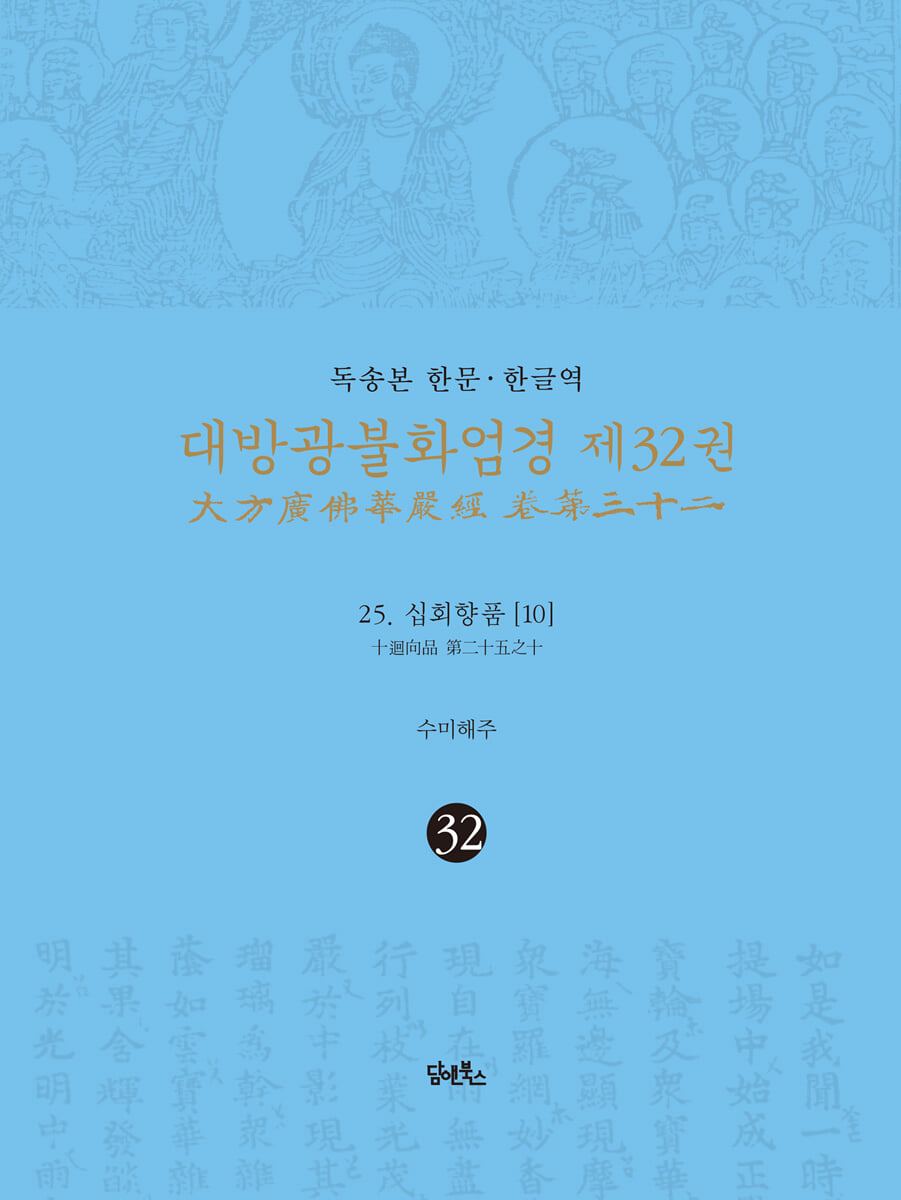
The 32nd volume of the Avatamsaka Sutra, translated into Chinese and Korean in the Dokseongbon edition
 |
Description
Book Introduction
A Guide to the Practice of the Faith for Practitioners Swimming in the Great Sea of Avatamsaka
『Dabanggwangbulhwaeomgyeong, Chinese and Korean translations of the Doksongbon』, Volume 32
25.
Ten Directions [10]
Volume 32, 25 of 『Daebanggwangbulhwaeomgyeong, Chinese and Korean translations of the recited version』, a book on the practice of the Avatamsaka Sutra compiled by Venerable Haeju, a leading scholar of the Avatamsaka Sutra and abbot of Sumijongsa Temple in Seoul, to help Buddhists practice their faith.
The Ten Chapters of the Buddhist Scriptures [10] were published.
The Sumijongsa Buddhist Scripture Research Institute has officially published a book to introduce the recitation and transcription of the sutras, which were produced independently by both lay and monks, to more Buddhists and the general public, and to guide them to the sea of Avatamsaka that leads to freedom from life and death and nirvana.
The Buddhist monk Haeju's Buddhist scriptures will be published simultaneously in the order of each volume, in both a recitation and transcription version, and the complete 80-volume Avatamsaka Sutra will be published.
『Dabanggwangbulhwaeomgyeong, Chinese and Korean translations of the Doksongbon』, Volume 32
25.
Ten Directions [10]
Volume 32, 25 of 『Daebanggwangbulhwaeomgyeong, Chinese and Korean translations of the recited version』, a book on the practice of the Avatamsaka Sutra compiled by Venerable Haeju, a leading scholar of the Avatamsaka Sutra and abbot of Sumijongsa Temple in Seoul, to help Buddhists practice their faith.
The Ten Chapters of the Buddhist Scriptures [10] were published.
The Sumijongsa Buddhist Scripture Research Institute has officially published a book to introduce the recitation and transcription of the sutras, which were produced independently by both lay and monks, to more Buddhists and the general public, and to guide them to the sea of Avatamsaka that leads to freedom from life and death and nirvana.
The Buddhist monk Haeju's Buddhist scriptures will be published simultaneously in the order of each volume, in both a recitation and transcription version, and the complete 80-volume Avatamsaka Sutra will be published.
- You can preview some of the book's contents.
Preview
Publisher's Review
In Volume 32 of the Avatamsaka Sutra, there are 25.
The Ten Directions [10] are included.
25.
The Ten Directions [10] is the content of the 10th, the Infinite Directions of the Equal Dharma Realm, among the ten directions of the Vajrapani Bodhisattva.
This is the tenth and final chapter of the Tenfold Path, and it explains the boundless paths of devotion, such as the Dharma Realm.
In order for a Bodhisattva to practice the Dharma, he must first return to his pure original mind, free from all defilements, ascend to the status of a Dharma teacher of the Ten-Hours Bodhisattva, and preach the Dharma for living beings.
To the question, “What is the boundless offering like the Dharma realm of Bodhisattva Mahasattva?” the answer is, “Bodhisattva Mahasattva ties a pure silk cloth around his head and, remaining in the position of a Dharma master, widely practices the Dharma offering.
He causes great compassion, allowing living beings to rest comfortably in the Bodhicitta, always practicing the benefits without rest, cultivating good roots with the Bodhicitta, and becoming a teacher of instruction for all living beings, showing them the path of omniscience.
For all living beings, he becomes the sun of the Dharma field, illuminating everything with the light of good roots. His mind is equal to all living beings, and he practices all good deeds without ceasing. His mind is pure and untainted, so his wisdom is free and he does not abandon any good roots of path karma.
“He will become a great and wise leader for all living beings, guiding them to enter a wide and peaceful and righteous path, becoming a constant guide for all living beings, cultivating all good roots and practices, and becoming an unbreakable and solid good friend for all living beings, enabling their good roots to grow and achieve success.”
As many of the Buddha's teachings talk about the importance of devotion, this section emphasizes that while it is important for living beings to accumulate merit, it is also important to devotion to many others.
The Doksongbon includes both the original Chinese text and the Korean translation.
The original Chinese text is on the left side of the text, and the corresponding Korean translation is on the right side.
The original text in Chinese characters is the Joseon Dynasty version of the Tripitaka Koreana.
The Tripitaka Koreana was created relatively early, and many later editions of the Tripitaka Koreana and studies on it were reflected in the original text through repeated editions.
The scope of reflecting different contents in the original text and the issue of variant characters were based on the content of the symposium at the end of each volume of the Tripitaka Koreana, and while examining the content before and after the scriptures, other symposiums were referenced. In terms of variant characters, the focus was on preserving the characteristics of the Tripitaka Koreana as much as possible.
The pronunciation and translation appended to the original Chinese text are based on the original text and have been partially revised according to the translation.
The Korean translation refers to existing translations and lectures, while at the same time, the parts where there are differences in interpretation and opinion are examined more deeply to reflect the interpretation of Monk Haeju.
It is the role of the practitioner who practices with the mind of Bodhi to resolve doubts that cannot be resolved through the teachings and lectures of the wise.
The driving force that deepens your studies lies entirely within yourself.
If you look at it with your eyes, read it out loud, and write it down phrase by phrase, at some point your writing skills will open and your eyes will open.
Translator's Note
Monk Haeju explains, “The Avatamsaka Sutra is a sutra that explains the Buddha world, the place Buddhists aspire to reach, and the various methods of liberation for reaching and adorning that Buddha world.”
The teachings of the Avatamsaka Sutra are said to be teachings that lead one to return to one's original place and to perfect the wisdom of living together with all beings in the world [安住世間成正覺].
It is said that all of this is the creation of the Buddha's wisdom mind [一切唯心造], and that it can be called the Haein (海印) as the adornment of liberation through the meritorious acts of the Bodhi mind (菩提心) that are manifested through faith.
Finally, regarding the publication of the 『Dabanggwangbul Avatamsaka Sutra in Chinese and Korean』 and the 『Dabanggwangbul Avatamsaka Sutra in Korean』, Venerable Haeju said, “I am grateful to the Buddha and Bodhisattva for their protection and the three-time karma that have enabled me to begin the Buddhist rite of distributing the Avatamsaka Sutra, and I hope that I can repay their kindness.
With everyone's help, we will publish all 80 volumes and work diligently to ensure that the publication of the Avatamsaka Sutra is successfully completed.
“I pray that the Avatamsaka Sutra will be widely distributed and that through the merits of reciting and copying the sutra, we can participate in the magnificence of liberation in the Avatamsaka Dharma realm.”
The Ten Directions [10] are included.
25.
The Ten Directions [10] is the content of the 10th, the Infinite Directions of the Equal Dharma Realm, among the ten directions of the Vajrapani Bodhisattva.
This is the tenth and final chapter of the Tenfold Path, and it explains the boundless paths of devotion, such as the Dharma Realm.
In order for a Bodhisattva to practice the Dharma, he must first return to his pure original mind, free from all defilements, ascend to the status of a Dharma teacher of the Ten-Hours Bodhisattva, and preach the Dharma for living beings.
To the question, “What is the boundless offering like the Dharma realm of Bodhisattva Mahasattva?” the answer is, “Bodhisattva Mahasattva ties a pure silk cloth around his head and, remaining in the position of a Dharma master, widely practices the Dharma offering.
He causes great compassion, allowing living beings to rest comfortably in the Bodhicitta, always practicing the benefits without rest, cultivating good roots with the Bodhicitta, and becoming a teacher of instruction for all living beings, showing them the path of omniscience.
For all living beings, he becomes the sun of the Dharma field, illuminating everything with the light of good roots. His mind is equal to all living beings, and he practices all good deeds without ceasing. His mind is pure and untainted, so his wisdom is free and he does not abandon any good roots of path karma.
“He will become a great and wise leader for all living beings, guiding them to enter a wide and peaceful and righteous path, becoming a constant guide for all living beings, cultivating all good roots and practices, and becoming an unbreakable and solid good friend for all living beings, enabling their good roots to grow and achieve success.”
As many of the Buddha's teachings talk about the importance of devotion, this section emphasizes that while it is important for living beings to accumulate merit, it is also important to devotion to many others.
The Doksongbon includes both the original Chinese text and the Korean translation.
The original Chinese text is on the left side of the text, and the corresponding Korean translation is on the right side.
The original text in Chinese characters is the Joseon Dynasty version of the Tripitaka Koreana.
The Tripitaka Koreana was created relatively early, and many later editions of the Tripitaka Koreana and studies on it were reflected in the original text through repeated editions.
The scope of reflecting different contents in the original text and the issue of variant characters were based on the content of the symposium at the end of each volume of the Tripitaka Koreana, and while examining the content before and after the scriptures, other symposiums were referenced. In terms of variant characters, the focus was on preserving the characteristics of the Tripitaka Koreana as much as possible.
The pronunciation and translation appended to the original Chinese text are based on the original text and have been partially revised according to the translation.
The Korean translation refers to existing translations and lectures, while at the same time, the parts where there are differences in interpretation and opinion are examined more deeply to reflect the interpretation of Monk Haeju.
It is the role of the practitioner who practices with the mind of Bodhi to resolve doubts that cannot be resolved through the teachings and lectures of the wise.
The driving force that deepens your studies lies entirely within yourself.
If you look at it with your eyes, read it out loud, and write it down phrase by phrase, at some point your writing skills will open and your eyes will open.
Translator's Note
Monk Haeju explains, “The Avatamsaka Sutra is a sutra that explains the Buddha world, the place Buddhists aspire to reach, and the various methods of liberation for reaching and adorning that Buddha world.”
The teachings of the Avatamsaka Sutra are said to be teachings that lead one to return to one's original place and to perfect the wisdom of living together with all beings in the world [安住世間成正覺].
It is said that all of this is the creation of the Buddha's wisdom mind [一切唯心造], and that it can be called the Haein (海印) as the adornment of liberation through the meritorious acts of the Bodhi mind (菩提心) that are manifested through faith.
Finally, regarding the publication of the 『Dabanggwangbul Avatamsaka Sutra in Chinese and Korean』 and the 『Dabanggwangbul Avatamsaka Sutra in Korean』, Venerable Haeju said, “I am grateful to the Buddha and Bodhisattva for their protection and the three-time karma that have enabled me to begin the Buddhist rite of distributing the Avatamsaka Sutra, and I hope that I can repay their kindness.
With everyone's help, we will publish all 80 volumes and work diligently to ensure that the publication of the Avatamsaka Sutra is successfully completed.
“I pray that the Avatamsaka Sutra will be widely distributed and that through the merits of reciting and copying the sutra, we can participate in the magnificence of liberation in the Avatamsaka Dharma realm.”
GOODS SPECIFICS
- Date of issue: January 24, 2023
- Format: Hardcover book binding method guide
- Page count, weight, size: 134 pages | 462g | 190*260*10mm
- ISBN13: 9791162013861
- ISBN10: 1162013869
You may also like
카테고리
korean


korean

![ELLE 엘르 스페셜 에디션 A형 : 12월 [2025]](http://librairie.coreenne.fr/cdn/shop/files/b8e27a3de6c9538896439686c6b0e8fb.jpg?v=1766436872&width=3840)


