

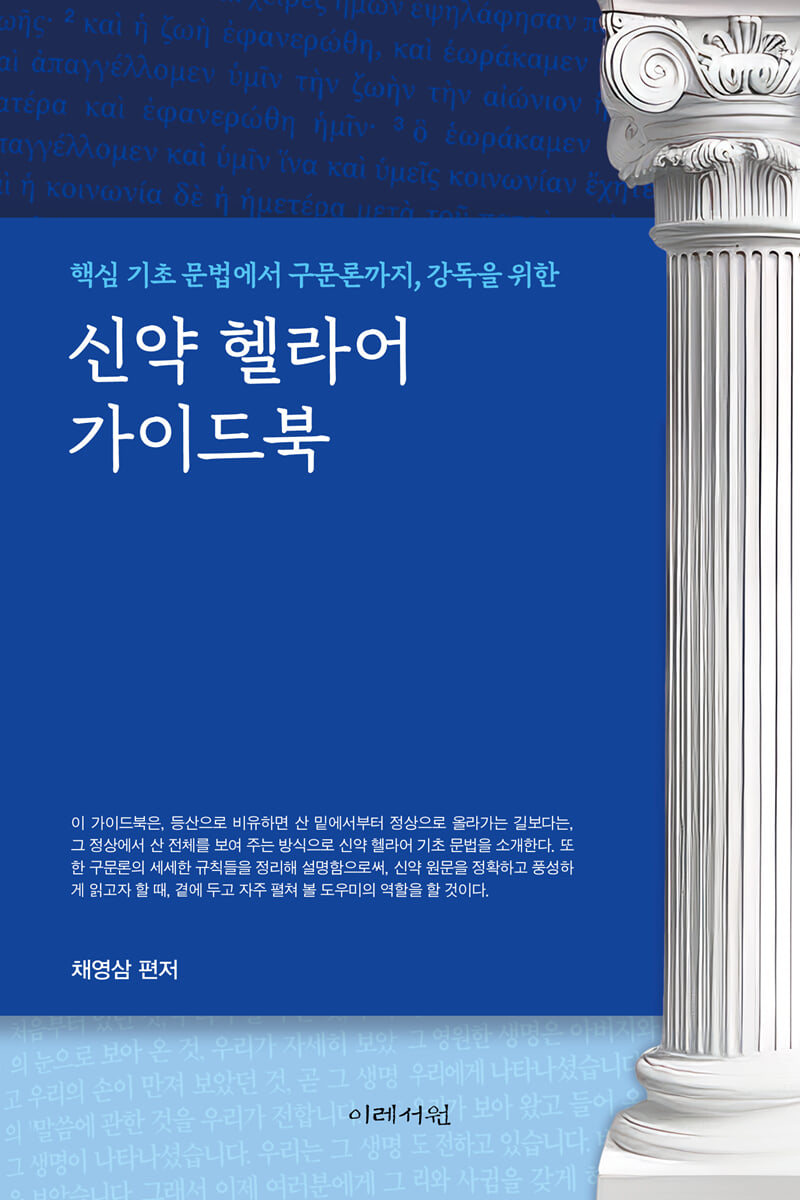
New Testament Greek Guidebook
 |
Description
Book Introduction
“The New Testament Greek is no longer a challenge, but a vivid experience.”
“When the original text is opened, the Word appears in a whole new light.”
From core basic grammar to syntax, this practical guide to Greek was written to aid in reading the New Testament. It is not a simple grammar textbook, but a guidebook that organizes key structures and syntax rules for readers who want to read and understand the original text of the Bible.
It helps New Testament Greek learners see the big picture of the entire system and then dive into the details where necessary.
It is useful for both seminarians and pastors who have already studied Greek but whose memory has become hazy, and for laypeople who want to begin studying the original text of the Bible.
The author emphasizes that “the experience of reading the New Testament Greek in its original text provides a vivid impression that cannot be obtained by reading only the translation.”
Just as seeing a tiger in a picture book is completely different from going to a zoo and seeing a live tiger in person, reading the original text directly allows you to experience the words coming to life and vividly.
This book goes beyond simple grammar theory and provides examples of original text readings, demonstrating concrete ways to actually read and interpret the New Testament text.
This allows readers to directly experience the nuances of the original Greek text and gain deeper insight into their sermons and Bible studies.
“When the original text is opened, the Word appears in a whole new light.”
From core basic grammar to syntax, this practical guide to Greek was written to aid in reading the New Testament. It is not a simple grammar textbook, but a guidebook that organizes key structures and syntax rules for readers who want to read and understand the original text of the Bible.
It helps New Testament Greek learners see the big picture of the entire system and then dive into the details where necessary.
It is useful for both seminarians and pastors who have already studied Greek but whose memory has become hazy, and for laypeople who want to begin studying the original text of the Bible.
The author emphasizes that “the experience of reading the New Testament Greek in its original text provides a vivid impression that cannot be obtained by reading only the translation.”
Just as seeing a tiger in a picture book is completely different from going to a zoo and seeing a live tiger in person, reading the original text directly allows you to experience the words coming to life and vividly.
This book goes beyond simple grammar theory and provides examples of original text readings, demonstrating concrete ways to actually read and interpret the New Testament text.
This allows readers to directly experience the nuances of the original Greek text and gain deeper insight into their sermons and Bible studies.
- You can preview some of the book's contents.
Preview
index
introduction
1_ How is this book structured?
2_Why should we study New Testament Greek?
3_ How to study New Testament Greek?
Part 1: Core Basic Grammar
1_ How to start?
2_ Reading habits
3_ Alphabet
4_ Memorizing frequently used words
5_ Understanding basic grammar
6_ Core Structures of Basic Greek Grammar
7_ Overview of noun conjugation
8 _ First and second conjugation patterns of nouns
9 _ Changes in definite articles
10_ Adjective Conjugation
11 _ Personal pronoun changes
12 _ Demonstrative pronoun changes
13 _ Third Change Noun Pattern
14 _ Verb Conjugation Marks (1) - Understanding the Structure
15 _ Marks of verb conjugation (2) - Types of actions and tenses
16 _ Marks of verb conjugation (3) - modal, infinitive, participle
17 _ Subjunctive
18 _ Imperative
19 _ Hope Law
20 _ Infinitive
21 _ Understanding Participles (1) - Marks
22 _ Understanding Participles (2) - Usage
23 _ Prepositions
Appendix 1: Understanding Syntax According to the 'Verbal Perspective'
1_ What does the ‘tense’ of a Greek verb indicate?
2_ Features of the Verbal Perspective Model
3_ Benefits of a Verbal Perspective Model
4_ Comparison and Evaluation of the 'Verbal Perspective' Model and the 'Type of Action' Model
Part 2: Rules of Syntactic Theory
I _ Verb Syntax
II _ Participle Syntax
A.
Participle tense
B.
Types of participles
III _ Types of Actions
IV _ Indicative method
A.
Present tense in the indicative mood
B.
Future tense in the indicative mood
C.
Past tense in the indicative mood
V _ subjunctive mood
A.
Conditional sentences used in the Independence Clause
B.
Subjunctive mood used in subordinate clauses
VI _ Imperative
A.
Imperative
B.
Prohibited
VII _ The Law of Hope
VIII _ Conditional sentences
IX _ Infinitive
A.
Usage of infinitive without article
B.
Usage of infinitive and relative articles
X _ case syntax
A.
introduction
B.
vocative case
C.
1st case (nominative case)
D.
2nd case (possessive case)
E.
3rd case (dative)
F.
4th case (objective case)
XI _ Indirect Discourse
XII _ Conjunctions
A.
coordinator
B.
subordinate conjunctions
XIII _ Unchangeable History
Appendix 2: The Practice of Reading the New Testament Greek Scriptures
1_ James 1:4a
2_ 1 John 1:1
References for Studying New Testament Greek
1_ How is this book structured?
2_Why should we study New Testament Greek?
3_ How to study New Testament Greek?
Part 1: Core Basic Grammar
1_ How to start?
2_ Reading habits
3_ Alphabet
4_ Memorizing frequently used words
5_ Understanding basic grammar
6_ Core Structures of Basic Greek Grammar
7_ Overview of noun conjugation
8 _ First and second conjugation patterns of nouns
9 _ Changes in definite articles
10_ Adjective Conjugation
11 _ Personal pronoun changes
12 _ Demonstrative pronoun changes
13 _ Third Change Noun Pattern
14 _ Verb Conjugation Marks (1) - Understanding the Structure
15 _ Marks of verb conjugation (2) - Types of actions and tenses
16 _ Marks of verb conjugation (3) - modal, infinitive, participle
17 _ Subjunctive
18 _ Imperative
19 _ Hope Law
20 _ Infinitive
21 _ Understanding Participles (1) - Marks
22 _ Understanding Participles (2) - Usage
23 _ Prepositions
Appendix 1: Understanding Syntax According to the 'Verbal Perspective'
1_ What does the ‘tense’ of a Greek verb indicate?
2_ Features of the Verbal Perspective Model
3_ Benefits of a Verbal Perspective Model
4_ Comparison and Evaluation of the 'Verbal Perspective' Model and the 'Type of Action' Model
Part 2: Rules of Syntactic Theory
I _ Verb Syntax
II _ Participle Syntax
A.
Participle tense
B.
Types of participles
III _ Types of Actions
IV _ Indicative method
A.
Present tense in the indicative mood
B.
Future tense in the indicative mood
C.
Past tense in the indicative mood
V _ subjunctive mood
A.
Conditional sentences used in the Independence Clause
B.
Subjunctive mood used in subordinate clauses
VI _ Imperative
A.
Imperative
B.
Prohibited
VII _ The Law of Hope
VIII _ Conditional sentences
IX _ Infinitive
A.
Usage of infinitive without article
B.
Usage of infinitive and relative articles
X _ case syntax
A.
introduction
B.
vocative case
C.
1st case (nominative case)
D.
2nd case (possessive case)
E.
3rd case (dative)
F.
4th case (objective case)
XI _ Indirect Discourse
XII _ Conjunctions
A.
coordinator
B.
subordinate conjunctions
XIII _ Unchangeable History
Appendix 2: The Practice of Reading the New Testament Greek Scriptures
1_ James 1:4a
2_ 1 John 1:1
References for Studying New Testament Greek
Into the book
To properly master the basic grammar of New Testament Greek, you need to choose a textbook that suits you from the list of “References for Learning New Testament Greek” at the end of this book, and steadily learn basic grammar by solving practice problems step by step.
This 'guidebook' was created to meet the needs of those who have learned basic grammar at least once in the past but need to read the original text of the New Testament in situations where they cannot remember the content.
Additionally, “Appendix 1” is included at the end of Part 1, which explains and explains how to use the “Verbal Aspects” regarding the tense of Greek verbs, which have been recently discussed.
Just as conventional theories about Greek verbs are not absolute, new theories need not obscure the validity of previous ones.
As sufficient discussion and verification are still required, it should be utilized in an appropriate and reasonable manner.
Finally, after introducing Part 2, “Rules of Syntactic,” we included reading commentaries on two New Testament passages in “Appendix 2” to illustrate the “practice of reading New Testament Greek.”
This 'guidebook' was created to meet the needs of those who have learned basic grammar at least once in the past but need to read the original text of the New Testament in situations where they cannot remember the content.
Additionally, “Appendix 1” is included at the end of Part 1, which explains and explains how to use the “Verbal Aspects” regarding the tense of Greek verbs, which have been recently discussed.
Just as conventional theories about Greek verbs are not absolute, new theories need not obscure the validity of previous ones.
As sufficient discussion and verification are still required, it should be utilized in an appropriate and reasonable manner.
Finally, after introducing Part 2, “Rules of Syntactic,” we included reading commentaries on two New Testament passages in “Appendix 2” to illustrate the “practice of reading New Testament Greek.”
--- From the "Introduction"
Publisher's Review
For anyone who wants to seriously interpret or preach the New Testament, New Testament Greek is a mountain that must be overcome.
Nowadays, there are many tools available to help you interpret the original language of the Bible.
However, even if you want to use such tools, you need a basic understanding of Greek grammar and syntax.
Because you need to know for yourself how to understand and handle the information you find.
So, the problem with learning New Testament Greek grammar is that it's so easy to forget it that you can even get confused about the alphabet after a short while.
Of course.
Because Greek is not a language we use all the time.
Moreover, when trying to read the original text of the New Testament, basic grammar knowledge alone is not enough.
Some explanations of syntax are needed.
However, there are not many books that are suitable for filling such needs, and there are also aspects that are difficult to access.
This book is the result of an attempt to fill these needs.
This book is not your typical basic Greek grammar book.
This guidebook introduces basic New Testament Greek grammar by showing the entire mountain from the summit, rather than climbing from the bottom to the top, like a mountain climbing metaphor.
It was also created to serve as a helpful guide to keep by your side and refer to frequently when you want to read the original New Testament text accurately and richly by organizing and explaining the detailed rules of syntax.
This guidebook provides readers with a comprehensive overview of basic New Testament Greek grammar and teaches them how to identify clues for syntactic help when reading the original New Testament text.
This book also provides guidance on how to understand and utilize relatively recently proposed new theories of Greek verbs.
It also includes examples of actual Greek reading, helping you improve your ability to read original texts beyond theoretical study.
Features of this book
ㆍ Core Summary Guidebook: Organizes complex Greek grammar into key structures essential for interpreting the New Testament, and utilizes various diagrams to visually understand the grammatical structure.
ㆍ In-depth learning through syntax: In addition to basic grammar, in-depth 'syntax rules' such as verb syntax, conditional sentences, participles, and infinitives are systematically compiled and included.
ㆍ In-depth analysis of the verbal perspective: The latest discussions on the 'types of action' and 'verbal perspective' of Greek verb tenses are included as an appendix, providing the insight necessary to understand the three-dimensional meaning of the text beyond simple tense interpretation.
ㆍ Emphasis on practical application: By actually reading two New Testament Greek texts (James 1:4a, 1 John 1:1), we help readers grasp the nuances of the original text.
Main readership
ㆍ A theology student who has studied basic Greek grammar in the past but wants to review it again.
ㆍ Seminary students who want to quickly grasp the core structure of Greek grammar
ㆍ Pastors who seek to deepen their sermons and biblical interpretation through original text research.
ㆍ A lay Bible reader who wants to read the New Testament in its original text and feel a deeper emotion than the translation.
Nowadays, there are many tools available to help you interpret the original language of the Bible.
However, even if you want to use such tools, you need a basic understanding of Greek grammar and syntax.
Because you need to know for yourself how to understand and handle the information you find.
So, the problem with learning New Testament Greek grammar is that it's so easy to forget it that you can even get confused about the alphabet after a short while.
Of course.
Because Greek is not a language we use all the time.
Moreover, when trying to read the original text of the New Testament, basic grammar knowledge alone is not enough.
Some explanations of syntax are needed.
However, there are not many books that are suitable for filling such needs, and there are also aspects that are difficult to access.
This book is the result of an attempt to fill these needs.
This book is not your typical basic Greek grammar book.
This guidebook introduces basic New Testament Greek grammar by showing the entire mountain from the summit, rather than climbing from the bottom to the top, like a mountain climbing metaphor.
It was also created to serve as a helpful guide to keep by your side and refer to frequently when you want to read the original New Testament text accurately and richly by organizing and explaining the detailed rules of syntax.
This guidebook provides readers with a comprehensive overview of basic New Testament Greek grammar and teaches them how to identify clues for syntactic help when reading the original New Testament text.
This book also provides guidance on how to understand and utilize relatively recently proposed new theories of Greek verbs.
It also includes examples of actual Greek reading, helping you improve your ability to read original texts beyond theoretical study.
Features of this book
ㆍ Core Summary Guidebook: Organizes complex Greek grammar into key structures essential for interpreting the New Testament, and utilizes various diagrams to visually understand the grammatical structure.
ㆍ In-depth learning through syntax: In addition to basic grammar, in-depth 'syntax rules' such as verb syntax, conditional sentences, participles, and infinitives are systematically compiled and included.
ㆍ In-depth analysis of the verbal perspective: The latest discussions on the 'types of action' and 'verbal perspective' of Greek verb tenses are included as an appendix, providing the insight necessary to understand the three-dimensional meaning of the text beyond simple tense interpretation.
ㆍ Emphasis on practical application: By actually reading two New Testament Greek texts (James 1:4a, 1 John 1:1), we help readers grasp the nuances of the original text.
Main readership
ㆍ A theology student who has studied basic Greek grammar in the past but wants to review it again.
ㆍ Seminary students who want to quickly grasp the core structure of Greek grammar
ㆍ Pastors who seek to deepen their sermons and biblical interpretation through original text research.
ㆍ A lay Bible reader who wants to read the New Testament in its original text and feel a deeper emotion than the translation.
GOODS SPECIFICS
- Date of issue: October 15, 2025
- Page count, weight, size: 224 pages | 140*210*20mm
- ISBN13: 9788974356842
- ISBN10: 8974356848
You may also like
카테고리
korean


korean

![GQ KOREA Mark (Monthly): December [2025]](http://librairie.coreenne.fr/cdn/shop/files/8ef265dbbfbf186523ed75ba7319009d.jpg?v=1765340328&width=3840)


