

Suttanipata Mind Study
 |
Description
Book Introduction
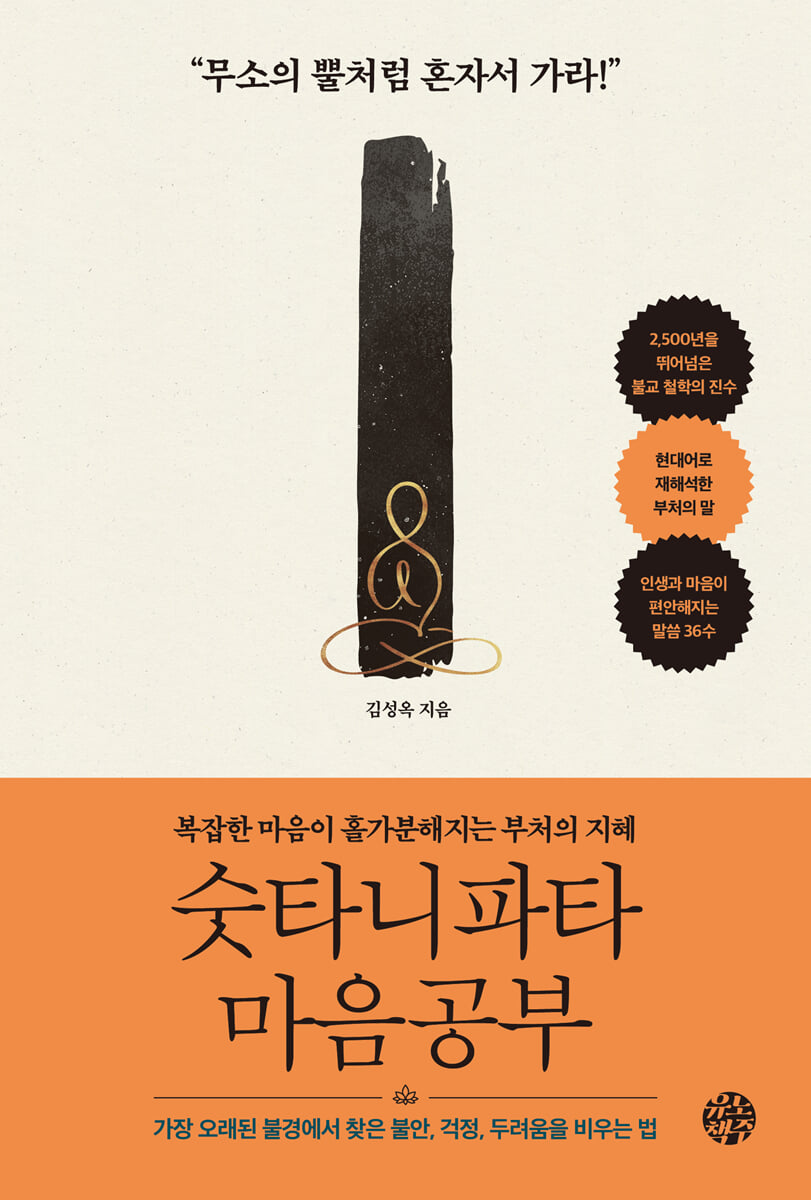
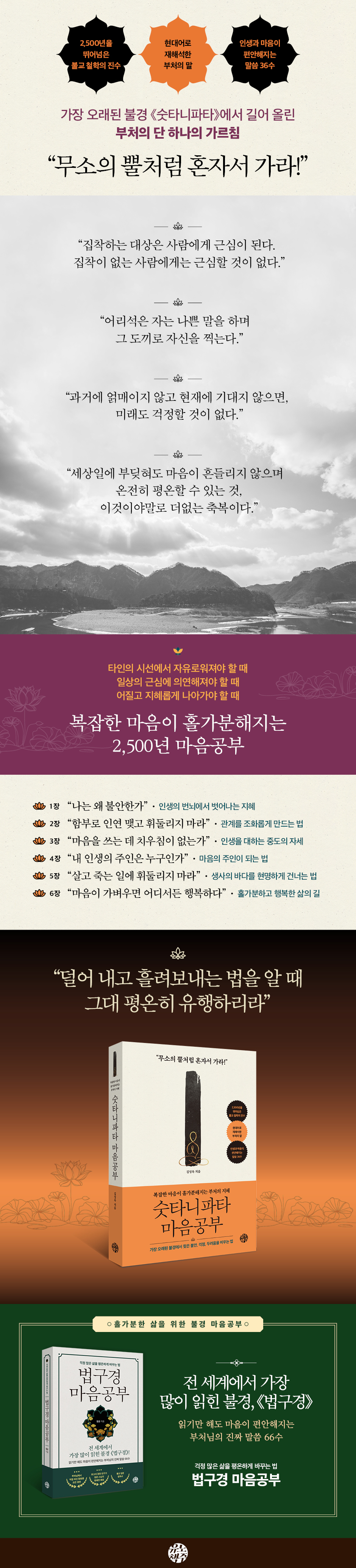
“Go alone like a rhinoceros horn!”
Found in the oldest Buddhist scripture, Suttanipata
The Buddha's only teaching
“Go alone like a rhinoceros horn!” Everyone has probably heard this saying at least once.
Here, the rhinoceros is referred to as a rhinoceros, and is depicted as a lonely being through the description of going alone.
At first glance, this phrase may bring to mind a life of isolation or independence, but if you look at the context of this sentence, you will discover a resonance of a completely different level.
The phrase “Go alone like a rhinoceros horn!” from the early Buddhist scripture “Suttanipata” is an expression that symbolizes the attitude of a practitioner who protects himself without being swayed by the world.
It refers to an attitude of quietly maintaining one's own place without being swayed by external evaluations, anxiety, or complicated emotions.
The Sutta Nipata is the oldest Buddhist scripture that vividly describes the Buddha's process of practice.
In a time when there were no religious orders or systems, the Buddha's words quietly and calmly explain how to view the suffering of life and how to live.
Above all, the compassionate gaze and vivid voice of the Buddha, who sought to deeply look into the suffering and anguish of the people of his time, remain intact, conveying a familiar resonance to us living today.
How do we fall into affliction? What holds us back? Why do we cling?
Buddha's wisdom that eases the complex mind
『Suttanipata Mind Study』 interprets the Buddha's teachings from ancient scriptures in modern language.
The author, who teaches Buddhism at Dongguk University and interprets the scriptures from a humanistic perspective, reflects on each verse in this book, addressing issues we face in life such as anxiety, relationships, desire, self, death, and happiness.
Beyond simple commentary, it allows us to examine ‘my heart now’ by applying those words to our lives today.
It also serves as a friendly bridge for those who are encountering the Suttanipāta for the first time or for those who are familiar with it but feel distant from it.
It shows that the ancient scriptures that have touched the hearts of countless people can also have a deep resonance in modern life.
The Suttanipata Mind Study does not speak of grand enlightenment.
Instead, it shows us how we should eat, what we should say, and who we should relate to in this life.
The courage to choose the direction that truly brings peace to my heart, rather than the direction the world wants me to go, is the true meaning of the saying, "Go alone like a rhinoceros horn," and the attitude toward life that this book seeks to convey.
I highly recommend reading this book, which will serve as a mental map that will point you in the right direction whenever you feel lost in an anxious and complex life.
When the noisy thoughts stop and a small peace settles in your heart through the wisdom of Buddha, life will become much more comfortable.
Found in the oldest Buddhist scripture, Suttanipata
The Buddha's only teaching
“Go alone like a rhinoceros horn!” Everyone has probably heard this saying at least once.
Here, the rhinoceros is referred to as a rhinoceros, and is depicted as a lonely being through the description of going alone.
At first glance, this phrase may bring to mind a life of isolation or independence, but if you look at the context of this sentence, you will discover a resonance of a completely different level.
The phrase “Go alone like a rhinoceros horn!” from the early Buddhist scripture “Suttanipata” is an expression that symbolizes the attitude of a practitioner who protects himself without being swayed by the world.
It refers to an attitude of quietly maintaining one's own place without being swayed by external evaluations, anxiety, or complicated emotions.
The Sutta Nipata is the oldest Buddhist scripture that vividly describes the Buddha's process of practice.
In a time when there were no religious orders or systems, the Buddha's words quietly and calmly explain how to view the suffering of life and how to live.
Above all, the compassionate gaze and vivid voice of the Buddha, who sought to deeply look into the suffering and anguish of the people of his time, remain intact, conveying a familiar resonance to us living today.
How do we fall into affliction? What holds us back? Why do we cling?
Buddha's wisdom that eases the complex mind
『Suttanipata Mind Study』 interprets the Buddha's teachings from ancient scriptures in modern language.
The author, who teaches Buddhism at Dongguk University and interprets the scriptures from a humanistic perspective, reflects on each verse in this book, addressing issues we face in life such as anxiety, relationships, desire, self, death, and happiness.
Beyond simple commentary, it allows us to examine ‘my heart now’ by applying those words to our lives today.
It also serves as a friendly bridge for those who are encountering the Suttanipāta for the first time or for those who are familiar with it but feel distant from it.
It shows that the ancient scriptures that have touched the hearts of countless people can also have a deep resonance in modern life.
The Suttanipata Mind Study does not speak of grand enlightenment.
Instead, it shows us how we should eat, what we should say, and who we should relate to in this life.
The courage to choose the direction that truly brings peace to my heart, rather than the direction the world wants me to go, is the true meaning of the saying, "Go alone like a rhinoceros horn," and the attitude toward life that this book seeks to convey.
I highly recommend reading this book, which will serve as a mental map that will point you in the right direction whenever you feel lost in an anxious and complex life.
When the noisy thoughts stop and a small peace settles in your heart through the wisdom of Buddha, life will become much more comfortable.
- You can preview some of the book's contents.
Preview
index
Opening Remarks: How to Escape Pain and Find Freedom
What kind of scripture is the Sutta Nipata?
Chapter 1: "Why Am I Anxious?" │ Wisdom for Escape from Life's Troubles
How to Cross the Vortex of Anxiety
Life is truly a sea of suffering.
Those without attachments have no worries.
The more you try to chase it away, the closer it gets
What are you planting in your heart?
The moment you become aware, silence comes.
Chapter 2: "Don't Form Relationships Carelessly and Be Swayed by Them"│How to Create Harmonious Relationships
As relationships deepen, more space is needed.
You'd better go alone
Don't compare yourself to others
The karma accumulated through words opens the gates of hell.
Those caught in the net of prejudice cannot fly.
There is no enlightenment without 'Bosi'
Chapter 3: "Impartiality in Your Attitude" │ A Moderate Approach to Life
Where does disaster begin?
A life of 'satisfaction with small desires' that brings true happiness
“Sense is the door, desire is the fire.”
Why do we seek the source of our anger in others?
Realize the 'Three Poisons' that Harm the Mind
There is no reason to be swayed by external forces.
Chapter 4: “Who is the Master of My Life?” │ How to Become the Master of Your Mind
Is the 'me' I know me?
The wisdom of 'no-self' that empties suffering
“Make yourself an island and travel the world.”
The one who conquers himself is the true winner.
Compare the weight of life to me
If you want to live with dignity, don't compare.
Chapter 5: "Don't Be Swayed by Life and Death" │ How to Wisely Cross the Sea of Life and Death
Even if you live a hundred years, in the end you will part ways.
Enlightenment that breaks the chain of reincarnation
“This body too will one day be like a corpse.”
When you pass the moment of death
Crossing the rough waves to a refuge
Shed your attachments like a snake shedding its skin.
Chapter 6: "If Your Heart is Light, You'll Be Happy Anywhere" │ The Path to a Carefree and Happy Life
The more you try to grasp it, the more you miss out on happiness.
Happiness and unhappiness are twin sisters
Don't try to be happy
Treat others with compassion
May all that exists be happy
As if today were the last day of my life
Conclusion: A Path from Anxiety and Worry to Peace
References
What kind of scripture is the Sutta Nipata?
Chapter 1: "Why Am I Anxious?" │ Wisdom for Escape from Life's Troubles
How to Cross the Vortex of Anxiety
Life is truly a sea of suffering.
Those without attachments have no worries.
The more you try to chase it away, the closer it gets
What are you planting in your heart?
The moment you become aware, silence comes.
Chapter 2: "Don't Form Relationships Carelessly and Be Swayed by Them"│How to Create Harmonious Relationships
As relationships deepen, more space is needed.
You'd better go alone
Don't compare yourself to others
The karma accumulated through words opens the gates of hell.
Those caught in the net of prejudice cannot fly.
There is no enlightenment without 'Bosi'
Chapter 3: "Impartiality in Your Attitude" │ A Moderate Approach to Life
Where does disaster begin?
A life of 'satisfaction with small desires' that brings true happiness
“Sense is the door, desire is the fire.”
Why do we seek the source of our anger in others?
Realize the 'Three Poisons' that Harm the Mind
There is no reason to be swayed by external forces.
Chapter 4: “Who is the Master of My Life?” │ How to Become the Master of Your Mind
Is the 'me' I know me?
The wisdom of 'no-self' that empties suffering
“Make yourself an island and travel the world.”
The one who conquers himself is the true winner.
Compare the weight of life to me
If you want to live with dignity, don't compare.
Chapter 5: "Don't Be Swayed by Life and Death" │ How to Wisely Cross the Sea of Life and Death
Even if you live a hundred years, in the end you will part ways.
Enlightenment that breaks the chain of reincarnation
“This body too will one day be like a corpse.”
When you pass the moment of death
Crossing the rough waves to a refuge
Shed your attachments like a snake shedding its skin.
Chapter 6: "If Your Heart is Light, You'll Be Happy Anywhere" │ The Path to a Carefree and Happy Life
The more you try to grasp it, the more you miss out on happiness.
Happiness and unhappiness are twin sisters
Don't try to be happy
Treat others with compassion
May all that exists be happy
As if today were the last day of my life
Conclusion: A Path from Anxiety and Worry to Peace
References
Detailed image
Into the book
I think the Yaksha Hemavata, who lived in the snowy mountains of the Himalayas, was like that too.
Early scriptures often feature stories of yakshas coming to hear the Buddha's sermons.
Yaksha refers to ghosts or spirits called Yaksha in Indian mythology and Buddhist literature, and we are familiar with the Chinese character word Yaksha (夜叉).
Those who do not belong to the human group have greater power than humans, and with that power they can help or harm humans.
In the Suttanipāta, the yaksha Hemavatha asks the Buddha why people suffer and how they can be freed from suffering.
And I ask again:
“Who crosses the flood in this world? Who crosses the sea in this world?” To this, the Buddha says:
“Only he who always observes the precepts, who is wise and whose mind is tranquil, who looks inward and abides in mindfulness, can cross the flood that is difficult to cross.” _Suttanipāta, 〈Hemavatha Sutta〉 174
--- From "How to Cross the Vortex of Anxiety"
Buddhist teachings do not end with speaking of suffering.
We will not omit the story of the cessation of suffering.
The content of the Buddha's teachings at Sarnath, the site of his first sermon, is no different.
It was about the arising of suffering and its cessation.
This is called the first turning of the wheel of the law, meaning that it is the first turning of the wheel of the law, and it explains the four noble truths.
The four truths are woven into a very coherent structure of cause and effect relationships.
It is very similar to the way diseases are diagnosed in ancient Indian medical texts.
It is a method of describing the symptoms of a disease, the cause of the disease, the state in which the disease has been cured, and the methods by which it can be treated.
Just as a doctor first diagnoses an illness, the Buddha examined the symptoms of suffering and then discovered its cause.
The Buddha's diagnosis is that the cause of all suffering is desire and attachment.
Moreover, just as a doctor treats a patient with a prescription, the Buddha presents specific methods for achieving the cessation of suffering.
It explains the 'Eightfold Path' in order: right view, right thought, right speech, right action, right livelihood, right effort, right awareness, and right meditation.
In this respect, the Four Noble Truths and the Noble Eightfold Path can be said to be a set of dharma teachings.
Looking back on his lifelong teachings, the Buddha said, “I teach only suffering and liberation from suffering.”
He was a doctor who cured the illnesses and sufferings of living beings.
The words of the Buddha, as the king of doctors and the king of medicine, are a prescription for today.
--- From "Life is truly a sea of suffering"
There is an interesting story told about these six senses, six senses, and six consciousnesses.
This happened when the Buddha visited Uruvela, a village near Rajagaha, the capital of Magadha.
This is also the place where Buddha practiced asceticism for six years before attaining enlightenment.
In that village there were three brothers, Kasapa, who lived by offering sacrifices on the altar of fire, and they had over a thousand disciples following them.
When the Buddha met the Kassapa brothers at sunset, he looked at the sky ablaze with the evening glow and said to them:
“Bhikkhus, the whole world is burning.
My eyes are burning.
The colors and shapes visible to the eye are burning.
“The perception of the eyes is burning….”
For those who serve fire, hearing that the world is on fire must have been a great shock.
You must have been even more surprised to hear that my eyes were burning.
It is said that after hearing this sermon, Brother Kassapa and about a thousand of his disciples took refuge in the Buddha.
What profound meaning could there possibly be in these words? Imagine the burning sensation of sensual desire within us as we gaze upon objects in the external world.
Don't we desire only to see beautiful things, hear pleasant sounds, smell fragrant scents, eat delicious foods, and touch only soft things? He described these sensual pleasures as burning fire.
It means to face the dangers of desire hidden behind sensual pleasure.
--- From “Sense is the door, desire is the fire”
The decisive event that made Prince Siddhartha of Kapilavastu decide to leave home was the problem of old age, illness, and death of the people he saw on the streets outside his palace.
One day, he sees an old man with hunched shoulders sitting wearily outside the school gate.
Everyone becomes anxious after realizing that they cannot avoid growing old.
He becomes even more worried after seeing a sick person outside the South Gate, breathing heavily and in physical pain.
After seeing the funeral procession of the dead man outside the West Gate, he was tormented by the fact that not only he, but also his father, King Jeongban, could not escape death, and that this was the case for all people in the world.
Moreover, his mother, Queen Maya, passed away just seven days after giving birth to Siddhartha, so Siddhartha must have always been afraid of death in his mother's absence.
Finally, outside the North Gate, you will see the practitioners.
Despite their gaunt and haggard appearance, they exuded a sense of detachment.
This incident becomes a decisive turning point for him to decide to follow the path of a practitioner like them.
In this somewhat schematic story of 'Samun Yugwan (四門遊觀),' which means wandering around the four gates of the east, west, south, and north, we encounter the shock of young Siddhartha witnessing aging, illness, and death for the first time.
Isn't the first encounter with death a shocking experience for everyone? It's a revelation of the unavoidable truth of life.
Early scriptures often feature stories of yakshas coming to hear the Buddha's sermons.
Yaksha refers to ghosts or spirits called Yaksha in Indian mythology and Buddhist literature, and we are familiar with the Chinese character word Yaksha (夜叉).
Those who do not belong to the human group have greater power than humans, and with that power they can help or harm humans.
In the Suttanipāta, the yaksha Hemavatha asks the Buddha why people suffer and how they can be freed from suffering.
And I ask again:
“Who crosses the flood in this world? Who crosses the sea in this world?” To this, the Buddha says:
“Only he who always observes the precepts, who is wise and whose mind is tranquil, who looks inward and abides in mindfulness, can cross the flood that is difficult to cross.” _Suttanipāta, 〈Hemavatha Sutta〉 174
--- From "How to Cross the Vortex of Anxiety"
Buddhist teachings do not end with speaking of suffering.
We will not omit the story of the cessation of suffering.
The content of the Buddha's teachings at Sarnath, the site of his first sermon, is no different.
It was about the arising of suffering and its cessation.
This is called the first turning of the wheel of the law, meaning that it is the first turning of the wheel of the law, and it explains the four noble truths.
The four truths are woven into a very coherent structure of cause and effect relationships.
It is very similar to the way diseases are diagnosed in ancient Indian medical texts.
It is a method of describing the symptoms of a disease, the cause of the disease, the state in which the disease has been cured, and the methods by which it can be treated.
Just as a doctor first diagnoses an illness, the Buddha examined the symptoms of suffering and then discovered its cause.
The Buddha's diagnosis is that the cause of all suffering is desire and attachment.
Moreover, just as a doctor treats a patient with a prescription, the Buddha presents specific methods for achieving the cessation of suffering.
It explains the 'Eightfold Path' in order: right view, right thought, right speech, right action, right livelihood, right effort, right awareness, and right meditation.
In this respect, the Four Noble Truths and the Noble Eightfold Path can be said to be a set of dharma teachings.
Looking back on his lifelong teachings, the Buddha said, “I teach only suffering and liberation from suffering.”
He was a doctor who cured the illnesses and sufferings of living beings.
The words of the Buddha, as the king of doctors and the king of medicine, are a prescription for today.
--- From "Life is truly a sea of suffering"
There is an interesting story told about these six senses, six senses, and six consciousnesses.
This happened when the Buddha visited Uruvela, a village near Rajagaha, the capital of Magadha.
This is also the place where Buddha practiced asceticism for six years before attaining enlightenment.
In that village there were three brothers, Kasapa, who lived by offering sacrifices on the altar of fire, and they had over a thousand disciples following them.
When the Buddha met the Kassapa brothers at sunset, he looked at the sky ablaze with the evening glow and said to them:
“Bhikkhus, the whole world is burning.
My eyes are burning.
The colors and shapes visible to the eye are burning.
“The perception of the eyes is burning….”
For those who serve fire, hearing that the world is on fire must have been a great shock.
You must have been even more surprised to hear that my eyes were burning.
It is said that after hearing this sermon, Brother Kassapa and about a thousand of his disciples took refuge in the Buddha.
What profound meaning could there possibly be in these words? Imagine the burning sensation of sensual desire within us as we gaze upon objects in the external world.
Don't we desire only to see beautiful things, hear pleasant sounds, smell fragrant scents, eat delicious foods, and touch only soft things? He described these sensual pleasures as burning fire.
It means to face the dangers of desire hidden behind sensual pleasure.
--- From “Sense is the door, desire is the fire”
The decisive event that made Prince Siddhartha of Kapilavastu decide to leave home was the problem of old age, illness, and death of the people he saw on the streets outside his palace.
One day, he sees an old man with hunched shoulders sitting wearily outside the school gate.
Everyone becomes anxious after realizing that they cannot avoid growing old.
He becomes even more worried after seeing a sick person outside the South Gate, breathing heavily and in physical pain.
After seeing the funeral procession of the dead man outside the West Gate, he was tormented by the fact that not only he, but also his father, King Jeongban, could not escape death, and that this was the case for all people in the world.
Moreover, his mother, Queen Maya, passed away just seven days after giving birth to Siddhartha, so Siddhartha must have always been afraid of death in his mother's absence.
Finally, outside the North Gate, you will see the practitioners.
Despite their gaunt and haggard appearance, they exuded a sense of detachment.
This incident becomes a decisive turning point for him to decide to follow the path of a practitioner like them.
In this somewhat schematic story of 'Samun Yugwan (四門遊觀),' which means wandering around the four gates of the east, west, south, and north, we encounter the shock of young Siddhartha witnessing aging, illness, and death for the first time.
Isn't the first encounter with death a shocking experience for everyone? It's a revelation of the unavoidable truth of life.
--- From "Even if you live a hundred years, in the end it's just parting"
Publisher's Review
“Why are you worried and afraid?”
As we live, there comes a time when life feels like a heavy burden to everyone.
A reality that doesn't keep up with your efforts, your physical strength gradually depleting, your relationships not going as planned... Even though the circumstances around you remain the same, your thoughts become more complicated and your heart sinks more and more.
People often say, “You have to empty your mind,” but actually letting go of that weight is never easy.
The 'suffering' that Buddha spoke of refers to this burden of the mind.
We ruminate on the irreversible past, let the present flow by anxiously, and worry about a future that has not yet arrived.
So the weight of my heart increases every day.
How can we alleviate such a complex and heavy heart? A clue to this question can be found in the Suttanipāta, the oldest Buddhist scripture.
This early Buddhist scripture, whose name means "a collection of scriptures," contains the Buddha's teachings from about 2,500 years ago in their most original form.
Short and concise poems reflect our attitudes and mindsets toward life more deeply than complex concepts or theories.
The sentences are simple, but the resonance is deep, and it conveys a vividness that makes you feel as if you are sitting face to face with Buddha and listening to him.
“Let go of the past.
Let nothing of the future be left behind.
“If you do not cling to the present, you will drift along peacefully.”
_『Suttanipāta』 verse 1099
The Buddha's teachings in the Sutta Nipata remind us that life can be much more liberating than we think if we let go of the burdens of our minds and are not shaken by the noise of the world.
This ancient scripture offers wisdom for finding peace of mind in a modern society filled with anxiety and stress.
36 Buddha's Words for Peace of Mind and Life
『Suttanipata Mind Study』 calmly examines how the Buddha's wisdom contained in 『Suttanipata』 can permeate the lives of modern people.
Chapter 1, “Why Am I Anxious,” deals with the vague anxiety that arises from constant comparison and an uncertain future.
By reflecting on the mental habits that hold onto that anxiety, you can step back and look at it without being swayed.
Chapter 2, “Don’t Get Swayed by Relationships” deals with the fatigue and obsession that arise from relationships.
By reflecting on how to maintain distance and balance between people, we can re-establish the center of our relationships.
Chapter 3, “Is there any bias in using the mind?” shows the way to stay in a peaceful mind by freeing oneself from the three poisons that cause suffering: greed, anger, and foolishness.
It teaches you how to control your mind without bias so that you can always maintain peace of mind in everyday life.
Chapter 4, “Who is the Master of My Life,” makes us realize how the idea of a fixed self can bind us.
By temporarily letting go of the frame called 'I', we will be able to live with a freer mind.
Chapter 5, “Don’t Be Swayed by Life and Death,” reveals that the fear of death makes life heavy.
By facing death head-on, we can live this moment more vividly.
Chapter 6, “If your mind is light, you are happy anywhere,” talks about peace that comes from within, regardless of the outside world.
It shows that when your mind becomes light, your life can change without any special conditions.
The flow of these six chapters goes beyond simply analyzing the problem or offering advice.
It shows you the way to lighten your mind and restore balance in life by asking yourself what you must hold on to in life and what you can now let go of.
What you will encounter at the end of that road will be nothing other than the relief that comes from letting go of a long-held burden.
With the wisdom of Buddha, which has endured for thousands of years, I hope to gradually let go of the burdens accumulated within me and move forward with lighter steps in the life given to me.
As we live, there comes a time when life feels like a heavy burden to everyone.
A reality that doesn't keep up with your efforts, your physical strength gradually depleting, your relationships not going as planned... Even though the circumstances around you remain the same, your thoughts become more complicated and your heart sinks more and more.
People often say, “You have to empty your mind,” but actually letting go of that weight is never easy.
The 'suffering' that Buddha spoke of refers to this burden of the mind.
We ruminate on the irreversible past, let the present flow by anxiously, and worry about a future that has not yet arrived.
So the weight of my heart increases every day.
How can we alleviate such a complex and heavy heart? A clue to this question can be found in the Suttanipāta, the oldest Buddhist scripture.
This early Buddhist scripture, whose name means "a collection of scriptures," contains the Buddha's teachings from about 2,500 years ago in their most original form.
Short and concise poems reflect our attitudes and mindsets toward life more deeply than complex concepts or theories.
The sentences are simple, but the resonance is deep, and it conveys a vividness that makes you feel as if you are sitting face to face with Buddha and listening to him.
“Let go of the past.
Let nothing of the future be left behind.
“If you do not cling to the present, you will drift along peacefully.”
_『Suttanipāta』 verse 1099
The Buddha's teachings in the Sutta Nipata remind us that life can be much more liberating than we think if we let go of the burdens of our minds and are not shaken by the noise of the world.
This ancient scripture offers wisdom for finding peace of mind in a modern society filled with anxiety and stress.
36 Buddha's Words for Peace of Mind and Life
『Suttanipata Mind Study』 calmly examines how the Buddha's wisdom contained in 『Suttanipata』 can permeate the lives of modern people.
Chapter 1, “Why Am I Anxious,” deals with the vague anxiety that arises from constant comparison and an uncertain future.
By reflecting on the mental habits that hold onto that anxiety, you can step back and look at it without being swayed.
Chapter 2, “Don’t Get Swayed by Relationships” deals with the fatigue and obsession that arise from relationships.
By reflecting on how to maintain distance and balance between people, we can re-establish the center of our relationships.
Chapter 3, “Is there any bias in using the mind?” shows the way to stay in a peaceful mind by freeing oneself from the three poisons that cause suffering: greed, anger, and foolishness.
It teaches you how to control your mind without bias so that you can always maintain peace of mind in everyday life.
Chapter 4, “Who is the Master of My Life,” makes us realize how the idea of a fixed self can bind us.
By temporarily letting go of the frame called 'I', we will be able to live with a freer mind.
Chapter 5, “Don’t Be Swayed by Life and Death,” reveals that the fear of death makes life heavy.
By facing death head-on, we can live this moment more vividly.
Chapter 6, “If your mind is light, you are happy anywhere,” talks about peace that comes from within, regardless of the outside world.
It shows that when your mind becomes light, your life can change without any special conditions.
The flow of these six chapters goes beyond simply analyzing the problem or offering advice.
It shows you the way to lighten your mind and restore balance in life by asking yourself what you must hold on to in life and what you can now let go of.
What you will encounter at the end of that road will be nothing other than the relief that comes from letting go of a long-held burden.
With the wisdom of Buddha, which has endured for thousands of years, I hope to gradually let go of the burdens accumulated within me and move forward with lighter steps in the life given to me.
GOODS SPECIFICS
- Date of issue: April 18, 2025
- Page count, weight, size: 308 pages | 474g | 142*210*20mm
- ISBN13: 9791171830985
- ISBN10: 117183098X
You may also like
카테고리
korean


korean

![GQ KOREA Mark (Monthly): December [2025]](http://librairie.coreenne.fr/cdn/shop/files/8ef265dbbfbf186523ed75ba7319009d.jpg?v=1765340328&width=3840)


