

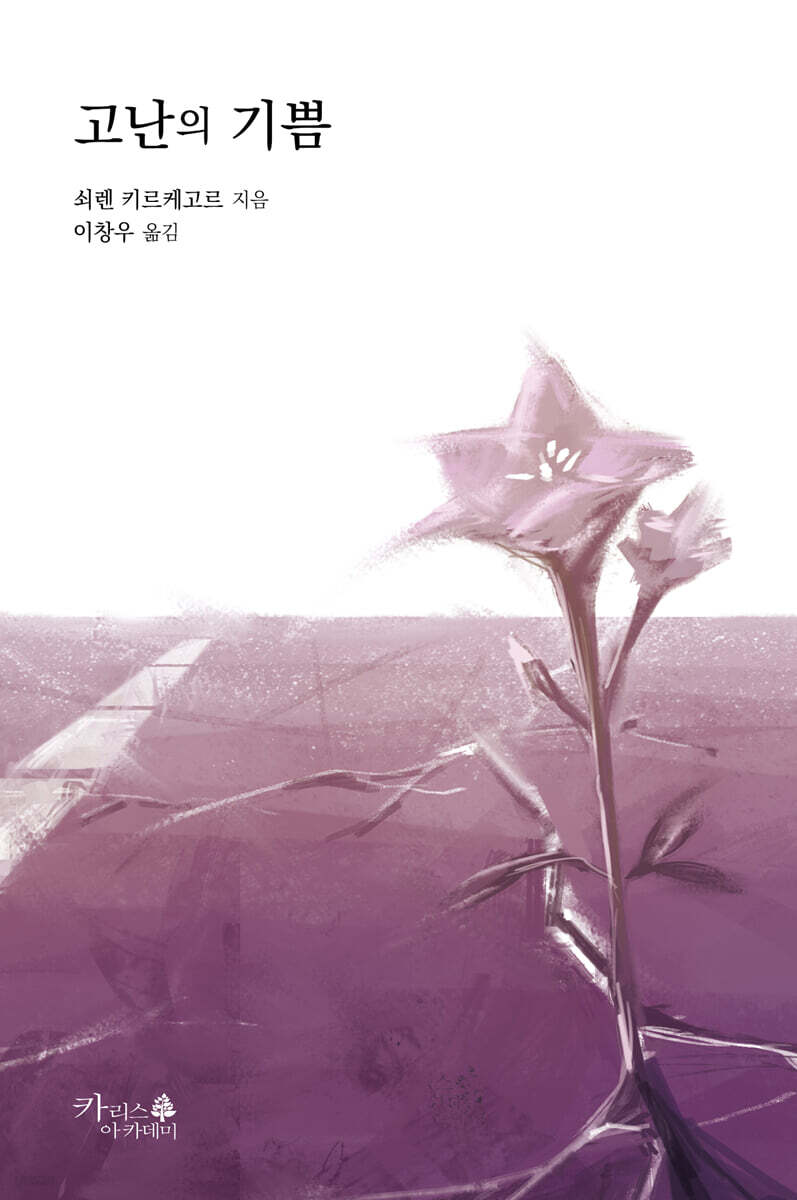
The joy of suffering
 |
Description
Book Introduction
Why do we avoid suffering? Does believing in Jesus make suffering disappear, or do we actually suffer? How often have we prayed for the removal of tribulation and suffering!
- But if suffering itself is the path, then removing the suffering makes the path disappear!
- Just as faith and hope without love are resonant gongs, so is joy without suffering a resonant gong!
Since the first publication of Kierkegaard's "The Anxiety of the Stranger" in March 2021, we have completed the translation and publication of the entire fourth volume of "Christian Intensification" for the first time in Korea.
After that, the first edition of 『The Joy of Suffering』 was sold out, so a revised edition was published.
The revised edition reflected the opinions of some readers by changing the entire text to formal language, and publishing all of Kierkegaard's discourses as part of the Christian Classics series.
In an increasingly challenging Christian publishing environment, we sincerely thank all those who have supported Kierkegaard's work with prayer and material support, as well as the readers who have sought out and read the book.
We ask for your continued interest so that we can fulfill this mission until the day when we complete the translation and publication of Kierkegaard's complete works.
- But if suffering itself is the path, then removing the suffering makes the path disappear!
- Just as faith and hope without love are resonant gongs, so is joy without suffering a resonant gong!
Since the first publication of Kierkegaard's "The Anxiety of the Stranger" in March 2021, we have completed the translation and publication of the entire fourth volume of "Christian Intensification" for the first time in Korea.
After that, the first edition of 『The Joy of Suffering』 was sold out, so a revised edition was published.
The revised edition reflected the opinions of some readers by changing the entire text to formal language, and publishing all of Kierkegaard's discourses as part of the Christian Classics series.
In an increasingly challenging Christian publishing environment, we sincerely thank all those who have supported Kierkegaard's work with prayer and material support, as well as the readers who have sought out and read the book.
We ask for your continued interest so that we can fulfill this mission until the day when we complete the translation and publication of Kierkegaard's complete works.
- You can preview some of the book's contents.
Preview
index
Preface to the Revised Edition _9
People who supported this book _10
Recommendation_12
Translator's Note _16
Chapter 1: The Joy of Suffering Once but Victory Eternally _41
Chapter 2: The Joy of Tribulation That Doesn't Take Away Hope, But Brings It_75
Chapter 3: The Joy of Making Others Richer the Poorer You Are _99
Chapter 4: The Joy of God Being Stronger in You, the Weaker You Are _129
Chapter 5: The Joy of Eternally Gaining What We Lost in Time _157
Chapter 6: 'When I Gain Everything', I Have the Joy of Losing Nothing _187
Chapter 7: The Joy of Adversity _205
Release: Eternal Litronello _233
People who supported this book _10
Recommendation_12
Translator's Note _16
Chapter 1: The Joy of Suffering Once but Victory Eternally _41
Chapter 2: The Joy of Tribulation That Doesn't Take Away Hope, But Brings It_75
Chapter 3: The Joy of Making Others Richer the Poorer You Are _99
Chapter 4: The Joy of God Being Stronger in You, the Weaker You Are _129
Chapter 5: The Joy of Eternally Gaining What We Lost in Time _157
Chapter 6: 'When I Gain Everything', I Have the Joy of Losing Nothing _187
Chapter 7: The Joy of Adversity _205
Release: Eternal Litronello _233
Publisher's Review
How can we be joyful in the midst of suffering?
1.
introduction
This article is a translation of Part 2 of Kierkegaard's Discourses on the Christian Religion, titled "Stemninger i Lidelsers Strid" (States of the Heart in the Struggle of Suffering), written in 1848.
Among the four parts of the 『Christian Discourse』, this discourse deals with the ‘joy’ of those who suffer more than anything else.
The translator believes that Kierkegaard's discourse on suffering is the pinnacle of Christian literature.
This reinforcement has tremendous insight into suffering.
As readers read this, I hope they will consider what kind of joy Kierkegaard is trying to suggest, and how the joy of the suffering differs from other joys.
There is another reinforcement of suffering in Kierkegaard's works.
This is the 'Gospel of Suffering' included in Part 3 of 'Various Strengthenings of the Mind' written in 1847.
These two works have in common the theme of suffering, and also the fact that they speak of the 'joy' of those who suffer.
The only difference is that while the Gospel of Suffering deals with suffering mostly from the perspective of the "way of discipleship," this discourse deals with suffering from the perspective of "time and eternity."
Kierkegaard is the 'philosopher of joy'.
Perhaps no one has emphasized joy as much as Kierkegaard! Yet, wherever he speaks of joy, words like "suffering," "tribulation," "adversity," and "burden" appear alongside it.
It is a serious misunderstanding that he spoke of depression, anxiety and despair.
This conclusion is based on reading only his book of thought and not his lectures.
For the sake of first-time readers, let me begin by talking about 'reinforcement'.
The word 'reinforcement' is translated as 'Discourse' in English and 'taler' in Danish.
In a word, it simply means 'story'.
The important point here is that Kierkegaard said that none of his works are 'sermons'.
A writing that does not have the value of a sermon, a writing that cannot be called a sermon, does not have that level of 'authority'.
This is an expression of his humility.
If you read his writings, you will find that they contain more essential concepts of Christianity than any sermon.
2.
irremovable suffering
People hate hardship.
So, above all, I want to overcome hardships with the power of faith.
Above all, we pray earnestly before God to remove suffering, adversity, and tribulation.
The thought behind this prayer is that joy mixed with suffering is not yet complete.
So, may you taste the joy of the kingdom of God.
This joy is pure joy, with all impurities removed.
In this joy, there is no suffering in the world, there is nothing but joy.
But this idea will be shattered in his work.
This is the book.
If any of you picked up this book hoping to learn how to eliminate suffering, hoping to find God-given joy in the rest of your life without suffering, you will likely be deeply disappointed.
Because this book has no intention of eliminating suffering.
Otherwise, this book will be a refreshing shock to readers.
In conclusion, Kierkegaard has no intention of eliminating suffering.
More precisely, I hope that suffering will remain an indispensable element in the joy of Christianity.
Of faith, hope, and love, the greatest is love.
Just as faith and hope without love are like a tinkling cymbal, so too is joy without suffering a tinkling cymbal.
Although it does not appear in this work, to quote a story from the Gospel of the Afflictions, the way of tribulation and the way of suffering are incorrect expressions.
This is a typical expression that encourages misunderstandings about Christianity.
No, this expression should be changed infinitely.
When we speak of the path of suffering, it seems as if we can separate the suffering from the path.
So I went to the prayer room and prayed.
I was praying in the prayer room to remove the hardships from my life and my path.
But keep in mind:
In Christianity, suffering itself is the way.
This is the essence of the path He took, the truth that Christianity speaks of.
If suffering itself is the path, then removing the suffering will make the path disappear.
Therefore, suffering is inevitable for those who walk this path.
Not only can you never get rid of something, but wanting to get rid of it is literally like deciding to board the train to hell.
But how many times have we prayed for the removal of suffering from our lives? Humanly speaking, how many people would desire suffering? Is this possible in their right mind? Of course, Kierkegaard argues that it's impossible to desire suffering in their right mind.
3.
Impossible wish
There may be people in this world who want to suffer.
For example, it seems that even the independence activists who chose to fight for independence during the Japanese colonial period wanted to suffer.
But Kierkegaard seems to want these people to suffer, but in reality, he wanted them to fight.
These people did not want to spend their lives sleeping and enjoying pleasure.
I didn't want a life full of wit, where I could gain profit without working hard.
They wanted to fight.
But to want to fight for the sake of fighting is to never want to suffer.
Beware! This is the exact opposite of the best.
Kierkegaard is more scathing on this point.
These people wanted to have some kind of tacit proof of how strong they were, the honor they had earned through fighting.
By becoming stronger through fighting, he wanted to continuously renew his self-esteem (Selvfølelse) through the constant struggle to fight.
They did not want to settle down in peace and quiet.
The desire to fight was too great.
I didn't want to hear any news that the fighting was over.
Just as the pride of the bowstring yearns for only one thing: to be drawn in battle, and no matter how many victories it gains, it is tormented by this one thing: to be slack and thrown into the storehouse, so they too wanted to live and die in the midst of the fight, on the day of battle, in the first and last strain of the struggle, in the whirlwind of battle.
So when we used the wise words 'suffering' and 'desiring to suffer', this was a misunderstanding, a deception, a delusion.
If someone had repeated his words to him and said, "Yes, you made the right choice," and now explained to him what those words meant, those aggressive people who had longed and challenged themselves to fight the world would probably have lost their courage.
Instead of getting into a fight, he would probably have gotten into trouble.
To desire suffering and to choose suffering—these are desires that have never awakened in the human heart.
Anyone who thinks this is only deceiving themselves.
To understand the thought of suffering and the joyful gospel of suffering, to endure suffering and actually benefit from it, to choose suffering and have it become the wisdom that actually leads to eternal happiness, one needs Jesus Christ, who walked this path, and one must learn from Him.
4.
delight
As a translator, if I were to evaluate this work, it would be that it ignites this impossible wish, this wish to suffer, this wish.
So how, then, can one rejoice in the midst of suffering? Kierkegaard doesn't clearly explain this joy.
In the seventh strengthening, “The Joy of Adversity,” he says:
“There is no need to develop this joy.
He who believes that adversity is prosperity has no need of this reinforcement.
There's no need to explain to him that this is a joy.
“For those who do not believe this, it is more important to hold on to the faith without wasting a single moment.”
It seems clear that Kierkegaard does not want to talk about this joy.
But any reader who reads this work properly will be able to easily infer what kind of joy there is in suffering.
This joy is indescribable, a joy that cannot be described.
So I can't say.
Kierkegaard once said in his diary:
10:30 a.m., May 19, 1838.
There is an indescribable joy that shines through us, so inexplicably that the apostle cried out, without any apparent reason, “Rejoice in the Lord always; again I will say, Rejoice!” (Philippians 4:4).
This joy is not this or that joy, but a full outcry of the soul, 'from the depths of the heart, with mouth and tongue': "I am glad with joy.
“With my joy, through my joy, in my joy, by my joy.” That is to say, some heavenly refrain that suddenly interrupts our other songs.
A refreshing and cool delight, like a gentle breeze, a breeze from the trade winds that blow across the plains of Mammoth to the eternal abode. (JP, 5:5324)
To properly understand this joy, we need the concepts of time and eternity.
First of all, for Kierkegaard, eternity and time are heterogeneous.
For Augustine, the question of time and eternity is not an alien one.
According to Augustine, time is absorbed into eternity.
Time is created with creation, and eternity is expressed as timelessness.
But for Kierkegaard, time cannot mix with eternity and always has heterogeneous properties, like water and oil.
We live in time.
It is a being tamed by time.
The problem is that nothing temporal is eternal.
All beings in time will eventually disappear.
There's a bigger problem here.
Within time, no being can be free.
There have been many thinkers, but not many have thought about the issues of time and freedom.
However, Kierkegaard thinks about whether humans living in time can be free.
Let me briefly explain why humans cannot be free within time.
Humans are individuals in time and live in society.
The problem is that individual humans cannot live outside of society.
In a word, humans are ‘social beings.’
This is like the relationship between a leaf and a tree, a leaf cannot live outside the tree.
The problem is that even if the leaves (individuals) fall and die, the tree lives on and the tree has permanence.
Likewise, even though individuals die and disappear from time, society continues to exist until now.
In this society, true freedom does not exist because humans must live by the rules and norms of society.
Just as nature is not free because it is bound by natural laws, humans cannot be free because they are bound by social laws.
Therefore, Kierkegaard brings in eternity to solve this problem.
In eternity, in the realm of the spirit, there is only one thing that does not exist, in Kierkegaard's favorite term, 'before God.'
What is this? A society that existed with permanence in time, a society that no longer exists in eternity.
In eternity, only individuals exist.
In eternity, each individual is a unique being.
In eternity he is alone.
There are no children in eternity.
In eternity there is no wife, no parents, no friends.
Kierkegaard draws this eternity into his mind as a remedy for the ills of this society.
Also, only in this eternity can one be free.
This is coram Deo, 'before God.'
But let us consider how this eternity becomes a joy.
Society is persistent.
It seems as if society has an eternity that can never disappear.
But what about individuals? They die and disappear like leaves.
This is precisely the cause of suffering in time.
An individual is so helpless.
No matter how much you enjoy the pleasures of this world, you are a being that must die and disappear someday.
No matter how many accomplishments one leaves behind in the world, he is still human and will die and disappear in vain.
If we take this even a little seriously, that is, if we recognize the fundamental problem of time, this makes us unhappy.
Animals seem to not suffer because they have no concept of time, whereas humans, who have an established concept of time, are the only ones who suffer because of time.
So this reinforcement says:
“Only temporal things can be lost in time.
Time cannot take anything away from you except what is temporal.
Another way to look at it is this: What is eternal can be eternally attained.” However severe the pain of loss, it is only temporal.
Kierkegaard does not seek to eliminate suffering, but to give us the courage to endure it by relying on eternity.
He also says:
“Let us now gather these thoughts together to capture joy, to captivate those who suffer with joy.
If the temporal is lost only in time and the eternal is lost forever, the benefit is clear.
“If I lose time, I gain eternity.”
5.
The Sanctification of Time
But it is not easy to lose time, to give up what is finite in this world.
I am not talking about forced giving up, but rather intentional giving up.
There is always pain involved.
For Kierkegaard, eternity is the opposite of time.
Eternity resists all time.
Accumulating time quantitatively does not make it eternal.
Rather, time tries to resemble eternity by calculating itself in numbers.
For example, consider someone who is suffering.
His suffering is never a one-time thing.
According to the calculation of time, he suffers for many days: one day, two days, three days, …
In other words, you are suffering on a fictional day.
Time torments the sufferer as if the suffering will last forever.
But just as a parasitic plant, no matter how long it grows or how far it spreads on the ground, can never grow taller than its host plant, so too does time.
When eternity reigns, time, however long it lasts, is but a moment.
This needs to be thought of backwards.
Time, like a parasitic plant, depends on those who suffer.
The time when you were the servant of the suffering will become the master of the suffering.
But the only power that can stop time is eternity.
There is a problem of ends and means here.
Acts 8:18-20 reads:
“When Simon saw that the Holy Spirit was given through the laying on of the apostles’ hands, he offered him money, saying, ‘Give me also this power, that anyone on whom I lay my hands may receive the Holy Spirit.’ But Peter said to him, ‘May your money perish with you, because you thought that the gift of God could be purchased with money!’”
First, considering time and eternity, should time (money) serve eternity (the Holy Spirit), or should eternity serve time? Next, considering ends and means, is the goal to make money using the Holy Spirit as a means, or to obtain the Holy Spirit using money as a means? Or can you buy eternal things (the Holy Spirit) with temporal things (money)? The goal or purpose always trumps the means.
At that time, if one seeks to gain eternal benefits in order to obtain earthly benefits, then earthly benefits are to him higher than eternal benefits.
But in this case, he loses something eternal.
This is the destruction that Kierkegaard speaks of.
But look what is happening in the church today.
How many there are who use the Holy Spirit for the benefit of this world, for their own selfish gain, to show off their own spiritual superiority, to serve their own spiritual pride.
How often do we live not to gain eternity from time, but to use eternity to capture time.
Above all, we need to ‘sanctify time.’
With the help of eternity.
Abraham Herschel, in his book The Sabbath, speaks of the sanctification of time.
“The problem of time can only be solved by sanctifying time.
There is nothing as elusive as time.
But for those who are with God, time is eternity in disguise.
Creation is God's language, time is His song, and the things of space are the consonants of that song.
Sanctifying time is like singing vowels in one voice with God.
“Conquering space and sanctifying time is the task given to mankind.”
But Abraham Herschel did not develop it further.
What can we do to sanctify time? The translator is convinced that, for Kierkegaard, the sanctification of time is obedience.
Obedience is the power that saves time.
For he learned obedience through what he suffered (Hebrews 5:8). He laid aside all temporal things by becoming obedient in life and death.
Those who obey Christ by suffering for him proclaim the glory of the Lord.
Therefore, the life of an obedient Christian is a song of praise to the glory of the Lord.
Obedience is the heavenly song that causes God's will to resound on earth.
The conquest of space is paradoxically only possible when we imitate Jesus Christ and renounce all things temporal.
So, how are Christians sanctified through this process? Christians are sanctified and purified through suffering.
Just as Christ learned obedience through what he suffered, so too do Christians learn obedience through what they suffer, and thus they are sanctified.
If you think in terms of eternity, a single hardship is just a movement, a passage.
You have to go through hardships.
Even if this suffering is as long as your life, even if it becomes a sword that pierces your very soul (Luke 2:35), it is only a passage.
What is passing through you is not suffering.
You go through hardships.
In the eternal sense, you can never get hurt.
In time, in the understanding of time, suffering appears terrible.
Due to visual illusions, hardships may appear to pass through you.
So it may seem like you are dying in agony.
But rather, it is you who is going through the hardship.
This is precisely what is meant by visual illusion.
It's like one actor killing another actor.
In this performance, it seems as if one actor is exactly stabbing the other.
But as we all know, this is not the case.
Not a hair of his head is harmed (Luke 21:18). Just as the murdered actor returns home unharmed, just as Daniel emerges from the lions' den unharmed (Daniel 6:10-23), just as his three friends walk into the furnace unharmed (Daniel 3:8-27), so too the soul of the believer walks into eternity unharmed by all temporary suffering.
Not harmed by death.
All temporary hardships are a mirage.
Death itself is a fool in the eternal sense! Just as moths and rust cannot destroy eternal treasures (what could be more impossible!), and thieves cannot steal them (Matthew 6:19-20), so temporary suffering, no matter how long it lasts, cannot harm the soul even a little.
No disease, no famine or poverty, no cold or heat, no matter how many things it consumes, can extinguish the soul.
No slander, no insult, no personal attack or persecution, no matter how much they steal or plunder, can destroy the soul.
Even death cannot extinguish the soul!
A single hardship is a passage that leaves no trace on the soul.
No, far more gloriously, this suffering is a passage that completely purifies the soul.
In effect, cleanliness is the trace left behind by passage.
As gold is purified in fire, so the soul is purified in suffering (Malachi 3:3). But what does fire remove from gold? It might be strange to call it "removal."
Because fire only removes the impurities in the gold.
So, what does gold lose in the fire? It might seem strange to say it loses this.
Because gold loses all its base things in the fire.
In other words, gold is benefiting from fire.
The same is true of all temporary hardships.
No matter how hard or how long the suffering lasts, suffering is inherently disempowering.
Suffering only removes the impure.
In other words, suffering brings purity.
6.
conclusion
I think the Korean church today has been preoccupied with eliminating suffering.
Rather than suffering for the truth, they tried to use the truth as a tool to avoid suffering.
This only produces Christians who are so deeply corrupted that they have no power in society.
The world is not in the truth.
Soon, proclaiming the truth in a world of untruth will be a path of suffering.
I think this is more of a life-threatening act than going into a communist country like North Korea and proclaiming democracy.
This is the work of proclaiming the kingdom of God while living in the world.
This work is always fraught with danger.
The world has been turned upside down these days due to the coronavirus pandemic.
No wonder the term "new normal" emerged. The lines between normal and abnormal have been reversed.
The outlook is that it will be difficult to return to the way things were before.
Nevertheless, there is a part of people's hearts that hopes that this crisis will pass.
We want to get back to normal as soon as possible, we want to travel, and we want to take off our masks.
‘Herd immunity’ is the only way to survive, and only when herd immunity is achieved can we return to normal.
So the whole world is busy getting vaccinated.
Let's understand this situation spiritually.
What exactly is spiritually normal and what is abnormal? I don't believe a life tamed by time is normal.
Spiritually, it is only normal to live a life that is tamed by eternity.
But as long as we decide to live that way, the general public, accustomed to time, cannot understand this life.
In spiritual life, the 'new normal' is living a life accustomed to eternity.
If we understand it spiritually, the coronavirus crisis will not end.
People hope this crisis will pass, but a spiritual crisis never passes.
Moreover, while the coronavirus can be overcome through herd immunity, there is no vaccine for this spiritual crisis, and herd immunity is simply impossible.
Only when each Christian endures each moment given to him with the help of eternity, only when he lives his life, does he sanctify time and attain eternity.
1.
introduction
This article is a translation of Part 2 of Kierkegaard's Discourses on the Christian Religion, titled "Stemninger i Lidelsers Strid" (States of the Heart in the Struggle of Suffering), written in 1848.
Among the four parts of the 『Christian Discourse』, this discourse deals with the ‘joy’ of those who suffer more than anything else.
The translator believes that Kierkegaard's discourse on suffering is the pinnacle of Christian literature.
This reinforcement has tremendous insight into suffering.
As readers read this, I hope they will consider what kind of joy Kierkegaard is trying to suggest, and how the joy of the suffering differs from other joys.
There is another reinforcement of suffering in Kierkegaard's works.
This is the 'Gospel of Suffering' included in Part 3 of 'Various Strengthenings of the Mind' written in 1847.
These two works have in common the theme of suffering, and also the fact that they speak of the 'joy' of those who suffer.
The only difference is that while the Gospel of Suffering deals with suffering mostly from the perspective of the "way of discipleship," this discourse deals with suffering from the perspective of "time and eternity."
Kierkegaard is the 'philosopher of joy'.
Perhaps no one has emphasized joy as much as Kierkegaard! Yet, wherever he speaks of joy, words like "suffering," "tribulation," "adversity," and "burden" appear alongside it.
It is a serious misunderstanding that he spoke of depression, anxiety and despair.
This conclusion is based on reading only his book of thought and not his lectures.
For the sake of first-time readers, let me begin by talking about 'reinforcement'.
The word 'reinforcement' is translated as 'Discourse' in English and 'taler' in Danish.
In a word, it simply means 'story'.
The important point here is that Kierkegaard said that none of his works are 'sermons'.
A writing that does not have the value of a sermon, a writing that cannot be called a sermon, does not have that level of 'authority'.
This is an expression of his humility.
If you read his writings, you will find that they contain more essential concepts of Christianity than any sermon.
2.
irremovable suffering
People hate hardship.
So, above all, I want to overcome hardships with the power of faith.
Above all, we pray earnestly before God to remove suffering, adversity, and tribulation.
The thought behind this prayer is that joy mixed with suffering is not yet complete.
So, may you taste the joy of the kingdom of God.
This joy is pure joy, with all impurities removed.
In this joy, there is no suffering in the world, there is nothing but joy.
But this idea will be shattered in his work.
This is the book.
If any of you picked up this book hoping to learn how to eliminate suffering, hoping to find God-given joy in the rest of your life without suffering, you will likely be deeply disappointed.
Because this book has no intention of eliminating suffering.
Otherwise, this book will be a refreshing shock to readers.
In conclusion, Kierkegaard has no intention of eliminating suffering.
More precisely, I hope that suffering will remain an indispensable element in the joy of Christianity.
Of faith, hope, and love, the greatest is love.
Just as faith and hope without love are like a tinkling cymbal, so too is joy without suffering a tinkling cymbal.
Although it does not appear in this work, to quote a story from the Gospel of the Afflictions, the way of tribulation and the way of suffering are incorrect expressions.
This is a typical expression that encourages misunderstandings about Christianity.
No, this expression should be changed infinitely.
When we speak of the path of suffering, it seems as if we can separate the suffering from the path.
So I went to the prayer room and prayed.
I was praying in the prayer room to remove the hardships from my life and my path.
But keep in mind:
In Christianity, suffering itself is the way.
This is the essence of the path He took, the truth that Christianity speaks of.
If suffering itself is the path, then removing the suffering will make the path disappear.
Therefore, suffering is inevitable for those who walk this path.
Not only can you never get rid of something, but wanting to get rid of it is literally like deciding to board the train to hell.
But how many times have we prayed for the removal of suffering from our lives? Humanly speaking, how many people would desire suffering? Is this possible in their right mind? Of course, Kierkegaard argues that it's impossible to desire suffering in their right mind.
3.
Impossible wish
There may be people in this world who want to suffer.
For example, it seems that even the independence activists who chose to fight for independence during the Japanese colonial period wanted to suffer.
But Kierkegaard seems to want these people to suffer, but in reality, he wanted them to fight.
These people did not want to spend their lives sleeping and enjoying pleasure.
I didn't want a life full of wit, where I could gain profit without working hard.
They wanted to fight.
But to want to fight for the sake of fighting is to never want to suffer.
Beware! This is the exact opposite of the best.
Kierkegaard is more scathing on this point.
These people wanted to have some kind of tacit proof of how strong they were, the honor they had earned through fighting.
By becoming stronger through fighting, he wanted to continuously renew his self-esteem (Selvfølelse) through the constant struggle to fight.
They did not want to settle down in peace and quiet.
The desire to fight was too great.
I didn't want to hear any news that the fighting was over.
Just as the pride of the bowstring yearns for only one thing: to be drawn in battle, and no matter how many victories it gains, it is tormented by this one thing: to be slack and thrown into the storehouse, so they too wanted to live and die in the midst of the fight, on the day of battle, in the first and last strain of the struggle, in the whirlwind of battle.
So when we used the wise words 'suffering' and 'desiring to suffer', this was a misunderstanding, a deception, a delusion.
If someone had repeated his words to him and said, "Yes, you made the right choice," and now explained to him what those words meant, those aggressive people who had longed and challenged themselves to fight the world would probably have lost their courage.
Instead of getting into a fight, he would probably have gotten into trouble.
To desire suffering and to choose suffering—these are desires that have never awakened in the human heart.
Anyone who thinks this is only deceiving themselves.
To understand the thought of suffering and the joyful gospel of suffering, to endure suffering and actually benefit from it, to choose suffering and have it become the wisdom that actually leads to eternal happiness, one needs Jesus Christ, who walked this path, and one must learn from Him.
4.
delight
As a translator, if I were to evaluate this work, it would be that it ignites this impossible wish, this wish to suffer, this wish.
So how, then, can one rejoice in the midst of suffering? Kierkegaard doesn't clearly explain this joy.
In the seventh strengthening, “The Joy of Adversity,” he says:
“There is no need to develop this joy.
He who believes that adversity is prosperity has no need of this reinforcement.
There's no need to explain to him that this is a joy.
“For those who do not believe this, it is more important to hold on to the faith without wasting a single moment.”
It seems clear that Kierkegaard does not want to talk about this joy.
But any reader who reads this work properly will be able to easily infer what kind of joy there is in suffering.
This joy is indescribable, a joy that cannot be described.
So I can't say.
Kierkegaard once said in his diary:
10:30 a.m., May 19, 1838.
There is an indescribable joy that shines through us, so inexplicably that the apostle cried out, without any apparent reason, “Rejoice in the Lord always; again I will say, Rejoice!” (Philippians 4:4).
This joy is not this or that joy, but a full outcry of the soul, 'from the depths of the heart, with mouth and tongue': "I am glad with joy.
“With my joy, through my joy, in my joy, by my joy.” That is to say, some heavenly refrain that suddenly interrupts our other songs.
A refreshing and cool delight, like a gentle breeze, a breeze from the trade winds that blow across the plains of Mammoth to the eternal abode. (JP, 5:5324)
To properly understand this joy, we need the concepts of time and eternity.
First of all, for Kierkegaard, eternity and time are heterogeneous.
For Augustine, the question of time and eternity is not an alien one.
According to Augustine, time is absorbed into eternity.
Time is created with creation, and eternity is expressed as timelessness.
But for Kierkegaard, time cannot mix with eternity and always has heterogeneous properties, like water and oil.
We live in time.
It is a being tamed by time.
The problem is that nothing temporal is eternal.
All beings in time will eventually disappear.
There's a bigger problem here.
Within time, no being can be free.
There have been many thinkers, but not many have thought about the issues of time and freedom.
However, Kierkegaard thinks about whether humans living in time can be free.
Let me briefly explain why humans cannot be free within time.
Humans are individuals in time and live in society.
The problem is that individual humans cannot live outside of society.
In a word, humans are ‘social beings.’
This is like the relationship between a leaf and a tree, a leaf cannot live outside the tree.
The problem is that even if the leaves (individuals) fall and die, the tree lives on and the tree has permanence.
Likewise, even though individuals die and disappear from time, society continues to exist until now.
In this society, true freedom does not exist because humans must live by the rules and norms of society.
Just as nature is not free because it is bound by natural laws, humans cannot be free because they are bound by social laws.
Therefore, Kierkegaard brings in eternity to solve this problem.
In eternity, in the realm of the spirit, there is only one thing that does not exist, in Kierkegaard's favorite term, 'before God.'
What is this? A society that existed with permanence in time, a society that no longer exists in eternity.
In eternity, only individuals exist.
In eternity, each individual is a unique being.
In eternity he is alone.
There are no children in eternity.
In eternity there is no wife, no parents, no friends.
Kierkegaard draws this eternity into his mind as a remedy for the ills of this society.
Also, only in this eternity can one be free.
This is coram Deo, 'before God.'
But let us consider how this eternity becomes a joy.
Society is persistent.
It seems as if society has an eternity that can never disappear.
But what about individuals? They die and disappear like leaves.
This is precisely the cause of suffering in time.
An individual is so helpless.
No matter how much you enjoy the pleasures of this world, you are a being that must die and disappear someday.
No matter how many accomplishments one leaves behind in the world, he is still human and will die and disappear in vain.
If we take this even a little seriously, that is, if we recognize the fundamental problem of time, this makes us unhappy.
Animals seem to not suffer because they have no concept of time, whereas humans, who have an established concept of time, are the only ones who suffer because of time.
So this reinforcement says:
“Only temporal things can be lost in time.
Time cannot take anything away from you except what is temporal.
Another way to look at it is this: What is eternal can be eternally attained.” However severe the pain of loss, it is only temporal.
Kierkegaard does not seek to eliminate suffering, but to give us the courage to endure it by relying on eternity.
He also says:
“Let us now gather these thoughts together to capture joy, to captivate those who suffer with joy.
If the temporal is lost only in time and the eternal is lost forever, the benefit is clear.
“If I lose time, I gain eternity.”
5.
The Sanctification of Time
But it is not easy to lose time, to give up what is finite in this world.
I am not talking about forced giving up, but rather intentional giving up.
There is always pain involved.
For Kierkegaard, eternity is the opposite of time.
Eternity resists all time.
Accumulating time quantitatively does not make it eternal.
Rather, time tries to resemble eternity by calculating itself in numbers.
For example, consider someone who is suffering.
His suffering is never a one-time thing.
According to the calculation of time, he suffers for many days: one day, two days, three days, …
In other words, you are suffering on a fictional day.
Time torments the sufferer as if the suffering will last forever.
But just as a parasitic plant, no matter how long it grows or how far it spreads on the ground, can never grow taller than its host plant, so too does time.
When eternity reigns, time, however long it lasts, is but a moment.
This needs to be thought of backwards.
Time, like a parasitic plant, depends on those who suffer.
The time when you were the servant of the suffering will become the master of the suffering.
But the only power that can stop time is eternity.
There is a problem of ends and means here.
Acts 8:18-20 reads:
“When Simon saw that the Holy Spirit was given through the laying on of the apostles’ hands, he offered him money, saying, ‘Give me also this power, that anyone on whom I lay my hands may receive the Holy Spirit.’ But Peter said to him, ‘May your money perish with you, because you thought that the gift of God could be purchased with money!’”
First, considering time and eternity, should time (money) serve eternity (the Holy Spirit), or should eternity serve time? Next, considering ends and means, is the goal to make money using the Holy Spirit as a means, or to obtain the Holy Spirit using money as a means? Or can you buy eternal things (the Holy Spirit) with temporal things (money)? The goal or purpose always trumps the means.
At that time, if one seeks to gain eternal benefits in order to obtain earthly benefits, then earthly benefits are to him higher than eternal benefits.
But in this case, he loses something eternal.
This is the destruction that Kierkegaard speaks of.
But look what is happening in the church today.
How many there are who use the Holy Spirit for the benefit of this world, for their own selfish gain, to show off their own spiritual superiority, to serve their own spiritual pride.
How often do we live not to gain eternity from time, but to use eternity to capture time.
Above all, we need to ‘sanctify time.’
With the help of eternity.
Abraham Herschel, in his book The Sabbath, speaks of the sanctification of time.
“The problem of time can only be solved by sanctifying time.
There is nothing as elusive as time.
But for those who are with God, time is eternity in disguise.
Creation is God's language, time is His song, and the things of space are the consonants of that song.
Sanctifying time is like singing vowels in one voice with God.
“Conquering space and sanctifying time is the task given to mankind.”
But Abraham Herschel did not develop it further.
What can we do to sanctify time? The translator is convinced that, for Kierkegaard, the sanctification of time is obedience.
Obedience is the power that saves time.
For he learned obedience through what he suffered (Hebrews 5:8). He laid aside all temporal things by becoming obedient in life and death.
Those who obey Christ by suffering for him proclaim the glory of the Lord.
Therefore, the life of an obedient Christian is a song of praise to the glory of the Lord.
Obedience is the heavenly song that causes God's will to resound on earth.
The conquest of space is paradoxically only possible when we imitate Jesus Christ and renounce all things temporal.
So, how are Christians sanctified through this process? Christians are sanctified and purified through suffering.
Just as Christ learned obedience through what he suffered, so too do Christians learn obedience through what they suffer, and thus they are sanctified.
If you think in terms of eternity, a single hardship is just a movement, a passage.
You have to go through hardships.
Even if this suffering is as long as your life, even if it becomes a sword that pierces your very soul (Luke 2:35), it is only a passage.
What is passing through you is not suffering.
You go through hardships.
In the eternal sense, you can never get hurt.
In time, in the understanding of time, suffering appears terrible.
Due to visual illusions, hardships may appear to pass through you.
So it may seem like you are dying in agony.
But rather, it is you who is going through the hardship.
This is precisely what is meant by visual illusion.
It's like one actor killing another actor.
In this performance, it seems as if one actor is exactly stabbing the other.
But as we all know, this is not the case.
Not a hair of his head is harmed (Luke 21:18). Just as the murdered actor returns home unharmed, just as Daniel emerges from the lions' den unharmed (Daniel 6:10-23), just as his three friends walk into the furnace unharmed (Daniel 3:8-27), so too the soul of the believer walks into eternity unharmed by all temporary suffering.
Not harmed by death.
All temporary hardships are a mirage.
Death itself is a fool in the eternal sense! Just as moths and rust cannot destroy eternal treasures (what could be more impossible!), and thieves cannot steal them (Matthew 6:19-20), so temporary suffering, no matter how long it lasts, cannot harm the soul even a little.
No disease, no famine or poverty, no cold or heat, no matter how many things it consumes, can extinguish the soul.
No slander, no insult, no personal attack or persecution, no matter how much they steal or plunder, can destroy the soul.
Even death cannot extinguish the soul!
A single hardship is a passage that leaves no trace on the soul.
No, far more gloriously, this suffering is a passage that completely purifies the soul.
In effect, cleanliness is the trace left behind by passage.
As gold is purified in fire, so the soul is purified in suffering (Malachi 3:3). But what does fire remove from gold? It might be strange to call it "removal."
Because fire only removes the impurities in the gold.
So, what does gold lose in the fire? It might seem strange to say it loses this.
Because gold loses all its base things in the fire.
In other words, gold is benefiting from fire.
The same is true of all temporary hardships.
No matter how hard or how long the suffering lasts, suffering is inherently disempowering.
Suffering only removes the impure.
In other words, suffering brings purity.
6.
conclusion
I think the Korean church today has been preoccupied with eliminating suffering.
Rather than suffering for the truth, they tried to use the truth as a tool to avoid suffering.
This only produces Christians who are so deeply corrupted that they have no power in society.
The world is not in the truth.
Soon, proclaiming the truth in a world of untruth will be a path of suffering.
I think this is more of a life-threatening act than going into a communist country like North Korea and proclaiming democracy.
This is the work of proclaiming the kingdom of God while living in the world.
This work is always fraught with danger.
The world has been turned upside down these days due to the coronavirus pandemic.
No wonder the term "new normal" emerged. The lines between normal and abnormal have been reversed.
The outlook is that it will be difficult to return to the way things were before.
Nevertheless, there is a part of people's hearts that hopes that this crisis will pass.
We want to get back to normal as soon as possible, we want to travel, and we want to take off our masks.
‘Herd immunity’ is the only way to survive, and only when herd immunity is achieved can we return to normal.
So the whole world is busy getting vaccinated.
Let's understand this situation spiritually.
What exactly is spiritually normal and what is abnormal? I don't believe a life tamed by time is normal.
Spiritually, it is only normal to live a life that is tamed by eternity.
But as long as we decide to live that way, the general public, accustomed to time, cannot understand this life.
In spiritual life, the 'new normal' is living a life accustomed to eternity.
If we understand it spiritually, the coronavirus crisis will not end.
People hope this crisis will pass, but a spiritual crisis never passes.
Moreover, while the coronavirus can be overcome through herd immunity, there is no vaccine for this spiritual crisis, and herd immunity is simply impossible.
Only when each Christian endures each moment given to him with the help of eternity, only when he lives his life, does he sanctify time and attain eternity.
GOODS SPECIFICS
- Publication date: December 12, 2022
- Page count, weight, size: 256 pages | 268g | 128*188*20mm
- ISBN13: 9791192348124
- ISBN10: 1192348125
You may also like
카테고리
korean


korean

![GQ KOREA Mark (Monthly): December [2025]](http://librairie.coreenne.fr/cdn/shop/files/8ef265dbbfbf186523ed75ba7319009d.jpg?v=1765340328&width=3840)


