

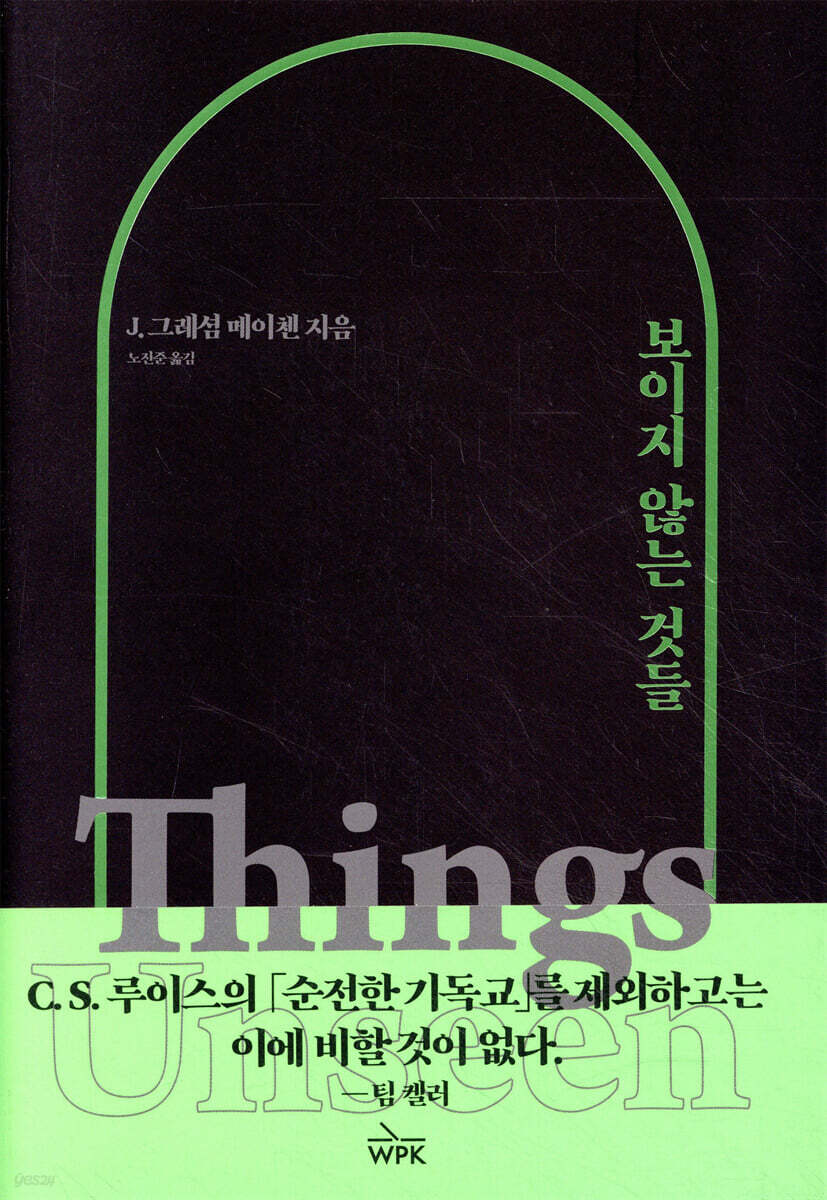
Invisible things
 |
Description
Book Introduction
In a post-truth era, a timeless classic
Radio lecture by Dr. Machen, author of Christianity and Liberalism
We live in an age of post-truth.
It is also said that this is not an era in which people do not believe in God, but an era in which anyone can become God.
People don't feel the need for theology.
In the 20th century, when theology was considered difficult and unrealistic, unlike today, a crucial task for the church was to rationally explain what we believe and approach the public with practical life issues.
It was liberal theologians who 'successfully' accomplished this task.
They were accomplishing this task by making Jesus a great moral teacher and by making Christianity a humanistic movement that helped humanity realize its ideals and individual happiness.
Reformed theologians, including Dr. Machen, felt a great burden.
They had to make it known to the public that the theological position they believed in and were convinced of was the most rational and realistic.
To say that everything must be theological ultimately means that God's rule must be the most realistic thing in the entire life of faith.
God's being God and God's revelation of Himself should not become an ivory tower-bound relic that is only treated in seminaries.
This book is a compilation of theological lectures given on Sunday afternoons over two years on Philadelphia radio, and clearly reveals the burden Dr. Machen felt.
This book covers topics in systematic theology.
However, rather than simply teaching the public 'easy-to-understand systematic theology', he appealed to people about why the Christian life must be theological in its entirety.
Meichen wanted to communicate with the public.
The purpose was not communication itself, but to reveal the timeless relevance of God's word.
Meichen's understanding and empathy for the contemporary circumstances of the people create an exquisite tension with his conviction in the ultimate, timeless solution to the problem.
Dr. Machen's sincerity and direction, which sought to communicate by holding on to the unchanging Word of Revelation in a changing era, are still alive today, unlike 80 years ago, when post-truth is the mainstream.
Translator's Note (Jinjun Noh, Co-CEO of PCM, Author of "Doubting Faith")
Radio lecture by Dr. Machen, author of Christianity and Liberalism
We live in an age of post-truth.
It is also said that this is not an era in which people do not believe in God, but an era in which anyone can become God.
People don't feel the need for theology.
In the 20th century, when theology was considered difficult and unrealistic, unlike today, a crucial task for the church was to rationally explain what we believe and approach the public with practical life issues.
It was liberal theologians who 'successfully' accomplished this task.
They were accomplishing this task by making Jesus a great moral teacher and by making Christianity a humanistic movement that helped humanity realize its ideals and individual happiness.
Reformed theologians, including Dr. Machen, felt a great burden.
They had to make it known to the public that the theological position they believed in and were convinced of was the most rational and realistic.
To say that everything must be theological ultimately means that God's rule must be the most realistic thing in the entire life of faith.
God's being God and God's revelation of Himself should not become an ivory tower-bound relic that is only treated in seminaries.
This book is a compilation of theological lectures given on Sunday afternoons over two years on Philadelphia radio, and clearly reveals the burden Dr. Machen felt.
This book covers topics in systematic theology.
However, rather than simply teaching the public 'easy-to-understand systematic theology', he appealed to people about why the Christian life must be theological in its entirety.
Meichen wanted to communicate with the public.
The purpose was not communication itself, but to reveal the timeless relevance of God's word.
Meichen's understanding and empathy for the contemporary circumstances of the people create an exquisite tension with his conviction in the ultimate, timeless solution to the problem.
Dr. Machen's sincerity and direction, which sought to communicate by holding on to the unchanging Word of Revelation in a changing era, are still alive today, unlike 80 years ago, when post-truth is the mainstream.
Translator's Note (Jinjun Noh, Co-CEO of PCM, Author of "Doubting Faith")
- You can preview some of the book's contents.
Preview
index
Commentary? Stephen Nichols 23
Part 1.
Christian Faith in the Modern World
Lecture 1: How Should We Face the Current Crisis? 38
Lesson 2: How Can We Know God? 48
Lesson 3: Did God Speak? 58
Is the Bible the Word of God? 67
Lecture 5: Do We Believe in Perfect Inspiration? 78
Lesson 6: Should We Defend the Bible? 90
Lesson 7: The Bible and Human Authority 102
A Life Built on Truth, Lesson 8, Part 114
Lesson 9: God the Creator 128
Lesson 10: The Trinity 141
Lesson 11: What is the Divinity of Christ? 154
Lesson 12: Does the Bible Teach the Deity of Christ? 167
Lesson 13: The Sermon on the Mount and the Deity of Christ 180
Lesson 14: What Did Jesus Say About Himself? 193
Lesson 15: The Supernatural Christ 204
Lesson 16: Did Christ Risen from the Dead? 216
Lesson 17: Paul's Testimony for Christ 228
Lesson 18: The Holy Spirit 240
Part 2.
Humanity from a Christian perspective
Lesson 19: The Living and True God 254
Lesson 20: God's Plan 266
Lecture 21: God's Plan and Human Freedom 278
What is the Round of 22 schedule? 291
Lesson 23: Does the Bible Teach Predestination? 302
Rebuttal to the Round of 24 Schedule 315
Lesson 25: God's Work in Creation and Providence 327
Lecture 26: The History of God's Providence 340
Lesson 27: Miracles 354
Lesson 28: Did God Create Humans? 368
Lesson 29: How Did God Create Humanity? (380)
Lecture 30: The Image of God in Man 393
Lecture 31: The Covenant of Life 406
Lecture 32: The Fall of Man 419
Lesson 33: What is Sin? 432
Lesson 34: The Majestic Law of God 445
Part 3.
Last broadcasts
Lesson 39: The Development of Christian Doctrine 514
Lecture 40: Creed and Doctrinal Progress 527
Lecture 41: God, Man, and Salvation (539)
Lesson 42: Christ the Prophet, Priest, and King 551
Lesson 43: What is a Prophet? 563
Lesson 44: Prophecy and the Gospel 575
Lesson 45: Jesus' Teachings 587
Lesson 46: Prophets and Priests 599
Lesson 47: Christ, Our Redeemer 611
Lesson 48: The Doctrine of Atonement 623
Lesson 49: Christ's Active Obedience 635
Lecture 50: The Bible's View of Atonement 647
Recommended Reading? Sinclair Ferguson 660
Recommended Reading? Richard Gaffin Jr. 665
Book Review: Machen's Rhetorical Approach? Timothy Keller 671
Part 1.
Christian Faith in the Modern World
Lecture 1: How Should We Face the Current Crisis? 38
Lesson 2: How Can We Know God? 48
Lesson 3: Did God Speak? 58
Is the Bible the Word of God? 67
Lecture 5: Do We Believe in Perfect Inspiration? 78
Lesson 6: Should We Defend the Bible? 90
Lesson 7: The Bible and Human Authority 102
A Life Built on Truth, Lesson 8, Part 114
Lesson 9: God the Creator 128
Lesson 10: The Trinity 141
Lesson 11: What is the Divinity of Christ? 154
Lesson 12: Does the Bible Teach the Deity of Christ? 167
Lesson 13: The Sermon on the Mount and the Deity of Christ 180
Lesson 14: What Did Jesus Say About Himself? 193
Lesson 15: The Supernatural Christ 204
Lesson 16: Did Christ Risen from the Dead? 216
Lesson 17: Paul's Testimony for Christ 228
Lesson 18: The Holy Spirit 240
Part 2.
Humanity from a Christian perspective
Lesson 19: The Living and True God 254
Lesson 20: God's Plan 266
Lecture 21: God's Plan and Human Freedom 278
What is the Round of 22 schedule? 291
Lesson 23: Does the Bible Teach Predestination? 302
Rebuttal to the Round of 24 Schedule 315
Lesson 25: God's Work in Creation and Providence 327
Lecture 26: The History of God's Providence 340
Lesson 27: Miracles 354
Lesson 28: Did God Create Humans? 368
Lesson 29: How Did God Create Humanity? (380)
Lecture 30: The Image of God in Man 393
Lecture 31: The Covenant of Life 406
Lecture 32: The Fall of Man 419
Lesson 33: What is Sin? 432
Lesson 34: The Majestic Law of God 445
Part 3.
Last broadcasts
Lesson 39: The Development of Christian Doctrine 514
Lecture 40: Creed and Doctrinal Progress 527
Lecture 41: God, Man, and Salvation (539)
Lesson 42: Christ the Prophet, Priest, and King 551
Lesson 43: What is a Prophet? 563
Lesson 44: Prophecy and the Gospel 575
Lesson 45: Jesus' Teachings 587
Lesson 46: Prophets and Priests 599
Lesson 47: Christ, Our Redeemer 611
Lesson 48: The Doctrine of Atonement 623
Lesson 49: Christ's Active Obedience 635
Lecture 50: The Bible's View of Atonement 647
Recommended Reading? Sinclair Ferguson 660
Recommended Reading? Richard Gaffin Jr. 665
Book Review: Machen's Rhetorical Approach? Timothy Keller 671
Into the book
The world today is much more turbulent than the atmosphere that prevailed in 1918.
Europe is armed to the teeth, and Russia is enduring a dictatorship more organized and brutal than any the world has ever seen.
In Germany, evil is perpetrated in the name of science, and in that country, as in Italy, forms of freedom are ignored.
A ghostly society is appearing before our eyes everywhere.
Here, security is bought at the price of freedom, like the safety of a well-fed beast in a stable, and all the highest aspirations of humanity are brutally trampled underfoot by an all-powerful government.
Is it time to be content with things as they are? Isn't it time to seriously ask ourselves whether there are lost secrets that humanity needs to recover to be rescued from the abyss?
---From "Lecture 1: How to Face the Current Crisis"
Modern people have tried to separate the natural from the supernatural in the image of Jesus as presented in the Gospels.
They say, “Let’s take away the supernatural elements that are so clichéd in that look.
Then we will be able to obtain the real image of Jesus as a great religious genius, neither more nor less.”
But efforts to distinguish ultimately failed.
Because in the gospel picture of Jesus, the supernatural element is shown to be an essential element that cannot be removed from the whole picture.
It couldn't be removed in such a superficial and easy way.
Because the image of Jesus depicted in the Gospels is supernatural from beginning to end.
---From “Lecture 6: Should We Defend the Bible?”
We stand in awe before the dynamic processes of nature.
We are astonished at our own insignificance and realize that we are but a tiny part of this immense whole.
To this vastness, which modern man has begun to understand, pantheists apply the name of God.
The universe itself, revealed as a whole, is God.
If we look at the meaning alone, that is what the word pantheism means.
This view has stimulated brilliant thought and inspired great poetic sensibilities in mankind.
But it offers no comfort to the oppressed and crushed soul.
If there were another name for the whole, God, and we possessed that God, we would not be any better off than we were before.
It makes no sense for us to appeal to nature's God from nature.
We are nothing more than pawns of power without direction.
---From “Lecture 9: God the Creator”
How can reformation be achieved? Some people seem to think it can be achieved by denying or ignoring everything that has been done in the Christian church for a long time.
They tell themselves.
“Let’s just go back to the Bible.
We need to break clearly with all the garbage of the church.” So they just sit around trying to summarize what the Bible teaches in clumsy, brief sentences, while the great creeds of the church just fade into oblivion.
If we imagine that at one moment all the creeds of Christianity were to vanish from people's memory and we had to understand the Bible from scratch, I believe that someday the essential creeds of the church would eventually be re-established.
It will take another 1,900 years.
If the foundation remains, the superstructure will be rebuilt.
But how great would the loss be? How terrible would it be to have to start the study of the Bible all over again, without the help of the great creeds, without the help of Augustine, without the help of the great theologians of the Reformation?
---From "Lecture 39: The Development of Christian Doctrine"
The authors of modern manifestos suggest that we bury our differences and cling to only a few essentials.
The authors of the Christian creeds call us to open the Bible and fully reveal the richness of truth it contains.
The authors of modern statements caution us not to ignore the various currents of thought that have taken hold in the church.
The authors of the Christian creeds are diligent in eliminating fatal errors from the official teachings of the Church, so that the Church may be a faithful servant of God's mystery.
The most important difference is that the authors of modern statements do not believe in the existence of truth at all.
They say that since doctrine is simply an expression of Christian experience, even if doctrine changes, the Christian experience remains.
So today's modernism becomes tomorrow's orthodoxy, and then another new modernism takes its place.
---From “Creed and Doctrinal Progress”
The lack of certainty has made the exaggerated progress of our present age seem like an illusion.
At the beginning of the modern era, and along the way, the Bible was almost abandoned.
Because nothing should be considered definite and all truth should be considered relative.
What will be the result? An unprecedented decadence? Freedom overturned, the slave trade running almost unchecked across the globe, centuries of achievements crumbling to dust, kindness and courtesy disregarded, and life stripped of all meaning?
We pursued science for science's sake, but ended up in a world war.
We pursued art for art's sake, but all that remained was ugliness and madness.
We pursued people for people, but we created a world of robots where people become machines.
Isn't it time, like the prodigal son who wandered far away, to return to ourselves? Isn't it time to pursue true progress by turning to the living God?
---From "Lecture 41: God, Man, Salvation"
Just read any of the many popular books on religion today.
Some books speak of the cross of Christ, and some even say that Christ's suffering was redemptive.
But the problem is that they claim that the cross of Christ is not only Christ's cross, but also our cross, and that while Christ's suffering is redemptive, our suffering is also redemptive.
We follow that path to attain a nobler life for our souls.
This is a gross distortion that is prevalent and central to most modern books on the cross.
They make the cross of Christ simply an example of a general principle for self-sacrifice.
This is the moral influence theory of atonement.
Europe is armed to the teeth, and Russia is enduring a dictatorship more organized and brutal than any the world has ever seen.
In Germany, evil is perpetrated in the name of science, and in that country, as in Italy, forms of freedom are ignored.
A ghostly society is appearing before our eyes everywhere.
Here, security is bought at the price of freedom, like the safety of a well-fed beast in a stable, and all the highest aspirations of humanity are brutally trampled underfoot by an all-powerful government.
Is it time to be content with things as they are? Isn't it time to seriously ask ourselves whether there are lost secrets that humanity needs to recover to be rescued from the abyss?
---From "Lecture 1: How to Face the Current Crisis"
Modern people have tried to separate the natural from the supernatural in the image of Jesus as presented in the Gospels.
They say, “Let’s take away the supernatural elements that are so clichéd in that look.
Then we will be able to obtain the real image of Jesus as a great religious genius, neither more nor less.”
But efforts to distinguish ultimately failed.
Because in the gospel picture of Jesus, the supernatural element is shown to be an essential element that cannot be removed from the whole picture.
It couldn't be removed in such a superficial and easy way.
Because the image of Jesus depicted in the Gospels is supernatural from beginning to end.
---From “Lecture 6: Should We Defend the Bible?”
We stand in awe before the dynamic processes of nature.
We are astonished at our own insignificance and realize that we are but a tiny part of this immense whole.
To this vastness, which modern man has begun to understand, pantheists apply the name of God.
The universe itself, revealed as a whole, is God.
If we look at the meaning alone, that is what the word pantheism means.
This view has stimulated brilliant thought and inspired great poetic sensibilities in mankind.
But it offers no comfort to the oppressed and crushed soul.
If there were another name for the whole, God, and we possessed that God, we would not be any better off than we were before.
It makes no sense for us to appeal to nature's God from nature.
We are nothing more than pawns of power without direction.
---From “Lecture 9: God the Creator”
How can reformation be achieved? Some people seem to think it can be achieved by denying or ignoring everything that has been done in the Christian church for a long time.
They tell themselves.
“Let’s just go back to the Bible.
We need to break clearly with all the garbage of the church.” So they just sit around trying to summarize what the Bible teaches in clumsy, brief sentences, while the great creeds of the church just fade into oblivion.
If we imagine that at one moment all the creeds of Christianity were to vanish from people's memory and we had to understand the Bible from scratch, I believe that someday the essential creeds of the church would eventually be re-established.
It will take another 1,900 years.
If the foundation remains, the superstructure will be rebuilt.
But how great would the loss be? How terrible would it be to have to start the study of the Bible all over again, without the help of the great creeds, without the help of Augustine, without the help of the great theologians of the Reformation?
---From "Lecture 39: The Development of Christian Doctrine"
The authors of modern manifestos suggest that we bury our differences and cling to only a few essentials.
The authors of the Christian creeds call us to open the Bible and fully reveal the richness of truth it contains.
The authors of modern statements caution us not to ignore the various currents of thought that have taken hold in the church.
The authors of the Christian creeds are diligent in eliminating fatal errors from the official teachings of the Church, so that the Church may be a faithful servant of God's mystery.
The most important difference is that the authors of modern statements do not believe in the existence of truth at all.
They say that since doctrine is simply an expression of Christian experience, even if doctrine changes, the Christian experience remains.
So today's modernism becomes tomorrow's orthodoxy, and then another new modernism takes its place.
---From “Creed and Doctrinal Progress”
The lack of certainty has made the exaggerated progress of our present age seem like an illusion.
At the beginning of the modern era, and along the way, the Bible was almost abandoned.
Because nothing should be considered definite and all truth should be considered relative.
What will be the result? An unprecedented decadence? Freedom overturned, the slave trade running almost unchecked across the globe, centuries of achievements crumbling to dust, kindness and courtesy disregarded, and life stripped of all meaning?
We pursued science for science's sake, but ended up in a world war.
We pursued art for art's sake, but all that remained was ugliness and madness.
We pursued people for people, but we created a world of robots where people become machines.
Isn't it time, like the prodigal son who wandered far away, to return to ourselves? Isn't it time to pursue true progress by turning to the living God?
---From "Lecture 41: God, Man, Salvation"
Just read any of the many popular books on religion today.
Some books speak of the cross of Christ, and some even say that Christ's suffering was redemptive.
But the problem is that they claim that the cross of Christ is not only Christ's cross, but also our cross, and that while Christ's suffering is redemptive, our suffering is also redemptive.
We follow that path to attain a nobler life for our souls.
This is a gross distortion that is prevalent and central to most modern books on the cross.
They make the cross of Christ simply an example of a general principle for self-sacrifice.
This is the moral influence theory of atonement.
---From “Lecture 49: Christ’s Active Obedience”
Publisher's Review
characteristic
- Presenting the direction Christianity should take in these perilous times.
- A collection of 50 friendly radio broadcast lectures
- Easier doctrinal lecture than the classic 『Christianity and Liberalism』
- Commemorating the 100th anniversary of the founding of Westminster Theological Seminary
- Includes Tim Keller's recommended book review!
For readers
- Readers who want to ask for the truth in a post-truth era
- Readers who want to know the origin of the doctrines learned in church
- Readers curious about the different side of Dr. Machen, known as a fighter against liberalism.
- Presenting the direction Christianity should take in these perilous times.
- A collection of 50 friendly radio broadcast lectures
- Easier doctrinal lecture than the classic 『Christianity and Liberalism』
- Commemorating the 100th anniversary of the founding of Westminster Theological Seminary
- Includes Tim Keller's recommended book review!
For readers
- Readers who want to ask for the truth in a post-truth era
- Readers who want to know the origin of the doctrines learned in church
- Readers curious about the different side of Dr. Machen, known as a fighter against liberalism.
GOODS SPECIFICS
- Publication date: October 31, 2022
- Page count, weight, size: 688 pages | 150*220*35mm
- ISBN13: 9791197706196
- ISBN10: 1197706194
You may also like
카테고리
korean


korean

![GQ KOREA Mark (Monthly): December [2025]](http://librairie.coreenne.fr/cdn/shop/files/8ef265dbbfbf186523ed75ba7319009d.jpg?v=1765340328&width=3840)


