

Slow Spirituality
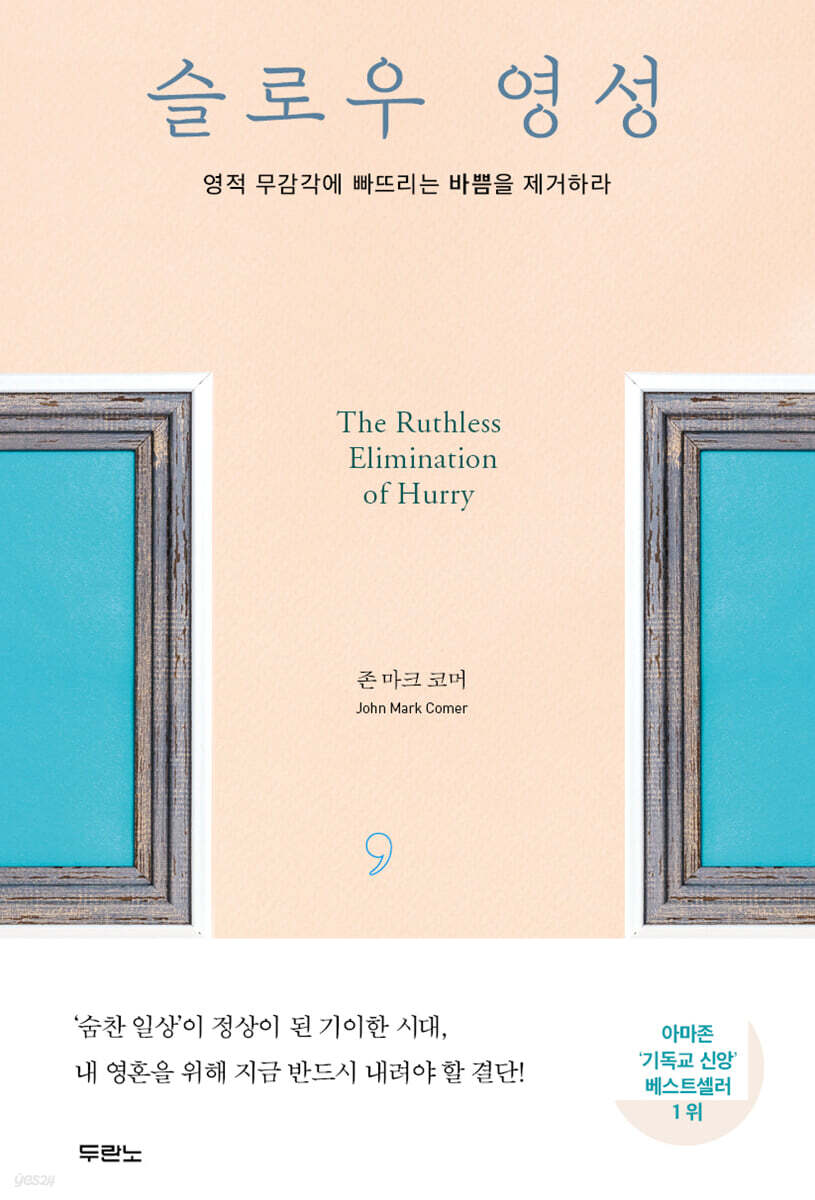 |
Description
Book Introduction
Amazon's #1 Bestseller in Christian Faith! Not truly living life A solution for modern people who are just passing through. The speed of daily life is also spirituality! Is the word "busy" a familiar phrase? Do you pride yourself on being a multitasker? Do you feel anxious if your smartphone isn't with you even for a moment? Are there times when you have nothing to do? Do you always have things you want to do and things you have to do piling up? Do you feel like your concentration and patience have declined significantly recently? Do you find yourself becoming emotionally agitated over trivial matters? Do you constantly find yourself wondering, "This isn't right," or "Is this the right way to live?" If so, you need this book. Introducing this book for the first time in Korea, author Pastor John Mark Comer addresses the modern ills of busyness, distraction, and addiction in simple and honest language. By depicting the sad (and at the same time extremely dangerous) daily lives of modern people suffering from 'time famine', it invites us, who are burdened by the heavy burden of life, to the path of Jesus and his way of life. "Slow Spirituality" is an invitation to ruthlessly eliminate busyness from life and revive a blurred spiritual life through spiritual training appropriate for this era. |
- You can preview some of the book's contents.
Preview
index
Foreword by John Ortberg.
Freedom doesn't come for free.
prolog.
A Patient's Confessions of Having Been Overcome by the "Busy" Epidemic
Part 1.
Addicted to the 'fast-paced life'
― An age of spiritual dullness, consumed by fleeting things
1.
Chronic busyness is the greatest enemy of spirituality in this age.
2.
Since when did we become so pressed for time?
3.
Impatience, a violent beast that kills 'everything precious'
Part 2.
How Jesus' People Use Their Time
― He, whose day was more full than anyone else's, never rushed?
4.
The solution to time scarcity isn't more time.
5.
Take up the 'easy yoke' with Jesus and walk at Jesus' pace
6.
We need 'spaces' and 'rules' where love, joy, and peace can dwell.
Intermission: Wait, What Is "Spiritual Training"?
Part 3.
Holistic "Slow Spirituality" Training for This Era
― A whole new way to bear the weight of life
Silence and Solitude Training /
7.
A battlefield of noise: Practice hearing God loudest every day.
Sabbath Training /
8.
The practice of stopping work, stopping desires, and stopping worries
Simplicity Training /
9.
Practice breaking the shackles of soul-destroying materialism and possessiveness.
Slowing down training /
10.
Practice slowing down both your 'thinking speed' and 'body movement speed'
Epilogue.
The ultimate goal is to 'return to our God'
Acknowledgements
main
Freedom doesn't come for free.
prolog.
A Patient's Confessions of Having Been Overcome by the "Busy" Epidemic
Part 1.
Addicted to the 'fast-paced life'
― An age of spiritual dullness, consumed by fleeting things
1.
Chronic busyness is the greatest enemy of spirituality in this age.
2.
Since when did we become so pressed for time?
3.
Impatience, a violent beast that kills 'everything precious'
Part 2.
How Jesus' People Use Their Time
― He, whose day was more full than anyone else's, never rushed?
4.
The solution to time scarcity isn't more time.
5.
Take up the 'easy yoke' with Jesus and walk at Jesus' pace
6.
We need 'spaces' and 'rules' where love, joy, and peace can dwell.
Intermission: Wait, What Is "Spiritual Training"?
Part 3.
Holistic "Slow Spirituality" Training for This Era
― A whole new way to bear the weight of life
Silence and Solitude Training /
7.
A battlefield of noise: Practice hearing God loudest every day.
Sabbath Training /
8.
The practice of stopping work, stopping desires, and stopping worries
Simplicity Training /
9.
Practice breaking the shackles of soul-destroying materialism and possessiveness.
Slowing down training /
10.
Practice slowing down both your 'thinking speed' and 'body movement speed'
Epilogue.
The ultimate goal is to 'return to our God'
Acknowledgements
main
Into the book
In our culture, “slow” is used as an expression of contempt.
We make fun of people with low IQs as being slow and dull.
If the waiter is slow, we complain that the service is poor, and if the movie is slow, we complain that it is boring.
So, Merriam-Webster's dictionary defines the English word "slow" as follows:
“I am mentally slow.
It's stupid.
Naturally inactive or lazy.
“You are either slow or lack the will.” The message from our culture is clear.
Slow is bad and fast is good.
But in Christ's upside-down kingdom, the value system is completely reversed.
Busyness is an attribute of Satan, and slowness is an attribute of Jesus.
Because Jesus is love itself, made of flesh and blood.
The same goes for the other two core attributes of Christ's kingdom: joy and peace.
At the heart of Jesus' vision of the kingdom are love, joy, and peace.
None of these three are simple emotions.
This is the overall state of mind.
This is not simply a good feeling, but an inner state that we become like when we follow Jesus, who perfectly embodied these three things.
And all three of these are incompatible with busyness.
--- p.40
Most historians point to 1370 as a turning point in Western society's relationship with time.
That year, the first public clock tower was erected in Cologne, Germany.
Before, time was natural.
Time was linked to the Earth's rotation and the four seasons.
I went to bed when the moon rose and opened my eyes when the sun rose.
In summer the days were long and lively, in winter the days were short and slow.
There was a rhythm to the day and the year.
In the words of French medievalist Jacques Le Goff, life “was not busy, not concerned with precision or productivity, but simply followed the rhythm of agriculture.”
But the clock changed all that.
The clock created artificial time.
The clock torments us from 9 a.m. to 5 p.m. all year round.
Now we don't listen to our bodies.
I started waking up not when my body was finished resting, but when the alarm clock started blaring its oppressive siren.
Sure, efficiency has improved, but we are now closer to machines than humans.
--- p.48
According to a recent study, smartphone users touch their phones an average of 2,617 times a day.
And we use our smartphones on average 76 times a day, spending 2.5 hours a day on them.
All smartphone users are like that.
Another study of millennials found that figure was twice as high.
In every study I've read, the vast majority of people surveyed had no idea how much time they actually spent on their smartphones.
--- p.55
In 2000, before the digital revolution, the attention span was 12 seconds.
The situation was already not so good.
But after that, it dropped to a whopping 8 seconds.
If you don't get a sense of how serious this situation is, look at the attention span of a goldfish.
A goldfish has a 9-second attention span.
Yes, that's right.
We're losing to goldfish too.
But it doesn't end here.
There are literally thousands, if not tens of thousands, of apps and devices that are 'planned' to steal our attention.
These are after our attention and our money.
Remember.
Your smartphone isn't really working for you.
Of course, you pay your cell phone bill.
But your smartphone doesn't work for you, it works for a corporation with billions of dollars in assets.
You are not a customer, you are just a product.
Your cell phone is stealing your peace of mind as it consumes your attention.
--- p.58
Busyness is often a symptom of something else that has a cause.
Something deeper.
Usually it's about running away from something.
Something here could be a wound from a father, a childhood trauma, abuse from a spouse, deep insecurity, a lack of self-esteem, a fear of failure, the reality of human limitations, or the tedious routine of middle age.
Or it could be running towards something.
Here, something could be a promotion, a purchase, an experience, a stamp in your passport, or a new stimulus.
We are running in the wrong direction, chasing what the world cannot give us: self-esteem, love, and a feeling of being welcomed.
In today's meritocracy, it's easy to feel like we're only worth what we earn: sales figures, quarterly reports, album sales, sermon responses, Instagram posts, or the material possessions we possess.
So we are constantly gasping for breath, chasing the wind that seems so elusive that it seems impossible to catch.
Sometimes our busyness isn't so dramatic.
It's not escapism, I'm just busy with the many responsibilities I have in the modern world.
But in either case the result is the same.
This is what William Irvine calls “the wrong life.”
--- pp.75-76
Life has emotional weight, and even spiritual weight.
We all feel this weight.
This is especially true as we get older.
The easy life is an illusion created by the advertisements and social media of this world.
Life is hard.
This is an undeniable fact.
As all the wise men of history have repeatedly said, no new technology or drug in this world can completely erase the suffering caused by the fall of humanity.
At best, we can only mitigate the effects by waiting for Jesus to return.
There is no way to avoid suffering altogether.
… (omitted)… Many people, both inside and outside the church, are looking for a way out.
I am looking for a way to shed the weight of this life that weighs heavily on my shoulders.
But there is no escape.
At best, all the world can offer is temporary pleasure to delay or deny inevitable suffering.
This is why Jesus did not offer a way out.
Jesus offers something far better: 'equipment.'
Jesus offers his disciples a whole new way to carry the weight of life.
easy.
Side by side with him.
Like two oxen working together in a field, shoulder to shoulder.
With Jesus.
At the speed of Jesus.
slowly.
Without rushing.
Focusing on the present.
Full of love, joy and peace.
There is no easy life.
It's just an easy yoke.
--- pp.109-110
Jesus' schedule was always full.
Sometimes it was so overwhelming that it was overflowing.
Of course, it was filled with only good things.
But Jesus never hurried.
Jesus always focused on the present moment and remained connected to God, other people, and himself.
It wasn't because I was easygoing by nature.
It wasn't because it was an old time when there was no Wi-Fi.
Because the way of life is different.
In every story, Jesus shows us a whole new way of life.
--- p.115
Growth in relationships cannot happen on its own without aligning our schedules and habits around following Jesus.
If we do that, Jesus' apprenticeship will remain at the level of concepts rather than real life.
The problem is that we are too busy to follow Jesus.
Every time I teach the rules of life and the core principles of a life with Jesus, I hear the same refrain:
“It’s all good, but I don’t have time for that.” “I’m too busy studying.” “I’m too busy with work to have time.” “The kids are still young.” “I’m so busy training for a marathon these days that I’m out of my mind.” “I just like to be active.”
Honestly, it's all excuses.
But I understand.
Because I live in the same world.
In the past, I would have just laughed off this awkward moment.
But as I got older, my face got thicker enough to feel a bit burdensome.
I want to ask you something carefully.
"Really? How many hours of television do you watch?" (This usually makes the situation more awkward.) "How much time do you spend on the Internet or social media? Shopping?" I want you to keep a record of how you spend your time for a week.
If you do that, you will be 'shocked' at how much time you waste on useless things.
--- pp.119-120
Training is a way to gain strength.
Spiritual training is similar yet different.
It is similar in that it is about “doing what can be done with direct effort” so that “what cannot be done with direct effort” can eventually be done.
Spiritual training is also a way to gain strength.
But it is different in that it uses not only its own strength (willpower) to do the right thing, but also relies on a power far greater than itself, namely the power of the Holy Spirit.
Spiritual training is about creating time and space to reach out to God from the deepest part of your being.
--- p.127
Boredom can be a gateway to prayer.
The countless boring moments that come every day are opportunities to wake up to the reality of God that surrounds us.
It was an opportunity to awaken one's own soul.
It was an opportunity to turn my heart back to God.
It was an opportunity to break free from the shackles of busyness and become conscious of God.
But now all these moments are gone.
The digital beast has devoured these precious moments.
The moment we feel even the slightest bit bored, we reach for our smartphones.
Check the news, reply to emails (click "Reply All"), read a tweet about Donald Trump's tweet and then tweet it back, check the weather today, research new shoes, and, naturally, log into an online game.
… (omitted) … This digital world, where we are so busy and distracted by so many things, is taking away our ability to focus on what is important.
The ability to focus on God.
The ability to focus on other people.
The ability to focus on all that is good, beautiful, and true in our world.
The ability to focus on our own soul.
--- pp.134-135
I used to read the ending of this story and think, 'Wow, Jesus is really spiritual.
I thought, 'You must have been praying all night!'
Of course, that's not wrong.
But we must pay close attention to the 'reason' why Jesus prayed all night.
Because that was the only time he could be alone and quiet.
Jesus was so busy that he didn't have time to be alone all day.
So he had no choice but to send all his disciples away and stay on the mountain all night (the word 'Eremos' is not used here, but the mountaintop at midnight perfectly satisfies the conditions of Eremos).
Jesus knew that time alone with the Father was far more important than sleep.
… (omitted) … Usually we are the exact opposite.
As more people come and go, life gets busier and more hectic, and we find less time to go to quiet places.
The first thing that disappears is the time spent sitting alone before God in a quiet place.
There is no time to pray, read the Psalms, or reflect inwardly.
There is no time for our souls to catch up with our bodies.
But the busier you are, the more time you need to spend in a quiet place.
--- pp.143-145
Social media has made this problem even more serious.
Now we are bombarded with images every day.
These bombs aren't just coming from marketing departments.
The rich, the famous, and even our friends and family are driving us to dissatisfaction with photos of their best moments.
All of this encourages sin that goes back to the Garden of Eden.
Exactly, jealousy.
Not being able to experience gratitude, joy, and satisfaction with one's own life, but instead greedily longing for the lives of others.
The result of the intersection of innate human dissatisfaction and the digital age is global emotional illness and spiritual death.
So, is there a habit that can break this endless cycle of dissatisfaction and help us find the rest of Jesus? You already know the answer.
Of course, there are many answers.
But the most important of these is the Sabbath.
--- p.165
Egypt is still very much alive.
We are now living in the heart of Egypt.
We live in a culture that cries out for 'more'.
A culture of burning greed.
A culture that demands everything.
A world that craves 'more' food, 'more' drinks, 'more' clothes, 'more' electronics, 'more' apps, 'more' stuff, 'bigger' houses (or 'more' buildings), 'more' experiences, and 'more' international travel.
… … To borrow the famous expression of Old Testament scholar Walter Brueggemann, the Sabbath is “an act of resistance.”
The Sabbath is an act of rebellion against Pharaoh and his empire.
It is a rebellion against all the “isms” of the Western world.
Globalism, capitalism, materialism.
All this sounds good, but it enslaves both rich and poor.
The Sabbath is the way to remain free.
It is a way to avoid returning to slavery.
More importantly, it is a way to avoid becoming a slave owner.
… …The Sabbath is an act of saying, “Enough is enough!”
--- pp.184, 187-188
Minimalism is not about organizing things.
It's not like I clean out my warehouse every spring.
It's not that I clean my closet every time I get a chance.
It's not like you buy cardboard boxes and tape from the supermarket.
Marie Kondo wrote a great book, but I think 'tidying up' is the opposite of minimalism.
If you have so much stuff that you have to organize and stack it in multiple cardboard boxes, you have too much stuff (unless you live in a small apartment in San Francisco or New York City).
“What if I only have what I need and don’t need to organize?” That’s a question worth considering.
… (omitted) … The goal is not to organize a closet or a storage room, but to organize ‘life’.
We need to get rid of all the useless clutter that causes anxiety and prevents us from focusing on what really matters.
We make fun of people with low IQs as being slow and dull.
If the waiter is slow, we complain that the service is poor, and if the movie is slow, we complain that it is boring.
So, Merriam-Webster's dictionary defines the English word "slow" as follows:
“I am mentally slow.
It's stupid.
Naturally inactive or lazy.
“You are either slow or lack the will.” The message from our culture is clear.
Slow is bad and fast is good.
But in Christ's upside-down kingdom, the value system is completely reversed.
Busyness is an attribute of Satan, and slowness is an attribute of Jesus.
Because Jesus is love itself, made of flesh and blood.
The same goes for the other two core attributes of Christ's kingdom: joy and peace.
At the heart of Jesus' vision of the kingdom are love, joy, and peace.
None of these three are simple emotions.
This is the overall state of mind.
This is not simply a good feeling, but an inner state that we become like when we follow Jesus, who perfectly embodied these three things.
And all three of these are incompatible with busyness.
--- p.40
Most historians point to 1370 as a turning point in Western society's relationship with time.
That year, the first public clock tower was erected in Cologne, Germany.
Before, time was natural.
Time was linked to the Earth's rotation and the four seasons.
I went to bed when the moon rose and opened my eyes when the sun rose.
In summer the days were long and lively, in winter the days were short and slow.
There was a rhythm to the day and the year.
In the words of French medievalist Jacques Le Goff, life “was not busy, not concerned with precision or productivity, but simply followed the rhythm of agriculture.”
But the clock changed all that.
The clock created artificial time.
The clock torments us from 9 a.m. to 5 p.m. all year round.
Now we don't listen to our bodies.
I started waking up not when my body was finished resting, but when the alarm clock started blaring its oppressive siren.
Sure, efficiency has improved, but we are now closer to machines than humans.
--- p.48
According to a recent study, smartphone users touch their phones an average of 2,617 times a day.
And we use our smartphones on average 76 times a day, spending 2.5 hours a day on them.
All smartphone users are like that.
Another study of millennials found that figure was twice as high.
In every study I've read, the vast majority of people surveyed had no idea how much time they actually spent on their smartphones.
--- p.55
In 2000, before the digital revolution, the attention span was 12 seconds.
The situation was already not so good.
But after that, it dropped to a whopping 8 seconds.
If you don't get a sense of how serious this situation is, look at the attention span of a goldfish.
A goldfish has a 9-second attention span.
Yes, that's right.
We're losing to goldfish too.
But it doesn't end here.
There are literally thousands, if not tens of thousands, of apps and devices that are 'planned' to steal our attention.
These are after our attention and our money.
Remember.
Your smartphone isn't really working for you.
Of course, you pay your cell phone bill.
But your smartphone doesn't work for you, it works for a corporation with billions of dollars in assets.
You are not a customer, you are just a product.
Your cell phone is stealing your peace of mind as it consumes your attention.
--- p.58
Busyness is often a symptom of something else that has a cause.
Something deeper.
Usually it's about running away from something.
Something here could be a wound from a father, a childhood trauma, abuse from a spouse, deep insecurity, a lack of self-esteem, a fear of failure, the reality of human limitations, or the tedious routine of middle age.
Or it could be running towards something.
Here, something could be a promotion, a purchase, an experience, a stamp in your passport, or a new stimulus.
We are running in the wrong direction, chasing what the world cannot give us: self-esteem, love, and a feeling of being welcomed.
In today's meritocracy, it's easy to feel like we're only worth what we earn: sales figures, quarterly reports, album sales, sermon responses, Instagram posts, or the material possessions we possess.
So we are constantly gasping for breath, chasing the wind that seems so elusive that it seems impossible to catch.
Sometimes our busyness isn't so dramatic.
It's not escapism, I'm just busy with the many responsibilities I have in the modern world.
But in either case the result is the same.
This is what William Irvine calls “the wrong life.”
--- pp.75-76
Life has emotional weight, and even spiritual weight.
We all feel this weight.
This is especially true as we get older.
The easy life is an illusion created by the advertisements and social media of this world.
Life is hard.
This is an undeniable fact.
As all the wise men of history have repeatedly said, no new technology or drug in this world can completely erase the suffering caused by the fall of humanity.
At best, we can only mitigate the effects by waiting for Jesus to return.
There is no way to avoid suffering altogether.
… (omitted)… Many people, both inside and outside the church, are looking for a way out.
I am looking for a way to shed the weight of this life that weighs heavily on my shoulders.
But there is no escape.
At best, all the world can offer is temporary pleasure to delay or deny inevitable suffering.
This is why Jesus did not offer a way out.
Jesus offers something far better: 'equipment.'
Jesus offers his disciples a whole new way to carry the weight of life.
easy.
Side by side with him.
Like two oxen working together in a field, shoulder to shoulder.
With Jesus.
At the speed of Jesus.
slowly.
Without rushing.
Focusing on the present.
Full of love, joy and peace.
There is no easy life.
It's just an easy yoke.
--- pp.109-110
Jesus' schedule was always full.
Sometimes it was so overwhelming that it was overflowing.
Of course, it was filled with only good things.
But Jesus never hurried.
Jesus always focused on the present moment and remained connected to God, other people, and himself.
It wasn't because I was easygoing by nature.
It wasn't because it was an old time when there was no Wi-Fi.
Because the way of life is different.
In every story, Jesus shows us a whole new way of life.
--- p.115
Growth in relationships cannot happen on its own without aligning our schedules and habits around following Jesus.
If we do that, Jesus' apprenticeship will remain at the level of concepts rather than real life.
The problem is that we are too busy to follow Jesus.
Every time I teach the rules of life and the core principles of a life with Jesus, I hear the same refrain:
“It’s all good, but I don’t have time for that.” “I’m too busy studying.” “I’m too busy with work to have time.” “The kids are still young.” “I’m so busy training for a marathon these days that I’m out of my mind.” “I just like to be active.”
Honestly, it's all excuses.
But I understand.
Because I live in the same world.
In the past, I would have just laughed off this awkward moment.
But as I got older, my face got thicker enough to feel a bit burdensome.
I want to ask you something carefully.
"Really? How many hours of television do you watch?" (This usually makes the situation more awkward.) "How much time do you spend on the Internet or social media? Shopping?" I want you to keep a record of how you spend your time for a week.
If you do that, you will be 'shocked' at how much time you waste on useless things.
--- pp.119-120
Training is a way to gain strength.
Spiritual training is similar yet different.
It is similar in that it is about “doing what can be done with direct effort” so that “what cannot be done with direct effort” can eventually be done.
Spiritual training is also a way to gain strength.
But it is different in that it uses not only its own strength (willpower) to do the right thing, but also relies on a power far greater than itself, namely the power of the Holy Spirit.
Spiritual training is about creating time and space to reach out to God from the deepest part of your being.
--- p.127
Boredom can be a gateway to prayer.
The countless boring moments that come every day are opportunities to wake up to the reality of God that surrounds us.
It was an opportunity to awaken one's own soul.
It was an opportunity to turn my heart back to God.
It was an opportunity to break free from the shackles of busyness and become conscious of God.
But now all these moments are gone.
The digital beast has devoured these precious moments.
The moment we feel even the slightest bit bored, we reach for our smartphones.
Check the news, reply to emails (click "Reply All"), read a tweet about Donald Trump's tweet and then tweet it back, check the weather today, research new shoes, and, naturally, log into an online game.
… (omitted) … This digital world, where we are so busy and distracted by so many things, is taking away our ability to focus on what is important.
The ability to focus on God.
The ability to focus on other people.
The ability to focus on all that is good, beautiful, and true in our world.
The ability to focus on our own soul.
--- pp.134-135
I used to read the ending of this story and think, 'Wow, Jesus is really spiritual.
I thought, 'You must have been praying all night!'
Of course, that's not wrong.
But we must pay close attention to the 'reason' why Jesus prayed all night.
Because that was the only time he could be alone and quiet.
Jesus was so busy that he didn't have time to be alone all day.
So he had no choice but to send all his disciples away and stay on the mountain all night (the word 'Eremos' is not used here, but the mountaintop at midnight perfectly satisfies the conditions of Eremos).
Jesus knew that time alone with the Father was far more important than sleep.
… (omitted) … Usually we are the exact opposite.
As more people come and go, life gets busier and more hectic, and we find less time to go to quiet places.
The first thing that disappears is the time spent sitting alone before God in a quiet place.
There is no time to pray, read the Psalms, or reflect inwardly.
There is no time for our souls to catch up with our bodies.
But the busier you are, the more time you need to spend in a quiet place.
--- pp.143-145
Social media has made this problem even more serious.
Now we are bombarded with images every day.
These bombs aren't just coming from marketing departments.
The rich, the famous, and even our friends and family are driving us to dissatisfaction with photos of their best moments.
All of this encourages sin that goes back to the Garden of Eden.
Exactly, jealousy.
Not being able to experience gratitude, joy, and satisfaction with one's own life, but instead greedily longing for the lives of others.
The result of the intersection of innate human dissatisfaction and the digital age is global emotional illness and spiritual death.
So, is there a habit that can break this endless cycle of dissatisfaction and help us find the rest of Jesus? You already know the answer.
Of course, there are many answers.
But the most important of these is the Sabbath.
--- p.165
Egypt is still very much alive.
We are now living in the heart of Egypt.
We live in a culture that cries out for 'more'.
A culture of burning greed.
A culture that demands everything.
A world that craves 'more' food, 'more' drinks, 'more' clothes, 'more' electronics, 'more' apps, 'more' stuff, 'bigger' houses (or 'more' buildings), 'more' experiences, and 'more' international travel.
… … To borrow the famous expression of Old Testament scholar Walter Brueggemann, the Sabbath is “an act of resistance.”
The Sabbath is an act of rebellion against Pharaoh and his empire.
It is a rebellion against all the “isms” of the Western world.
Globalism, capitalism, materialism.
All this sounds good, but it enslaves both rich and poor.
The Sabbath is the way to remain free.
It is a way to avoid returning to slavery.
More importantly, it is a way to avoid becoming a slave owner.
… …The Sabbath is an act of saying, “Enough is enough!”
--- pp.184, 187-188
Minimalism is not about organizing things.
It's not like I clean out my warehouse every spring.
It's not that I clean my closet every time I get a chance.
It's not like you buy cardboard boxes and tape from the supermarket.
Marie Kondo wrote a great book, but I think 'tidying up' is the opposite of minimalism.
If you have so much stuff that you have to organize and stack it in multiple cardboard boxes, you have too much stuff (unless you live in a small apartment in San Francisco or New York City).
“What if I only have what I need and don’t need to organize?” That’s a question worth considering.
… (omitted) … The goal is not to organize a closet or a storage room, but to organize ‘life’.
We need to get rid of all the useless clutter that causes anxiety and prevents us from focusing on what really matters.
--- pp.221-223
Publisher's Review
Amazon's #1 Bestseller in Christian Faith!
Not truly living life
A solution for modern people who are just passing through.
The speed of daily life is also spirituality!
Is the word "busy" a familiar phrase? Do you pride yourself on being a multitasker? Do you feel anxious if your smartphone isn't with you even for a moment? Are there times when you have nothing to do? Do you always have things you want to do and things you have to do piling up? Do you feel like your concentration and patience have declined significantly recently? Do you find yourself becoming emotionally agitated over trivial matters? Do you constantly find yourself wondering, "This isn't right," or "Is this the right way to live?"
If so, you need this book.
Introducing this book for the first time in Korea, author Pastor John Mark Comer addresses the modern ills of busyness, distraction, and addiction in simple and honest language.
By depicting the sad (and at the same time extremely dangerous) daily lives of modern people suffering from 'time famine', it invites us, who are burdened by the heavy burden of life, to the path of Jesus and his way of life.
"Slow Spirituality" is an invitation to ruthlessly eliminate busyness from life and revive a blurred spiritual life through spiritual training appropriate for this era.
A strange era where 'breathless daily life' has become the norm,
A decision I must make now for my soul!
At the age of thirty-three, John Mark Comer made the bold decision to step down from his position as senior pastor of a large, rapidly growing, and high-profile multi-site church.
To live emotionally and spiritually healthy, he mercilessly slowed down, simplified his life based on Jesus' habits, and began to live a life "abiding" in Jesus.
This book is the product of those precious decisions and training.
If you're feeling increasingly weary, if your daily life feels meaningless, and if you secretly wonder if there might be a better path, follow his story and find your own pace! A whole new way to shoulder the weight of life.
How to live “freely and lightly” at the pace of Jesus.
Your tangled mind will be healed, and your quality of life will change!
Not truly living life
A solution for modern people who are just passing through.
The speed of daily life is also spirituality!
Is the word "busy" a familiar phrase? Do you pride yourself on being a multitasker? Do you feel anxious if your smartphone isn't with you even for a moment? Are there times when you have nothing to do? Do you always have things you want to do and things you have to do piling up? Do you feel like your concentration and patience have declined significantly recently? Do you find yourself becoming emotionally agitated over trivial matters? Do you constantly find yourself wondering, "This isn't right," or "Is this the right way to live?"
If so, you need this book.
Introducing this book for the first time in Korea, author Pastor John Mark Comer addresses the modern ills of busyness, distraction, and addiction in simple and honest language.
By depicting the sad (and at the same time extremely dangerous) daily lives of modern people suffering from 'time famine', it invites us, who are burdened by the heavy burden of life, to the path of Jesus and his way of life.
"Slow Spirituality" is an invitation to ruthlessly eliminate busyness from life and revive a blurred spiritual life through spiritual training appropriate for this era.
A strange era where 'breathless daily life' has become the norm,
A decision I must make now for my soul!
At the age of thirty-three, John Mark Comer made the bold decision to step down from his position as senior pastor of a large, rapidly growing, and high-profile multi-site church.
To live emotionally and spiritually healthy, he mercilessly slowed down, simplified his life based on Jesus' habits, and began to live a life "abiding" in Jesus.
This book is the product of those precious decisions and training.
If you're feeling increasingly weary, if your daily life feels meaningless, and if you secretly wonder if there might be a better path, follow his story and find your own pace! A whole new way to shoulder the weight of life.
How to live “freely and lightly” at the pace of Jesus.
Your tangled mind will be healed, and your quality of life will change!
GOODS SPECIFICS
- Publication date: August 18, 2021
- Page count, weight, size: 300 pages | 386g | 140*217*17mm
- ISBN13: 9788953140455
- ISBN10: 8953140455
You may also like
카테고리
korean


korean

![GQ KOREA Mark (Monthly): December [2025]](http://librairie.coreenne.fr/cdn/shop/files/8ef265dbbfbf186523ed75ba7319009d.jpg?v=1765340328&width=3840)


