

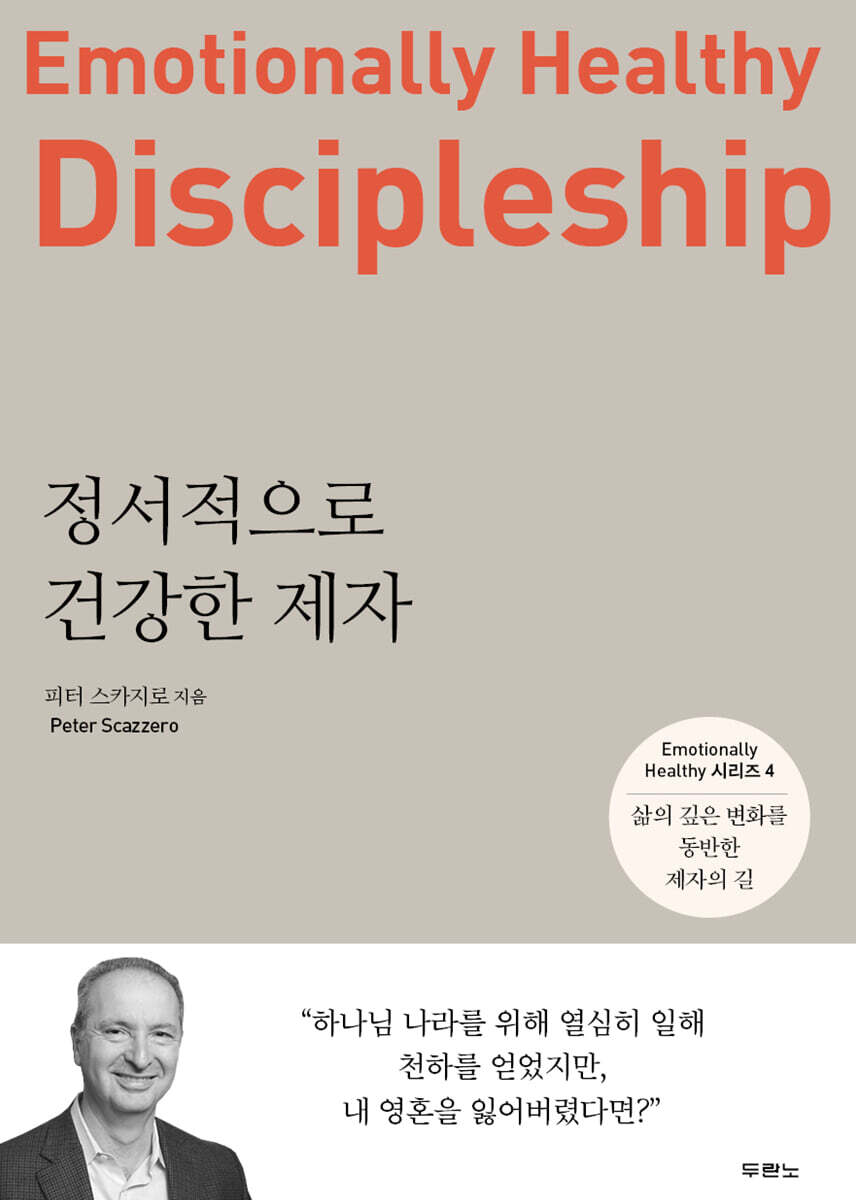
emotionally healthy disciples
 |
Description
Book Introduction
Christianity without the living Christ cannot but be Christianity without discipleship training.
Christianity without discipleship is always Christianity without Christ.
- Bonhoeffer
The Importance of Disciple Training
As Dietrich Bonhoeffer said, “Christianity without the living Christ is Christianity without discipleship, and Christianity without discipleship is always Christianity without Christ.” Discipleship is so important, but this book begins by confessing that the ministry that devoted decades to discipleship, giving everything to nurture disciples, was none other than a ministry filled with anger and hurt.
Christianity without discipleship is always Christianity without Christ.
- Bonhoeffer
The Importance of Disciple Training
As Dietrich Bonhoeffer said, “Christianity without the living Christ is Christianity without discipleship, and Christianity without discipleship is always Christianity without Christ.” Discipleship is so important, but this book begins by confessing that the ministry that devoted decades to discipleship, giving everything to nurture disciples, was none other than a ministry filled with anger and hurt.
- You can preview some of the book's contents.
Preview
index
Recommendation
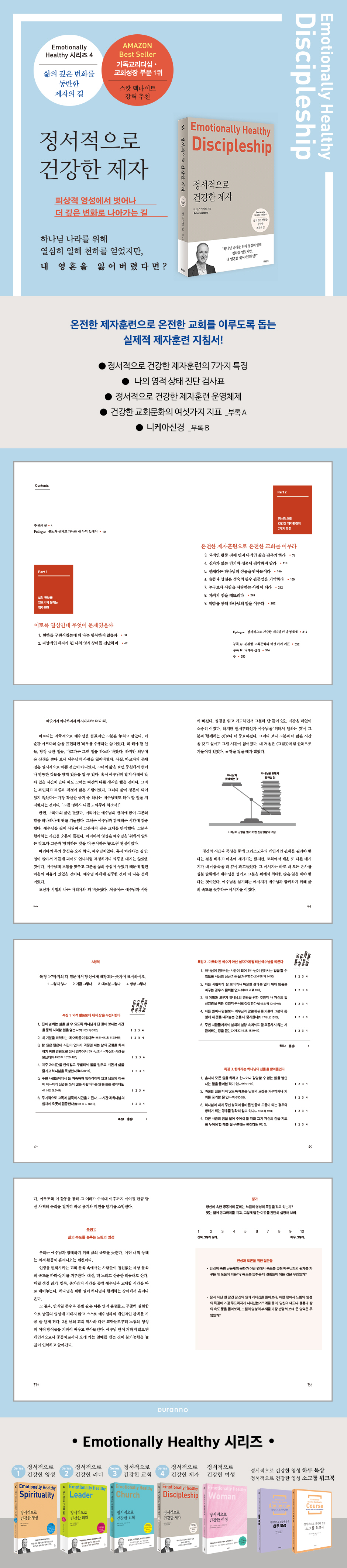
Prologue Before my ministry filled with anger and hurt
Part 1 Discipleship that Doesn't Transform Lives
What could be the problem with all this hard work?
1.
I saved the world, so why am I not happy?
2.
Diagnosing my spiritual state as a superficial disciple
Part 2: Seven Characteristics of Emotionally Healthy Discipleship
Build a complete church through complete discipleship training.
3.
Before engaging in external activities, first cultivate an inner life.
4.
Don't be obsessed with popularity and success without the cross.
5.
Accept God's gift of limitations.
6.
Remember that grief and loss are essential gateways to maturity.
7.
Become a person who loves people more than anyone else
8.
Break the power of the past
9.
Accomplish God's work through weakness
Epilogue: An Emotionally Healthy Discipleship Training System
Appendix A: Six Indicators of a Healthy Church Culture
Appendix B Nicene Creed
main
Prologue Before my ministry filled with anger and hurt
Part 1 Discipleship that Doesn't Transform Lives
What could be the problem with all this hard work?
1.
I saved the world, so why am I not happy?
2.
Diagnosing my spiritual state as a superficial disciple
Part 2: Seven Characteristics of Emotionally Healthy Discipleship
Build a complete church through complete discipleship training.
3.
Before engaging in external activities, first cultivate an inner life.
4.
Don't be obsessed with popularity and success without the cross.
5.
Accept God's gift of limitations.
6.
Remember that grief and loss are essential gateways to maturity.
7.
Become a person who loves people more than anyone else
8.
Break the power of the past
9.
Accomplish God's work through weakness
Epilogue: An Emotionally Healthy Discipleship Training System
Appendix A: Six Indicators of a Healthy Church Culture
Appendix B Nicene Creed
main
Detailed image
Into the book
Where did things go wrong?
Our church's first service began with only a few people.
But thanks to God's powerful work, the church continued to grow rapidly.
Taking advantage of my ability to speak Spanish, we have been holding services in Spanish since the third year of our founding.
By the end of the sixth year, nearly 400 people were attending the English service and about 250 were attending the Spanish service.
Moreover, the establishment of two new churches was truly a remarkable achievement.
God has taught us many things about prayer, fasting, healing, spiritual warfare, the gifts of the Holy Spirit, and how to hear God's voice.
Every week new people came to Christ, and countless others developed personal relationships with Him.
Ministries that creatively serve the poor are being created one after another.
We trained leaders, continuously expanded small groups, fed the homeless, and planted new churches.
But, while it was flashy on the outside, the internal condition beneath the surface was not so good.
Immature and childish behaviors continued to recur.
The conflict never ended.
By avoiding burdensome conversations in the name of breaking down racial, economic, and cultural barriers, our community has been derailed day by day.
What was most frustrating of all was the undesirable behavior of some of the core believers.
Although they themselves burned with passion for God, others viewed them as critical, untrustworthy, and unapproachable.
Although I didn't realize it at the time, many of the problems in our church stemmed from my own problems and immaturity.
My superficial life as a disciple was being reproduced in the people I led.
Our church was dynamic, but it wasn't a fun place for the leaders, especially my wife and I.
Perhaps that is why there were frequent resignations among ministers.
But we blamed it on spiritual warfare and the harsh pastoral environment of New York City.
People around me encouraged me, saying that it was a natural growing pain that often occurs in large organizations and businesses.
But we weren't a business.
We were the church!
My wife and I knew something was wrong.
Our couple's morale was dropping day by day.
Church leaders felt that ministry was a heavy burden.
We were those who, in our zeal for the kingdom of God, gained the world and lost our own souls (Mark 8:36).
Something was tightly twisted.
I was secretly dreaming of retirement.
At that time, I was only in my mid-30s.
I examined myself spiritually, but I could not find the cause of my lack of joy.
I hadn't committed any immoral acts, harbored no resentment, or coveted anything that belonged to others. Why was this happening? I couldn't figure it out.
Hide my face, full of anger and hurt
For the next two years, my life continued to fall into the abyss.
It felt like my life was falling into a black hole.
I cried out to God with tears in my eyes, asking Him to help me and change me.
But it felt like God had decided to turn a deaf ear to my cries.
My wife's outburst was painful, but it opened the floodgates of liberation for us.
My wife finally shed her 'good' spiritual facade.
That facade was a huge stumbling block that kept us from facing the truth about our marriage and our lives.
I listened.
The wife also listened.
We looked back on our parents' lives and marriages.
I honestly looked back at the state of our church.
The state of our church mirrored the dysfunctional aspects of my childhood home.
Until then, we both lived knowing that we shouldn't feel these emotions.
I discovered the shocking truth that what I thought was true discipleship training was actually superficial discipleship training that was only a few centimeters deep.
We have believed in Jesus for over 17 years, but the discipleship training we have known and practiced during that time has been superficial.
It was a great shock to realize that even though I had studied the Bible and prayed diligently for so long, there were still many areas of my life that I had not opened to God.
How can this be?
I have practiced everything countless pastors and leaders have taught me about following Jesus.
I was loyal and completely devoted.
I believed in the power of God, the Bible, prayer, and the gifts of the Holy Spirit.
But how could my life, my marriage, and my leadership be so completely ruined?
Where has all God's explosive power gone?
Especially when it came to my faith and my role as a leader, I felt like I was dead.
But what initially felt like death was actually the beginning of a long journey that opened up a new relationship with God.
It was the starting point for changes in our lives, our marriages, our families, our churches, and countless churches around the world.
I discovered that the problem was not the Christian faith itself, but the way we were trained and raised as disciples.
Poor discipleship training full of holes that only looks good on the outside
I learned a lot about stone architecture from my son-in-law, Brett.
Five years ago, my son-in-law entered the world of stonemasonry, one of the oldest professions in history, as an apprentice to a master stonemason, and only recently reached the second level, becoming a journeyman.
It still takes more than 7 years of training to become a master craftsman.
The total training period can take well over 10 years and up to 15 years.
It is no wonder that there are only a handful of master stonemasons, as the process of progressing from apprentice to skilled worker to master is so slow and arduous.
Buildings built by these stonemasons can withstand harsh weather for thousands of years.
We can see this in the pyramids of Egypt, the castles of the Middle Ages, and the well-built stone farmhouses of today.
The cost and time involved in quarrying, cutting, transporting, and then hiring craftsmen to build the stone are enormous, so the construction industry has been constantly looking for cheaper alternatives.
Nowadays, stone slabs called 'cladding' are mainly used to create an exterior that looks like real stone.
Cladding is broadly divided into two types.
There are natural cladding and artificial cladding.
Natural cladding is made by cutting large rocks into thin slabs, 3-13 centimeters thick, and attaching them to the exterior walls of houses or buildings.
Synthetic cladding is a material made from artificial materials such as cement.
At first glance, it looks and feels like expensive natural rock, but it is cheaper than the heavy stones used by stonemasons, and even less expensive than natural cladding.
Even the installation is quick and easy.
There are even brands that promote their products as 'DIY' products.
Anyone can easily install it by just looking at the YouTube description.
By now you've probably guessed why I brought up stonework and cladding.
The answer is simple.
Most discipleship training in modern churches is similar to cladding.
On the surface, everything seems real.
The congregation is vibrant, optimistic, and filled with faith that Jesus will carry them through life's crises and valleys.
Everyone is spiritually uplifted by the fervent worship and heart-wrenching sermons.
In every church, we hear touching testimonies and shed hot tears.
Small group meetings and Sunday gatherings are lively and warm.
It feels like the new things God wants to do among us are happening at a rapid pace.
The problem is that it is difficult to find a discipleship training method like Jesus' that can withstand a heavy load like a stone.
On the outside, it looks real enough to withstand the weight of wind and rain and the passage of time.
But the reality is not like that.
For the first 17 years after becoming a disciple of Jesus, my life was a life of cladding.
On the surface, it looked good enough, but my discipleship and leadership were riddled with gaping holes.
For a while there were no major problems.
Because my talent and passion covered a lot of the gaps below the surface.
But it wasn't long before the poor discipleship training of myself and our church, hidden beneath the thin veneer, was starkly exposed.
---From the text
The Thick Stone of Emotionally Healthy Discipleship
Emotionally Healthy Discipleship is a powerful call to a sharp turn toward real discipleship, like a heavy stone.
Of course, the process is difficult, complicated, and burdensome.
But like true stone architecture, the result is something that will last a long time.
The essence of Emotionally Healthy Discipleship (EHD) is a biblical theology that, when properly implemented, can transform every area of a church, ministry, or other organization.
Emotionally Healthy Discipleship (EHD) is a discipleship structure built on a foundation of stones that can withstand heavy loads.
When believers undergo this type of training, they remain unshaken no matter how severe the crisis or upheaval may be around them.
Our church's first service began with only a few people.
But thanks to God's powerful work, the church continued to grow rapidly.
Taking advantage of my ability to speak Spanish, we have been holding services in Spanish since the third year of our founding.
By the end of the sixth year, nearly 400 people were attending the English service and about 250 were attending the Spanish service.
Moreover, the establishment of two new churches was truly a remarkable achievement.
God has taught us many things about prayer, fasting, healing, spiritual warfare, the gifts of the Holy Spirit, and how to hear God's voice.
Every week new people came to Christ, and countless others developed personal relationships with Him.
Ministries that creatively serve the poor are being created one after another.
We trained leaders, continuously expanded small groups, fed the homeless, and planted new churches.
But, while it was flashy on the outside, the internal condition beneath the surface was not so good.
Immature and childish behaviors continued to recur.
The conflict never ended.
By avoiding burdensome conversations in the name of breaking down racial, economic, and cultural barriers, our community has been derailed day by day.
What was most frustrating of all was the undesirable behavior of some of the core believers.
Although they themselves burned with passion for God, others viewed them as critical, untrustworthy, and unapproachable.
Although I didn't realize it at the time, many of the problems in our church stemmed from my own problems and immaturity.
My superficial life as a disciple was being reproduced in the people I led.
Our church was dynamic, but it wasn't a fun place for the leaders, especially my wife and I.
Perhaps that is why there were frequent resignations among ministers.
But we blamed it on spiritual warfare and the harsh pastoral environment of New York City.
People around me encouraged me, saying that it was a natural growing pain that often occurs in large organizations and businesses.
But we weren't a business.
We were the church!
My wife and I knew something was wrong.
Our couple's morale was dropping day by day.
Church leaders felt that ministry was a heavy burden.
We were those who, in our zeal for the kingdom of God, gained the world and lost our own souls (Mark 8:36).
Something was tightly twisted.
I was secretly dreaming of retirement.
At that time, I was only in my mid-30s.
I examined myself spiritually, but I could not find the cause of my lack of joy.
I hadn't committed any immoral acts, harbored no resentment, or coveted anything that belonged to others. Why was this happening? I couldn't figure it out.
Hide my face, full of anger and hurt
For the next two years, my life continued to fall into the abyss.
It felt like my life was falling into a black hole.
I cried out to God with tears in my eyes, asking Him to help me and change me.
But it felt like God had decided to turn a deaf ear to my cries.
My wife's outburst was painful, but it opened the floodgates of liberation for us.
My wife finally shed her 'good' spiritual facade.
That facade was a huge stumbling block that kept us from facing the truth about our marriage and our lives.
I listened.
The wife also listened.
We looked back on our parents' lives and marriages.
I honestly looked back at the state of our church.
The state of our church mirrored the dysfunctional aspects of my childhood home.
Until then, we both lived knowing that we shouldn't feel these emotions.
I discovered the shocking truth that what I thought was true discipleship training was actually superficial discipleship training that was only a few centimeters deep.
We have believed in Jesus for over 17 years, but the discipleship training we have known and practiced during that time has been superficial.
It was a great shock to realize that even though I had studied the Bible and prayed diligently for so long, there were still many areas of my life that I had not opened to God.
How can this be?
I have practiced everything countless pastors and leaders have taught me about following Jesus.
I was loyal and completely devoted.
I believed in the power of God, the Bible, prayer, and the gifts of the Holy Spirit.
But how could my life, my marriage, and my leadership be so completely ruined?
Where has all God's explosive power gone?
Especially when it came to my faith and my role as a leader, I felt like I was dead.
But what initially felt like death was actually the beginning of a long journey that opened up a new relationship with God.
It was the starting point for changes in our lives, our marriages, our families, our churches, and countless churches around the world.
I discovered that the problem was not the Christian faith itself, but the way we were trained and raised as disciples.
Poor discipleship training full of holes that only looks good on the outside
I learned a lot about stone architecture from my son-in-law, Brett.
Five years ago, my son-in-law entered the world of stonemasonry, one of the oldest professions in history, as an apprentice to a master stonemason, and only recently reached the second level, becoming a journeyman.
It still takes more than 7 years of training to become a master craftsman.
The total training period can take well over 10 years and up to 15 years.
It is no wonder that there are only a handful of master stonemasons, as the process of progressing from apprentice to skilled worker to master is so slow and arduous.
Buildings built by these stonemasons can withstand harsh weather for thousands of years.
We can see this in the pyramids of Egypt, the castles of the Middle Ages, and the well-built stone farmhouses of today.
The cost and time involved in quarrying, cutting, transporting, and then hiring craftsmen to build the stone are enormous, so the construction industry has been constantly looking for cheaper alternatives.
Nowadays, stone slabs called 'cladding' are mainly used to create an exterior that looks like real stone.
Cladding is broadly divided into two types.
There are natural cladding and artificial cladding.
Natural cladding is made by cutting large rocks into thin slabs, 3-13 centimeters thick, and attaching them to the exterior walls of houses or buildings.
Synthetic cladding is a material made from artificial materials such as cement.
At first glance, it looks and feels like expensive natural rock, but it is cheaper than the heavy stones used by stonemasons, and even less expensive than natural cladding.
Even the installation is quick and easy.
There are even brands that promote their products as 'DIY' products.
Anyone can easily install it by just looking at the YouTube description.
By now you've probably guessed why I brought up stonework and cladding.
The answer is simple.
Most discipleship training in modern churches is similar to cladding.
On the surface, everything seems real.
The congregation is vibrant, optimistic, and filled with faith that Jesus will carry them through life's crises and valleys.
Everyone is spiritually uplifted by the fervent worship and heart-wrenching sermons.
In every church, we hear touching testimonies and shed hot tears.
Small group meetings and Sunday gatherings are lively and warm.
It feels like the new things God wants to do among us are happening at a rapid pace.
The problem is that it is difficult to find a discipleship training method like Jesus' that can withstand a heavy load like a stone.
On the outside, it looks real enough to withstand the weight of wind and rain and the passage of time.
But the reality is not like that.
For the first 17 years after becoming a disciple of Jesus, my life was a life of cladding.
On the surface, it looked good enough, but my discipleship and leadership were riddled with gaping holes.
For a while there were no major problems.
Because my talent and passion covered a lot of the gaps below the surface.
But it wasn't long before the poor discipleship training of myself and our church, hidden beneath the thin veneer, was starkly exposed.
---From the text
The Thick Stone of Emotionally Healthy Discipleship
Emotionally Healthy Discipleship is a powerful call to a sharp turn toward real discipleship, like a heavy stone.
Of course, the process is difficult, complicated, and burdensome.
But like true stone architecture, the result is something that will last a long time.
The essence of Emotionally Healthy Discipleship (EHD) is a biblical theology that, when properly implemented, can transform every area of a church, ministry, or other organization.
Emotionally Healthy Discipleship (EHD) is a discipleship structure built on a foundation of stones that can withstand heavy loads.
When believers undergo this type of training, they remain unshaken no matter how severe the crisis or upheaval may be around them.
---From the "Prologue"
Publisher's Review
The modern church
We are facing a crisis in disciple training.
Here, we present a path forward from this crisis.
In front of disciples who are spiritually adults but emotionally infants
She realizes that she is not Mary, but Martha, and that not only she, but also the church is full of flawed disciples who only look good on the outside.
Realizing that this is not something that can be handled with traditional discipleship training that only emphasizes spiritual maturity, and facing the reality of Martha, who lost her relationship with God while working for Him, I felt the need for discipleship training that achieves not only spiritual but also emotional maturity.
We are confronted with the spiritual maturity of adults but emotional infancy, and propose a new model for building a complete church through complete discipleship training.
This may not be the author's confession alone.
"I was just a superficial disciple."
A journey from superficial faith to profound transformation
“Why I Wrote This Book”
Before I understood the principles of emotionally healthy discipleship, whenever my congregation's discipleship efforts stalled, I simply responded by pushing harder and adding new programs.
No matter how hard I tried, there was no change, and the more I tried, the more confused and frustrated I became.
Only after both my personal life and my ministry had fallen into the abyss did we realize that what we needed was a radically new way of discipling people, one that delved beneath the surface of their lives to enable them to make profound changes and ultimately have a long-term, sustainable impact on the world.
From there, the journey to emotionally healthy discipleship began.
Discipleship that overlooks emotional maturity
Looks good on the outside but full of holes
It only creates bad disciples.
New discipleship training is needed.
As pastors and leaders, we want to see lives transformed by the gospel.
So, I'm running around day and night to care for people, start new ministries, deliver creative sermon series, and keep up with the latest trends.
Even though the church does all the 'right things', strangely, no deep change appears beneath the surface of the people.
Every church has a hidden culture.
If we don't address this culture, the same problems will just keep happening year after year.
Traditional discipleship training
- It doesn't help people slow down and develop a deeper personal relationship with Jesus.
- I do not dispute the success of Western culture and the comfortable Christianity that ignores the radical call to follow Jesus on the cross.
- Does not acknowledge sadness, loss, or weakness.
This causes people to become defensive and easily upset.
- Spiritual maturity is not measured by one's ability to love others.
As a result, modern churchgoers consider themselves spiritually mature, but remain emotionally immature.
There is a better way than this.
Emotionally Healthy Discipleship
- Before you 'do' something for Jesus, learn how to be with Him,
- Accepting God's gift of limitations,
- Discovering the treasures hidden in sorrow and loss,
- Leading people with the theology of weakness,
- Loving God, loving oneself, and loving others are powerfully integrated not only on an intellectual level but also on a life experience level.
- Slow down the pace of life and focus more on who we are internally rather than what we do externally.
We desperately need a healthy culture that leads people to a deeper level of discipleship below the surface.
Because only then will the disciples gain the power to actually change the world.
Emotionally Healthy Church offers a new, biblical framework for transforming every aspect of church life: leadership, team development, couples and singles ministry, small groups, preaching, worship, Sunday school and youth ministry, administration, and outreach.
If countless believers and leaders in Korean churches are experiencing similar experiences and concerns, this book will serve as a new alternative.
We are facing a crisis in disciple training.
Here, we present a path forward from this crisis.
In front of disciples who are spiritually adults but emotionally infants
She realizes that she is not Mary, but Martha, and that not only she, but also the church is full of flawed disciples who only look good on the outside.
Realizing that this is not something that can be handled with traditional discipleship training that only emphasizes spiritual maturity, and facing the reality of Martha, who lost her relationship with God while working for Him, I felt the need for discipleship training that achieves not only spiritual but also emotional maturity.
We are confronted with the spiritual maturity of adults but emotional infancy, and propose a new model for building a complete church through complete discipleship training.
This may not be the author's confession alone.
"I was just a superficial disciple."
A journey from superficial faith to profound transformation
“Why I Wrote This Book”
Before I understood the principles of emotionally healthy discipleship, whenever my congregation's discipleship efforts stalled, I simply responded by pushing harder and adding new programs.
No matter how hard I tried, there was no change, and the more I tried, the more confused and frustrated I became.
Only after both my personal life and my ministry had fallen into the abyss did we realize that what we needed was a radically new way of discipling people, one that delved beneath the surface of their lives to enable them to make profound changes and ultimately have a long-term, sustainable impact on the world.
From there, the journey to emotionally healthy discipleship began.
Discipleship that overlooks emotional maturity
Looks good on the outside but full of holes
It only creates bad disciples.
New discipleship training is needed.
As pastors and leaders, we want to see lives transformed by the gospel.
So, I'm running around day and night to care for people, start new ministries, deliver creative sermon series, and keep up with the latest trends.
Even though the church does all the 'right things', strangely, no deep change appears beneath the surface of the people.
Every church has a hidden culture.
If we don't address this culture, the same problems will just keep happening year after year.
Traditional discipleship training
- It doesn't help people slow down and develop a deeper personal relationship with Jesus.
- I do not dispute the success of Western culture and the comfortable Christianity that ignores the radical call to follow Jesus on the cross.
- Does not acknowledge sadness, loss, or weakness.
This causes people to become defensive and easily upset.
- Spiritual maturity is not measured by one's ability to love others.
As a result, modern churchgoers consider themselves spiritually mature, but remain emotionally immature.
There is a better way than this.
Emotionally Healthy Discipleship
- Before you 'do' something for Jesus, learn how to be with Him,
- Accepting God's gift of limitations,
- Discovering the treasures hidden in sorrow and loss,
- Leading people with the theology of weakness,
- Loving God, loving oneself, and loving others are powerfully integrated not only on an intellectual level but also on a life experience level.
- Slow down the pace of life and focus more on who we are internally rather than what we do externally.
We desperately need a healthy culture that leads people to a deeper level of discipleship below the surface.
Because only then will the disciples gain the power to actually change the world.
Emotionally Healthy Church offers a new, biblical framework for transforming every aspect of church life: leadership, team development, couples and singles ministry, small groups, preaching, worship, Sunday school and youth ministry, administration, and outreach.
If countless believers and leaders in Korean churches are experiencing similar experiences and concerns, this book will serve as a new alternative.
GOODS SPECIFICS
- Publication date: April 28, 2021
- Page count, weight, size: 368 pages | 506g | 150*210*30mm
- ISBN13: 9788953140011
- ISBN10: 8953140013
You may also like
카테고리
korean


korean

![GQ KOREA Mark (Monthly): December [2025]](http://librairie.coreenne.fr/cdn/shop/files/8ef265dbbfbf186523ed75ba7319009d.jpg?v=1765340328&width=3840)


