

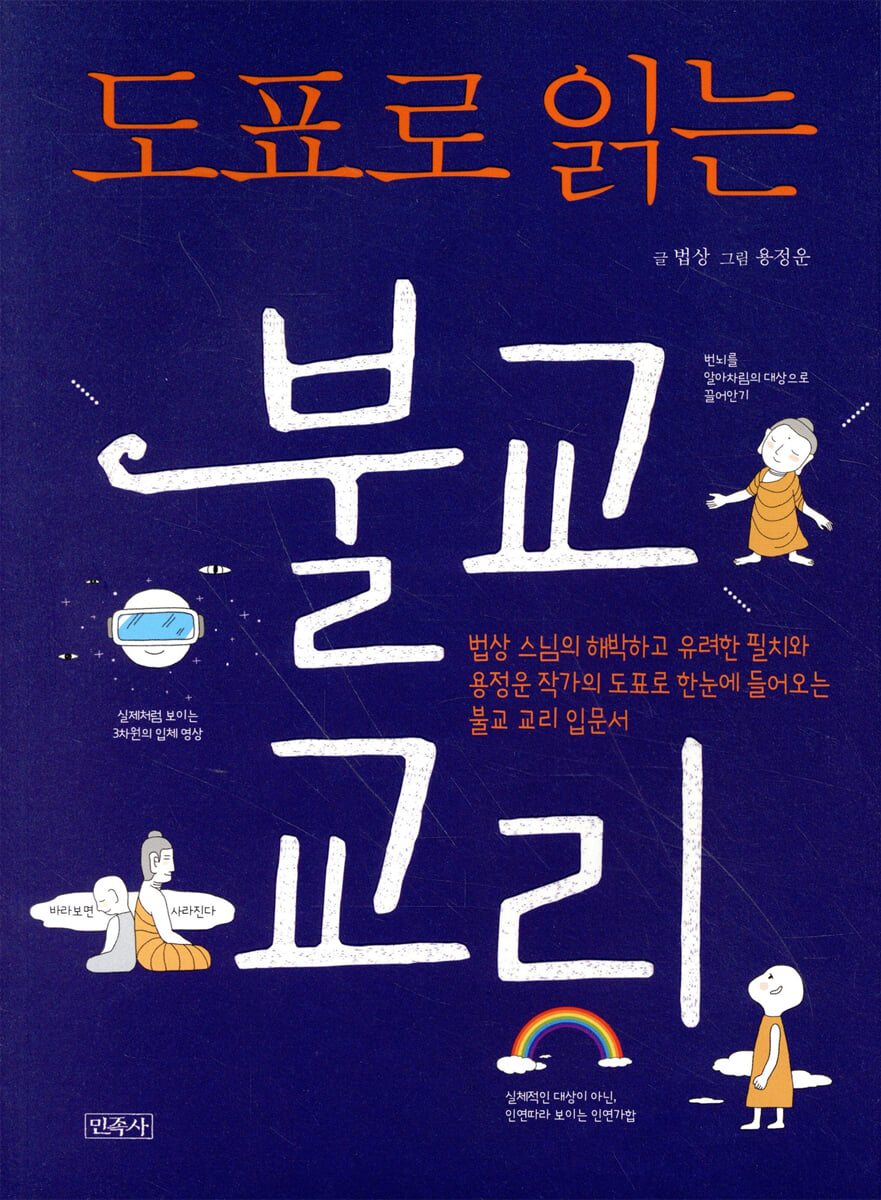
Buddhist Doctrines in Diagrams
 |
Description
Book Introduction
The "Reading with Diagrams" introductory series published by Minjoksa, a renowned Buddhist book publisher with 40 years of experience.
When we think of ‘Buddhism’, we have a strong image of it being rigid and boring.
The "Reading ○○ with Diagrams" series was planned with the aim of breaking away from such an image of Buddhism and creating a "book that people would want to read" while also containing the history, doctrines, and thoughts of Buddhism.
This series discards the typical image that comes to mind when you think of a 'diagram' and instead presents the diagrams through cute cartoons, organizing the content of each piece in a clear and easy-to-understand manner.
It concisely contains the essential information that readers need to know to help them understand the basics of Buddhism. It is also good to use as a textbook as it is composed of short but informative content.
The third book in the 'Reading with Diagrams' series, 'Reading Buddhist Doctrines with Diagrams', was written by Monk Beopsang, who communicates with over 70,000 subscribers across religions through his YouTube channel 'Monk Beopsang's Moktak Sound', and the diagrams were drawn by artist Yong Jeong-un, who has spread Buddhism through meditation cartoons and drawings.
In the flowing writing style characteristic of the monk Beopsang, Buddhist doctrines that are often perceived as vague and difficult are systematically explained in an easy-to-understand manner.
Yong Jeong-un's delicate and charming cartoons and diagrams allow even readers new to Buddhism to easily approach Buddhist doctrines.
When we think of ‘Buddhism’, we have a strong image of it being rigid and boring.
The "Reading ○○ with Diagrams" series was planned with the aim of breaking away from such an image of Buddhism and creating a "book that people would want to read" while also containing the history, doctrines, and thoughts of Buddhism.
This series discards the typical image that comes to mind when you think of a 'diagram' and instead presents the diagrams through cute cartoons, organizing the content of each piece in a clear and easy-to-understand manner.
It concisely contains the essential information that readers need to know to help them understand the basics of Buddhism. It is also good to use as a textbook as it is composed of short but informative content.
The third book in the 'Reading with Diagrams' series, 'Reading Buddhist Doctrines with Diagrams', was written by Monk Beopsang, who communicates with over 70,000 subscribers across religions through his YouTube channel 'Monk Beopsang's Moktak Sound', and the diagrams were drawn by artist Yong Jeong-un, who has spread Buddhism through meditation cartoons and drawings.
In the flowing writing style characteristic of the monk Beopsang, Buddhist doctrines that are often perceived as vague and difficult are systematically explained in an easy-to-understand manner.
Yong Jeong-un's delicate and charming cartoons and diagrams allow even readers new to Buddhism to easily approach Buddhist doctrines.
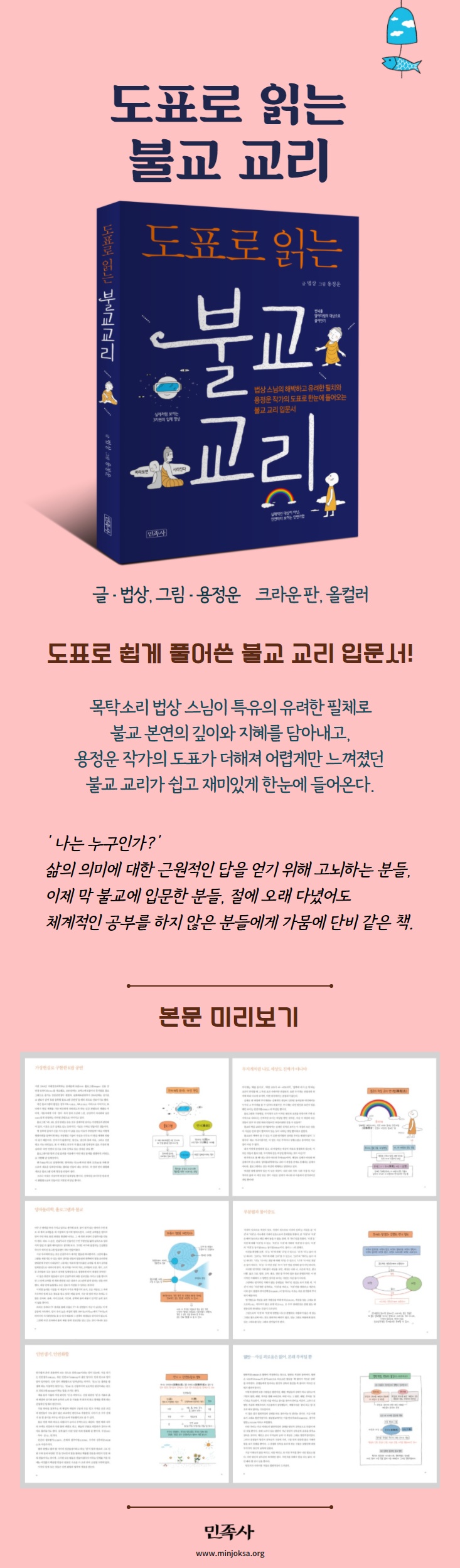
- You can preview some of the book's contents.
Preview
index
Preface 4
Chapter 1 Acting Method
14 K-pop Performances in Virtual Reality
Like a rainbow, neither I nor the world is real 16
Quantum Physics, Holograms, and Buddhism 18
The Universe in a Speck of Dust 21
What is Acting 24
Indiscrimination and inequality 26
Two Meanings of Law 28
Acting, selflessness, compassion, and the middle way are one 30
32. Fate and Harmony
There was nothing, but through causes and conditions, something came into being. 34
The Law of Cause and Effect Attraction 35
Acting Method in Life Practice 38
Chapter 2 The Three Dharma Seals
Standard of Truth 44
The Three Dharmas and the Four Dharmas 46
Everything in the world changes 47
The Free Microcosm of Free 49 Free
The Free World of Macrocosm 50
I can't let you go even if I die for free 51
Surrender to the free flow of change and take a deep rest 52
The Emptiness or Freedom of No Self 53
Neither the self nor the possessions are mine. 54
Selfless thoughts, personality, and feelings are not mine 55
The Illusion of Being Alive 56
The world doesn't go my way 58
The Four Kinds of Suffering 59 The Eight Kinds of Suffering 61
What if it's not worth obsessing over? 63
Nirvana: The Cessation of Suffering and Perfect Happiness 66
Nirvana: The Three Poisons That Torment Me 67
Nirvana is in fact no suffering, it is simply Buddhahood. 68
Chapter 3: The Twelve Places and the Eighteen Precepts
All Dharma: Who am I? Where am I? 72
What lies between "me" and "outside me"? 74
Six Senses and Activities of the Six Muscles 75
Six Sense Objects of the Six Senses 76
When I am polluted and when I am clean 78
I am there, and the world exists 80
The moment the world shines beautifully 81
How did the Twelve Places of "I" and "the World" come into being? 84
The Twelve Classifications of Everything in the World, 86
Twelve Places Only Exist When I See Them 88
The Twelve Reasons for Suffering 90
The Twelve Places: The World I Understand 91
The Eighteen Precepts: The Process of Creating a Mind 93
The Eighteen Commandments: The Illusion of the Mind as "I" 94
The Six Consciousnesses of the Eighteen Realms: Did I Create Suffering? 95
Eighteen Precepts: To escape the suffering I created, 96
Chapter 4 Five Elements
The Reality of Things We Think We Have, Touch 100
The Birth of Feeling, Thought, and Will 101
3 Classifications of Everything in the World 102
This is how the illusion of a country began 104
The five aggregates and the five aggregates, the non-self. So, is there a "me"? Or not? 105
The Form Aggregate Body is Not Me 106
The feeling of Su-on (受蘊) is not mine 109
Thoughts are not me 112
The Aggregate of Actions is not me 116
The consciousness aggregate mind is not me 122
Why am I not the Ohon-mu-a 'I'? 126
The Five Aggregates that Eliminate Suffering 128
The Cessation of Physical [Color] Suffering 130
The Cessation of Emotional Suffering 131
The Cessation of Conceptual Suffering 132
The Cessation of Suffering from Conditioned Actions 134
The Cessation of Cognitive Suffering 135
Meditation on the Five Aggregates for Escape from Suffering 137
Chapter 5: The Twelve Links of Dependent Origination
The Twelve Links of Dependent Origination and the Law of Dependent Origination 140
The Book of Obedience and the Book of Interpreters, The Book of Genetic Disillusionment and the Book of Disillusionment 142
Anonymous 144
Line 145
Consciousness 148
Name and Color 150
Sixth Entry 152
Touch 154
Receiving 155
Love 156
Take 158
Yu (有) 159
Life 162
Old age and death 163
Chapter 6: The Four Noble Truths
The Truth of Suffering and its Cessation 168
Why is Go Seong-je's life so miserable? 170
Why is the suffering of the old noble truth a sacred truth? 171
Accepting the Truth of Suffering, Part 172
The more you reject the suffering of the old man, the more it persists. 173
The Twelve Links of Dependent Origination and the 176th Dependent Origination
The Twelve Causes of Suffering, Chapter 177
The Core Causes of Suffering in the Sacrament of the Suffering of the Sacrament: Ignorance and Desire 180
The Cessation of Suffering 182
Why There Are So Many Practice Methods in Taoist Buddhism 185
The Twelve Paths to the Cessation of Suffering, Part 187
Chapter 7: Buddhist Practice
The Wisdom of the Middle Way, 198
200 as it is in the middle
All doctrines of the Middle Way are different expressions of the Middle Way 201
There is no such thing as absolute right or wrong 202
Accepting the Middle Way and Not Knowing 203
The Eightfold Path to a Righteous Life 206
The Eightfold Path, Right View 208
The Eightfold Path of Right Thought 210
The Eightfold Path, Right Speech 212
The Eightfold Path, Right Action 214
The Eightfold Path to Right Living 215
Eightfold Path of Right Diligence 217
The Eightfold Path of Right Mindfulness 218
The Eightfold Path, Correct Concentration 219
The Four Foundations of Mindfulness, the Middle Path, and the Noble Eightfold Path 221
Observations on the Body 223
Observations on Feelings 226
Observations on the Mind 228
Observations on the Law 229
Awareness and Direct Knowledge of the Mind 240
Chapter 1 Acting Method
14 K-pop Performances in Virtual Reality
Like a rainbow, neither I nor the world is real 16
Quantum Physics, Holograms, and Buddhism 18
The Universe in a Speck of Dust 21
What is Acting 24
Indiscrimination and inequality 26
Two Meanings of Law 28
Acting, selflessness, compassion, and the middle way are one 30
32. Fate and Harmony
There was nothing, but through causes and conditions, something came into being. 34
The Law of Cause and Effect Attraction 35
Acting Method in Life Practice 38
Chapter 2 The Three Dharma Seals
Standard of Truth 44
The Three Dharmas and the Four Dharmas 46
Everything in the world changes 47
The Free Microcosm of Free 49 Free
The Free World of Macrocosm 50
I can't let you go even if I die for free 51
Surrender to the free flow of change and take a deep rest 52
The Emptiness or Freedom of No Self 53
Neither the self nor the possessions are mine. 54
Selfless thoughts, personality, and feelings are not mine 55
The Illusion of Being Alive 56
The world doesn't go my way 58
The Four Kinds of Suffering 59 The Eight Kinds of Suffering 61
What if it's not worth obsessing over? 63
Nirvana: The Cessation of Suffering and Perfect Happiness 66
Nirvana: The Three Poisons That Torment Me 67
Nirvana is in fact no suffering, it is simply Buddhahood. 68
Chapter 3: The Twelve Places and the Eighteen Precepts
All Dharma: Who am I? Where am I? 72
What lies between "me" and "outside me"? 74
Six Senses and Activities of the Six Muscles 75
Six Sense Objects of the Six Senses 76
When I am polluted and when I am clean 78
I am there, and the world exists 80
The moment the world shines beautifully 81
How did the Twelve Places of "I" and "the World" come into being? 84
The Twelve Classifications of Everything in the World, 86
Twelve Places Only Exist When I See Them 88
The Twelve Reasons for Suffering 90
The Twelve Places: The World I Understand 91
The Eighteen Precepts: The Process of Creating a Mind 93
The Eighteen Commandments: The Illusion of the Mind as "I" 94
The Six Consciousnesses of the Eighteen Realms: Did I Create Suffering? 95
Eighteen Precepts: To escape the suffering I created, 96
Chapter 4 Five Elements
The Reality of Things We Think We Have, Touch 100
The Birth of Feeling, Thought, and Will 101
3 Classifications of Everything in the World 102
This is how the illusion of a country began 104
The five aggregates and the five aggregates, the non-self. So, is there a "me"? Or not? 105
The Form Aggregate Body is Not Me 106
The feeling of Su-on (受蘊) is not mine 109
Thoughts are not me 112
The Aggregate of Actions is not me 116
The consciousness aggregate mind is not me 122
Why am I not the Ohon-mu-a 'I'? 126
The Five Aggregates that Eliminate Suffering 128
The Cessation of Physical [Color] Suffering 130
The Cessation of Emotional Suffering 131
The Cessation of Conceptual Suffering 132
The Cessation of Suffering from Conditioned Actions 134
The Cessation of Cognitive Suffering 135
Meditation on the Five Aggregates for Escape from Suffering 137
Chapter 5: The Twelve Links of Dependent Origination
The Twelve Links of Dependent Origination and the Law of Dependent Origination 140
The Book of Obedience and the Book of Interpreters, The Book of Genetic Disillusionment and the Book of Disillusionment 142
Anonymous 144
Line 145
Consciousness 148
Name and Color 150
Sixth Entry 152
Touch 154
Receiving 155
Love 156
Take 158
Yu (有) 159
Life 162
Old age and death 163
Chapter 6: The Four Noble Truths
The Truth of Suffering and its Cessation 168
Why is Go Seong-je's life so miserable? 170
Why is the suffering of the old noble truth a sacred truth? 171
Accepting the Truth of Suffering, Part 172
The more you reject the suffering of the old man, the more it persists. 173
The Twelve Links of Dependent Origination and the 176th Dependent Origination
The Twelve Causes of Suffering, Chapter 177
The Core Causes of Suffering in the Sacrament of the Suffering of the Sacrament: Ignorance and Desire 180
The Cessation of Suffering 182
Why There Are So Many Practice Methods in Taoist Buddhism 185
The Twelve Paths to the Cessation of Suffering, Part 187
Chapter 7: Buddhist Practice
The Wisdom of the Middle Way, 198
200 as it is in the middle
All doctrines of the Middle Way are different expressions of the Middle Way 201
There is no such thing as absolute right or wrong 202
Accepting the Middle Way and Not Knowing 203
The Eightfold Path to a Righteous Life 206
The Eightfold Path, Right View 208
The Eightfold Path of Right Thought 210
The Eightfold Path, Right Speech 212
The Eightfold Path, Right Action 214
The Eightfold Path to Right Living 215
Eightfold Path of Right Diligence 217
The Eightfold Path of Right Mindfulness 218
The Eightfold Path, Correct Concentration 219
The Four Foundations of Mindfulness, the Middle Path, and the Noble Eightfold Path 221
Observations on the Body 223
Observations on Feelings 226
Observations on the Mind 228
Observations on the Law 229
Awareness and Direct Knowledge of the Mind 240
Detailed image
Into the book
Holograms, VR, AR, and immersive content are all related to virtual reality that appears real.
All of these things seem real, but in fact they are all fake.
Why am I writing this article, which suddenly reads like a newspaper article, from the very beginning? It's because the virtual reality technology that's shaking up modern society is so deeply intertwined with the real world.
It may be hard to believe, but you, your body and mind, the people you're connected to, and even this world are all virtual realities, like holographic images! It's just that fateful connections have temporarily come together to make them appear real.
--- p.14
This whole world that is spread out before you, me, my family, my job, and everything in this world and my life up until now is not real, but is merely a play on words in my mind!
--- p.16
Will this universe last forever? No.
The universe is constantly changing and repeating the cycle of formation, existence, destruction, and emptiness.
When the interstellar matter between stars gathers to a certain density and light pressure from the stars is applied, the interstellar matter accelerates its compression and contraction, increasing its internal pressure and temperature. When the temperature rises above 10 million degrees, nuclear fusion begins, creating a star that emits light on its own.
A star created in this way maintains a constant size and brightness for a while as it continues to undergo nuclear fusion, which turns hydrogen into helium. Eventually, when the hydrogen, the raw material for nuclear fusion reactions, is used up, the light disappears and the star's life ends.
In this way, the separate castle lord's attack is repeated continuously.
The sun in our solar system has been undergoing nuclear fusion reactions for about 5 billion years since its formation and has been going through the stage of a stellar phase. After another 5 billion years, all of its hydrogen will be consumed and it will enter the stage of a vacuum. So, just like the microscopic world, the universe, which is a macroscopic world, is not always the same, but is constantly changing, and all things are impermanent.
--- p.50
The world and I change incessantly.
This is the reality of existence.
There is no good or bad, no right or wrong here.
There is no need to be happy when it appears, and there is no need to be sad when it disappears.
There is no discrimination or meaning in nothingness.
I just follow my fate and go along with the times and relationships that come my way. That's all there is to it.
--- p.51
Open your mind to the possibility of change at every moment.
How foolish it is to pursue 'constancy' in a changing world.
Just let this world change.
Don't hold on to anything.
The Buddha's words are only this.
--- p.53
If I really am, then this is me and I should be able to do as I please.
Can I do whatever I want with this body? When you were born, did you choose to be born? Did you choose your appearance, gender, country, aptitude, hobbies, talents, and so on? No.
Did you choose your height? Did you choose your appearance and face? Did you choose your rough skin? What about aging? Do you digest your breakfast after you eat it? It happens automatically.
What about growing old, getting sick, and dying? Can I choose that for myself? No.
It happens on its own.
I can't get involved in that.
Is there really nothing we can do? Aging, illness, and death all happen naturally, according to the circumstances of the times.
In fact, there is no room for 'me' to intervene there.
Because there is no 'I'.
--- p.56
People only perceive, experience, and live in the external world [six external entrances] that they have created through their own six internal entrances.
What I consider the world and what others consider the world cannot be the same.
The world unfolds differently depending on who sees it.
To put it simply, neither I nor this world exist independently, but rather are merely entities of causal relationships that exist through the actions of our minds.
Because there are internal and external entrances, there are internal and external entrances, and because there are external entrances, there are internal and external entrances. However, internal and external entrances do not exist separately.
In other words, I and the world do not exist in a substantial way, and what I see is merely an act.
--- p.88
In Buddhism, there are many sayings such as ‘let go of discrimination’ and ‘let go of knowing.’
This discernment, this knowing, is the very food.
This does not mean that you should not have any discernment or knowledge at all, but that you should use that mind, but not be obsessed with it as the reality.
--- p.124
I'm certain that even at this very moment, countless people have reached the state of extinction! Now, it's your turn to be here.
If you open your eyes and open your heart, there is a way.
It is said that there are two types of nirvana.
Nirvana achieved while alive is called 'nirvana with the source of survival, that is, the physical body remaining' and is called 'nirvana with no source of survival remaining'.
The latter means complete nirvana, so it is called parinirvana, which is the state of nirvana where all mental and physical suffering has been extinguished.
--- p.184
Jeongsayu is not a specific way of thinking.
There is no such thing as 'this kind of thinking is righteous thinking'.
Rather than following the content of the thought, you just need to realize that the essence of the thought is emptiness because it is acting and non-self.
In Zen, this is expressed as checking the position before a thought arises.
When you do this, you won't be obsessed with the thoughts that come up, and you won't identify with them by holding onto them as 'your thoughts' just because they come up.
When a good idea comes to mind, it is not right thinking to identify with the thought by thinking, "I am smart," or when a selfish thought comes to mind, it is not right thinking to identify with the thought by thinking, "I am selfish."
--- p.210
If we let go of the vain illusions of subject and object and self-concept, and begin to see and perceive things as they are without discrimination, we will suddenly realize that all objects are not objects at all.
This is the confirmation of the Dhamma.
Correct awareness, the right mind, is not the subject of 'this' noticing the object of 'that', but 'the law seeing the law', and the self confirming itself.
It is the awareness of the law of non-dharma that I confirm myself and that what I see is what I see.
All things, all beings, all existences (dhamma) are Dhamma.
All of these things seem real, but in fact they are all fake.
Why am I writing this article, which suddenly reads like a newspaper article, from the very beginning? It's because the virtual reality technology that's shaking up modern society is so deeply intertwined with the real world.
It may be hard to believe, but you, your body and mind, the people you're connected to, and even this world are all virtual realities, like holographic images! It's just that fateful connections have temporarily come together to make them appear real.
--- p.14
This whole world that is spread out before you, me, my family, my job, and everything in this world and my life up until now is not real, but is merely a play on words in my mind!
--- p.16
Will this universe last forever? No.
The universe is constantly changing and repeating the cycle of formation, existence, destruction, and emptiness.
When the interstellar matter between stars gathers to a certain density and light pressure from the stars is applied, the interstellar matter accelerates its compression and contraction, increasing its internal pressure and temperature. When the temperature rises above 10 million degrees, nuclear fusion begins, creating a star that emits light on its own.
A star created in this way maintains a constant size and brightness for a while as it continues to undergo nuclear fusion, which turns hydrogen into helium. Eventually, when the hydrogen, the raw material for nuclear fusion reactions, is used up, the light disappears and the star's life ends.
In this way, the separate castle lord's attack is repeated continuously.
The sun in our solar system has been undergoing nuclear fusion reactions for about 5 billion years since its formation and has been going through the stage of a stellar phase. After another 5 billion years, all of its hydrogen will be consumed and it will enter the stage of a vacuum. So, just like the microscopic world, the universe, which is a macroscopic world, is not always the same, but is constantly changing, and all things are impermanent.
--- p.50
The world and I change incessantly.
This is the reality of existence.
There is no good or bad, no right or wrong here.
There is no need to be happy when it appears, and there is no need to be sad when it disappears.
There is no discrimination or meaning in nothingness.
I just follow my fate and go along with the times and relationships that come my way. That's all there is to it.
--- p.51
Open your mind to the possibility of change at every moment.
How foolish it is to pursue 'constancy' in a changing world.
Just let this world change.
Don't hold on to anything.
The Buddha's words are only this.
--- p.53
If I really am, then this is me and I should be able to do as I please.
Can I do whatever I want with this body? When you were born, did you choose to be born? Did you choose your appearance, gender, country, aptitude, hobbies, talents, and so on? No.
Did you choose your height? Did you choose your appearance and face? Did you choose your rough skin? What about aging? Do you digest your breakfast after you eat it? It happens automatically.
What about growing old, getting sick, and dying? Can I choose that for myself? No.
It happens on its own.
I can't get involved in that.
Is there really nothing we can do? Aging, illness, and death all happen naturally, according to the circumstances of the times.
In fact, there is no room for 'me' to intervene there.
Because there is no 'I'.
--- p.56
People only perceive, experience, and live in the external world [six external entrances] that they have created through their own six internal entrances.
What I consider the world and what others consider the world cannot be the same.
The world unfolds differently depending on who sees it.
To put it simply, neither I nor this world exist independently, but rather are merely entities of causal relationships that exist through the actions of our minds.
Because there are internal and external entrances, there are internal and external entrances, and because there are external entrances, there are internal and external entrances. However, internal and external entrances do not exist separately.
In other words, I and the world do not exist in a substantial way, and what I see is merely an act.
--- p.88
In Buddhism, there are many sayings such as ‘let go of discrimination’ and ‘let go of knowing.’
This discernment, this knowing, is the very food.
This does not mean that you should not have any discernment or knowledge at all, but that you should use that mind, but not be obsessed with it as the reality.
--- p.124
I'm certain that even at this very moment, countless people have reached the state of extinction! Now, it's your turn to be here.
If you open your eyes and open your heart, there is a way.
It is said that there are two types of nirvana.
Nirvana achieved while alive is called 'nirvana with the source of survival, that is, the physical body remaining' and is called 'nirvana with no source of survival remaining'.
The latter means complete nirvana, so it is called parinirvana, which is the state of nirvana where all mental and physical suffering has been extinguished.
--- p.184
Jeongsayu is not a specific way of thinking.
There is no such thing as 'this kind of thinking is righteous thinking'.
Rather than following the content of the thought, you just need to realize that the essence of the thought is emptiness because it is acting and non-self.
In Zen, this is expressed as checking the position before a thought arises.
When you do this, you won't be obsessed with the thoughts that come up, and you won't identify with them by holding onto them as 'your thoughts' just because they come up.
When a good idea comes to mind, it is not right thinking to identify with the thought by thinking, "I am smart," or when a selfish thought comes to mind, it is not right thinking to identify with the thought by thinking, "I am selfish."
--- p.210
If we let go of the vain illusions of subject and object and self-concept, and begin to see and perceive things as they are without discrimination, we will suddenly realize that all objects are not objects at all.
This is the confirmation of the Dhamma.
Correct awareness, the right mind, is not the subject of 'this' noticing the object of 'that', but 'the law seeing the law', and the self confirming itself.
It is the awareness of the law of non-dharma that I confirm myself and that what I see is what I see.
All things, all beings, all existences (dhamma) are Dhamma.
--- p.242
Publisher's Review
The profound and elegant writing style of the monk Beopsang
A glance at the diagram by Yong Jeong-un
An introduction to Buddhist doctrine!
Buddhist Doctrines in Diagrams
A concise yet systematic description,
An introductory guide to Buddhist doctrine, presented in easy-to-understand diagrams.
A series of introductory books titled "Reading with Diagrams" published by Minjoksa, a renowned Buddhist book publisher with 40 years of experience.
When we think of ‘Buddhism’, we have a strong image of it being rigid and boring.
The "Reading ○○ with Diagrams" series was planned with the aim of breaking away from such an image of Buddhism and creating a "book that people would want to read" while also containing the history, doctrines, and thoughts of Buddhism.
This series discards the typical image that comes to mind when you think of a 'diagram' and instead presents the diagrams through cute cartoons, organizing the content of each piece in a clear and easy-to-understand manner.
It concisely contains the essential information that readers need to know to help them understand the basics of Buddhism. It is also good to use as a textbook as it is composed of short but informative content.
The third in the "Reading with Diagrams" series, "Reading Buddhist Doctrines with Diagrams"
The first book in the series 'Reading the History of the Nation with Diagrams', 'Introduction to Buddhism with Diagrams' (written by Lee Ja-rang and Lee Pil-won, illustrated by Bae Jong-hoon), is a book that breaks the vague preconception that Buddhism is difficult, and has received great acclaim, including being selected as the '2016 Sejong Books' Best Book in the General Education Category' and one of the '10 Buddhist Books of the Year'.
The second book, "Introduction to Reading Buddhist Scriptures with Diagrams" (written by Jeong Woon, illustrated by Bae Jong-hoon), systematically categorizes and explains the vast Buddhist scriptures, making it easy to understand the meaning, core content, and lessons of each scripture.
And this time, the third book in the ‘Reading with Diagrams’ series, ‘Reading Buddhist Doctrines with Diagrams’, has been published.
This book was written by Monk Beopsang, who has been communicating with over 70,000 subscribers across religions through his YouTube channel, “Monk Beopsang’s Moktak Sound,” and the diagrams were drawn by artist Yong Jeong-un, who has been spreading Buddhism through meditation cartoons and drawings.
With the characteristically flowing writing style of Monk Beopsang, the vague and difficult Buddhist doctrines are systematically explained in an easy-to-understand manner, and the delicate and cute cartoons and diagrams of artist Yong Jeong-un intuitively present the difficult Buddhist doctrines at a glance, allowing even readers who are new to Buddhism to easily approach them.
Containing the depth and wisdom of Buddhism in a trendy style
An introduction to authentic Buddhist doctrine
“Studying Buddhism is, in fact, a process in which the Buddhist doctrines, which have been considered fundamental, are embodied in life beyond understanding them in the head, and through enlightenment, life undergoes a drastic change.
At the beginning, it was this study, and at the end of the study, in the end, only this study remains.
(…) The more I study, the more I cannot help but admire this Buddhist doctrine.
“How could the Buddha have conveyed such profound teachings in such simple language in the past?” (_From the preface by Venerable Beopsang)
These days, the number of people interested in mind study and meditation for the purpose of mental healing and stress relief is rapidly increasing.
Accordingly, the need to properly convey Buddhist teachings, which can be said to be the ideological foundation of mind study and meditation, has arisen.
Interest in Buddhist doctrines related to mind study and meditation has increased regardless of religion, from Buddhists to followers of other religions and non-religious people.
There are also many people who want to learn about Buddhism to find answers to questions about the origin of life, such as, “Who am I?” and “What is the meaning of life?”
The author, Venerable Beopsang, has written about Buddhist doctrines in various ways, including through 『Buddha Class』 (published by Minjoksa) and a commentary on the Heart Sutra. Among them, 『Reading Buddhist Doctrines with Diagrams』 is a Buddhist doctrine book that beginners can use when studying Buddhism on their own, or a doctrine book with diagrams and pictures that can be used as a textbook at Buddhist universities.
This book on Buddhist doctrines is designed to be accessible to not only beginners in Buddhism but also readers interested in Buddhism through mind study and meditation, in a trendy style that is not too difficult to understand, while still containing the inherent depth and wisdom of Buddhism.
Buddhist doctrines that were once considered difficult can be understood at a glance.
This book is divided into seven chapters, and it concisely contains the essential contents of Buddhist doctrine to help readers understand it. A brief overview is as follows.
Chapter 1, ‘The Method of Acting’, covers the basic foundations of Buddhist doctrine.
This is a chapter that lays the foundation of Buddhist doctrines, such as the theory of dependent origination and the law of cause and effect.
Chapter 2, ‘The Three Dharma Seals’, deals with the core doctrines of Buddhism, such as impermanence, non-self, suffering, and nirvana.
It clearly understands the standards of truth in Buddhism and comprehensively explains the teachings that serve as the theoretical foundation for Buddhist practice.
Chapter 3, 'The Twelve Sources and the Eighteen Realms', deals with the fundamental questions of life, 'Who am I?' and 'Where am I?' through the six senses, six realms, twelve sources, and eighteen realms.
Chapter 4, "O-on," deals with the things we think "exist," and how feelings, thoughts, and wills arise.
Through the five aggregates and the five aggregates' non-self, we can think about the question, "Do I exist or not?"
Chapter 5, “The Twelve Links of Dependent Origination,” deals with the Twelve Links of Dependent Origination, the law of dependent origination that the Buddha realized.
The Twelve Links of Dependent Origination are teachings that specifically explain how the problems of human suffering, such as old age, illness, and death, arise and how they disappear.
Chapter 6, “The Four Noble Truths,” deals with the four noble truths of suffering, the path from the origin of suffering to the cessation of suffering, why life is suffering, why suffering is a noble truth, the twelve causes of suffering, and the twelve paths leading to the cessation of suffering.
Chapter 7, 'Buddhist Practice', discusses how to live wisely and abundantly through the Middle Path and the Noble Eightfold Path.
“The seemingly difficult content was so much fun, and with each page I turned, there were moments of enlightenment.
He speaks with vividness and kindness, as if he were listening to a sermon in front of you.
(Omitted) I was so proud that my paintings could contribute to such a precious Buddhist teaching, and I was so thrilled to be able to share those moments of joy with the countless readers who will be on the path to enlightenment while reading the writings of Venerable Beopsang.” (_From the preface by Yong Jeong-un)
『Buddhist Doctrines in Diagrams』 stands out for its concise and systematic descriptions.
As the title, “Buddhist Doctrines in Diagrams,” suggests, it is very impressive that the content of each chapter is organized clearly in diagrams so that it can be understood at a glance.
Just by reading and looking at it, you can clearly understand the Buddhist doctrine at a glance, draw the outline of Buddhism, and quickly approach the Buddhist doctrine that seemed difficult. This book is truly an introductory book, and its reputation as the best introductory book is not without reason.
As the author Yong Jeong-un, who drew the diagram, said, I hope that through this book, you will experience moments of joy as you learn about Buddhist doctrines that were once considered difficult in a fun way.
A glance at the diagram by Yong Jeong-un
An introduction to Buddhist doctrine!
Buddhist Doctrines in Diagrams
A concise yet systematic description,
An introductory guide to Buddhist doctrine, presented in easy-to-understand diagrams.
A series of introductory books titled "Reading with Diagrams" published by Minjoksa, a renowned Buddhist book publisher with 40 years of experience.
When we think of ‘Buddhism’, we have a strong image of it being rigid and boring.
The "Reading ○○ with Diagrams" series was planned with the aim of breaking away from such an image of Buddhism and creating a "book that people would want to read" while also containing the history, doctrines, and thoughts of Buddhism.
This series discards the typical image that comes to mind when you think of a 'diagram' and instead presents the diagrams through cute cartoons, organizing the content of each piece in a clear and easy-to-understand manner.
It concisely contains the essential information that readers need to know to help them understand the basics of Buddhism. It is also good to use as a textbook as it is composed of short but informative content.
The third in the "Reading with Diagrams" series, "Reading Buddhist Doctrines with Diagrams"
The first book in the series 'Reading the History of the Nation with Diagrams', 'Introduction to Buddhism with Diagrams' (written by Lee Ja-rang and Lee Pil-won, illustrated by Bae Jong-hoon), is a book that breaks the vague preconception that Buddhism is difficult, and has received great acclaim, including being selected as the '2016 Sejong Books' Best Book in the General Education Category' and one of the '10 Buddhist Books of the Year'.
The second book, "Introduction to Reading Buddhist Scriptures with Diagrams" (written by Jeong Woon, illustrated by Bae Jong-hoon), systematically categorizes and explains the vast Buddhist scriptures, making it easy to understand the meaning, core content, and lessons of each scripture.
And this time, the third book in the ‘Reading with Diagrams’ series, ‘Reading Buddhist Doctrines with Diagrams’, has been published.
This book was written by Monk Beopsang, who has been communicating with over 70,000 subscribers across religions through his YouTube channel, “Monk Beopsang’s Moktak Sound,” and the diagrams were drawn by artist Yong Jeong-un, who has been spreading Buddhism through meditation cartoons and drawings.
With the characteristically flowing writing style of Monk Beopsang, the vague and difficult Buddhist doctrines are systematically explained in an easy-to-understand manner, and the delicate and cute cartoons and diagrams of artist Yong Jeong-un intuitively present the difficult Buddhist doctrines at a glance, allowing even readers who are new to Buddhism to easily approach them.
Containing the depth and wisdom of Buddhism in a trendy style
An introduction to authentic Buddhist doctrine
“Studying Buddhism is, in fact, a process in which the Buddhist doctrines, which have been considered fundamental, are embodied in life beyond understanding them in the head, and through enlightenment, life undergoes a drastic change.
At the beginning, it was this study, and at the end of the study, in the end, only this study remains.
(…) The more I study, the more I cannot help but admire this Buddhist doctrine.
“How could the Buddha have conveyed such profound teachings in such simple language in the past?” (_From the preface by Venerable Beopsang)
These days, the number of people interested in mind study and meditation for the purpose of mental healing and stress relief is rapidly increasing.
Accordingly, the need to properly convey Buddhist teachings, which can be said to be the ideological foundation of mind study and meditation, has arisen.
Interest in Buddhist doctrines related to mind study and meditation has increased regardless of religion, from Buddhists to followers of other religions and non-religious people.
There are also many people who want to learn about Buddhism to find answers to questions about the origin of life, such as, “Who am I?” and “What is the meaning of life?”
The author, Venerable Beopsang, has written about Buddhist doctrines in various ways, including through 『Buddha Class』 (published by Minjoksa) and a commentary on the Heart Sutra. Among them, 『Reading Buddhist Doctrines with Diagrams』 is a Buddhist doctrine book that beginners can use when studying Buddhism on their own, or a doctrine book with diagrams and pictures that can be used as a textbook at Buddhist universities.
This book on Buddhist doctrines is designed to be accessible to not only beginners in Buddhism but also readers interested in Buddhism through mind study and meditation, in a trendy style that is not too difficult to understand, while still containing the inherent depth and wisdom of Buddhism.
Buddhist doctrines that were once considered difficult can be understood at a glance.
This book is divided into seven chapters, and it concisely contains the essential contents of Buddhist doctrine to help readers understand it. A brief overview is as follows.
Chapter 1, ‘The Method of Acting’, covers the basic foundations of Buddhist doctrine.
This is a chapter that lays the foundation of Buddhist doctrines, such as the theory of dependent origination and the law of cause and effect.
Chapter 2, ‘The Three Dharma Seals’, deals with the core doctrines of Buddhism, such as impermanence, non-self, suffering, and nirvana.
It clearly understands the standards of truth in Buddhism and comprehensively explains the teachings that serve as the theoretical foundation for Buddhist practice.
Chapter 3, 'The Twelve Sources and the Eighteen Realms', deals with the fundamental questions of life, 'Who am I?' and 'Where am I?' through the six senses, six realms, twelve sources, and eighteen realms.
Chapter 4, "O-on," deals with the things we think "exist," and how feelings, thoughts, and wills arise.
Through the five aggregates and the five aggregates' non-self, we can think about the question, "Do I exist or not?"
Chapter 5, “The Twelve Links of Dependent Origination,” deals with the Twelve Links of Dependent Origination, the law of dependent origination that the Buddha realized.
The Twelve Links of Dependent Origination are teachings that specifically explain how the problems of human suffering, such as old age, illness, and death, arise and how they disappear.
Chapter 6, “The Four Noble Truths,” deals with the four noble truths of suffering, the path from the origin of suffering to the cessation of suffering, why life is suffering, why suffering is a noble truth, the twelve causes of suffering, and the twelve paths leading to the cessation of suffering.
Chapter 7, 'Buddhist Practice', discusses how to live wisely and abundantly through the Middle Path and the Noble Eightfold Path.
“The seemingly difficult content was so much fun, and with each page I turned, there were moments of enlightenment.
He speaks with vividness and kindness, as if he were listening to a sermon in front of you.
(Omitted) I was so proud that my paintings could contribute to such a precious Buddhist teaching, and I was so thrilled to be able to share those moments of joy with the countless readers who will be on the path to enlightenment while reading the writings of Venerable Beopsang.” (_From the preface by Yong Jeong-un)
『Buddhist Doctrines in Diagrams』 stands out for its concise and systematic descriptions.
As the title, “Buddhist Doctrines in Diagrams,” suggests, it is very impressive that the content of each chapter is organized clearly in diagrams so that it can be understood at a glance.
Just by reading and looking at it, you can clearly understand the Buddhist doctrine at a glance, draw the outline of Buddhism, and quickly approach the Buddhist doctrine that seemed difficult. This book is truly an introductory book, and its reputation as the best introductory book is not without reason.
As the author Yong Jeong-un, who drew the diagram, said, I hope that through this book, you will experience moments of joy as you learn about Buddhist doctrines that were once considered difficult in a fun way.
GOODS SPECIFICS
- Publication date: December 10, 2020
- Page count, weight, size: 244 pages | 518g | 176*248*20mm
- ISBN13: 9791189269746
- ISBN10: 1189269740
You may also like
카테고리
korean


korean

![GQ KOREA Mark (Monthly): December [2025]](http://librairie.coreenne.fr/cdn/shop/files/8ef265dbbfbf186523ed75ba7319009d.jpg?v=1765340328&width=3840)


