

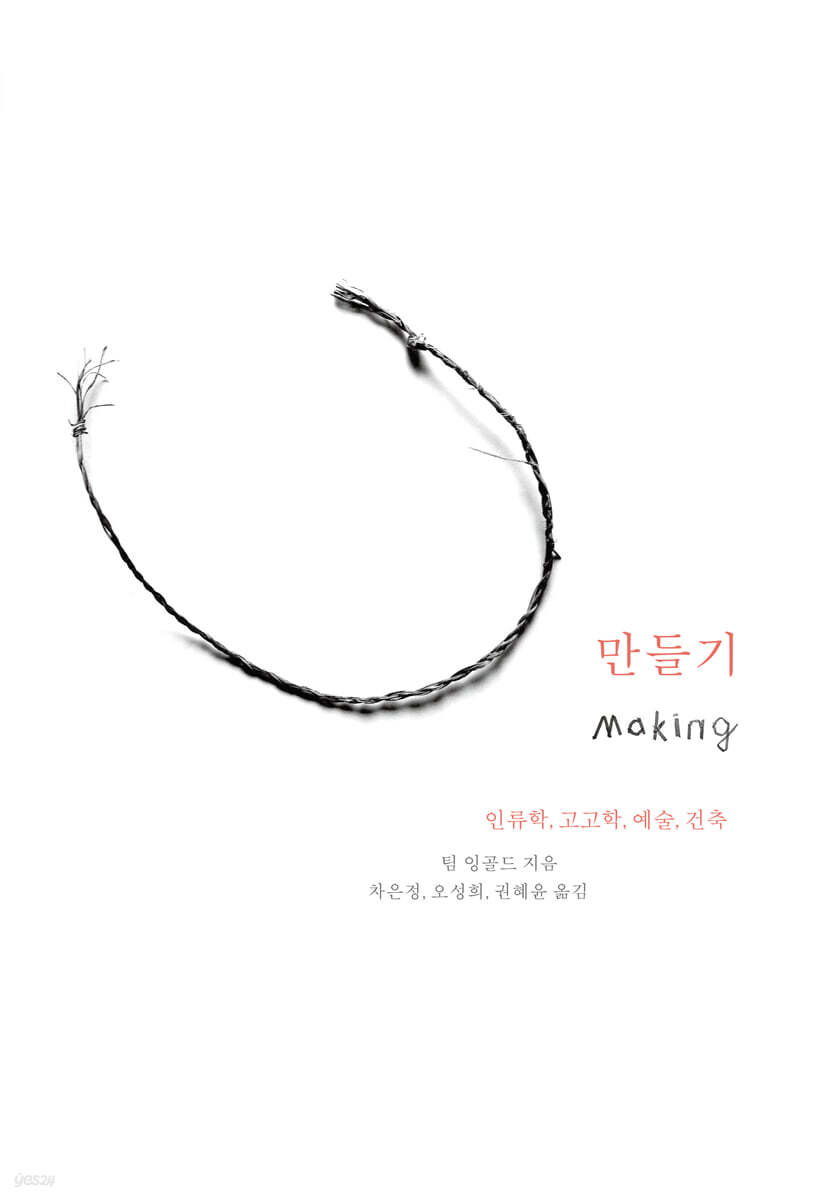
making
 |
Description
Book Introduction
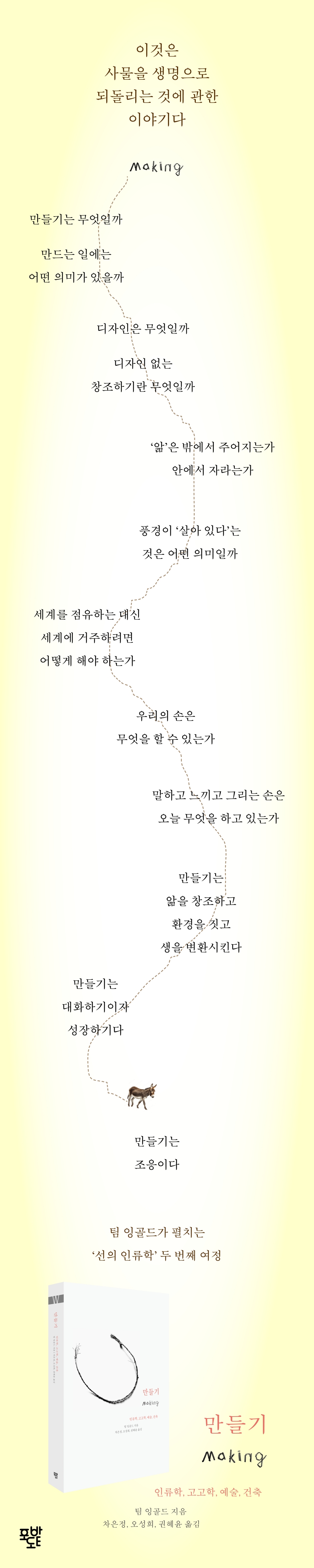
What does making do? Making creates knowledge, builds environments, and transforms life.
In this book, anthropologist Tim Ingold emphasizes that the essence of making something lies not in the design, but in the process of making.
He emphasizes that creating something is not about projecting a predetermined result onto material, but rather a process in which the creator and the material grow together in harmony.
Furthermore, it presents a way of knowing that does not reduce things to fixed objects, but rather perceives them as living substances with a flow of creation.
According to Ingold's view, 'knowledge' is not given from the outside, but grows within us in a way that allows us to interact with things, and only then does it become a part of us.
This book offers profound reflections on the meaning of the act of creating things, the relationship between material and form, the problems of design, the recognition of living landscapes, the meaning of action, and the capabilities and role of hands in our bodies.
It also presents a variety of novel examples of craftsmanship, including prehistoric stone tool making, medieval cathedral construction, the creation of round mounds, the erection of monuments, kite flying, painting, and writing.
Making is the march of life, the constant movement of harmony in a world that generates and transforms.
In this book, anthropologist Tim Ingold emphasizes that the essence of making something lies not in the design, but in the process of making.
He emphasizes that creating something is not about projecting a predetermined result onto material, but rather a process in which the creator and the material grow together in harmony.
Furthermore, it presents a way of knowing that does not reduce things to fixed objects, but rather perceives them as living substances with a flow of creation.
According to Ingold's view, 'knowledge' is not given from the outside, but grows within us in a way that allows us to interact with things, and only then does it become a part of us.
This book offers profound reflections on the meaning of the act of creating things, the relationship between material and form, the problems of design, the recognition of living landscapes, the meaning of action, and the capabilities and role of hands in our bodies.
It also presents a variety of novel examples of craftsmanship, including prehistoric stone tool making, medieval cathedral construction, the creation of round mounds, the erection of monuments, kite flying, painting, and writing.
Making is the march of life, the constant movement of harmony in a world that generates and transforms.
- You can preview some of the book's contents.
Preview
index
Preface and Acknowledgments
Chapter 1: Knowing from the Inside Out
Chapter 2 The Substance of Life
Chapter 3: Making a Hand Axe
Chapter 4: On Building a House
Chapter 5: The Awake Watchmaker
Chapter 6: The Round Mound and the Earth and Sky
Chapter 7: Bodies on the Run
Chapter 8: Speaking with Hands
Chapter 9: Drawing a Line
Translator's Note
References
Search
Chapter 1: Knowing from the Inside Out
Chapter 2 The Substance of Life
Chapter 3: Making a Hand Axe
Chapter 4: On Building a House
Chapter 5: The Awake Watchmaker
Chapter 6: The Round Mound and the Earth and Sky
Chapter 7: Bodies on the Run
Chapter 8: Speaking with Hands
Chapter 9: Drawing a Line
Translator's Note
References
Search
Detailed image
Into the book
Know yourself! This is the only advice my research participants often gave me when I was a novice field researcher among the Saami people in northeastern Finland, more than 40 years ago, feeling lost and unsure of how to proceed with practical work.
--- p.15
In order to know something, you have to grow into it, let it grow within you and become a part of you.
--- p.15
In the art of inquiry, thinking is carried out in accordance with and in constant response to the flow and ebb and flow of the material with which we work.
This substance thinks through us as we think through substance.
Every task here is an experiment.
--- p.29
We are used to thinking of making as a projection.
It starts with first having an idea in mind of what we want to achieve and then gathering the raw materials needed to make it happen.
And the projection ends the moment the material takes its intended form.
At this point we say that we have created an artifact.
--- p.62
I'd rather think of making as a process of growth.
This places the creator from the beginning as a participant in a world full of living matter.
This substance is what he has to work with, and in the process of making, the creator 'joins forces' with it, putting it together or separating it, synthesizing and refining it, and anticipates what will emerge.
--- p.63
An investigation of the curious case of the Acheulean biface leads us inexorably to the conclusion that the essential relationship of a world in the making (a world quite distinct from the one we can look back on, as if it were completed long ago) is not that of matter and form, but that of force and matter.
--- p.120~121
Fragile flint becomes liquid in the hands of a skilled stone toolmaker, revealing itself in swirling currents.
Here, every potential blow or tornado becomes a ripple, from which the fracture surface spreads out like a wave.
The stone tool maker follows this flow with a rhythmic striking motion that breaks the flakes.
--- p.122~123
Medieval buildings were designed precisely through that process of 'caring', that is, through the intelligence of skilled craftsmanship.
We can say of the stonemasons who built the building that they not only designed while drawing, but also drew while designing.
But their designs were a process of work, like drawing, not a projection of the mind.
--- p.151
An investigation of the curious case of the Acheulean biface leads us inexorably to the conclusion that the essential relationship of a world in the making (a world quite distinct from the one we can look back on, as if it were completed long ago) is not that of matter and form, but that of force and matter.
--- p.158
What could design possibly mean if it weren't for the planning that precedes execution?
--- p.185~186
Design must be about looking forward to the future.
Design is not about pursuing completeness or conclusion, but rather about dealing with hopes and dreams rather than plans or predictions, and aiming for an open ending.
As Finnish architect Juhani Pallasmaa wrote, “Design is always a search for the unknown.”
--- p.187
The task of design is to pursue and bring back these hopes and dreams.
Traveling lightly, unburdened by the weight of heavy material, the designer's lines chase the phantoms of the fleeing imagination and rein them in before they escape, leaving their mark like landmarks in the field of practice for the makers and builders to follow at their own slower, more weighty pace.
--- p.187~188
In this relationship of envelopment and unfolding, the mound once again reveals its difference from the monument.
As Olwig writes, “In Ting, law relied on living memory, but monuments literally inscribe memory in dead stone” (ibid.: 33).
In the mound, the past gathers as a foundation for the continued continuity of life.
In monuments, on the other hand, the past is pushed back and survives only as a relic.
Mound--- p. Objects invite us to participate in the process of forming a mound, but monuments shut us out.
It is closed and finished.
--- p.212
Just as a craftsman thinks from material, a dancer thinks from the body.
In a body that is alive and dynamically composed, personality and organism are one.
The body is an organism-personality.
But as mentioned before, the body is also a thing.
If so, we no longer need to discuss the relationship between people and things.
Because people are also things.
--- p.235
It's no wonder that theorists, in their futile efforts to revive things, have been forced to invoke the concept of object agency! The appeal to agency, in other words, is a natural consequence of the logic of embodiment—the logic of transforming things into themselves.
To neutralize this logic of embodiment, we must exert all our power at once to banish the specter of embodied agency and breathe life back into things.
--- p.238
In a word, hands can speak.
Hands can be spoken of both in the meticulous attention to the conditions of their progress in carrying out a task, and also in the movements they make and the technical acts of leaving traces on materials.
--- p.288~289
Technological advancements have moved towards replacing the tactile sensitivity of the fingertips with the reactive coordination of hand gestures.
As hands are replaced by fingertips, the manipulation, reaching, and grasping that the hands do become metaphors for understanding that model the experience of the body rather than active movements in themselves.
We say that we 'handle' ideas, 'grasp' concepts, and 'reach out' to some level of knowledge, but we do not use our hands directly.
--- p.306
All true scholars are donkeys.
Stubborn, capricious, persistent, curious and impatient.
Be fascinated and amazed by your own world.
He wants to take his time and go at his own pace.
They will live in hope and will not believe in illusions such as certainty.
The path they take is open in all directions.
It is unpredictable.
They take the seeds of things to heart and pursue them, and in doing so they find themselves.
As you probably already know, all learning is self-discovery.
Where to next? Find out for yourself!
--- p.15
In order to know something, you have to grow into it, let it grow within you and become a part of you.
--- p.15
In the art of inquiry, thinking is carried out in accordance with and in constant response to the flow and ebb and flow of the material with which we work.
This substance thinks through us as we think through substance.
Every task here is an experiment.
--- p.29
We are used to thinking of making as a projection.
It starts with first having an idea in mind of what we want to achieve and then gathering the raw materials needed to make it happen.
And the projection ends the moment the material takes its intended form.
At this point we say that we have created an artifact.
--- p.62
I'd rather think of making as a process of growth.
This places the creator from the beginning as a participant in a world full of living matter.
This substance is what he has to work with, and in the process of making, the creator 'joins forces' with it, putting it together or separating it, synthesizing and refining it, and anticipates what will emerge.
--- p.63
An investigation of the curious case of the Acheulean biface leads us inexorably to the conclusion that the essential relationship of a world in the making (a world quite distinct from the one we can look back on, as if it were completed long ago) is not that of matter and form, but that of force and matter.
--- p.120~121
Fragile flint becomes liquid in the hands of a skilled stone toolmaker, revealing itself in swirling currents.
Here, every potential blow or tornado becomes a ripple, from which the fracture surface spreads out like a wave.
The stone tool maker follows this flow with a rhythmic striking motion that breaks the flakes.
--- p.122~123
Medieval buildings were designed precisely through that process of 'caring', that is, through the intelligence of skilled craftsmanship.
We can say of the stonemasons who built the building that they not only designed while drawing, but also drew while designing.
But their designs were a process of work, like drawing, not a projection of the mind.
--- p.151
An investigation of the curious case of the Acheulean biface leads us inexorably to the conclusion that the essential relationship of a world in the making (a world quite distinct from the one we can look back on, as if it were completed long ago) is not that of matter and form, but that of force and matter.
--- p.158
What could design possibly mean if it weren't for the planning that precedes execution?
--- p.185~186
Design must be about looking forward to the future.
Design is not about pursuing completeness or conclusion, but rather about dealing with hopes and dreams rather than plans or predictions, and aiming for an open ending.
As Finnish architect Juhani Pallasmaa wrote, “Design is always a search for the unknown.”
--- p.187
The task of design is to pursue and bring back these hopes and dreams.
Traveling lightly, unburdened by the weight of heavy material, the designer's lines chase the phantoms of the fleeing imagination and rein them in before they escape, leaving their mark like landmarks in the field of practice for the makers and builders to follow at their own slower, more weighty pace.
--- p.187~188
In this relationship of envelopment and unfolding, the mound once again reveals its difference from the monument.
As Olwig writes, “In Ting, law relied on living memory, but monuments literally inscribe memory in dead stone” (ibid.: 33).
In the mound, the past gathers as a foundation for the continued continuity of life.
In monuments, on the other hand, the past is pushed back and survives only as a relic.
Mound--- p. Objects invite us to participate in the process of forming a mound, but monuments shut us out.
It is closed and finished.
--- p.212
Just as a craftsman thinks from material, a dancer thinks from the body.
In a body that is alive and dynamically composed, personality and organism are one.
The body is an organism-personality.
But as mentioned before, the body is also a thing.
If so, we no longer need to discuss the relationship between people and things.
Because people are also things.
--- p.235
It's no wonder that theorists, in their futile efforts to revive things, have been forced to invoke the concept of object agency! The appeal to agency, in other words, is a natural consequence of the logic of embodiment—the logic of transforming things into themselves.
To neutralize this logic of embodiment, we must exert all our power at once to banish the specter of embodied agency and breathe life back into things.
--- p.238
In a word, hands can speak.
Hands can be spoken of both in the meticulous attention to the conditions of their progress in carrying out a task, and also in the movements they make and the technical acts of leaving traces on materials.
--- p.288~289
Technological advancements have moved towards replacing the tactile sensitivity of the fingertips with the reactive coordination of hand gestures.
As hands are replaced by fingertips, the manipulation, reaching, and grasping that the hands do become metaphors for understanding that model the experience of the body rather than active movements in themselves.
We say that we 'handle' ideas, 'grasp' concepts, and 'reach out' to some level of knowledge, but we do not use our hands directly.
--- p.306
All true scholars are donkeys.
Stubborn, capricious, persistent, curious and impatient.
Be fascinated and amazed by your own world.
He wants to take his time and go at his own pace.
They will live in hope and will not believe in illusions such as certainty.
The path they take is open in all directions.
It is unpredictable.
They take the seeds of things to heart and pursue them, and in doing so they find themselves.
As you probably already know, all learning is self-discovery.
Where to next? Find out for yourself!
--- p.352
Publisher's Review
The process of growing together in harmony with living things
The ongoing march of life in a world of creation and transformation
The essence of making is the interweaving of sensation and matter, like the affectionate gaze of lovers, until they become indistinguishable from each other, like warp and weft.
? From “Chapter 7: Bodies on the Run”
『Making』 is a Korean translation of 『Making』, a book by anthropologist Tim Ingold published in 2013.
This book is the second of three volumes in what is known as the "Anthropology of Lines Trilogy," published between Lines (2007) and Life of Lines (2015).
This book leads us to perceive the material world not as something fixed, but as a moving, creating and transforming entity.
At this time, Ingold emphasizes that human beings, like other beings, are 'living things' that grow in harmony with things within the world.
In this book, Ingold opposes the way of thinking that divides theorists and practitioners into oppositional groups and proposes a way of integrating theory and practice.
According to the integrated view, ‘knowledge’ is not something given from outside.
'Knowledge' grows from within in a way that harmonizes with things and only then becomes a part of us.
Ingold argues that this way of knowing is true in art and architecture, as well as in anthropology and archaeology.
Below is a brief summary of the contents of each chapter.
Chapter 1: Knowing from the Inside Out
“To know something, you have to grow into it, let it grow inside you and become a part of you.”
Is knowledge given from the outside, or does it grow from within? Ingold focuses on the way we know, not through objectification from an external, transcendental position, but through participation and experience within the world.
He emphasizes that in order to learn the true way of knowing, we must abandon the way of learning 'about ~' and switch to the way of learning 'with ~'.
From this perspective, the 'ethnographic' method in anthropology is criticized.
Opposing ethnographic methods of recording that reduce to retrospective narratives, he instead advocates 'participant observation' as a participatory and transformative practice.
Chapter 2 The Substance of Life
“This is a story about bringing things back to life.”
We often think of making as follows:
The idea of what you want to achieve is put into your head, you project it onto the material, and the moment the material finally takes the intended form, the creation is considered 'complete'.
This is a way of thinking influenced by materialism.
Ingold opposes this perception, arguing that the essence of making is not the imposition of spirit on the material of an artifact through projection, but rather the process of deriving form by following the living flow of the practitioner and the material.
Ingold criticizes hylomorphism and develops morphogenetic theory by referring to Gilbert Simondon's theory of individuation.
It also includes a critique of the concept of 'materiality' as discussed in material culture studies.
Chapter 3: Making a Hand Axe
“Fragile flint becomes liquid in the hands of a skilled stone toolmaker, revealing itself in a swirling stream.
Here, every potential blow or tornado becomes a ripple, from which the fracture surface spreads out like a wave.
The stone tool maker follows this flow with a rhythmic striking motion that breaks the flakes.”
How were hand axes made? This question has long been considered "one of the most bizarre mysteries of prehistoric times," and archaeology has offered various theories about their production methods.
The traditional assumption is that there was a 'pre-existing' design to create a symmetrical form for the hand axe, and that the axe was manufactured accordingly.
Ingold examines the various theories surrounding the making of hand axes and reexamines the nature of the act of creating things.
This argues that tools such as stone tools were not created through the relationship between material and shape, but through the relationship between force and matter, that is, through the activity of coordination.
Chapter 4: On Building a House
“Medieval buildings were designed precisely from that ‘care’ process, from the intelligence of skilled craftsmanship.
We can say of the stonemasons who built the building that they not only designed while drawing, but also drew while designing.
But their designs were a process of work, like drawing, not a projection of the mind.”
Were medieval cathedrals the product of pre-planned designs? While there is evidence that medieval stonemasons drew plans, their drawings were more like drawings than the architectural blueprints we know today.
Their drawings reflect the creative problem-solving process on site.
Therefore, it is confirmed that even large-scale buildings such as medieval cathedrals were not “the magnificent completion of some anonymous architect’s speculative vision,” but rather were achieved through repeated “communications” and “rough practices” between numerous stonemasons and workers on site.
Chapter 5: The Awake Watchmaker
"What can design mean if it isn't planning before execution?"
This chapter delves deeper into the debate surrounding design.
What does design mean? Is design no longer distinct from making? Are design and making simply two words denoting the same thing?
Ingold argues that design should be open-ended, addressing hopes and dreams rather than seeking completeness or closure.
It is about dealing with expectations about the future, not plans or predictions.
He emphasizes that one can only have creative imagination if one pursues hopes and dreams.
Chapter 6: The Round Mound and the Earth and Sky
“In the mound, the past gathers as a foundation for the continued continuity of life.
“In contrast, in monuments the past is pushed back and remains only as a relic.”
How do round mounds form? How do earth and sky meet and blend? How do trees grow? What does the wind do in the forest? How is the environment created?
Ingold says that the environment is “never the environment of the object.”
The environment is not a passive object, but an environment that swells, grows, embraces, unfolds, and flows.
In other words, the environment creates itself with vivid energy and power.
That is why Ingold says that even if we occupy the 'world of objects', the world will only appear to be turned away from the occupant.
A way to participate in the movement and ongoing formation of the world.
Ingold describes it as inhabit.
Chapter 7: Bodies on the Run
“Just as a craftsman thinks from material, a dancer thinks from the body.
In a body that is alive and dynamically composed, personality and organism are one.
The body is an organism-personality.
But as mentioned before, the body is also a thing.
If so, we no longer need to discuss the relationship between people and things.
Because people are also things.”
What is the body? Ingold says the body is the very tumult of passionate activity.
Then, we again focus on the situation in which we ask what the body is.
Even when we think about the body, we think from the body.
The body is not an object of embodiment, but something that activates.
Ingold seeks to dismantle the dichotomy between subject and object, as well as the dichotomy between person and organism, through a discussion of activation that rejects fixed embodiment.
Furthermore, it criticizes modern theories that discuss the ‘agency of objects.’
'Agency' is a thought based on the false premise that reduces things to 'objects', and if we recognize that there are no objects, then there is only action, not agency.
Ingold describes kite flying as an example.
For a kite to float and dance in the sky, the action of the kite flyr, the kite, and the air is necessary.
At this time, if only humans are the subject and the smoke and air are the objects, then the smoke and air must be seen as having ‘action’.
But as we know, air does not act of itself, it does not move with agency.
It does not move by its own agency, but by the action of the air of the year.
That is why Ingold says that kite flying cannot be a 'dance of agency', but rather a 'dance of action'.
Kite flight can only be described as a dance of activity in which the actions of the person, the action of the kite, and the action of the air are in harmony.
There are no objects here.
Chapter 8: Speaking with Hands
“In a word, hands can speak.
“The hand can be spoken of not only by the meticulous attention to the conditions of its progress in carrying out a task, but also by the movements it makes and the technical acts [of leaving traces on materials].”
How did the hand evolve? Archaeologist André Leroygrand explains in "Act and Speech" that at some point in the past, when humans entered the realm of social life and symbolic culture, the relationship between the hand and the face was reconfigured, with the hand evolving to handle technical operations, and the face to handle language and speech.
But Ingold reminds us that to create here is to converse.
So, does the hand that performs the act of creation actually operate the technique, as Leroigrand suggests? In this chapter, Ingold reveals that the hand speaks.
While the eyes are visual and rational organs, the hands are tactile and have the ability to respond responsively.
Therefore, Ingold argues that the role of the hand must be strengthened to combat hand degeneration.
The story about the lines drawn by speaking hands continues in the next chapter.
Chapter 9: Drawing a Line
“Speaking drawing is not an image, nor is it an expression of an image.
It is a trace of gesture.”
As discussed earlier, the role of hands in interacting with materials during the production process is diverse.
Hands are hands that speak, hands that feel, and hands that draw.
In this chapter, we look at what the drawing hand does.
One of the things that hands do is 'drawing as a way of speaking'.
This is possible because every hand-drawn line becomes a trace of a body movement.
The lines of bodily movement are the lines of drawing, so to speak.
Drawing while talking is like playing music.
For example, playing the cello involves touching the bow hairs to the strings to create a melody, which is an act of drawing, just like tracing a drawing on paper with a pencil.
Similar examples can also be found in archaeologists' excavation work.
When an archaeologist traces a cross-section of an excavation site with a trowel, this is also like drawing.
The same goes for building construction.
When a builder builds walls and passageways with a construction tool like a shovel, his hands are doing nothing but drawing.
After examining the speaking drawing performed by the hand, Ingold concludes the book by examining the nature and qualities of lines.
In contrast to the linear way of people who strive for 'integrated and consistent thinking', Ingold focuses more on the path of the donkey that walks along a winding line.
Ingold suggests that we too should break away from the rut of straight lines and follow the path of the donkey, discovering our own lives at our own pace and moving forward along the road.
The ongoing march of life in a world of creation and transformation
The essence of making is the interweaving of sensation and matter, like the affectionate gaze of lovers, until they become indistinguishable from each other, like warp and weft.
? From “Chapter 7: Bodies on the Run”
『Making』 is a Korean translation of 『Making』, a book by anthropologist Tim Ingold published in 2013.
This book is the second of three volumes in what is known as the "Anthropology of Lines Trilogy," published between Lines (2007) and Life of Lines (2015).
This book leads us to perceive the material world not as something fixed, but as a moving, creating and transforming entity.
At this time, Ingold emphasizes that human beings, like other beings, are 'living things' that grow in harmony with things within the world.
In this book, Ingold opposes the way of thinking that divides theorists and practitioners into oppositional groups and proposes a way of integrating theory and practice.
According to the integrated view, ‘knowledge’ is not something given from outside.
'Knowledge' grows from within in a way that harmonizes with things and only then becomes a part of us.
Ingold argues that this way of knowing is true in art and architecture, as well as in anthropology and archaeology.
Below is a brief summary of the contents of each chapter.
Chapter 1: Knowing from the Inside Out
“To know something, you have to grow into it, let it grow inside you and become a part of you.”
Is knowledge given from the outside, or does it grow from within? Ingold focuses on the way we know, not through objectification from an external, transcendental position, but through participation and experience within the world.
He emphasizes that in order to learn the true way of knowing, we must abandon the way of learning 'about ~' and switch to the way of learning 'with ~'.
From this perspective, the 'ethnographic' method in anthropology is criticized.
Opposing ethnographic methods of recording that reduce to retrospective narratives, he instead advocates 'participant observation' as a participatory and transformative practice.
Chapter 2 The Substance of Life
“This is a story about bringing things back to life.”
We often think of making as follows:
The idea of what you want to achieve is put into your head, you project it onto the material, and the moment the material finally takes the intended form, the creation is considered 'complete'.
This is a way of thinking influenced by materialism.
Ingold opposes this perception, arguing that the essence of making is not the imposition of spirit on the material of an artifact through projection, but rather the process of deriving form by following the living flow of the practitioner and the material.
Ingold criticizes hylomorphism and develops morphogenetic theory by referring to Gilbert Simondon's theory of individuation.
It also includes a critique of the concept of 'materiality' as discussed in material culture studies.
Chapter 3: Making a Hand Axe
“Fragile flint becomes liquid in the hands of a skilled stone toolmaker, revealing itself in a swirling stream.
Here, every potential blow or tornado becomes a ripple, from which the fracture surface spreads out like a wave.
The stone tool maker follows this flow with a rhythmic striking motion that breaks the flakes.”
How were hand axes made? This question has long been considered "one of the most bizarre mysteries of prehistoric times," and archaeology has offered various theories about their production methods.
The traditional assumption is that there was a 'pre-existing' design to create a symmetrical form for the hand axe, and that the axe was manufactured accordingly.
Ingold examines the various theories surrounding the making of hand axes and reexamines the nature of the act of creating things.
This argues that tools such as stone tools were not created through the relationship between material and shape, but through the relationship between force and matter, that is, through the activity of coordination.
Chapter 4: On Building a House
“Medieval buildings were designed precisely from that ‘care’ process, from the intelligence of skilled craftsmanship.
We can say of the stonemasons who built the building that they not only designed while drawing, but also drew while designing.
But their designs were a process of work, like drawing, not a projection of the mind.”
Were medieval cathedrals the product of pre-planned designs? While there is evidence that medieval stonemasons drew plans, their drawings were more like drawings than the architectural blueprints we know today.
Their drawings reflect the creative problem-solving process on site.
Therefore, it is confirmed that even large-scale buildings such as medieval cathedrals were not “the magnificent completion of some anonymous architect’s speculative vision,” but rather were achieved through repeated “communications” and “rough practices” between numerous stonemasons and workers on site.
Chapter 5: The Awake Watchmaker
"What can design mean if it isn't planning before execution?"
This chapter delves deeper into the debate surrounding design.
What does design mean? Is design no longer distinct from making? Are design and making simply two words denoting the same thing?
Ingold argues that design should be open-ended, addressing hopes and dreams rather than seeking completeness or closure.
It is about dealing with expectations about the future, not plans or predictions.
He emphasizes that one can only have creative imagination if one pursues hopes and dreams.
Chapter 6: The Round Mound and the Earth and Sky
“In the mound, the past gathers as a foundation for the continued continuity of life.
“In contrast, in monuments the past is pushed back and remains only as a relic.”
How do round mounds form? How do earth and sky meet and blend? How do trees grow? What does the wind do in the forest? How is the environment created?
Ingold says that the environment is “never the environment of the object.”
The environment is not a passive object, but an environment that swells, grows, embraces, unfolds, and flows.
In other words, the environment creates itself with vivid energy and power.
That is why Ingold says that even if we occupy the 'world of objects', the world will only appear to be turned away from the occupant.
A way to participate in the movement and ongoing formation of the world.
Ingold describes it as inhabit.
Chapter 7: Bodies on the Run
“Just as a craftsman thinks from material, a dancer thinks from the body.
In a body that is alive and dynamically composed, personality and organism are one.
The body is an organism-personality.
But as mentioned before, the body is also a thing.
If so, we no longer need to discuss the relationship between people and things.
Because people are also things.”
What is the body? Ingold says the body is the very tumult of passionate activity.
Then, we again focus on the situation in which we ask what the body is.
Even when we think about the body, we think from the body.
The body is not an object of embodiment, but something that activates.
Ingold seeks to dismantle the dichotomy between subject and object, as well as the dichotomy between person and organism, through a discussion of activation that rejects fixed embodiment.
Furthermore, it criticizes modern theories that discuss the ‘agency of objects.’
'Agency' is a thought based on the false premise that reduces things to 'objects', and if we recognize that there are no objects, then there is only action, not agency.
Ingold describes kite flying as an example.
For a kite to float and dance in the sky, the action of the kite flyr, the kite, and the air is necessary.
At this time, if only humans are the subject and the smoke and air are the objects, then the smoke and air must be seen as having ‘action’.
But as we know, air does not act of itself, it does not move with agency.
It does not move by its own agency, but by the action of the air of the year.
That is why Ingold says that kite flying cannot be a 'dance of agency', but rather a 'dance of action'.
Kite flight can only be described as a dance of activity in which the actions of the person, the action of the kite, and the action of the air are in harmony.
There are no objects here.
Chapter 8: Speaking with Hands
“In a word, hands can speak.
“The hand can be spoken of not only by the meticulous attention to the conditions of its progress in carrying out a task, but also by the movements it makes and the technical acts [of leaving traces on materials].”
How did the hand evolve? Archaeologist André Leroygrand explains in "Act and Speech" that at some point in the past, when humans entered the realm of social life and symbolic culture, the relationship between the hand and the face was reconfigured, with the hand evolving to handle technical operations, and the face to handle language and speech.
But Ingold reminds us that to create here is to converse.
So, does the hand that performs the act of creation actually operate the technique, as Leroigrand suggests? In this chapter, Ingold reveals that the hand speaks.
While the eyes are visual and rational organs, the hands are tactile and have the ability to respond responsively.
Therefore, Ingold argues that the role of the hand must be strengthened to combat hand degeneration.
The story about the lines drawn by speaking hands continues in the next chapter.
Chapter 9: Drawing a Line
“Speaking drawing is not an image, nor is it an expression of an image.
It is a trace of gesture.”
As discussed earlier, the role of hands in interacting with materials during the production process is diverse.
Hands are hands that speak, hands that feel, and hands that draw.
In this chapter, we look at what the drawing hand does.
One of the things that hands do is 'drawing as a way of speaking'.
This is possible because every hand-drawn line becomes a trace of a body movement.
The lines of bodily movement are the lines of drawing, so to speak.
Drawing while talking is like playing music.
For example, playing the cello involves touching the bow hairs to the strings to create a melody, which is an act of drawing, just like tracing a drawing on paper with a pencil.
Similar examples can also be found in archaeologists' excavation work.
When an archaeologist traces a cross-section of an excavation site with a trowel, this is also like drawing.
The same goes for building construction.
When a builder builds walls and passageways with a construction tool like a shovel, his hands are doing nothing but drawing.
After examining the speaking drawing performed by the hand, Ingold concludes the book by examining the nature and qualities of lines.
In contrast to the linear way of people who strive for 'integrated and consistent thinking', Ingold focuses more on the path of the donkey that walks along a winding line.
Ingold suggests that we too should break away from the rut of straight lines and follow the path of the donkey, discovering our own lives at our own pace and moving forward along the road.
GOODS SPECIFICS
- Date of issue: August 11, 2025
- Page count, weight, size: 392 pages | 530g | 145*210*25mm
- ISBN13: 9791188501410
- ISBN10: 1188501410
You may also like
카테고리
korean


korean

![GQ KOREA Mark (Monthly): December [2025]](http://librairie.coreenne.fr/cdn/shop/files/8ef265dbbfbf186523ed75ba7319009d.jpg?v=1765340328&width=3840)


