

Going to see art with a blind friend
 |
Description
Book Introduction
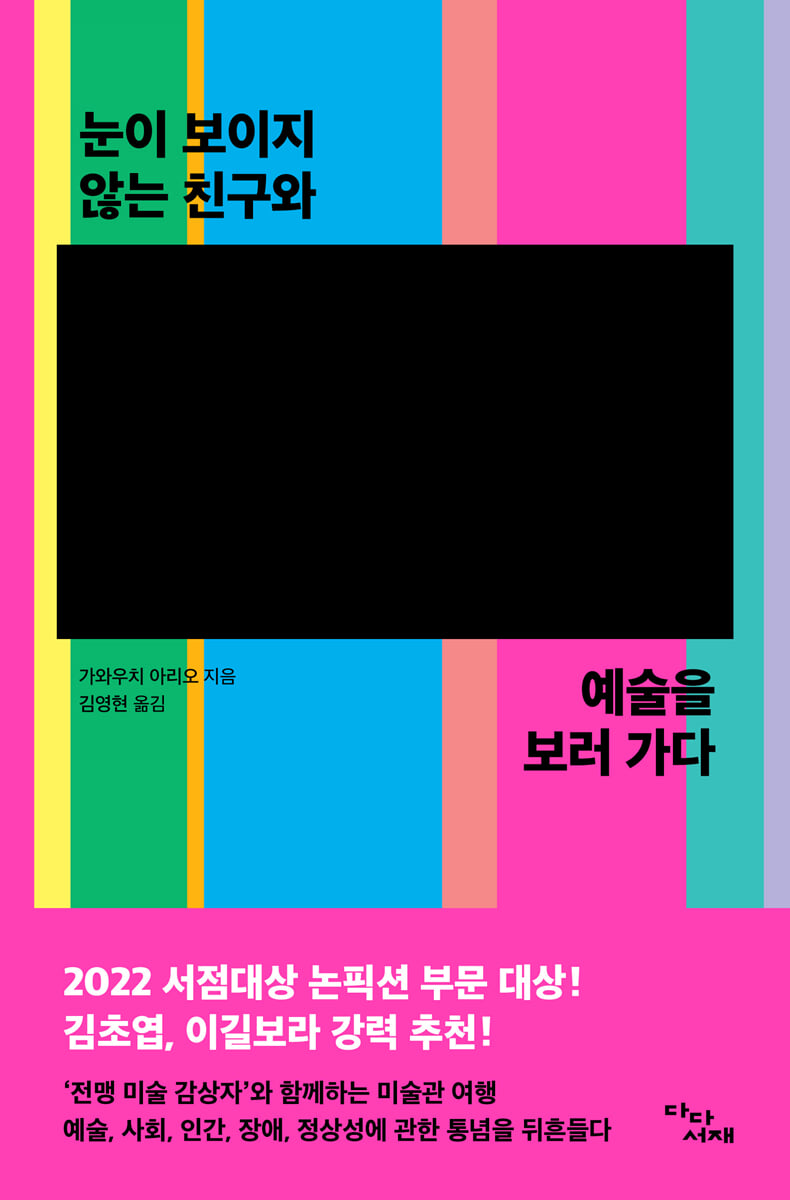
"Going to See Art with a Sightless Friend" is a book written by the author, winner of the Nitta Jiro Literature Award and the Kaiko Takeshi Nonfiction Award, and contains records of visiting art museums around Japan with Kenji Shiratori, a congenitally blind man, and appreciating various works of art.
How does a blind person perceive a work of art? Shiratori Kenji accompanies a sighted person to a work of art, where he listens to visual explanations and discusses the artwork while appreciating it.
In the process, the conversation expands beyond the boundaries of art to include various topics such as art, humanity, society, history, disability, and normalcy.
Shiratori's way of viewing art not only breaks away from familiar methods of appreciating art, but also changes the familiar perspective on the world.
When you see it with him, the painting, the people, and the world all come across with completely different colors and textures.
The book became a bestseller immediately after its publication in Japan, was nominated for the 53rd Soichi Oya Nonfiction Award, and won the grand prize in the nonfiction category of the 2022 Booksellers' Awards, in which Japanese booksellers select the best book of the year.
How does a blind person perceive a work of art? Shiratori Kenji accompanies a sighted person to a work of art, where he listens to visual explanations and discusses the artwork while appreciating it.
In the process, the conversation expands beyond the boundaries of art to include various topics such as art, humanity, society, history, disability, and normalcy.
Shiratori's way of viewing art not only breaks away from familiar methods of appreciating art, but also changes the familiar perspective on the world.
When you see it with him, the painting, the people, and the world all come across with completely different colors and textures.
The book became a bestseller immediately after its publication in Japan, was nominated for the 53rd Soichi Oya Nonfiction Award, and won the grand prize in the nonfiction category of the 2022 Booksellers' Awards, in which Japanese booksellers select the best book of the year.
- You can preview some of the book's contents.
Preview
index
prolog
Chapter 1: There's an art gallery there
Chapter 2: What the Masseuse and Leonardo da Vinci Have in Common
Chapter 3: What Even the Stars of the Universe Cannot Resist
Chapter 4: Buildings and Planes, a Landscape of Nowhere
Chapter 5: What is the field that looks like a lake?
Days when we all enjoyed art together
Chapter 6: Tears Glittering in the Ghost's Eyes
Chapter 7: People Going into the Wilderness
Chapter 8: A Diary I Will Never Read Again
Chapter 9: Where Did Everyone Go?
Chapter 10: Visiting the Orsay Museum from a Corner
Chapter 11 Just to Dream
Chapter 12 The Lake with the White Bird
Acknowledgements
Epilogue
List of included works
References
Chapter 1: There's an art gallery there
Chapter 2: What the Masseuse and Leonardo da Vinci Have in Common
Chapter 3: What Even the Stars of the Universe Cannot Resist
Chapter 4: Buildings and Planes, a Landscape of Nowhere
Chapter 5: What is the field that looks like a lake?
Days when we all enjoyed art together
Chapter 6: Tears Glittering in the Ghost's Eyes
Chapter 7: People Going into the Wilderness
Chapter 8: A Diary I Will Never Read Again
Chapter 9: Where Did Everyone Go?
Chapter 10: Visiting the Orsay Museum from a Corner
Chapter 11 Just to Dream
Chapter 12 The Lake with the White Bird
Acknowledgements
Epilogue
List of included works
References
Detailed image
Into the book
When it comes to vision, we often think of the 'eyes' and eyesight as important, but it is actually said to be a problem related to the brain.
What is absolutely necessary in the act of seeing an object is previously accumulated knowledge and experience, that is, information in the brain.
Whether it's a landscape, art, or a person's face, we interpret and understand everything based on our own experiences and memories.
--- p.25
Even if they are visually impaired, those who were born blind and those who became blind after growing up have had completely different experiences throughout their lives, so the amount of information and the content of the information accumulated in their heads are bound to be different.
So, the world that Mr. Shiratori 'sees', who has extremely limited experience seeing things, is different from that of people who are able to see and people who have lost their sight halfway through life.
In other words, Mr. Shiratori cannot reproduce in his mind the cup I am holding in front of me right now in the same size, color, and shape.
He 'sees' the cup using a completely different imagination.
If we turn this around, even a 'sighted person' cannot even imagine what Shiratori-san 'sees'.
--- p.139
“For example, if you know someone with a disability, you might think that even if the child is born with a slight disability, it will be okay, as long as the child is healthy.
But would that person really be okay with their child having anencephaly? I don't think it's possible to go that far.
“You could call that kind of thinking eugenics.”
--- p.311
Even people who believe they are self-reliant often rely heavily on something: their family, their company, a service, technology, natural resources, their natural environment, or the legacy their parents left behind.
The moment we lose something, our lives can fall apart.
Administrative agencies that once deemed people with disabilities "unfortunate," the current trend of emphasizing only "self-responsibility" for those who experience failure in life, and the tendency to measure a person's worth solely by their "ability" to "do" something are now exerting negative influences on society in various ways.
--- p.316
“We can’t be anyone else.
I can't be a depressed person who is so mentally and physically exhausted that I stay locked in my room, or a person with ADHD.
Neither can we be blind, nor can we be anyone else.
You can't try to understand someone else's feelings! It's a society where only shallow, pretentious thoughts like "I can't" and "I can" are used to show off.
Today's society.
So it's annoying! So we'd rather just stand up and go "Wow!"
“I want to laugh in this world.”
What is absolutely necessary in the act of seeing an object is previously accumulated knowledge and experience, that is, information in the brain.
Whether it's a landscape, art, or a person's face, we interpret and understand everything based on our own experiences and memories.
--- p.25
Even if they are visually impaired, those who were born blind and those who became blind after growing up have had completely different experiences throughout their lives, so the amount of information and the content of the information accumulated in their heads are bound to be different.
So, the world that Mr. Shiratori 'sees', who has extremely limited experience seeing things, is different from that of people who are able to see and people who have lost their sight halfway through life.
In other words, Mr. Shiratori cannot reproduce in his mind the cup I am holding in front of me right now in the same size, color, and shape.
He 'sees' the cup using a completely different imagination.
If we turn this around, even a 'sighted person' cannot even imagine what Shiratori-san 'sees'.
--- p.139
“For example, if you know someone with a disability, you might think that even if the child is born with a slight disability, it will be okay, as long as the child is healthy.
But would that person really be okay with their child having anencephaly? I don't think it's possible to go that far.
“You could call that kind of thinking eugenics.”
--- p.311
Even people who believe they are self-reliant often rely heavily on something: their family, their company, a service, technology, natural resources, their natural environment, or the legacy their parents left behind.
The moment we lose something, our lives can fall apart.
Administrative agencies that once deemed people with disabilities "unfortunate," the current trend of emphasizing only "self-responsibility" for those who experience failure in life, and the tendency to measure a person's worth solely by their "ability" to "do" something are now exerting negative influences on society in various ways.
--- p.316
“We can’t be anyone else.
I can't be a depressed person who is so mentally and physically exhausted that I stay locked in my room, or a person with ADHD.
Neither can we be blind, nor can we be anyone else.
You can't try to understand someone else's feelings! It's a society where only shallow, pretentious thoughts like "I can't" and "I can" are used to show off.
Today's society.
So it's annoying! So we'd rather just stand up and go "Wow!"
“I want to laugh in this world.”
--- p.406
Publisher's Review
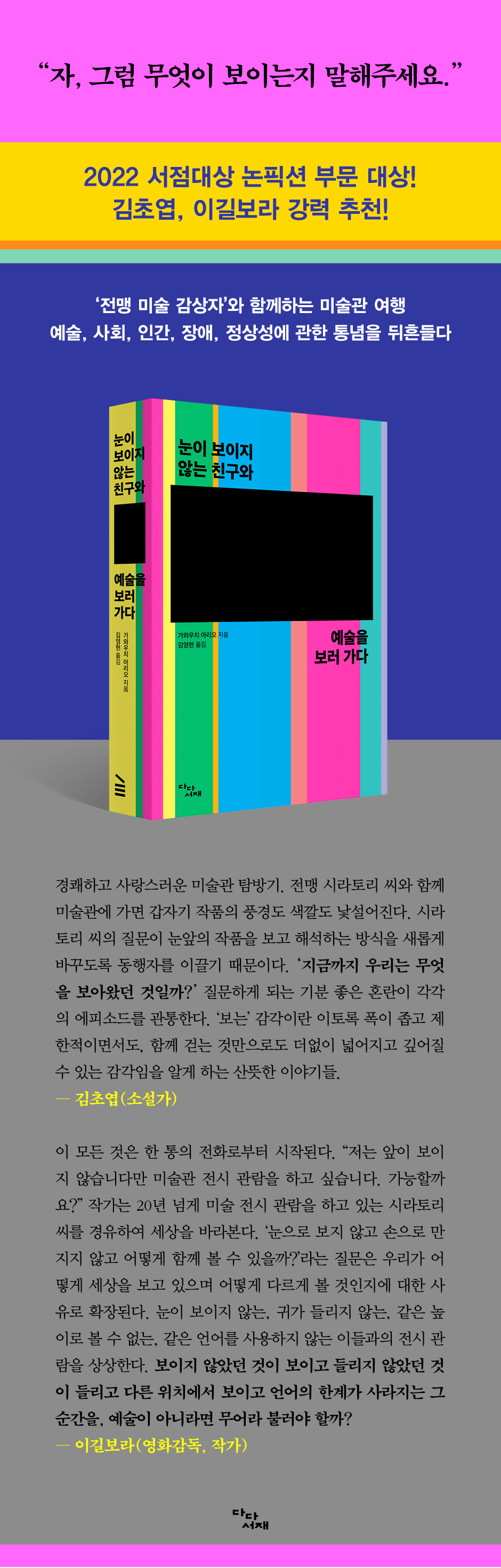
“Okay, then tell me what you see.”
Art Museum Tour with a "Blind Art Appreciator"
Shaking up conventional wisdom about art, society, humanity, disability, and normalcy
★ 2022 Bookstore Awards Nonfiction Category Grand Prize Winner!
★ Finalist for the 53rd Oya Soichi Nonfiction Award!
★ Strongly recommended by Kim Cho-yeop and Lee Gil-bo-ra!
"Going to See Art with a Sightless Friend" is a book written by the author, winner of the Nitta Jiro Literature Award and the Kaiko Takeshi Nonfiction Award, and contains records of visiting art museums around Japan with Kenji Shiratori, a congenitally blind man, and appreciating various works of art.
How does a blind person perceive a work of art? Shiratori Kenji accompanies a sighted person to a work of art, where he listens to visual explanations and discusses the artwork while appreciating it.
In the process, the conversation expands beyond the boundaries of art to include various topics such as art, humanity, society, history, disability, and normalcy.
Shiratori's way of viewing art not only breaks away from familiar methods of appreciating art, but also changes the familiar perspective on the world.
When you see it with him, the painting, the people, and the world all come across with completely different colors and textures.
The book became a bestseller immediately after its publication in Japan, was nominated for the 53rd Soichi Oya Nonfiction Award, and won the grand prize in the nonfiction category of the 2022 Booksellers' Awards, in which Japanese booksellers select the best book of the year.
I can't see, but I go to the art museum.
Art Museum Tour with a Blind Appreciator
Genji Shiratori was born blind and has almost no visual memory.
After graduating from a school for the blind, he naturally obtained a massage therapist license, but he began to question, "Is it okay if I only know about the blind community?" and developed a desire to do something that was not typical of a blind person.
Then, by chance, he goes to an exhibition of Da Vinci's works and his life changes.
Feeling drawn to art viewing, he called an art gallery and asked for guidance, saying, “I can’t see, but I want to see the artwork.”
That's how his visit to the art gallery begins.
How can one appreciate art when one can't see? Genji Shiratori "sees" art by discussing various topics with his companions, who provide visual information about the artwork.
It's not the right answer, but it's about sharing various interpretations that reflect each person's subjectivity and opinion, and enjoying the process of 'trying to understand what is difficult to understand.'
This method of appreciation that Shiratori has naturally acquired is very similar to the “interactive appreciation” advocated by the Museum of Modern Art (MoMA) in New York and utilized around the world, and so Japanese art museum officials are also paying attention to it.
Having lived as a blind art appreciator for over 20 years, Shiratori conducts "Appreciation Workshops for Sighted and Blind People" throughout Japan as a guide to "interactive appreciation."
The author, who lived a post-Japanese life working in American companies and at the UN headquarters in Paris, returned to work as a writer and won the Nitta Jiro Literature Prize and the Kaiko Takeshi Nonfiction Prize. He met Kenji Shiratori after an acquaintance said, “It would be fun to see his work together,” and ended up working with him for over two years.
This book, which contains the story of that two-year journey, became a bestseller immediately after its publication, was nominated for the 53rd Soichi Oya Nonfiction Award, and won the Grand Prize in the Nonfiction category of the 2022 Bookstore Awards.
Additionally, the author co-directed a feature-length documentary, "The Blind Mr. Shiratori Goes to See Art," which was screened throughout Japan.
Things that were invisible begin to become visible
Conversations that transcend common sense and break down prejudice.
Everyone who has seen Shiratori Genji's work says the same thing.
When you go to an art museum with him, you see things you hadn't seen before, and the familiar art museum feels like a completely different place.
Human vision is a rather imperfect ability.
Humans view both landscapes and art based on the knowledge and experience accumulated in their brains.
In the process, vision becomes distorted once more because we make our own judgments by affirming or denying the objects in front of us based on the memory information.
Additionally, since people who can see are exposed to a vast amount of visual information on a daily basis, they unconsciously select only the information they need.
That is, even if it is right in front of you, there are many cases where you cannot see it or each person sees it differently.
Why do familiar things seem different when you see Shiratori Genji and his works? It's because, facing a work you would normally just glance over, you strive to "see it better," to "see it anew," to tell him a little more about it.
Just having a blind person next to you increases your visual resolution and broadens your field of vision.
It's not just vision that changes.
As the audience struggles to narrow down their opinions about the artist and the meaning of his work, they share their personal experiences and engage in conversations about a wide range of topics, from trivial matters like dreams and memories to art, history, and social issues.
In the meantime, not only will the works before your eyes begin to look slightly different, but you will also begin to look at the slightly different points of view, the discrimination within yourself that you had not noticed, and the social common sense and conventions that you had never questioned with a new perspective.
Just as Genji Shiratori borrows the eyes of those who view his work, those who participate in his work also borrow the eyes through which he views the world.
Can art change society?
A Journey of "Seeing Together" to Resist Cynicism and Arrogance
Although this book depicts a journey to an art museum and see works of art, the author goes a step further and sharply examines the society that embraces art and the common sense that permeates that society as a whole.
From a young age, Genji Shiratori heard that he had to work harder because he was disabled, and he grew up trying to get closer to non-disabled people.
In fact, it is not the individuals who are born with disabilities that need to change, but society.
Eventually, he begins to question and resent the absurdity of forcing effort on individuals.
In this society, which revolves around the premise of ‘being able to see,’ ‘being able to hear,’ and ‘being able to do things on one’s own,’ the idea that ‘people with disabilities are unfortunate’ is deeply rooted.
In the past, the 'Movement to Not Have Unfortunate Children' and the sterilization of disabled people, which were carried out under the leadership of government agencies in Japan, were based on this social eugenics ideology.
However, Kenji Shiratori, who criticizes such a social atmosphere, also asks whether his behavior, such as going to art galleries and taking pictures, is based on a sense of discrimination against people with disabilities.
Shiratori gradually breaks free from the unconscious compulsion to become closer to non-disabled people, realizing that “‘can do’ and ‘can’t do’ are not pluses and minuses.”
The author also confesses to his own internal prejudices that he had not yet realized, and criticizes not only stereotypes about people with disabilities, but also the trend of emphasizing only independence and growth, and the system of sacrificing people for greater good, including economic development.
Furthermore, through our journey with Shiratori Genji, we are shaken by our own arrogance and neutrality as we realize the tragedy that arises when different definitions collide, the hidden eugenics in the hearts of ordinary people, and the realistic limits of our efforts to empathize with others.
Shiratori Kenji and those who joined him on his pilgrimage to art museums also confessed that they "met art and became comfortable with it."
Thanks to the experience of looking at art with Shiratori, their consciousness and lives have changed, and that change is quietly spreading from person to person.
Being with other beings, looking at art and the world together, trying to understand each other and accepting that we cannot understand each other.
It is precisely in that ‘seeing together’ that we find the power that allows us to continue living in this contradictory world.
Art Museum Tour with a "Blind Art Appreciator"
Shaking up conventional wisdom about art, society, humanity, disability, and normalcy
★ 2022 Bookstore Awards Nonfiction Category Grand Prize Winner!
★ Finalist for the 53rd Oya Soichi Nonfiction Award!
★ Strongly recommended by Kim Cho-yeop and Lee Gil-bo-ra!
"Going to See Art with a Sightless Friend" is a book written by the author, winner of the Nitta Jiro Literature Award and the Kaiko Takeshi Nonfiction Award, and contains records of visiting art museums around Japan with Kenji Shiratori, a congenitally blind man, and appreciating various works of art.
How does a blind person perceive a work of art? Shiratori Kenji accompanies a sighted person to a work of art, where he listens to visual explanations and discusses the artwork while appreciating it.
In the process, the conversation expands beyond the boundaries of art to include various topics such as art, humanity, society, history, disability, and normalcy.
Shiratori's way of viewing art not only breaks away from familiar methods of appreciating art, but also changes the familiar perspective on the world.
When you see it with him, the painting, the people, and the world all come across with completely different colors and textures.
The book became a bestseller immediately after its publication in Japan, was nominated for the 53rd Soichi Oya Nonfiction Award, and won the grand prize in the nonfiction category of the 2022 Booksellers' Awards, in which Japanese booksellers select the best book of the year.
I can't see, but I go to the art museum.
Art Museum Tour with a Blind Appreciator
Genji Shiratori was born blind and has almost no visual memory.
After graduating from a school for the blind, he naturally obtained a massage therapist license, but he began to question, "Is it okay if I only know about the blind community?" and developed a desire to do something that was not typical of a blind person.
Then, by chance, he goes to an exhibition of Da Vinci's works and his life changes.
Feeling drawn to art viewing, he called an art gallery and asked for guidance, saying, “I can’t see, but I want to see the artwork.”
That's how his visit to the art gallery begins.
How can one appreciate art when one can't see? Genji Shiratori "sees" art by discussing various topics with his companions, who provide visual information about the artwork.
It's not the right answer, but it's about sharing various interpretations that reflect each person's subjectivity and opinion, and enjoying the process of 'trying to understand what is difficult to understand.'
This method of appreciation that Shiratori has naturally acquired is very similar to the “interactive appreciation” advocated by the Museum of Modern Art (MoMA) in New York and utilized around the world, and so Japanese art museum officials are also paying attention to it.
Having lived as a blind art appreciator for over 20 years, Shiratori conducts "Appreciation Workshops for Sighted and Blind People" throughout Japan as a guide to "interactive appreciation."
The author, who lived a post-Japanese life working in American companies and at the UN headquarters in Paris, returned to work as a writer and won the Nitta Jiro Literature Prize and the Kaiko Takeshi Nonfiction Prize. He met Kenji Shiratori after an acquaintance said, “It would be fun to see his work together,” and ended up working with him for over two years.
This book, which contains the story of that two-year journey, became a bestseller immediately after its publication, was nominated for the 53rd Soichi Oya Nonfiction Award, and won the Grand Prize in the Nonfiction category of the 2022 Bookstore Awards.
Additionally, the author co-directed a feature-length documentary, "The Blind Mr. Shiratori Goes to See Art," which was screened throughout Japan.
Things that were invisible begin to become visible
Conversations that transcend common sense and break down prejudice.
Everyone who has seen Shiratori Genji's work says the same thing.
When you go to an art museum with him, you see things you hadn't seen before, and the familiar art museum feels like a completely different place.
Human vision is a rather imperfect ability.
Humans view both landscapes and art based on the knowledge and experience accumulated in their brains.
In the process, vision becomes distorted once more because we make our own judgments by affirming or denying the objects in front of us based on the memory information.
Additionally, since people who can see are exposed to a vast amount of visual information on a daily basis, they unconsciously select only the information they need.
That is, even if it is right in front of you, there are many cases where you cannot see it or each person sees it differently.
Why do familiar things seem different when you see Shiratori Genji and his works? It's because, facing a work you would normally just glance over, you strive to "see it better," to "see it anew," to tell him a little more about it.
Just having a blind person next to you increases your visual resolution and broadens your field of vision.
It's not just vision that changes.
As the audience struggles to narrow down their opinions about the artist and the meaning of his work, they share their personal experiences and engage in conversations about a wide range of topics, from trivial matters like dreams and memories to art, history, and social issues.
In the meantime, not only will the works before your eyes begin to look slightly different, but you will also begin to look at the slightly different points of view, the discrimination within yourself that you had not noticed, and the social common sense and conventions that you had never questioned with a new perspective.
Just as Genji Shiratori borrows the eyes of those who view his work, those who participate in his work also borrow the eyes through which he views the world.
Can art change society?
A Journey of "Seeing Together" to Resist Cynicism and Arrogance
Although this book depicts a journey to an art museum and see works of art, the author goes a step further and sharply examines the society that embraces art and the common sense that permeates that society as a whole.
From a young age, Genji Shiratori heard that he had to work harder because he was disabled, and he grew up trying to get closer to non-disabled people.
In fact, it is not the individuals who are born with disabilities that need to change, but society.
Eventually, he begins to question and resent the absurdity of forcing effort on individuals.
In this society, which revolves around the premise of ‘being able to see,’ ‘being able to hear,’ and ‘being able to do things on one’s own,’ the idea that ‘people with disabilities are unfortunate’ is deeply rooted.
In the past, the 'Movement to Not Have Unfortunate Children' and the sterilization of disabled people, which were carried out under the leadership of government agencies in Japan, were based on this social eugenics ideology.
However, Kenji Shiratori, who criticizes such a social atmosphere, also asks whether his behavior, such as going to art galleries and taking pictures, is based on a sense of discrimination against people with disabilities.
Shiratori gradually breaks free from the unconscious compulsion to become closer to non-disabled people, realizing that “‘can do’ and ‘can’t do’ are not pluses and minuses.”
The author also confesses to his own internal prejudices that he had not yet realized, and criticizes not only stereotypes about people with disabilities, but also the trend of emphasizing only independence and growth, and the system of sacrificing people for greater good, including economic development.
Furthermore, through our journey with Shiratori Genji, we are shaken by our own arrogance and neutrality as we realize the tragedy that arises when different definitions collide, the hidden eugenics in the hearts of ordinary people, and the realistic limits of our efforts to empathize with others.
Shiratori Kenji and those who joined him on his pilgrimage to art museums also confessed that they "met art and became comfortable with it."
Thanks to the experience of looking at art with Shiratori, their consciousness and lives have changed, and that change is quietly spreading from person to person.
Being with other beings, looking at art and the world together, trying to understand each other and accepting that we cannot understand each other.
It is precisely in that ‘seeing together’ that we find the power that allows us to continue living in this contradictory world.
GOODS SPECIFICS
- Date of issue: October 23, 2023
- Page count, weight, size: 432 pages | 642g | 135*205*25mm
- ISBN13: 9791191716276
- ISBN10: 1191716279
You may also like
카테고리
korean


korean

![GQ KOREA Mark (Monthly): December [2025]](http://librairie.coreenne.fr/cdn/shop/files/8ef265dbbfbf186523ed75ba7319009d.jpg?v=1765340328&width=3840)


