

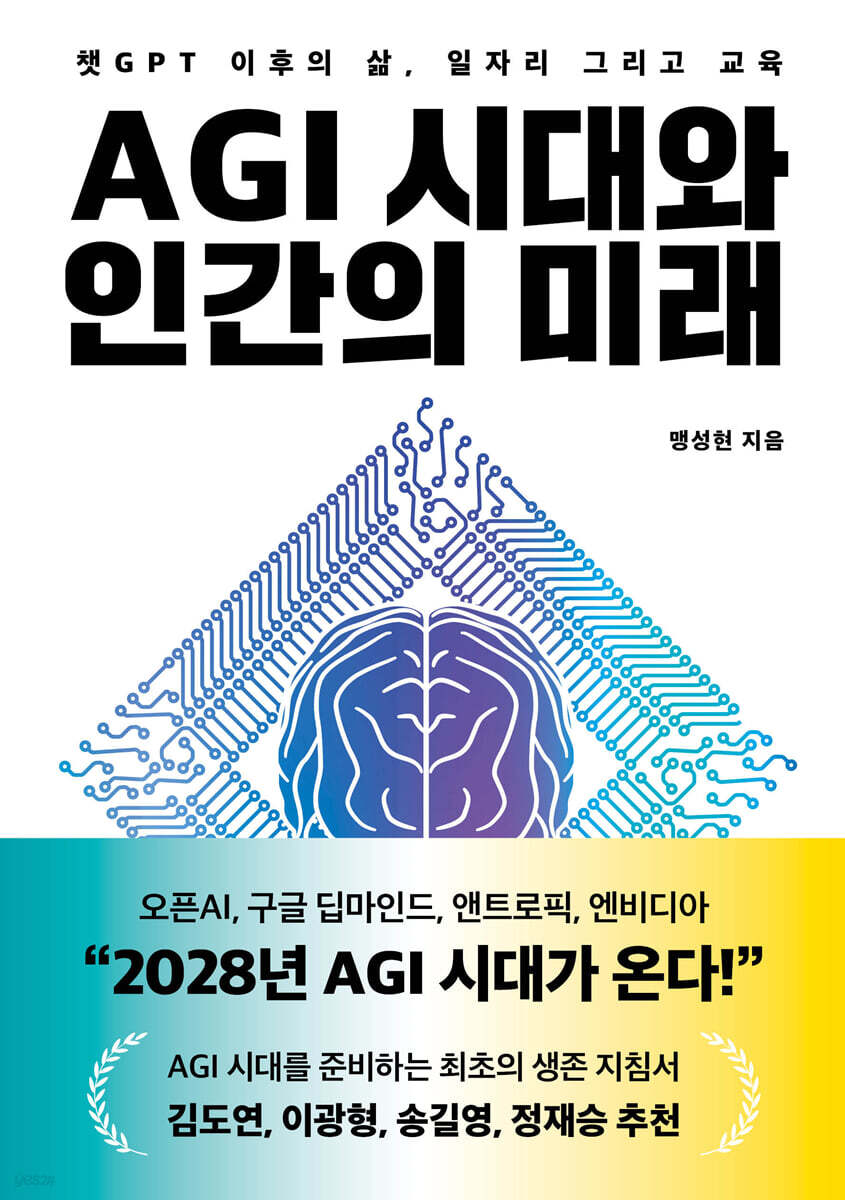
The AGI Era and the Future of Humanity
 |
Description
Book Introduction
The first survival guide to prepare for the "AGI era" arriving in 2028. OpenAI, Google DeepMind, Anthropic, and Nvidia, which are accelerating AI development even at the expense of safety and security, have all publicly stated that they will reach AGI by 2028. AGI, which is assessed as a 'threat to the level of human extinction', refers to general artificial intelligence, that is, AI that implements intelligence equal to or greater than that of humans. GPT-4o, which has recently become a hot topic, is an early stage that signals the beginning of the AGI era. This book is the first survival guide to prepare for the AGI era, containing strategies for humans and AI to coexist and simultaneously co-evolve until the AGI era by fully understanding the direction of AI technology derived from ChatGPT and more clearly understanding human nature and capabilities. |
- You can preview some of the book's contents.
Preview
index
prolog
Chapter 1: Beyond AI: The Era of AGI
An accelerated future
No one likes an uncertain future | A world we've never experienced | Generative AI from the outside
Look into me to know you
Reading | The Language Model We All Have
Amazing and scary newborn chatGPT
The Meaning of a Newborn | Why It's Scary | Limitations and New Relationships
AI that grows in power
Unstoppable Expansion | Uncertain Future
Chapter 2: The Beginning of AGI: Generative AI
AI 'Primate'
Finding Roots for the Future | AI Is Also a Data Transformation Program | The Trajectory of AI Development
The Secret Behind ChatGPT's Birth
Mimicking Human Neural Networks | Language Models Are the Key | How Do We Generate Them? | The Beauty of Transformers' Simplicity | Algorithms, Data, and Models
creative ability
Making Humans Uneasy | Where Does Such Ability Come From? | The Magic of Abstraction | Conversational Intelligence | 100-Level Perceptiveness
The Evolutionary Ecosystem of Generative AI
Still an Immature Child | Element-by-Element Rooting | The Emergence of a Human-AI Coexistence Ecosystem
Chapter 3: The Second Cognitive Revolution
Transformation of tools
Homo technicus | From abacus to ChatGPT | The aftermath of digital civilization | Is ChatGPT a tool?
The Second Cognitive Revolution
Revolutionary change | Explosion of knowledge | Automation of mental labor | Meeting the requirements of the cognitive revolution
What are we doing
The defenseless Alpha Generation, the active MZ generation | The insecure older generation's unintentional misconduct | How much do we really need to know?
Chapter 4: The Opportunities and Existential Risks of AI
Synergy between human intelligence and AI
Collaboration with Teachers | AI Leading Research Innovation | An Era of Creativity | Collaboration in the Medical Field | The Most Changing Field of Law | Even Areas Requiring Emotion
Threat to human existence
Existential Risk | Intentions and Consequences Are Separate | A Divided Society | The Trap of Deification | The Need for Responsible Thinking
A typhoon looming on the job horizon
Projected Scale | Changing Labor Market | New Opportunities | Social Impact
Chapter 5: Human Intelligence and AI
Horizon of Intelligence
Intelligence in Everyday Life | Intelligence Theory and AI | Theory of Multiple Intelligences | Where Does Problem-Solving Ability Come From?
Human Intelligence vs. AI
Cognitive Perspective | Comparison through Thought Experiments | Comparison by Specific Intelligence | AI Transforms Humans
Precious unique human abilities
Desire and Intention | Sense and Perception | Consciousness and Creativity | Empathic Intelligence: Killing Three Birds with One Stone | Metacognition: The Gift of Social Needs | Embodied Experience | Social Interaction
Chapter 6: Future Strategies for Coexistence with AI
Coexistence and Coevolution with AI
Why Coexistence? | How to Coexist | Direction of Coevolution
Preparation for the new human race
A Time for Change Is Coming | A Different Pattern of Change from the Past | The Saying, "Education is a Century-Long Plan" | Expectations for a Coexistence Strategy
Nine Essential Skills for the AGI Era
Literacy | Integrated Insight | Creativity | AI Literacy | Adaptability to Technological Change | Knowledge and Information Value Judgment | Empathy-Based Collaboration | Embodied Experience | Emotional Humanity
Transformation of education
The die has been cast | A society in motion | Educational goals that capture the spirit of the times | Change is happening on the ground
Epilogue
annotation
Chapter 1: Beyond AI: The Era of AGI
An accelerated future
No one likes an uncertain future | A world we've never experienced | Generative AI from the outside
Look into me to know you
Reading | The Language Model We All Have
Amazing and scary newborn chatGPT
The Meaning of a Newborn | Why It's Scary | Limitations and New Relationships
AI that grows in power
Unstoppable Expansion | Uncertain Future
Chapter 2: The Beginning of AGI: Generative AI
AI 'Primate'
Finding Roots for the Future | AI Is Also a Data Transformation Program | The Trajectory of AI Development
The Secret Behind ChatGPT's Birth
Mimicking Human Neural Networks | Language Models Are the Key | How Do We Generate Them? | The Beauty of Transformers' Simplicity | Algorithms, Data, and Models
creative ability
Making Humans Uneasy | Where Does Such Ability Come From? | The Magic of Abstraction | Conversational Intelligence | 100-Level Perceptiveness
The Evolutionary Ecosystem of Generative AI
Still an Immature Child | Element-by-Element Rooting | The Emergence of a Human-AI Coexistence Ecosystem
Chapter 3: The Second Cognitive Revolution
Transformation of tools
Homo technicus | From abacus to ChatGPT | The aftermath of digital civilization | Is ChatGPT a tool?
The Second Cognitive Revolution
Revolutionary change | Explosion of knowledge | Automation of mental labor | Meeting the requirements of the cognitive revolution
What are we doing
The defenseless Alpha Generation, the active MZ generation | The insecure older generation's unintentional misconduct | How much do we really need to know?
Chapter 4: The Opportunities and Existential Risks of AI
Synergy between human intelligence and AI
Collaboration with Teachers | AI Leading Research Innovation | An Era of Creativity | Collaboration in the Medical Field | The Most Changing Field of Law | Even Areas Requiring Emotion
Threat to human existence
Existential Risk | Intentions and Consequences Are Separate | A Divided Society | The Trap of Deification | The Need for Responsible Thinking
A typhoon looming on the job horizon
Projected Scale | Changing Labor Market | New Opportunities | Social Impact
Chapter 5: Human Intelligence and AI
Horizon of Intelligence
Intelligence in Everyday Life | Intelligence Theory and AI | Theory of Multiple Intelligences | Where Does Problem-Solving Ability Come From?
Human Intelligence vs. AI
Cognitive Perspective | Comparison through Thought Experiments | Comparison by Specific Intelligence | AI Transforms Humans
Precious unique human abilities
Desire and Intention | Sense and Perception | Consciousness and Creativity | Empathic Intelligence: Killing Three Birds with One Stone | Metacognition: The Gift of Social Needs | Embodied Experience | Social Interaction
Chapter 6: Future Strategies for Coexistence with AI
Coexistence and Coevolution with AI
Why Coexistence? | How to Coexist | Direction of Coevolution
Preparation for the new human race
A Time for Change Is Coming | A Different Pattern of Change from the Past | The Saying, "Education is a Century-Long Plan" | Expectations for a Coexistence Strategy
Nine Essential Skills for the AGI Era
Literacy | Integrated Insight | Creativity | AI Literacy | Adaptability to Technological Change | Knowledge and Information Value Judgment | Empathy-Based Collaboration | Embodied Experience | Emotional Humanity
Transformation of education
The die has been cast | A society in motion | Educational goals that capture the spirit of the times | Change is happening on the ground
Epilogue
annotation
Detailed image

Into the book
You will need to devise a strategy while shaking off the anxiety that is creeping in.
The first military strategy that comes to mind in times like these is 'Know your enemy and know yourself, you will not be in danger in a hundred battles'.
This is because we need to find out as much as possible about the direction of AI technology resulting from ChatGPT (GP) and understand human nature and capabilities more clearly (JiGi).
--- p.13, from “Prologue”
If the first reason for the buzz surrounding ChatGPT is the surprise of its current capabilities, the second reason is the changes that will occur in the future.
--- p.21, from “Chapter 1: Beyond AI to the Era of AGI”
People now take it for granted that AI can solve difficult problems or think logically, but they feel uneasy when they realize that creativity, one of the last bastions of human intelligence, is being challenged.
--- p.100, from “Chapter 2: The Beginning of AGI: Generative AI”
But what this book values more than anything else is its exploration of the multifaceted nature of human intelligence.
By understanding the differences between AI and human intelligence, we can understand the future direction of AI development and what abilities humans will need in the future.
--- p.172, from “Chapter 3: The Second Cognitive Revolution”
Therefore, collaboration with autonomous AI will increasingly become a necessity rather than an option. As long as AI's safety is guaranteed, it will attain the status of a "member of society," as depicted in science fiction films.
--- p.178, from “Chapter 4: Opportunities and Existential Risks Brought by AI”
What abilities will humans need in the future, when AGI emerges? Understanding the differences between AI and human thought processes will not only contribute to AI development, but also shed light on the direction in which human capabilities should be developed.
--- p.238, from “Chapter 5 Human Intelligence and AI”
At this point in the AI era, it is an existential question to ask how humans and AI will coexist and how they will co-evolve as the era of AGI approaches.
--- p.305, from “Chapter 6: Future Strategies for Coexistence with AI”
This is because we believe that clearly recognizing and differentiating the similarities and differences between humans and AI to maximize humanity is the only way to create a society where humans and AI can coexist appropriately.
The first military strategy that comes to mind in times like these is 'Know your enemy and know yourself, you will not be in danger in a hundred battles'.
This is because we need to find out as much as possible about the direction of AI technology resulting from ChatGPT (GP) and understand human nature and capabilities more clearly (JiGi).
--- p.13, from “Prologue”
If the first reason for the buzz surrounding ChatGPT is the surprise of its current capabilities, the second reason is the changes that will occur in the future.
--- p.21, from “Chapter 1: Beyond AI to the Era of AGI”
People now take it for granted that AI can solve difficult problems or think logically, but they feel uneasy when they realize that creativity, one of the last bastions of human intelligence, is being challenged.
--- p.100, from “Chapter 2: The Beginning of AGI: Generative AI”
But what this book values more than anything else is its exploration of the multifaceted nature of human intelligence.
By understanding the differences between AI and human intelligence, we can understand the future direction of AI development and what abilities humans will need in the future.
--- p.172, from “Chapter 3: The Second Cognitive Revolution”
Therefore, collaboration with autonomous AI will increasingly become a necessity rather than an option. As long as AI's safety is guaranteed, it will attain the status of a "member of society," as depicted in science fiction films.
--- p.178, from “Chapter 4: Opportunities and Existential Risks Brought by AI”
What abilities will humans need in the future, when AGI emerges? Understanding the differences between AI and human thought processes will not only contribute to AI development, but also shed light on the direction in which human capabilities should be developed.
--- p.238, from “Chapter 5 Human Intelligence and AI”
At this point in the AI era, it is an existential question to ask how humans and AI will coexist and how they will co-evolve as the era of AGI approaches.
--- p.305, from “Chapter 6: Future Strategies for Coexistence with AI”
This is because we believe that clearly recognizing and differentiating the similarities and differences between humans and AI to maximize humanity is the only way to create a society where humans and AI can coexist appropriately.
--- p.384, from "Epilogue"
Publisher's Review
OpenAI, Google DeepMind, Antropic, Nvidia
“The era of AGI is coming in 2028!”
The First Survival Guide to Preparing for the AGI Era
The emergence of ChatGPT, a "generative artificial intelligence" unveiled by the American company OpenAI in late 2022, brought about both wonder and fear.
ChatGPT is an AI that reads and fuses almost all text produced by humans, and then performs language-based intellectual tasks such as answering questions or writing instructions through conversation.
Will ChatGPT be the starting point of the evolution of Homo sapiens into a new species, or will it be the seed of misfortune that will send human civilization drifting to an unknown destination?
A recent research report commissioned by the U.S. State Department is a hot topic.
“AGI is considered a major risk factor for catastrophic loss of control,” the report said, noting that “OpenAI, Google DeepMind, Antropy, and Nvidia have all publicly stated that they could reach AGI by 2028.”
The author argues that even setting aside grand narratives like safety, security, and AI ethics, this AI technology “can revolutionize human thought and cognitive activity because it can collect, refine, and refine human thoughts and experiences.”
This book asks whether we are ready to find answers to existential questions like, "How will our lives be different in 10 years? How will our job ecosystem change? How should Generation MZ adapt to the new era of work? What will future generations be like if we continue to follow the current education system and culture?"
The author suggests that as a way to prepare for an uncertain future, 'Know your enemy and know yourself, and you will not be in danger in a hundred battles.'
It is self-evident that without understanding the differences in the nature and "intellectual abilities" of humans and AI, it is impossible to develop strategies to bridge the various gaps.
This book is the first survival guide to prepare for the AGI era, containing strategies for humans and AI to coexist and simultaneously co-evolve until the AGI era by finding out the direction of AI technology derived from ChatGPT as much as possible (GP) and understanding human nature and abilities more clearly (JiGi).
Now, what are we preparing for?
After the second cognitive revolution started with Chat GPT
Prepare for a world where humans and AI coexist!
In 2010, there was an event that left a mark on the history of human 'intellectual revolution'.
The advent of Google ushered in the 'era of search.'
However, you had to first find the information or facts you needed through Googling, and then read the content to extract the necessary parts.
To help with this, tools based on natural language processing technologies such as document classification, information extraction, machine translation, and question-answering have emerged.
Up to this point, most of the techniques for deconstructing or 'analyzing' data have been applied, focusing on 'reading' skills, and the 'creation process' of writing sentences and composing paragraphs to create the final work has remained a unique domain that humans must undertake.
However, ChatGPT 'understands' human language by absorbing all the content in the 'human brain', and mixes the content here and there to create new text with the content desired by the user.
This is why ChatGPT is called a 'generative' AI, differentiating it from the 'analytical'-oriented AI era.
If "generative" AI, capable of replacing the intellectual activities previously reserved for humans, performs mental labor here and there, what will humans do? What unique domains and jobs will remain that only humans can perform? These are difficult questions that require consideration of human nature and capabilities.
This book examines how the AI technology paradigm shift, starting with ChatGPT, will change our lives and jobs, and explores how we should prepare for future generations.
A key element that must be incorporated into these discussions is an understanding of the diversity of human capabilities.
It is absurd to speculate on the survival strategies of future generations and prepare for the transition to the AGI era without understanding the differences between generative AI and human nature.
The first part of this book (Chapters 1 and 2) explains the core concepts of ChatGPT and 'generative AI' technology in a language accessible to the general public, allowing them to gauge its impact and future development direction.
Here, we will connect the ChatGPT technology with how the human brain works as revealed by neuroscience, making this technology relatively accessible.
The second part (Chapters 3 and 4) examines the significance of the "second cognitive revolution" triggered by ChatGPT from a historical perspective, contrasting the opportunities brought about by AI with the existential and potential risks.
In particular, it highlights the need for coexistence between humans and AI by looking at the job ecosystem that will change with the advent of AI.
Chapter 5, which is the final part, compares the similarities and fundamental differences between human intelligence and artificial intelligence, summarizing the current status and limitations of 'generative AI' and examining the inherent nature of humans.
Chapter 6 presents the essential skills that future generations must cultivate as they prepare for the AGI era, along with a method of coexistence, and suggests a direction for how education should be transformed for the "new humanity."
Homo Symbius: Humans Coexisting with AI
Human survival in the AGI era
It depends on comprehensive thinking and strengthening humanity.
The author believes that “clearly recognizing and differentiating the similarities and differences between humans and AI to maximize humanity is the only way to create a society where humans and AI can coexist appropriately.”
This book does not stop at a humanistic and sociological discourse on AI, nor does it focus on technical explanations or applications of AI.
The author says he wants to bring a human touch to the AI field by connecting the two extremes of humans and AI, thereby leading to human-centered thinking.
Because I believe that 'AI should remain AI, and humans should remain humans.'
How will the world change in the near future? Generative AI will become more technologically advanced, and an open AI ecosystem will gradually become established.
Vision AI will also overcome its current limitations by connecting with powerful large-scale language models to understand real-world context and user intent.
As technological advancements advance, issues such as AI safety, reliability, and ethics will receive significant attention from academia and industry.
Because without resolving these issues, the industrialization of AI is not sustainable.
As cooperation between humans and AI naturally expands, a form of coexistence will take hold. However, as we enter the era of AGI, where AI creates AI, and AI acts as the brain of robots, new types of threats will emerge.
In terms of jobs, what will come will come and what will come will come.
However, the pace of change is so rapid that it will be difficult to cope with the current education system and learning objectives.
The author says that even if we aim for coexistence and co-evolution with AI, human 'life' must always be at the center, and in order to cope with this change, if we look at the education of future generations at the individual, organizational, and school levels and go into detail centered on the 'nine essential abilities' that must be possessed in the AGI era presented in Chapter 6 of this book, we will be able to minimize the shock that we will receive when we enter the AGI era.
“The era of AGI is coming in 2028!”
The First Survival Guide to Preparing for the AGI Era
The emergence of ChatGPT, a "generative artificial intelligence" unveiled by the American company OpenAI in late 2022, brought about both wonder and fear.
ChatGPT is an AI that reads and fuses almost all text produced by humans, and then performs language-based intellectual tasks such as answering questions or writing instructions through conversation.
Will ChatGPT be the starting point of the evolution of Homo sapiens into a new species, or will it be the seed of misfortune that will send human civilization drifting to an unknown destination?
A recent research report commissioned by the U.S. State Department is a hot topic.
“AGI is considered a major risk factor for catastrophic loss of control,” the report said, noting that “OpenAI, Google DeepMind, Antropy, and Nvidia have all publicly stated that they could reach AGI by 2028.”
The author argues that even setting aside grand narratives like safety, security, and AI ethics, this AI technology “can revolutionize human thought and cognitive activity because it can collect, refine, and refine human thoughts and experiences.”
This book asks whether we are ready to find answers to existential questions like, "How will our lives be different in 10 years? How will our job ecosystem change? How should Generation MZ adapt to the new era of work? What will future generations be like if we continue to follow the current education system and culture?"
The author suggests that as a way to prepare for an uncertain future, 'Know your enemy and know yourself, and you will not be in danger in a hundred battles.'
It is self-evident that without understanding the differences in the nature and "intellectual abilities" of humans and AI, it is impossible to develop strategies to bridge the various gaps.
This book is the first survival guide to prepare for the AGI era, containing strategies for humans and AI to coexist and simultaneously co-evolve until the AGI era by finding out the direction of AI technology derived from ChatGPT as much as possible (GP) and understanding human nature and abilities more clearly (JiGi).
Now, what are we preparing for?
After the second cognitive revolution started with Chat GPT
Prepare for a world where humans and AI coexist!
In 2010, there was an event that left a mark on the history of human 'intellectual revolution'.
The advent of Google ushered in the 'era of search.'
However, you had to first find the information or facts you needed through Googling, and then read the content to extract the necessary parts.
To help with this, tools based on natural language processing technologies such as document classification, information extraction, machine translation, and question-answering have emerged.
Up to this point, most of the techniques for deconstructing or 'analyzing' data have been applied, focusing on 'reading' skills, and the 'creation process' of writing sentences and composing paragraphs to create the final work has remained a unique domain that humans must undertake.
However, ChatGPT 'understands' human language by absorbing all the content in the 'human brain', and mixes the content here and there to create new text with the content desired by the user.
This is why ChatGPT is called a 'generative' AI, differentiating it from the 'analytical'-oriented AI era.
If "generative" AI, capable of replacing the intellectual activities previously reserved for humans, performs mental labor here and there, what will humans do? What unique domains and jobs will remain that only humans can perform? These are difficult questions that require consideration of human nature and capabilities.
This book examines how the AI technology paradigm shift, starting with ChatGPT, will change our lives and jobs, and explores how we should prepare for future generations.
A key element that must be incorporated into these discussions is an understanding of the diversity of human capabilities.
It is absurd to speculate on the survival strategies of future generations and prepare for the transition to the AGI era without understanding the differences between generative AI and human nature.
The first part of this book (Chapters 1 and 2) explains the core concepts of ChatGPT and 'generative AI' technology in a language accessible to the general public, allowing them to gauge its impact and future development direction.
Here, we will connect the ChatGPT technology with how the human brain works as revealed by neuroscience, making this technology relatively accessible.
The second part (Chapters 3 and 4) examines the significance of the "second cognitive revolution" triggered by ChatGPT from a historical perspective, contrasting the opportunities brought about by AI with the existential and potential risks.
In particular, it highlights the need for coexistence between humans and AI by looking at the job ecosystem that will change with the advent of AI.
Chapter 5, which is the final part, compares the similarities and fundamental differences between human intelligence and artificial intelligence, summarizing the current status and limitations of 'generative AI' and examining the inherent nature of humans.
Chapter 6 presents the essential skills that future generations must cultivate as they prepare for the AGI era, along with a method of coexistence, and suggests a direction for how education should be transformed for the "new humanity."
Homo Symbius: Humans Coexisting with AI
Human survival in the AGI era
It depends on comprehensive thinking and strengthening humanity.
The author believes that “clearly recognizing and differentiating the similarities and differences between humans and AI to maximize humanity is the only way to create a society where humans and AI can coexist appropriately.”
This book does not stop at a humanistic and sociological discourse on AI, nor does it focus on technical explanations or applications of AI.
The author says he wants to bring a human touch to the AI field by connecting the two extremes of humans and AI, thereby leading to human-centered thinking.
Because I believe that 'AI should remain AI, and humans should remain humans.'
How will the world change in the near future? Generative AI will become more technologically advanced, and an open AI ecosystem will gradually become established.
Vision AI will also overcome its current limitations by connecting with powerful large-scale language models to understand real-world context and user intent.
As technological advancements advance, issues such as AI safety, reliability, and ethics will receive significant attention from academia and industry.
Because without resolving these issues, the industrialization of AI is not sustainable.
As cooperation between humans and AI naturally expands, a form of coexistence will take hold. However, as we enter the era of AGI, where AI creates AI, and AI acts as the brain of robots, new types of threats will emerge.
In terms of jobs, what will come will come and what will come will come.
However, the pace of change is so rapid that it will be difficult to cope with the current education system and learning objectives.
The author says that even if we aim for coexistence and co-evolution with AI, human 'life' must always be at the center, and in order to cope with this change, if we look at the education of future generations at the individual, organizational, and school levels and go into detail centered on the 'nine essential abilities' that must be possessed in the AGI era presented in Chapter 6 of this book, we will be able to minimize the shock that we will receive when we enter the AGI era.
GOODS SPECIFICS
- Date of issue: June 5, 2024
- Page count, weight, size: 400 pages | 624g | 152*215*22mm
- ISBN13: 9791188366866
- ISBN10: 1188366866
You may also like
카테고리
korean


korean

![GQ KOREA Mark (Monthly): December [2025]](http://librairie.coreenne.fr/cdn/shop/files/8ef265dbbfbf186523ed75ba7319009d.jpg?v=1765340328&width=3840)


