

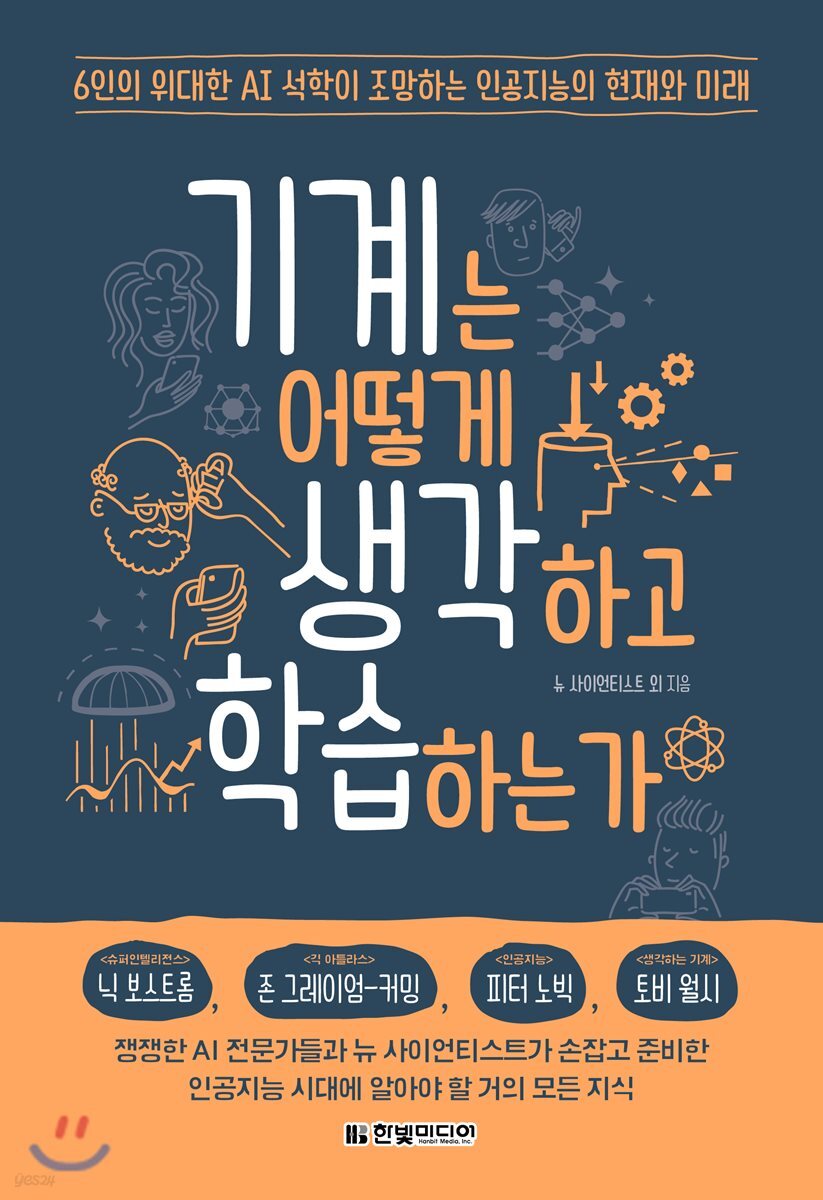
How Machines Think and Learn
 |
Description
Book Introduction
Will artificial intelligence destroy us or save us?
Someday in the future, machine intelligence will surpass the capabilities of the human brain.
How do these machines think and learn? New Scientist joins forces with AI experts including Nick Bostrom, Peter Norvig, and Toby Walsh to explore the present and future of artificial intelligence.
This fascinating book explores essential knowledge needed in the age of artificial intelligence, including self-driving cars, killer robots, machine learning, and AI ethics. After reading this book, you'll be able to answer the question: is AI truly a disaster?
Someday in the future, machine intelligence will surpass the capabilities of the human brain.
How do these machines think and learn? New Scientist joins forces with AI experts including Nick Bostrom, Peter Norvig, and Toby Walsh to explore the present and future of artificial intelligence.
This fascinating book explores essential knowledge needed in the age of artificial intelligence, including self-driving cars, killer robots, machine learning, and AI ethics. After reading this book, you'll be able to answer the question: is AI truly a disaster?
- You can preview some of the book's contents.
Preview
index
Chapter 1: Creatures Modeled after Humans
Chapter 2 Learning Machines
Chapter 3: If there is anything a human can do
Chapter 4: The Question of Life and Death
Chapter 5: Into the Unknown World
Chapter 6: The Creative Machine
Chapter 7: The True Dangers of Artificial Intelligence
Chapter 8: Will machines become the masters of the Earth after humans?
Appendix 50 Ideas
Chapter 2 Learning Machines
Chapter 3: If there is anything a human can do
Chapter 4: The Question of Life and Death
Chapter 5: Into the Unknown World
Chapter 6: The Creative Machine
Chapter 7: The True Dangers of Artificial Intelligence
Chapter 8: Will machines become the masters of the Earth after humans?
Appendix 50 Ideas
Into the book
Consider a tank with broken brakes.
And there are five people on the tracks who don't know what will happen next.
If you do nothing, these five will die.
However, you can also press a switch to divert the trolley onto a different track, killing only one other person on that track.
What to do? / A similar dilemma: Should a self-driving car avoid a jaywalker who suddenly steps off the sidewalk onto the road, even if it means swerving into the next lane? If a self-driving car detects a large truck approaching from behind at excessive speed while waiting at an intersection for children to cross, should it move to protect the occupants, or risk a collision and save the children? --- p.147
In 2016, robots began killing living things without warning.
This isn't a Robocop remake, but a real-life story about killer robots being deployed to kill starfish that are destroying the coral on Australia's Great Barrier Reef.
One of the world's most advanced autonomous weapons systems, the robot, known as 'Cotsbot', can select targets and deploy lethal weapons without human intervention.
(...) The Coatsbot demonstrates that humans now have the technology to develop robots that can select their own targets and autonomously decide whether to kill them.
--- p.161
In 2009, Colton and graduate student Anna Kshechikowska asked Painting Pool to create an interpretation of the war in Afghanistan based on a news article.
The result was a shocking picture of Afghan civilians, explosions and war-related graves side by side.
(...) The painting pool can also create a picture from nothing.
One of the works in the painting pool, a series Colton calls "Four Seasons," presents a simple landscape as a blurred square.
It is difficult to judge how good a work is without applying different standards to software and human works.
Colton argues that it is important to note that the painter painted the landscape without reference to photographs.
--- p.220
Could digital replicas feel pain? Should we apply the same care we give to animals or humans when conducting medical research to these digital simulations? This question hinges entirely on whether software can feel pain.
(...) I don't think most people find any real pain in this program.
It's essentially just an interactive animation, like a virtual pet toy.
You may feel empathy for the subject, but in the end it's like talking to a doll.
But a simulator that simulates the entire brain, including the neural connections of animals and even humans, is a different matter.
And there are five people on the tracks who don't know what will happen next.
If you do nothing, these five will die.
However, you can also press a switch to divert the trolley onto a different track, killing only one other person on that track.
What to do? / A similar dilemma: Should a self-driving car avoid a jaywalker who suddenly steps off the sidewalk onto the road, even if it means swerving into the next lane? If a self-driving car detects a large truck approaching from behind at excessive speed while waiting at an intersection for children to cross, should it move to protect the occupants, or risk a collision and save the children? --- p.147
In 2016, robots began killing living things without warning.
This isn't a Robocop remake, but a real-life story about killer robots being deployed to kill starfish that are destroying the coral on Australia's Great Barrier Reef.
One of the world's most advanced autonomous weapons systems, the robot, known as 'Cotsbot', can select targets and deploy lethal weapons without human intervention.
(...) The Coatsbot demonstrates that humans now have the technology to develop robots that can select their own targets and autonomously decide whether to kill them.
--- p.161
In 2009, Colton and graduate student Anna Kshechikowska asked Painting Pool to create an interpretation of the war in Afghanistan based on a news article.
The result was a shocking picture of Afghan civilians, explosions and war-related graves side by side.
(...) The painting pool can also create a picture from nothing.
One of the works in the painting pool, a series Colton calls "Four Seasons," presents a simple landscape as a blurred square.
It is difficult to judge how good a work is without applying different standards to software and human works.
Colton argues that it is important to note that the painter painted the landscape without reference to photographs.
--- p.220
Could digital replicas feel pain? Should we apply the same care we give to animals or humans when conducting medical research to these digital simulations? This question hinges entirely on whether software can feel pain.
(...) I don't think most people find any real pain in this program.
It's essentially just an interactive animation, like a virtual pet toy.
You may feel empathy for the subject, but in the end it's like talking to a doll.
But a simulator that simulates the entire brain, including the neural connections of animals and even humans, is a different matter.
--- p.282~283
Publisher's Review
New Scientist and six AI scholars reveal
Chatbots, smartphones, self-driving cars, creative machines, etc.
Almost everything you need to know in the age of artificial intelligence
Someday in the future, machine intelligence will surpass the capabilities of the human brain.
Is the AI apocalypse, predicted by Stephen Hawking, imminent, where superintelligent machines replace humanity? Or is it the advent of a utopia where machines effortlessly perform complex tasks? We may not realize it, but we already interact with AI every day.
We guide calls, authorize card use, and assist with physician diagnoses.
Self-driving cars, driven by decision-making computers, will soon be on the road.
So how do these machines think and learn? In this book, AI experts and New Scientist, the world's most popular science magazine, explore how artificial intelligence can help us understand our own intelligence and how machines can compose music or write stories.
It consists of eight chapters, including Turing machines and chatbots, machines that learn through machine learning, machines that play games, see and listen, AI ethics as seen through examples of self-driving cars and killer robots, creative machines, the social impact of AI such as jobs, and the future of artificial intelligence.
Chatbots, smartphones, self-driving cars, creative machines, etc.
Almost everything you need to know in the age of artificial intelligence
Someday in the future, machine intelligence will surpass the capabilities of the human brain.
Is the AI apocalypse, predicted by Stephen Hawking, imminent, where superintelligent machines replace humanity? Or is it the advent of a utopia where machines effortlessly perform complex tasks? We may not realize it, but we already interact with AI every day.
We guide calls, authorize card use, and assist with physician diagnoses.
Self-driving cars, driven by decision-making computers, will soon be on the road.
So how do these machines think and learn? In this book, AI experts and New Scientist, the world's most popular science magazine, explore how artificial intelligence can help us understand our own intelligence and how machines can compose music or write stories.
It consists of eight chapters, including Turing machines and chatbots, machines that learn through machine learning, machines that play games, see and listen, AI ethics as seen through examples of self-driving cars and killer robots, creative machines, the social impact of AI such as jobs, and the future of artificial intelligence.
GOODS SPECIFICS
- Date of issue: December 5, 2018
- Page count, weight, size: 336 pages | 497g | 153*223*30mm
- ISBN13: 9791162241387
- ISBN10: 1162241381
You may also like
카테고리
korean


korean

![GQ KOREA Mark (Monthly): December [2025]](http://librairie.coreenne.fr/cdn/shop/files/8ef265dbbfbf186523ed75ba7319009d.jpg?v=1765340328&width=3840)


