

Conqueror of the Earth
 |
Description
Book Introduction
- A word from MD
-
A new evolutionary theory from a master that sparked huge controversyThe latest work by Edward Wilson, the master of synthesis.
The epic story of humanity, which has spread across the globe over the past 60,000 years and conquered the Earth by forming organized societies, is analyzed using evolutionary biology, anthropology, linguistics, and brain science.
A controversial work that presents a new perspective on human sociality, one that is completely different from existing views!
Edward Osborne Wilson's latest book, The Social Conquest of Earth, presents us with a new challenge (perhaps a new spark).
This book reconstructs the history of social life, from the microscopic replicators smaller than dust to the expansion of the entire Earth and space, from the perspective of 'group selection theory.'
Based on evolutionary biology, it moves across anthropology, psychology, linguistics, and brain science to uncover the origins of morality, religion, philosophy, art, and science, which form the foundation of human civilization.
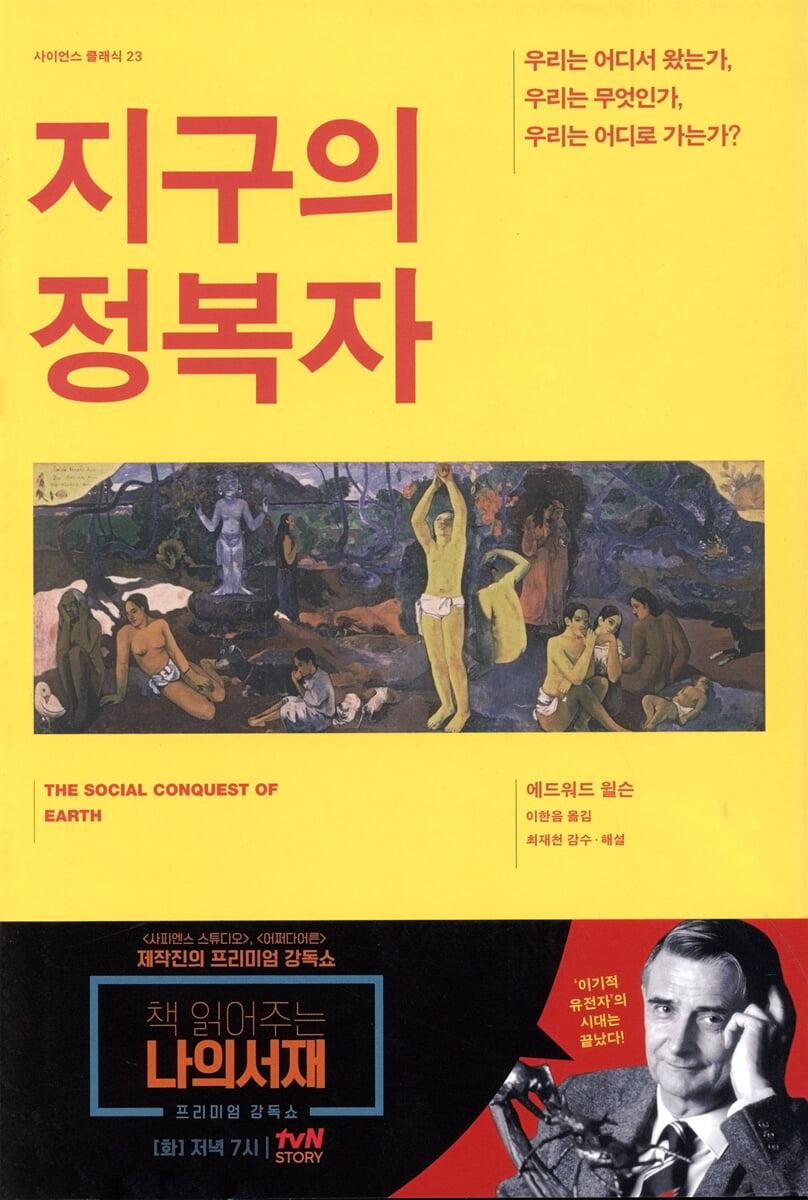
Wilson begins the book with the questions, “Where do we come from, what are we, where are we going?”
This is what the great painter Paul Gauguin wrote instead of the title of his huge painting of Tahitian landscapes and people painted in 1897.
On the other hand, it is argued that only by basing ourselves on a scientific perspective can we obtain a feasible way to solve the riddles of the human condition.
It reconstructs the true story of human creation, the steps that humanity had to take to acquire sociality and build civilization, from a broader, more comprehensive perspective that no thinker, prophet, or religious figure could ever tell.
By comparing and analyzing the evolutionary history of humans with that of social insects like ants, which, like humans, used their sociality as a weapon to conquer the Earth some 60 million years ago, it provides us with a clear explanation of the origins of the human condition that we have never seen or heard before.
It meticulously examines the question of why ants became sustainable conquerors of the Earth by coexisting, living together, and coevolving with other creatures, while humans became unsustainable conquerors who destroyed the very life on Earth where we were born and must live.
This book reconstructs the history of social life, from the microscopic replicators smaller than dust to the expansion of the entire Earth and space, from the perspective of 'group selection theory.'
Based on evolutionary biology, it moves across anthropology, psychology, linguistics, and brain science to uncover the origins of morality, religion, philosophy, art, and science, which form the foundation of human civilization.
Wilson begins the book with the questions, “Where do we come from, what are we, where are we going?”
This is what the great painter Paul Gauguin wrote instead of the title of his huge painting of Tahitian landscapes and people painted in 1897.
On the other hand, it is argued that only by basing ourselves on a scientific perspective can we obtain a feasible way to solve the riddles of the human condition.
It reconstructs the true story of human creation, the steps that humanity had to take to acquire sociality and build civilization, from a broader, more comprehensive perspective that no thinker, prophet, or religious figure could ever tell.
By comparing and analyzing the evolutionary history of humans with that of social insects like ants, which, like humans, used their sociality as a weapon to conquer the Earth some 60 million years ago, it provides us with a clear explanation of the origins of the human condition that we have never seen or heard before.
It meticulously examines the question of why ants became sustainable conquerors of the Earth by coexisting, living together, and coevolving with other creatures, while humans became unsustainable conquerors who destroyed the very life on Earth where we were born and must live.
- You can preview some of the book's contents.
Preview
index
Introductory remarks in front of Gauguin's painting
Part 1: The Mystery of 'Sociality'
Chapter 1: The Human Condition
Part 2: Where Do We Come From?
Chapter 2 Two Paths to Conquest
Chapter 3: Corners of the Evolutionary Maze
Chapter 4: A Leaping Ground
Chapter 5: Navigating the Evolution Maze
Chapter 6: The Driving Force of Social Evolution 0
Chapter 7: Tribalism Inscribed in Human Nature
Chapter 8: War, the Inherited Curse
Chapter 9: Escape
Chapter 10: An Explosion of Creativity
Chapter 11: The Race Against Civilization
Part 3: The Conquest of the Invertebrate Kingdom by Social Insects
Chapter 12: The Invention of Sociality
Chapter 13: Inventions That Evolved Social Insects
Part 4: The Power of Social Evolution
Chapter 14: The Scarcity Dilemma of Eusociality
Chapter 15: Altruism and Eusociality in Insects Discovered
Chapter 16: The Great Leap of Insects
Chapter 17: How Natural Selection Evolved Social Instincts
Chapter 18: The Power of Social Evolution
Chapter 19: A New Theory of Eusociality
Part 5: What Are We?
Chapter 20: Human Nature
Chapter 21: The Threshold of Culture
Chapter 22: The Origin of Language
Chapter 23: The Evolution of Cultural Differences
Chapter 24: The Origin of Morality and Honor
Chapter 25: The Origins of Religion
Chapter 26: The Origins of Creative Art
Part 6: Where Are We Going?
Chapter 27: The New Enlightenment
Acknowledgements
After Moving: Facing the Flow of Time (Lee Han-eum)
Commentary: Edward Wilson (Choi Jae-cheon), the Conqueror of Academics
References / Copyright / Index
Part 1: The Mystery of 'Sociality'
Chapter 1: The Human Condition
Part 2: Where Do We Come From?
Chapter 2 Two Paths to Conquest
Chapter 3: Corners of the Evolutionary Maze
Chapter 4: A Leaping Ground
Chapter 5: Navigating the Evolution Maze
Chapter 6: The Driving Force of Social Evolution 0
Chapter 7: Tribalism Inscribed in Human Nature
Chapter 8: War, the Inherited Curse
Chapter 9: Escape
Chapter 10: An Explosion of Creativity
Chapter 11: The Race Against Civilization
Part 3: The Conquest of the Invertebrate Kingdom by Social Insects
Chapter 12: The Invention of Sociality
Chapter 13: Inventions That Evolved Social Insects
Part 4: The Power of Social Evolution
Chapter 14: The Scarcity Dilemma of Eusociality
Chapter 15: Altruism and Eusociality in Insects Discovered
Chapter 16: The Great Leap of Insects
Chapter 17: How Natural Selection Evolved Social Instincts
Chapter 18: The Power of Social Evolution
Chapter 19: A New Theory of Eusociality
Part 5: What Are We?
Chapter 20: Human Nature
Chapter 21: The Threshold of Culture
Chapter 22: The Origin of Language
Chapter 23: The Evolution of Cultural Differences
Chapter 24: The Origin of Morality and Honor
Chapter 25: The Origins of Religion
Chapter 26: The Origins of Creative Art
Part 6: Where Are We Going?
Chapter 27: The New Enlightenment
Acknowledgements
After Moving: Facing the Flow of Time (Lee Han-eum)
Commentary: Edward Wilson (Choi Jae-cheon), the Conqueror of Academics
References / Copyright / Index
Publisher's Review
The era of selfish genes is over!
The latest work by Edward Wilson, the scientist of integration
Religion, war, sports, and altruistic group selection
It made us humans, conquerors of the Earth!
『The Conquerors of the Earth』 is a masterpiece that records and analyzes the epic story of our species, which emerged only a few hundred thousand years ago and has spread across the globe over the past 60,000 years, developing agriculture, forming highly organized societies, and developing a unique language-based culture to conquer the Earth.
The depth and scope of thought, as befitting the work of Edward Wilson, who advocated for integration, transcends the boundaries of almost all the disciplines we deal with.
Wilson, as I have observed, is not a person with a keen ability for instantaneous analysis.
But the ability to sit quietly and alone, to look at a given problem from multiple angles and to synthesize perspectives from various disciplines is, as far as I know, unparalleled.
There are actually many different types of geniuses in the world.
He is, as he preaches, the epitome of a comprehensive talent.
This book is a masterpiece by one of the greatest living scholars, reaching the pinnacle of his scholarly journey.
It's a book you'll read and read and read until it's worn out.
- Choi Jae-cheon (Director of the National Institute of Ecology, translator of "Tongseop")
Edward Osborne Wilson was always a warrior.
Whether he published "Sociobiology" or "Consilience," he always sparked debates that swept not only the natural sciences but also the humanities and social sciences, and even the religious world, and through these debates, he irreversibly advanced the world's intellectual society.
We no longer think of the mind as a blank slate, nor do we unilaterally believe that humans are the lords of creation, qualitatively different from other creatures.
We have come to realize that we cannot understand anything without a comprehensive understanding of the "human nature" engraved in our humanity by the history of the universe and the evolution of life, encompassing not only the humanities and social sciences and the arts, but also the natural sciences.
Wilson played a huge role in bringing us to this new stage in the history of intelligence.
In his latest work, The Social Conquest of Earth, published by Science Books, Wilson poses a new challenge (perhaps a new spark) to us.
This book reconstructs the history of social life, from its origins as microscopic replicators smaller than dust to its expansion into space, from the perspective of group selection theory.
Based on evolutionary biology, it moves across anthropology, psychology, linguistics, and brain science to uncover the origins of morality, religion, philosophy, art, and science, which form the foundation of human civilization.
It comprehensively explains the history of conquest by social creatures that conquered the Earth.
This is literally a landmark book in the history of evolutionary biology, and it is the culmination of his comprehensive and legendary career as a founder of sociobiology and two-time Pulitzer Prize winner.
Wilson begins the book with the question, “Where do we come from, what are we, where are we going?”
This is what the great painter Paul Gauguin wrote instead of the title of his huge painting of Tahitian landscapes and people painted in 1897.
(This painting is now in the Boston Museum of Fine Arts in Boston, where Edward Wilson lives.) And these are fundamental questions that have preoccupied religious, philosophical, and natural thinkers for thousands of years.
Gauguin painted this picture and decided to commit suicide.
(It ends in an attempt.) Edward Wilson introduces this story of Gauguin at the beginning of the book, pointing out that no philosopher, priest, or thinker has been able to give a satisfactory answer to the question Gauguin raised through his life and paintings.
Rather, he coldly describes how religion, philosophy, and ideology have only proven their ignorance and incompetence.
Wilson argues that only by basing our approach on a scientific perspective can we find a feasible way to solve the puzzle of the human condition.
Edward Wilson said, “The origin of modern humans was a fluke.
“It was a stroke of luck that, while somewhat good for our species, would have permanently bad consequences for the vast majority of other creatures.”
Wilson traces the history of that australopithecus, the first hominids, through the emergence of modern humans, Homo sapiens, who spread across the globe, built civilizations, and achieved the tremendous creative achievements that Wilson describes as “the Creative Explosion.”
It reconstructs the true story of human creation, the steps that humanity had to take to acquire sociality and build civilization, from a broader, more comprehensive perspective that no thinker, prophet, or religious figure could ever tell.
By comparing and analyzing the evolutionary history of humans with that of social insects like ants, which, like humans, used their sociality as a weapon to conquer the Earth some 60 million years ago, it provides us with a clear explanation of the origins of the human condition that we have never seen or heard before.
This book meticulously examines the question: why did ants coexist, co-exist, and co-evolve with other creatures to become sustainable conquerors of the Earth, while humans have become unsustainable conquerors, destroying the very life they were born with and will continue to live on?
This fundamentally shakes the old worldview that confines the history of human civilization to the small tribal categories of nation, race, or humanity.
In other words, the human condition is a uniquely human confusion rooted in the processes of shaping us.
In our nature, the worst and the best coexist and will always remain so.
Even if it were possible to wipe out the worst, we would become less than human.
- Page 76
Beyond the selfish gene and kin selection theory!
A new evolutionary science and revolutionary worldview presented by Edward Wilson, the founder of sociobiology.
This existing paradigm of social evolution became increasingly fragile over the past 40 years and ultimately failed.
From kin selection as a process, to Hamilton's inequality as a condition for cooperation, to inclusive fitness as a description of the Darwinian status of colony members, this line of reasoning doesn't work well.
If kin selection does indeed occur in animals, it is clearly a weak form of selection that occurs only under special conditions that can easily be changed.
The concept of inclusive fitness is merely a mathematical illusion that cannot have any realistic or concrete biological meaning.
Moreover, it cannot be used to trace the evolutionary dynamics of social systems with a genetic basis.
- Page 224
Wilson goes one step further in his tale of conquering two Earths.
Edward Wilson, an aging biologist who can hardly be called a veteran anymore, carries out a powerful provocation across the entire spectrum of modern knowledge society, from the humanities to the natural sciences, with a passion that rivals that of any young scientist or philosopher.
In particular, it raises a flag against the 'kin selection theory', which is the mainstream theory in modern evolutionary biology.
Wilson points out and criticizes the theory of kin selection, which he once supported and contributed most to popularizing, and its extension, the theory of the "selfish gene," as having fatal limitations in explaining the evolution of social organisms, the evolution of altruism, and the evolution of cooperation, based on empirical evidence collected from laboratory and field surveys and mathematical theories developed by mathematicians and economists.
As an alternative, we propose a multilevel selection theory in which group selection and individual selection interact.
Wilson is a professor of mathematics at Harvard University, Martin A.
Nowak, author of "Supercooperators," refined the new theory of multilevel selection, and published it in Nature in 2010, causing a huge stir in the world of evolutionary biology.
Wilson wrote this book amidst a barrage of criticism from evolutionary biologists around the world following the publication of his paper.
Wilson details a new theory of eusocial evolution, traversing the division of labor of social insects, from his and Nowak's ants and termites to humans, and even human tribal aggression and altruistic self-sacrifice.
Kin selection theory and selfish gene theory are criticized for failing to explain the social evolution of ants, which consist of a queen ant and worker ants that are robots that are an extension of the queen ant's genotype, or the dynamics of the evolution of human society, which requires subordinating individuals with selfish instincts to the group's goals.
It is not kin selection, but multilevel selection that intertwines group selection and individual selection that has created human genes into genetic chimeras (synthetic animals in Greek mythology) that combine selfish and altruistic genes, and that humans are destined to live in an antagonism (??) between selfish and altruistic instincts engraved at the genetic level.
Through this book, Wilson declares that the era of the 'selfish gene' that has dominated evolutionary biology for the past 40 years is over.
The 'sociality' created by the interaction of group selection and individual selection was the revolutionary force that made humankind's conquest of the Earth possible.
This book ignites a debate that divides the global evolutionary biology community into proponents of kin selection and proponents of group selection. The front lines of science are now ablaze with a new debate, following the debates sparked by 'sociobiology' and 'consilience.'
Through this book, readers will be able to enjoy the intellectual thrill of participating in debates between the world's leading scholars.
But Edward Wilson and this book do not stop at introducing the theoretical cutting edge of modern biology.
Wilson traces the traces of social evolution throughout human culture.
It introduces the influence of genes engraved in human nature, as seen in incest avoidance and color names, and tells the story of the development of human intelligence based on the latest cognitive archaeological research findings on Neanderthals and Homo sapiens, and explains how the mechanism of gene-culture coevolution creates linguistic and cultural diversity.
It also explains how religion, morality, and honor originated through gene-culture coevolution and multilevel selection.
It is about elucidating where we came from and what we are, with the power of a new theory of eusocial evolution.
What was the driving force that pushed us to the threshold of a complex culture? It was likely group selection.
A group whose members could read each other's intentions, cooperate, and predict the actions of competing groups would have a tremendous advantage over a less capable group.
There would certainly have been competition between group members, and that competition would have led to natural selection of traits that gave one individual an advantage over another.
But for a species venturing into new environments and competing with powerful rivals, what was more important was unity and cooperation within the group.
In other words, morality, obedience to leaders, religious fervor, and fighting prowess, combined with imagination and memory, produced winners.
- Page 273
From insights into the biological origins of the human condition
Bringing together comprehensive wisdom for a sustainable future for humanity!
We had neither the means nor the ability to foresee the consequences of our early success.
We continue to reproduce and consume, blindly obeying instincts inherited from our Paleolithic ancestors, who were simply trapped in a poorer and more barbaric environment.
- Page 100
Are humans inherently good, corrupted by the forces of evil? Or are humans inherently evil, and only the forces of good can save them? Humans possess both.
And it will be that way forever unless we change our genes.
The human dilemma was predestined by the way our species evolved and therefore became an unchangeable part of human nature.
Humanity and its social order are inherently imperfect, and fortunately so.
In a world of constant change, we need the flexibility that only imperfection can provide.
- Page 295
So where do we go from here? Wilson sees humanity's current predicament as dire.
Wilson, a long-time ecologist who has long advocated for the protection of biodiversity, warns that unlike ants, another conqueror of the Earth, humans are destroying the very life on which they were born and in which they live.
If we continue this way, “we are turning the gold we inherited from our ancestors into useless junk, and for that we will be despised by our descendants.” As our human race advances in conquering the Earth, the Earth will rush towards the point of extinction, faster than we have rushed towards civilization.
To understand where the destruction of modern ecosystems and the crisis of biodiversity came from and to stop it, we had to take a close look at the history of social organisms' conquest of the Earth.
Wilson is convinced that if we have “a simple ethic of courtesy to one another, an intellectual attitude of ruthless application of reason, and a readiness to accept ourselves for what we truly are,” and thus come to understand the true nature of our human condition, we will find solutions to our problems.
Wilson concludes his book by answering Gauguin's question:
So, Gauguin, why did you put that inscription on your painting? Of course, I have an answer.
Just in case anyone missed the point, I wanted to clarify what the various human activities depicted in the Tahitian landscape symbolize.
But I feel there was something more to it.
Perhaps you wrote the three questions in that way to say that there are no answers in the civilized world you rejected and left behind, nor in the primitive world you chose to find peace.
Or perhaps you meant that art can't go any further than you've gone.
After all your hard work, isn't there nothing you can do personally but write down those thorny questions?
But let me give you another reason why you left us with that riddle.
This does not necessarily conflict with the other conjectures just mentioned.
I see the words you wrote as a cry of victory.
You've lived a passionate life, traveling far and wide, discovering and embracing new forms of visual art, asking those questions in new ways, and creating truly original work from it all.
In that sense, you have lived a great life.
It was never in vain.
We are now getting closer to the answer you seek by integrating rational analysis and the arts, and by equally combining science and the humanities.
- Pages 363-364
From “very simple beginnings” to “Star Wars civilizations,” life has evolved.
What will the future hold? Without a comprehensive wisdom that combines the knowledge gained through science, the humanities, the social sciences, and the arts, we will not be able to overcome the current crisis.
The conquerors of the Earth will walk the path to destruction the moment they complete their conquest.
Now it is time to listen to the voice of comprehensive wisdom from Darwin's living apostle.
The latest work by Edward Wilson, the scientist of integration
Religion, war, sports, and altruistic group selection
It made us humans, conquerors of the Earth!
『The Conquerors of the Earth』 is a masterpiece that records and analyzes the epic story of our species, which emerged only a few hundred thousand years ago and has spread across the globe over the past 60,000 years, developing agriculture, forming highly organized societies, and developing a unique language-based culture to conquer the Earth.
The depth and scope of thought, as befitting the work of Edward Wilson, who advocated for integration, transcends the boundaries of almost all the disciplines we deal with.
Wilson, as I have observed, is not a person with a keen ability for instantaneous analysis.
But the ability to sit quietly and alone, to look at a given problem from multiple angles and to synthesize perspectives from various disciplines is, as far as I know, unparalleled.
There are actually many different types of geniuses in the world.
He is, as he preaches, the epitome of a comprehensive talent.
This book is a masterpiece by one of the greatest living scholars, reaching the pinnacle of his scholarly journey.
It's a book you'll read and read and read until it's worn out.
- Choi Jae-cheon (Director of the National Institute of Ecology, translator of "Tongseop")
Edward Osborne Wilson was always a warrior.
Whether he published "Sociobiology" or "Consilience," he always sparked debates that swept not only the natural sciences but also the humanities and social sciences, and even the religious world, and through these debates, he irreversibly advanced the world's intellectual society.
We no longer think of the mind as a blank slate, nor do we unilaterally believe that humans are the lords of creation, qualitatively different from other creatures.
We have come to realize that we cannot understand anything without a comprehensive understanding of the "human nature" engraved in our humanity by the history of the universe and the evolution of life, encompassing not only the humanities and social sciences and the arts, but also the natural sciences.
Wilson played a huge role in bringing us to this new stage in the history of intelligence.
In his latest work, The Social Conquest of Earth, published by Science Books, Wilson poses a new challenge (perhaps a new spark) to us.
This book reconstructs the history of social life, from its origins as microscopic replicators smaller than dust to its expansion into space, from the perspective of group selection theory.
Based on evolutionary biology, it moves across anthropology, psychology, linguistics, and brain science to uncover the origins of morality, religion, philosophy, art, and science, which form the foundation of human civilization.
It comprehensively explains the history of conquest by social creatures that conquered the Earth.
This is literally a landmark book in the history of evolutionary biology, and it is the culmination of his comprehensive and legendary career as a founder of sociobiology and two-time Pulitzer Prize winner.
Wilson begins the book with the question, “Where do we come from, what are we, where are we going?”
This is what the great painter Paul Gauguin wrote instead of the title of his huge painting of Tahitian landscapes and people painted in 1897.
(This painting is now in the Boston Museum of Fine Arts in Boston, where Edward Wilson lives.) And these are fundamental questions that have preoccupied religious, philosophical, and natural thinkers for thousands of years.
Gauguin painted this picture and decided to commit suicide.
(It ends in an attempt.) Edward Wilson introduces this story of Gauguin at the beginning of the book, pointing out that no philosopher, priest, or thinker has been able to give a satisfactory answer to the question Gauguin raised through his life and paintings.
Rather, he coldly describes how religion, philosophy, and ideology have only proven their ignorance and incompetence.
Wilson argues that only by basing our approach on a scientific perspective can we find a feasible way to solve the puzzle of the human condition.
Edward Wilson said, “The origin of modern humans was a fluke.
“It was a stroke of luck that, while somewhat good for our species, would have permanently bad consequences for the vast majority of other creatures.”
Wilson traces the history of that australopithecus, the first hominids, through the emergence of modern humans, Homo sapiens, who spread across the globe, built civilizations, and achieved the tremendous creative achievements that Wilson describes as “the Creative Explosion.”
It reconstructs the true story of human creation, the steps that humanity had to take to acquire sociality and build civilization, from a broader, more comprehensive perspective that no thinker, prophet, or religious figure could ever tell.
By comparing and analyzing the evolutionary history of humans with that of social insects like ants, which, like humans, used their sociality as a weapon to conquer the Earth some 60 million years ago, it provides us with a clear explanation of the origins of the human condition that we have never seen or heard before.
This book meticulously examines the question: why did ants coexist, co-exist, and co-evolve with other creatures to become sustainable conquerors of the Earth, while humans have become unsustainable conquerors, destroying the very life they were born with and will continue to live on?
This fundamentally shakes the old worldview that confines the history of human civilization to the small tribal categories of nation, race, or humanity.
In other words, the human condition is a uniquely human confusion rooted in the processes of shaping us.
In our nature, the worst and the best coexist and will always remain so.
Even if it were possible to wipe out the worst, we would become less than human.
- Page 76
Beyond the selfish gene and kin selection theory!
A new evolutionary science and revolutionary worldview presented by Edward Wilson, the founder of sociobiology.
This existing paradigm of social evolution became increasingly fragile over the past 40 years and ultimately failed.
From kin selection as a process, to Hamilton's inequality as a condition for cooperation, to inclusive fitness as a description of the Darwinian status of colony members, this line of reasoning doesn't work well.
If kin selection does indeed occur in animals, it is clearly a weak form of selection that occurs only under special conditions that can easily be changed.
The concept of inclusive fitness is merely a mathematical illusion that cannot have any realistic or concrete biological meaning.
Moreover, it cannot be used to trace the evolutionary dynamics of social systems with a genetic basis.
- Page 224
Wilson goes one step further in his tale of conquering two Earths.
Edward Wilson, an aging biologist who can hardly be called a veteran anymore, carries out a powerful provocation across the entire spectrum of modern knowledge society, from the humanities to the natural sciences, with a passion that rivals that of any young scientist or philosopher.
In particular, it raises a flag against the 'kin selection theory', which is the mainstream theory in modern evolutionary biology.
Wilson points out and criticizes the theory of kin selection, which he once supported and contributed most to popularizing, and its extension, the theory of the "selfish gene," as having fatal limitations in explaining the evolution of social organisms, the evolution of altruism, and the evolution of cooperation, based on empirical evidence collected from laboratory and field surveys and mathematical theories developed by mathematicians and economists.
As an alternative, we propose a multilevel selection theory in which group selection and individual selection interact.
Wilson is a professor of mathematics at Harvard University, Martin A.
Nowak, author of "Supercooperators," refined the new theory of multilevel selection, and published it in Nature in 2010, causing a huge stir in the world of evolutionary biology.
Wilson wrote this book amidst a barrage of criticism from evolutionary biologists around the world following the publication of his paper.
Wilson details a new theory of eusocial evolution, traversing the division of labor of social insects, from his and Nowak's ants and termites to humans, and even human tribal aggression and altruistic self-sacrifice.
Kin selection theory and selfish gene theory are criticized for failing to explain the social evolution of ants, which consist of a queen ant and worker ants that are robots that are an extension of the queen ant's genotype, or the dynamics of the evolution of human society, which requires subordinating individuals with selfish instincts to the group's goals.
It is not kin selection, but multilevel selection that intertwines group selection and individual selection that has created human genes into genetic chimeras (synthetic animals in Greek mythology) that combine selfish and altruistic genes, and that humans are destined to live in an antagonism (??) between selfish and altruistic instincts engraved at the genetic level.
Through this book, Wilson declares that the era of the 'selfish gene' that has dominated evolutionary biology for the past 40 years is over.
The 'sociality' created by the interaction of group selection and individual selection was the revolutionary force that made humankind's conquest of the Earth possible.
This book ignites a debate that divides the global evolutionary biology community into proponents of kin selection and proponents of group selection. The front lines of science are now ablaze with a new debate, following the debates sparked by 'sociobiology' and 'consilience.'
Through this book, readers will be able to enjoy the intellectual thrill of participating in debates between the world's leading scholars.
But Edward Wilson and this book do not stop at introducing the theoretical cutting edge of modern biology.
Wilson traces the traces of social evolution throughout human culture.
It introduces the influence of genes engraved in human nature, as seen in incest avoidance and color names, and tells the story of the development of human intelligence based on the latest cognitive archaeological research findings on Neanderthals and Homo sapiens, and explains how the mechanism of gene-culture coevolution creates linguistic and cultural diversity.
It also explains how religion, morality, and honor originated through gene-culture coevolution and multilevel selection.
It is about elucidating where we came from and what we are, with the power of a new theory of eusocial evolution.
What was the driving force that pushed us to the threshold of a complex culture? It was likely group selection.
A group whose members could read each other's intentions, cooperate, and predict the actions of competing groups would have a tremendous advantage over a less capable group.
There would certainly have been competition between group members, and that competition would have led to natural selection of traits that gave one individual an advantage over another.
But for a species venturing into new environments and competing with powerful rivals, what was more important was unity and cooperation within the group.
In other words, morality, obedience to leaders, religious fervor, and fighting prowess, combined with imagination and memory, produced winners.
- Page 273
From insights into the biological origins of the human condition
Bringing together comprehensive wisdom for a sustainable future for humanity!
We had neither the means nor the ability to foresee the consequences of our early success.
We continue to reproduce and consume, blindly obeying instincts inherited from our Paleolithic ancestors, who were simply trapped in a poorer and more barbaric environment.
- Page 100
Are humans inherently good, corrupted by the forces of evil? Or are humans inherently evil, and only the forces of good can save them? Humans possess both.
And it will be that way forever unless we change our genes.
The human dilemma was predestined by the way our species evolved and therefore became an unchangeable part of human nature.
Humanity and its social order are inherently imperfect, and fortunately so.
In a world of constant change, we need the flexibility that only imperfection can provide.
- Page 295
So where do we go from here? Wilson sees humanity's current predicament as dire.
Wilson, a long-time ecologist who has long advocated for the protection of biodiversity, warns that unlike ants, another conqueror of the Earth, humans are destroying the very life on which they were born and in which they live.
If we continue this way, “we are turning the gold we inherited from our ancestors into useless junk, and for that we will be despised by our descendants.” As our human race advances in conquering the Earth, the Earth will rush towards the point of extinction, faster than we have rushed towards civilization.
To understand where the destruction of modern ecosystems and the crisis of biodiversity came from and to stop it, we had to take a close look at the history of social organisms' conquest of the Earth.
Wilson is convinced that if we have “a simple ethic of courtesy to one another, an intellectual attitude of ruthless application of reason, and a readiness to accept ourselves for what we truly are,” and thus come to understand the true nature of our human condition, we will find solutions to our problems.
Wilson concludes his book by answering Gauguin's question:
So, Gauguin, why did you put that inscription on your painting? Of course, I have an answer.
Just in case anyone missed the point, I wanted to clarify what the various human activities depicted in the Tahitian landscape symbolize.
But I feel there was something more to it.
Perhaps you wrote the three questions in that way to say that there are no answers in the civilized world you rejected and left behind, nor in the primitive world you chose to find peace.
Or perhaps you meant that art can't go any further than you've gone.
After all your hard work, isn't there nothing you can do personally but write down those thorny questions?
But let me give you another reason why you left us with that riddle.
This does not necessarily conflict with the other conjectures just mentioned.
I see the words you wrote as a cry of victory.
You've lived a passionate life, traveling far and wide, discovering and embracing new forms of visual art, asking those questions in new ways, and creating truly original work from it all.
In that sense, you have lived a great life.
It was never in vain.
We are now getting closer to the answer you seek by integrating rational analysis and the arts, and by equally combining science and the humanities.
- Pages 363-364
From “very simple beginnings” to “Star Wars civilizations,” life has evolved.
What will the future hold? Without a comprehensive wisdom that combines the knowledge gained through science, the humanities, the social sciences, and the arts, we will not be able to overcome the current crisis.
The conquerors of the Earth will walk the path to destruction the moment they complete their conquest.
Now it is time to listen to the voice of comprehensive wisdom from Darwin's living apostle.
GOODS SPECIFICS
- Date of publication: November 14, 2013
- Format: Hardcover book binding method guide
- Page count, weight, size: 416 pages | 734g | 152*224*30mm
- ISBN13: 9788983716200
- ISBN10: 8983716207
You may also like
카테고리
korean


korean

![GQ KOREA Mark (Monthly): December [2025]](http://librairie.coreenne.fr/cdn/shop/files/8ef265dbbfbf186523ed75ba7319009d.jpg?v=1765340328&width=3840)


