

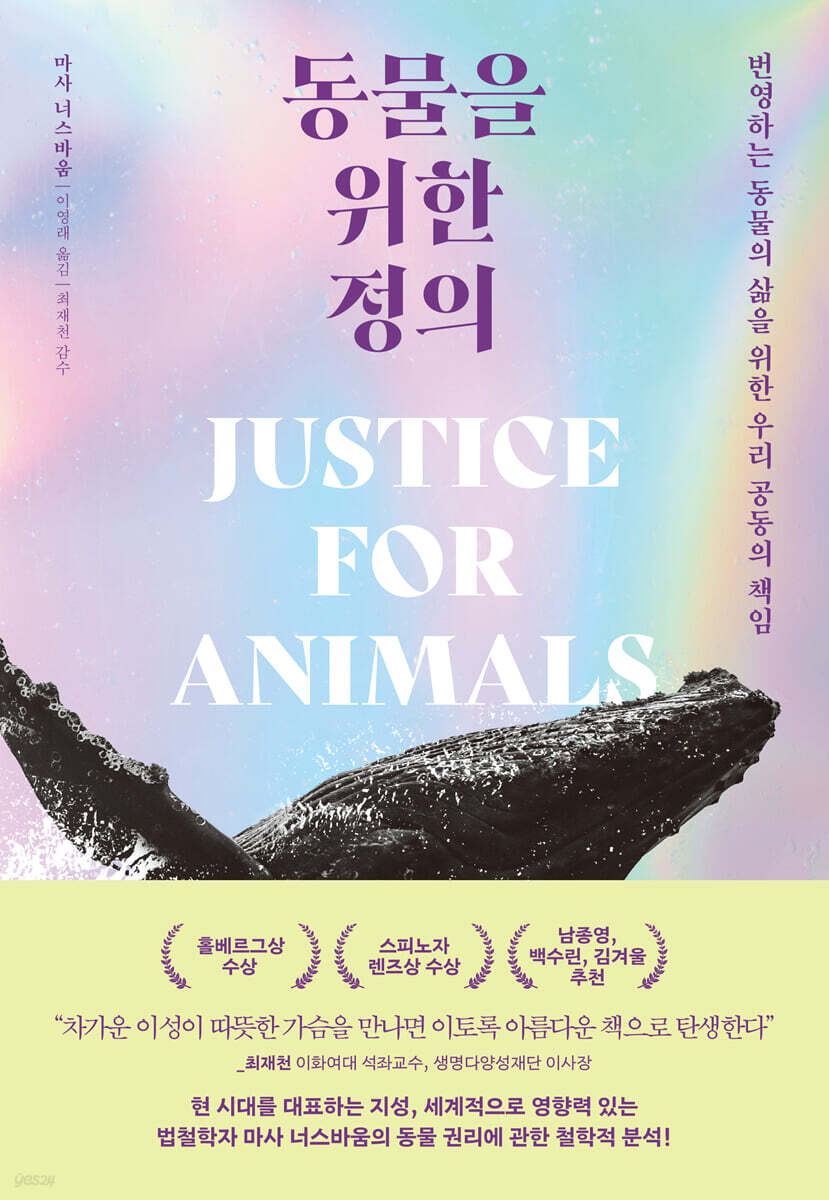
Justice for Animals
 |
Description
Book Introduction
Professor Choi Jae-cheon: "When cold reason meets warm heart, such a beautiful book is born." Strongly recommended by Nam Jong-young, Baek Su-rin, and Kim Gyul-wool Holberg Prize, awarded to the best philosopher and thinker Winner of the 2022 International Spinoza Lens Prize Local media outlets, including [Kirkus], [Publisher's Weekly], and [Science], have praised the book. A representative intellectual of the present age, a globally influential person A Philosophical Analysis of Animal Rights by Legal Philosopher Martha Nussbaum -All animals deserve respect! Martha Nussbaum, a world-renowned legal philosopher and one of America's leading intellectuals, has now written a book on animal rights. The author, who has written numerous papers and books on a wide range of topics, including Greek and Roman philosophy, existential philosophy, political philosophy, and feminism, was led to the lives of animals by his late daughter. The author's daughter, Rachel Nussbaum, dedicated her life to improving the lives of abused and suffering creatures as an attorney for the animal legal organization Friends of Animals, but died at the young age of 47 from a drug-resistant fungal infection following an organ transplant. Justice for Animals is a constructive mourning born from a deep affection for his deceased daughter, and a product of his love for all animals on earth. In a world where animals are dying from hunger, terrorism, poverty, and disease, many people will likely view the unjust harm and suffering of other animals negatively, as well as the significant time and money spent caring for them. The author argues that human interests should never be given absolute priority, and that all living things are equally important. Most of the threats to human life from poverty and disease today are due to the absence of effective government institutions, not to “natural” limits on Earth’s capacity. We can and must envision and work toward a multi-species world where all species have the opportunity to thrive. Furthermore, we must remember that an ethical attunement to animal life and a sense of wonder at their complexity and dignity are part of our humanity, without which human life itself would be impoverished. It's easy to assume that humans only violate animal rights or are responsible for the obvious harms, such as animal abuse and neglect, slaughter in horrific conditions, poaching, hunting, and whaling, or for less direct but clearly human-caused harms, such as plastic in the ocean, interference with sonar, shipping, and oil spills. They feel no responsibility for other damages that appear to be caused by “nature,” such as drought, famine, or the loss of traditional foraging grounds (like the ice packs that polar bears must use to migrate across the ocean for survival). The author argues that rather than feeling guilty, we should accept that humanity has a shared responsibility to face these problems and solve them. The author, a philosopher and political theorist deeply involved in law and legal education, seeks to change the situation by providing a philosophical theory that can provide appropriate legal advice based on an accurate view of animal life. Laws are created based on the theories held by humans. If the theory was racist, so was the law; if it was sexist, so was the law. Most human political thinking worldwide is anthropocentric and animal-exclusive. Even theories that claim to help fight against injustice today are deeply flawed, based on inadequate perspectives that do not ground animal life. Flawed theories tend to give flawed advice. This book examines the flaws in three theories currently supporting animal justice and rights in law and philosophy, then argues why a new theory is needed to guide politics and law, and proposes a new theory for thinking about justice and injustice for animals: the capabilities approach. |
- You can preview some of the book's contents.
Preview
index
A Recommendation: Compassion for the miserable lives of animals, and the "transformational anger" needed to rectify such situations.
Entering
Chapter 1: Cruelty and Neglect: Injustice in Animal Lives
Chapter 2: Nature's Ladder and the "So Similar to Us" Approach
Chapter 3: Utilitarians: Pleasure and Pain
Chapter 4: Christine Korsgaard's Kantian Approach
Chapter 5: The Competency Approach: Respect for Lifeforms and Coexistence
Chapter 6: Sensitivity to Pleasure and Pursuit of Goals: Scope
Chapter 7: The Harm of Death
Chapter 8: Tragic Conflicts and How to Move Beyond Them
Chapter 9: Animals that live with us
Chapter 10: “Wildness” and Human Responsibility
Chapter 11: The Power of Friendship
Chapter 12 The Role of Law
Conclusion: Embrace a sense of wonder and respect for differences, rather than a “because they’re too similar to us” approach.
Acknowledgements
References | Notes | Index
Entering
Chapter 1: Cruelty and Neglect: Injustice in Animal Lives
Chapter 2: Nature's Ladder and the "So Similar to Us" Approach
Chapter 3: Utilitarians: Pleasure and Pain
Chapter 4: Christine Korsgaard's Kantian Approach
Chapter 5: The Competency Approach: Respect for Lifeforms and Coexistence
Chapter 6: Sensitivity to Pleasure and Pursuit of Goals: Scope
Chapter 7: The Harm of Death
Chapter 8: Tragic Conflicts and How to Move Beyond Them
Chapter 9: Animals that live with us
Chapter 10: “Wildness” and Human Responsibility
Chapter 11: The Power of Friendship
Chapter 12 The Role of Law
Conclusion: Embrace a sense of wonder and respect for differences, rather than a “because they’re too similar to us” approach.
Acknowledgements
References | Notes | Index
Detailed image
.jpg)
Into the book
Now, let's imagine this Hal.
He was found dead washed up on a beach in the Philippines.
The once healthy body is now gaunt.
Researchers found 88 pounds (about 39.9 kilograms) of plastic bags, cups and other single-use plastic waste inside his body.
(A pair of slippers was also found among the debris from another whale that had similarly choked on plastic.) Hal starved to death.
Plastic fed the whales, but did not provide them with nutrition.
In the end, there was no room for real food.
Some of the plastic in Hal's stomach was so old that it had calcified and turned into plastic bricks.
He will never sing again.
--- From "Entering"
The competency approach, unlike other popular approaches, does not rank animals by their similarity to humans, nor does it seek to privilege those animals deemed “most like us.”
The competency approach is as interested in finches and pigs as it is in whales and elephants.
The capabilities approach argues that the human form of life has nothing to do with thinking about what each type of animal needs and deserves.
What is meaningful is their own way of life.
Just as humans wish to enjoy the goodness peculiar to human life, so too do finches wish to enjoy the goodness peculiar to their lives, and whales wish to enjoy the goodness peculiar to their lives.
(The room for individual differentiation for each person is part of the life they pursue.) We must abandon the lazy attitude of portraying animals as inferior to humans by taking the same kind of life as our own as a standard, and continue to expand ourselves and learn.
According to the capabilities approach, each creature capable of hedonic sensation (having a subjective view of the world and being able to feel pain and pleasure) should have the opportunity to flourish in a life form unique to that creature.
--- From "Entering"
Some people have affectionate relationships with animals.
This kind of affection can become the starting point for a more comprehensive interest.
But basic affection alone may not be enough.
Because they only have affection for what they know and have no affection for the millions of animals they don't know.
Just as parents who raise their children with love are not motivated to work to end hunger and child sexual abuse around the world.
Is there anything else that might elicit help? What emotions have the potential to break free from the everyday background?
--- From "Chapter 1: Cruelty and Neglect"
The utilitarian approach deserves great respect for its sensitivity to animal suffering.
The utilitarian approach seems to be the exact opposite of the “too similar to us” approach I criticized earlier.
In the sense that it attacks the arrogance of the human species.
But in another sense, both approaches share flaws.
Both fail to grasp the incredible diversity and inclusiveness of the animal world.
What emerges when we pay close attention is neither a “ladder” nor a single, homogeneous nature.
Instead, the enormous complexity is revealed in the interlocking activities that make up the way all animals live.
In other words, both approaches lack wonder and careful curiosity.
--- From "Chapter 3 Utilitarians"
In a world where humans starve and die from lack of medical care, can we justify spending significant time and money caring for other animals? That was the reaction of a young development professional at the Human Development and Capabilities Association when I presented part of this research.
Those who disagreed with me would have hoped that I would prioritize human interests, but I firmly believe that we should not put human interests first.
I believe that all living things are equally important.
I also argue that the dilemma is poorly posed.
Most of the threats to human life from poverty and disease today are due to the absence of effective government institutions, not to “natural” limits on Earth’s capacity.
We can and must envision and work toward a multi-species world where all species have the opportunity to thrive.
--- From "Chapter 8: Tragic Conflict and How to Overcome It"
Many people think they love their pets, but are unaware of what that special responsibility entails.
There are many animals that are malnourished.
Many, if not most, dogs are under-exercised.
Also, many pet owners think of their pets as beings that they can treat as they please, fun to play with when they feel like it, but okay to leave them alone when they are busy or not in the mood to play.
(Many people think of “pets” as living toys.) Cats often do well left alone, but dogs need interaction and affection.
There are many dogs who do not get to enjoy this to its fullest.
Additionally, many people do not do enough research on the specific type of dog or cat they are considering adopting, simply choosing a breed that looks good or is popular without considering whether their lifestyle will fit the animal's needs.
--- From "Chapter 9: Animals Living with Us"
Some say it is immoral to provide expensive medical care to pets while so many poor people are suffering.
This is an objection based on a great misconception.
Just because not all children have health insurance doesn't mean you shouldn't care for your own children's medical needs.
They are confusing special responsibility with general responsibility.
Adults who adopt a pet (or decide to have a child) have a special responsibility to provide appropriate medical care for that animal.
At the same time, we all have a general responsibility to ensure that the poor meet their special responsibilities and to enforce them when they fail to meet them.
--- From "Chapter 9: Animals Living with Us"
It's easy to think that humans are only responsible for the obvious harms, like poaching, hunting, and whaling, and the less obvious but clearly human-caused harms, like plastic in the oceans, sonar interference, shipping, and oil spills.
They feel no responsibility for other damages that appear to be caused by “nature,” such as drought, famine, and the loss of traditional foraging grounds (like the ice packs that polar bears must use to migrate across the ocean for survival).
But if we think about it a little, we can see that we cannot draw this line clearly, or perhaps we cannot draw the line itself.
Human activities are the primary cause of climate change, which causes droughts, famines, floods, and fires, destroying the habitats of many species.
Human activities pollute the atmosphere.
He was found dead washed up on a beach in the Philippines.
The once healthy body is now gaunt.
Researchers found 88 pounds (about 39.9 kilograms) of plastic bags, cups and other single-use plastic waste inside his body.
(A pair of slippers was also found among the debris from another whale that had similarly choked on plastic.) Hal starved to death.
Plastic fed the whales, but did not provide them with nutrition.
In the end, there was no room for real food.
Some of the plastic in Hal's stomach was so old that it had calcified and turned into plastic bricks.
He will never sing again.
--- From "Entering"
The competency approach, unlike other popular approaches, does not rank animals by their similarity to humans, nor does it seek to privilege those animals deemed “most like us.”
The competency approach is as interested in finches and pigs as it is in whales and elephants.
The capabilities approach argues that the human form of life has nothing to do with thinking about what each type of animal needs and deserves.
What is meaningful is their own way of life.
Just as humans wish to enjoy the goodness peculiar to human life, so too do finches wish to enjoy the goodness peculiar to their lives, and whales wish to enjoy the goodness peculiar to their lives.
(The room for individual differentiation for each person is part of the life they pursue.) We must abandon the lazy attitude of portraying animals as inferior to humans by taking the same kind of life as our own as a standard, and continue to expand ourselves and learn.
According to the capabilities approach, each creature capable of hedonic sensation (having a subjective view of the world and being able to feel pain and pleasure) should have the opportunity to flourish in a life form unique to that creature.
--- From "Entering"
Some people have affectionate relationships with animals.
This kind of affection can become the starting point for a more comprehensive interest.
But basic affection alone may not be enough.
Because they only have affection for what they know and have no affection for the millions of animals they don't know.
Just as parents who raise their children with love are not motivated to work to end hunger and child sexual abuse around the world.
Is there anything else that might elicit help? What emotions have the potential to break free from the everyday background?
--- From "Chapter 1: Cruelty and Neglect"
The utilitarian approach deserves great respect for its sensitivity to animal suffering.
The utilitarian approach seems to be the exact opposite of the “too similar to us” approach I criticized earlier.
In the sense that it attacks the arrogance of the human species.
But in another sense, both approaches share flaws.
Both fail to grasp the incredible diversity and inclusiveness of the animal world.
What emerges when we pay close attention is neither a “ladder” nor a single, homogeneous nature.
Instead, the enormous complexity is revealed in the interlocking activities that make up the way all animals live.
In other words, both approaches lack wonder and careful curiosity.
--- From "Chapter 3 Utilitarians"
In a world where humans starve and die from lack of medical care, can we justify spending significant time and money caring for other animals? That was the reaction of a young development professional at the Human Development and Capabilities Association when I presented part of this research.
Those who disagreed with me would have hoped that I would prioritize human interests, but I firmly believe that we should not put human interests first.
I believe that all living things are equally important.
I also argue that the dilemma is poorly posed.
Most of the threats to human life from poverty and disease today are due to the absence of effective government institutions, not to “natural” limits on Earth’s capacity.
We can and must envision and work toward a multi-species world where all species have the opportunity to thrive.
--- From "Chapter 8: Tragic Conflict and How to Overcome It"
Many people think they love their pets, but are unaware of what that special responsibility entails.
There are many animals that are malnourished.
Many, if not most, dogs are under-exercised.
Also, many pet owners think of their pets as beings that they can treat as they please, fun to play with when they feel like it, but okay to leave them alone when they are busy or not in the mood to play.
(Many people think of “pets” as living toys.) Cats often do well left alone, but dogs need interaction and affection.
There are many dogs who do not get to enjoy this to its fullest.
Additionally, many people do not do enough research on the specific type of dog or cat they are considering adopting, simply choosing a breed that looks good or is popular without considering whether their lifestyle will fit the animal's needs.
--- From "Chapter 9: Animals Living with Us"
Some say it is immoral to provide expensive medical care to pets while so many poor people are suffering.
This is an objection based on a great misconception.
Just because not all children have health insurance doesn't mean you shouldn't care for your own children's medical needs.
They are confusing special responsibility with general responsibility.
Adults who adopt a pet (or decide to have a child) have a special responsibility to provide appropriate medical care for that animal.
At the same time, we all have a general responsibility to ensure that the poor meet their special responsibilities and to enforce them when they fail to meet them.
--- From "Chapter 9: Animals Living with Us"
It's easy to think that humans are only responsible for the obvious harms, like poaching, hunting, and whaling, and the less obvious but clearly human-caused harms, like plastic in the oceans, sonar interference, shipping, and oil spills.
They feel no responsibility for other damages that appear to be caused by “nature,” such as drought, famine, and the loss of traditional foraging grounds (like the ice packs that polar bears must use to migrate across the ocean for survival).
But if we think about it a little, we can see that we cannot draw this line clearly, or perhaps we cannot draw the line itself.
Human activities are the primary cause of climate change, which causes droughts, famines, floods, and fires, destroying the habitats of many species.
Human activities pollute the atmosphere.
--- From Chapter 10, “Wildness” and Human Responsibility
Publisher's Review
Compassion for the miserable lives of animals and “transformational anger”
Our shared responsibility to ensure and protect the capabilities of animals
First, how can we get people interested in the philosophical argument that animals have rights? The author argues that those who have affectionate relationships with some animals can use this affection as a starting point for a broader concern for animal rights, but argues that basic affection alone is not enough.
For example, people who care about and love the panda Fubao want to learn about the panda's lifestyle and ensure that it is given dignity, social competence, curiosity, play, planning, and freedom of movement.
But he only has affection for what he knows, and has no affection for the millions of animals he does not know.
Just as parents who raise their children with love are not motivated to work to end hunger and child sexual abuse around the world.
The author attempts to awaken a sense of ethical wonder that can lead to ethical compassion and forward-looking indignation when animals' efforts are unjustly frustrated.
All of these feelings are closely linked to the capabilities approach that the author developed as a guide for the International Agency for Human Development.
The diversity, dignity, social competence, curiosity, play, planning, free movement, and opportunities to thrive of animal life forms are its core contents and are the minimum basic rights and justice of animals.
According to the author's capabilities approach, citizenship for companion animals (meaning that companion animals should have a say in policies that affect their lives) means, above all, that these companion animals are ends, not means, and that their species-specific capabilities should be developed to an appropriate standard through public policy, as specified in some basic law.
Therefore, all humans have a common duty to guarantee and protect the capacities of animals.
With this book, we are liberated from Peter Singer's Animal Liberation!
A new theoretical basis for animal rights, moving beyond anthropocentrism and viewing it from the animal's perspective.
The “So Like Us” approach, which focuses on winning protections for a limited range of animals because of their similarities to humans, is a human-centered theory that has had a significant impact on American law and policy through the work of legal scholar and activist Stephen Wise.
This theory is overly narrow and does not correspond to the heterogeneity and diversity of animal life.
Moreover, this theory is unproductive as a strategy to expand animal qualifications.
Even within the human-centered “so similar to us” approach, if we embrace a sense of wonder and respect for difference rather than viewing our similarities to humans as a source of legal and political principles, it can become part of an “overlapping consensus.”
Given that this view was originally inspired by the Christian perspective, which views all of nature as God's creation and humans as responsible stewards rather than arrogant rulers, it is reasonable to expect that progress in that direction could be made.
The most prominent approach to animal justice today is the utilitarian approach developed by the contemporary Austrian philosopher Peter Singer.
This approach, which builds on the utilitarianism of the 18th-century British philosopher Jeremy Bentham and extends the tradition of Henry Sidgwick to establish a significant utilitarian logic for animal rights, focuses solely on pain and pleasure as universal norms guiding the lives of all beings capable of experiencing pleasure.
While this approach deserves great respect for its sensitivity to pain, it also has many flaws, which, while it has many strengths, make it too numerous to serve as an adequate guide.
We need to find an approach that takes into account the entirety of animal life and the aspects of animal prosperity and deprivation.
Here we examine the Kantian approach of philosopher Christine Korsgaard, which has made great strides in respecting the dignity of animal life, but has limitations in some respects.
Korsgaard's Kantian approach contains both Kantian and Aristotelian elements.
It says that animals should be treated as ends in themselves, not as tools for human purposes; that is, they should be treated as beings who value their own purposes.
The author also agrees with Korsgaard that a good approach to animal justice requires both Aristotelian and Kantian elements.
However, it failed to properly evaluate the subjectivity of animals and the complexity of animal life.
In other words, while Korsgaard avoided most of the errors of the “too similar to us” approach described above, he ultimately tied himself to a version of that approach: the idea that animals’ value derives from their similarity to humans.
It still has the flaw of separating humans as animals from the natural world.
The competency approach, which corrects the flaws of all the above approaches, gives striving creatures a chance to thrive.
Opportunities for flourishing are not just about avoiding suffering, but also a list of positive opportunities: to enjoy health, to protect bodily integrity, to develop and exercise one's senses and imagination, to have the possibility to plan one's life, to have a variety of social relationships, to play and enjoy pleasure, to relate to other species and the natural world, and to control oneself in significant ways.
The author describes the competency approach as a virtual constitution for all non-human animals in the world.
There is no country where animals are citizens, but they should be seen as citizens, with rights the non-fulfillment of which would be unjust.
Not the “because they’re so similar to us” approach
Embracing 'wonder and respect for difference'
-We must be reborn from arrogant rulers to responsible stewards!
This book alone will not change the dire plight of animals for whom we all share a common responsibility.
But it will help awaken or strengthen the wonder, compassion, and rage (“transformational anger”) that the author talks about in this book.
Justice for Animals is a philosophical treatise that aims to explain a perspective that can direct our efforts and to show that it is superior to other theories currently in use.
There is much we can do to bring us closer to justice, and each reader must find something to investigate, something to do, and take on a small part of this vast collective responsibility.
Nussbaum argues that the fight to improve the plight of many animals and to redress abuses requires courageous activism, dedicated and resourceful legal work, organizations and dedicated members dedicated to the lives of animals, donations to these organizations, creative and rigorous scientific research, and efforts to communicate the beauty and amazing abilities of animals and their current plight to the public through journalism, film, and the visual arts.
Everyone who reads this book can find their own role in this effort, depending on their circumstances and capabilities.
I also sincerely hope that this book will move your heart in various ways—wonder, compassion, outrage, hope—so that you will make choices for justice and become a person who loves animals.
A thought-provoking guide to ethical coexistence with the Earth's diverse creatures.
_ 『Circus』
A poignant and brilliant blend of political analysis, philosophical inquiry, and call to action, this book is a must-read.
_ [Publisher's Weekly]
Here, as in her other works, Nussbaum's argument is thorough, elegantly written, and persuasive.
It is so elaborately refined that even Aristotle himself would have to be in top form to engage with the subject.
[…] is sure to become a classic in ethics.
_Matthew Scully, [National Review]
A wonderful and accessible piece of work.
[…] Every reader, not just those already committed to animal rights, should read Nussbaum’s book.”
_ [Chicago Review of Books]
Nussbaum's writing is lively, direct, and full of stories and anecdotes.
This book is entertaining and constructive.
[…] The virtue of this book is that the author’s mind is so clearly revealed.
_ Dale Jamieson, [Science]
Our shared responsibility to ensure and protect the capabilities of animals
First, how can we get people interested in the philosophical argument that animals have rights? The author argues that those who have affectionate relationships with some animals can use this affection as a starting point for a broader concern for animal rights, but argues that basic affection alone is not enough.
For example, people who care about and love the panda Fubao want to learn about the panda's lifestyle and ensure that it is given dignity, social competence, curiosity, play, planning, and freedom of movement.
But he only has affection for what he knows, and has no affection for the millions of animals he does not know.
Just as parents who raise their children with love are not motivated to work to end hunger and child sexual abuse around the world.
The author attempts to awaken a sense of ethical wonder that can lead to ethical compassion and forward-looking indignation when animals' efforts are unjustly frustrated.
All of these feelings are closely linked to the capabilities approach that the author developed as a guide for the International Agency for Human Development.
The diversity, dignity, social competence, curiosity, play, planning, free movement, and opportunities to thrive of animal life forms are its core contents and are the minimum basic rights and justice of animals.
According to the author's capabilities approach, citizenship for companion animals (meaning that companion animals should have a say in policies that affect their lives) means, above all, that these companion animals are ends, not means, and that their species-specific capabilities should be developed to an appropriate standard through public policy, as specified in some basic law.
Therefore, all humans have a common duty to guarantee and protect the capacities of animals.
With this book, we are liberated from Peter Singer's Animal Liberation!
A new theoretical basis for animal rights, moving beyond anthropocentrism and viewing it from the animal's perspective.
The “So Like Us” approach, which focuses on winning protections for a limited range of animals because of their similarities to humans, is a human-centered theory that has had a significant impact on American law and policy through the work of legal scholar and activist Stephen Wise.
This theory is overly narrow and does not correspond to the heterogeneity and diversity of animal life.
Moreover, this theory is unproductive as a strategy to expand animal qualifications.
Even within the human-centered “so similar to us” approach, if we embrace a sense of wonder and respect for difference rather than viewing our similarities to humans as a source of legal and political principles, it can become part of an “overlapping consensus.”
Given that this view was originally inspired by the Christian perspective, which views all of nature as God's creation and humans as responsible stewards rather than arrogant rulers, it is reasonable to expect that progress in that direction could be made.
The most prominent approach to animal justice today is the utilitarian approach developed by the contemporary Austrian philosopher Peter Singer.
This approach, which builds on the utilitarianism of the 18th-century British philosopher Jeremy Bentham and extends the tradition of Henry Sidgwick to establish a significant utilitarian logic for animal rights, focuses solely on pain and pleasure as universal norms guiding the lives of all beings capable of experiencing pleasure.
While this approach deserves great respect for its sensitivity to pain, it also has many flaws, which, while it has many strengths, make it too numerous to serve as an adequate guide.
We need to find an approach that takes into account the entirety of animal life and the aspects of animal prosperity and deprivation.
Here we examine the Kantian approach of philosopher Christine Korsgaard, which has made great strides in respecting the dignity of animal life, but has limitations in some respects.
Korsgaard's Kantian approach contains both Kantian and Aristotelian elements.
It says that animals should be treated as ends in themselves, not as tools for human purposes; that is, they should be treated as beings who value their own purposes.
The author also agrees with Korsgaard that a good approach to animal justice requires both Aristotelian and Kantian elements.
However, it failed to properly evaluate the subjectivity of animals and the complexity of animal life.
In other words, while Korsgaard avoided most of the errors of the “too similar to us” approach described above, he ultimately tied himself to a version of that approach: the idea that animals’ value derives from their similarity to humans.
It still has the flaw of separating humans as animals from the natural world.
The competency approach, which corrects the flaws of all the above approaches, gives striving creatures a chance to thrive.
Opportunities for flourishing are not just about avoiding suffering, but also a list of positive opportunities: to enjoy health, to protect bodily integrity, to develop and exercise one's senses and imagination, to have the possibility to plan one's life, to have a variety of social relationships, to play and enjoy pleasure, to relate to other species and the natural world, and to control oneself in significant ways.
The author describes the competency approach as a virtual constitution for all non-human animals in the world.
There is no country where animals are citizens, but they should be seen as citizens, with rights the non-fulfillment of which would be unjust.
Not the “because they’re so similar to us” approach
Embracing 'wonder and respect for difference'
-We must be reborn from arrogant rulers to responsible stewards!
This book alone will not change the dire plight of animals for whom we all share a common responsibility.
But it will help awaken or strengthen the wonder, compassion, and rage (“transformational anger”) that the author talks about in this book.
Justice for Animals is a philosophical treatise that aims to explain a perspective that can direct our efforts and to show that it is superior to other theories currently in use.
There is much we can do to bring us closer to justice, and each reader must find something to investigate, something to do, and take on a small part of this vast collective responsibility.
Nussbaum argues that the fight to improve the plight of many animals and to redress abuses requires courageous activism, dedicated and resourceful legal work, organizations and dedicated members dedicated to the lives of animals, donations to these organizations, creative and rigorous scientific research, and efforts to communicate the beauty and amazing abilities of animals and their current plight to the public through journalism, film, and the visual arts.
Everyone who reads this book can find their own role in this effort, depending on their circumstances and capabilities.
I also sincerely hope that this book will move your heart in various ways—wonder, compassion, outrage, hope—so that you will make choices for justice and become a person who loves animals.
A thought-provoking guide to ethical coexistence with the Earth's diverse creatures.
_ 『Circus』
A poignant and brilliant blend of political analysis, philosophical inquiry, and call to action, this book is a must-read.
_ [Publisher's Weekly]
Here, as in her other works, Nussbaum's argument is thorough, elegantly written, and persuasive.
It is so elaborately refined that even Aristotle himself would have to be in top form to engage with the subject.
[…] is sure to become a classic in ethics.
_Matthew Scully, [National Review]
A wonderful and accessible piece of work.
[…] Every reader, not just those already committed to animal rights, should read Nussbaum’s book.”
_ [Chicago Review of Books]
Nussbaum's writing is lively, direct, and full of stories and anecdotes.
This book is entertaining and constructive.
[…] The virtue of this book is that the author’s mind is so clearly revealed.
_ Dale Jamieson, [Science]
GOODS SPECIFICS
- Date of issue: December 20, 2023
- Page count, weight, size: 512 pages | 736g | 152*220*35mm
- ISBN13: 9791141122515
- ISBN10: 1141122510
You may also like
카테고리
korean


korean

![ELLE 엘르 스페셜 에디션 A형 : 12월 [2025]](http://librairie.coreenne.fr/cdn/shop/files/b8e27a3de6c9538896439686c6b0e8fb.jpg?v=1766436872&width=3840)


